

Personal rapid transit

Encyclopedia

Public transport
Public transport is a shared passenger transportation service which is available for use by the general public, as distinct from modes such as taxicab, car pooling or hired buses which are not shared by strangers without private arrangement.Public transport modes include buses, trolleybuses, trams...
ation mode featuring small automated vehicles operating on a network of specially built guide ways. PRT is a type of automated guideway transit
Automated guideway transit
Automated guideway transit is a fully automated, driverless, grade-separated transit system in which vehicles are automatically guided along a "guideway". The vehicles are often rubber tired, but other systems including steel wheels, air cushion and maglev systems have also been used in experiments...
(AGT), a class of system which also includes larger vehicles all the way to small subway systems.
In PRT designs, vehicles are sized for individual or small group travel, typically carrying no more than 3 to 6 passengers per vehicle. Guide ways are arranged in a network topology, with all stations located on sidings, and with frequent merge/diverge points. This approach allows for nonstop, point-to-point travel, bypassing all intermediate stations. The point-to-point service has been compared to a taxi
Taxicab
A taxicab, also taxi or cab, is a type of vehicle for hire with a driver, used by a single passenger or small group of passengers, often for a non-shared ride. A taxicab conveys passengers between locations of their choice...
or a horizontal lift (elevator).
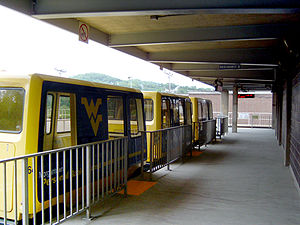
PRT was a major area of study in the 1960s and 1970s. In 1975, Morgantown PRT, an experimental automated system which exhibits some (but not all) features of PRT, was opened to the public after significant construction cost overruns. Morgantown PRT remains in use today, and there have been discussions on expanding it.
A PRT system (by 2getthere) went into operation in Masdar City
Masdar City
Masdar is a project in Abu Dhabi, in the United Arab Emirates. Its core is a planned city, which is being built by the Abu Dhabi Future Energy Company, a subsidiary of Mubadala Development Company, with the majority of seed capital provided by the government of Abu Dhabi...
in the UAE in November 2010. The system has 10 passenger and 3 freight vehicles serving 2 passenger and 3 freight stations connected by 1.2 kilometers of one-way track. The system is in operation 18 hours a day, seven days a week serving the Masdar Institute of Science and Technology
Masdar Institute of Science and Technology
The Masdar Institute of Science and Technology is a graduate level, research-oriented university which is focused on alternative energy, sustainability, and the environment...
. Trips take about 2 and a half minutes (i.e., an average speed of roughly 12mph / 20km/h) and are presently free of charge. Average wait times are expected to be about 30 seconds.
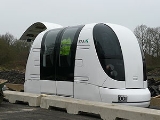
Another PRT system (by ULTra PRT) began public passenger trials at London Heathrow Airport, Terminal 5, in May 2011. As of September 2011 it is fully operational and bus service between the business parking lot and Terminal 5 has been discontinued.
Several cities have recently expressed interest in PRT, and two small city-based systems are currently in development, in Suncheon, South Korea and Amritsar, India.`
Overview
Most mass transit systems move people in groups over scheduled routes. This has inherent inefficiencies. For passengers, time is wasted by waiting for the next arrival, indirect routes to their destination, stopping for passengers with other destinations, and often confusing or inconsistent schedules. Slowing and accelerating large weights can undermine public transport's benefit to the environment while slowing other traffic. Personal rapid transit systems attempt to eliminate these wastes by moving small groups nonstop in automated vehicles on fixed tracks. Passengers can theoretically board a pod immediately upon arriving at a station, and can—with a sufficiently extensive network of tracks—take relatively direct routes to their destination without stops.Perhaps most importantly, PRT systems offer many traits similar to cars. For example, they offer privacy and the ability to choose one's own schedule. PRT may in fact allow for quicker transportation than cars during rush hour, since automated vehicles avoid unnecessary slowing. A PRT system can also transport freight.
The low weight of PRT's small vehicles allows smaller guideways and support structures than mass transit systems like light rail. The smaller structures translate into lower construction cost, smaller easements
Track transition curve
A track transition curve, or spiral easement, is a mathematically calculated curve on a section of highway, or railroad track, where a straight section changes into a curve. It is designed to prevent sudden changes in centripetal force...
, and less visually obtrusive infrastructure.
As it stands, PRT remains a potential rather than a proven reality. A city-wide deployment with many lines and closely spaced stations, as envisioned by proponents, has yet to be constructed. Past projects have failed because of financing, cost overruns, regulatory conflicts, political issues, misapplied technology, and flaws in design, engineering or review.
However, the theory remains active. For example, from 2002–2005, the EDICT project, sponsored by the European Union, conducted a study on the feasibility of PRT in four European cities. The study involved 12 research organizations, and concluded that PRT:
- would provide future cities "a highly accessible, user-responsive, environmental friendly transport system which offers a sustainable and economic solution."
- could "cover its operating costs, and provide a return which could pay for most, if not all, of its capital costs."
- would provide "a level of service which is superior to that available from conventional public transport"
- would be "well received by the public, both public transport and car users."
The report also concluded that, despite these advantages, public authorities will not commit to building PRT because of the risks associated with being the first public implementation.
| Similar to automobile Automobile An automobile, autocar, motor car or car is a wheeled motor vehicle used for transporting passengers, which also carries its own engine or motor... s |
|
| Similar to tram Tram A tram is a passenger rail vehicle which runs on tracks along public urban streets and also sometimes on separate rights of way. It may also run between cities and/or towns , and/or partially grade separated even in the cities... s, bus Bus A bus is a road vehicle designed to carry passengers. Buses can have a capacity as high as 300 passengers. The most common type of bus is the single-decker bus, with larger loads carried by double-decker buses and articulated buses, and smaller loads carried by midibuses and minibuses; coaches are... es, and monorail Monorail A monorail is a rail-based transportation system based on a single rail, which acts as its sole support and its guideway. The term is also used variously to describe the beam of the system, or the vehicles traveling on such a beam or track... s |
Bus stop A bus stop is a designated place where buses stop for passengers to board or leave a bus. These are normally positioned on the highway and are distinct from off-highway facilities such as bus stations. The construction of bus stops tends to reflect the level of usage... s or taxi stand Taxi stand A taxicab stand is a queue area on a street or on private property where taxicabs line up to wait for passengers.-How stands work:... s |
| Similar to automated people mover People mover A people mover or automated people mover is a fully automated, grade-separated mass transit system.The term is generally used only to describe systems serving relatively small areas such as airports, downtown districts or theme parks, but is sometimes applied to considerably more complex automated... s |
|
| Distinct features |
Drag (physics) In fluid dynamics, drag refers to forces which act on a solid object in the direction of the relative fluid flow velocity... and increase speed, energy efficiency and passenger density |
The PRT acronym was introduced formally in 1978 by J. Edward Anderson
J. Edward Anderson
John Edward Anderson is an American engineer and proponent of personal rapid transit.-Career:Anderson was born in China in the 1920s. His family returned to the United States in the 1930s. He obtained a BS from Iowa State University and a masters from the University of Minnesota - both in the...
. The Advanced Transit Association (ATRA), a group which advocates the use of technological solutions to transit problems, compiled a definition in 1988 that can be seen here.
Existing and planned networks
Currently, two PRT networks and one quasi-PRT network are operational, and several more are in the planning stage.| Location | Status | System | Date | Guideway | Stations / vehicles | Notes | |
|---|---|---|---|---|---|---|---|
| Morgantown Morgantown, West Virginia Morgantown is a city in Monongalia County, West Virginia. It is the county seat of Monongalia County. Placed along the banks of the Monongahela River, Morgantown is the largest city in North-Central West Virginia, and the base of the Morgantown metropolitan area... , West Virginia, US |
Operational | WVU PRT Morgantown Personal Rapid Transit The Morgantown Personal Rapid Transit system is a one-of-a-kind people mover system in Morgantown, West Virginia, United States... |
1975 | km | 5 / 73 | Up to 20 passengers per vehicle, some rides not point-to-point during low usage periods | |
| Masdar City Masdar City Masdar is a project in Abu Dhabi, in the United Arab Emirates. Its core is a planned city, which is being built by the Abu Dhabi Future Energy Company, a subsidiary of Mubadala Development Company, with the majority of seed capital provided by the government of Abu Dhabi... , Abu Dhabi, UAE |
Operational (first phase) | 2getthere | 2011 | 1,5 kilometers | 5 / 13 | Initial plans called for automobiles to be banned, with PRT as the only powered intra-city transport (along with an inter-city light rail line) Masdar is now considering allowing other motorized transport modes, such as EVs Electric vehicle An electric vehicle , also referred to as an electric drive vehicle, uses one or more electric motors or traction motors for propulsion... |
|
| London Heathrow Airport London Heathrow Airport London Heathrow Airport or Heathrow , in the London Borough of Hillingdon, is the busiest airport in the United Kingdom and the third busiest airport in the world in terms of total passenger traffic, handling more international passengers than any other airport around the globe... , England |
Operational | ULTra ULTra ULTra is a personal rapid transit system developed by ULTra PRT,... |
2011 | km | 3 / 21 | Currently a pilot system, connecting Terminal 5 with a long-term car park. If the pilot is successful, BAA plans to extend it throughout the airport. | |
| Suncheon Suncheon, South Korea Suncheon is a city in Jeollanam-do, South Korea. Located in the province of Jeollanam-do,It is a scenic agricultural and industrial city of around 250,000 people near Suncheon Bay. It is located in the southeastern corner of Jeollanam-do, just over an hour south-east of Gwangju... , Republic of Korea |
Under Construction | Vectus | 2013 | 9.8 km (6.1 mi) | 2 / 40 | Will connect Suncheon to the future site of the International Gardening Festival. | |
| Daventry Daventry Daventry is a market town in Northamptonshire, England, with a population of 22,367 .-Geography:The town is also the administrative centre of the larger Daventry district, which has a population of 71,838. The town is 77 miles north-northwest of London, 13.9 miles west of Northampton and 10.2... , Northamptonshire, UK |
Proposed | T.B.D. | km | 5 / 25 | Network is envisioned to ultimately expand to 55.3 km (34.4 mi) of guideway, and 500 vehicles. | ||
| Capital City, Dubai, UAE | Proposed | T.B.D. | |||||
| Lulu Island, Abu Dhabi, UAE | Proposed | T.B.D. | |||||
| Santa Cruz Santa Cruz, California Santa Cruz is the county seat and largest city of Santa Cruz County, California in the US. As of the 2010 U.S. Census, Santa Cruz had a total population of 59,946... , California, US |
Proposed | T.B.D. | |||||
| Bawadi Bawadi Bawadi is a project announced by the government of Dubai, United Arab Emirates on 1 May 2006. The developer is Tatweer, a subsidiary of Dubai Holding.... , Dubai, UAE |
Proposed | T.B.D. | The overall Bawadi development is 139 million sq. meters and 10 km in length | ||||
| Gurgaon Gurgaon Gurgaon is the second largest city in the Indian state of Haryana. Gurgaon is the industrial and financial center of Haryana. It is located 30 km south of national capital New Delhi, about 10 kilometers from Dwarka Sub City and 268 km south of Chandigarh, the state capital... , Haryana, India |
Proposed | ULTra ULTra ULTra is a personal rapid transit system developed by ULTra PRT,... |
45.5 km | Total 7 routes proposed. | |||
| Milton Keynes Milton Keynes Milton Keynes , sometimes abbreviated MK, is a large town in Buckinghamshire, in the south east of England, about north-west of London. It is the administrative centre of the Borough of Milton Keynes... , UK |
Proposed | T.B.D. |
Designs
The following table summarizes several well-known PRT designs.| System | Location | Active? | Status | Seating capacity (per vehicle) |
Guideway | Suspended/ supported |
Propulsion |
|---|---|---|---|---|---|---|---|
| Morgantown PRT Morgantown Personal Rapid Transit The Morgantown Personal Rapid Transit system is a one-of-a-kind people mover system in Morgantown, West Virginia, United States... (Boeing Boeing The Boeing Company is an American multinational aerospace and defense corporation, founded in 1916 by William E. Boeing in Seattle, Washington. Boeing has expanded over the years, merging with McDonnell Douglas in 1997. Boeing Corporate headquarters has been in Chicago, Illinois since 2001... ) |
West Virginia | Yes | In service | 8 seated plus 12 standing | concrete | supported | rotary motors |
| ULTra ULTra ULTra is a personal rapid transit system developed by ULTra PRT,... |
UK | Yes | In service | 4 | concrete | supported, rubber wheeled | rotary motors |
| 2getthere PRT | Netherlands | Yes | In service | 4-6 | concrete | supported, rubber wheeled | rotary motors |
| Vectus PRT (POSCO POSCO POSCO is a multinational steel-making company headquartered in Pohang, South Korea. It is the world's third-largest steelmaker by market value and the most profitable Asia-based steelmaker.... ) |
South Korea | Yes | Full prototype | 4 | steel | supported | linear motor Linear motor A linear motor is an electric motor that has had its stator and rotor "unrolled" so that instead of producing a torque it produces a linear force along its length... s |
| Cabinentaxi Cabinentaxi Cabinentaxi, sometimes Cabintaxi in English, was a German people mover development project undertaken by Demag and Messerschmitt-Bölkow-Blohm with funding and support from the Bundesministerium für Forschung und Technologie... |
Germany | no | Completed system but never installed | 3,12,18 | steel | both, solid rubber wheels | linear motor Linear motor A linear motor is an electric motor that has had its stator and rotor "unrolled" so that instead of producing a torque it produces a linear force along its length... s |
| CVS Computer-controlled Vehicle System The Computer-controlled Vehicle System, almost universally referred to as CVS, was a personal rapid transit system developed by a Japanese industrial consortium during the 1970s... |
Japan | No | Full prototype | 4 | steel | supported, rubber wheels | rotary motors |
| PRT2000 (Raytheon Raytheon Raytheon Company is a major American defense contractor and industrial corporation with core manufacturing concentrations in weapons and military and commercial electronics. It was previously involved in corporate and special-mission aircraft until early 2007... ) |
US | No | Full prototype | 4 | steel | supported | rotary motors |
| Monocab/ROMAG (Rohr, Inc. Rohr, Inc. Goodrich Aerostructures Group, formerly Rohr, Inc., is an aerospace manufacturing company based in Chula Vista, California, south of San Diego... ) |
US | No | Full prototype, displayed at Transpo '72 | 40 | concrete | both, rubber wheels (Monocab), maglev (ROMAG) | rotary motor (Monocab), linear motor (ROMAG) |
| Shweeb Shweeb Shweeb is a proposed personal transit network based on human-powered monorail cars. The project prototype was originally designed and implemented in Rotorua, New Zealand as a leisure attraction.... |
Rotorua Rotorua Rotorua is a city on the southern shores of the lake of the same name, in the Bay of Plenty region of the North Island of New Zealand. The city is the seat of the Rotorua District, a territorial authority encompassing the city and several other nearby towns... , New Zealand |
yes | Leisure installation | 1 | Steel | Suspended | Human power, bicycle Recumbent bicycle A recumbent bicycle is a bicycle that places the rider in a laid-back reclining position. Most recumbent riders choose this type of design for ergonomic reasons; the rider's weight is distributed comfortably over a larger area, supported by back and buttocks... |
| MISTER MISTER MISTER is a personal rapid transit system developed in Poland... |
Poland | Yes | Partial prototype | 5 | steel | suspended | rotary motors |
| Skytran SkyTran SkyTran is a patented Personal Rapid Transit system first proposed by inventor Douglas Malewicki in 1990, and under development by Unimodal Inc. Lightweight two-passenger vehicles suspended from elevated passive magnetic levitation tracks are expected to achieve the equivalent of over 200 miles per... |
US | No | Partial prototype | 2 seated | steel | suspended, magnetic levitation Inductrack Inductrack is a passive, fail-safe electrodynamic magnetic levitation system, using only unpowered loops of wire in the track and permanent magnets on the vehicle to achieve magnetic levitation. The track can be in one of two configurations, a "ladder track" and a "laminated track"... |
linear motor Linear motor A linear motor is an electric motor that has had its stator and rotor "unrolled" so that instead of producing a torque it produces a linear force along its length... s |
| Skyweb Express (Taxi2000) | Minnesota | Yes | Partial prototype | 3 | steel | supported | linear motor Linear motor A linear motor is an electric motor that has had its stator and rotor "unrolled" so that instead of producing a torque it produces a linear force along its length... s |
| JPods | US | Yes | Mockup | 4 | steel | suspended | rotary motors |
| Launchpoint Technologies SPM Maglev | US | Yes | Concept | ? | ? | supported | ? |
| Skycab AB Skycab | Sweden | Yes | Concept | ? | ? | supported | ? |
| Interstate Traveller | US | Yes | Concept | ? | ? | supported | ? |
| BM Design / BM One | Finland | Yes | Concept | 2-3 | steel round pipe | supported | rotary motors + track assistance on climbs |
Morgantown PRT is known as a quasi-PRT system, because it lacks some PRT features such as 100% on-demand service.
Origins
Modern PRT concepts began around 1953 when Donn Fichter, a city transportation planner, began research on PRT and alternative transportation methods. In 1964, Fichter published a book, which proposed an automated public transit system for areas of medium to low population density. One of the key points made in the book was Fichter's belief that people would not leave their cars in favor of public transit unless the system offered flexibility and end-to-end transit times that were much better than existing systems – flexibility and performance he felt only a PRT system could provide. Several other urban and transit planners also wrote on the topic and some early experimentation followed, but PRT remained relatively unknown.Around the same time, Edward Haltom was studying monorail
Monorail
A monorail is a rail-based transportation system based on a single rail, which acts as its sole support and its guideway. The term is also used variously to describe the beam of the system, or the vehicles traveling on such a beam or track...
systems. Haltom noticed that the time to start and stop a conventional large monorail train, like those of the Wuppertal Schwebebahn, meant that a single line could only support between 20 and 40 vehicles an hour. In order to get reasonable passenger movements on such a system, the trains had to be large enough to carry hundreds of passengers (see headway
Headway
Headway is a measurement of the distance/time between vehicles in a transit system. The precise definition varies depending on the application, but it is most commonly measured as the distance from the tip of one vehicle to the tip of the next one behind it, expressed as the time it will take for...
for a general discussion). This, in turn, demanded large guideways that could support the weight of these large vehicles, driving up capital costs to the point where he considered them unattractive.
Haltom turned his attention to developing a system that could operate with shorter timings, thereby allowing the individual cars to be smaller while preserving the same overall route capacity. Smaller cars would mean less weight at any given point, which meant smaller and less expensive guideways. To eliminate the backup at stations, the system used "offline" stations that allowed the mainline traffic to bypass the stopped vehicles. He designed the Monocab system using six-passenger cars suspended on wheels from an overhead guideway. Like most suspended systems, it suffered from the problem of difficult switching arrangements. Since the car rode on a rail, switching from one path to another required the rail to be moved; a slow process that limited the possible headways.
UMTA is formed
By the late 1950s the problems with urban sprawlUrban sprawl
Urban sprawl, also known as suburban sprawl, is a multifaceted concept, which includes the spreading outwards of a city and its suburbs to its outskirts to low-density and auto-dependent development on rural land, high segregation of uses Urban sprawl, also known as suburban sprawl, is a...
were becoming evident in the US. When cities improved roads and the transit times were lowered, suburbs developed at ever increasing distances from the city cores, and people moved out of the downtown areas. Lacking pollution control systems, the rapid rise in car ownership and the longer trips to and from work was causing significant air quality problems. Additionally, movement to the suburbs led to a flight of capital from the downtown areas, one cause of the rapid urban decay
Urban decay
Urban decay is the process whereby a previously functioning city, or part of a city, falls into disrepair and decrepitude...
seen in the US.
Mass transit systems were one way to combat these problems. Yet during this period, the US federal government was feeding the problems by funding the development of the Interstate Highway System
Interstate Highway System
The Dwight D. Eisenhower National System of Interstate and Defense Highways, , is a network of limited-access roads including freeways, highways, and expressways forming part of the National Highway System of the United States of America...
, while at the same time funding for mass transit was being rapidly scaled back. Public transit ridership in most cities plummeted.
In 1962, President John F. Kennedy
John F. Kennedy
John Fitzgerald "Jack" Kennedy , often referred to by his initials JFK, was the 35th President of the United States, serving from 1961 until his assassination in 1963....
charged the United States Congress
United States Congress
The United States Congress is the bicameral legislature of the federal government of the United States, consisting of the Senate and the House of Representatives. The Congress meets in the United States Capitol in Washington, D.C....
with the task of addressing these problems. These plans came to fruition in 1964, when President Lyndon B. Johnson
Lyndon B. Johnson
Lyndon Baines Johnson , often referred to as LBJ, was the 36th President of the United States after his service as the 37th Vice President of the United States...
signed the Urban Mass Transportation Act
Urban Mass Transportation Act
Urban Mass Transportation Act may refer to:* Urban Mass Transportation Act of 1964* Urban Mass Transportation Act of 1970Now it is called Federal Transit Act...
of 1964 into law, thereby forming the Urban Mass Transportation Administration. The UMTA was set up to fund mass transit developments in the same fashion that the earlier Federal Aid Highway Act of 1956
Federal Aid Highway Act of 1956
The Federal-Aid Highway Act of 1956, popularly known as the National Interstate and Defense Highways Act , was enacted on June 29, 1956, when Dwight D. Eisenhower signed the bill into law...
had helped create in the Interstate Highways. That is, the UMTA would help cover the capital costs of building out new infrastructure.
PRT research starts
However, planners who were aware of the PRT concept were worried that building more systems based on existing technologies would not help the problem, as Fitcher had earlier noted. Proponents suggested that systems would have to offer the flexibility of a car:
The reason for the sad state of public transit is a very basic one - the transit systems just do not offer a service which will attract people away from their automobiles. Consequently, their patronage comes very largely from those who cannot drive, either because they are too young, too old, or because they are too poor to own and operate an automobile. Look at it from the standpoint of a commuter who lives in a suburb and is trying to get to work in the central business district (CBD). If he is going to go by transit, a typical scenario might be the following: he must first walk to the closest bus stop, let us say a five or ten minute walk, and then he may have to wait up to another ten minutes, possibly in inclement weather, for the bus to arrive. When it arrives, he may have to stand unless he is lucky enough to find a seat. The bus will be caught up in street congestion and move slowly, and it will make many stops completely unrelated to his trip objective. The bus may then let him off at a terminal to a suburban train. Again he must wait, and, after boarding the train, again experience a number of stops on the way to the CBD, and possibly again he may have to stand in the aisle. He will get off at the station most convenient to his destination and possibly have to transfer again onto a distribution system. It is no wonder that in those cities where ample inexpensive parking is available, most of those who can drive do drive.
In 1966, the United States Department of Housing and Urban Development
United States Department of Housing and Urban Development
The United States Department of Housing and Urban Development, also known as HUD, is a Cabinet department in the Executive branch of the United States federal government...
was asked to "undertake a project to study … new systems of urban transportation that will carry people and goods … speedily, safely, without polluting the air, and in a manner that will contribute to sound city planning". The resulting report was published in 1968, and proposed the development of PRT, as well as other systems such as dial-a-bus and high-speed interurban links
In the late 1960s, the Aerospace Corporation, an independent non-profit corporation set up by the US Congress, spent substantial time and money on PRT, and performed much of the early theoretical and systems analysis. However, this corporation is not allowed to sell to non-federal government customers. In 1969, members of the study team published the first widely publicized description of PRT in Scientific American
Scientific American
Scientific American is a popular science magazine. It is notable for its long history of presenting science monthly to an educated but not necessarily scientific public, through its careful attention to the clarity of its text as well as the quality of its specially commissioned color graphics...
.
In 1978 the team also published a book.
In 1967, aerospace giant Matra
Matra
Mécanique Aviation Traction or Matra was a French company covering a wide range of activities mainly related to automobile, bicycles, aeronautics and weaponry. In 1994, it became a subsidiary of the Lagardère Group and now operates under that name.Matra was owned by the Floirat family...
started the Aramis project in Paris
Paris
Paris is the capital and largest city in France, situated on the river Seine, in northern France, at the heart of the Île-de-France region...
. After spending about 500 million franc
Franc
The franc is the name of several currency units, most notably the Swiss franc, still a major world currency today due to the prominence of Swiss financial institutions and the former currency of France, the French franc until the Euro was adopted in 1999...
s, the project was canceled when it failed its qualification trials in November 1987. The designers tried to make Aramis work like a "virtual train," but control software issues caused cars to bump unacceptably. The project ultimately failed.
The oil crisis of 1973 made vehicle fuels more expensive, which naturally interested people in alternative transportation.
Between 1970 and 1978, Japan
Japan
Japan is an island nation in East Asia. Located in the Pacific Ocean, it lies to the east of the Sea of Japan, China, North Korea, South Korea and Russia, stretching from the Sea of Okhotsk in the north to the East China Sea and Taiwan in the south...
operated a project called Computer-controlled Vehicle System (CVS). In a full-scale test facility, 84 vehicles operated at speeds up to 60 kilometres per hour (37.3 mph) on a 4.8 kilometres (3 mi) guideway; one-second headway
Headway
Headway is a measurement of the distance/time between vehicles in a transit system. The precise definition varies depending on the application, but it is most commonly measured as the distance from the tip of one vehicle to the tip of the next one behind it, expressed as the time it will take for...
s were achieved during tests. Another version of CVS was in public operation for six months from 1975–1976. This system had 12 single-mode vehicles and four dual-mode vehicles on a 1.6 kilometre (0.994196378639691 mi) track with five stations. This version carried over 800,000 passengers. CVS was cancelled when Japan's Ministry of Land, Infrastructure and Transport declared it unsafe under existing rail safety regulations, specifically in respect of braking and headway distances.
On March 23, 1973, U.S. Urban Mass Transportation Administration (UMTA) administrator Frank Herringer testified before Congress: "A DOT program leading to the development of a short, one-half to one-second headway, high-capacity PRT (HCPRT) system will be initiated in fiscal year 1974." However, this HCPRT program was diverted into a modest technology program. According to PRT supporter J. Edward Anderson
J. Edward Anderson
John Edward Anderson is an American engineer and proponent of personal rapid transit.-Career:Anderson was born in China in the 1920s. His family returned to the United States in the 1930s. He obtained a BS from Iowa State University and a masters from the University of Minnesota - both in the...
, this was "because of heavy lobbying from interests fearful of becoming irrelevant if a genuine PRT program became visible". From that time forward people interested in HCPRT were unable to obtain UMTA research funding.
In 1975, the Morgantown Personal Rapid Transit
Morgantown Personal Rapid Transit
The Morgantown Personal Rapid Transit system is a one-of-a-kind people mover system in Morgantown, West Virginia, United States...
project was completed. It has five off-line stations that enable non-stop, individually programmed trips. This is a crucial characteristic of PRT. However, it is not considered a PRT system because its vehicles are too heavy and carry too many people. When it carries many people, it does not operate in a point-to-point fashion, instead running like an automated people mover from one end of the line to the other. Morgantown PRT is still in continuous operation at West Virginia University
West Virginia University
West Virginia University is a public research university in Morgantown, West Virginia, USA. Other campuses include: West Virginia University at Parkersburg in Parkersburg; West Virginia University Institute of Technology in Montgomery; Potomac State College of West Virginia University in Keyser;...
in Morgantown
Morgantown, West Virginia
Morgantown is a city in Monongalia County, West Virginia. It is the county seat of Monongalia County. Placed along the banks of the Monongahela River, Morgantown is the largest city in North-Central West Virginia, and the base of the Morgantown metropolitan area...
, West Virginia with about 15,000 riders per day . It successfully demonstrates automated control, but was not sold to other sites because the steam-heated track has proven too expensive.
From 1969 to 1980, Mannesmann Demag and MBB
Messerschmitt-Bölkow-Blohm
Messerschmitt-Bölkow-Blohm was a German aerospace company formed as the result of several mergers in the late 1960s. Among its best-known products was the MBB Bo 105 light twin helicopter...
cooperated to build the Cabinentaxi
Cabinentaxi
Cabinentaxi, sometimes Cabintaxi in English, was a German people mover development project undertaken by Demag and Messerschmitt-Bölkow-Blohm with funding and support from the Bundesministerium für Forschung und Technologie...
urban transportation system in Germany. Together the firms formed the Cabintaxi Joint Venture. They created an extensive PRT technology that was considered fully developed by the German Government and its safety authorities. The system was to have been installed in Hamburg
Hamburg
-History:The first historic name for the city was, according to Claudius Ptolemy's reports, Treva.But the city takes its modern name, Hamburg, from the first permanent building on the site, a castle whose construction was ordered by the Emperor Charlemagne in AD 808...
, but budget cuts stopped the proposed project before the start of construction. With no other potential projects on the horizon, the joint venture disbanded, and the fully developed PRT technology was never installed. Cabintaxi Corporation, a US-based company obtained the technology in 1985, and remains active in the private-sector market for transportation systems.
In the 1990s, Raytheon
Raytheon
Raytheon Company is a major American defense contractor and industrial corporation with core manufacturing concentrations in weapons and military and commercial electronics. It was previously involved in corporate and special-mission aircraft until early 2007...
invested heavily in a system called PRT 2000, based on technology developed by J. Edward Anderson
J. Edward Anderson
John Edward Anderson is an American engineer and proponent of personal rapid transit.-Career:Anderson was born in China in the 1920s. His family returned to the United States in the 1930s. He obtained a BS from Iowa State University and a masters from the University of Minnesota - both in the...
at the University of Minnesota
University of Minnesota
The University of Minnesota, Twin Cities is a public research university located in Minneapolis and St. Paul, Minnesota, United States. It is the oldest and largest part of the University of Minnesota system and has the fourth-largest main campus student body in the United States, with 52,557...
. Raytheon failed to install a contracted system in Rosemont
Rosemont, Illinois
Rosemont is a village in Cook County, Illinois, United States located immediately northwest of Chicago. The village was incorporated in 1956, though it had been settled long before that...
, Illinois, near Chicago
Chicago
Chicago is the largest city in the US state of Illinois. With nearly 2.7 million residents, it is the most populous city in the Midwestern United States and the third most populous in the US, after New York City and Los Angeles...
, when estimated costs escalated to US$50 million per mile, allegedly due to design changes that increased the weight and cost of the system relative to Anderson's original design. In 2000, rights to the technology reverted to the University of Minnesota, and were subsequently purchased by Taxi2000.
In 2002, 2getthere operated 25 4-passenger "CyberCabs" at Holland's 2002 Floriade horticultural exhibition. These transported passengers along a track spiraling up to the summit of Big Spotters Hill. The track was approximately 600 metres (1,969 ft) long (one-way) and featured only two stations. The six-month operations were intended to research the public acceptance of PRT-like systems. The CyberCab as designed for the exhibition was very open. It was comparable to a Neighborhood electric vehicle
Neighborhood electric vehicle
A Neighborhood Electric Vehicle is a U.S. denomination for battery electric vehicles that are legally limited to roads with posted speed limits as high as depending on the particular laws of the state, usually are built to have a top speed of , and have a maximum loaded weight of 3,000 lbs...
, except it steered itself using magnetic guidance points embedded in the pavement.
Ford Research proposed a dual-mode
Dual-mode vehicle
A dual-mode vehicle is a vehicle that can run on conventional road surfaces or a dedicated track known as a "guideway". Dual-mode vehicles are commonly electrically powered and run in dual-mode for power too, using batteries for short distance and low speeds, and track-fed power for longer...
system called PRISM.
It would use public guideways with privately purchased but certified dual-mode vehicles. The vehicles would weigh less than 600 kg (1,323 lb). Most energy use occurs on highways, so small, elevated guideways would inductively power
Transformer
A transformer is a device that transfers electrical energy from one circuit to another through inductively coupled conductors—the transformer's coils. A varying current in the first or primary winding creates a varying magnetic flux in the transformer's core and thus a varying magnetic field...
highway use and recharge batteries for off-guideway use. Central computers could do routing.
In January 2003, the prototype ULTra ("Urban Light Transport") system in Cardiff, Wales, was certified to carry passengers by the UK Railway Inspectorate on a 1 km (0.621372736649807 mi) test track. ULTra was selected in October 2005 by BAA plc
BAA plc
BAA Ltd. is the Spanish-owned operator of six British airports and Naples Airport in Italy, making the company one of the largest transport companies in the world. BAA stems from British Airports Authority and is owned by a consortium led by Grupo Ferrovial, a Spanish firm specialising in...
for London's Heathrow Airport. As of September 2011, a pilot system of the Heathrow PRT is fully operational, transporting passengers from a remote parking lot to the central terminal area. Further plans call for expansion throughout the airport and the surrounding region, pending the results of the pilot phase.
In June 2006, a Korean/Swedish consortium, Vectus Ltd, started constructing a 400 metres (1,312 ft) test track in Uppsala, Sweden.
This test system was presented at the 2007 PodCar City conference in Uppsala, Sweden.
The Vectus project was based on The Fornebu/Oslo PRT Project. At the time, the urban development area around Telenor's new headquarter (at the Fornebu area near Oslo) was subject to intense debates as to various more or less innovative public transport systems. The idea of a PRT came up as a possible local solution as well as a business opportunity. In 2000, The Fornebu/Oslo PRT Project started as a part of an internal educational exercise within ICT strategy innovation within Telenor ASA, a major ICT corporation. As the poster shows, the student project was later transformed into a fast working concept, technology and business development project with various industry partners and a project group of around 10. The Korean steel company POSCO joined in, and developed the project further in Uppsala, Sweden, in part through new partners, but with all essential elements from the Fornebu/Oslo PRT Project, as further industrial or governmental support found in the Oslo area vanished. The poster describes the consortium and main results from the Oslo PRT project period. Key persons in this concept development phase were - as to technology and operational features development - Ingmar Andreasson, Göteborg, Sweden, Jan Orsten, indep. traffic planner, Oslo, Alan Forster, Force Ltd, GB, and Andrew Howard, HWG Ltd, GB. Beyond the general conceptual description, the ICT systems were developed by Noventus AB and others at later stages.
In 2007, the Polish PRT system MISTER
MISTER
MISTER is a personal rapid transit system developed in Poland...
was prototyped, and permission was given to install it in two Polish cities. MISTER is a typical overhead PRT system engineered for economical aerial reuse of streets' right of ways, that still gives ground-level access to wheelchairs and freight.
System design
Among the handful of prototype systems (and the larger number that exist on paper) there is a substantial diversity of design approaches, some of which are controversial.Vehicle design
Vehicle weight influences the size and cost of a system's guideways, which are in turn a major part of the capital cost of the system. Larger vehicles are more expensive to produce, require larger and more expensive guideways, and use more energy to start and stop. If vehicles are too large, point-to-point routing also becomes less economically feasible. Against this, smaller vehicles have more surface area per passenger (thus have higher total air resistance which dominates the energy cost of keeping vehicles moving at speed) and larger motors are generally more efficient than smaller ones.The number of riders who will share a vehicle is a key unknown. In the U.S., the average private automobile carries 1.16 persons, and most industrialized countries commonly average below two people; not having to share a vehicle with strangers is a key advantage of private transport. Based on these figures, some have suggested that two passengers per vehicle (such as with UniModal), or even a single passenger per vehicle is optimum. Other designs use an auto for a model, and choose larger vehicles, making it possible to accommodate families with small children, riders with bicycles, disabled passengers with wheelchairs, or a pallet
Pallet
A pallet , sometimes called a skid, is a flat transport structure that supports goods in a stable fashion while being lifted by a forklift, pallet jack, front loader or other jacking device. A pallet is the structural foundation of a unit load which allows handling and storage efficiencies...
or two of freight.
Propulsion
All current designs are powered by electricityElectricity
Electricity is a general term encompassing a variety of phenomena resulting from the presence and flow of electric charge. These include many easily recognizable phenomena, such as lightning, static electricity, and the flow of electrical current in an electrical wire...
. In order to reduce vehicle weight, power is generally transmitted via lineside conductors rather than using on-board batteries. According to the designer of Skyweb/Taxi2000, J. Edward Anderson
J. Edward Anderson
John Edward Anderson is an American engineer and proponent of personal rapid transit.-Career:Anderson was born in China in the 1920s. His family returned to the United States in the 1930s. He obtained a BS from Iowa State University and a masters from the University of Minnesota - both in the...
, the lightest system is a linear induction motor
Linear induction motor
A linear induction motor is an AC asynchronous linear motor that works by the same general principles as other induction motors but which has been designed to directly produce motion in a straight line....
(LIM) on the car, with a stationary conductive rail for both propulsion and braking. LIMs are used in a small number of rapid transit applications, but most designs use rotary motors. Most such systems retain a small on-board battery to reach the next stop after a power-failure.
ULTra
ULTra
ULTra is a personal rapid transit system developed by ULTra PRT,...
uses on-board batteries, recharged at stops. This increases the safety, and reduces the complexity, cost and maintenance of the guideway. As a result, a grade-level ULTRa guideway resembles a sidewalk with curbs and is very inexpensive to construct. ULTRa resembles a small automated electric car, and uses similar components.
Switching
Most designers avoid track switchingRailroad switch
A railroad switch, turnout or [set of] points is a mechanical installation enabling railway trains to be guided from one track to another at a railway junction....
, instead advocating vehicle-mounted switches or conventional steering. Those designers say that vehicle-switching permits faster switching, so vehicles can be closer together. It also simplifies the guideway, makes junctions less visually obtrusive and reduces the impact of malfunctions, because a failed switch on one vehicle is less likely to affect other vehicles. Other designers point out that track-switching simplifies the vehicles, reducing the number of small moving parts in each car. Track-switching replaces in-vehicle mechanisms with larger track-moving components, that can be designed for durability with little regard for weight or size.
Track switching greatly increases headway distance. A vehicle must wait for the previous vehicle to clear the track, for the track to switch and for the switch to be verified. If the track switching is faulty, vehicles must be able to stop before reaching the switch, and all vehicles approaching the failed junction would be affected.
Mechanical vehicle switching minimizes inter-vehicle spacing or headway distance, but it also increases the minimum distances between consecutive junctions. A mechanically switching vehicle, maneuvering between two adjacent junctions with different switch settings cannot proceed from one junction to the next. The vehicle must adopt a new switch position, and then wait for the in-vehicle switch's locking mechanism to be verified. If the vehicle switching is faulty, that vehicle must be able to stop before reaching the next switch, and all vehicles approaching the failed vehicle would be affected.
Infrastructure design

Guideways
There is some debate over the best type of guideway. Among the proposals are beams similar to monorails, bridge-like trusses supporting internal tracks, and cables embedded in a roadway. Most designs put the vehicle on top of the track, which reduces visual intrusion and cost as well as easing ground-level installation. An overhead track is necessarily higher, but may also be narrower. Most designs use the guideway to distribute power and data communications, including to the vehicles. The Morgantown PRTMorgantown Personal Rapid Transit
The Morgantown Personal Rapid Transit system is a one-of-a-kind people mover system in Morgantown, West Virginia, United States...
failed its cost targets because of its steam-heated track, so most proposals plan to resist snow and ice in ways that should be less expensive.
Stations
Proposals usually have stations close together, and located on side tracks so that through traffic can bypass vehicles picking up or dropping off passengers. Each station might have multiple berths, with perhaps one-third of the vehicles in a system being stored at stations waiting for passengers. Stations are envisioned to be minimalistic, without facilities such as rest rooms. For elevated stations, an elevator may be required for accessibility.At least one system, MISTER
MISTER
MISTER is a personal rapid transit system developed in Poland...
provides wheelchair and freight access by using a cogway in the track, so that the vehicle itself can go from a grade-level stop to an overhead track.
Some designs have included substantial extra expense for the track needed to decelerate to and accelerate from stations. In at least one system, Aramis, this nearly doubled the width and cost of the required right-of-way and caused the nonstop passenger delivery concept to be abandoned. Other designs have schemes to reduce this cost, for example merging vertically to reduce the footprint.
Headway distance
Spacing of vehicles on the guideway influences the maximum passenger capacity of a track, so designers prefer smaller headwayHeadway
Headway is a measurement of the distance/time between vehicles in a transit system. The precise definition varies depending on the application, but it is most commonly measured as the distance from the tip of one vehicle to the tip of the next one behind it, expressed as the time it will take for...
distances. Computerized control theoretically permits closer spacing than the two-second headways recommended for cars at speed, since multiple vehicles can be braked simultaneously. There are also prototypes for automatic guidance of private cars
Driverless car
An autonomous car, also known as robotic or informally as driverless, is an autonomous vehicle capable of fulfilling the human transportation capabilities of a traditional car. As an autonomous vehicle, it is capable of sensing its environment and navigating on its own...
based on similar principles.
Very short headways are controversial. The UK Railway Inspectorate has evaluated the ULTra design and is willing to accept one-second headways, pending successful completion of initial operational tests at more than 2 seconds. In other jurisdictions, existing rail regulations apply to PRT systems (see CVS, above); these typically calculate headways in terms of absolute stopping distances, which would restrict capacity and make PRT systems unfeasible. No regulatory agency has yet endorsed headways below one second, although proponents believe that regulators may be willing to reduce headways as operational experience increases.
Capacity
PRT is usually proposed as an alternative to rail systems, so comparisons tend to be with rail. PRT vehicles seat fewer passengers than trains and buses, and must offset this by combining higher average speeds, diverse routes, and shorter headways. Proponents assert that equivalent or higher overall capacity could be achieved by these means. Since there are no full-scale installations, capacity calculations are based on simulation and modeling.Single line capacity
With two-second headways and four-person vehicles, a single PRT line can achieve theoretical maximum capacity of 7,200 passengers per hour. However, most estimates assume that vehicles will not generally be filled to capacity, due to the point-to-point nature of PRT. At a more typical average vehicle occupancy of 1.5 persons per vehicle, the maximum capacity is 2,700 passengers per hour. Some researchers have suggested that rush hour capacity can be improved if operating policies support ridesharing.
Capacity is inversely proportional to headway. Therefore, moving from two-second headways to one-second headways would double PRT capacity. Half-second headways would quadruple capacity. Theoretical minimum PRT headways would be based on the mechanical time to engage brakes, and these are much less than a half second. Although no regulatory agency has as yet (June 2006) approved headways shorter than two seconds, researchers suggest that high capacity PRT (HCPRT) designs could operate safely at half-second headways.
In simulations of rush hour or high-traffic events, about one-third of vehicles on the guideway need to travel empty to resupply stations with vehicles in order to minimize response time. This is analogous to trains and buses travelling nearly empty on the return trip to pick up more rush hour passengers.
Grade separated light rail systems can move 15,000 passengers per hour on a fixed route, but these are usually fully grade separated systems. Street level systems typically move up to 7,500 passengers per hour. Heavy rail subways can move 50,000 passengers per hour. As with PRT, these estimates depend on having enough trains. Neither light nor heavy rail scales well for off-peak operation.
Networked PRT capacity
The above discussion compares line or corridor capacity and may therefore not be relevant for a networked PRT system, where several parallel lines (or parallel components of a grid) carry traffic. In addition, Muller estimated that while PRT may need more than one guideway to match the capacity of a conventional system, the capital cost of the multiple guideways may still be less than that of the single guideway conventional system. Thus comparisons of line capacity should also consider the cost per line.
PRT systems should require much less horizontal space than existing metro systems, with individual cars being typically around 50% as wide for side-by-side seating configurations, and less than 33% as wide for single-file configurations. This is an important factor in densely populated, high-traffic areas.
Travel speed
For a given peak speed, nonstop journeys are about three times as fast as those with intermediate stops. This is not just because of the time for starting and stopping. Scheduled vehicles are also slowed by boardings and exits for multiple destinations.Therefore, a given PRT seat transports about three times as many passenger miles per day as a seat performing scheduled stops. So PRT should also reduce the number of needed seats threefold for a given number of passenger miles.
While a few PRT designs have operating speeds of 100 km/h (60 mph), and one as high as 241 km/h (150 mph), most are in the region of 40–70 km/h (25–45 mph). Rail systems generally have higher maximum speeds, typically 90–130 km/h (55–80 mph) and sometimes well in excess of 160 km/h (100 mph), but average travel speed is reduced about threefold by scheduled stops and passenger transfers.
Ridership attraction
If PRT designs deliver the claimed benefit of being substantially faster than cars in areas with heavy traffic, simulations suggest that PRT could attract many more automobile drivers than other public transit systems. Standard mass transit simulations accurately predict that 2% of auto drivers will switch to trains. These same methods predict that 25% to 60% of auto drivers would switch to PRT.Control algorithms
The typical control algorithm places vehicles in imaginary moving "slots" that go around the loops of track. Real vehicles are allocated a slot by track-side controllers. On-board computers maintain their position by using a negative feedback loop to stay near the center of the commanded slot. Early PRT vehicles measured their position by adding up the distance using odometerOdometer
An odometer or odograph is an instrument that indicates distance traveled by a vehicle, such as a bicycle or automobile. The device may be electronic, mechanical, or a combination of the two. The word derives from the Greek words hodós and métron...
s, with periodic check points to compensate for cumulative errors.
Next-generation GPS and radio location can also be used for accurate positioning.
Another style of control assigns a path and speed to a vehicle, after verifying that the path does not violate the safety margins of other vehicles. This permits system speeds and safety margins to be adjusted to design or operating conditions, and may use slightly less energy.
The maker of the ULTra PRT system reports that testing of its control system shows lateral (side-to-side) accuracy of 1 cm, and docking accuracy better than 2 cm.
Safety
Computer control eliminates errors from human drivers, so PRT designs in a controlled environment should be much safer than private motoring on roads. Most designs enclose the running gear in the guideway to prevent derailments. Grade-separated guideways would prevent conflict with pedestrians or manually controlled vehicles. Other public transit safety engineeringSafety engineering
Safety engineering is an applied science strongly related to systems engineering / industrial engineering and the subset System Safety Engineering...
approaches, such as redundancy and self-diagnosis of critical systems, are also included in designs.
The Morgantown system, more correctly described as an Automated Guideway Transit
People mover
A people mover or automated people mover is a fully automated, grade-separated mass transit system.The term is generally used only to describe systems serving relatively small areas such as airports, downtown districts or theme parks, but is sometimes applied to considerably more complex automated...
system (AGT), has completed 110 million passenger-miles without serious injury. According to the U.S. Department of Transportation, AGT systems as a group have higher injury rates than any other form of rail-based transit (subway, metro, light rail, or commuter rail) though still much better than ordinary buses or automobiles. More recent research by the British company ULTra PRT reported that AGT systems have a better safety than more conventional, non-automated modes.
As with many current transit systems, personal passenger safety concerns are likely to be addressed through CCTV monitoring, and communication with a central command center from which engineering or other assistance may be dispatched.
Energy efficiency
The energy efficiency advantages claimed by PRT proponents include two basic operational characteristics of PRT: an increased average load factor; and the elimination of intermediate starting and stopping.Average load factor, in transit systems, is the ratio of the total number of riders to the total theoretical capacity. A transit vehicle running at full capacity has a 100% load factor, while an empty vehicle has 0% load factor. If a transit vehicle spends half the time running at 100% and half the time running at 0%, the average load factor is 50%. Higher average load factor corresponds to lower energy consumption per passenger, so designers attempt to maximize this metric.
Scheduled mass transit (i.e. buses or trains,) trades off service frequency and load factor. Buses and trains must run on a predefined schedule, even during off-peak times when demand is low and vehicles are nearly empty. So to increase load factor, transportation planners try to predict times of low demand, and run reduced schedules or smaller vehicles at these times. This increases passengers' wait times. In many cities, trains and buses do not run at all at night or on weekends.
PRT vehicles, in contrast, would only move in response to demand, which places a theoretical lower bound on their average load factor. This allows 24-hour service without many of the costs of scheduled mass transit.
ULTra PRT estimates its system will consume 839 BTU per passenger mile (0.55 MJ per passenger km). By comparison, automobiles consume 3,496 BTU, and personal trucks consume 4,329 BTU per passenger mile.
Due to PRT's efficiency, some proponents say solar becomes a viable power source. PRT elevated structures provide a ready platform for solar collectors, therefore some proposed designs include solar power as a characteristic of their networks.
For bus and rail transit, energy usage per passenger-mile is dependent on service frequency and ridership, and can vary significantly from peak to non-peak. Therefore, aggregate statistics are used to calculate overall energy usage passenger-mile. In the US, buses consume an average of 4,318 BTU/passenger-mile, transit rail 2,750 BTU/passenger-mile, and commuter rail 2,569 BTU/passenger-mile.
Cost characteristics
The initial capital costs of PRT are large, but compare favorably with those of other transportation modes. Its system design tries to pay down those costs as quickly as possible, while maximizing the useful lifetime of the project. Proponents' cost estimates in passenger mile range from the cost of a bicycle (US $0.01–0.05/passenger-mile, Unimodal) to the cost of a small motorcycle ($0.20/passenger mile, TAXI 2000), and are strongly disputed by opponents. It's agreed that PRT systems require no individual license, parking or insurance fees, and buy energy in bulk from inexpensive providers.Most of the initial investment is in guideways. Estimates of guideway cost range from US$0.8 million (for MicroRail) to $22 million per mile, with most estimates falling in the $10m to $15m range. These costs may not include the purchase of rights of way or system infrastructure, such as storage and maintenance yards and control centers, and reflect unidirectional travel along one guideway, the standard form of service in current PRT proposals. Bidirectional service is normally provided by moving vehicles around the block. To reach capacities of competing systems, a system requires thousands of vehicles. Some PRT proposals incorporate these costs in their per-mile estimates.
PRT designs generally assume dual-use rights of way, for example by mounting the transit system on narrow poles on an existing street. If dedicated rights of way were required for an application, costs could be considerably higher. If tunneled, small vehicle size can reduce tunnel volume compared with that required for an automated people mover (APM)
People mover
A people mover or automated people mover is a fully automated, grade-separated mass transit system.The term is generally used only to describe systems serving relatively small areas such as airports, downtown districts or theme parks, but is sometimes applied to considerably more complex automated...
. Dual mode systems would use existing roads, as well as special-purpose PRT guideways. In some designs the guideway is just a cable buried in the street (a technology proven in industrial automation). Similar technology could equally be applied to private automobiles.
A design with many modular components, mass production, driverless operation and redundant systems should in theory result in low operating costs and high reliability. Predictions of low operating cost generally depend on low operations and maintenance costs. Whether these assumptions are valid will not be known until full scale operations are commenced since reliability cannot be proven by prototype systems.
Transportation systems allocate the cost of their roads by measuring wear. PRT routes are disaggregated, and vehicles only move to carry passengers, so PRT measures wear and energy based on passengers or weight carried, rather than vehicle schedules. This brings large theoretical savings compared to trains, but appears more expensive than buses and streetcars, whose roads are subsidized by sunk, preallocated fuel taxes.
So, some planners dispute the cost-estimates of PRT when compared to light rail
Light rail
Light rail or light rail transit is a form of urban rail public transportation that generally has a lower capacity and lower speed than heavy rail and metro systems, but higher capacity and higher speed than traditional street-running tram systems...
systems, whose costs vary widely with non-grade-separated streetcars being relatively low cost and systems involving elevated track or tunnels costing up to US$200 million per mile.
Opposition and controversy
Opposition to PRT schemes has been expressed based on a number of concerns:Technical feasibility debate
The Ohio, Kentucky, Indiana (OKI) Central Loop Report compared the Taxi 2000 PRT concept proposed by the Skyloop Committee to other transportation modes (busBus
A bus is a road vehicle designed to carry passengers. Buses can have a capacity as high as 300 passengers. The most common type of bus is the single-decker bus, with larger loads carried by double-decker buses and articulated buses, and smaller loads carried by midibuses and minibuses; coaches are...
, light rail
Light rail
Light rail or light rail transit is a form of urban rail public transportation that generally has a lower capacity and lower speed than heavy rail and metro systems, but higher capacity and higher speed than traditional street-running tram systems...
and vintage trolley
Tram
A tram is a passenger rail vehicle which runs on tracks along public urban streets and also sometimes on separate rights of way. It may also run between cities and/or towns , and/or partially grade separated even in the cities...
). In the Taxi 2000 PRT system, the Loop Study Advisory Committee identified "significant environmental, technical and potential fire and life safety concerns…" and the PRT system was "…still an unproven technology with significant questions about cost and feasibility of implementation." Skyloop contested this conclusion, arguing that Parsons Brinckerhoff
Parsons Brinckerhoff
Parsons Brinckerhoff is a professional services firm with 14,000 employees in 150 offices providing construction and operation management, planning, design, engineering, program management, strategic consulting, environmental and sustainability services for clients and communities in the Americas,...
changed several aspects of the system design without consulting with Taxi 2000, then rejected this modified design. Despite the report's concerns regarding the implementation obstacles of PRT, the report did conclude that compared to the other alternatives, PRT offered the most acceptable point-to-point travel times, the most reliable service levels, the highest level of frequency of service and geography coverage, and was most able to maintain schedule. The report further concluded that, compared to the other alternatives, PRT would have over 3 times the ridership of the next closest alternative, including new transit riders over 9 times higher than the next closest alternative.
Vukan R. Vuchic, Professor of Transportation Engineering at the University of Pennsylvania and a proponent of traditional forms of transit, has stated his belief that the combination of small vehicles and expensive guideway makes it highly impractical in both cities (not enough capacity) and suburbs (guideway too expensive). According to Vuchic: "...the PRT concept combines two mutually incompatible elements of these two systems: very small vehicles with complicated guideways and stations. Thus, in central cities, where heavy travel volumes could justify investment in guideways, vehicles would be far too small to meet the demand. In suburbs, where small vehicles would be ideal, the extensive infrastructure would be economically unfeasible and environmentally unacceptable."
PRT supporters claim that Vuchic's conclusions are based on flawed assumptions. PRT proponent J.E. Anderson wrote, in a rebuttal to Vuchic: "I have studied and debated with colleagues and antagonists every objection to PRT, including those presented in papers by Professor Vuchic, and find none of substance. Among those willing to be briefed in detail and to have all of their questions and concerns answered, I find great enthusiasm to see the system built."
The manufacturers of ULTra acknowledge that current forms of their system would provide insufficient capacity in high density areas such as central London, and that the investment costs for the tracks and stations are comparable to building new roads, making the current version of ULTra more suitable for suburbs and other moderate capacity applications, or as a supplementary system in larger cities.
Lessons from baggage handling
There is a history of PRT style systems constructed at airports for use in moving bags from check in to x-ray and loading points for various aircraft. Some of these systems failed or had problems and this has led to conclusions that PRT systems would fail in a similar way.More recently however there have also been some significant success stories in this area. The Bagtrax system provided by Vanderlande Industries is successfully installed at 6 airports now. These include major airports such as Schiphol Airport in Amsterdam and Terminal 5 at Heathrow Airport, London. The performance of these modern systems exceed conventional conveyor systems by far.
Also the "Telebag System" is operational in 5 airports including London's Luton Airport, which handles significant volumes of traffic.
The "Autover System" is another that is also used at a number of airports. At Dubai Airport for example, 31 vehicles carry 1200 pieces of luggage per hour (one piece of luggage per vehicle) from 6 origins to 24 destinations along 618 m of track making 9 loops with 16 junctions.
Regulatory concerns
Possible regulatory concerns include emergency safety, headways, and accessibility for the disabled.Many jurisdictions regulate PRT systems as if they were trains. At least one successful prototype, CVS, failed deployment because it could not obtain permits from regulators.
Also, several PRT systems have been proposed for California, but the California Public Utilities Commission (CPUC) states that its rail regulations apply to PRT, and these require railway-sized headways.
The degree to which CPUC would hold PRT to "light rail" and "rail fixed guideway" safety standards is not clear because it can grant particular exemptions and revise regulations.
If safety or access considerations require the addition of walkways, ladders, platforms or other emergency/disabled access to or egress from PRT guideways, the size of the guideway may be increased. This may impact the feasibility of a PRT system, though the degree of impact would be highly dependent on both the particular design and the municipality involved.
Concerns about PRT research
Wayne D. Cottrell of the University of Utah conducted a critical review of PRT academic literature since the 1960s. He concluded that there are several issues that would benefit from more research, including: urban integration, risks of PRT investment, bad publicity, technical problems, and competing interests from other transport modes. He suggests that these issues, "while not unsolvable, are formidable," and that the literature might be improved by better introspection and criticism of PRT. He also suggests that more government funding is essential for such research to proceed, especially in the US.New urbanist opinion
Several proponents of new urbanismNew urbanism
New Urbanism is an urban design movement, which promotes walkable neighborhoods that contain a range of housing and job types. It arose in the United States in the early 1980s, and has gradually continued to reform many aspects of real estate development, urban planning, and municipal land-use...
, an urban design movement that advocates for walkable cities, have expressed opinions on PRT.
Peter Calthorpe
Peter Calthorpe
Peter Calthorpe is a San Francisco-based architect, urban designer and urban planner. He is a founding member of the Congress for New Urbanism, a Chicago-based advocacy group formed in 1992 that promotes sustainable building practices.-Biography:...
and Sir Peter Hall
Peter Hall (urbanist)
Sir Peter Geoffrey Hall, FBA is an English town planner, urbanist and geographer. He is the Bartlett Professor of Planning and Regeneration at The Bartlett, University College London and President of both the Town and Country Planning Association and the Regional Studies Association.He is...
have supported the concept, but James Howard Kunstler
James Howard Kunstler
James Howard Kunstler is an American author, social critic, public speaker, and blogger. He is best known for his books The Geography of Nowhere , a history of American suburbia and urban development, and the more recent The Long Emergency , where he argues that declining oil production is likely...
disagrees: "If we're going to replace the car why do it with something that's not only like the car, but not really as good as the car? It just seems crazy." He also referred to PRT proponents as "a particular kind of crank".
Other concerns
Concerns have been expressed about the visual impact of elevated guideways and stations. The 2001 OKI Report stated that Skyloop's elevated guideways would create visual barriers, loss of privacy, and be inconsistent with the character of historic neighborhoods. Some in the business community in Cincinnati who were opposed believed elevated guideways would remove potential customers from the street level where their shops are advertised.As with other modes of public transit, there are also concerns about policing against terrorism and vandalism. Such concerns are however of greater weight because a vandal would have the entire duration of an unaccompanied journey to inflict damage on a vehicle.
Group rapid transit
Group rapid transit (GRT) is similar to personal rapid transit but with higher-occupancy vehicles and grouping of passengers with potentially different origin-destination pairs. In this respect GRT can be seen as a sort of horizontal elevator. Such systems may have fewer direct-to-destination trips than single-destination PRT but still have fewer average stops than conventional transit, acting more as an automated share taxiShare taxi
A share taxi is a mode of transport that falls between taxis and conventional buses. These informal vehicles for hire are found throughout the world. They are smaller than buses, and usually take passengers on a fixed or semi-fixed route without timetables, usually leaving when all seats are filled...
system than a private cab system. Such a system may have advantages over low-capacity PRT in some applications, such as where higher passenger density is required or advantageous. It is also conceivable for a GRT system to have a range of vehicle sizes to accommodate different passenger load requirements, for example at different times of day or on routes with less or more average traffic. Such a system may constitute an "optimal" surface transportation routing solution in terms of balancing trip time and convenience with resource efficiency.
GRT has principally been proposed as a corridor service, where it can potentially provide a travel time improvement over conventional rail or bus and can also interface with PRT systems. However, GRT's necessary grouping of passengers makes it much less attractive in applications with lower passenger density or where few origin-destination pairs are shared among passengers.
The same passenger grouping and destination scheduling approach is used in some advanced elevators, in the form of a destination control system.
See also
- Duke University Medical Center Patient Rapid TransitDuke University Medical Center Patient Rapid TransitDuke University Medical Center Patient Rapid Transit or Personnel Rapid Transit was an automated people mover system located at the Duke University Medical Center in North Carolina, in the United States. The system was in operation from 1979 to 2009, and service is now discontinued...
, a permanently discontinued personal rapid transit system.