

Perpendicular recording

Encyclopedia
Perpendicular recording is a technology for data recording on hard disk
s. It was first proven advantageous in 1976 by Shun-ichi Iwasaki, then professor of the Tohoku University
in Japan
, and first commercially implemented in 2005.
recording can deliver more than three times the storage density
of traditional longitudinal recordinghttp://www.eetimes.com/showArticle.jhtml?articleID=171200282&pgno=2. There was some interest in using the system in floppy disk
s in the 1980s, but the technology was never reliable. Since about 2005 the technology has come into use for hard disk drives. Hard disk technology with longitudinal recording has an estimated limit of 100 to 200 gigabit
per square inch due to the superparamagnetic effect
, though this estimate is constantly changing. Perpendicular recording is predicted to allow information densities of up to around 1 Tbit/sq. inch (1000 Gbit/sq. inch). drives with densities of 667Gb/in2 were available commercially, and there have been perpendicular recording demonstrations of 800-900Gb/in2.
 The main challenge in designing magnetic information storage media is to retain the magnetization of the medium despite thermal fluctuations caused by the superparamagnetic limit. If the thermal energy is too high, there may be enough energy to reverse the magnetization in a region of the medium, destroying the data stored there. The energy required to reverse the magnetization of a magnetic region is proportional to the size of the magnetic region and the magnetic coercivity
of the material. The larger the magnetic region is and the higher the magnetic coercivity
of the material, the more stable the medium is. There is a minimum size for a magnetic region at a given temperature and coercivity. If it is any smaller it is likely to be spontaneously de-magnetized by local thermal fluctuations. Perpendicular recording uses higher coercivity material because the head's write field penetrates the medium more efficiently in the perpendicular geometry.
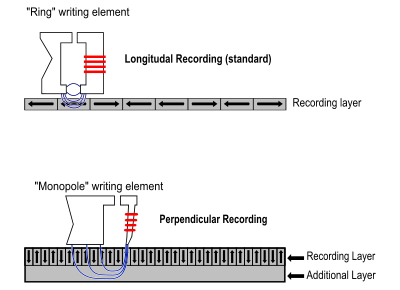
The popular explanation for the advantage of perpendicular recording is that it achieves higher storage densities by aligning the poles of the magnetic elements, which represent bits, perpendicularly to the surface of the disk platter, as shown in the illustration. In this not-quite-accurate explanation, aligning the bits in this manner takes less platter than what would have been required had they been placed longitudinally so they can be placed closer together on the platter, thus increasing the number of magnetic elements that can be stored in a given area. The true picture is a bit more complex, having to do with the use of a magnetically "stronger" (higher coercivity) material as the storage medium. This is possible because in a perpendicular arrangement the magnetic flux is guided through a magnetically soft (and relatively thick) underlayer underneath the hard magnetic media films (considerably complicating and thickening the total disk structure). This magnetically soft underlayer can be effectively considered a part of the write head, making the write head more efficient, thus making it possible to produce a stronger write field gradient with essentially the same head materials as for longitudinal heads, and therefore allowing for the use of the higher coercivity magnetic storage medium. A higher coercivity medium is inherently thermally more stable, as stability is proportional to the product of bit (or magnetic grain) volume times the uniaxial anisotropy constant Ku, which in turn is higher for a material with a higher magnetic coercivity.
began shipping its first laptop
sized 2.5 inches (63.5 mm) hard drive using perpendicular recording technology, the Seagate Momentus 5400.3. Seagate also announced at that time that the majority of its hard disk storage devices would utilize the new technology by the end of 2006.
In April 2006, Seagate began shipping the first 3.5 inch perpendicular recording hard drive, the Cheetah 15K.5, with up to 300GB storage, running at 15,000 rpm and claim to have 30% better performance than their predecessors with a data rate
of 73-125 Mbyte/s.
In April 2006, Seagate announced the Barracuda 7200.10, a series of 3.5 inches (88.9 mm) HDDs utilizing perpendicular recording with a maximum capacity of 750 GB. Drives began shipping in late April 2006.
Hitachi
announced a 20 GB Microdrive
. Hitachi's first laptop drive (2.5-inch) based on perpendicular recording became available in mid-2006, featuring a maximum capacity of 160 GB.
In June 2006, Toshiba
announced a 2.5 inches (63.5 mm) hard drive of 200-GB capacity with mass production starting in August, effectively raising the standard of mobile storage capacity.
In July 2006, Western Digital
announced volume production of its WD Scorpio 2.5 inches (63.5 mm) hard drives using WD-designed and manufactured perpendicular magnetic recording (PMR) technology to achieve 80 GB-per-platter density.
In August 2006 Fujitsu
extended its 2.5 inches (63.5 mm) lineup to include SATA models utilizing perpendicular recording, offering up to 160GB capacity.
In December 2006 Toshiba
said its new 100GB two-platter HDD is based on perpendicular magnetic recording (PMR) and was designed in the "short" 1.8-inch form factor.
In December 2006 Fujitsu announced its MHX2300BT series of 2.5 inches (63.5 mm) hard disk drives, with capacities of 250 and 300 GB.
In January 2007 Hitachi
announced the first 1-Terabyte Hard Drive using the technology, which they then delivered in April 2007.
In July 2008 Seagate Technology
announced a 1.5 Terabyte SATA Hard Drive using PMR technology.
In January 2009 Western Digital
announced the first 2.0 Terabyte SATA Hard Drive using PMR technology.
In February 2009 Seagate Technology
announced the first 7,200rpm 2.0 Terabyte SATA Hard Drive using PMR technology with choice of SATA 2 or SAS 2.0 interface.
Hard disk
A hard disk drive is a non-volatile, random access digital magnetic data storage device. It features rotating rigid platters on a motor-driven spindle within a protective enclosure. Data is magnetically read from and written to the platter by read/write heads that float on a film of air above the...
s. It was first proven advantageous in 1976 by Shun-ichi Iwasaki, then professor of the Tohoku University
Tohoku University
, abbreviated to , located in the city of Sendai, Miyagi Prefecture in the Tōhoku Region, Japan, is a Japanese national university. It is the third oldest Imperial University in Japan and is a member of the National Seven Universities...
in Japan
Japan
Japan is an island nation in East Asia. Located in the Pacific Ocean, it lies to the east of the Sea of Japan, China, North Korea, South Korea and Russia, stretching from the Sea of Okhotsk in the north to the East China Sea and Taiwan in the south...
, and first commercially implemented in 2005.
Advantages
PerpendicularPerpendicular
In geometry, two lines or planes are considered perpendicular to each other if they form congruent adjacent angles . The term may be used as a noun or adjective...
recording can deliver more than three times the storage density
Computer storage density
Memory storage density is a measure of the quantity of information bits that can be stored on a given length of track, area of surface, or in a given volume of a computer storage medium. Generally, higher density is more desirable, for it allows greater volumes of data to be stored in the same...
of traditional longitudinal recordinghttp://www.eetimes.com/showArticle.jhtml?articleID=171200282&pgno=2. There was some interest in using the system in floppy disk
Floppy disk
A floppy disk is a disk storage medium composed of a disk of thin and flexible magnetic storage medium, sealed in a rectangular plastic carrier lined with fabric that removes dust particles...
s in the 1980s, but the technology was never reliable. Since about 2005 the technology has come into use for hard disk drives. Hard disk technology with longitudinal recording has an estimated limit of 100 to 200 gigabit
Gigabit
The gigabit is a multiple of the unit bit for digital information or computer storage. The prefix giga is defined in the International System of Units as a multiplier of 109 , and therefore...
per square inch due to the superparamagnetic effect
Superparamagnetism
Superparamagnetism is a form of magnetism, which appears in small ferromagnetic or ferrimagnetic nanoparticles. In sufficiently small nanoparticles, magnetization can randomly flip direction under the influence of temperature. The typical time between two flips is called the Néel relaxation time...
, though this estimate is constantly changing. Perpendicular recording is predicted to allow information densities of up to around 1 Tbit/sq. inch (1000 Gbit/sq. inch). drives with densities of 667Gb/in2 were available commercially, and there have been perpendicular recording demonstrations of 800-900Gb/in2.
Technology
Coercivity
In materials science, the coercivity, also called the coercive field or coercive force, of a ferromagnetic material is the intensity of the applied magnetic field required to reduce the magnetization of that material to zero after the magnetization of the sample has been driven to saturation...
of the material. The larger the magnetic region is and the higher the magnetic coercivity
Coercivity
In materials science, the coercivity, also called the coercive field or coercive force, of a ferromagnetic material is the intensity of the applied magnetic field required to reduce the magnetization of that material to zero after the magnetization of the sample has been driven to saturation...
of the material, the more stable the medium is. There is a minimum size for a magnetic region at a given temperature and coercivity. If it is any smaller it is likely to be spontaneously de-magnetized by local thermal fluctuations. Perpendicular recording uses higher coercivity material because the head's write field penetrates the medium more efficiently in the perpendicular geometry.
The popular explanation for the advantage of perpendicular recording is that it achieves higher storage densities by aligning the poles of the magnetic elements, which represent bits, perpendicularly to the surface of the disk platter, as shown in the illustration. In this not-quite-accurate explanation, aligning the bits in this manner takes less platter than what would have been required had they been placed longitudinally so they can be placed closer together on the platter, thus increasing the number of magnetic elements that can be stored in a given area. The true picture is a bit more complex, having to do with the use of a magnetically "stronger" (higher coercivity) material as the storage medium. This is possible because in a perpendicular arrangement the magnetic flux is guided through a magnetically soft (and relatively thick) underlayer underneath the hard magnetic media films (considerably complicating and thickening the total disk structure). This magnetically soft underlayer can be effectively considered a part of the write head, making the write head more efficient, thus making it possible to produce a stronger write field gradient with essentially the same head materials as for longitudinal heads, and therefore allowing for the use of the higher coercivity magnetic storage medium. A higher coercivity medium is inherently thermally more stable, as stability is proportional to the product of bit (or magnetic grain) volume times the uniaxial anisotropy constant Ku, which in turn is higher for a material with a higher magnetic coercivity.
Implementations
Toshiba produced the first commercially available disk drive (1.8") using this technology in 2005 . Shortly thereafter in January 2006, Seagate TechnologySeagate Technology
Seagate Technology is one of the world's largest manufacturers of hard disk drives. Incorporated in 1978 as Shugart Technology, Seagate is currently incorporated in Dublin, Ireland and has its principal executive offices in Scotts Valley, California, United States.-1970s:On November 1, 1979...
began shipping its first laptop
Laptop
A laptop, also called a notebook, is a personal computer for mobile use. A laptop integrates most of the typical components of a desktop computer, including a display, a keyboard, a pointing device and speakers into a single unit...
sized 2.5 inches (63.5 mm) hard drive using perpendicular recording technology, the Seagate Momentus 5400.3. Seagate also announced at that time that the majority of its hard disk storage devices would utilize the new technology by the end of 2006.
In April 2006, Seagate began shipping the first 3.5 inch perpendicular recording hard drive, the Cheetah 15K.5, with up to 300GB storage, running at 15,000 rpm and claim to have 30% better performance than their predecessors with a data rate
Data signaling rate
In telecommunication, data signaling rate , also known as gross bit rate, is the aggregate rate at which data pass a point in the transmission path of a data transmission system.Notes:#The DSR is usually expressed in bits per second....
of 73-125 Mbyte/s.
In April 2006, Seagate announced the Barracuda 7200.10, a series of 3.5 inches (88.9 mm) HDDs utilizing perpendicular recording with a maximum capacity of 750 GB. Drives began shipping in late April 2006.
Hitachi
Hitachi, Ltd.
is a Japanese multinational conglomerate headquartered in Marunouchi 1-chome, Chiyoda, Tokyo, Japan. The company is the parent of the Hitachi Group as part of the larger DKB Group companies...
announced a 20 GB Microdrive
Microdrive
Microdrive is a brand name for a miniature, 1-inch hard disk designed to fit in a CompactFlash Type II slot. The release of similar drives by other makers has led to them often being referred to as 'microdrives'...
. Hitachi's first laptop drive (2.5-inch) based on perpendicular recording became available in mid-2006, featuring a maximum capacity of 160 GB.
In June 2006, Toshiba
Toshiba
is a multinational electronics and electrical equipment corporation headquartered in Tokyo, Japan. It is a diversified manufacturer and marketer of electrical products, spanning information & communications equipment and systems, Internet-based solutions and services, electronic components and...
announced a 2.5 inches (63.5 mm) hard drive of 200-GB capacity with mass production starting in August, effectively raising the standard of mobile storage capacity.
In July 2006, Western Digital
Western Digital
Western Digital Corporation is one of the largest computer hard disk drive manufacturers in the world. It has a long history in the electronics industry as an integrated circuit maker and a storage products company. Western Digital was founded on April 23, 1970 by Alvin B...
announced volume production of its WD Scorpio 2.5 inches (63.5 mm) hard drives using WD-designed and manufactured perpendicular magnetic recording (PMR) technology to achieve 80 GB-per-platter density.
In August 2006 Fujitsu
Fujitsu
is a Japanese multinational information technology equipment and services company headquartered in Tokyo, Japan. It is the world's third-largest IT services provider measured by revenues....
extended its 2.5 inches (63.5 mm) lineup to include SATA models utilizing perpendicular recording, offering up to 160GB capacity.
In December 2006 Toshiba
Toshiba
is a multinational electronics and electrical equipment corporation headquartered in Tokyo, Japan. It is a diversified manufacturer and marketer of electrical products, spanning information & communications equipment and systems, Internet-based solutions and services, electronic components and...
said its new 100GB two-platter HDD is based on perpendicular magnetic recording (PMR) and was designed in the "short" 1.8-inch form factor.
In December 2006 Fujitsu announced its MHX2300BT series of 2.5 inches (63.5 mm) hard disk drives, with capacities of 250 and 300 GB.
In January 2007 Hitachi
Hitachi, Ltd.
is a Japanese multinational conglomerate headquartered in Marunouchi 1-chome, Chiyoda, Tokyo, Japan. The company is the parent of the Hitachi Group as part of the larger DKB Group companies...
announced the first 1-Terabyte Hard Drive using the technology, which they then delivered in April 2007.
In July 2008 Seagate Technology
Seagate Technology
Seagate Technology is one of the world's largest manufacturers of hard disk drives. Incorporated in 1978 as Shugart Technology, Seagate is currently incorporated in Dublin, Ireland and has its principal executive offices in Scotts Valley, California, United States.-1970s:On November 1, 1979...
announced a 1.5 Terabyte SATA Hard Drive using PMR technology.
In January 2009 Western Digital
Western Digital
Western Digital Corporation is one of the largest computer hard disk drive manufacturers in the world. It has a long history in the electronics industry as an integrated circuit maker and a storage products company. Western Digital was founded on April 23, 1970 by Alvin B...
announced the first 2.0 Terabyte SATA Hard Drive using PMR technology.
In February 2009 Seagate Technology
Seagate Technology
Seagate Technology is one of the world's largest manufacturers of hard disk drives. Incorporated in 1978 as Shugart Technology, Seagate is currently incorporated in Dublin, Ireland and has its principal executive offices in Scotts Valley, California, United States.-1970s:On November 1, 1979...
announced the first 7,200rpm 2.0 Terabyte SATA Hard Drive using PMR technology with choice of SATA 2 or SAS 2.0 interface.
External links
- Magnetic Disk History History of Magnetic Disk Storage Based on Perpendicular Magnetic Recording
- High-resolution graphic
- Hitachi Research page
- "Get Perpendicular" A Flash animation and song explaining perpendicular recording from Hitachi Research
- Perpendicular Magnetic Recording (Hardcover) by Sakhrat Khizroev, Dmitri Litvinov: ISBN 1-4020-2662-5
- Photo Release: PMR Inventor Sees Result of Life's Work : Shun-ichi Iwasaki at his first visit at Hitachi's manufacturing facility in Prachinburi, Thailand
- Seagate goes perpendicular