


Periplasmic space

Encyclopedia
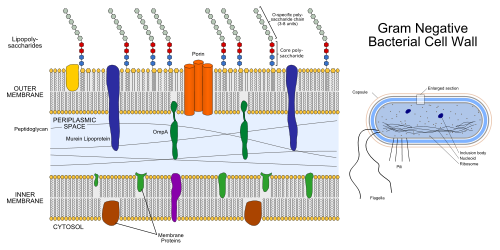
The periplasmic space or periplasm is a space between the peptidoglycan cell wall
and inner membrane
of Gram-negative
bacteria or the equivalent space outside the inner membrane of Gram-positive bacteria. It may constitute up to 40% of the total cell volume in Gram-negative
species, and is drastically smaller in Gram-positive
species. The space contains a loose network of murein (peptidoglycan) chains, as well as a gel containing hydrolytic and degradative enzymes. In addition, it includes nutrient binding and transport proteins, hydrolytic proteins, and antibiotic resistance proteins. Other enzymes in the gel are involved in various biochemical pathways including peptidoglycan synthesis, electron transport, and alteration of substances toxic to the cell (xenobiotic metabolism
). In some species, the gel also contains beta-lactamase
, an enzyme responsible for degrading penicillin
. This can be of clinical importance when considering antibiotic resistance
.
, the term "periplasmic space" refers to the thin region between the plasma membrane and the cell wall.
Cell wall
The cell wall is the tough, usually flexible but sometimes fairly rigid layer that surrounds some types of cells. It is located outside the cell membrane and provides these cells with structural support and protection, and also acts as a filtering mechanism. A major function of the cell wall is to...
and inner membrane
Inner membrane
The inner membrane is the biological membrane of an organelle or Gram-negative bacteria that is within an outer membrane....
of Gram-negative
Gram-negative
Gram-negative bacteria are bacteria that do not retain crystal violet dye in the Gram staining protocol. In a Gram stain test, a counterstain is added after the crystal violet, coloring all Gram-negative bacteria with a red or pink color...
bacteria or the equivalent space outside the inner membrane of Gram-positive bacteria. It may constitute up to 40% of the total cell volume in Gram-negative
Gram-negative
Gram-negative bacteria are bacteria that do not retain crystal violet dye in the Gram staining protocol. In a Gram stain test, a counterstain is added after the crystal violet, coloring all Gram-negative bacteria with a red or pink color...
species, and is drastically smaller in Gram-positive
Gram-positive
Gram-positive bacteria are those that are stained dark blue or violet by Gram staining. This is in contrast to Gram-negative bacteria, which cannot retain the crystal violet stain, instead taking up the counterstain and appearing red or pink...
species. The space contains a loose network of murein (peptidoglycan) chains, as well as a gel containing hydrolytic and degradative enzymes. In addition, it includes nutrient binding and transport proteins, hydrolytic proteins, and antibiotic resistance proteins. Other enzymes in the gel are involved in various biochemical pathways including peptidoglycan synthesis, electron transport, and alteration of substances toxic to the cell (xenobiotic metabolism
Xenobiotic metabolism
Xenobiotic metabolism is the set of metabolic pathways that modify the chemical structure of xenobiotics, which are compounds foreign to an organism's normal biochemistry, such as drugs and poisons...
). In some species, the gel also contains beta-lactamase
Beta-lactamase
Beta-lactamases are enzymes produced by some bacteria and are responsible for their resistance to beta-lactam antibiotics like penicillins, cephamycins, and carbapenems . These antibiotics have a common element in their molecular structure: a four-atom ring known as a beta-lactam...
, an enzyme responsible for degrading penicillin
Penicillin
Penicillin is a group of antibiotics derived from Penicillium fungi. They include penicillin G, procaine penicillin, benzathine penicillin, and penicillin V....
. This can be of clinical importance when considering antibiotic resistance
Antibiotic resistance
Antibiotic resistance is a type of drug resistance where a microorganism is able to survive exposure to an antibiotic. While a spontaneous or induced genetic mutation in bacteria may confer resistance to antimicrobial drugs, genes that confer resistance can be transferred between bacteria in a...
.
Other Usage
In yeastYeast
Yeasts are eukaryotic micro-organisms classified in the kingdom Fungi, with 1,500 species currently described estimated to be only 1% of all fungal species. Most reproduce asexually by mitosis, and many do so by an asymmetric division process called budding...
, the term "periplasmic space" refers to the thin region between the plasma membrane and the cell wall.
Further reading
- D. White, The Physiology and Biochemistry of Prokaryotes, Oxford University Press, Oxford, 2000, pp. 22.