

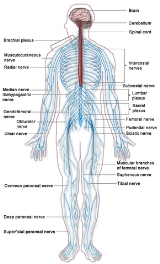
Peripheral nervous system

Encyclopedia
The peripheral nervous system (PNS) consists of the nerves and ganglia outside of the brain
and spinal cord
. The main function of the PNS is to connect the central nervous system
(CNS) to the limbs and organs. Unlike the CNS, the PNS is not protected by the bone
of spine and skull, or by the blood–brain barrier, leaving it exposed to toxin
s and mechanical injuries. The peripheral nervous system is divided into the somatic nervous system
and the autonomic nervous system
; some textbooks also include sensory system
s. It is also a part of the nervous system
.
The cranial nerves are part of the PNS. The cranial nerve ganglia originate in the CNS. However, axons extend beyond the brain and are therefore considered part of the PNS.
in different directions. These two groups of neurons are:
and autonomic nervous system
. The somatic nervous system
is responsible for coordinating the body movements, and also for receiving external stimuli. It is the system that regulates activities that are under conscious control.
The autonomic nervous system
is then split into the sympathetic division
, parasympathetic division
, and enteric division
. The sympathetic nervous system responds to impending danger, and is responsible for the increase of one's heartbeat and blood pressure, among other physiological changes, along with the sense of excitement one feels due to the increase of adrenaline in the system. ("fight or flight" responses). It also slows down the digestive system so that more blood is available to carry oxygen to the vital organs such as brain, heart and muscles. The parasympathetic nervous system, on the other hand, is evident when a person is resting and feels relaxed, and is responsible for such things as the constriction of the pupil, the slowing of the heart, the dilation of the blood vessels, and the stimulation of the digestive and genitourinary systems. ("rest and digest" responses). The role of the enteric nervous system is to manage every aspect of digestion, from the esophagus to the stomach, small intestine and colon.
originate from the brainstem ,and mainly control the functions of the anatomic structures of the head with some exceptions. The nuclei of cranial nerves I and II lie in the forebrain and thalamus, respectively, and are thus not considered to be true cranial nerves. CN X (10) receives visceral sensory information from the thorax and abdomen, and CN XI (11) is responsible for innervating the sternocleidomastoid
and trapezius muscle
s, neither of which is exclusively in the head.
Spinal nerve
s take their origins from the spinal cord
. They control the functions of the rest of the body. In humans, there are 31 pairs of spinal nerves: 8 cervical, 12 thoracic, 5 lumbar, 5 sacral and 1 coccygeal. In the cervical region, the spinal nerve roots come out above the corresponding vertebrae (i.e. nerve root between the skull and 1st cervical vertebrae is called spinal nerve C1). From the thoracic region to the coccygeal region, the spinal nerve roots come out below the corresponding vertebrae. It is important to note that this method creates a problem when naming the spinal nerve root between C7 and T1 (so it is called spinal nerve root C8). In the lumbar and sacral region, the spinal nerve roots travel within the dural sac and they travel below the level of L2 as the cauda equina.
Spinal nerve C1 is called the suboccipital nerve
which provides motor innervation to muscles at the base of the skull
.
C2 and C3 form many of the nerves of the neck, providing both sensory and motor control. These include the greater occipital nerve
which provides sensation to the back of the head, the lesser occipital nerve
which provides sensation to the area behind the ear
s, the greater auricular nerve
and the lesser auricular nerve
. See occipital neuralgia
.
The phrenic nerve
arises from nerve roots C3, C4 and C5. It innervates the diaphragm, enabling breathing. If the spinal cord is transected above C3, then spontaneous breathing is not possible. See myelopathy
, or plexus brachialis, a tangled array of nerves, splitting, combining and recombining, to form the nerves that subserve the upper-limb and upper back. Although the brachial plexus may appear tangled, it is highly organized and predictable, with little variation between people. See brachial plexus injuries.
, sacral nerves
, and coccygeal nerve
form the lumbosacral plexus
, the first lumbar nerve being frequently joined by a branch from the twelfth thoracic. For descriptive purposes this plexus is usually divided into three parts:
lumbar plexus,
sacral plexus
, and
pudendal plexus
and noradrenaline. However, there are several other neurotransmitters as well, jointly labeled Non-noradrenergic, non-cholinergic
(NANC) transmitters. Examples of such transmitters include non-peptides: ATP
, GABA, dopamine
, NO
, and peptides: neuropeptide Y
, VIP
, GnRH, Substance P
and CGRP.
Brain
The brain is the center of the nervous system in all vertebrate and most invertebrate animals—only a few primitive invertebrates such as sponges, jellyfish, sea squirts and starfishes do not have one. It is located in the head, usually close to primary sensory apparatus such as vision, hearing,...
and spinal cord
Spinal cord
The spinal cord is a long, thin, tubular bundle of nervous tissue and support cells that extends from the brain . The brain and spinal cord together make up the central nervous system...
. The main function of the PNS is to connect the central nervous system
Central nervous system
The central nervous system is the part of the nervous system that integrates the information that it receives from, and coordinates the activity of, all parts of the bodies of bilaterian animals—that is, all multicellular animals except sponges and radially symmetric animals such as jellyfish...
(CNS) to the limbs and organs. Unlike the CNS, the PNS is not protected by the bone
Bone
Bones are rigid organs that constitute part of the endoskeleton of vertebrates. They support, and protect the various organs of the body, produce red and white blood cells and store minerals. Bone tissue is a type of dense connective tissue...
of spine and skull, or by the blood–brain barrier, leaving it exposed to toxin
Toxin
A toxin is a poisonous substance produced within living cells or organisms; man-made substances created by artificial processes are thus excluded...
s and mechanical injuries. The peripheral nervous system is divided into the somatic nervous system
Somatic nervous system
The somatic nervous system is the part of the peripheral nervous system associated with the voluntary control of body movements via skeletal muscles...
and the autonomic nervous system
Autonomic nervous system
The autonomic nervous system is the part of the peripheral nervous system that acts as a control system functioning largely below the level of consciousness, and controls visceral functions. The ANS affects heart rate, digestion, respiration rate, salivation, perspiration, diameter of the pupils,...
; some textbooks also include sensory system
Sensory system
A sensory system is a part of the nervous system responsible for processing sensory information. A sensory system consists of sensory receptors, neural pathways, and parts of the brain involved in sensory perception. Commonly recognized sensory systems are those for vision, hearing, somatic...
s. It is also a part of the nervous system
Nervous system
The nervous system is an organ system containing a network of specialized cells called neurons that coordinate the actions of an animal and transmit signals between different parts of its body. In most animals the nervous system consists of two parts, central and peripheral. The central nervous...
.
The cranial nerves are part of the PNS. The cranial nerve ganglia originate in the CNS. However, axons extend beyond the brain and are therefore considered part of the PNS.
By direction
There are two types of neurons, carrying nerve impulsesAction potential
In physiology, an action potential is a short-lasting event in which the electrical membrane potential of a cell rapidly rises and falls, following a consistent trajectory. Action potentials occur in several types of animal cells, called excitable cells, which include neurons, muscle cells, and...
in different directions. These two groups of neurons are:
- The sensory neurons are afferent neurons which relay nerve impulses toward the central nervous systemCentral nervous systemThe central nervous system is the part of the nervous system that integrates the information that it receives from, and coordinates the activity of, all parts of the bodies of bilaterian animals—that is, all multicellular animals except sponges and radially symmetric animals such as jellyfish...
. - The motor neurons are efferent neurons which relay nerve impulses away from the central nervous system.
By function
The peripheral nervous system is functionally as well as structurally divided into the somatic nervous systemSomatic nervous system
The somatic nervous system is the part of the peripheral nervous system associated with the voluntary control of body movements via skeletal muscles...
and autonomic nervous system
Autonomic nervous system
The autonomic nervous system is the part of the peripheral nervous system that acts as a control system functioning largely below the level of consciousness, and controls visceral functions. The ANS affects heart rate, digestion, respiration rate, salivation, perspiration, diameter of the pupils,...
. The somatic nervous system
Somatic nervous system
The somatic nervous system is the part of the peripheral nervous system associated with the voluntary control of body movements via skeletal muscles...
is responsible for coordinating the body movements, and also for receiving external stimuli. It is the system that regulates activities that are under conscious control.
The autonomic nervous system
Autonomic nervous system
The autonomic nervous system is the part of the peripheral nervous system that acts as a control system functioning largely below the level of consciousness, and controls visceral functions. The ANS affects heart rate, digestion, respiration rate, salivation, perspiration, diameter of the pupils,...
is then split into the sympathetic division
Sympathetic nervous system
The sympathetic nervous system is one of the three parts of the autonomic nervous system, along with the enteric and parasympathetic systems. Its general action is to mobilize the body's nervous system fight-or-flight response...
, parasympathetic division
Parasympathetic nervous system
The parasympathetic nervous system is one of the two main divisions of the autonomic nervous system . The ANS is responsible for regulation of internal organs and glands, which occurs unconsciously...
, and enteric division
Enteric nervous system
The enteric nervous system is a subdivision of the autonomic nervous system that directly controls the gastrointestinal system in vertebrates.It is derived from neural crest.-Function:...
. The sympathetic nervous system responds to impending danger, and is responsible for the increase of one's heartbeat and blood pressure, among other physiological changes, along with the sense of excitement one feels due to the increase of adrenaline in the system. ("fight or flight" responses). It also slows down the digestive system so that more blood is available to carry oxygen to the vital organs such as brain, heart and muscles. The parasympathetic nervous system, on the other hand, is evident when a person is resting and feels relaxed, and is responsible for such things as the constriction of the pupil, the slowing of the heart, the dilation of the blood vessels, and the stimulation of the digestive and genitourinary systems. ("rest and digest" responses). The role of the enteric nervous system is to manage every aspect of digestion, from the esophagus to the stomach, small intestine and colon.
Specific nerves and plexi
Ten out of the twelve cranial nervesCranial nerves
Cranial nerves are nerves that emerge directly from the brain, in contrast to spinal nerves, which emerge from segments of the spinal cord. In humans, there are traditionally twelve pairs of cranial nerves...
originate from the brainstem ,and mainly control the functions of the anatomic structures of the head with some exceptions. The nuclei of cranial nerves I and II lie in the forebrain and thalamus, respectively, and are thus not considered to be true cranial nerves. CN X (10) receives visceral sensory information from the thorax and abdomen, and CN XI (11) is responsible for innervating the sternocleidomastoid
Sternocleidomastoid muscle
In human anatomy, the sternocleidomastoid muscle , also known as sternomastoid and commonly abbreviated as SCM, is a paired muscle in the superficial layers of the anterior portion of the neck...
and trapezius muscle
Trapezius muscle
In human anatomy, the trapezius is a large superficial muscle that extends longitudinally from the occipital bone to the lower thoracic vertebrae and laterally to the spine of the scapula...
s, neither of which is exclusively in the head.
Spinal nerve
Spinal nerve
The term spinal nerve generally refers to a mixed spinal nerve, which carries motor, sensory, and autonomic signals between the spinal cord and the body...
s take their origins from the spinal cord
Spinal cord
The spinal cord is a long, thin, tubular bundle of nervous tissue and support cells that extends from the brain . The brain and spinal cord together make up the central nervous system...
. They control the functions of the rest of the body. In humans, there are 31 pairs of spinal nerves: 8 cervical, 12 thoracic, 5 lumbar, 5 sacral and 1 coccygeal. In the cervical region, the spinal nerve roots come out above the corresponding vertebrae (i.e. nerve root between the skull and 1st cervical vertebrae is called spinal nerve C1). From the thoracic region to the coccygeal region, the spinal nerve roots come out below the corresponding vertebrae. It is important to note that this method creates a problem when naming the spinal nerve root between C7 and T1 (so it is called spinal nerve root C8). In the lumbar and sacral region, the spinal nerve roots travel within the dural sac and they travel below the level of L2 as the cauda equina.
Cervical spinal nerves (C1–C4)
The first 4 cervical spinal nerves, C1 through C4, split and recombine to produce a variety of nerves that subserve the neck and back of head.Spinal nerve C1 is called the suboccipital nerve
Suboccipital nerve
The first cervical nerve, the suboccipital nerve exits the spinal cord between the skull and the first cervical vertebra, the atlas.It supplies muscles around the suboccipital triangle including the rectus capitis posterior major, obliquus capitis superior, and obliquus capitis inferior. The...
which provides motor innervation to muscles at the base of the skull
Human skull
The human skull is a bony structure, skeleton, that is in the human head and which supports the structures of the face and forms a cavity for the brain.In humans, the adult skull is normally made up of 22 bones...
.
C2 and C3 form many of the nerves of the neck, providing both sensory and motor control. These include the greater occipital nerve
Greater occipital nerve
The greater occipital nerve is a spinal nerve, specifically the medial branch of the dorsal primary ramus of cervical spinal nerve 2. This nerve arises from between the first and second cervical vertebrae, along with the lesser occipital nerve. It ascends after emerging from the suboccipital...
which provides sensation to the back of the head, the lesser occipital nerve
Lesser occipital nerve
The lesser occipital nerve or small occipital nerve is a cutaneous spinal nerve arising between the second and third cervical vertebrae, along with the greater occipital nerve...
which provides sensation to the area behind the ear
Ear
The ear is the organ that detects sound. It not only receives sound, but also aids in balance and body position. The ear is part of the auditory system....
s, the greater auricular nerve
Greater auricular nerve
The great auricular nerve originates from the cervical plexus, composed of branches of spinal nerves C2 and C3. It provides sensory innervation for the skin over parotid gland and mastoid process, and both surfaces of the outer ear.-Terminology:...
and the lesser auricular nerve
Lesser auricular nerve
The lesser auricular nerve originates from the cervical plexus, composed of branches of spinal nerves C2 and C3.The Great auricular nerve runs posteriorly to the ear, and is "greater" since it provides most of the innervation to the ear: the back of the ear, front of the ear and earlobe...
. See occipital neuralgia
Occipital neuralgia
Occipital neuralgia, also known as C2 neuralgia, Arnold's neuralgia, is a medical condition characterized by chronic pain in the upper neck, back of the head and behind the eyes. These areas correspond to the locations of the lesser and greater occipital nerves.-Causes:Occipital neuralgia is...
.
The phrenic nerve
Phrenic nerve
The phrenic nerve originates mainly from the 4th cervical nerve, but also receives contributions from the 5th and 3rd cervical nerves in humans....
arises from nerve roots C3, C4 and C5. It innervates the diaphragm, enabling breathing. If the spinal cord is transected above C3, then spontaneous breathing is not possible. See myelopathy
Myelopathy
Myelopathy refers to pathology of the spinal cord. When due to trauma, it is known as spinal cord injury. When inflammatory, it is known as myelitis. Disease that is vascular in nature is known as vascular myelopathy....
Brachial plexus (C5–T1)
The last four cervical spinal nerves, C5 through C8, and the first thoracic spinal nerve, T1,combine to form the brachial plexusBrachial plexus
The brachial plexus is a network of nerve fibers, running from the spine, formed by the ventral rami of the lower four cervical and first thoracic nerve roots...
, or plexus brachialis, a tangled array of nerves, splitting, combining and recombining, to form the nerves that subserve the upper-limb and upper back. Although the brachial plexus may appear tangled, it is highly organized and predictable, with little variation between people. See brachial plexus injuries.
Lumbosacral plexus (L1–C0)
The anterior divisions of the lumbar nervesLumbar nerves
The lumbar nerves are the five spinal nerves emerging from the lumbar vertebrae. They are divided into posterior and anterior divisions.-Posterior divisions:...
, sacral nerves
Sacral nerves
The five sacral nerves emerge from the sacrum. Although the vertebral components of the sacrum are fused into a single bone, the sacral vertebrae are still used to number the sacral nerves....
, and coccygeal nerve
Coccygeal nerve
-Structure:The coccygeal nerve is the 31st spinal nerve. It arises from the sacral plexus, and its ventral ramus helps form the coccygeal plexus. It does not divide into a medial and lateral branch...
form the lumbosacral plexus
Lumbosacral plexus
The anterior divisions of the lumbar nerves, sacral nerves, and coccygeal nerve form the lumbosacral plexus, the first lumbar nerve being frequently joined by a branch from the twelfth thoracic. For descriptive purposes this plexus is usually divided into three parts:* lumbar plexus* sacral plexus*...
, the first lumbar nerve being frequently joined by a branch from the twelfth thoracic. For descriptive purposes this plexus is usually divided into three parts:
lumbar plexus,
sacral plexus
Sacral plexus
-External links:*...
, and
pudendal plexus
Pudendal plexus
The pudendal plexus is a term used for a compound structure consisting of sacral spinal nerves.Some sources describe it as S2-S4 of the lumbosacral plexus.In some older texts, it is a rough approximation of the coccygeal plexus....
Neurotransmitters
The main neurotransmitters of the peripheral nervous system are acetylcholineAcetylcholine
The chemical compound acetylcholine is a neurotransmitter in both the peripheral nervous system and central nervous system in many organisms including humans...
and noradrenaline. However, there are several other neurotransmitters as well, jointly labeled Non-noradrenergic, non-cholinergic
Non-noradrenergic, non-cholinergic transmitter
A non-noradrenergic, non-cholinergic transmitter is a neurotransmitter of the peripheral nervous system that is neither of the main two PNS transmitters, i.e. noradrenaline and acetylcholine.-Comparison table:...
(NANC) transmitters. Examples of such transmitters include non-peptides: ATP
Adenosine triphosphate
Adenosine-5'-triphosphate is a multifunctional nucleoside triphosphate used in cells as a coenzyme. It is often called the "molecular unit of currency" of intracellular energy transfer. ATP transports chemical energy within cells for metabolism...
, GABA, dopamine
Dopamine
Dopamine is a catecholamine neurotransmitter present in a wide variety of animals, including both vertebrates and invertebrates. In the brain, this substituted phenethylamine functions as a neurotransmitter, activating the five known types of dopamine receptors—D1, D2, D3, D4, and D5—and their...
, NO
Nitric oxide
Nitric oxide, also known as nitrogen monoxide, is a diatomic molecule with chemical formula NO. It is a free radical and is an important intermediate in the chemical industry...
, and peptides: neuropeptide Y
Neuropeptide Y
Neuropeptide Y is a 36-amino acid peptide neurotransmitter found in the brain and autonomic nervous system."NPY has been associated with a number of physiologic processes in the brain, including the regulation of energy balance, memory and learning, and epilepsy." The main effect is increased food...
, VIP
Vasoactive intestinal peptide
Vasoactive intestinal peptide also known as the vasoactive intestinal polypeptide or VIP is a peptide hormone containing 29 amino acid residues that is produced in many tissues of vertebrates including the gut, pancreas and suprachiasmatic nuclei of the hypothalamus in the brain...
, GnRH, Substance P
Substance P
In the field of neuroscience, substance P is a neuropeptide: an undecapeptide that functions as a neurotransmitter and as a neuromodulator. It belongs to the tachykinin neuropeptide family. Substance P and its closely related neuropeptide neurokinin A are produced from a polyprotein precursor...
and CGRP.
See also
- Spinal nerves
- Cranial nervesCranial nervesCranial nerves are nerves that emerge directly from the brain, in contrast to spinal nerves, which emerge from segments of the spinal cord. In humans, there are traditionally twelve pairs of cranial nerves...
- Autonomic nervous systemAutonomic nervous systemThe autonomic nervous system is the part of the peripheral nervous system that acts as a control system functioning largely below the level of consciousness, and controls visceral functions. The ANS affects heart rate, digestion, respiration rate, salivation, perspiration, diameter of the pupils,...
- Connective tissue in the peripheral nervous systemConnective tissue in the peripheral nervous systemA peripheral nerve contains two types of tissue: nerve fibers, and connective tissue. Dendrites and axons with schwann cells and myelin sheath are surrounded by connective tissue. A nerve fiber in the peripheral nervous system consists of an axon or long dendrite, myelin sheath and their schwann...