
Home      Discussion      Topics      Dictionary      Almanac
Signup       Login
Periodontal probe

Periodontal probe

Discussion
Ask a question about 'Periodontal probe'
Start a new discussion about 'Periodontal probe'
Answer questions from other users
Full Discussion Forum
 
Encyclopedia
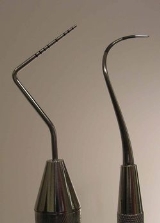
A periodontal probe is an instrument in dentistry
Dentistry
Dentistry is the known evaluation, diagnosis, prevention, and treatment of diseases, disorders and conditions of the soft and hard tissues of the jaw , the oral cavity, maxillofacial area and the adjacent and associated structures and their impact on the human body. Dentistry is a part of stomatology...

 commonly used in the dental armamentarium
Dental armamentarium
Dental instruments are the tools that dental professionals use to provide dental treatment. They include tools to examine, manipulate, restore and remove teeth and surrounding oral structures....

. It is usually long, thin, and blunted at the end. The primary purpose of a periodontal probe is to measure pocket depths around a tooth
Tooth
Teeth are small, calcified, whitish structures found in the jaws of many vertebrates that are used to tear, scrape, and chew food. Some animals, particularly carnivores, also use teeth for hunting or defense. The roots of teeth are covered by gums...

 in order to establish the state of health of the periodontium
Periodontium
Periodontium refers to the specialized tissues that both surround and support the teeth, maintaining them in the maxillary and mandibular bones. The word comes from the Greek terms peri-, meaning "around" and -odons, meaning "tooth." Literally taken, it means that which is "around the tooth"...

. There are markings inscribed onto the head of the instrument for accuracy and readability.


Proper use of the periodontal probe is necessary to maintain accuracy. The tip of the instrument is placed with light pressure of 10-20 grams into the gingival sulcus
Gingival sulcus
The gingival sulcus is an area of potential space between a tooth and the surrounding gingival tissue and is lined by sulcular epithelium. The depth of the sulcus is bounded by two entities: apically by the gingival fibers of the connective tissue attachment and coronally by the free gingival...

, which is an area of potential space between a tooth and the surrounding tissue. It is important to keep the periodontal probe parallel to the contours of the root of the tooth and to insert the probe down to the base of the pocket. This results in obscuring a section of the periodontal probe's tip. The first marking visible above the pocket indicates the measurement of the pocket depth. It has been found that the average, healthy pocket depth is around 3 mm with no bleeding upon probing. Depths greater than 3 mm can be associated with "attachment loss" of the tooth to the surrounding alveolar bone
Bone
Bones are rigid organs that form part of the endoskeleton of vertebrates. They function to move, support, and protect the various organs of the body, produce red and white blood cells and store minerals. Bone tissue is a type of dense connective tissue...

, which is a characteristic found in periodontitis. Pocket depths greater than 3 mm can also be a sign of gingival hyperplasia.

There are many different types of periodontal probes, and each has its own manner of indicating measurements on the tip of the instrument. For example, the Michigan O probe has markings at 3 mm, 6 mm and 8 mm and the Williams probe has circumferential lines at 1 mm, 2 mm, 3 mm, 5 mm, 7 mm, 8 mm, 9 mm, and 10 mm . The PCP12 probe with Marquis markings has alternating shades every 3 mm. Unlike the previous two mentioned, the Naber's probe is curved and is used for measuring into the furcation area between the roots of a tooth.


The periodontal probe can also be used to measure other dental instruments, tooth preparations during restorative procedures, gingival recession, attached gingiva, and oral lesions or pathologies.

External links