
Home      Discussion      Topics      Dictionary      Almanac
Signup       Login
Percolation threshold

Percolation threshold

Overview
Percolation threshold is a mathematical term related to percolation theory
Percolation theory
In mathematics, percolation theory describes the behavior of connected clusters in a random graph. The applications of percolation theory to materials science and other domains are discussed in the article percolation.-Introduction:...

, which is the formation of long-range connectivity in random systems. Below the threshold a giant connected component does not exist while above it, there exists a giant component of the order of system size. In engineering and coffee making, percolation represents the flow of fluids through porous media, but in the mathematics and physics worlds it generally refers to simplified lattice models
Lattice model (physics)
In physics, a lattice model is a physical model that is defined on a lattice, as opposed to the continuum of space or spacetime. Lattice models originally occurred in the context of condensed matter physics, where the atoms of a crystal automatically form a lattice. Currently, lattice models are...

 of random systems or networks (graphs), and the nature of the connectivity in them.
Discussion
Ask a question about 'Percolation threshold'
Start a new discussion about 'Percolation threshold'
Answer questions from other users
Full Discussion Forum
 
Quotations

"An oasis in the middle of the ocean: Office buildings, hotels, theaters and shopping centers, sitting slightly above the surface of the sea in neat rows surrounded by greenery and flowers, with canals of clear blue water, water taxis and gondolas providing transportation for the inhabitants."

"A new country that has never existed before, which will be built in a moderately tropical sea, a perfect climate, a paradise: Utopia!"

"The International University of Advanced Studies, has been founded and is dedicated to teaching the disciplines and imparting the knowledge that will be needed in the next century for survival on Earth, the colonization of the oceans, and the exploration and colonization of space. Access to classes taught by the University may be obtained over the Internet."

"New Utopia will be managed by a Board of Governors; managing what we believe to be the most perfect city/state ever conceived, blending the philosophies of both Ayn Rand and Robert Heinlein."

Encyclopedia
Percolation threshold is a mathematical term related to percolation theory
Percolation theory
In mathematics, percolation theory describes the behavior of connected clusters in a random graph. The applications of percolation theory to materials science and other domains are discussed in the article percolation.-Introduction:...

, which is the formation of long-range connectivity in random systems. Below the threshold a giant connected component does not exist while above it, there exists a giant component of the order of system size. In engineering and coffee making, percolation represents the flow of fluids through porous media, but in the mathematics and physics worlds it generally refers to simplified lattice models
Lattice model (physics)
In physics, a lattice model is a physical model that is defined on a lattice, as opposed to the continuum of space or spacetime. Lattice models originally occurred in the context of condensed matter physics, where the atoms of a crystal automatically form a lattice. Currently, lattice models are...

 of random systems or networks (graphs), and the nature of the connectivity in them.
The percolation threshold is the critical value of the occupation probability
p, or more generally a critical surface for a group of parameters p1, p2, ...,
such that infinite connectivity (percolation
Percolation
In physics, chemistry and materials science, percolation concerns the movement and filtering of fluids through porous materials...

) first occurs.

Percolation models


The most common percolation model is to take a regular lattice, like a square lattice, and
make it into a random network by randomly "occupying" sites (vertices) or bonds (edges) with a
statistically independent probability p. At a critical threshold pc, large clusters and long-range connectivity first appears, and this is called the percolation threshold. More general systems have several probabilities p1, p2, etc., and the transition is characterized by a critical surface or manifold. One can also consider continuum
systems, such as overlapping disks and spheres placed randomly, or the negative
space (Swiss-cheese
Swiss cheese (mathematics)
In mathematics, a Swiss cheese is a compact subset of the complex plane obtained by removing from a closed disc some countable union of open discs. More generally, a Swiss cheese may be all or part of Euclidean space Rn – or of an even more complicated manifold – with "holes" in it....

 models).

In the systems described so far, it has been assumed that the occupation
of a site or bond is completely random—this is the so-called Bernoulli
Bernoulli process
In probability and statistics, a Bernoulli process is a finite or infinite sequence of binary random variables, so it is a discrete-time stochastic process that takes only two values, canonically 0 and 1. The component Bernoulli variables Xi are identical and independent...

 percolation.

For a continuum system, random occupancy corresponds to the points being placed by a
Poisson process
Poisson process
A Poisson process, named after the French mathematician Siméon-Denis Poisson , is a stochastic process in which events occur continuously and independently of one another...

. Further variations involve correlated percolation, such as
percolation clusters related to Ising and Potts models of ferromagnets, in which
the bonds are put down by the Fortuin-Kasteleyn method.

In bootstrap or
k-sat percolation, sites and/or bonds are first occupied and then
successively culled from a system if a site does not have at least k
neighbors. Another important model of percolation, in a different
universality class altogether, is directed percolation
Directed percolation
In statistical physics Directed Percolation refers to a class of models that mimic filtering of fluids through porous materials along a given direction. Varying the microscopic connectivity of the pores, these models display a phase transition from a macroscopically permeable to an impermeable ...

, where connectivity along a bond depends upon the direction of the flow.

Over the last several decades, a tremendous amount of work has gone into
finding exact and approximate values of the percolation thresholds for a variety
of these systems. Exact thresholds are only known for certain two-dimensional
lattices that can be broken up into a self-dual array, such that under a
triangle-triangle transformation, the system remains the same. Studies
using numerical methods have led to numerous improvements in algorithms and
several theoretical discoveries.

The purpose of this page is to gather in one place the most up-to-date
precise values of percolation thresholds and critical surfaces,
including all the exact results that are known.

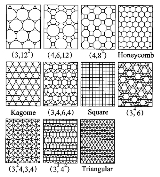
The notation such as (4,82) comes from Grünbaum
Grünbaum
Grünbaum is a German surname meaning "green tree" and may refer to:* Adolf Grünbaum , German-born philosopher of science* Branko Grünbaum, Croatian-born mathematician* Elizabeth Grünbaum...

 and Shepard,
and indicates that around a given vertex, going in the clockwise direction, one encounters
first a square and then two octagons. Besides the eleven Archimedean lattices
composed of regular polygons with every site equivalent, many other more complicated lattices with sites of different classes have been studied.

Thresholds on Archimedean lattices


This is a picture of the 11 Archimedean Lattices or uniform tilings, in which all polygons are regular and each vertex is surrounded by the same sequence of polygons. The notation (34 , 6) for example means that every vertex is surrounded by four triangles and one hexagon. Drawings from
. See also Uniform Tilings.
Lattice z Site Percolation Threshold Bond Percolation Threshold
(3, 122 ) 3 > 0.807900764... = (1 - 2 sin (π/18))1/2
| 0.74042195(80),
0.74042081(10),
0.74042077(2),
(4, 6, 12) 3 3 0.747806(4) 0.69373383(72)
(4, 82) 3 3 0.729724(3) 0.67680232(63)
honeycomb (63) 3 3 > 0.652703645... = 1-2 sin (π/18), 1+ p3-3p2=0
kagomé (3, 6, 3, 6) 4 4 0.652703645... = 1 - 2 sin(π/18) 0.524404978(5), 0.52440499(2),
0.52440516(10), 0.5244053(3)
(3, 4, 6, 4) 4 4 0.621819(3) 0.52483258(53)
square (44): 2N 4 4 0.59274621(13), 0.59274621(33), 0.59274598(4), 0.59274605(3) 1/2
maple leaf (34,6 ) 5 5 0.579498(3) 0.43430621(50)
snub square, puzzle (32, 4, 3, 4 ) 5 5 0.550806(3) 0.41413743(46)
(33, 42) 5 5 0.550213(3) 0.41964191(43)
triangular (36) 6 6 1/2 0.347296355... = 2 sin (π/18), 1+ p3-3p=0
square: 3N, 4N, 6N 4 > 0.592...
square: 3N+2N, 4N+3N, 6N+4N 8 0.407...
square: 4N+2N 8 0.337...
square: 6N+3N 8 0.337...
square: 5N 8 0.270...
square: 6N+2N 8 0.277...
square: 4N+3N+2N 12 0.288...
square: 6N+4N+3N 12 0.288...
square: 5N+2N 12 0.236...
square: 5N+3N 12 0.225...
square: 5N+4N 12 0.221...
square: 6N+3N+2N 12 0.240...
square: 6N+4N+2N 12 0.233...
square: 6N+5N 12 0.199...
square: 5N+3N+2N 16 0.219...
square: 5N+4N+2N 16 0.208...
square: 5N+4N+3N 16 0.202...
square: 6N+5N+2N 16 0.187...
square: 6N+5N+3N 16 0.182...
square: 6N+5N+4N 16 0.179...
square: 6N+4N+3N+2N 16 0.208...
square: 5N+4N+3N+2N 20 0.196...
square: 6N+5N+3N+2N 20 0.177...
square: 6N+5N+4N+2N 20 0.172...
square: 6N+5N+4N+3N 20 0.167...
square: 6N+5N+4N+3N+2N 24 0.164...


Note: sometimes "hexagonal" is used in place of honeycomb, although
in some fields, a triangular
lattice is also called "hexagonal" (as in hexagonal lattice
Hexagonal lattice
The hexagonal lattice or equilateral triangular lattice is one of the five 2D lattice types.Three nearby points form an equilateral triangle. In images four orientations of such a triangle are by far the most common...

). z = bulk coordination number
Coordination number
In chemistry and crystallography, the coordination number of a central atom in a molecule or crystal is the number of its nearest neighbours. This number is determined somewhat differently for molecules and for crystals....

.

2N = nearest neighbours, 3N = next-nearest neighbours, 4N = next-next-nearest neighbours, 5N = next-next-next-nearest neighbours, etc.

Approximate formulas for thresholds of Archimedean lattices (Under construction)

Lattice z Site Percolation Threshold Bond Percolation Threshold
(3, 122 ) 3
(4, 6, 12) 3
(4, 82) 3 0.676835..., 4p3 + 3p4 - 6 p5- 2 p6 = 1
honeycomb (63) 3
kagomé (3, 6, 3, 6) 4 0.524430..., 3p2 + 6p3 - 12 p4+ 6 p5 - p6 = 1
(3, 4, 6, 4) 4
square (44) 4 1/2 (exact)
(34,6 ) 5 0.434371..., 12p3 + 36p4 -21 p5- 327 p6 + 69p7 + 2532p8 - 6533 p9
+ 8256 p10 - 6255p11 + 2951p12 - 837 p13+ 126 p14 - 7p15= 1
snub square, puzzle (32, 4, 3, 4 ) 5
(33, 42) 5
triangular (36) 6 1/2 (exact)


Archimedean Duals (Laves Lattices)

Laves lattices are the duals to the Archimedean lattices. Drawings from. See also Uniform Tilings.
Lattice z Site Percolation Threshold Bond Percolation Threshold
Cairo pentagonal
D(32,4,3,4)=(2/3)(53)+(1/3)(54)
3,4 3⅓ 0.650184 pcbond=1-pcbond(32,4,3,4)
0.58586256(54)
D(33,42)=(1/3)(54)+(2/3)(53) 3,4 3⅓ 0.647084 pcbond=1-Pcbond(33,42)
0.58035808(57)
D(34,6)=(1/5)(46)+(4/5)(43) 3,6 3 3/5 0.639447 pcbond=1-pcbond(34,6 )
0.56569378(50)
dice
D(3,6,3,6)=(1/3)(46)+(2/3)(43)
3,6 4 0.5851(4), 0.585040 pcbond=1-pcbond(3,6,3,6 )
0.475595021(5), 0.47559500(8), 0.47559483(90), 0.475594(7)
ruby
D(3,4,6,4)=(1/6)(46)+(2/6)(43)+(3/6)(44)
3,4,6 4 0.582410 Pcbond=1-Pcbond(3,4,6,4 )
0.47516741(47)
cross
D(4,6,12)= (1/6)(312)+(2/6)(36)+(1/2)(34)
4,6,12 6 1/2 pcbond=1-pcbond(4,6,12)
0.30626616(28)
asanoha
D(3, 122)=(2/3)(33)+(1/3)(312)
3,12 6 1/2 pcbond=1-pcbond(3, 122)0.25957804(20), 0.25957918(90), 0.25957922(8)
union jack
D(4,82 )=(1/2)(34)+(1/2)(38)
4,8 6 1/2 pcbond=1-pcbond(4,82 )
0.23219767(37)


Site bond percolation (both thresholds apply simultaneously to one system).
Lattice z Site Percolation Threshold Bond Percolation Threshold
square 4 4 0.615185(15) 0.95
0.667280(15) 0.85
0.732100(15) 0.75
0.75 0.726195(15)
0.815560(15) 0.65
0.85 0.615810(30)
0.95 0.533620(15)

2-Uniform Lattices


Top 3 Lattices: #13 #12 #36


Bottom 3 Lattices: #34 #37 #11


Top 2 Lattices: #35 #30


Bottom 2 Lattices: #41 #42


Top 4 Lattices: #22 #23 #21 #20


Bottom 3 Lattices: #16 #17 #15

Top 2 Lattices: #31 #32


Bottom Lattice: #33

| 41
|(1/2)(3,4,3,12) + (1/2)(3, 122)
| 4,3
|
| 0.7680(2)>
# Lattice z Site Percolation Threshold Bond Percolation Threshold
0.67493252(36)
42 (1/3)(3,4,6,4) + (2/3)(4,6,12) 4,3 0.7157(2) 0.64536587(40)
36 (1/7)(36) + (6/7)(32,4,12) 6,4 0.6808(2) 0.55778329(40)
15 (2/3)(32,62) + (1/3)(3,6,3,6) 4,4 0.6499(2) 0.53632487(40)
34 (1/7)(36) + (6/7)(32,62) 6,3 0.6329(2) 0.51707873(70)
16 (4/5)(3,42,6) + (1/5)(3,6,3,6) 4,4 0.6286(2) 0.51891529(35)
17 (4/5)(3,42,6) + (1/5)(3,6,3,6)* 4,4 0.6279(2) 0.51769462(35)
35 (2/3)(3,42,6) + (1/3)(3,4,6,4) 4,4 0.6221(2) 0.51973831(40)
11 (1/2)(34,6) + (1/2)(32,62) 5,4 0.6171(2) 0.48921280(37)
37 (1/2)(33,42) + (1/2)(3,4,6,4) 5,4 0.5885(2) 0.47229486(38)
30 (1/2)(32,4,3,4) + (1/2)(3,4,6,4) 5,4 0.5883(2) 0.46573078(72)
23 (1/2)(33,42) + (1/2)(44) 5,4 0.5720(2) 0.45844622(40)
22 (2/3)(33,42) + (1/3)(44) 5,4 0.5648(2) 0.44528611(40)
12 (1/4)(36) + (3/4)(34,6) 6,5 0.5607(2) 0.41109890(37)
33 (1/2)(33,42) + (1/2)(32,4,3,4) 5,5 0.5505(2) 0.41628021(35)
32 (1/3)(33,42) + (2/3)(32,4,3,4) 5,5 0.5504(2) 0.41549285(36)
31 (1/7)(36) + (6/7)(32,4,3,4) 6,5 0.5440(2) 0.40379585(40)
13 (1/2)(36) + (1/2)(34,6) 6,5 0.5407(2) 0.38914898(35)
21 (1/3)(36) + (2/3)(33,42) 6,5 0.5342(2) 0.39491996(40)
20 (1/2)(36) + (1/2)(33,42) 6,5 0.5258(2) 0.38285085(38)

Thresholds on 2d bowtie and martini lattices


To the left, center, and right are: the martini lattice, the martini-A lattice, the martini-B lattice. Below: the martini covering lattice, same as the 2x2, 1x1 subnet for kagome-type lattices.


Some other examples of generalized bow-tie lattices (a-d) and the duals of the lattices (e-h)
Lattice z Site Percolation Threshold Bond Percolation Threshold
martini (3/4)(3,92)+(1/4)(93) 3 3 4 - 3p3=0
> 0.707107... = 1/√2
bow-tie (c) 3,4 3 1/7 0.672929..., 1-2p3-2p4-2p5-7p6+18p7+11p8-35p9+21p10-4p11=0
bow-tie (d) 3,4 3⅓ 0.625457..., 1-2p2-3p3+4p4-p5=0
martini-A (2/3)(3,72)+(1/3)(3,73) 3,4 3⅓ 1/√2 0.625457..., 1-2p2-3p3+4p4-p5=0
bow-tie dual lattice (e) 3,4 3⅔ 0.595482..., 1-pcbond (bow-tie (a))
bow-tie (b) 3,4,6 3⅔ 0.533213..., 1-p- 2p3 -4p4-4p5+156+ 13p7-36p8+19p9+ p10 + p11=0
martini covering (1/2)(33,9)+(1/2)(3,9,3,9) 4 4 0.707107... = 1/√2 0.57086651(33)
martini-B (1/2)(3,5,3,52)+(1/2)(3,52) 3, 5 4 0.618034... = 2/(1 +√5)..., 1- p2-p=0 1/2
bow-tie dual lattice (f) 3,4,8 4 2/5 0.466787..., 1-pcbond (bow-tie (b))
bow-tie (a) (1/2)(32,4,32,4)+(1/2)(3,4,3) 4,6 5 0.5472(2) 0.404518..., 1 - p - 6p2 +6p3-p5=0
bow-tie dual lattice (h) 3,6,8 5 0.374543..., 1-pcbond(bow-tie (d))
bow-tie dual lattice (g) 3,6,10 0.327071..., 1-pcbond(bow-tie (c))

Thresholds on other 2d lattices

Lattice z Site Percolation Threshold Bond Percolation Threshold
square covering lattice (non-planar) 6 6 > 0.3371(1)
square matching lattice (non-planar) 8 8 0.40725395(3) 0.25036834(6)

Thresholds on subnet lattices


The 2 × 2 subnet is known as the "triangular kagome" lattice

Lattice z Site Percolation Threshold Bond Percolation Threshold
checkerboard – 2 × 2 subnet 4,3 > 0.596303(1)
checkerboard – 4 × 4 subnet 4,3 > 0.633685(9)
checkerboard – 8 × 8 subnet 4,3 > 0.642318(5)
checkerboard – 16 × 16 subnet 4,3 > 0.64237(1)
checkerboard- 32 × 32 subnet 4,3 > 0.64219(2)
checkerboard – subnet 4,3 > 0.642216(10)
kagome – 2 × 2 subnet 4 2)
> 0.6008624(10), 0.60086193(3)
kagome – 3 × 3 subnet 4 > 0.6193296(10), 0.61933176(5), 0.61933044(32)
kagome – 4 × 4 subnet 4 > 0.625365(3), 0.62536424(7)
kagome – subnet 4 > 0.628961(2)
kagome – (1 × 1):(3 × 3) subnet 4,3 0.728355596425196... 0.58609776(37)
kagome – (1 × 1):(4 × 4) subnet 0.738348473943256...
kagome – (1 × 1):(5 × 5) subnet 0.743548682503071...
kagome – (1 × 1):(6 × 6) subnet 0.746418147634282...
kagome – (2 × 2):(3 × 3) subnet 0.61091770(30)
triangular – 2 × 2 subnet 6,4 > 0.471628788
triangular – 3 × 3 subnet 6,4 > 0.509077793
triangular – 4 × 4 subnet 6,4 > 0.524364822
triangular – 5 × 5 subnet 6,4 > 0.5315976(10)
triangular – subnet 6,4 > 0.53993(1)

Thresholds of dimers a square lattice

system z Site Threshold
unoriented dimers 4 0.5617
parallel dimers 4 0.5683

Thresholds of polymers (random walks) on a square lattice


System is composed of ordinary (non-avoiding) random walks of length l on the square lattice.
l (polymer length) z Bond Percolation
1 4 0.5(exact)
2 4 0.47697(4)
4 4 0.44892(6)
8 4 0.41880(4)

Thresholds of self-avoiding walks of length k added by random sequential adsorption

k z Site Thresholds Bond Thresholds
1 4 0.593(2) 0.5009(2)
2 4 0.564(2) 0.4859(2)
3 4 0.552(2) 0.4732(2)
4 4 0.542(2) 0.4630(2)
5 4 0.531(2) 0.4565(2)
6 4 0.522(2) 0.4497(2)
7 4 0.511(2) 0.4423(2)
8 4 0.502(2) 0.4348(2)
9 4 0.493(2) 0.4291(2)
10 4 0.488(2) 0.4232(2)
11 4 0.482(2) 0.4159(2)
12 4 0.476(2) 0.4114(2)
13 4 0.471(2) 0.4061(2)
14 4 0.467(2) 0.4011(2)
15 4 0.4011(2) 0.3979(2)

Thresholds on 2d inhomogeneous lattices

Lattice z Site Percolation Threshold Bond Percolation Threshold
bowtie with p = 1/2 on one non-diagonal bond 3 > 0.3819654(5)

Thresholds for 2d continuum models

System Φc ηc nc
Aligned squares of side 0.6666(4) 1.098(1)
Randomly oriented squares 0.6254(2) 0.9819(6)
Disks of radius r 0.6763475(6) 1.128085(2) 1.466322(2)
Ellipses of aspect ratio 2 0.63 0.76 1.94
Ellipses of aspect ratio 5 0.455 0.607 3.864
Ellipses of aspect ratio 10 0.301 0.358 4.56
Ellipses of aspect ratio 20 0.178 0.196 4.99
Ellipses of aspect ratio 50 0.081 0.084 5.38
Ellipses of aspect ratio 100 0.0417 0.0426 5.42
Ellipses of aspect ratio 1000 0.0043 0.00431 5.5
Sticks of length 5.63726(6)
Voids around disks of radius r 0.159(2)

equals critical total area for disks, where N is the number of objects and L is the system size.

for ellipses of semi-major and semi-minor axes of a and b, respectively. Aspect ratio

equals critical area fraction.

equals number of objects of length per unit area.

For ellipses,

For void percolation, is the critical void fraction.

For more ellipse values, see

Thresholds on 2d random and quasi-lattices


Left to right: (a) Voronoi diagram (solid lines) and the dual Delaunay triangulation (dotted lines) for a Poisson distribution
Poisson distribution
In probability theory and statistics, the Poisson distribution is a discrete probability distribution that expresses the probability of a given number of events occurring in a fixed interval of time and/or space if these events occur with a known average rate and independently of the time since...

 of points, (b) Delaunay triangulation only, (c) Voronoi diagram (black lines) and the covering or line graph (dotted red lines).

Lattice z Site Percolation Threshold Bond Percolation Threshold
Voronoi tessellation 3 3 0.71410(2) 0.68, 0.666931(5), 0.6670(1)
Voronoi covering 4 4 0.666931(2) 0.53618(2)
Penrose rhomb dual 4 4 0.6381(3) 0.5233(2)
Penrose rhomb
Penrose tiling
A Penrose tiling is a non-periodic tiling generated by an aperiodic set of prototiles named after Sir Roger Penrose, who investigated these sets in the 1970s. The aperiodicity of the Penrose prototiles implies that a shifted copy of a Penrose tiling will never match the original...

4 4 > 0.4770(2)
Delaunay triangulation
In mathematics and computational geometry, a Delaunay triangulation for a set P of points in a plane is a triangulation DT such that no point in P is inside the circumcircle of any triangle in DT. Delaunay triangulations maximize the minimum angle of all the angles of the triangles in the...

6 6 1/2 0.333069(2)

Thresholds on slabs

Lattice z Site Percolation Threshold Bond Percolation Threshold
h= 2, SC, open b.c. > 0.47424
h = 3, BCC, periodic b.c. > 0.21113018(38)
h = 4, BCC, periodic b.c. > 0.20235168(59)
h= 4, SC, open b.c. > 0.3997
h = 5, SC, periodic b.c. > 0.278102(5)
h = 6, SC, periodic b.c. > 0.272380(2)
h = 7, SC, periodic b.c. 5,6 > 0.268459(1)
h= 8, SC, open b.c. >.0.3557
h = 8, SC, periodic b.c. > 0.265615(5)


More for SC open b.c. in Ref.

h is the thickness of the slab, h x ∞ x ∞.

Thresholds on 3d lattices

Lattice z Site Percolation Threshold Bond Percolation Threshold Dimer Percolation Threshold
ice
Ice crystals
Ice crystals are a small crystalline form of ice including hexagonal columns, hexagonal plates, dendritic crystals, and diamond dust. The highly symmetric shapes are due to depositional growth, namely, direct deposition of water vapour onto the ice crystal...

4 > 0.388(10)
diamond
Diamond cubic
The diamond cubic crystal structure is a repeating pattern of 8 atoms that certain materials may adopt as they solidify. While the first known example was diamond, other elements in group IV also adopt this structure, including tin, the semiconductors silicon and germanium, and silicon/germanium...

4 0.426(+0.08,-0.02) 0.4301(4) 0.390(11), 0.3893(2)
simple cubic
Cubic honeycomb
The cubic honeycomb is the only regular space-filling tessellation in Euclidean 3-space, made up of cubic cells. It has 4 cubes around every edge, and 8 cubes around each vertex. Its vertex figure is a regular octahedron....

6 0.311604(6), 0.311605(5), 0.311600(5),
0.3116077(4),
0.3116081(13),
0.3116080(4),
0.3116004(35)
0.2488126(5) 0.2488125(25) 0.2555(1)
Icosahedral Penrose 6 (average) 0.285 0.225
Penrose w/2 diagonals 6.764 (average) 0.271 0.207
bcc
Cubic crystal system
In crystallography, the cubic crystal system is a crystal system where the unit cell is in the shape of a cube. This is one of the most common and simplest shapes found in crystals and minerals....

8 0.2459615(10), 0.2460(3) , 0.2464(7) 0.1802875(10)
fcc 12 0.1992365(10) 0.1201635(10)
hcp 12 0.1992555(10) 0.1201640(10)
La2-x Srx Cu O4 12 0.19927(2)
Penrose w/8 diagonals 12.764 (average) 0.188 0.111
simple cubic
Cubic honeycomb
The cubic honeycomb is the only regular space-filling tessellation in Euclidean 3-space, made up of cubic cells. It has 4 cubes around every edge, and 8 cubes around each vertex. Its vertex figure is a regular octahedron....

 with short-length correlation
6+ 0.126(1)
simple cubic
Cubic honeycomb
The cubic honeycomb is the only regular space-filling tessellation in Euclidean 3-space, made up of cubic cells. It has 4 cubes around every edge, and 8 cubes around each vertex. Its vertex figure is a regular octahedron....

 with 2NN
12 0.199...
simple cubic
Cubic honeycomb
The cubic honeycomb is the only regular space-filling tessellation in Euclidean 3-space, made up of cubic cells. It has 4 cubes around every edge, and 8 cubes around each vertex. Its vertex figure is a regular octahedron....

 with 3NN
8 0.245...
simple cubic
Cubic honeycomb
The cubic honeycomb is the only regular space-filling tessellation in Euclidean 3-space, made up of cubic cells. It has 4 cubes around every edge, and 8 cubes around each vertex. Its vertex figure is a regular octahedron....

 with NN+2NN
18 0.137... , 0.13735(5)
simple cubic
Cubic honeycomb
The cubic honeycomb is the only regular space-filling tessellation in Euclidean 3-space, made up of cubic cells. It has 4 cubes around every edge, and 8 cubes around each vertex. Its vertex figure is a regular octahedron....

 with NN+3NN
> 14
| 0.142...
simple cubic
Cubic honeycomb
The cubic honeycomb is the only regular space-filling tessellation in Euclidean 3-space, made up of cubic cells. It has 4 cubes around every edge, and 8 cubes around each vertex. Its vertex figure is a regular octahedron....

 with 2NN+3NN
20 0.103...
simple cubic
Cubic honeycomb
The cubic honeycomb is the only regular space-filling tessellation in Euclidean 3-space, made up of cubic cells. It has 4 cubes around every edge, and 8 cubes around each vertex. Its vertex figure is a regular octahedron....

 with NN+2NN+3NN
26 0.097... , 0.0976445(10)


NN = nearest neighbor, 2NN = next-nearest neighbor, 3NN = next-next nearest neighbor

Question: the bond thresholds for the HCP and FCC lattice
agree within the small statistical error. Are they identical,
and if not, how far apart are they? Which threshold is expected to be bigger?

Thresholds for 3d continuum models

System Φc ηc
Aligned cubes of side 0.2773(2) 0.3248(3)
Randomly oriented cubes of side 0.2168(2) 0.2444(3)
Spheres of radius r 0.289573(2) 0.341889(3)
Voids around spheres of radius r (showing void fraction) 0.030(2), 0.0301(3), 0.0294, 0.0300(3) 3.506(8)
Randomly oriented disks of radius r (in 3D) 0.9614(5)
Randomly oriented square plates of side 0.8647(6)
Randomly oriented triangular plates of side 0.7295(6)

is the total volume, where N is the number of objects and L is the system size.

is the critical volume fraction.

For disks and plates, these are effective volumes and volume fractions.

For void ("Swiss-Cheese" model), is the critical void fraction.

Thresholds on hypercubic lattices

d z Site Thresholds Bond Thresholds
4 8 0.1968861(14), 0.196889(3) , 0.196901(5) 0.1601314(13), 0.160130(3), 0.1601310(10)
5 10 0.1407966(15) 0.118172(1), 0.1181718(3)
6 12 0.109017(2) 0.0942019(6)
7 14 0.0889511(9), 0.088939(20) 0.0786752(3)
8 16 0.0752101(5) 0.06770839(7)
9 18 0.0652095(3) 0.05949601(5)
10 20 0.0575930(1) 0.05309258(4)
11 22 0.05158971(8) 0.04794969(1)
12 24 0.04673099(6) 0.04372386(1)
13 26 0.04271508(8) 0.04018762(1)

d z Site Thresholds Bond Thresholds τ
4 8 0.196889(3) 0.160130(3) 2.313(3)
5 10 0.14081(1) 0.118174(4) 2.412(4)


Simulation parameters and results for pc and the Fisher exponent τ.
d z Site Thresholds Bond Thresholds zspread dmin
4 8 0.196889 0.160130 0.622(2) 1.607(5)
5 10 0.14081 0.118174 0.552(2) 1.812(6)


Simulation parameters and results for the spreading exponent zspread and shortest path exponent.

Thresholds on kagomé lattices in higher dimensions

d z Site Thresholds Bond Thresholds rw
3 6 0.3895(2) 0.417(1)
4 8 0.2715(3) 0.274(1)
5 10 0.2084(4) 0.208(1)
6 12 0.1677(7) 0.170(1)

Thresholds on hyperbolic, hierarchical, and tree lattices


Visualization of a triangular hyperbolic lattice {3,7} projected on the Poincaré disk
Depiction of the non-planar Hanoi network HN-NP
Lattice z Site Percolation Threshold Bond Percolation Threshold
Lower Upper
{4,5} hyperbolic 5 5 0.27 0.52
{7,3} hyperbolic 3 3 0.72 0.53
{3,7} hyperbolic 7 7 0.20 0.37
{∞,3} Cayley tree 3 3 1/2 1
Enhanced binary tree (EBT) 0.304(1) 0.48, 0.564(1)
Enhanced binary tree dual 0.436(1) 0.696(1)
Non-Planar Hanoi Network (HN-NP) 0.319445 0.381996
Cayley tree with grandparents 8 0.158656326 >-

Note: {m,n} is the Shläfli symbol, signifying a hyperbolic lattice in which n regular m-gons meet at every vertex

Thresholds for directed percolation

Lattice z Site Percolation Threshold Bond Percolation Threshold
(1+1)-d square, diagonal direction 2 0.705489(4), 0.70548522(4) 0.644701(2), 0.644701(1), 0.64470015(5), 0.644700185(5)
(1+1)-d triangular 3 0.5956468(5) 0.478025(1)
(2+1)-d simple cubic, diagonal planes 3 0.43531(1) 0.382223(7)
(2+1)-d square nn (= bcc) 4 0.3445736(3), 0.344575(15) 0.2873383(1), 0.287338(3)
(3+1)-d hypercubic, diagonal planes 4 0.3025(10)
(3+1)-d cubic, nn 6 0.2081040(4) 0.1774970(5)
(3+1)-d body-centered hypercubic 8 0.160950(30)
(4+1)-d hypercubic, nn 8 0.1461593(2), 0.1461582(3) 0.1288557(5)
(4+1)-d body-centered hypercubic 16 0.075582(17)
0.0755850(3)
(5+1)-d hypercubic, nn 10 0.1123373(2) 0.1016796(5)
(5+1)-d body-centered hypercubic 32 0.035967(23)
(6+1)-d hypercubic, nn 12 0.0913087(2) 0.0841997(14)
(7+1)-d hypercubic,nn 14 0.07699336(7) 0.07195(5)

nn = nearest neighbors. For a (d+1)-dimensional hypercubic system, the hypercube is in d dimensions and the time direction points to the 2d nearest neighbors.

General formulas for exact results


Inhomogeneous triangular lattice bond percolation


Inhomogeneous honeycomb lattice bond percolation = kagomé lattice site percolation


Inhomogeneous (3,12^2) lattice,

or

Inhomogeneous martini lattice (bond percolation)


Inhomogeneous martini lattice (site percolation). r = site in the star


Inhomogeneous martini-A (3–7) lattice. Left side (top of "A" to bottom): . Right side: . Cross bond: .


Inhomogeneous martini-B (3–5) lattice

Inhomogeneous checkerboard lattice (conjecture)

Percolation thresholds of graphs


For random graphs not embedded in space the percolation threshold can be calculated exactly. For example for random regular graphs where all nodes have the same degree k, pc=1/k. For Erdos - Reyni (ER) graphs with Poissonian degree distribution, pc=1/. The critical threshold was calculated exactly also for interdependent ER networks.

See also

  • Percolation
    Percolation
    In physics, chemistry and materials science, percolation concerns the movement and filtering of fluids through porous materials...

  • Percolation theory
    Percolation theory
    In mathematics, percolation theory describes the behavior of connected clusters in a random graph. The applications of percolation theory to materials science and other domains are discussed in the article percolation.-Introduction:...

  • Graph theory
    Graph theory
    In mathematics and computer science, graph theory is the study of graphs, mathematical structures used to model pairwise relations between objects from a certain collection. A "graph" in this context refers to a collection of vertices or 'nodes' and a collection of edges that connect pairs of...

  • Percolation critical exponents
  • 2D percolation cluster
  • Directed percolation
    Directed percolation
    In statistical physics Directed Percolation refers to a class of models that mimic filtering of fluids through porous materials along a given direction. Varying the microscopic connectivity of the pores, these models display a phase transition from a macroscopically permeable to an impermeable ...

  • Effective Medium Approximations
    Effective Medium Approximations
    Effective medium approximations or effective medium theory are physical models that describe the macroscopic properties of a medium based on the properties and the relative fractions of its components...

  • Epidemic models on lattices
    Epidemic models on lattices
    Classic epidemic models of disease transmission are described in Epidemic model and Compartmental models in epidemiology. Here we discuss the behavior when such models are simulated on a lattice.-Introduction:...

  • Uniform Tilings