

Pequot War

Encyclopedia
Pequot
Pequot people are a tribe of Native Americans who, in the 17th century, inhabited much of what is now Connecticut. They were of the Algonquian language family. The Pequot War and Mystic massacre reduced the Pequot's sociopolitical influence in southern New England...
tribe against an alliance of the Massachusetts Bay
Massachusetts Bay Colony
The Massachusetts Bay Colony was an English settlement on the east coast of North America in the 17th century, in New England, situated around the present-day cities of Salem and Boston. The territory administered by the colony included much of present-day central New England, including portions...
, Plymouth
Plymouth Colony
Plymouth Colony was an English colonial venture in North America from 1620 to 1691. The first settlement of the Plymouth Colony was at New Plymouth, a location previously surveyed and named by Captain John Smith. The settlement, which served as the capital of the colony, is today the modern town...
, and Saybrook
Saybrook Colony
The Saybrook Colony was established in late 1635 at the mouth of the Connecticut River in present day Old Saybrook, Connecticut by John Winthrop, the Younger, son of John Winthrop, the Governor of Massachusetts. The former was designated Governor by the original settlers which included Colonel...
colonies who were aided by their Native American
Indigenous peoples of the Americas
The indigenous peoples of the Americas are the pre-Columbian inhabitants of North and South America, their descendants and other ethnic groups who are identified with those peoples. Indigenous peoples are known in Canada as Aboriginal peoples, and in the United States as Native Americans...
allies (the Narragansett
Narragansett (tribe)
The Narragansett tribe are an Algonquian Native American tribe from Rhode Island. In 1983 they regained federal recognition as the Narragansett Indian Tribe of Rhode Island. In 2009, the United States Supreme Court ruled against their request that the Department of Interior take land into trust...
and Mohegan
Mohegan
The Mohegan tribe is an Algonquian-speaking tribe that lives in the eastern upper Thames River valley of Connecticut. Mohegan translates to "People of the Wolf". At the time of European contact, the Mohegan and Pequot were one people, historically living in the lower Connecticut region...
tribes). Hundreds were killed; hundreds more were captured and sold into slavery to the West Indies. Other survivors were dispersed. At the end of the war, about seven hundred Pequots had been killed or taken into captivity. The result was the elimination of the Pequot as a viable polity in what is present-day Southern New England.
It would take the Pequot more than three and a half centuries to regain political and economic power in their traditional homeland region along the Pequot (present-day Thames
Thames River (Connecticut)
The Thames River is a short river and tidal estuary in the U.S. state of Connecticut. It flows south for through eastern Connecticut from the junction of the Yantic and Shetucket rivers at Norwich, to New London and Groton, which flank its mouth at the Long Island Sound.Differing from its...
) and Mystic
Mystic River (Connecticut)
The Mystic River is a estuary in the southeast corner of the U. S. state of Connecticut. Its main tributary is Whitford Brook. It empties into Fishers Island Sound, dividing the village of Mystic between the towns of Groton and Stonington. Much of the river is tidal...
rivers in what is now southeastern Connecticut
Connecticut
Connecticut is a state in the New England region of the northeastern United States. It is bordered by Rhode Island to the east, Massachusetts to the north, and the state of New York to the west and the south .Connecticut is named for the Connecticut River, the major U.S. river that approximately...
.
Etymology
The name PequotPequot
Pequot people are a tribe of Native Americans who, in the 17th century, inhabited much of what is now Connecticut. They were of the Algonquian language family. The Pequot War and Mystic massacre reduced the Pequot's sociopolitical influence in southern New England...
is a Mohegan
Mohegan
The Mohegan tribe is an Algonquian-speaking tribe that lives in the eastern upper Thames River valley of Connecticut. Mohegan translates to "People of the Wolf". At the time of European contact, the Mohegan and Pequot were one people, historically living in the lower Connecticut region...
term, the meaning of which is in dispute among Algonquian
Algonquian languages
The Algonquian languages also Algonkian) are a subfamily of Native American languages which includes most of the languages in the Algic language family. The name of the Algonquian language family is distinguished from the orthographically similar Algonquin dialect of the Ojibwe language, which is a...
-language specialists. Most recent sources claim that "Pequot" comes from Paquatauoq, (the destroyers), thereby relying on the speculations of an early twentieth-century authority on Algonquian languages. Frank Speck
Frank Speck
Frank Gouldsmith Speck was an American anthropologist and professor at the University of Pennsylvania, specializing in the Algonquian and Iroquoian peoples among the Eastern Woodland Native Americans of the United States and First Nations peoples of eastern boreal Canada.-Early life and...
, a anthropologist and specialist of Pequot-Mohegan in the 1920s-1930s, had doubts. He believed that another term, translated as relating to the "shallowness of a body of water", seemed more plausible.
Origins
The Pequot and their traditional enemies, the MoheganMohegan
The Mohegan tribe is an Algonquian-speaking tribe that lives in the eastern upper Thames River valley of Connecticut. Mohegan translates to "People of the Wolf". At the time of European contact, the Mohegan and Pequot were one people, historically living in the lower Connecticut region...
, were at one time a single socio-political entity. Anthropologists and historians contend that sometime before contact with the Puritan
Puritan
The Puritans were a significant grouping of English Protestants in the 16th and 17th centuries. Puritanism in this sense was founded by some Marian exiles from the clergy shortly after the accession of Elizabeth I of England in 1558, as an activist movement within the Church of England...
English, the Pequot split into the two competing groups. The earliest historians of the Pequot War speculated that the Pequot migrated from the upper Hudson River
Hudson River
The Hudson is a river that flows from north to south through eastern New York. The highest official source is at Lake Tear of the Clouds, on the slopes of Mount Marcy in the Adirondack Mountains. The river itself officially begins in Henderson Lake in Newcomb, New York...
Valley toward central and eastern Connecticut sometime around 1500. These claims are disputed by the evidence of modern archeology and anthropology finds.
In the 1630s, the Connecticut River
Connecticut River
The Connecticut River is the largest and longest river in New England, and also an American Heritage River. It flows roughly south, starting from the Fourth Connecticut Lake in New Hampshire. After flowing through the remaining Connecticut Lakes and Lake Francis, it defines the border between the...
Valley was in turmoil. The Pequot aggressively worked to extend their area of control, at the expense of the Wampanoag to the north, the Narragansett
Narragansett (tribe)
The Narragansett tribe are an Algonquian Native American tribe from Rhode Island. In 1983 they regained federal recognition as the Narragansett Indian Tribe of Rhode Island. In 2009, the United States Supreme Court ruled against their request that the Department of Interior take land into trust...
to the east, the Connecticut River Valley Algonquians
Algonquian peoples
The Algonquian are one of the most populous and widespread North American native language groups, with tribes originally numbering in the hundreds. Today hundreds of thousands of individuals identify with various Algonquian peoples...
and Mohegan
Mohegan
The Mohegan tribe is an Algonquian-speaking tribe that lives in the eastern upper Thames River valley of Connecticut. Mohegan translates to "People of the Wolf". At the time of European contact, the Mohegan and Pequot were one people, historically living in the lower Connecticut region...
to the west, and the Algonquian people of present-day Long Island
Long Island
Long Island is an island located in the southeast part of the U.S. state of New York, just east of Manhattan. Stretching northeast into the Atlantic Ocean, Long Island contains four counties, two of which are boroughs of New York City , and two of which are mainly suburban...
to the south. The tribes contended for political dominance and control of the European fur trade. A series of smallpox
Smallpox
Smallpox was an infectious disease unique to humans, caused by either of two virus variants, Variola major and Variola minor. The disease is also known by the Latin names Variola or Variola vera, which is a derivative of the Latin varius, meaning "spotted", or varus, meaning "pimple"...
epidemic
Epidemic
In epidemiology, an epidemic , occurs when new cases of a certain disease, in a given human population, and during a given period, substantially exceed what is expected based on recent experience...
s over the course of the previous three decades had severely reduced the Indian populations, due to their lack of immunity to the disease. As a result, there was a power vacuum in the area.
The Dutch
Dutch colonization of the Americas
Dutch trading posts and plantations in the Americas precede the much wider known colonization activities of the Dutch in Asia. Whereas the first Dutch fort in Asia was built in 1600 , the first forts and settlements on the Essequibo river in Guyana and on the Amazon date from the 1590s...
and the English
British colonization of the Americas
British colonization of the Americas began in 1607 in Jamestown, Virginia and reached its peak when colonies had been established throughout the Americas...
were also striving to extend the reach of their trade into the interior to achieve dominance in the lush, fertile region. By 1636, the Dutch had fortified their trading post, and the English had built a trading fort at Saybrook
Old Saybrook, Connecticut
Old Saybrook is a town in Middlesex County, Connecticut, United States. The population was 10,367 at the 2000 census. It contains the incorporated borough of Fenwick, as well as the census-designated places of Old Saybrook Center and Saybrook Manor.-History:...
. English Puritan
Puritan
The Puritans were a significant grouping of English Protestants in the 16th and 17th centuries. Puritanism in this sense was founded by some Marian exiles from the clergy shortly after the accession of Elizabeth I of England in 1558, as an activist movement within the Church of England...
s from Massachusetts Bay
Massachusetts Bay Colony
The Massachusetts Bay Colony was an English settlement on the east coast of North America in the 17th century, in New England, situated around the present-day cities of Salem and Boston. The territory administered by the colony included much of present-day central New England, including portions...
and Plymouth
Plymouth Colony
Plymouth Colony was an English colonial venture in North America from 1620 to 1691. The first settlement of the Plymouth Colony was at New Plymouth, a location previously surveyed and named by Captain John Smith. The settlement, which served as the capital of the colony, is today the modern town...
colonies settled at the newly established river towns of Windsor
Windsor, Connecticut
Windsor is a town in Hartford County, Connecticut, United States, and was the first English settlement in the state. It lies on the northern border of Connecticut's capital, Hartford. The population was estimated at 28,778 in 2005....
, Hartford
Hartford, Connecticut
Hartford is the capital of the U.S. state of Connecticut. The seat of Hartford County until Connecticut disbanded county government in 1960, it is the second most populous city on New England's largest river, the Connecticut River. As of the 2010 Census, Hartford's population was 124,775, making...
and Wethersfield
Wethersfield, Connecticut
Wethersfield is a town in Hartford County, Connecticut, United States. Many records from colonial times spell the name Weathersfield, while Native Americans called it Pyquag...
.
Participants
- Pequot: Sachem SassacusSassacusSassacus was a Pequot sachem....
- Eastern NianticNiantic (tribe)The Niantic, or in their own language, the Nehântick or Nehantucket were a tribe of New England Native Americans, who were living in Connecticut and Rhode Island during the early colonial period. Due to intrusions of the Pequot, the Niantic were divided into an eastern and western division...
- Western Niantic: Sachem Sassious
- Mohigg: Sachem UncasUncasUncas was a sachem of the Mohegan who through his alliance with the English colonists in New England against other Indian tribes made the Mohegan the leading regional Indian tribe in lower Connecticut.-Early life and family:...
- Niantic Sagamore Wequash
- Narragansett: Sachem Miantonomo
- Montauk or MontaukettMontaukettThe Montaukett is an Algonquian-speaking Native American group native to the eastern end of Long Island, New York and one of the thirteen historical indigenous centers...
). - Massachusetts Bay Colony: Governors Henry VaneHenry Vane the YoungerSir Henry Vane , son of Henry Vane the Elder , was an English politician, statesman, and colonial governor...
and John WinthropJohn WinthropJohn Winthrop was a wealthy English Puritan lawyer, and one of the leading figures in the founding of the Massachusetts Bay Colony, the first major settlement in New England after Plymouth Colony. Winthrop led the first large wave of migrants from England in 1630, and served as governor for 12 of...
, Captains John UnderhillCaptain John UnderhillJohn Underhill was an early English settler and soldier in the Massachusetts Bay Colony, the Province of New Hampshire, the New Haven Colony, New Netherland, and later the Province of New York...
and John EndecottJohn EndecottJohn Endecott was an English colonial magistrate, soldier and the first governor of the Massachusetts Bay Colony. During all of his years in the colony but one, he held some form of civil, judicial, or military high office... - Plymouth Colony: Governors Edward WinslowEdward WinslowEdward Winslow was an English Pilgrim leader on the Mayflower. He served as the governor of Plymouth Colony in 1633, 1636, and finally in 1644...
and William BradfordWilliam Bradford (1590-1657)William Bradford was an English leader of the settlers of the Plymouth Colony in Massachusetts, and served as governor for over 30 years after John Carver died. His journal was published as Of Plymouth Plantation...
, and Captain Myles StandishMyles StandishMyles Standish was an English military officer hired by the Pilgrims as military advisor for Plymouth Colony. One of the Mayflower passengers, Standish played a leading role in the administration and defense of Plymouth Colony from its inception... - Connecticut Colony: Thomas HookerThomas HookerThomas Hooker was a prominent Puritan colonial leader, who founded the Colony of Connecticut after dissenting with Puritan leaders in Massachusetts...
, Captain John Mason, Robert SeeleyRobert SeeleyRobert Seeley, also Seely, Seelye, or Ciely, was an early Puritan settler in the Massachusetts Bay Colony who helped establish Watertown, Wethersfield, and New Haven. He also served as second-in-command to John Mason in the Pequot War.-Early life:Robert Seeley was born in Bluntisham-cum-Earith,... - Saybrook Colony: Lion GardinerLion GardinerLion Gardiner , an early English settler and soldier in the New World, founded the first English settlement in what became the state of New York on Long Island. His legacy includes Gardiners Island, which is held by his descendants.-Early life:...
Causes for war
Before the war's inception, efforts to control fur trade access resulted in a series of escalating incidents and attacks that increased tensions on both sides. Political divisions between the Pequot and Mohegan widened as they aligned with different trade sources—the Mohegan with the English, and the Pequot with the Dutch. The Pequot attacked a group of Mattabesic Indians who had attempted to trade at Hartford. Tension also increased as Massachusetts Bay Colony began to manufacture wampumWampum
Wampum are traditional, sacred shell beads of the Eastern Woodlands tribes of the indigenous people of North America. Wampum include the white shell beads fashioned from the North Atlantic channeled whelk shell; and the white and purple beads made from the quahog, or Western North Atlantic...
, the supply of which the Pequot had controlled up until 1633.
In 1634, John Stone, an English rogue, smuggler, privateer
Privateer
A privateer is a private person or ship authorized by a government by letters of marque to attack foreign shipping during wartime. Privateering was a way of mobilizing armed ships and sailors without having to spend public money or commit naval officers...
, and slaver
Slavery
Slavery is a system under which people are treated as property to be bought and sold, and are forced to work. Slaves can be held against their will from the time of their capture, purchase or birth, and deprived of the right to leave, to refuse to work, or to demand compensation...
, and seven of his crewmen were killed by the Western Niantic
Niantic
Niantic may refer to:* Niantic , tribe of native AmericansShips*Niantic , relic of San Francisco Gold Rush*USS Niantic Victory, Victory ship later renamed USNS Watertown...
, tributary clients of the Pequot, in retaliation for the Dutch having killed the principal Pequot Tatobem sachem
Sachem
A sachem[p] or sagamore is a paramount chief among the Algonquians or other northeast American tribes. The two words are anglicizations of cognate terms from different Eastern Algonquian languages...
. Tatobem had boarded a Dutch vessel to trade. Instead of conducting trade, the Dutch seized the sachem and demanded a substantial ransom for his safe return. The Pequot quickly sent a bushel of wampum, but received Tatobem's corpse in return.
Stone, the privateer, was from the West Indies. He had been banished from Boston
Boston
Boston is the capital of and largest city in Massachusetts, and is one of the oldest cities in the United States. The largest city in New England, Boston is regarded as the unofficial "Capital of New England" for its economic and cultural impact on the entire New England region. The city proper had...
for malfeasance. Setting sail from Boston, Stone was killed by Western Niantics near the mouth of the Connecticut River
Connecticut River
The Connecticut River is the largest and longest river in New England, and also an American Heritage River. It flows roughly south, starting from the Fourth Connecticut Lake in New Hampshire. After flowing through the remaining Connecticut Lakes and Lake Francis, it defines the border between the...
while kidnapping their women and children to sell as slaves in the Virginia Colony. Colonial officials in Boston protested the killing. The Pequot sachem Sassacus refused the colonists' demands that the Western Niantic warriors responsible for Stone's death be turned over to them for trial and punishment.
On July 20, 1636, a respected trader named John Oldham was attacked on a trading voyage to Block Island
Block Island
Block Island is part of the U.S. state of Rhode Island and is located in the Atlantic Ocean approximately south of the coast of Rhode Island, east of Montauk Point on Long Island, and is separated from the Rhode Island mainland by Block Island Sound. The United States Census Bureau defines Block...
. He and several of his crew were killed and his ship looted by Narragansett
Narragansett
Narragansett may refer to:*Narragansett , a Pennsylvania Railroad train*Narragansett , an Amtrak train*Narragansett **Narragansett land claim*Narragansett, Rhode Island, a town*Narragansett Bay*Narragansett...
-allied Indians who sought to discourage English settlers from trading with their Pequot rivals. In the weeks that followed, colonial officials from Massachusetts Bay, Rhode Island, and Connecticut, assumed the Narragansett were the likely culprits. Knowing that the Indians of Block Island were allies of the Eastern Niantic, who were allied with the Narragansett, Puritan officials became suspicious of the Narragansett. However, Narragansett leaders were able to convince the English that the perpetrators were being sheltered by the Pequots.
Battles
News of Oldham's death became the subject of sermons in the Massachusetts Bay Colony. In August, Governor Vane sent John EndecottJohn Endecott
John Endecott was an English colonial magistrate, soldier and the first governor of the Massachusetts Bay Colony. During all of his years in the colony but one, he held some form of civil, judicial, or military high office...
to exact revenge on the Indians of Block Island. Endecott's party of roughly 90 men sailed to Block Island and attacked two apparently abandoned Niantic villages. Most of the Niantic escaped, while two of Endecott's men were injured. The English claimed to have killed 14, but later Narragansett reports claimed only one Indian was killed on the island. The Puritan militia burned the villages to the ground. They carried away crops which the Niantic had stored for winter, and destroyed what they could not carry. Endecott went on to Fort Saybrook.
The English at Saybrook were not happy about the raid, but agreed that some of them would accompany Endecott as guides. Endecott sailed along the coast to a Pequot village, where he repeated the previous year's demand of payment for the death of Stone and more for Oldham. After some discussion, Endecott concluded that the Pequot were stalling and attacked. The Pequot ruse had worked, and most escaped into the woods. Endecott had his forces burn down the village and crops before sailing home.
Pequot raids
In the aftermath, the English of Connecticut Colony had to deal with the anger of the Pequot. The Pequot attempted to get their allies, some 36 tributary villages, to join their cause but were only partly effective. The Western Niantic joined them but the Eastern Niantic remained neutral. The traditional enemies of the Pequot, the Mohegan and the Narragansett, openly sided with the English. The Narragansett had warred with and lost territory to the Pequot in 1622. Now their friend Roger WilliamsRoger Williams (theologian)
Roger Williams was an English Protestant theologian who was an early proponent of religious freedom and the separation of church and state. In 1636, he began the colony of Providence Plantation, which provided a refuge for religious minorities. Williams started the first Baptist church in America,...
urged the Narragansett to side with the English against the Pequot.
Through the fall and winter, Fort Saybrook was effectively besieged. People who ventured outside were killed. As spring arrived in 1637, the Pequot stepped up their raids on Connecticut towns. On April 23, Wongunk chief Sequin attacked Wethersfield with Pequot help. They killed six men and three women, a number of cattle and horses, and took two young girls captive. (They were daughters of Abraham Swain and were later ransomed by Dutch traders.) In all, the towns lost about 30 settlers.
In May, leaders of Connecticut river towns met in Hartford, raised a militia, and placed Captain John Mason in command. Mason set out with 90 militia and 70 Mohegan warriors under Uncas to punish the Pequot. At Fort Saybrook, Captain Mason was joined by John Underhill and another 20 men. Underhill and Mason proceeded to the principal Pequot village, near present-day Groton
Groton, Connecticut
Groton is a town located on the Thames River in New London County, Connecticut, United States. The population was 39,907 at the 2000 census....
, but the Pequot chose to defend their fortified village. Ill-equipped to take the village, Mason sailed east and stopped at the village of Misistuck (present-day Mystic
Mystic, Connecticut
Mystic is a village and census-designated place in New London County, Connecticut, in the United States. The population was 4,001 at the 2000 census. A historic locality, Mystic has no independent government because it is not a legally recognized municipality in the state of Connecticut...
).
The Mystic massacre
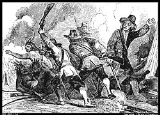
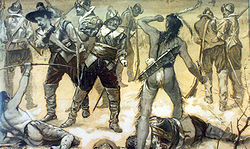
Believing that the English had returned to Boston, the Pequot sachem Sassacus took several hundred of his warriors to make another raid on Hartford. Mason had visited and recruited the Narragansett, who joined him with several hundred warriors. Several allied Niantic warriors also joined Mason's group. On May 26, 1637, with a force up to about 400 fighting men, Mason attacked Misistuck by surprise. He estimated that "six or seven Hundred" Pequot were there when his forces assaulted the palisadePalisade
A palisade is a steel or wooden fence or wall of variable height, usually used as a defensive structure.- Typical construction :Typical construction consisted of small or mid sized tree trunks aligned vertically, with no spacing in between. The trunks were sharpened or pointed at the top, and were...
. As some 150 warriors had accompanied Sassacus to Hartford, so the inhabitants remaining were largely Pequot women and children, and older men. Mason ordered that the enclosure be set on fire. Justifying his conduct later, Mason declared that the attack against the Pequot was the act of a God who "laughed his Enemies and the Enemies of his People to scorn making [the Pequot] as a fiery Oven . . . Thus did the Lord judge among the Heathen, filling [Mystic] with dead Bodies." Mason insisted that any Pequot attempting to escape the flames should be killed. Of the estimated 600 to 700 Pequot resident at Mystic that day, only seven survived to be taken prisoner, while another seven escaped to the woods.
The Narragansett and Mohegan warriors with Mason and Underhill's colonial militia were horrified by the actions and "manner of the Englishmen's fight . . . because it is too furious, and slays too many men." The Narragansett left the warfare and returned home.
Believing the mission accomplished, Mason set out for home. Becoming temporarily lost, his militia narrowly missed returning Pequot warriors. After seeing the destruction of Mystic, they gave chase to the English forces, but to little avail.
War's end
The destruction of people and the village of Mystic broke the Pequot. The English victory also deprived them of their allies. Forced to abandon their villages, the Pequot fled—mostly in small bands—to seek refuge with other southern Algonquian peoples. Many were hunted down by Mohegan and Narragansett warriors. The largest group, led by Sassacus, were denied aid by the MetoacMetoac
Metoac is the collective name for the group of culturally and linguistically related Native American settlements roughly east of what is now the Nassau County line on, Long Island in New York at the time of European contact in the 17th century. Metoac does not specifically refer to political,...
(Montauk, or Montaukett) from present-day Long Island. Sassacus led roughly 400 warriors west along the coast toward the Dutch
Dutch people
The Dutch people are an ethnic group native to the Netherlands. They share a common culture and speak the Dutch language. Dutch people and their descendants are found in migrant communities worldwide, notably in Suriname, Chile, Brazil, Canada, Australia, South Africa, New Zealand, and the United...
at New Amsterdam
New Amsterdam
New Amsterdam was a 17th-century Dutch colonial settlement that served as the capital of New Netherland. It later became New York City....
and their Native allies. When they crossed the Connecticut River, the Pequot killed three men whom they encountered near Fort Saybrook.
In mid-June, John Mason set out from Saybrook with 160 men and 40 Mohegan scouts led by Uncas. They caught up with the refugees at Sasqua, a Mattabesic village near present-day Fairfield, Connecticut
Fairfield, Connecticut
Fairfield is a town located in Fairfield County, Connecticut, United States. It is bordered by the towns of Bridgeport, Trumbull, Easton, Redding and Westport along the Gold Coast of Connecticut. As of the 2010 census, the town had a population of 59,404...
. Surrounded in a nearby swamp
Swamp
A swamp is a wetland with some flooding of large areas of land by shallow bodies of water. A swamp generally has a large number of hammocks, or dry-land protrusions, covered by aquatic vegetation, or vegetation that tolerates periodical inundation. The two main types of swamp are "true" or swamp...
, the Pequot refused to surrender. The English allowed several hundred, mostly women and children, to leave with the Mattabesic. In the ensuing battle, Sassacus broke free with perhaps 80 warriors, but 180 Pequot men were killed or captured. The colonists memorialized this event as the Great Swamp Fight, or Fairfield Swamp Fight
Fairfield Swamp Fight
The Fairfield Swamp Fight was the last engagement of the Pequot War and marked defeat of the Pequot tribe in the war and the loss of their recognition as a political entity in the 17th century. The participants in the conflict were the Pequot and the English with their allied tribes...
in its modern interpretation.
Sassacus and his followers had hoped to gain refuge among the Mohawk in present-day New York. However, the Mohawk instead killed Sassacus and his warriors. They sent Sassacus' scalp to Hartford as a symbolic offering of Mohawk friendship with the Connecticut Colony. English colonial officials continued to call for hunting down what remained of the Pequot months after war's end.
Aftermath
In September, the victorious Mohegan and Narragansett met at the General Court of Connecticut and agreed on the disposition of the Pequot and their lands. The agreement, known as the first Treaty of HartfordTreaty of Hartford
The term Treaty of Hartford applies to three historic agreements negotiated at Hartford, Connecticut. The 1638 treaty divided the spoils of the Pequot War. The 1650 treaty defined a border between the Dutch Nieuw Amsterdam and English settlers in Connecticut...
, was signed on September 21, 1638. About 200 Pequot "old men, women, and children" survived the war and massacre at Mystic. Unable to find refuge with a neighboring tribe, they finally gave up and offered themselves as slaves
Slavery
Slavery is a system under which people are treated as property to be bought and sold, and are forced to work. Slaves can be held against their will from the time of their capture, purchase or birth, and deprived of the right to leave, to refuse to work, or to demand compensation...
in exchange for life:
Other Pequot were enslaved and shipped to Bermuda
Bermuda
Bermuda is a British overseas territory in the North Atlantic Ocean. Located off the east coast of the United States, its nearest landmass is Cape Hatteras, North Carolina, about to the west-northwest. It is about south of Halifax, Nova Scotia, Canada, and northeast of Miami, Florida...
or the West Indies, or were forced to become household servants in English households in Connecticut and Massachusetts Bay. Colonists appropriated Pequot lands under claims of a "just war
Just War
Just war theory is a doctrine of military ethics of Roman philosophical and Catholic origin, studied by moral theologians, ethicists and international policy makers, which holds that a conflict ought to meet philosophical, religious or political criteria.-Origins:The concept of justification for...
". They essentially declared the Pequot extinct by prohibiting speaking the name of the people. The few Pequot who managed to evade death or slavery later recovered from captivity by the Mohegan and were assigned reservations in Connecticut Colony.
The colonists attributed the success of end of the murderous aggression of the Pequot tribe to an act of God:
Lion Gardiner
Lion Gardiner
Lion Gardiner , an early English settler and soldier in the New World, founded the first English settlement in what became the state of New York on Long Island. His legacy includes Gardiners Island, which is held by his descendants.-Early life:...
, a soldier involved in the Pequot War, in his 1660 Relation of the Pequot Wars, expressed a different perspective:
This was the first instance wherein Algonquian peoples of what is now southern New England encountered European-style warfare. The idea of "total war" was kind of new to them. After the Pequot War, the native were too scared to rise up against the colonists. In 1675, a fairly long period of peace came to an end with King Philip's War
King Philip's War
King Philip's War, sometimes called Metacom's War, Metacomet's War, or Metacom's Rebellion, was an armed conflict between Native American inhabitants of present-day southern New England and English colonists and their Native American allies in 1675–76. The war is named after the main leader of the...
.
Historical accounts and controversies
The earliest accounts of the Pequot War were written by the victors within one year of the war. Later histories, with few exceptions, recounted events from a similar perspective, restating arguments first used by the war's military leaders, such as John Underhill and John Mason, as well the Puritan divines Increase MatherIncrease Mather
Increase Mather was a major figure in the early history of the Massachusetts Bay Colony and Province of Massachusetts Bay . He was a Puritan minister who was involved with the government of the colony, the administration of Harvard College, and most notoriously, the Salem witch trials...
and his son Cotton Mather
Cotton Mather
Cotton Mather, FRS was a socially and politically influential New England Puritan minister, prolific author and pamphleteer; he is often remembered for his role in the Salem witch trials...
.
Recent historians and other specialists have reviewed these accounts. In 2004, an artist and archaeologist teamed up to evaluate the sequence of events in the Pequot War. Their popular history took issue with events, and whether John Mason and John Underhill wrote the accounts that appeared under their names. The authors have been adopted as honorary members of the Lenape Pequot.
Most modern historians such as Alfred A. Cave, a specialist in the ethnohistory of colonial America, do not debate questions of the outcome of the battle or its chronology. However, Caves contends that Mason and Underhill's eyewitness accounts, as well as the contemporaneous histories of Mather and Hubbard, were more "polemical than substantive." The causes of the outbreak of hostilities, the reasons for the English fear and hatred of the Pequot, and the ways in which English dealt with and wrote about the Pequot, have been re-evaluated within a larger context than daily colonial life.
Revisionist historians have placed the background of the Pequot War within the context of European history, in which religious wars gave rise to increased violence, and Dutch and English colonization in North America, as well as the geopolitical ambitions and struggles of contending Native peoples during the first half of the seventeenth century. Such historians have doubts about traditional histories, characterizing them as hegemonic narratives that valorize Puritans at the expense of a "demonized" Native population. Alden T. Vaughan, a noted historian of colonial America, at first was a critic of the Pequot. Later he wrote that the Pequot were not "solely or even primarily responsible" for the war. He went on, "The Bay colony's gross escalation of violence ... made all-out war unavoidable; until then, negotiation was at least conceivable."
In popular culture
- In 2004, PBS aired the television documentary Mystic Voices: The Story of the Pequot War.
- The Mystic Massacre was featured in the 2006 History Channel series 10 Days that Unexpectedly Changed America10 Days that Unexpectedly Changed America10 Days That Unexpectedly Changed America is a ten-hour, ten-part television miniseries that aired on the History Channel from April 9 through April 13, 2006. The material was later adapted and published as a book by the same title.-Overview:...
.
Primary Sources
- Bradford, William. Of Plimoth Plantation, 1620-1647, ed. Samuel Eliot Morison (New York, NY: Alfred A. Knopf, 1966).
- Gardiner, Lion. Leift Lion Gardener his Relation of the Pequot Warres (Boston: [First Printing] Massachusetts Historical Society Collections, 1833). Online edition (1901)
- Hubbard, William. The History of the Indian Wars in New England 2 vols. (Boston: Samuel G. Drake, 1845).
- Johnson, Edward. Wonder-Working Providence of Sion's Saviour in New England by Captain Edward Johnson of Woburn, Massachusetts Bay. With an historical introduction and an index by William Frederick Poole (Andover, MA: W. F. Draper, [London: 1654] 1867).
- Mason, John. A Brief History of the Pequot War: Especially of the Memorable taking of their Fort at Mistick in Connecticut in 1637/Written by Major John Mason, a principal actor therein, as then chief captain and commander of Connecticut forces; With an introduction and some explanatory notes by the Reverend Mr. Thomas Prince (Boston: Printed & sold by. S. Kneeland & T. Green in Queen Street, 1736).Online edition
- Mather, Increase. A Relation of the Troubles which have Hapned in New-England, by Reason of the Indians There, from the Year 1614 to the Year 1675 (New York: Arno Press, [1676] 1972).
- Orr, Charles ed., History of the Pequot War: The Contemporary Accounts of Mason, Underhill, Vincent, and Gardiner (Cleveland, 1897).
- Underhill, John. Nevves from America; or, A New and Experimentall Discoverie of New England: Containing, a True Relation of their War-like Proceedings these two yeares last past, with a figure of the Indian fort, or Palizado. Also a discovery of these places, that as yet have very few or no inhabitants which would yeeld speciall accommodation to such as will plant there . . . By Captaine Iohn Underhill, a commander in the warres there (London: Printed by I. D[awson] for Peter Cole, and are to be sold at the signe of the Glove in Corne-hill neere the Royall Exchange, 1638). Online edition
- Vincent, Philip. A True Relation of the late Battell fought in New England, between the English, and the Salvages: VVith the present state of things there (London: Printed by M[armaduke] P[arsons] for Nathanael Butter, and Iohn Bellamie, 1637). Online edition
Secondary Sources
- Adams, James T. The Founding of New England (Boston: The Atlantic Monthly Press, 1921).
- Apess, William. A Son of the Forest (The Experience of William Apes, a Native of the Forest Comprising a Notice of the Pequod tribe of Indians), and other writings, ed. Barry O'Connell (Amherst: University of Massachusetts Press, [1829] 1997).
- Bancroft, George. A History of the United States, from the Discovery of the American Continent, 9 vols. (Boston: Little, Brown & Co., 1837–1866): I:402-404.
- Boissevain, Ethel. "Whatever Became of the New England Indians Shipped to Bermuda to be Sold as Slaves," Man in the Northwest 11 (Spring 1981), pp. 103–114.
- Bradstreet, Howard. The Story of the War with the Pequots, Retold (New Haven, CT: Yale University Press, 1933).
- Cave, Alfred A. "The Pequot Invasion of Southern New England: A Reassessment of the Evidence," New England Quarterly 62 (1989): 27-44.
- _______. "Who Killed John Stone? A Note on the Origins of the Pequot War," William and Mary Quarterly, 3rd Ser., vol. 49, no. 3. (Jul., 1992), pp. 509–521.
- ______. The Pequot War (Amherst: University of Massachusetts Press, 1996).
- Channing, Edward. A History of the United States (New York: Macmillan, 1912–1932).
- Cronon, William. Changes in the Land: Indians, Colonists, and the Ecology of New England (New York: Hill and Wang, 1985).
- Crosby, Alfred W. "Virgin Soil Epidemics as a Factor in the Aboriginal Depopulation in America," William and Mary Quarterly, 3rd Ser., vol. 33, no. 2 (Apr., 1976) , pp. 289–299.
- De Forest, John W. History of the Indians of Connecticut from the Earliest known Period to 1850 (Hartford, 1853).
- Dempsey, Jack, and David R. Wagner, MYSTIC FIASCO: How the Indians Won The Pequot War. 249pp., 50 illustrations/photos, Annotated Chronology, Index. Scituate MA: Digital Scanning Inc. 2004. See also "Mystic Massacre"
- Drinnon, Richard, Facing West: The Metaphysics of Indian-Hating and Empire-Building (Norman: University of Oklahoma Press, 1997).
- Fickes, Michael L. "'They Could Not Endure That Yoke': The Captivity of Pequot Women and Children after the War of 1637," New England Quarterly, vol. 73, no. 1. (Mar., 2000), pp. 58–81.
- Freeman, Michael. "Puritans and Pequots: The Question of Genocide," New England Quarterly, vol. 68, no. 2. (Jun., 1995), pp. 278–293.
- Greene, Evarts P. The Foundations of American Nationality (New York: American Book Co., 1922).
- Hall, David. Worlds of Wonder, Days of Judgment: Popular Religious Belief in Early New England (Cambridge, MA: Harvard University Press, 1990).
- Hauptman, Laurence M. "The Pequot War and Its Legacies," in The Pequots in Southern New England: The Fall and Rise of an Indian Nation, ed. Laurence M. Hauptman and James D. Wherry (Norman: University of Oklahoma Press, 1990), p. 69.
- Hildreth, Richard. The History of the United States of America (New York: Harper & Bros., 1856–60), I: 237-42.
- Hirsch, Adam J. "The Collision of Military Cultures in Seventeenth-Century New England," Journal of American History, vol. 74, no. 4. (Mar., 1988), pp. 1187–1212.
- Holmes, Abiel. The Annals of America: From the Discovery by Columbus in the Year 1492, to the Year 1826 (Cambridge: Hilliard and Brown, 1829).
- Howe, Daniel W. The Puritan Republic of the Massachusetts Bay in New England (Indianapolis: Bowen-Merrill, 1899).
- Hutchinson, Thomas. The History of the Colony of Massachuset's Bay, From the first settlement thereof in 1628 (London: Printed for M. Richardson ..., 1765).
- Jennings, Francis P. The Invasion of America: Indians, Colonialism, and the Cant of Conquest (Chapel Hill: Institute of Early American History and Culture, University of North Carolina Press, 1975).
- Karr, Ronald Dale. "'Why Should You Be So Furious?': The Violence of the Pequot War," Journal of American History, vol. 85, no. 3. (Dec., 1998), pp. 876–909.
- Katz, Steven T. "The Pequot War Reconsidered," New England Quarterly, vol. 64, no. 2. (Jun., 1991), pp. 206–224.
- ______. "Pequots and the Question of Genocide: A Reply to Michael Freeman," New England Quarterly, vol. 68, no. 4. (Dec., 1995), pp. 641–649.
- Kupperman, Karen O. Settling with the Indians: The Meeting of English and Indian Cultures in America, 1580-1640 (Totowa, N.J.: Rowman and Littlefield, 1980).
- Lipman, Andrew. "'A meanes to knitt them togeather': The Exchange of Body Parts in the Pequot War." William and Mary Quarterly Third Series, Vol. 65, No. 1 (2008): 3-28.
- Means, Carrol Alton. "Mohegan-Pequot Relationships, as Indicated by the Events Leading to the Pequot Massacre of 1637 and Subsequent Claims in the Mohegan Land Controversy," Archaeological Society of Connecticut Bulletin 21 (2947): 26-33.
- Macleod, William C. The American Indian Frontier (New York: A.A. Knopf, 1928).
- McBride, Kevin. "Prehistory of the Lower Connecticut Valley" (Ph.D. diss., University of Connecticut, 1984).
- Michelson, Truman D. "Notes on Algonquian Language," International Journal of American Linguistics 1 (1917): 56-57.
- Oberg, Micheal. Uncas: First of the Mohegans (Ithaca, NY: Cornell University Press, 2003).
- Parkman, Francis. France and England in North America, ed. David Levin (New York, NY: Viking Press, 1983): I:1084.
- Salisbury, Neal. Manitou and Providence: Indians, Europeans, and the Making of New England, 1500-1643 (New York: Oxford University Press, 1982).
- Segal, Charles M. and David C. Stineback, eds. Puritans, Indians, and Manifest Destiny (New York: Putnam, 1977).
- Snow, Dean R., and Kim M. Lamphear, "European Contact and Indian Depopulation in the Northeast: The Timing of the First Epidemics," Ethnohistory 35 (1988): 16-38.
- Speck, Frank. "Native Tribes and Dialects of Connecticut: A Mohegan-Pequot Diary," Annual Reports of the U.S. Bureau of Ethnology 43 (1928).
- Spiero, Arthur E., and Bruce E. Speiss, "New England Pandemic of 1616-1622: Cause and Archaeological Implication," Man in the Northeast 35 (1987): 71-83
- Sylvester, Herbert M. Indian Wars of New England, 3 vols. (Boston: W.B. Clarke Co., 1910), 1:183-339.
- Trumbull, Benjamin. A Complete History of Connecticut: Civil and Ecclesiastical, From the Emigration of its First Planters, from England, in the Year 1630, to the Year 1764; and to the close of the Indian Wars (New Haven: Maltby, Goldsmith and Co. and Samuel Wadsworth, 1818).
- Vaughan, Alden T. "Pequots and Puritans: The Causes of the War of 1637," William and Mary Quarterly 3rd Ser., Vol. 21, No. 2 (Apr., 1964), pp. 256–269; also republished in Roots of American Racism: Essays on the Colonial Experience (New York: Oxford University Press, 1995).
- ______. New England Frontier: Puritans and Indians 1620-1675 (Norman: University of Oklahoma Press, 1995, Reprint).
- Willison, George F. Saints and Strangers, Being the Lives of the Pilgrim Fathers & their Families, with their Friends & Foes; & An Account of their Posthumous Wanderings in limbo, their Final Resurrection & Rise to Glory, & the Strange Pilgrimages of Plymouth Rock (New York: Reynal & Hitchcock, 1945)
- Wilson, Woodrow. A History of the American People, 5 vols. (New York and London : Harper & Brothers, 1906).
External links
- 1736 version of John Mason's account
- Pequot War timeline from Columbia University
- A summary of the Pequots and their history
- A brief history of the Pequot War
- Society of Colonial War's account
- Cape Cod Online: Worlds Rejoined.
- The Royal Gazette: Bermudians (Mohegans) and Pequots Reconnect
- P. Vincent, A True Relation of the Late Battell fought in New England online edition
- John Underhill, Newes from America online edition
- Lion Gardener, Relation of the Pequot Warres online edition
- John Mason, A Brief History of the Pequot War online edition