Penrose triangle

Encyclopedia

Impossible object
An impossible object is a type of optical illusion consisting of a two-dimensional figure which is instantly and subconsciously interpreted by the visual system as representing a projection of a three-dimensional object although it is not actually possible for such an object to exist An impossible...
. It was first created by the Swedish artist Oscar Reutersvärd
Oscar Reutersvärd
Oscar Reutersvärd , "the father of the impossible figure", was an artist who pioneered the art of impossible objects. These are images such as what was later renamed the Penrose triangle that appear to depict solid objects, which, however, are impossible to construct in reality...
in 1934. The mathematician
Mathematician
A mathematician is a person whose primary area of study is the field of mathematics. Mathematicians are concerned with quantity, structure, space, and change....
Roger Penrose
Roger Penrose
Sir Roger Penrose OM FRS is an English mathematical physicist and Emeritus Rouse Ball Professor of Mathematics at the Mathematical Institute, University of Oxford and Emeritus Fellow of Wadham College...
independently devised and popularised it in the 1950s, describing it as "impossibility in its purest form". It is featured prominently in the works of artist M. C. Escher
M. C. Escher
Maurits Cornelis Escher , usually referred to as M. C. Escher , was a Dutch graphic artist. He is known for his often mathematically inspired woodcuts, lithographs, and mezzotints...
, whose earlier depictions of impossible objects partly inspired it.
The tribar appears to be a solid
Solid
Solid is one of the three classical states of matter . It is characterized by structural rigidity and resistance to changes of shape or volume. Unlike a liquid, a solid object does not flow to take on the shape of its container, nor does it expand to fill the entire volume available to it like a...
object, made of three straight beams of square cross-section which meet pairwise at right angles at the vertices of the triangle
Triangle
A triangle is one of the basic shapes of geometry: a polygon with three corners or vertices and three sides or edges which are line segments. A triangle with vertices A, B, and C is denoted ....
they form. The beams may be broken, forming cubes or cuboids; the logo of National Westminster Bank
National Westminster Bank
National Westminster Bank Plc, commonly known as NatWest, is the largest retail and commercial bank in the United Kingdom and has been part of The Royal Bank of Scotland Group Plc since 2000. The Royal Bank of Scotland Group is ranked as the second largest bank in the world by assets...
, comprising three chevrons that form a broken hexagon, has sometimes been depicted with the chevrons as two sides of cubes forming the corners of a Penrose triangle.

3-manifold
In mathematics, a 3-manifold is a 3-dimensional manifold. The topological, piecewise-linear, and smooth categories are all equivalent in three dimensions, so little distinction is made in whether we are dealing with say, topological 3-manifolds, or smooth 3-manifolds.Phenomena in three dimensions...
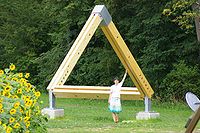
s. There also exist 3-dimensional solid shapes each of which, when viewed from a certain angle, appears the same as the purple, green, and yellow 2-dimensional depiction of the Penrose triangle on this page. The term "Penrose triangle" can refer to the 2-dimensional depiction or the impossible object itself.
M.C. Escher's lithograph Waterfall
Waterfall (M. C. Escher)
Waterfall is a lithography print by the Dutch artist M. C. Escher which was first printed in October, 1961. It shows an apparent paradox where water from the base of a waterfall appears to run downhill before reaching the top of the waterfall....
depicts a watercourse that flows in a zigzag along the long sides of two elongated Penrose triangles, so that it ends up two stories higher than it began. The resulting waterfall, forming the short sides of both triangles, drives a water wheel
Water wheel
A water wheel is a machine for converting the energy of free-flowing or falling water into useful forms of power. A water wheel consists of a large wooden or metal wheel, with a number of blades or buckets arranged on the outside rim forming the driving surface...
. Escher helpfully points out that in order to keep the wheel turning some water must occasionally be added to compensate for evaporation
Evaporation
Evaporation is a type of vaporization of a liquid that occurs only on the surface of a liquid. The other type of vaporization is boiling, which, instead, occurs on the entire mass of the liquid....
.
A 3D model recreating the Penrose triangle with partial inverted cubes (similar to the Hollow-Face illusion
Hollow-Face illusion
The Hollow-Face illusion is an optical illusion in which the perception of a concave mask of a face appears as a normal convex face....
) is available under the Public Domain for everyone to view, download and even print for themselves: Thingiverse - Penrose Triangle Illusion
If a line is traced around the Penrose triangle, a 3-loop Möbius strip
Möbius strip
The Möbius strip or Möbius band is a surface with only one side and only one boundary component. The Möbius strip has the mathematical property of being non-orientable. It can be realized as a ruled surface...
is formed.
Other Penrose polygons
While it is possible to construct analogies to the Penrose triangle with other regular polygons to create a Penrose polygon, the visual effect is not as striking, and as the sides increase, the object seems merely to be warped or twisted.External links
- An article about impossible triangle sculpture in Perth
- Escher for Real constructions
- Three-dimensional model of a Penrose triangle for SketchUp
- Build an impossible triangle
- Impossible sculptures by Francis Tabary
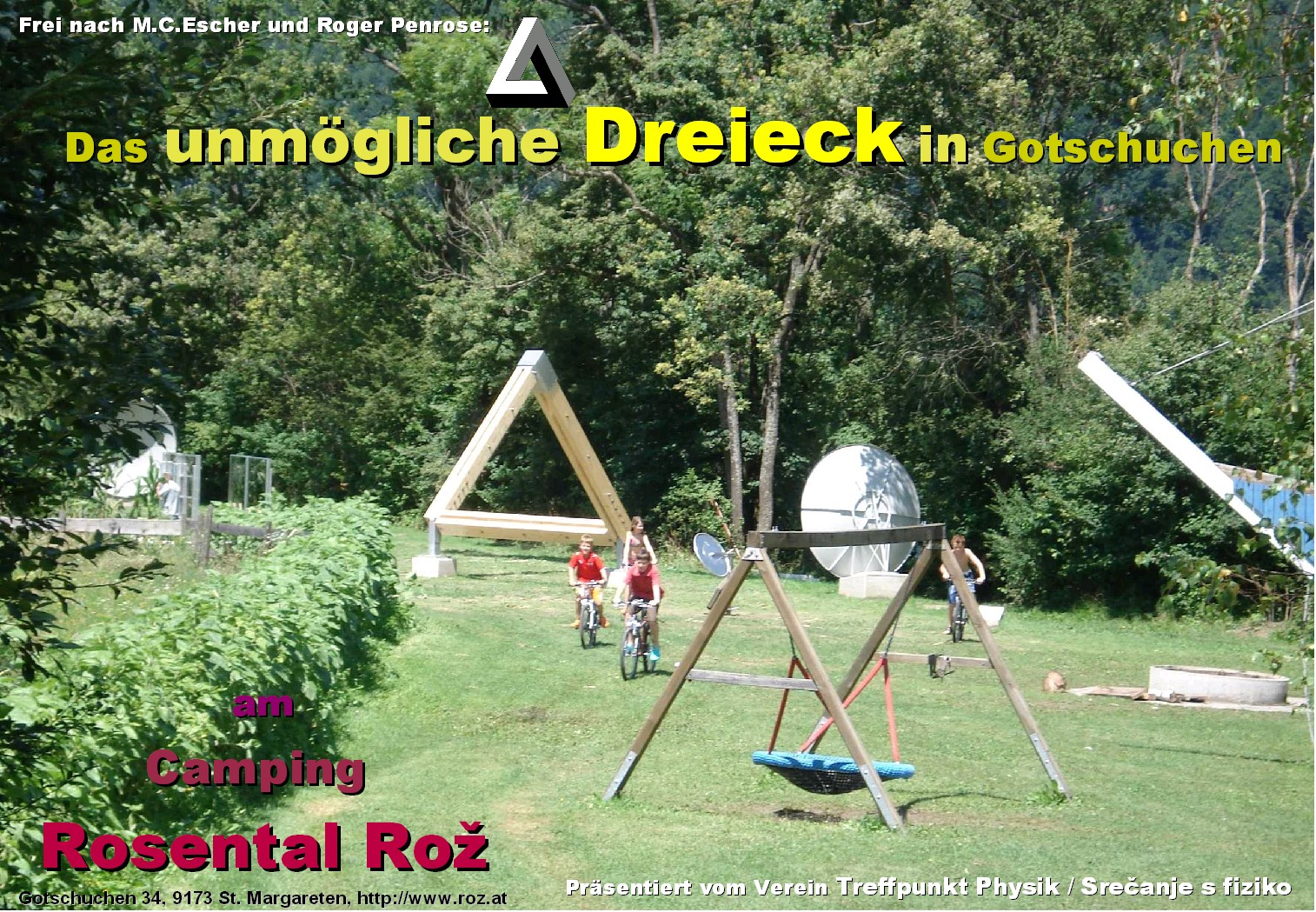
- A large Tribar in Austria/Europe At Camping Rosental Roz in Carinthia/Austria
- 360 Cities - Penrose Triangle An interactive panoramic image of the Penrose Triangle in Perth Western Australia