

Penalty card

Encyclopedia
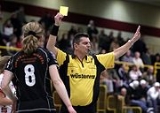
A penalty card is used in many sports as a means of warning, reprimanding or penalising a player, coach or team official. Penalty cards are most commonly used by referee
s or umpires to indicate that a player has committed an offense. The referee will hold the card above his or her head while looking or pointing towards the player that has committed the offense. The colour and/or shape of the card used by the official indicates the type or seriousness of the offence and the level of punishment that is to be applied.
By analogy the term is sometimes used in other areas than sport. For example, the UK Radio Authority speaks of issuing a yellow card to those who break its rules.
. Aston had been appointed to the FIFA
Referees' Committee and was responsible for all referees at the 1966 FIFA World Cup
. In the quarter finals, England met Argentina at Wembley Stadium
. After the match, newspaper reports stated that referee Rudolf Kreitlein
had cautioned both Bobby
and Jack Charlton
, as well as sending off Argentinian Antonio Rattin. The referee had not made his decision clear during the game, and England manager Alf Ramsey
approached FIFA for post-match clarification. This incident started Aston thinking about ways to make a referee's decisions clearer to both players and spectators. Aston realised that a colour coding scheme based on the same principle as used on traffic lights (yellow - caution, red - stop) would traverse language barriers and clarify whether a player had been cautioned or expelled. As a result, yellow cards to indicate a caution and red cards to indicate an expulsion were used for the first time in the 1970 FIFA World Cup
in Mexico. The use of penalty cards has since been adopted and expanded by several sporting codes, with each sport adapting the idea to its specific set of rules or laws.
 A yellow card is used in many different sporting codes. Its meaning differs among sports, however it most commonly indicates a caution given to a player regarding his or her conduct, or indicates a temporary suspension. Examples include:
In most tournaments, the accumulation of a certain number of yellow cards over several matches results in disqualification of the offending player for a certain number of subsequent matches, the exact number of cards and matches varying by jurisdiction.
 A red card is used in several different sporting codes. Its meaning differs among sports, however it most commonly indicates a serious offence and often results in a player being permanently suspended from the game (commonly known as an ejection
, dismissal, expulsion, removal, or sending-off, often with personal embarrassment
). Examples include:
In most tournaments, a single direct red card (i.e. not one received as a result of two successive yellow ones) results in disqualification of the offending player for one or more of subsequent matches, the exact number of matches varying by the offence committed and by jurisdiction. Since the red card is the main punitive instrument against unsportsmanlike behavior, recurrent offenders and team captains are often punished more harshly than others.
 A green card is used in some sports to indicate an official warning to a player who has committed a minor offence that does not warrant a more serious sanction.
to indicate a five minute timed penalty given to a player. The offending player must leave the playing area and wait on a penalty bench near the centre line until the penalty has expired. During the 5 minute period the player may not be replaced, although he or she may be replaced with a different player when the penalty has expired. Offences that can warrant a white card include trying to hinder the opponents from executing a free-stroke, illegal substitution or repeated illegal but non-violent attacks on an opponent.
to indicate a ten minute timed penalty given to a player. The offending player must leave the playing area and wait on a penalty bench near the centre line until the penalty has expired. During the 10 minute period the player may not be replaced, although he or she may be replaced with a different player when the penalty has expired. A blue card is typically shown for offences that are more serious than those warranting a white card including attacking an opponent in a violent or dangerous way, causing advantage by intentionally stopping the ball with a high stick or protesting a referee's decision.
A blue card is also frequently used in indoor soccer in the United States, signifying that the offender must leave the field and stay in a penalty box (usually 2-5 minutes), while his team plays down a man (identical to ice hockey
). If a goal is scored by the team opposite of the offender, then the offender may return to the field immediately. It is also used in the Clericus Cup
association football league for a 5 minute bench penalty for unsportsmanlike play.
and football
. It is issued by the director
, or the referee for severe rule infractions. In football, a black card will result in a permanent ban, or expulsion from the football club. A second instance of a Group 3 offence, and all Group 4 offences including deliberate brutality, refusal to fence, refusal to salute, and refusal to shake hands can be punished with a black card. When the black card is issued, the offending fencer is excluded from the remainder of the competition and may be suspended from further tournaments. In the official record of the tournament, his or her name is replaced with the words "FENCER EXCLUDED".
In the Gaelic Games
of Gaelic football
and hurling
, a black card - also known as a tick or black book - is recorded against a player for a minor infringement not warranting a yellow card. The act of the referee physically holding up his black notebook in the same manner as a card has been discontinued by the GAA
.
Referee
A referee is the person of authority, in a variety of sports, who is responsible for presiding over the game from a neutral point of view and making on the fly decisions that enforce the rules of the sport...
s or umpires to indicate that a player has committed an offense. The referee will hold the card above his or her head while looking or pointing towards the player that has committed the offense. The colour and/or shape of the card used by the official indicates the type or seriousness of the offence and the level of punishment that is to be applied.
By analogy the term is sometimes used in other areas than sport. For example, the UK Radio Authority speaks of issuing a yellow card to those who break its rules.
History and origin
The idea of using language-neutral coloured cards to communicate a referee's intentions originated with British football referee Ken AstonKen Aston
Kenneth George "Ken" Aston, MBE was an English teacher, soldier, and football referee, who was responsible for many important developments in football refereeing.- Early life and career :...
. Aston had been appointed to the FIFA
FIFA
The Fédération Internationale de Football Association , commonly known by the acronym FIFA , is the international governing body of :association football, futsal and beach football. Its headquarters are located in Zurich, Switzerland, and its president is Sepp Blatter, who is in his fourth...
Referees' Committee and was responsible for all referees at the 1966 FIFA World Cup
1966 FIFA World Cup
The 1966 FIFA World Cup, the eighth staging of the World Cup, was held in England from 11 July to 30 July. England beat West Germany 4–2 in the final, winning the World Cup for the first time, so becoming the first host to win the tournament since Italy in 1934.-Host selection:England was chosen as...
. In the quarter finals, England met Argentina at Wembley Stadium
Wembley Stadium
The original Wembley Stadium, officially known as the Empire Stadium, was a football stadium in Wembley, a suburb of north-west London, standing on the site now occupied by the new Wembley Stadium that opened in 2007...
. After the match, newspaper reports stated that referee Rudolf Kreitlein
Rudolf Kreitlein
Rudolf Kreitlein is a former German international football referee from the 1960s.- England v Argentina, 1966 World Cup :...
had cautioned both Bobby
Bobby Charlton
Sir Robert "Bobby" Charlton CBE is an English former professional football player, a member of the England team who won the World Cup and Ballon d'Or for European Footballer of the Year in 1966...
and Jack Charlton
Jack Charlton
John "Jack" Charlton, OBE, DL is a former footballer and manager who played for Leeds United in the 1950s, 1960s and 1970s, and was part of the England team who won the 1966 World Cup...
, as well as sending off Argentinian Antonio Rattin. The referee had not made his decision clear during the game, and England manager Alf Ramsey
Alf Ramsey
Sir Alfred Ernest "Alf" Ramsey was an English footballer and manager of the English national football team from 1963 to 1974. His greatest achievement was winning the 1966 World Cup with England on 30 July 1966...
approached FIFA for post-match clarification. This incident started Aston thinking about ways to make a referee's decisions clearer to both players and spectators. Aston realised that a colour coding scheme based on the same principle as used on traffic lights (yellow - caution, red - stop) would traverse language barriers and clarify whether a player had been cautioned or expelled. As a result, yellow cards to indicate a caution and red cards to indicate an expulsion were used for the first time in the 1970 FIFA World Cup
1970 FIFA World Cup
The 1970 FIFA World Cup, the ninth staging of the World Cup, was held in Mexico, from 31 May to 21 June. The 1970 tournament was the first World Cup hosted in North America, and the first held outside South America and Europe. In a match-up of two-time World Cup champions, the final was won by...
in Mexico. The use of penalty cards has since been adopted and expanded by several sporting codes, with each sport adapting the idea to its specific set of rules or laws.
Yellow card
- Association football: A yellow card is shown by the referee to indicate that a player has been officially cautioned. The player's details are then recorded by the referee in a small notebook; hence a caution is also known as a "booking". A player who has been cautioned may continue playing in the game; however, a player who receives a second caution in a match is sent off (shown the yellow card again, and then a red card (see below)), meaning that he must leave the field immediately and take no further part in the game. The player may not be replaced by a substitute. Law 12 of the Laws of the Game (which are set by the International Football Association BoardInternational Football Association BoardThe International Football Association Board is the body that determines the Laws of the Game of association football.-Operations:...
and used by FIFAFIFAThe Fédération Internationale de Football Association , commonly known by the acronym FIFA , is the international governing body of :association football, futsal and beach football. Its headquarters are located in Zurich, Switzerland, and its president is Sepp Blatter, who is in his fourth...
) lists the types of offences and misconductMisconduct (football)Misconduct in association football is any conduct by a player that is deemed by the referee to warrant a disciplinary sanction in accordance with Law 12 of the Laws of the Game. Misconduct may occur at any time, including when the ball is out of play, during half-time and before and after the...
that may result in a caution. It also states that "only a player, substitute or substituted player" can be cautioned. The seven reasons for a caution are:
- Unsporting behaviour
- Dissent by word or action
- Persistently infringing the laws of the game
- Delaying the restart of play
- Failing to respect the required distance of a corner kick or free kick
- Entering or re-entering the field of play without the referee’s permission
- Deliberately leaving the field of play without the referee’s permission
In most tournaments, the accumulation of a certain number of yellow cards over several matches results in disqualification of the offending player for a certain number of subsequent matches, the exact number of cards and matches varying by jurisdiction.
- BandyBandyBandy is a team winter sport played on ice, in which skaters use sticks to direct a ball into the opposing team's goal.The rules of the game have many similarities to those of association football: the game is played on a rectangle of ice the same size as a football field. Each team has 11 players,...
: A yellow card indicates a warning given to an entire team for technical fouls such as errors in the execution of goal-throws or free strokes, or the obstruction of a player without ball. Subsequent technical fouls by the same team result in a five minute penalty indicated by a white card.
- Canoe poloCanoe poloCanoe Polo is a competitive ball sport played on water, in a defined "field", between two teams of 5 players, each in a kayak...
: A yellow card indicates a player has received two minute temporary suspension. A yellow card can be awarded for a deliberate and/or dangerous foul that prevents the scoring of a near certain goal, dangerous illegal play that is deliberate or repeated, foul or abusive language, continuously disputing a referee's decisions or receiving a third green card for any reason.
- Equestrian sports: Yellow cards may be issued during FEIInternational Federation for Equestrian SportsThe Fédération Équestre Internationale or in English, the International Federation for Equestrian Sports, is the international governing body of equestrian sports. It recognizes ten international disciplines...
sanctioned events for abuse of a horse or incorrect behavior towards an official. Abuse of the horse may include riding an obviously lame horse, riding an exhausted horse, excessive use of whipWhipA whip is a tool traditionally used by humans to exert control over animals or other people, through pain compliance or fear of pain, although in some activities whips can be used without use of pain, such as an additional pressure aid in dressage...
and/or spurSpurA spur is a metal tool designed to be worn in pairs on the heels of riding boots for the purpose of directing a horse to move forward or laterally while riding. It is usually used to refine the riding aids and to back up the natural aids . The spur is used in every equestrian discipline...
s, and dangerous riding. Riders may choose to not accept issued cards, but doing so may lead to a disciplinary hearing. A rider receiving a yellow card can be disqualified from the event and subsequently fined or suspended.
- Fencing: A yellow card indicates a warning to a fencer and is valid for the remainder of the bout. In some cases, an annulment of any hit scored by the fencer at fault may also occur. Yellow cards are awarded for Group 1 offences such as making bodily contact with the opposing fencer (in foilFoil (fencing)A foil is a type of weapon used in fencing. It is the most common weapon in terms of usage in competition, and is usually the choice for elementary classes for fencing in general.- Components:...
or sabreSabre (fencing)The sabre is one of the three weapons of modern sport fencing, and is alternatively spelled saber in American English. The sabre differs from the other modern fencing weapons, the épée and foil, in that it is possible to score with the edge of the blade; for this reason, sabreur movements and...
), leaving the piste without permission, or refusing to obey the referee. A yellow card can also be awarded when, at the first call by the referee, a fencer does not present himself on the piste ready to fence. Any person not on the piste who disturbs the good order of the competition may also receive a yellow card on the first infringement.
- Field hockeyField hockeyField Hockey, or Hockey, is a team sport in which a team of players attempts to score goals by hitting, pushing or flicking a ball into an opposing team's goal using sticks...
: A yellow card indicates a temporary suspension. The length of the suspension is determined by the umpire, but in accordance with International Hockey FederationInternational Hockey FederationThe International Field Hockey Federation is the global governing body of field hockey...
rules is a minimum of 5 minutes playing time. It is possible for a player to receive two yellow cards for different offences during the same match, however the period of suspension must be significantly longer with each yellow card. When an offence for which a yellow card has been awarded is repeated, the yellow card must not be used again and a more severe penalty must be awarded. There must also be a clear difference between the duration of a yellow card suspension for a minor offence and the duration for a major offence. The yellow card can be shown to a specific player or to the captain for misconduct by the entire team. In this case, the captain is temporarily suspended.
- HandballTeam handballHandball is a team sport in which two teams of seven players each pass a ball to throw it into the goal of the other team...
: A yellow card indicates a warning and can be given to a player or team official for unsportsmanlike conduct, or to a player whose actions are mainly or exclusively directed at the opponent and not at the ball. IHFInternational Handball FederationThe International Handball Federation, often referred to by the acronym IHF, is the administrative and controlling body for International team handball.- Championships :*World Men's Handball Championship*World Women's Handball Championship...
rules also allow referees to use discretion to award a yellow card outside of these situations.
- Mixed Martial ArtsMixed martial artsMixed Martial Arts is a full contact combat sport that allows the use of both striking and grappling techniques, both standing and on the ground, including boxing, wrestling, Brazilian jiu-jitsu, muay Thai, kickboxing, karate, judo and other styles. The roots of modern mixed martial arts can be...
promotions PRIDE(defunct), DEEPDEEPDeep is a Japan- based mixed martial arts promoting and sanctioning organization. It is promoted by Shigeru Saeki who is also the former Public Relations Director of Pride Fighting Championships. Deep is considered second-tier Japanese promotion, as a feeder to larger shows like Dream. Their...
, and ZSTZSTZST is a Japan-based promoting and sanctioning organization of mixed martial arts, and it also holds amateur MMA events. ZST adopts unique rules in the MMA industry. Much like RINGS, strikes to head on the ground are prohibited...
: A warning, the third leads to disqualification.
- Racewalking: A yellow card indicates a competitor's foot fails to be on the ground when the rear leg is being raised, or the front leg is not straightened when it makes contact with the ground.
- Rugby leagueRugby leagueRugby league football, usually called rugby league, is a full contact sport played by two teams of thirteen players on a rectangular grass field. One of the two codes of rugby football, it originated in England in 1895 by a split from Rugby Football Union over paying players...
: Yellow cards are not usually used in rugby league in the southern hemisphere with referees indicating a 10 minute suspension by raising both arms straight out with fingers spread (to indicate 10 minutes). This is otherwise known as a 'sin-bin'.
- Rugby unionRugby unionRugby union, often simply referred to as rugby, is a full contact team sport which originated in England in the early 19th century. One of the two codes of rugby football, it is based on running with the ball in hand...
: According to the laws of the game published by the International Rugby BoardInternational Rugby BoardThe International Rugby Board is the governing body for the sport of rugby union. It was founded in 1886 as the International Rugby Football Board by the unions of Scotland, Wales and Ireland. England refused to join until 1890. The International Rugby Football Board changed its name to the...
(IRB), during international matches, any player who commits an offence under Law 10 - Foul Play may be shown a yellow card and suspended from the game for 10 minutes. Offences include obstruction, unfair play, repeated infringements, dangerous play and misconduct which is prejudicial to the game. Receiving a yellow card is known colloquially as being sent to the "sin bin". A player receiving a second yellow card in a game will also be shown a red card (see below) meaning that he or she has been sent-offEjection (sports)In sports, an ejection is one of several disqualifying actions assessed to a player or coach by a game official , usually for unsportsmanlike conduct....
and will be unable to take part in the remainder of the match.
- VolleyballVolleyballVolleyball is a team sport in which two teams of six players are separated by a net. Each team tries to score points by grounding a ball on the other team's court under organized rules.The complete rules are extensive...
: A yellow card can be used in different ways to indicate several penalties. A player or team staff member can be shown a yellow card for the first instance of rude conduct and the referee may also penalise a team for delaying the game by pointing to the wrist using a yellow card. Both offences result in a loss of rally. A yellow card can also be used together with a red card to indicate a participant has been disqualified and can take no further part in the match. In the NCAA, red and yellow cards in the same hand indicate that the player must sit out the rest of that game, while red and yellow cards held apart indicate that the participant is disqualified and must leave the playing and spectator areas.
- Water poloWater poloWater polo is a team water sport. The playing team consists of six field players and one goalkeeper. The winner of the game is the team that scores more goals. Game play involves swimming, treading water , players passing the ball while being defended by opponents, and scoring by throwing into a...
: Given to entire bench as warning for disrespectful conduct from the coach, individual players, or the entire bench. Following the issuance of a yellow card, further incidents will result in a red card and the expulsion of individual players and coaches.
Red card
Ejection (sports)
In sports, an ejection is one of several disqualifying actions assessed to a player or coach by a game official , usually for unsportsmanlike conduct....
, dismissal, expulsion, removal, or sending-off, often with personal embarrassment
Walk of shame
The walk of shame refers to where a person must walk past strangers or peers alone for an embarrassing reason before reaching a place of privacy. Most commonly, it occurs the morning after a night out at a bar, dance club, or party...
). Examples include:
- Association football: A red card is shown by a referee to signify that a player has been sent off. A player who has been sent off is required to leave the field of play immediately and must take no further part in the game. The player who has been sent off cannot be replaced during the game; his or her team must continue the game with one fewer player. Only players, substitutes and substituted players may receive a red card. If a goalkeeper receives a red card, one of his teammates must be substituted out for another goalkeeper. If the team has already used up all its allotted substitutions, an outfield player has to take over in goal. Law 12 of the Laws of the Game lists the categories of misconduct for which a player may be sent off. These are:
- Serious foul play (a violent foul)
- Violent conduct (any other act of violence)
- Spitting at anyone
- A deliberate handling offense to deny an obvious goal-scoring opportunity by any player other than a goalkeeper in his own penalty area
- Committing an offence that denies an opponent an obvious goal-scoring opportunity (informally known as a professional foulProfessional foulIn sports, a professional foul is a deliberate act of foul play, usually to prevent an opponent's scoring.-Association football:The concept gained notoriety in association football after an infamous incident in the 1980 FA Cup Final when Willie Young of Arsenal committed a deliberate foul on Paul...
) - Using offensive, insulting or abusive language or gestures
- Receiving a second caution (yellow card) in one game
In most tournaments, a single direct red card (i.e. not one received as a result of two successive yellow ones) results in disqualification of the offending player for one or more of subsequent matches, the exact number of matches varying by the offence committed and by jurisdiction. Since the red card is the main punitive instrument against unsportsmanlike behavior, recurrent offenders and team captains are often punished more harshly than others.
- BandyBandyBandy is a team winter sport played on ice, in which skaters use sticks to direct a ball into the opposing team's goal.The rules of the game have many similarities to those of association football: the game is played on a rectangle of ice the same size as a football field. Each team has 11 players,...
: A red card indicates a player has been excluded for the remainder of the match and cannot be substituted. Red card offences include directly attacking an opponent or using abusive language. A coach or substitute may also be penalised with a red card. In this situation, a player currently on the rink also serves a ten minute penalty, resulting in the number of players being reduced by one.
- Canoe poloCanoe poloCanoe Polo is a competitive ball sport played on water, in a defined "field", between two teams of 5 players, each in a kayak...
: A red card indicates a player has been sent off for the remainder of the match can cannot be substituted. A red card can be awarded if a personal attack on a player occurs, repeated foul or abusive language, or when the award of a yellow card is disputed or has not had the desired effect of causing the player to control his play or attitude. A red card is also awarded when a player has received a second yellow card for any reason.
- FencingFencingFencing, which is also known as modern fencing to distinguish it from historical fencing, is a family of combat sports using bladed weapons.Fencing is one of four sports which have been featured at every one of the modern Olympic Games...
: A red card is used to indicate that a fencer has committed an offence that warrants a penalty hit to be awarded to the opponent. Second and subsequent Group 1 offences, all Group 2 offences and first Group 3 offences are penalised with a red card. A red card may also be awarded when, at the second call by the referee, a fencer does not present himself on the piste ready to fence.
- Field hockeyField hockeyField Hockey, or Hockey, is a team sport in which a team of players attempts to score goals by hitting, pushing or flicking a ball into an opposing team's goal using sticks...
: A red card results in a player being permanently suspended from the game. The player cannot take any further part in the game and cannot be substituted. Unlike other penalty cards in field hockey, the red card is never given to the captain for team misconduct. In addition to their colour, red cards in field hockey are often circular in shape.
- HandballTeam handballHandball is a team sport in which two teams of seven players each pass a ball to throw it into the goal of the other team...
: A red card indicates a disqualification of a player who has committed an offence such unsportsmanlike conduct, serious foul play or receiving a third two minute suspension. A red card prevents a player from playing in the remainder of the match and as a result reduces the number of players that are available to a team. A red card also carries a two minute suspension for the team, meaning that a team cannot replace the disqualified player until the two minute team suspension has expired.
- Mixed martial arts promotion PRIDE: A red card is issued as punishment and results in a 10% deduction of the guilty fighter's fight purse (only used when fights are conducted under PRIDE's Bushido rules).
- Racewalking: A red card indicates that a competitor's foot failed to be on the ground when the rear leg is being raised, or the front leg is not straightened when it makes contact with the ground. A judge would issue a yellow card for the first infraction committed by a competitor, and if the same judge detects a second infraction from the same infraction a red card is issued. Three red cards, from three different judges, will result in a competitor’s disqualification.
- Rugby leagueRugby leagueRugby league football, usually called rugby league, is a full contact sport played by two teams of thirteen players on a rectangular grass field. One of the two codes of rugby football, it originated in England in 1895 by a split from Rugby Football Union over paying players...
: Although not officially used, in rugby league a referee may send a player off by pointing the offender towards the grandstand. He may not take any further part in the match.
- Rugby unionRugby unionRugby union, often simply referred to as rugby, is a full contact team sport which originated in England in the early 19th century. One of the two codes of rugby football, it is based on running with the ball in hand...
: A red card is used to indicate that a player has been sent off and can take no further part in the game. They cannot not be replaced, leaving their team with one less player for the remainder of the game. During international matches, any player who commits an offence under Law 10 - Foul Play may be shown a red card. Red cards are normally issued for serious offences. Any player receiving a second yellow card in a game will automatically be shown a red card.
- VolleyballVolleyballVolleyball is a team sport in which two teams of six players are separated by a net. Each team tries to score points by grounding a ball on the other team's court under organized rules.The complete rules are extensive...
: A red card is used to indicate the expulsion of a player or team official and can be issued by the referee for the second instance of rude conduct or the first instance of offensive conduct. Expelled players must leave the playing area and remain in the penalty area for the remainder of the set. If an expelled player cannot be legally substituted, his/her team loses the set. A red card shown together with a yellow card indicates a participant has been disqualified and can take no further part in the match. In the NCAA, red and yellow cards in the same hand indicate that the player must sit out the rest of that game, while red and yellow cards held apart indicate that the participant is disqualified and must leave the playing and spectator areas.
- In beach volleyballBeach volleyballBeach volleyball, or sand volleyball, is an Olympic team sport played by two teams of two players on a sand court divided by a net.Like volleyball, the object of the game is to send the ball over the net in order to ground it on the opponent’s court, and to prevent the same effort by the opponent....
, where each team is composed of only two players, red cards can still be issued for offenses similar to that of regular volleyball, but instead of ejecting the offending player, the opposing team is usually awarded service and a penalty point.
- Water poloWater poloWater polo is a team water sport. The playing team consists of six field players and one goalkeeper. The winner of the game is the team that scores more goals. Game play involves swimming, treading water , players passing the ball while being defended by opponents, and scoring by throwing into a...
: A red card is issued to a coach and/or player(s) on the bench for a second incident of misconduct after receiving a yellow card.
Green card
- Canoe poloCanoe poloCanoe Polo is a competitive ball sport played on water, in a defined "field", between two teams of 5 players, each in a kayak...
: A green card indicates an official warning that can be applied to an individual player or a whole team. A green card can be awarded for deliberate unsporting behavior or unnecessary verbal communication to the referee.
- Field hockeyField hockeyField Hockey, or Hockey, is a team sport in which a team of players attempts to score goals by hitting, pushing or flicking a ball into an opposing team's goal using sticks...
: A green card indicates an official warning when a minor offence has occurred. A second green card for the same player will result in a yellow card (5 minute suspension). In this case, the umpire will show a green card, followed by a yellow card. When an offence for which a green card has been awarded is repeated, a yellow card should be awarded. A green card can be given to a specific player or to the captain as a warning to the entire team. Cards shown to the captain as a warning to the team are treated separate from cards shown to the captain as a player. In addition to their colour, green cards in field hockey are often triangular in shape.
White card
A white card is used in bandyBandy
Bandy is a team winter sport played on ice, in which skaters use sticks to direct a ball into the opposing team's goal.The rules of the game have many similarities to those of association football: the game is played on a rectangle of ice the same size as a football field. Each team has 11 players,...
to indicate a five minute timed penalty given to a player. The offending player must leave the playing area and wait on a penalty bench near the centre line until the penalty has expired. During the 5 minute period the player may not be replaced, although he or she may be replaced with a different player when the penalty has expired. Offences that can warrant a white card include trying to hinder the opponents from executing a free-stroke, illegal substitution or repeated illegal but non-violent attacks on an opponent.
Blue card
A blue card is used in bandyBandy
Bandy is a team winter sport played on ice, in which skaters use sticks to direct a ball into the opposing team's goal.The rules of the game have many similarities to those of association football: the game is played on a rectangle of ice the same size as a football field. Each team has 11 players,...
to indicate a ten minute timed penalty given to a player. The offending player must leave the playing area and wait on a penalty bench near the centre line until the penalty has expired. During the 10 minute period the player may not be replaced, although he or she may be replaced with a different player when the penalty has expired. A blue card is typically shown for offences that are more serious than those warranting a white card including attacking an opponent in a violent or dangerous way, causing advantage by intentionally stopping the ball with a high stick or protesting a referee's decision.
A blue card is also frequently used in indoor soccer in the United States, signifying that the offender must leave the field and stay in a penalty box (usually 2-5 minutes), while his team plays down a man (identical to ice hockey
Ice hockey
Ice hockey, often referred to as hockey, is a team sport played on ice, in which skaters use wooden or composite sticks to shoot a hard rubber puck into their opponent's net. The game is played between two teams of six players each. Five members of each team skate up and down the ice trying to take...
). If a goal is scored by the team opposite of the offender, then the offender may return to the field immediately. It is also used in the Clericus Cup
Clericus Cup
The Clericus Cup is an annual association football tournament contested by teams from the Roman Colleges, which are seminaries of the Catholic Church located in Rome. During the fourth season , the tournament involved sixteen schools and fielded players from 65 countries, with the majority coming...
association football league for a 5 minute bench penalty for unsportsmanlike play.
Black card
A black card is used in both fencingFencing
Fencing, which is also known as modern fencing to distinguish it from historical fencing, is a family of combat sports using bladed weapons.Fencing is one of four sports which have been featured at every one of the modern Olympic Games...
and football
Football
Football may refer to one of a number of team sports which all involve, to varying degrees, kicking a ball with the foot to score a goal. The most popular of these sports worldwide is association football, more commonly known as just "football" or "soccer"...
. It is issued by the director
Tournament director
Tournament directors typically perform a number of key functions at competitive sporting and gaming events of all kinds. The extent of the tournament director's duties varies depending on the size of the tournament, the nature of the competition, and the number of other officials to whom roles can...
, or the referee for severe rule infractions. In football, a black card will result in a permanent ban, or expulsion from the football club. A second instance of a Group 3 offence, and all Group 4 offences including deliberate brutality, refusal to fence, refusal to salute, and refusal to shake hands can be punished with a black card. When the black card is issued, the offending fencer is excluded from the remainder of the competition and may be suspended from further tournaments. In the official record of the tournament, his or her name is replaced with the words "FENCER EXCLUDED".
In the Gaelic Games
Gaelic games
Gaelic games are sports played in Ireland under the auspices of the Gaelic Athletic Association. The two main games are Gaelic football and hurling...
of Gaelic football
Gaelic football
Gaelic football , commonly referred to as "football" or "Gaelic", or "Gah" is a form of football played mainly in Ireland...
and hurling
Hurling
Hurling is an outdoor team game of ancient Gaelic origin, administered by the Gaelic Athletic Association, and played with sticks called hurleys and a ball called a sliotar. Hurling is the national game of Ireland. The game has prehistoric origins, has been played for at least 3,000 years, and...
, a black card - also known as a tick or black book - is recorded against a player for a minor infringement not warranting a yellow card. The act of the referee physically holding up his black notebook in the same manner as a card has been discontinued by the GAA
Gaelic Athletic Association
The Gaelic Athletic Association is an amateur Irish and international cultural and sporting organisation focused primarily on promoting Gaelic games, which include the traditional Irish sports of hurling, camogie, Gaelic football, handball and rounders...
.
See also
- Racing instruction flags
- Penalty flagPenalty flagThe penalty flag is a yellow cloth used in several field sports including American football and lacrosse by game officials to identify and sometimes mark the location of penalties or infractions that occur during regular play. It is usually wrapped around a weight, such as sand or beans so it can...
- Shows red card to abuserShows red card to abuserShows red card to abuser is a campaign against domestic violence launched by the Spanish Ministry of Equality on 18 March 2010 that has the support of many famous artists, journalists and athletes...
- Walk of shameWalk of shameThe walk of shame refers to where a person must walk past strangers or peers alone for an embarrassing reason before reaching a place of privacy. Most commonly, it occurs the morning after a night out at a bar, dance club, or party...