
Home      Discussion      Topics      Dictionary      Almanac
Signup       Login
Pegmatite

Pegmatite

Overview

Discussion
Ask a question about 'Pegmatite'
Start a new discussion about 'Pegmatite'
Answer questions from other users
Full Discussion Forum
 
Unanswered Questions
Encyclopedia

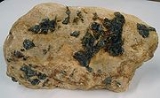
A pegmatite is a very crystalline, intrusive igneous rock
Igneous rock
Igneous rock is one of the three main rock types, the others being sedimentary and metamorphic rock. Igneous rock is formed through the cooling and solidification of magma or lava...

 composed of interlocking crystals usually larger than 2.5 cm in size; such rocks are referred to as pegmatitic.

Most pegmatites are composed of quartz
Quartz
Quartz is the second-most-abundant mineral in the Earth's continental crust, after feldspar. It is made up of a continuous framework of SiO4 silicon–oxygen tetrahedra, with each oxygen being shared between two tetrahedra, giving an overall formula SiO2. There are many different varieties of quartz,...

, feldspar
Feldspar
Feldspars are a group of rock-forming tectosilicate minerals which make up as much as 60% of the Earth's crust....

 and mica
Mica
The mica group of sheet silicate minerals includes several closely related materials having highly perfect basal cleavage. All are monoclinic, with a tendency towards pseudohexagonal crystals, and are similar in chemical composition...

; in essence a granite
Granite
Granite is a common and widely occurring type of intrusive, felsic, igneous rock. Granite usually has a medium- to coarse-grained texture. Occasionally some individual crystals are larger than the groundmass, in which case the texture is known as porphyritic. A granitic rock with a porphyritic...

. Rarer intermediate composition and mafic
Mafic
Mafic is an adjective describing a silicate mineral or rock that is rich in magnesium and iron; the term is a portmanteau of the words "magnesium" and "ferric". Most mafic minerals are dark in color and the relative density is greater than 3. Common rock-forming mafic minerals include olivine,...

 pegmatites containing amphibole, Ca-plagioclase feldspar, pyroxene and other minerals are known, found in recrystallised zones and apophyses associated with large layered intrusions.

Crystal size is the most striking feature of pegmatites, with crystals usually over 5 cm in size. Individual crystals over 10 meters across have been found, and the world's largest crystal was found within a pegmatite.

Similarly, crystal texture and form within pegmatitic rock may be taken to extreme size and perfection. Feldspar within a pegmatite may display exaggerated and perfect twinning, exsolution lamellae, and when affected by hydrous crystallization, macroscale graphic texture is known, with feldspar and quartz intergrown. Perthite
Perthite
Perthite is used to describe an intergrowth of two feldspars: a host grain of potassium-rich alkali feldspar includes exsolved lamellae or irregular intergrowths of sodic alkali feldspar . Typically the host grain is orthoclase or microcline, and the lamellae are albite...

 feldspar within a pegmatite often shows gigantic perthitic texture visible to the naked eye.

Petrology


Crystal growth rates in pegmatite must be incredibly fast to allow gigantic crystals to grow within the confines and pressures of the Earth's crust. For this reason, the consensus on pegmatitic growth mechanisms involves a combination of the following processes;
  • Low rates of nucleation
    Nucleation
    Nucleation is the extremely localized budding of a distinct thermodynamic phase. Some examples of phases that may form by way of nucleation in liquids are gaseous bubbles, crystals or glassy regions. Creation of liquid droplets in saturated vapor is also characterized by nucleation...

     of crystals coupled with high diffusivity
    Diffusion
    Molecular diffusion, often called simply diffusion, is the thermal motion of all particles at temperatures above absolute zero. The rate of this movement is a function of temperature, viscosity of the fluid and the size of the particles...

     to force growth of a few large crystals instead of many smaller crystals
  • High vapor and water pressure, to assist in the enhancement of conditions of diffusivity
  • High concentrations of fluxing elements such as boron
    Boron
    Boron is the chemical element with atomic number 5 and the chemical symbol B. Boron is a metalloid. Because boron is not produced by stellar nucleosynthesis, it is a low-abundance element in both the solar system and the Earth's crust. However, boron is concentrated on Earth by the...

     and lithium
    Lithium
    Lithium is a soft, silver-white metal that belongs to the alkali metal group of chemical elements. It is represented by the symbol Li, and it has the atomic number 3. Under standard conditions it is the lightest metal and the least dense solid element. Like all alkali metals, lithium is highly...

     which lower the temperature of solidification within the magma
    Magma
    Magma is a mixture of molten rock, volatiles and solids that is found beneath the surface of the Earth, and is expected to exist on other terrestrial planets. Besides molten rock, magma may also contain suspended crystals and dissolved gas and sometimes also gas bubbles. Magma often collects in...

     or vapor
  • Low thermal gradients coupled with a high wall rock temperature, explaining the preponderance for pegmatite to occur only within greenschist metamorphic terranes


Despite this consensus on likely chemical, thermal and compositional conditions required to promote pegmatite growth there are three main theories behind pegmatite formation;
Theory name Theory
Metamorphic pegmatite fluids are created by devolatilisation (dewatering) of metamorphic rocks, particularly felsic gneiss, to liberate the right constituents and water, at the right temperature
Magmatic pegmatites tend to occur in the aureoles of granites in most cases, and are usually granitic in character, often closely matching the compositions of nearby granites. Pegmatites thus represent exsolved granitic material which crystallises in the country rocks
Metasomatic
Metasomatism
Metasomatism is the chemical alteration of a rock by hydrothermal and other fluids.Metasomatism can occur via the action of hydrothermal fluids from an igneous or metamorphic source. In the igneous environment, metasomatism creates skarns, greisen, and may affect hornfels in the contact...

pegmatite, in a few cases, could be explained by the action of hot alteration fluids upon a rock mass, with bulk chemical and textural change.


Metasomatism is currently not well favored as a mechanism for pegmatite formation and it is likely that metamorphism and magmatism are both contributors toward the conditions necessary for pegmatite genesis.

Mineralogy


The mineralogy of a pegmatite is in all cases dominated by some form of feldspar, often with mica and usually with quartz, being altogether "granitic" in character. Beyond that, pegmatite may include most minerals associated with granite and granite-associated hydrothermal systems, granite-associated mineralisation styles, for example greisen
Greisen
Greisen is a highly altered granitic rock or pegmatite. Greisen is formed by autogenic alteration of a granite and is a class of endoskarn.Greisens appear as highly altered rocks, partly coarse, crystalline granite, partly vuggy with miarolitic cavities, disseminated halide minerals such as...

s, and somewhat with skarn
Skarn
Skarn is an old Swedish mining term originally used to describe a type of silicate gangue, or waste rock, associated with iron-ore bearing sulfide deposits apparently replacing Archean age limestones in Sweden's Persberg mining district. In modern usage the term "skarn" has been expanded to refer...

 associated mineralisation.

It is however impossible to quantify the mineralogy of pegmatite in simple terms because of their varied mineralogy and difficulty in estimating the modal abundance of mineral species which are of only a trace amount. This is because of the difficulty in counting and sampling mineral grains in a rock which may have crystals from centimeters to meters across.

Garnet, commonly almandine
Almandine
Almandine , also known incorrectly as almandite, is a species of mineral belonging to the garnet Group. The name is a corruption of alabandicus, which is the name applied by Pliny the Elder to a stone found or worked at Alabanda, a town in Caria in Asia Minor. Almandine is an iron alumina garnet,...

 or spessartine
Spessartine
Spessartine previously named spessartite, is a nesosilicate, manganese aluminium garnet species, Mn3Al23.The name is a derivative of Spessart in Bavaria, Germany, the type locality of the mineral. It occurs most often in granite pegmatite and allied rock types and in certain low grade metamorphic...

, is a common mineral within pegmatites intruding mafic and carbonate-bearing sequences. Pegmatites associated with granitic domes within the Archaean Yilgarn Craton
Yilgarn craton
The Yilgarn Craton is a large craton which constitutes the bulk of the Western Australian land mass. It is bounded by a mixture of sedimentary basins and Proterozoic fold and thrust belts...

 intruding ultramafic and mafic rocks contain red, orange and brown almandine garnet.

Tantalum and niobium minerals (columbite
Columbite
Columbite, also called niobite, niobite-tantalite and columbate [2O6], is a black mineral group that is an ore of niobium and tantalum. It has a submetallic luster and a high density and is a niobate of iron and manganese, containing tantalate of iron. This mineral group was first found in Haddam,...

, tantalite
Tantalite
Tantalite, [2O6], is a mineral group that is close to columbite. The two are often grouped together as a semi-singular mineral called coltan or "columbite-tantalite" in many mineral guides. However, tantalite has a much greater specific gravity than columbite...

, niobite) are found in association with spodumene
Spodumene
Spodumene is a pyroxene mineral consisting of lithium aluminium inosilicate, LiAl2, and is a source of lithium. It occurs as colorless to yellowish, purplish, or lilac kunzite , yellowish-green or emerald-green hiddenite, prismatic crystals, often of great size...

, lepidolite
Lepidolite
Lepidolite Lepidolite Lepidolite (KLi2Al(Al,Si)3O10(F,OH)2 is a lilac-gray or rose-colored phyllosilicate mineral of the mica group that is a secondary source of lithium. It is associated with other lithium-bearing minerals like spodumene in pegmatite bodies. It is one of the major sources of the...

, tourmaline
Tourmaline
Tourmaline is a crystal boron silicate mineral compounded with elements such as aluminium, iron, magnesium, sodium, lithium, or potassium. Tourmaline is classified as a semi-precious stone and the gem comes in a wide variety of colors...

, cassiterite
Cassiterite
Cassiterite is a tin oxide mineral, SnO2. It is generally opaque, but it is translucent in thin crystals. Its luster and multiple crystal faces produce a desirable gem...

 in the massive Greenbushes Pegmatite in the Yilgarn Craton of Western Australia, considered a typical metamorphic pegmatite unassociated with granite.

Geochemistry


Pegmatite is difficult to sample representatively due to the large size of the constituent mineral crystals. Often, bulk samples of some 50–60 kg of rock must be crushed to obtain a meaningful and repeatable result. Hence, pegmatite is often characterised by sampling the individual minerals which comprise the pegmatite, and comparisons are made according to mineral chemistry.

Geochemically, pegmatites typically have major element compositions approximating "granite
Granite
Granite is a common and widely occurring type of intrusive, felsic, igneous rock. Granite usually has a medium- to coarse-grained texture. Occasionally some individual crystals are larger than the groundmass, in which case the texture is known as porphyritic. A granitic rock with a porphyritic...

", however, when found in association with granitic plutons it is likely that a pegmatite dike will have a different trace element composition with greater enrichment in large-ion lithophile (incompatible) elements, boron, beryllium, aluminium, potassium and lithium, uranium, thorium, cesium, et cetera.

Occasionally, enrichment in the unusual trace elements will result in crystallisation of equally unusual and rare minerals such as beryl
Beryl
The mineral beryl is a beryllium aluminium cyclosilicate with the chemical formula Be3Al26. The hexagonal crystals of beryl may be very small or range to several meters in size. Terminated crystals are relatively rare...

, tourmaline
Tourmaline
Tourmaline is a crystal boron silicate mineral compounded with elements such as aluminium, iron, magnesium, sodium, lithium, or potassium. Tourmaline is classified as a semi-precious stone and the gem comes in a wide variety of colors...

, columbite
Columbite
Columbite, also called niobite, niobite-tantalite and columbate [2O6], is a black mineral group that is an ore of niobium and tantalum. It has a submetallic luster and a high density and is a niobate of iron and manganese, containing tantalate of iron. This mineral group was first found in Haddam,...

, tantalite
Tantalite
Tantalite, [2O6], is a mineral group that is close to columbite. The two are often grouped together as a semi-singular mineral called coltan or "columbite-tantalite" in many mineral guides. However, tantalite has a much greater specific gravity than columbite...

, zinnwaldite
Zinnwaldite
Zinnwaldite, KLiFeAlO102, is a potassium lithium iron aluminium silicate hydroxide fluoride silicate mineral in the mica group. IMA status: a series, not a mineral.-Name and discovery:...

 and so forth. In most cases, there is no particular genetic significance to the presence of rare mineralogy within a pegmatite, however it is possible to see some causative and genetic links between, say, tourmaline-bearing granite dikes and tourmaline-bearing pegmatites within the area of influence of a composite granite intrusion (Mount Isa Inlier, Queensland, Australia).

Economic importance


Pegmatites are important because they often contain rare earth
Rare earth element
As defined by IUPAC, rare earth elements or rare earth metals are a set of seventeen chemical elements in the periodic table, specifically the fifteen lanthanides plus scandium and yttrium...

 minerals and gemstone
Gemstone
A gemstone or gem is a piece of mineral, which, in cut and polished form, is used to make jewelry or other adornments...

s, such as aquamarine, tourmaline
Tourmaline
Tourmaline is a crystal boron silicate mineral compounded with elements such as aluminium, iron, magnesium, sodium, lithium, or potassium. Tourmaline is classified as a semi-precious stone and the gem comes in a wide variety of colors...

, topaz
Topaz
Topaz is a silicate mineral of aluminium and fluorine with the chemical formula Al2SiO42. Topaz crystallizes in the orthorhombic system and its crystals are mostly prismatic terminated by pyramidal and other faces.-Color and varieties:...

, fluorite
Fluorite
Fluorite is a halide mineral composed of calcium fluoride, CaF2. It is an isometric mineral with a cubic habit, though octahedral and more complex isometric forms are not uncommon...

, apatite
Apatite
Apatite is a group of phosphate minerals, usually referring to hydroxylapatite, fluorapatite, chlorapatite and bromapatite, named for high concentrations of OH−, F−, Cl− or Br− ions, respectively, in the crystal...

 and corundum
Corundum
Corundum is a crystalline form of aluminium oxide with traces of iron, titanium and chromium. It is a rock-forming mineral. It is one of the naturally clear transparent materials, but can have different colors when impurities are present. Transparent specimens are used as gems, called ruby if red...

, often along with tin
Tin
Tin is a chemical element with the symbol Sn and atomic number 50. It is a main group metal in group 14 of the periodic table. Tin shows chemical similarity to both neighboring group 14 elements, germanium and lead and has two possible oxidation states, +2 and the slightly more stable +4...

 and tungsten
Tungsten
Tungsten , also known as wolfram , is a chemical element with the chemical symbol W and atomic number 74.A hard, rare metal under standard conditions when uncombined, tungsten is found naturally on Earth only in chemical compounds. It was identified as a new element in 1781, and first isolated as...

 minerals, among others.
For example, beautiful crystals of aquamarines and topaz
Topaz
Topaz is a silicate mineral of aluminium and fluorine with the chemical formula Al2SiO42. Topaz crystallizes in the orthorhombic system and its crystals are mostly prismatic terminated by pyramidal and other faces.-Color and varieties:...

 can be found in pegmatites in the mountains of Colorado
Colorado
Colorado is a U.S. state that encompasses much of the Rocky Mountains as well as the northeastern portion of the Colorado Plateau and the western edge of the Great Plains...

 and Idaho
Idaho
Idaho is a state in the Rocky Mountain area of the United States. The state's largest city and capital is Boise. Residents are called "Idahoans". Idaho was admitted to the Union on July 3, 1890, as the 43rd state....

.

Pegmatites are the primary source of lithium
Lithium
Lithium is a soft, silver-white metal that belongs to the alkali metal group of chemical elements. It is represented by the symbol Li, and it has the atomic number 3. Under standard conditions it is the lightest metal and the least dense solid element. Like all alkali metals, lithium is highly...

 either as spodumene, lithiophyllite or usually from lepidolite (Li-mica). The only used source for caesium is also a mineral from a zoned pegmatite, pollucite
Pollucite
Pollucite is a zeolite mineral with the formula 2Al2Si4O12·2H2O with iron, calcium, rubidium and potassium as common substituting elements. It is important as a significant ore of caesium and sometimes rubidium. It forms a solid solution series with analcime. It crystallizes in the isometric -...

. The majority of the world's beryllium is sourced from non-gem quality beryl within pegmatite. Tantalum, niobium, rare-earth elements are sourced from a few pegmatites worldwide, notably the Greenbushes Pegmatite. Bismuth, molybdenum and tin have been won from pegmatite, but this is not yet an important source of these metals.

Nomenclature


Pegmatites can be classified according to the elements or mineral of interest, for instance "lithian pegmatite" to describe a Li-bearing or Li-mineral bearing pegmatite, or "boron pegmatite" for those containing tourmaline.

There is often no meaningful way to distinguish pegmatites according to chemistry due to the difficulty of obtaining a representative sample, but often groups of pegmatites can be distinguished on contact textures, orientation, accessory minerals and timing. These may be named formally or informally as a class of intrusive rock or within a larger igneous association.

While difficult to be certain of derivation of pegmatite in the strictest sense, often pegmatites are referred to as "metamorphic", "granitic" or "metasomatic", based on the interpretations of the investigating geologist.

Occurrence


Worldwide, notable pegmatite occurrences are within the major craton
Craton
A craton is an old and stable part of the continental lithosphere. Having often survived cycles of merging and rifting of continents, cratons are generally found in the interiors of tectonic plates. They are characteristically composed of ancient crystalline basement rock, which may be covered by...

s, and within greenschist-facies metamorphic belts. However, pegmatite localities are only well recorded when economic mineralisation is found.

Within the metamorphic belts, pegmatite tends to concentrate around granitic bodies within zones of low mean strain and within zones of extension, for example within the strain shadow of a large rigid granite body. Similarly, pegmatite is often found within the contact zone of granite, transitional with some greisen
Greisen
Greisen is a highly altered granitic rock or pegmatite. Greisen is formed by autogenic alteration of a granite and is a class of endoskarn.Greisens appear as highly altered rocks, partly coarse, crystalline granite, partly vuggy with miarolitic cavities, disseminated halide minerals such as...

s, as a late-stage magmatic-hydrothermal effect of syn-metamorphic granitic magmatism. Some skarn
Skarn
Skarn is an old Swedish mining term originally used to describe a type of silicate gangue, or waste rock, associated with iron-ore bearing sulfide deposits apparently replacing Archean age limestones in Sweden's Persberg mining district. In modern usage the term "skarn" has been expanded to refer...

s associated with granites also tend to host pegmatites.

Aplite
Aplite
Aplite in petrology, the name given to intrusive rock in which quartz and feldspar are the dominant minerals. Aplites are usually very fine-grained, white, grey or pinkish, and their constituents are visible only with the help of a magnifying lens...

 and porphyry
Porphyry (geology)
Porphyry is a variety of igneous rock consisting of large-grained crystals, such as feldspar or quartz, dispersed in a fine-grained feldspathic matrix or groundmass. The larger crystals are called phenocrysts...

 dikes
Dike (geology)
A dike or dyke in geology is a type of sheet intrusion referring to any geologic body that cuts discordantly across* planar wall rock structures, such as bedding or foliation...

 and veins
Vein (geology)
In geology, a vein is a distinct sheetlike body of crystallized minerals within a rock. Veins form when mineral constituents carried by an aqueous solution within the rock mass are deposited through precipitation...

may intrude pegmatites and wall rocks adjacent to intrusions, creating a confused sequence of felsic intrusive apophyses (thin branches or offshoots of igneous bodies) within the aureole of some granites.

Further reading

  • London, D. (2008): Pegmatites. Canadian Mineralogist Special Publication 10, 347 pp.
  • Tan, Li-ping, 1966, Major Pegmatite Deposits of New York State, New York State Museum Bulletin No. 408