

Paw

Encyclopedia

Mammal
Mammals are members of a class of air-breathing vertebrate animals characterised by the possession of endothermy, hair, three middle ear bones, and mammary glands functional in mothers with young...
, generally a quadruped
Quadruped
Quadrupedalism is a form of land animal locomotion using four limbs or legs. An animal or machine that usually moves in a quadrupedal manner is known as a quadruped, meaning "four feet"...
, that has claw
Claw
A claw is a curved, pointed appendage, found at the end of a toe or finger in most mammals, birds, and some reptiles. However, the word "claw" is also often used in reference to an invertebrate. Somewhat similar fine hooked structures are found in arthropods such as beetles and spiders, at the end...
s or nails. A hard foot is called a hoof
Hoof
A hoof , plural hooves or hoofs , is the tip of a toe of an ungulate mammal, strengthened by a thick horny covering. The hoof consists of a hard or rubbery sole, and a hard wall formed by a thick nail rolled around the tip of the toe. The weight of the animal is normally borne by both the sole...
. Paws are used to pad feet for walking and increase friction
Friction
Friction is the force resisting the relative motion of solid surfaces, fluid layers, and/or material elements sliding against each other. There are several types of friction:...
.
Common characteristics
The paw is characterised by thin, pigmentPigment
A pigment is a material that changes the color of reflected or transmitted light as the result of wavelength-selective absorption. This physical process differs from fluorescence, phosphorescence, and other forms of luminescence, in which a material emits light.Many materials selectively absorb...
ed, keratin
Keratin
Keratin refers to a family of fibrous structural proteins. Keratin is the key of structural material making up the outer layer of human skin. It is also the key structural component of hair and nails...
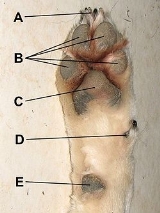
ised, hairless epidermis covering subcutaneous, collagenous, and adipose tissue, which make up the pads. These pads act as a cushion for the load-bearing limbs of the animal. The paw consists of the large, heart-shaped metacarpal pad (forelimb) or metatarsal pad (rear limb), and generally four load-bearing digital
Toe
Toes are the digits of the foot of a tetrapod. Animal species such as cats that walk on their toes are described as being digitigrade. Humans, and other animals that walk on the soles of their feet, are described as being plantigrade; unguligrade animals are those that walk on hooves at the tips of...
pads, although there can be five or six toes in the case of bear
Bear
Bears are mammals of the family Ursidae. Bears are classified as caniforms, or doglike carnivorans, with the pinnipeds being their closest living relatives. Although there are only eight living species of bear, they are widespread, appearing in a wide variety of habitats throughout the Northern...
s and the Giant Panda
Giant Panda
The giant panda, or panda is a bear native to central-western and south western China. It is easily recognized by its large, distinctive black patches around the eyes, over the ears, and across its round body. Though it belongs to the order Carnivora, the panda's diet is 99% bamboo...
. A carpal pad is also found on the forelimb which is used for additional traction
Traction
- Engineering :*Forces:** Traction , adhesive friction or force in the context of vehicle** Traction vector, in mechanics, the force per unit area on a surface, including normal and shear components...
when stopping or descending a slope in digitigrade
Digitigrade
A digitigrade is an animal that stands or walks on its digits, or toes. Digitigrades include walking birds , cats, dogs, and many other mammals, but not plantigrades or unguligrades...
species. Additional dewclaw
Dewclaw
A dewclaw is a vestigial digit on the foot of many mammals, birds, and reptiles . It commonly grows high on the leg so that in digitigrade species, when the animal is standing, it does not make contact with the ground...
s can also be present.
The paw also includes a horny, beak shaped claw
Claw
A claw is a curved, pointed appendage, found at the end of a toe or finger in most mammals, birds, and some reptiles. However, the word "claw" is also often used in reference to an invertebrate. Somewhat similar fine hooked structures are found in arthropods such as beetles and spiders, at the end...
on each digit
Toe
Toes are the digits of the foot of a tetrapod. Animal species such as cats that walk on their toes are described as being digitigrade. Humans, and other animals that walk on the soles of their feet, are described as being plantigrade; unguligrade animals are those that walk on hooves at the tips of...
. Though usually hairless, certain animals do have fur on the soles of their paws. An example is the Red Panda
Red Panda
The red panda , is a small arboreal mammal native to the eastern Himalayas and southwestern China. It is the only species of the genus Ailurus. Slightly larger than a domestic cat, it has reddish-brown fur, a long, shaggy tail, and a waddling gait due to its shorter front legs...
, whose furry soles help insulate them in their snowy habitat.
Animals with paws
- Members of the CanidaeCanidaeCanidae is the biological family of carnivorous and omnivorous mammals that includes wolves, foxes, jackals, coyotes, and domestic dogs. A member of this family is called a canid . The Canidae family is divided into two tribes: Canini and Vulpini...
family, such as dogDogThe domestic dog is a domesticated form of the gray wolf, a member of the Canidae family of the order Carnivora. The term is used for both feral and pet varieties. The dog may have been the first animal to be domesticated, and has been the most widely kept working, hunting, and companion animal in...
s and foxFoxFox is a common name for many species of omnivorous mammals belonging to the Canidae family. Foxes are small to medium-sized canids , characterized by possessing a long narrow snout, and a bushy tail .Members of about 37 species are referred to as foxes, of which only 12 species actually belong to...
es - FelinesFelidaeFelidae is the biological family of the cats; a member of this family is called a felid. Felids are the strictest carnivores of the thirteen terrestrial families in the order Carnivora, although the three families of marine mammals comprising the superfamily pinnipedia are as carnivorous as the...
, such as catCatThe cat , also known as the domestic cat or housecat to distinguish it from other felids and felines, is a small, usually furry, domesticated, carnivorous mammal that is valued by humans for its companionship and for its ability to hunt vermin and household pests...
s and tigerTigerThe tiger is the largest cat species, reaching a total body length of up to and weighing up to . Their most recognizable feature is a pattern of dark vertical stripes on reddish-orange fur with lighter underparts...
s; some of these animals may have toe tuftToe tuftToe tufts are commonly found on cats with medium to long coats. Clumps of fur that stick out at least 1-2cm beyond the paw pad can be considered tufts. In addition to soft paw pads, toe tufts help a cat to silently stalk its prey by muffling excess noise. However, outdoor cats tend to lose their...
s - BearBearBears are mammals of the family Ursidae. Bears are classified as caniforms, or doglike carnivorans, with the pinnipeds being their closest living relatives. Although there are only eight living species of bear, they are widespread, appearing in a wide variety of habitats throughout the Northern...
s and RaccoonRaccoonProcyon is a genus of nocturnal mammals, comprising three species commonly known as raccoons, in the family Procyonidae. The most familiar species, the common raccoon , is often known simply as "the" raccoon, as the two other raccoon species in the genus are native only to the tropics and are...
s - WeaselWeaselWeasels are mammals forming the genus Mustela of the Mustelidae family. They are small, active predators, long and slender with short legs....
s and other mustelids - RodentRodentRodentia is an order of mammals also known as rodents, characterised by two continuously growing incisors in the upper and lower jaws which must be kept short by gnawing....
s