

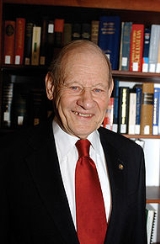
Paul Kurtz

Encyclopedia
Paul Kurtz is a prominent American skeptic
and secular humanist
. He has been called "the father of secular humanism." He is Professor Emeritus of Philosophy at the State University of New York at Buffalo, having previously also taught at Vassar, Trinity, and Union colleges, and the New School for Social Research.
Kurtz has published of over 800 articles or reviews and has authored and edited over 50 books. Many of his books have been translated into over 60 languages. They include "The Transcendental Temptation," "Forbidden Fruit: The Ethics of Secularism," "The Courage to Become," and "Multi-Secularism: A New Agenda." His published bibliography of writings from 1952 to 2003 runs over 79 pages.
Kurtz founded the publishing house Prometheus Books in 1969. He is also the founder and past chairman of the Committee for Skeptical Inquiry (formerly the Committee for the Scientific Investigation of Claims of the Paranormal (CSICOP)), the Council for Secular Humanism
, and the Center for Inquiry
. On May 18, 2010, he resigned from all these positions. Moreover, the Center for Inquiry accepted his resignation as chairman emeritus and board member, the culmination of a years-long "leadership transition," thanking him "for his decades of service" while alluding to "concerns about Dr. Kurtz’s day-to-day management of the organization."
At the Council of Secular Humanism's Los Angeles conference (7–10 October 2010), tension over the future of humanism was on display as Kurtz urged a more accommodationist approach to religion while his successors argued for a more adversarial approach.
He was editor in chief of Free Inquiry
magazine, a publication of the Council for Secular Humanism. He was co-president of the International Humanist and Ethical Union
(IHEU). He is a Fellow of the American Association for the Advancement of Science
, and Humanist Laureate and president of the International Academy of Humanism
. As a member of the American Humanist Association
, he contributed to the writing of Humanist Manifesto II
. Former editor of The Humanist, 1967-78. The asteroid
(6629) Kurtz was named in his honor.
from New York University
, and the Master's degree
and Doctor of Philosophy
degree from Columbia University
. Kurtz was left-wing
in his youth, but has said that serving in the United States Army
in World War II
taught him the dangers of ideology. He saw the Buchenwald and Dachau concentration camps
after they were liberated, and became disillusioned with Communism
when he encountered Russian slave laborers who had been taken to Nazi Germany
by force but refused to return to the Soviet Union
at the end of the war.
," which had received wide publicity through fundamentalist Christians in the 1980s, humanism was more widely perceived as a religion (or a pseudoreligion
) that did not include the supernatural. This can be seen in the first article of the original Humanist Manifesto
which refers to "Religious Humanists" and by Charles and Clara Potter's influential 1930 book Humanism: A New Religion.
Kurtz used the publicity generated by fundamentalist preachers to grow the membership of the Council for Secular Humanism
, as well as strip the religious aspects found in the earlier humanist movement. He founded the Center for Inquiry in 1991. There are now some 40 Centers and Communities worldwide, including in Los Angeles, Washington, New York City, London, Amsterdam, Warsaw, Moscow, Beijing, Hyderabad, Toronto, Dakar, Buenos Aires and Kathmandu.
In 1999 Kurtz was given the International Humanist Award by the IHEU.
Kurtz believes that the nonreligious members of the community should take a positive view on life. Religious skepticism
, according to Paul Kurtz, is only one aspect of the secular humanistic outlook.
On 18 May 2010 the Boards of Directors of the Council for Secular Humanism, its supporting organization, the Center for Inquiry, and another supported organization, the Committee for Skeptical Inquiry, issued a statement announcing that it accepted Dr. Kurtz's resignation as chairman emeritus, as a member of each board, and as editor in chief of Free Inquiry
.
that do not rely on belief in the transcendent or supernatural. A eupraxsophy is a nonreligious
lifestance or worldview emphasizing the importance of living an ethical and exuberant life, and relying on rational
methods such as logic
, observation
and science
(rather than faith
, mysticism
or revelation
) toward that end. The word is based on the Greek words for "good", "practice", and "wisdom." Eupraxsophies, like religions, are cosmic in their outlook, but eschew the supernatural component of religion, avoiding the "transcendental temptation," as Kurtz puts it. Although critical of supernatural religion, he has attempted to develop affirmative ethical values of naturalistic humanism. Kurtz's Eupraxophy, then, is a practical analysis of morality that has much in common (if it is not identical to) the philosophy behind the Science of morality
.
. In 1976 CSICOP started Skeptical Inquirer
, its official journal. Like Martin Gardner
, Carl Sagan
, Isaac Asimov
, James Randi
and others, Kurtz has popularized scientific skepticism
and critical thinking
about claims of the paranormal. Kurtz wrote:
In The Transcendental Temptation, Kurtz analyzes how provable are the claims of Jesus
, Moses
, Muhammad
as well as the founders of religions on American soil such as Joseph Smith and Ellen White. He also evaluates the antics of the most famous modern psychic
s and what he believes are the fruitless researches of parapsychologists
. The Transcendental Temptation is considered among Kurtz's most influential writings.
On 19 April 2007 Kurtz appeared on Penn & Teller
's television show Bullshit!
arguing that exorcism
and Satanic cult
s are "hype and paranoia".
Scientific skepticism
Scientific skepticism is the practice of questioning the veracity of claims lacking empirical evidence or reproducibility, as part of a methodological norm pursuing "the extension of certified knowledge". For example, Robert K...
and secular humanist
Secular humanism
Secular Humanism, alternatively known as Humanism , is a secular philosophy that embraces human reason, ethics, justice, and the search for human fulfillment...
. He has been called "the father of secular humanism." He is Professor Emeritus of Philosophy at the State University of New York at Buffalo, having previously also taught at Vassar, Trinity, and Union colleges, and the New School for Social Research.
Kurtz has published of over 800 articles or reviews and has authored and edited over 50 books. Many of his books have been translated into over 60 languages. They include "The Transcendental Temptation," "Forbidden Fruit: The Ethics of Secularism," "The Courage to Become," and "Multi-Secularism: A New Agenda." His published bibliography of writings from 1952 to 2003 runs over 79 pages.
Kurtz founded the publishing house Prometheus Books in 1969. He is also the founder and past chairman of the Committee for Skeptical Inquiry (formerly the Committee for the Scientific Investigation of Claims of the Paranormal (CSICOP)), the Council for Secular Humanism
Council for Secular Humanism
The Council for Secular Humanism is a secular humanist organization headquartered in Amherst, New York. In 1980 CODESH issued A Secular Humanist Declaration, an argument for and statement of belief in Democratic Secular Humanism...
, and the Center for Inquiry
Center for Inquiry
The Center for Inquiry is a non-profit educational organization with headquarters in the United States whose primary mission is to encourage evidence-based inquiry into paranormal and fringe science claims, alternative medicine and mental health practices, religion, secular ethics, and society...
. On May 18, 2010, he resigned from all these positions. Moreover, the Center for Inquiry accepted his resignation as chairman emeritus and board member, the culmination of a years-long "leadership transition," thanking him "for his decades of service" while alluding to "concerns about Dr. Kurtz’s day-to-day management of the organization."
At the Council of Secular Humanism's Los Angeles conference (7–10 October 2010), tension over the future of humanism was on display as Kurtz urged a more accommodationist approach to religion while his successors argued for a more adversarial approach.
He was editor in chief of Free Inquiry
Free Inquiry
Free Inquiry is a bi-monthly journal of secular humanist opinion and commentary published by the Council for Secular Humanism, which is part of the Center for Inquiry. Philosopher Paul Kurtz is the editor-in-chief and Thomas W. Flynn the editor. Feature articles cover a wide range of topics from a...
magazine, a publication of the Council for Secular Humanism. He was co-president of the International Humanist and Ethical Union
International Humanist and Ethical Union
The International Humanist and Ethical Union is an umbrella organisation embracing humanist, atheist, rationalist, secular, skeptic, freethought and Ethical Culture organisations worldwide. Founded in Amsterdam in 1952, the IHEU is a democratic union of more than 100 member organizations in 40...
(IHEU). He is a Fellow of the American Association for the Advancement of Science
American Association for the Advancement of Science
The American Association for the Advancement of Science is an international non-profit organization with the stated goals of promoting cooperation among scientists, defending scientific freedom, encouraging scientific responsibility, and supporting scientific education and science outreach for the...
, and Humanist Laureate and president of the International Academy of Humanism
International Academy of Humanism
The International Academy of Humanism is a programme of the Council for Secular Humanism. It was established to recognize great humanists and disseminate humanist thinking. According to its declared mission, members of the academy are devoted to free inquiry, are committed to a scientific outlook,...
. As a member of the American Humanist Association
American Humanist Association
The American Humanist Association is an educational organization in the United States that advances Humanism. "Humanism is a progressive philosophy of life that, without theism and other supernatural beliefs, affirms our ability and responsibility to lead ethical lives of personal fulfillment that...
, he contributed to the writing of Humanist Manifesto II
Humanist Manifesto II
The second Humanist Manifesto was written in 1973 by Paul Kurtz and Edwin H. Wilson, and was intended to update the previous one. It begins with a statement that the excesses of Nazism and world war had made the first seem "far too optimistic", and indicated a more hardheaded and realistic...
. Former editor of The Humanist, 1967-78. The asteroid
Asteroid
Asteroids are a class of small Solar System bodies in orbit around the Sun. They have also been called planetoids, especially the larger ones...
(6629) Kurtz was named in his honor.
Early years
Kurtz received his bachelor's degreeBachelor's degree
A bachelor's degree is usually an academic degree awarded for an undergraduate course or major that generally lasts for three or four years, but can range anywhere from two to six years depending on the region of the world...
from New York University
New York University
New York University is a private, nonsectarian research university based in New York City. NYU's main campus is situated in the Greenwich Village section of Manhattan...
, and the Master's degree
Master's degree
A master's is an academic degree granted to individuals who have undergone study demonstrating a mastery or high-order overview of a specific field of study or area of professional practice...
and Doctor of Philosophy
Doctor of Philosophy
Doctor of Philosophy, abbreviated as Ph.D., PhD, D.Phil., or DPhil , in English-speaking countries, is a postgraduate academic degree awarded by universities...
degree from Columbia University
Columbia University
Columbia University in the City of New York is a private, Ivy League university in Manhattan, New York City. Columbia is the oldest institution of higher learning in the state of New York, the fifth oldest in the United States, and one of the country's nine Colonial Colleges founded before the...
. Kurtz was left-wing
Left-wing politics
In politics, Left, left-wing and leftist generally refer to support for social change to create a more egalitarian society...
in his youth, but has said that serving in the United States Army
United States Army
The United States Army is the main branch of the United States Armed Forces responsible for land-based military operations. It is the largest and oldest established branch of the U.S. military, and is one of seven U.S. uniformed services...
in World War II
World War II
World War II, or the Second World War , was a global conflict lasting from 1939 to 1945, involving most of the world's nations—including all of the great powers—eventually forming two opposing military alliances: the Allies and the Axis...
taught him the dangers of ideology. He saw the Buchenwald and Dachau concentration camps
Nazi concentration camps
Nazi Germany maintained concentration camps throughout the territories it controlled. The first Nazi concentration camps set up in Germany were greatly expanded after the Reichstag fire of 1933, and were intended to hold political prisoners and opponents of the regime...
after they were liberated, and became disillusioned with Communism
Communism
Communism is a social, political and economic ideology that aims at the establishment of a classless, moneyless, revolutionary and stateless socialist society structured upon common ownership of the means of production...
when he encountered Russian slave laborers who had been taken to Nazi Germany
Nazi Germany
Nazi Germany , also known as the Third Reich , but officially called German Reich from 1933 to 1943 and Greater German Reich from 26 June 1943 onward, is the name commonly used to refer to the state of Germany from 1933 to 1945, when it was a totalitarian dictatorship ruled by...
by force but refused to return to the Soviet Union
Soviet Union
The Soviet Union , officially the Union of Soviet Socialist Republics , was a constitutionally socialist state that existed in Eurasia between 1922 and 1991....
at the end of the war.
Secular humanism
Kurtz was largely responsible for the secularization of humanism. Before Kurtz embraced the term "secular humanismSecular humanism
Secular Humanism, alternatively known as Humanism , is a secular philosophy that embraces human reason, ethics, justice, and the search for human fulfillment...
," which had received wide publicity through fundamentalist Christians in the 1980s, humanism was more widely perceived as a religion (or a pseudoreligion
Pseudoreligion
Pseudoreligion, or pseudotheology, is a generally pejorative term applied to a non-mainstream belief system or philosophy which is functionally similar to a religious movement, typically having a founder, principal text, liturgy and faith-based beliefs....
) that did not include the supernatural. This can be seen in the first article of the original Humanist Manifesto
Humanist Manifesto
Humanist Manifesto is the title of three manifestos laying out a Humanist worldview. They are the original Humanist Manifesto , the Humanist Manifesto II , and Humanism and Its Aspirations...
which refers to "Religious Humanists" and by Charles and Clara Potter's influential 1930 book Humanism: A New Religion.
Kurtz used the publicity generated by fundamentalist preachers to grow the membership of the Council for Secular Humanism
Council for Secular Humanism
The Council for Secular Humanism is a secular humanist organization headquartered in Amherst, New York. In 1980 CODESH issued A Secular Humanist Declaration, an argument for and statement of belief in Democratic Secular Humanism...
, as well as strip the religious aspects found in the earlier humanist movement. He founded the Center for Inquiry in 1991. There are now some 40 Centers and Communities worldwide, including in Los Angeles, Washington, New York City, London, Amsterdam, Warsaw, Moscow, Beijing, Hyderabad, Toronto, Dakar, Buenos Aires and Kathmandu.
In 1999 Kurtz was given the International Humanist Award by the IHEU.
Kurtz believes that the nonreligious members of the community should take a positive view on life. Religious skepticism
Religious skepticism
Religious skepticism is a type of skepticism relating to religion, but should not be confused with atheism. Religious skeptics question religious authority and are not necessarily anti-religious but are those skeptical of a specific or all religious beliefs or practices. Some are deists, believing...
, according to Paul Kurtz, is only one aspect of the secular humanistic outlook.
On 18 May 2010 the Boards of Directors of the Council for Secular Humanism, its supporting organization, the Center for Inquiry, and another supported organization, the Committee for Skeptical Inquiry, issued a statement announcing that it accepted Dr. Kurtz's resignation as chairman emeritus, as a member of each board, and as editor in chief of Free Inquiry
Free Inquiry
Free Inquiry is a bi-monthly journal of secular humanist opinion and commentary published by the Council for Secular Humanism, which is part of the Center for Inquiry. Philosopher Paul Kurtz is the editor-in-chief and Thomas W. Flynn the editor. Feature articles cover a wide range of topics from a...
.
Neo-Humanism
On March 2, 2010 Kurtz issued a new "Neo-Humanist Statement of Secular Principles and Values: Personal, Progressive, and Planetary."The Paul Kurtz Lecture Series
In June 2010 the State University of New York at Buffalo announced the establishment of the Paul Kurtz Lecture Series. The series will bring notable speakers to the University's campus in Amherst, New York to speak on topics relevant to the philosophy of humanism and philosophical naturalism. Kurtz made the bequest and charitable gift annuity to the University, where he taught from 1965 to 1991, to help aid the development of critical intelligence of future generations of UB students. On November 5, 2010 the University announced that cognitive scientist Steve Pinker would inaugurate the new Paul Kurtz Lecture Series on Dec. 2, 2010.Eupraxsophy
Kurtz coined the term eupraxsophy (originally eupraxophy) to refer to philosophies or lifestances such as secular humanism and ConfucianismConfucianism
Confucianism is a Chinese ethical and philosophical system developed from the teachings of the Chinese philosopher Confucius . Confucianism originated as an "ethical-sociopolitical teaching" during the Spring and Autumn Period, but later developed metaphysical and cosmological elements in the Han...
that do not rely on belief in the transcendent or supernatural. A eupraxsophy is a nonreligious
Irreligion
Irreligion is defined as an absence of religion or an indifference towards religion. Sometimes it may also be defined more narrowly as hostility towards religion. When characterized as hostility to religion, it includes antitheism, anticlericalism and antireligion. When characterized as...
lifestance or worldview emphasizing the importance of living an ethical and exuberant life, and relying on rational
Rationality
In philosophy, rationality is the exercise of reason. It is the manner in which people derive conclusions when considering things deliberately. It also refers to the conformity of one's beliefs with one's reasons for belief, or with one's actions with one's reasons for action...
methods such as logic
Logic
In philosophy, Logic is the formal systematic study of the principles of valid inference and correct reasoning. Logic is used in most intellectual activities, but is studied primarily in the disciplines of philosophy, mathematics, semantics, and computer science...
, observation
Observation
Observation is either an activity of a living being, such as a human, consisting of receiving knowledge of the outside world through the senses, or the recording of data using scientific instruments. The term may also refer to any data collected during this activity...
and science
Science
Science is a systematic enterprise that builds and organizes knowledge in the form of testable explanations and predictions about the universe...
(rather than faith
Faith
Faith is confidence or trust in a person or thing, or a belief that is not based on proof. In religion, faith is a belief in a transcendent reality, a religious teacher, a set of teachings or a Supreme Being. Generally speaking, it is offered as a means by which the truth of the proposition,...
, mysticism
Mysticism
Mysticism is the knowledge of, and especially the personal experience of, states of consciousness, i.e. levels of being, beyond normal human perception, including experience and even communion with a supreme being.-Classical origins:...
or revelation
Revelation
In religion and theology, revelation is the revealing or disclosing, through active or passive communication with a supernatural or a divine entity...
) toward that end. The word is based on the Greek words for "good", "practice", and "wisdom." Eupraxsophies, like religions, are cosmic in their outlook, but eschew the supernatural component of religion, avoiding the "transcendental temptation," as Kurtz puts it. Although critical of supernatural religion, he has attempted to develop affirmative ethical values of naturalistic humanism. Kurtz's Eupraxophy, then, is a practical analysis of morality that has much in common (if it is not identical to) the philosophy behind the Science of morality
Science of morality
Science of morality can refer to a number of ethically naturalistic views. Historically, the term was introduced by Jeremy Bentham . In meta-ethics, ethical naturalism bases morality on rational and empirical consideration of the natural world...
.
Critique of the paranormal
Another aspect in Kurtz’s legacy is his critique of the paranormalParanormal
Paranormal is a general term that designates experiences that lie outside "the range of normal experience or scientific explanation" or that indicates phenomena understood to be outside of science's current ability to explain or measure...
. In 1976 CSICOP started Skeptical Inquirer
Skeptical Inquirer
The Skeptical Inquirer is a bimonthly American magazine published by the Committee for Skeptical Inquiry with the subtitle: The magazine for science and reason....
, its official journal. Like Martin Gardner
Martin Gardner
Martin Gardner was an American mathematics and science writer specializing in recreational mathematics, but with interests encompassing micromagic, stage magic, literature , philosophy, scientific skepticism, and religion...
, Carl Sagan
Carl Sagan
Carl Edward Sagan was an American astronomer, astrophysicist, cosmologist, author, science popularizer and science communicator in astronomy and natural sciences. He published more than 600 scientific papers and articles and was author, co-author or editor of more than 20 books...
, Isaac Asimov
Isaac Asimov
Isaac Asimov was an American author and professor of biochemistry at Boston University, best known for his works of science fiction and for his popular science books. Asimov was one of the most prolific writers of all time, having written or edited more than 500 books and an estimated 90,000...
, James Randi
James Randi
James Randi is a Canadian-American stage magician and scientific skeptic best known as a challenger of paranormal claims and pseudoscience. Randi is the founder of the James Randi Educational Foundation...
and others, Kurtz has popularized scientific skepticism
Scientific skepticism
Scientific skepticism is the practice of questioning the veracity of claims lacking empirical evidence or reproducibility, as part of a methodological norm pursuing "the extension of certified knowledge". For example, Robert K...
and critical thinking
Critical thinking
Critical thinking is the process or method of thinking that questions assumptions. It is a way of deciding whether a claim is true, false, or sometimes true and sometimes false, or partly true and partly false. The origins of critical thinking can be traced in Western thought to the Socratic...
about claims of the paranormal. Kurtz wrote:
[An] explanation for the persistence of the paranormal, I submit, is due to the transcendental temptation. In my book by that name, I present the thesis that paranormal and religious phenomena have similar functions in human experience; they are expressions of a tendency to accept magical thinkingMagical thinkingMagical thinking is causal reasoning that looks for correlation between acts or utterances and certain events. In religion, folk religion, and superstition, the correlation posited is between religious ritual, such as prayer, sacrifice, or the observance of a taboo, and an expected benefit or...
. This temptation has such profound roots within human experience and culture that it constantly reasserts itself.
In The Transcendental Temptation, Kurtz analyzes how provable are the claims of Jesus
Jesus
Jesus of Nazareth , commonly referred to as Jesus Christ or simply as Jesus or Christ, is the central figure of Christianity...
, Moses
Moses
Moses was, according to the Hebrew Bible and Qur'an, a religious leader, lawgiver and prophet, to whom the authorship of the Torah is traditionally attributed...
, Muhammad
Muhammad
Muhammad |ligature]] at U+FDF4 ;Arabic pronunciation varies regionally; the first vowel ranges from ~~; the second and the last vowel: ~~~. There are dialects which have no stress. In Egypt, it is pronounced not in religious contexts...
as well as the founders of religions on American soil such as Joseph Smith and Ellen White. He also evaluates the antics of the most famous modern psychic
Psychic
A psychic is a person who professes an ability to perceive information hidden from the normal senses through extrasensory perception , or is said by others to have such abilities. It is also used to describe theatrical performers who use techniques such as prestidigitation, cold reading, and hot...
s and what he believes are the fruitless researches of parapsychologists
Parapsychology
The term parapsychology was coined in or around 1889 by philosopher Max Dessoir, and originates from para meaning "alongside", and psychology. The term was adopted by J.B. Rhine in the 1930s as a replacement for the term psychical research...
. The Transcendental Temptation is considered among Kurtz's most influential writings.
On 19 April 2007 Kurtz appeared on Penn & Teller
Penn & Teller
Penn & Teller are Las Vegas headliners whose act is an amalgam of illusion and comedy. Penn Jillette is a raconteur; Teller generally uses mime while performing, although his voice can occasionally be heard during their performance...
's television show Bullshit!
Bullshit!
Penn & Teller: Bullshit! is an American documentary television series that aired from 2003 to 2010 on the premium cable channel Showtime. In Canada, the series aired on The Movie Network and Movie Central.- Overview :...
arguing that exorcism
Exorcism
Exorcism is the religious practice of evicting demons or other spiritual entities from a person or place which they are believed to have possessed...
and Satanic cult
Satanism
Satanism is a group of religions that is composed of a diverse number of ideological and philosophical beliefs and social phenomena. Their shared feature include symbolic association with, admiration for the character of, and even veneration of Satan or similar rebellious, promethean, and...
s are "hype and paranoia".
See also
- American philosophyAmerican philosophyAmerican philosophy is the philosophical activity or output of Americans, both within the United States and abroad. The Internet Encyclopedia of Philosophy notes that while American philosophy lacks a "core of defining features, American Philosophy can nevertheless be seen as both reflecting and...
- Center for InquiryCenter for InquiryThe Center for Inquiry is a non-profit educational organization with headquarters in the United States whose primary mission is to encourage evidence-based inquiry into paranormal and fringe science claims, alternative medicine and mental health practices, religion, secular ethics, and society...
- Committee for Skeptical Inquiry
- Council for Secular HumanismCouncil for Secular HumanismThe Council for Secular Humanism is a secular humanist organization headquartered in Amherst, New York. In 1980 CODESH issued A Secular Humanist Declaration, an argument for and statement of belief in Democratic Secular Humanism...
- Critical thinkingCritical thinkingCritical thinking is the process or method of thinking that questions assumptions. It is a way of deciding whether a claim is true, false, or sometimes true and sometimes false, or partly true and partly false. The origins of critical thinking can be traced in Western thought to the Socratic...
- Free InquiryFree InquiryFree Inquiry is a bi-monthly journal of secular humanist opinion and commentary published by the Council for Secular Humanism, which is part of the Center for Inquiry. Philosopher Paul Kurtz is the editor-in-chief and Thomas W. Flynn the editor. Feature articles cover a wide range of topics from a...
(magazine) - Humanist Manifesto IIHumanist Manifesto IIThe second Humanist Manifesto was written in 1973 by Paul Kurtz and Edwin H. Wilson, and was intended to update the previous one. It begins with a statement that the excesses of Nazism and world war had made the first seem "far too optimistic", and indicated a more hardheaded and realistic...
- Prometheus BooksPrometheus BooksPrometheus Books is a publishing company founded in August 1969 by Paul Kurtz, who also founded the Council for Secular Humanism and co-founded the Committee for Skeptical Inquiry. He is currently the chairman of all three organizations. Prometheus Books publishes a range of books, including many...
- Secular HumanismSecular humanismSecular Humanism, alternatively known as Humanism , is a secular philosophy that embraces human reason, ethics, justice, and the search for human fulfillment...
- Scientific skepticismScientific skepticismScientific skepticism is the practice of questioning the veracity of claims lacking empirical evidence or reproducibility, as part of a methodological norm pursuing "the extension of certified knowledge". For example, Robert K...
- List of Jewish scientists and philosophers
- List of Jewish American philosophers
- List of American philosophers
External links
- PaulKurtz.net - official website
- Paul Kurtz page at the Council for Secular Humanism site
- A Vigorous Skeptic of Everything but Fact The New York Times, June 19, 2002 (requires registration)
- Citation of Rationalist International Award 2000 to Paul Kurtz
- A critical 1981 article about Kurtz and CSICOP by a former colleague and CSICOP board member
- What is Secular Humanism?, speech by Paul Kurtz to the Freethought Association
- In Defense of Eupraxophy by Paul Kurtz, Humanism Today Vol 6, 1991.
- Eupraxsophy Revisited by Paul Kurtz, republished from Free InquiryFree InquiryFree Inquiry is a bi-monthly journal of secular humanist opinion and commentary published by the Council for Secular Humanism, which is part of the Center for Inquiry. Philosopher Paul Kurtz is the editor-in-chief and Thomas W. Flynn the editor. Feature articles cover a wide range of topics from a...
, Vol 24, Num 6, June/July 2006