


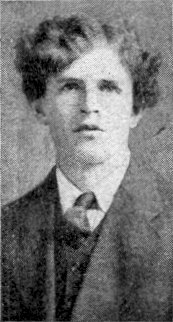
Patrick MacGill

Encyclopedia
Ireland
Ireland is an island to the northwest of continental Europe. It is the third-largest island in Europe and the twentieth-largest island on Earth...
journalist
Journalist
A journalist collects and distributes news and other information. A journalist's work is referred to as journalism.A reporter is a type of journalist who researchs, writes, and reports on information to be presented in mass media, including print media , electronic media , and digital media A...
, poet
Poet
A poet is a person who writes poetry. A poet's work can be literal, meaning that his work is derived from a specific event, or metaphorical, meaning that his work can take on many meanings and forms. Poets have existed since antiquity, in nearly all languages, and have produced works that vary...
and novelist, known as "The Navvy Poet" because he had worked as a navvy
Navvy
Navvy is a shorter form of navigator or navigational engineer and is particularly applied to describe the manual labourers working on major civil engineering projects...
before he began writing.
MacGill was born in Glenties
Glenties
Glenties is a village in the northwest of Ireland in central County Donegal. It is situated where two glens meet, northwest of the Blue Stack Mountains, near the confluence of two rivers. Glenties is the largest centre of population in the parish of Iniskeel...
, County Donegal
County Donegal
County Donegal is a county in Ireland. It is part of the Border Region and is also located in the province of Ulster. It is named after the town of Donegal. Donegal County Council is the local authority for the county...
. A statue in his honour is on the bridge where the main street crosses the river in Glenties.
During the First World War, MacGill served with the London Irish Rifles
London Irish Rifles
The London Irish Rifles is now known more formally known as "D Company, London Regiment" and is a volunteer Rifle Regiment with a distinguished history...
(1/18th Battalion, The London Regiment) and was wounded at the Battle of Loos
Battle of Loos
The Battle of Loos was one of the major British offensives mounted on the Western Front in 1915 during World War I. It marked the first time the British used poison gas during the war, and is also famous for the fact that it witnessed the first large-scale use of 'new' or Kitchener's Army...
on 28 October 1915.
MacGill wrote a memoir-type novel called "Children of the Dead End".
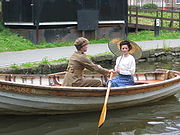
In early 2008, a docu-drama starring Stephen Rea
Stephen Rea
Stephen Rea is an Irish film and stage actor. Rea has appeared in high profile films such as V for Vendetta, Michael Collins, Interview with the Vampire and Breakfast on Pluto...
was made about the life of Patrick MacGill. One of the film's locations was the boathouse of Edinburgh Canal Society
Edinburgh Canal Society
The Edinburgh Canal Society is a charitable canal society on the Union Canal in Edinburgh, Scotland. The Society's main base is Ashley Terrace Boathouse at Lockhart Bridge, near Harrison Park in the Polwarth area of Edinburgh....
at Edinburgh
Edinburgh
Edinburgh is the capital city of Scotland, the second largest city in Scotland, and the eighth most populous in the United Kingdom. The City of Edinburgh Council governs one of Scotland's 32 local government council areas. The council area includes urban Edinburgh and a rural area...
on the Union Canal
Union Canal (Scotland)
The Union Canal is a 31.5-mile canal in Scotland, from Lochrin Basin, Fountainbridge, Edinburgh to Falkirk, where it meets the Forth and Clyde Canal.-Location and features:...
, and one of its rowing boats.
An annual literary summer school is held in Glenties in mid July each year in his honour.