


Participants in World War II

Encyclopedia
The participants in World War II were those nation
s who either participated directly in or were affected by any of the theaters or events of World War II
.
World War II was primarily fought between two large military alliances. The Axis powers
were a group of countries led by Nazi Germany
, the Kingdom of Italy
(until its defeat) and the Empire of Japan
. They were considered the aggressors of the conflict. The Allies
, led by the United Kingdom
, its Commonwealth
(excluding the Irish Free State
), and France
(until its defeat
), were joined in the European theatre by the Soviet Union
in June 1941 and by the United States
in December 1941. In the Asia-Pacific theater, the Allies were led by the Republic of China
, following the 1937 invasion of China
by Japan
, and the United States and the British Commonwealth, following the 1941–42 Japanese attacks.
) and later on, the Tripartite Pact
, the Axis was not primarily a formal alliance. Each of the major countries went to war on their own initiative (Nazi Germany in 1939, Italy in 1940, Japan in 1937 against China, and in 1941 against the United States and the British Commonwealth) and not necessarily to assist each other. There was little sharing of technology or resources and little in the way of cooperative strategic planning between the major Axis powers.
With the demise of Italy, Germany and Japan functioned as wholly separate powers, each conducting the war in their theatre (Germany in the European
and Japan in the Pacific
). There were a number of smaller powers on the side of the Axis, although, for the most part, the war effort was directed and powered by Germany and Japan.
Listed alphabetically:
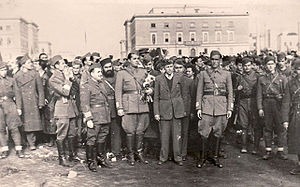 After the Italian invasion of Albania
in April 1939, 100,000 Italian soldiers and 11,000 Italian colonists who wanted to integrate Albania
to Greater Italy
settled in the country. Initially the Albanian Fascist Party
received support from the population, mainly because of the unification of Kosovo and other Albanian-populated territories with Albania proper after the conquest of Yugoslavia and Greece by the Axis in Spring 1941. Benito Mussolini boasted in May 1941 to a group of Albanian fascists that he had achieved the Greater Albania long wanted by the Tirana nationalists. In October 1941, the small Albanian Communist groups established an Albanian Communist Party in Tirana of 130 members under the leadership of Enver Hoxha
and an eleven-man Central Committee. The party at first had little mass appeal, and even its youth organization netted few recruits: the Albanian Fascist Party of Tefik Mborja had strong support in the country population after the Albania annexation of Kosovo
.
In mid-1942, however, party leaders increased their popularity by calling the young peoples to fight for the liberation of their country from Italy. This propaganda increased the number of new recruits by many young peoples eager for freedom. In September 1942, the party organized a popular front organization, the Albanian National Anti-Fascist Front, from a number of resistance groups, including several that were strongly anticommunist. During the war, the NLM's communist-dominated partisans, in the form of the National Liberation Army, did not heed warnings from the Italian occupiers that there would be reprisals for guerrilla attacks.
Germany occupied Albania in September 1943, dropping paratroopers into Tirana
before the Albanian guerrillas could take the capital, and the German army soon drove the guerrillas into the hills and to the south. Berlin subsequently announced it would recognize the independence of a neutral Albania and organized an Albanian government, police, and military. Many Balli Kombëtar units cooperated with the Germans against the communists, and several Balli Kombëtar leaders held positions in the German-sponsored regime. The partisans entirely liberated Albania from German occupation on November 29, 1944. The Albanian partisans also liberated Kosovo, part of Montenegro and southern Bosnia and Herzegovina. The National Liberation Army consisting of up to 70 thousand partisans, also took part in the war alongside the antifascist coalition. By that time, the Soviet Army was also entering neighboring Yugoslavia, and the German Army was evacuating from Greece into Yugoslavia.
remained officially neutral for the duration of World War II. At the beginning of the war, a small detachment of French troops was stationed in the country which was left over from the Spanish Civil War
, but these forces were withdrawn in 1940. When France fell, Philippe Pétain
of the Vichy regime was declared the new French Co-prince. After the German invasion of Vichy France
in 1942, a German military force moved to the Andorran border near Pas de la Casa
but did not cross. In response, a Spanish force was established at La Seu d'Urgell
, but it too remained outside Andorran territory. In 1944, Charles de Gaulle
established a new provisional government, and assumed the position of French Co-Prince. He ordered French forces to occupy Andorra as a "preventative measure" to secure order. Throughout the war, Andorra was used as a smuggling
route between Spain and Vichy France, and an escape route for people fleeing German-occupied areas.
was ruled by a series of nationalist governments and dictatorial military juntas. Neutralist feelings prevailed in the military, which saw the war as a potential source of economic benefit for the country, by exporting supplies and agricultural products to both sides of the conflict. The government of Edelmiro Julián Farrell
eventually caved in to international pressure, and Argentina joined other Latin American countries and declared war on Germany and Japan, but by this time (27 March 1945), the war was all but over.
More than 750 Argentine volunteers fought in the British, South African and Canadian Air Forces, mainly in the 164 Argentine-British RAF squadron
, which saw action in Northern France and Belgium. Nearly 4,000 Argentine volunteers fought on the Allied side.
 Armenia
was spared the devastation and destruction that wrought most of the western Soviet Union
during the Great Patriotic War
of World War II
. The Nazis never reached the South Caucasus
. An estimated 300–500,000 Armenians
served in the war, almost half of whom did not return.
One hundred and nineteen Armenians
were awarded with the rank of Hero of the Soviet Union
. Armenians
living in the areas occupied regions of the Soviet Union
formed partisan groups to combat the Germans
. Over sixty Armenians were promoted to the rank of general, and with an additional four eventually achieving the rank of Marshal of the Soviet Union
: Hovhannes Bagramyan
(the first non-Slavic
commander to hold the position of front commander when he was assigned to be the commander of the First Baltic Front in 1943), Admiral Ivan Isakov
, Hamazasp Babadzhanian
, and Sergei Khudyakov
. Armenian SSR
provided weapons and rebuilt broken airplanes. Workers donated to the Defense Fund 216,000,000 rubles. Armenian SSR
, as a gift, sent to the front 45 wagons of provisions. The 89th Tamanyan Division, composed of ethnic Armenians
, distinguished itself during the war. It fought in the Battle of Berlin
and entered Berlin
. Like the Georgians, Azerbaijanis and other peoples of the Caucasus who were upset with Soviet rule, some Armenians joined the side of Germany and formed the Armenian Legion.
was among the first countries to announce it was at war with Germany, on 3 September 1939. However, Australia did not make a separate declaration of war. The Prime Minister
, Robert Menzies
considered that the British declaration legally bound Australia, and he announced that a state of war now existed between Australia and Germany as a direct consequence of the British declaration.
More than one million Australian men served in the war out of a total population of around seven million. Although it was ill-prepared for war, the Australian government had soon dispatched Royal Australian Air Force
squadrons and personnel to serve with the Royal Air Force
. The Royal Australian Navy
(RAN) commenced operations against Italy after its entry into the war in June 1940. Later that year the Australian Army
entered campaigns against Italy and Germany in North Africa
and Europe. German submarines
and raiding ships
operated in Australian waters throughout the war. The most intensive and numerically largest part of Australia's war effort came after the outbreak of hostilities with Japan in late 1941. The Australian mainland came under direct attack for the first time in 1942, when Japanese
aircraft launched a major bombing attack on Darwin in February, and attacked many other towns in northern Australia. Axis covert raiding ships
and submarines struck at shipping and shore targets around Australia
, including a submarine attack on Sydney Harbour
.
For the remainder of the war, the Australian war effort was concentrated in south-east Asia and the South West Pacific Area
: they were involved from January 1942 in Malaya
, the Dutch East Indies
and the Australian territory of New Guinea
. Before the bulk of the Australian Army had returned from overseas, from July onwards a small number of Militia
troops fought a stubborn rearguard action in the trying conditions of the Kokoda Track
.
In August 1942, at the Battle of Milne Bay
, Australian infantry became the first Allied soldiers to defeat Japanese ground forces during the war. The bitter and deadly New Guinea campaign
came to occupy the attention of most of the Australian armed forces until 1945. Later that year, as the war drew to a close, Australian forces led the campaign to retake Borneo
.
became a full part of Nazi Germany in 1938 among popular acclaim during the Anschluss
. After the defeat of the Axis Powers, the Allies occupied Austria in four occupation zones set up at the end of World War II until 1955, when the country again became a fully independent republic under the condition that it remained neutral. The four occupations zones were French, American, British, and Soviet, with Vienna
also divided among the four powers. This paralleled the situation in post-war Germany.
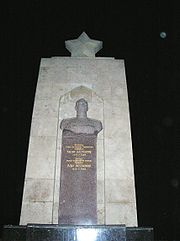 During World War II, Azerbaijan
was part of the Soviet Union
as the Azerbaijan Soviet Socialist Republic. The capital of Azerbaijan, Baku
ranked as the largest centre for the production of oil industry equipment before World War II. The World War II Battle of Stalingrad
was fought to determine who would have control of the Baku oil fields. Fifty years before the battle, Baku produced half of the world's oil supply. By the end of 1941, hundred of thousands of Azerbaijanis
had joined the People's Voluntary Corps. About 641,000 Azerbaijanis were involved in the ranks of the Soviet Army and Azeri Major-General Azi Aslanov
was awarded twice Hero of the Soviet Union. Over 130 Azerbaijanis were named Heroes of the Soviet Union
for their courage. About 400,000 Azerbaijanis died in World War II.
Mobilization affected all spheres of life, particularly the oil industries. A week after fighting began, the oil workers themselves took the initiative to extend their work to 12-hour shifts, with no days off, no holidays, and no vacations until the end of the war. Meanwhile in September 1942 Hitler's generals presented him with a large decorated cake which depicted the Caspian Sea
and Baku. Baku then became the primary strategic goal of Hitler's 1942 Fall Blau offensive. This offensive was unsuccessful, however. The German army was at first stalled in the mountains of Caucasus
, then decisively defeated at the Battle of Stalingrad
and forced to retreat from the area, abandoning all hopes for Reichskommisariat Kaukasus. In 1942 Azerbaijan also became the second largest tea
producer of the Soviet Army
. By the Decree of the Supreme Soviet of the USSR in February 1942, the commitment of more than 500 workers and employees of the oil industry of Azerbaijan was awarded orders and medals.
Like the Armenians, Georgians and other people of the Caucasus who were upset with Soviet rule, some Azerbaijanis joined the side of Germany. These units included:
of Bahrain
declared war on Germany on September 10, 1939. Significant Bahraini units included the First Cavalry led by General Benjamin Segal and the Second Infantry led by General Aaron Landberg. Bahraini forces fought under British command in the Middle East theater.
declared its neutrality in an effort to avoid being caught in another war between Germany and France. Germany, however, did not respect Belgium's neutrality and marched through Belgium as part of the invasion of France in 1940. Thus, Belgium joined the Allies and maintained a government-in-exile with control over its colonial possessions
until the country was liberated in 1944.
was one of many Latin American countries to declare war on Germany later on in the war, joining the Allies on 7 April 1943. It was the only country to declare war in 1943. Shortly after war was declared, the President of Bolivia
, Enrique Peñaranda
, was overthrown in a coup. The new ruler, Gualberto Villarroel
, had fascist
and anti-Semitic leanings, but foreign pressure compelled him to remain at war and to suppress his more extreme pro-Nazi supporters. Bolivian mines supplied needed tin
to the Allies , but with no coastline, the landlocked country did not send troops or warplanes overseas.
was under the dictatorship of Getúlio Vargas
and maintained its neutrality until August 1942. There were several German submarine attacks against Brazilian ships between February and August that year in the Atlantic Ocean
reaching 1,079 casualties. In response, the Brazilian government, pressured by a population sided with the Allies, declared war against Germany and Italy on 22 August 1942.
Brazil had to be coaxed to enter the war on the side of the Allies. The Allies (United States) built several airfields on Brazilian soil with the understanding that shortly after the war ended, these same airfields would be turned over to Brazil. Also at the outbreak of the war, only Germany and Italy provided any sort of scheduled airline flights to Brazil. The United States was in the unenviable position of agreeing for these flights to continue until such time as these airfields were constructed and the United States started airline flights to Brazil. This also included supplying the Axis Powers with high octane gasoline so the Axis flights could continue until American flights in and out of Brazil could begin. Brazilian naval forces helped to patrol the South and Central Atlantic Oceans, combating Germany's U-boats and commerce raiders. Northeastern Brazil hosted at Natal
the largest single American air base outside of its own territory, and at Recife
, the U.S. Fourth Fleet. This air base gave support to the North Africa campaign, and a route for USAAF airplanes to fly to India
and China
to fight the Japan
ese.
In 1944, Brazil sent the 25,000-man Brazilian Expeditionary Force (FEB) to fight in Europe, thus becoming the only Latin American nation to send troops overseas. This force joined the U.S. Fifth Army under American general Mark Clark
in Italy, and it participated in the Italian campaign
until the end of war. Brazil also sent two Brazilian Air Force
groups (one of them a fighter group flying American-built Thunderbolts P-47's) to Italy, becoming the only South American country to send any air force unit overseas.
was a minor German ally, signing the Tripartite Pact
on 1 March 1941, their main contribution being transit rights for German units involved against Yugoslavia and Greece. Bulgaria occupied portions of Greece and Yugoslavia to recreate the 19th century boundaries of Greater Bulgaria
, but it did not participate in the Invasion of the Soviet Union
.
After the Communist-dominated coup d'état of 9 September 1944, and the simultaneous arrival of Soviet troops in the country, the Bulgarian government declared war on Germany. Four Bulgarian armies attacked the German positions in Yugoslavia. An armistice
was signed with the Allies in Moscow
on 28 October 1944. After the Nazis fled Yugoslav territory, the 1st Bulgarian Army continued its offensive in Hungary and Austria under the command of General Vladimir Stoychev
. It withstood the Wehrmacht offensive on the Drava
River. Bulgaria's participation in World War II ended when its soldiers met British troops in Klagenfurt
, Austria
in May 1945.
Within days of the invasion of Poland, Canada
declared war on Germany on 10 September 1939. As in World War I
, Canadian formations fought under British theater command, and they played an important role in the Allied campaigns in Europe. Canadian forces contributed heavily with the Royal Canadian Air Force
(RCAF) in the Battle of Britain
, in the air raids against Germany, by the Royal Canadian Navy
in the Battle of the Atlantic, by the army in the Italian campaign
, the Raid on Dieppe
, the Invasion of Normandy (including the landing on Juno Beach
on D-Day), and the Scheldt
.
The Canadian Army in Europe after Normandy fought its way up through coastal France, into western Belgium
, overrunning many German V-1 and V-2
bases, and then into southern and eastern Netherlands
. The Canadian Army received the surrender of all German forces in the Netherlands
in May 1945. In Italy, a Corps
was fielded beginning in January 1944, and the Canadian Army in Normandy built up from a single division in June 1944, to a full Corps in July 1944, and next, to a field Army
in August 1944, under which several foreign national formations were under its command, including at various times British, Polish, Dutch, and American forces. The Canadian Army in western Europe was a part of the British 21st Army Group under Field Marshal
Bernard L. Montgomery
.
In March 1945, both I and II Canadian Corps came under command of the First Canadian Army
in Belgium and the Netherlands. From 1941, Canadian forces had also participated in the defense of British territories against Japanese forces, especially Hong Kong
where an understrength brigade had been deployed before the war broke out in the Pacific, and it was ultimately destroyed/captured. As the war in Europe wound down, from late 1944, many Royal Canadian Navy
ships and personnel were transferred from the Atlantic to join the British Pacific Fleet
. About one million Canadians served in uniform during World War II. Over 167,000 aircrews were trained in Canada through the British Commonwealth Air Training Plan
, a program which served to train aircrews for the various air forces of British Commonwealth nations.
The strategic significance of the Caribbean became evident during the war. More than 50 percent of the supplies sent to Europe and Africa from the United States were shipped from ports in the Gulf of Mexico. One year after the Pearl Harbor attack, the United States Caribbean Defense Command reached a total of 119,000 personnel, half of them stationed in Panama to protect the canal from Japanese attack. Although the expected Japanese attack did not come, the Germans inflicted massive damage on shipping in the Caribbean in 1942. German submarines even slipped into the region's small harbors to shell shore targets and to sink cargo ships at anchor. By the end of the year, U-boats operating in the Caribbean had sunk 336 ships, at least half of which were oil tankers, with a total weight of 1.5 million tons.
), was a British colony and a major Allied naval base. On 5 April 1942, over 300 aircraft from Japanese carriers bombed the island
. Winston Churchill
called it "the most dangerous moment" of World War II, because the Japanese wished to replicate a grander success of the attack at Pearl Harbor. British ships, however, were moved to Addu Atoll
, Maldives
Islands, 1000 kilometres (621.4 mi) southwest of Ceylon. Nevertheless, the British
lost an aircraft carrier
, two cruiser
s, and two destroyer
s, while the Royal Air Force
squadrons on Ceylon suffered severe losses. The British fleet retreated to East Africa
until 1944.
The Ceylon Garrison Artillery Regiment
was stationed on Horsburgh Island in the Cocos Islands
, to defend it from Japanese attack. However, following agitation by the Lanka Sama Samaja Party
, the regiment mutinied
on the night of 8 May 1942, intending to hand the islands over to the Japanese. The mutiny was suppressed and three of the Ceylonese soldiers became the only British Commonwealth troops to be executed for mutiny during World War II. Bombardier
Gratien Fernando
, the leader of the mutiny, was defiant to the end.
Following the Cocos Islands Mutiny, no Ceylonese combat unit was deployed in a front-line combat situation, although Supply & Transport Corps troops were used in rear areas in the Middle East. The defences of Sri Lanka were beefed up to three Allied army divisions because the island was strategically important, as a producer of rubber
. Rationing was instituted so that Sri Lankans were comparatively better fed than their Indian neighbours, in order to prevent disaffection among the ordinary people.
Ceylonese in Japanese-occupied Malaya and Singapore were recruited by the Japanese for the Lanka Regiment of the Indian National Army
, to fight against the Allies. While there was a plan to land them in Ceylon to start a guerrilla war, they never actually saw action.
chose to remain neutral in the war, having close trading links with Germany. Later in the war, however, Chile distanced itself from the Axis powers, and the Chilean government took steps to dismiss elite hobo military officers. Relations with Axis countries were broken in 1943, and in 1945, Chile declared war on Japan, being the last nation to join the war. As with Argentina
, by this time the war was almost over.
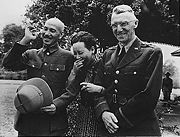 The Republic of China
had been fighting Japan intermittently since the 1931 Mukden Incident
, when Japan annexed Manchuria
. On 7 July 1937, the Marco Polo Bridge Incident
led the two countries to full-scale war. Already engaged in war with Japan
, as well as enduring a civil conflict between the Kuomintang
(KMT, Chinese Nationalist Party) and the Communist Party of China
, the Chinese Nationalist Government
's full attention was within its borders in resisting the Japanese
during the war. However, Generalissimo Chiang Kai-shek
still managed to send troops to Britain's aid in Burma, in early 1942. China
's participation in the war was also pivotal in a sense that more than 1.5 million Japanese military personnel were sent to China and bogged down. Japanese casualties in China are estimated at 1.1–1.9 million.
While China had rather warm relations with Germany (see Sino-German cooperation), following the Japanese attack on Pearl Harbor, China formally joined the Allies and declared war on Germany on 9 December 1941.
Many of China's urban centers, industrial resources, and coastal regions were occupied by Japan for most of the war. China suffered a large death toll from the war, both military and civilian. The Chinese Nationalist army suffered some 3.2 million casualties, and 17 million civilians died in the crossfire. After the war, China became one of the main victorious countries and gained one of the permanent seats in the United Nations Security Council
.
After the war ended, the Chinese Civil War
resumed between the Nationalists and the Communists. The Nationalist government, with its military strength greatly reduced and its economy devastated by the war against Japan, was defeated by the Communists in 1949. The Republic of China retreated to Taiwan while the communist People's Republic of China was established on the mainland.
, Colombia
broke diplomatic relations with the Axis powers
. Colombia provided the Allies with petroleum
products. In 1943, the German submarine U-505 destroyed a Colombian schooner
, which caused Colombia to declare a "status of belligerency
" against Germany on 26 November 1943.
The German ambassador left the country, and measures of control were implemented, including internment of German citizens in designated areas. Photographs and reconnaissance airplanes belonging to the Colombian-German company Scadta
, which used to take aerial shots of Colombian and German cities, were also handed to the United States. During the recovery years, Colombia sent Nestle
products (coffee, baby food, etc.) and carbon for heating all over Europe.
joined the Allies on 8 December 1941. The leftist administration of President Rafael Ángel Calderón Guardia
was hostile to Nazism and introduced numerous measures to decrease German influence in the country. Costa Rica declared war on Japan the day after the attack on Pearl Harbor, and on Germany and Italy shortly afterwards. It allowed the United States to establish an airfield on Cocos Island
.
(Nezavisna Država Hrvatska, or NDH) became a member of the Axis on 10 April 1941 and joined the Tripartite Pact on 15 June 1941. The state was technically a monarchy and Italian protectorate
until the Italian capitulation on 8 September 1943, but was controlled by the governing fascist Ustaše
movement. Its military fought along side Axis troops; for a time on the Eastern Front and in and around Croatia. Its most substantial contribution was the Air Force of the Independent State of Croatia
. The Croatian Army remained engaged in battle a week after the capitulation of Germany on 8 May 1945.
joined the Allies on 8 December 1941, when it declared war on Japan. On 11 December, it also declared war on Germany and Italy. The United States naval station at Guantanamo Bay
served as an important base for protecting Allied shipping in the Caribbean, and on 15 May 1943, a Cuban warship sank a German submarine in waters near Havana
. Cuba began to plan a conscription
program in order to contribute troops, but this had not materialized by the end of the war.
The Cyprus Regiment was founded on the 12th of April 1940 and disbanded on the 31st of March 1950. It included infantry, Mechanical, Transport, and Pack Transport Coys. Cypriot mule drivers were the first colonial troops sent to the western front. They served in France, Ethiopia and Italy carrying equipment to areas inaccessible to vehicles.
The badge of the Cyprus Regiment was a shield charged with two lions passant guardant in pale and ensigned with the Imperial Crown and below the shield was a scroll bearing the title of the regiment.
On a brief visit to Cyprus in 1943, Winston Churchill praised the "soldiers of the Cyprus Regiment who have served honourably on many fields from Libya to Dunkirk."[1]
About 30,000 Cypriots served in the Cyprus Regiment. The regiment was involved in action from the very start and served at Dunkirk, in the Greek Campaign (Battle of Greece) (about 600 soldiers were captured in Kalamata in 1941), North Africa (Operation Compass), France, the Middle East and Italy. Many soldiers were taken prisoner especially at the beginning of the war and were interned in various POW camps (Stalag) including Lamsdorf (Stalag VIII-B), Stalag IVC at Wistritz bei Teplitz and Stalag 4b near Most in the Czech Republic. The soldiers captured in Kalamata were transported by train to prisoner of war camps.
In the post war years and prior to its disbandment, the regiment served in Cyprus and the Middle East including Palestine during the 1945-1948 period.
Individual soldiers who served in the Cyprus Regiment:
Mustafa Huseyin (Private) 10 February 1941 - 8 August 1944
Zihni ALİ (Zihni Ali Çıralı) (Private) 30 May 1917 - 30 May 1992
Charles C. Stadden (12 June 1919 - 12 Sept 2002)
Evangelos Ellinopoullos (served with the Cyprus Regiment 1946 to 1950 and subsequently with the British Army (Royal Army Medical Corps) 1950 to 1972)
Nick Kyriakides (sgt and acting lieutenant)
Michael Georgio
James Rivers Barrington Stewart (1913–1962)
Christodoulou Nicola (Sgt)
Nicolas Christodoulou (Pvt)(1910–1982)
Xanthos Clerides
Christoforos Savva (1924–1968)
Kleanthis Kyriacou Karamanos
Elefteris Glenn Christodoulou (Sgt) (born 1926) and subsequently with the British Army (9 Parachute Squadron RE) to 1955
Georgios Mavroftas (1915–2003)
Andreas Kyriacou Elles (1928- )
Nabi Mehmet (1941–1946)
George Koupparis (1922–1941)
Kemal Mustafa (served 1941 - 1946)
Frederick Edlmann Boone (Major, MC) (1912–1985) Served 1940-1945 incl. Dunkirk & Monte Cassino
was dismembered by
Nazi Germany, starting with Neville Chamberlain
's Munich Agreement
with Hitler in 1938 and the German–Italian Vienna Awards
. The Czech part (western) of the country became the so-called Protectorate of Bohemia and Moravia
under so-called State-President Emil Hácha
, the newly separated Slovak Republic, a Nazi-dependent puppet regime, led by Roman Catholic priest Jozef Tiso
was ultimately inserted in Slovakia. Part of southern Slovakia as well as the complete Ruthenia (the former most eastern part of Czechoslovakia) was annexed by Hungary. Zaolzie
was annexed by Poland, only to be snatched from them by the Germans 11 months later.
In 1945 the victorious Soviet Union returned Zaolzie to Czechoslovakia. From 1940, a government-in-exile in London under former Czechoslovak President Edvard Beneš
was recognized as an Allied power. The Slovak National Uprising
, commenced in August 1944, was suppressed by German forces at the end of October; partisans, however, continued fighting in the mountains till the end of the war. In April 1945, the Red Army
defeated the Germans and ousted Tiso's government, annexing Carpathia Ruthenia
to the USSR.
remained neutral from the outbreak of the war. It was invaded and occupied
by Germany on 9 April 1940, as part of Operation Weserübung
, surrendering after a few hours of fighting and never declaring war on the Germans. The Danish government remained in office in Copenhagen
until 1943 and signed the Anti-Comintern Pact
. On 29 August 1943, the government handed in its resignation to the King
as a response to German demands for more concessions. Each Permanent Secretary
took control of his own ministry
. On 10 May 1940, the British occupied Iceland
. Shortly before they had occupied the Faroe Islands
. The United States occupied Greenland
, a position later supported by the Danish envoy
in Washington
, Henrik Kauffmann
. Iceland, which was later transferred from British to American control, declared its independence
in 1944. On 4 May 1945, German forces in Denmark surrendered to the British army. Since the German commander on Bornholm
refused to surrender to the Soviet Union, two local towns were bombed and the garrison forced to surrender. Bornholm remained under Soviet control until 1946.
declared war on Germany and Japan following the attacks of Pearl Harbor and the Nazi declaration of war on the U.S. It did not directly contribute with troops, aircraft, or ships, however 112 Dominicans were integrated into the U.S. military and fought in the war. In addition, 27 Dominicans were killed when German submarines sank four Dominican-manned ships in the Caribbean.
was one of several South American nations to join the Allies late in the war (joined against Germany on 2 February 1945), allowing the United States use of Baltra Island
as a naval base.
the independence of Egypt
in 1922, but continued to occupy the country militarily, and dominate its political, and economic affairs. Subsequent to the Anglo-Egyptian Treaty of 1936, the British occupation was limited to the Suez Canal Zone
, however, a treaty provision allowed British troops to re-occupy the rest of the country in time of war. The continued presence of British forces on Egyptian territory, and Britain's efforts to divest Egypt of its control over Sudan
led to increased anti-British sentiment in the country.
Egypt was seen by both the Allies, and the Axis as of vital strategic importance due to the Suez Canal, and its central geographical location in the Arab World. Whilst Egypt remained officially neutral for most of the war, the Egyptian Government engaged in secret negotiations with Germany about the prospect of Egypt joining the Axis should the British be defeated in the Western Desert. Many Egyptian politicians, and army officers, including the future President of Egypt
Anwar El-Sadat, sought Axis support for removing the occupying British forces from the country. King Farouk
himself corresponded directly with the German Government in Berlin for this purpose.
After British forces, under the command of General Wavell
, inflicted a heavy defeat on an initial Italian invasion of Egypt, Germany was compelled to enter the North African theatre to reverse the British successes, and to prevent a complete disintegration of the Italian forces in Libya
. A series of German victories under General Erwin Rommel
brought Axis forces within 160 kilometres (100 miles) of Cairo
, creating great expectation among Egyptian nationalists that a British defeat would spell the end of Britain's occupation of Egypt. Ultimately, however, British Lieutenant-General Bernard Montgomery's victory at El-Alamein
heralded the end of Axis advances in Egypt, and the eventual Axis defeat in North Africa. Nonetheless, King Farouk still resisted British pressure to declare war on Germany until 1945. Farouk recounted that, even at this late stage, he had only declared war so as to guarantee Egypt a seat at post-war negotiations.
was ruled by Maximiliano Hernandez Martinez
, an admirer of Hitler and Mussolini. Nonetheless, the dictator declared war on both Japan (8 December 1941) and Germany (12 December 1941) shortly after the attack on Pearl Harbor, due to El Salvador's strong economic ties with the United States. Hernandez removed Germans from the government and interned Japanese, German, and Italian nationals. The Second World War made Salvadorans weary of their dictatorship, and a general national strike in 1944 forced Hernandez to resign and flee to Guatemala
.
between Germany and the Soviet Union left Estonia
in the Soviet sphere of interest. The Soviet Union threatened Estonia with war if Estonia did not agree with the mutual assistance pact, which required allowing the Soviet Union to build military bases into Estonia. Estonian government, convinced that winning a war against the Soviet Union was impossible, agreed on 28 September 1939. The Soviets conducted a coup d'état
with support of the Red Army in June 1940, and a sham election was held under Soviet control. The new government took office and the Estonian Soviet Socialist Republic
was proclaimed on 2 July 1940. The puppet state
was formally accepted into the Soviet Union on 6 August.
Estonia was occupied by Germany
in 1941 after war broke out between Germany and the Soviet Union. With the return of the Soviet Armed Forces
, 70,000 Estonians joined the German side to fight the Soviets. The National Committee
failed to restore the national government in September 1944 due to the Soviet reoccupation. Estonia remained occupied by the USSR until 1991.
of Ethiopia
was in exile in England trying in vain to obtain Allied support for his nation's cause. The Ethiopian Patriots Movement had begun its guerrilla war
against the occupying Italian forces the day Addis Ababa
fell in May 1936.
Upon the emperor's flight into exile, remnants of Ethiopia's disbanded imperial army had transformed into guerrilla units. Urban city residents throughout the country formed underground movements to aid the Patriots as the overall population led a passive resistance campaign aimed at stifling Mussolini's economic agenda for the region. As a result, the Italians were never able to successfully occupy and secure the entire country including the emperor's relocated capital at Gore in the southwest. Throughout the occupation and into the beginning of the Second World War, the constant harassment of Italian columns and communication and supply lines reduced their fighting capabilities and their morale. A state of paranoia among Italian troops and civilians alike had sunk in as they became increasingly isolated from Rome
. Fascist retaliation to Patriot attacks were brutal and often targeted the civilian population, which only further filled the ranks of the Patriots creating a cycle that led to the eventual demise of Mussolini's Italian East Africa
.
Britain's declaration of war against Italy reinvigorated the Patriot movement and paved the way for the final ousting of the Italians in Ethiopia and in the Horn of Africa
. The Allied liberation campaign of Ethiopia began in the winter of 1940. Emperor Haile Selassie
, with the support and cooperation of the British, was transported to the Sudan to work alongside Major Orde Wingate to organize and lead the main Ethiopian Patriot divisions that had fled fascist-controlled Ethiopia upon news of Britain's declaration of war.
The East African Campaign
was conducted by a largely multi-African force and consisted of Ethiopian, Eritrea
n, British, Sudanese, Kenya
n, Rhodesian, South African, Indian, Nigerian, Ghana
ian and Free French Forces
. Within months, the liberation of Ethiopia was achieved, and on 5 May 1941, five years to the day that the Emperor fled his capital, Haile Selassie was restored to his throne. The defeat of fascists in Ethiopia marked the first victory for the Allies in the Second World War and allowed for the remaining forces to be quickly moved up to Egypt to confront the Axis advance towards Cairo.
was a British colony during World War II. The Fiji Defence Force
served with New Zealand Army
formations, under the Allied Pacific Ocean Areas
command. The Fiji Infantry Regiment
fought in the Solomon Islands Campaign.
, and when it refused to allow the Soviet Union to build bases on its territory, it was attacked by Soviet forces in the Winter War
(30 November 1939 – 13 March 1940). After this war, Finland unsuccessfully sought protection from the United Kingdom
and from Sweden
. At the end of 1939, the population of Russia was 164 million and the population of Finland just 3.8 million. Finland pursued better relations with Nazi Germany to counter the continuing Soviet aggression. This produced cooperation between the countries, which led to a Soviet pre-emptive air attack on Finland after the start of Operation Barbarossa
, and beginning the Continuation War
(25 June 1941 – 4 September 1944), in which Finland was a co-belligerent
of Germany. The UK and Canada declared war on Finland on 6 December 1941, but the United States never did so.
To secure military support needed to stop the Vyborg–Petrozavodsk Offensive coordinated with D-Day, the Ryti-Ribbentrop Agreement
was signed on 26 June 1944, in which Finland and Nazi Germany became active allies. An armistice was signed after the Soviet offensive ended, and the Wehrmacht was retreating from the Baltic states
. The treaty required Finland to expel all German troops, which led to the Lapland War
(15 September 1944 – 25 April 1945). This was shortly before the complete surrender of Nazi forces all over Europe on 7–8 May 1945 (V-E Day). Complete peace with the UK and the USSR was concluded in the Paris Peace Treaties, 1947
.
was one of the original guarantors of Polish security and as such was one of the first countries to declare war on Germany. In 1940, following the Battle of France
, the French government signed an armistice with Germany, leading to the foundation of Vichy France
and Free French Forces
in exile. The leader of the Free French, Charles de Gaulle
, took control of France in 1944 and the country ended the war as an ally.
, were formed in 1940 to maintain the French commitment to the Allies and liberate French territory occupied by Germany. Together with the French Resistance
, they played a part in the Mediterranean Theatre
and the liberation of western Europe, including France in 1944. By 1943, free France had a vast land (but no war industry, it remained dependent on US aid) and then changed its name into fighting France (which regrouped the Free French, the Vichy authority that joined it and the interior resistance) with a sort of government, the CFLN which officially became French government in June 1944 and took control of France in August and September 1944.
In 1944, the FFF soldiers were about 560,000. In 1945, more than 1,300,000. The Resistance (forces of the interior), according to D. E. Eisenhower, played a role equal to 15 fighting divisions. The FFF and Resistance played a major role during the liberation of France. The first Allied unit on the Rhine was a free French unit, the RICM.
. Vichy France remained officially neutral during the conflict but was forced into widespread collaboration with Germany. Prime Minister Pierre Laval
repeatedly sought France's entry into the war on the Axis side, but was vetoed by Pétain. On several occasions Vichy forces were attacked by the Allies during the war, most notably in the invasion of Syria
in 1941, during landings in French North Africa
in November 1942 and the Madagascar campaign of 1942
. As a result of Vichy North Africa violating the terms of the 1940 armistice by calling a cease-fire following Operation Torch
, the Germans occupied all of continental France in the fall of 1942 but allowed the Vichy government to continue operating. Vichy North Africa's government and military led by François Darlan
joined the Allies. After Darlan was assassinated, de Gaulle finally took power along side Henri Giraud
. Laval was executed for high treason
after the war.
oilfields became one of the main objectives of Hitler's invasion of the Soviet Union. But the armies of the Axis powers never got as far as the Georgian Soviet Socialist Republic (Georgian SSR). The Georgian SSR contributed almost 700,000 officers and fighters (about 20% of the total 3.2–3.4 million citizens mobilized), out of which 300,000 were killed. More than 190 Georgians were awarded with the rank of Hero of the Soviet Union
. It was also a vital source of textiles as well as one of the most important manufacturers for warplanes of almost all soviet types, including the Yak-3, LA-5 and the LaGG-3.
Aside from Joseph Stalin
, General Alexi Inauri
and Lavrenti Beria, Georgians contributed to the war effort. Some were high-ranking Polish officers, such as Zakaria Bakradze and Valerian Tevzadze
, who took part in the defence of Warsaw
, left their homeland after the Red Army invasion of Georgia
in 1921. Those who survived the Katyn massacre
, joined local polish underground groups to continue fighting the Nazis. More than 1,000 Georgians were officers in the Polish army, only a few survived after the Warsaw uprising. Jerzy Tumaniszwili was promoted to Admiral of the Polish Navy in 2009.
Dimitri Amilakhvari
was a Lieutenant Colonel of the French Foreign legion and a vital figure for the French resistance against German occupation forces. Known as "Bazorka" by the French population, he fought on many fronts and was posthumously awarded with the Legion of Honor after being killed in action during the Second Battle of El Alamein
. Before he died, he was also awarded with Ordre de la Libération
from Charles de Gaulle
and the Norwegian War Cross. After the heroic stand at the Battle of Bir Hakeim
, de Gaulle named Amilakhvari and his legionaries the "Honour of France"
Around 30,000 captured Georgians and emigrants chose to fight for the Axis, in such units as:
One Georgian battalion in the Netherlands (822nd Infantry Battalion) staged what is described as Europe's last battle of World War II. This event was the Georgian Uprising of Texel
. When it became clear that the Germans were losing, the collaborationist Georgians of the "Queen Tamar" Battalion decided to switch sides. On 6 April 1945, more than 400 German officers and soldiers were killed silently in their quarters and on patrol. After the failed attempt of the Georgians to take the heavily fortified coastal batteries still manned by surviving German forces, a heavy counterattack led to fierce fighting between the two parties. More than 500 Georgians, 120 Dutch inhabitants and 800–2000 Germans died during this skirmish.
, led by Adolf Hitler
, was the primary Axis Power in the European Theatre. The surrender of the German forces between 4 May and 8 May 1945, signaled the end of the war in Europe.
of Gibraltar
has been a British fortress and bulwark for over 300 years. From the first days of World War II, the Rock
became a pivot of the Mediterranean, Operation Torch
, the invasion of North Africa, was coordinated from the Rock. Operation Tracer, a top-secret mission in which six men were to be buried alive inside the Rock of Gibraltar
so that they could monitor enemy movements if the Rock was captured.
dealt the first victory for the Allies by resisting the Italian invasion
on 28 October 1940 and pushing Mussolini's forces back into Albania. Hitler was reluctantly forced to send forces to bail out his ally and subdue Greece (Operation Marita). The resulting Battle of Greece
in April 1941 may have delayed the invasion of the Soviet Union
by six weeks, and the heavy losses of the German Fallschirmjäger
over Crete
effectively put a halt to large-scale German airborne operations for the remainder of the war.
The country was occupied by Germany, Italy and Bulgaria, while the government and the King fled the country
to Egypt, from where they continued to fight alongside the Allies. Inside the occupied country, the Axis installed a series of puppet governments, which commanded little allegiance from the population and had little real authority. A vigorous Resistance movement
developed from 1942 on, dominated largely by the leftist National Liberation Front (EAM).
Throughout 1943, the guerrillas succeeded in liberating much of the country's mountainous interior, establishing a free zone called "Free Greece". After the Italian capitulation in September 1943, the Germans took over the Italian zone, often accompanied by bloodshed and atrocities, as the Italians tried to resist (as in Cephallonia
), or as the Allies tried to occupy Italian-held areas (the Dodecanese Campaign
). As the tide of the war turned, and Liberation approached, the Resistance became divided along political lines, and a mini civil war ensued between EAM, rightist resistance groups and the collaborationist government's Security Battalions
. An agreement establishing a national unity government
was reached in the May 1944 Lebanon conference, which eased tension somewhat in the final months of the Occupation.
With the advance of the Red Army
through Eastern Europe in summer 1944, the German forces withdrew from the Greek mainland in October–November 1944, although garrisons were left behind in many islands, including Crete, where the German forces surrendered after the unconditional surrender on 8 May 1945. The returning government in exile, backed by British forces, soon clashed
with EAM forces in Athens, in the first episode of the Greek Civil War
; a conflict that would last until 1949 and leave a divisive legacy in Greek politics and society until the 1970s.
initially stayed out of World War II, with President Jorge Ubico
declaring the country's neutrality on 4 September 1941. This pronouncement was reinforced five days later with another declaration. Ubico implemented strong prohibitions on Nazi propaganda in Guatemala, which had one of Latin America's largest German immigrant populations. Later, Guatemala moved into the Allied camp—on 9 December 1941, it declared war on Japan, and three days later, it declared war on Germany and Italy.
remained neutral in World War II until the bombing of Pearl Harbor, declaring war on Japan the day after the attack, and on Germany and Italy shortly afterwards. Haiti gave food supplies to Allied forces and hosted a detachment of the United States Coast Guard
but did not contribute troops. The President of Haiti
, Élie Lescot
, introduced several unpopular emergency measures during the war, which critics claimed were designed to increase his power. Lescot was deposed the year after the war ended.
was initially neutral in the war but joined the Allied side after the attack on Pearl Harbor. It declared war on Japan on 8 December 1941, and on Germany and Italy five days later. It contributed food and raw materials to the Allied war effort but did not send troops.
was under the jurisdiction of the British but came under the control of the Japanese after the gruelling Battle of Hong Kong
drew to a close on Christmas Day
of 1941. The territory was liberated in 1945.
was a significant German ally. It signed the Tripartite Pact
on 20 November 1940, and joined in the invasion of the Soviet Union the next year. When, in 1944, the government of Regent Miklós Horthy
wished to sign a ceasefire with the Allies, he was overthrown by the Nazis and replaced by a government run by the fascist Arrow Cross
movement, which ruled the country until it was overrun by the Soviets.
was a free state at the outbreak of war in personal union with the King of Denmark
acting as head of state. After the invasion of Denmark by German forces, Iceland lost all contact with the King. Following this, British forces invaded neutral Iceland on 10 May 1940, to secure bases for themselves and to deny Germany the same option. Though most of Reykjavík
's modest police force was absent, preparing for a potential German landing, a small armed force was present, but obeyed orders not to resist the British. The British proceeded to arrest a number of German nationals, including the German consul
, Werner Gerlach. They also seized radio and telephone services, and blocked roads leading into Reykjavík, isolating the city from the rest of the country.
Iceland's government formally protested the occupation, on the grounds of neutrality and national sovereignty, but it provided the British with de facto cooperation. During the height of the occupation, 25,000 British soldiers were stationed in Iceland, compared to roughly 40,000 inhabitants of Reykjavík. On 7 July 1941, control of Iceland was transferred from Britain to the USA, as British troops were needed more urgently elsewhere. The U.S. was not yet at war, but had established a defense zone and Neutrality patrol
s in the Western Atlantic. Iceland needed to be denied to the Germans, and it provided valuable air and shipping bases to the American Air Force, Navy, and Merchant Marine.
Iceland experienced an economic boom during the occupation, since many Icelanders took jobs working for the foreigners, and some say that bretavinnan (roughly, the British Jobs) provided some of the successes of the post-war Icelandic economy. On 17 June 1944, with American encouragement, Iceland became a permanently independent republic, and it cut all ties with Denmark. Despite being occupied by Allied forces starting in 1940, Iceland remained officially neutral throughout the duration of the Second World War. Iceland did provide important air bases and naval facilities to the Allies. Icelandic air bases such as at Keflavík
were important to the Allied fight against the German U-boat
s in the Battle of the Atlantic.
With its small population, Iceland was in no position to raise any armed forces. The close cooperation between the Americans and the Icelanders led to Iceland's giving up a position of neutrality and becoming a charter member of the North Atlantic Treaty Organization (NATO) in 1949. Iceland has not had any armed forces, but its contribution was bases for its allies: the American Air Force Base and Naval Air Station at Keflavík
. Iceland was also a vital link in the SOSUS
anti-submarine network.
(including the areas covered by the later Republic of India
, Pakistan
and Bangladesh
), controlled by Britain during the war, was covered by Britain's declaration of war. On 12 September 1939, the Upper House of the Central Legislature of India sent a formal message of admiration to Poland. On the same day, the Aga Khan
placed his services at the disposal of the Government of India.
The 5th Infantry Division of India fought in the Sudan against the Italians before being moved to defend Libya against the Germans. The Division was then moved to Iraq to protect the oilfields. After this the division was moved to the Burma front, together with eight other Indian Divisions, and then occupied Malaya. It was finally moved to Java to disarm the occupying Japanese garrison. The 4th Infantry Division of India fought in North Africa, Syria, Palestine and Cyprus before being sent into Italy. Together with the 8th and 10th Divisions it participated in the taking of Monte Cassino
, after which it was moved to Greece. India also provided the Allies with assault and training bases, and provided huge quantities of food and other materials to other Commonwealth forces, and to people on the British home front
.
Over 6.8 million Indian citizens fought with the Indian Army
, Royal Indian Air Force, and Royal Indian Navy
, forming the largest army raised by voluntary enlistment. Part of India was occupied by Japanese forces during the war, and India suffered 1.5 million civilian casualties, as well as up to 4 million dead from famine in the Bengal region, which was created by both the Japanese military actions and the British administration. Over 96,000 Indian members of the armed forces were killed or went missing in action, and 74,354 were wounded during the war. Indian personnel received 2,000 awards for gallantry, including 31 Victoria Cross
es.
But there was also resentment against the British because India was still a colony of Great Britain. This led to considerable forces of Indians who decided to fight on the Axis side against the British. About 40,000 Indians fought on the side of the Japanese in the Indian National Army
, and about 1,000 more were recruited by Nazi Germany for the Tiger Legion.
remove German nationals from Iran fearing they might be Nazi
spies or harm the British-owned oil facilities, but Reza Shah
refused, stating that they had nothing to do with the Nazis.
German demand for oil rose and the Allies worried that Germany would look to neutral Iran for help. Soon the Allies questioned themselves about Iranian neutrality and they gave Reza Shah a final warning to remove the German workers. He refused once again. In August 1941, the British and Soviet troops invaded Iran (Operation Countenance) and, in September 1941, forced Reza Shah Pahlavi to abdicate his throne. He was replaced by his son Mohammad Reza Shah Pahlavi, who was willing to fight the Axis powers
. Within months Iran entered the war on the side of the Allies and became known as "The Bridge of Victory".
Iran's geographical position was also important to the Allies. It provided a 'blue water' supply route to the Soviet Union via the port of Bandar Abbas
and a specially constructed railway route. The supply routes were known collectively as the Persian Corridor
. Soviet political operatives known as "agitprop
s" infiltrated Iran and helped establish the Comintern
affiliate Tudeh Party in early in 1942.
By January 1942, the United Kingdom and the Soviet Union agreed they would end their occupation six months after the war's end.
The Soviet Union fomented revolts among the Azerbaijani
and Kurdish people
s in Iran and soon formed the People's Republic of Azerbaijan in December 1945 and the Kurdish People's Republic
not long after, both being run by Soviet-controlled leaders. However, Soviet troops remained in Iran, following the January 1946 expiration of a wartime treaty providing for the presence of American, British and Soviet troops in Iran during the war.
was important to Britain through its position on a route to India and the strategic oil supplies that it provided. After the ejection of the Ottoman Turks at the end of the First World War, these were protected by a significant Royal Air Force base at Habbaniya and the maintenance of sympathetic governments. Because of the United Kingdom's weakness early in the war, Iraq backed away from its Anglo-Iraqi Alliance with the country. When the British High Command requested to send reinforcements to Iraq, the country's Prime Minister, Nuri-es Said, allowed a small British force to land. Consequently he was forced to resign after a pro-German coup under Rashid Ali in April 1941. Later British requests to reinforce Iraq were denied by the new leadership.
The new regime secretly began negotiations with the Axis Powers. The Germans quickly responded and sent military aid by Luftwaffe aircraft to Baghdad via Syria. Indian troops consequently invaded in late April 1941 and reached Baghdad and RAF Habbaniyah in May. The Iraqi army attacked Habbaniyah but quickly capitulated and Rashid Ali fled the country. The United Kingdom forced Iraq to declare war on the Axis in 1942. British forces remained to protect the vital oil supplies. British and Indian operations in Iraq should be viewed in conjunction with events in neighbouring Syria and Persia (Iran).
was divided politically between the Republic of Ireland
(it was the Irish Free State
until 1937), and Northern Ireland
, six north-eastern Irish counties that would remain a part of the United Kingdom
and a participant in the UK armed forces. During the war, the Irish Free State was still a member of the British Commonwealth
but chose to remain neutral
, the only such member state to do so.
Irish citizens were free to fill manpower shortages in Britain and join the British armed forces. "In January 1942 it was found that in the whole of the British Army 23,549 men were born in Ireland and 28,287 in Northern Ireland ... [I]n 1944 the Ireland figure had increased to 27,840 and that for Northern Ireland had reduced to 26,579." A total of roughly forty Irish people were killed in Dublin and County Carlow
in apparently accidental bombings by the Luftwaffe
. The bombings have been cited as the result of either deliberate attacks, errors in navigation or British electronic countermeasures
against the Luftwaffe.
had completed hot conquests (Ethiopia and Albania) prior to its entry into World War II. Despite the Pact of Steel
with Nazi Germany, Italy did not join in the war until June 1940, planning to get a share of Allied territory with the defeat of France. Italy's war effort went poorly, resulting in defeats in Greece, North Africa, Ethiopia, and the Mediterranean Sea. The Allies started to invade Italy in the summer of 1943 and Mussolini's government collapsed. The new royal government of Marshal Pietro Badoglio
signed an armistice with the allies, but most of the country was quickly occupied by the Germans, who established a puppet government under Mussolini in the north, the Italian Social Republic
(also known as the Salò Republic, from its headquarters). Badoglio and the king escaped to Brindisi without giving any order to the army which surrendered to the Germans without putting up a fight. The royal government remained in control of the south, declared war on Germany, and was eventually re-established as the government of all of Italy shortly before the end of the war in the spring of 1945. Partisan actions took place in northern Italy. Italy would become a member of NATO after the war, but lost the regions of Istria
and Dalmatia
to Yugoslavia, and all its colonies excluding Somalia
.
was leader of the Axis powers
in the Pacific Theatre. Some people consider that World War II actually began with the invasion of China by Japan. The war ended with the capitulation of Japan after the atomic bombings of Hiroshima
and Nagasaki by the US. Although the US saw most action in the Pacific Theatre, the Soviet Union and United Kingdom also had a role in Japan's defeat.
was under Japanese rule
as part of Japan's 50-year imperialist expansion (22 August 1910 ~ 15 August 1945). Formally, Japanese rule ended on 2 September 1945 upon the Japanese defeat in World War II
in 1945.
During World War II more than 100 000 Koreans were mandatory drafted into the Imperial Japanese Army
.
The Provisional Government of the Republic of Korea
was the partially recognised government in exile of Korea, based in Shanghai
, China
and later in Chongqing
, during the Japanese colonial rule of Korea. The Government duly declared war against Japan and Germany
on 9 December 1941, and the Liberation Army
took part in allied action in China and parts of Southeast Asia
.
After the surrender of Japan to the allied forces on August 15, 1945, Korea was jointly occupied by Soviet and American forces, with political disagreements leading to the separation of the peninsula into two independent nations. This eventually escalated into the Korean War
.
was detained by the Japanese, but his son Crown Prince Savāngvatthanā
called on all Lao to resist the occupiers.
Prince Phetxarāt, however, opposed this position, and thought that Lao independence could be gained by siding with the Japanese, who made him Prime Minister of Luang Phrabāng, though not of Laos as a whole. In practice the country was in chaos and Phetxarāt's government had no real authority. Another Lao group, the Lao Sēri (Free Lao), received unofficial support from the Free Thai movement in the Isan region. Thailand re-annexed a small portion of Laos following the conclusion of the French–Thai War in 1941. The territories were only returned to French sovereignty in October 1946.
, Latvia
was compelled to accept Soviet garrisons. On 16 June 1940, threatening an invasion The Soviet Union issued an ultimatum demanding that government be replaced and that unlimited number of Soviet troops be admitted. Knowing that the Red Army had entered Lithuania a day before, and that its troops were massed along the eastern border and mindful of the Soviet military bases in Western Latvia, the government acceded to the demands, and Soviet troops occupied the country on June 17. On August 5, 1940, following mock parliamentary elections, Latvia was annexed into USSR. The following year, August 1940 to June 1941 is known as the Year of Terror in Latvia; USSR security agencies "Sovietized" Latvia, in the process killing or deporting to their deaths in slave labor camps between 35,000 and 50,000 residents of Latvia.
After the outbreak of German-Soviet hostilities, Soviet forces were quickly driven out of the territory of Latvia by German forces, with Riga being liberated from the Soviets on 1 July 1941 (eight days after the start of hostilities). Initially, the German forces were almost universally hailed as liberators, but Nazi occupation policies gradually changed that. With the gradual defeat of the German Armies on the Eastern Front, the Red Amy started reoccupying Latvia in the late summer of 1944. Riga was retaken by Soviet forces on 13 October 1944, and a major part of the German Army Group North (Heersgruppe Nord) was cut off in Kurzeme
, the peninsula that forms the northwestern part of Latvia. There they locally raised Latvian units formed the "Kurland Fortress", which successfully held out until the end of the war and only surrendered because it was ordered to by Admiral Donitz as part of the overall German surrender. Both occupation powers recruited volunteers and drafted conscripts for their armies from the local population, but for both practical reasons and the staunchly anti-communist inclination of the population, the vast majority of men fought on the Axis side.
The Latvian Waffen SS Volunteer Legion was officially formed on 16 March 1943, but the first Latvian Security Police Battalions had been formed more than a year earlier. Despite the word "volunteer" in the name of the Legion, the German Occupation Government soon resorted to conscription to increase it size, and Latvia became one of two countries (the other was Estonia) from where the Waffen SS soldiers were draftees. By 1 July 1944, more than 110,000 men were under arms in German controlled units. The Latvian Legion consisted of 87,550 men, of them 31,446 serving in the combat units that were directly part of the Waffen SS (the 15th and 19th Waffen-Grenadier Divisions), 12,118 in Border Guard regiments, 42,386 in various Police Forces, and 1,600 in other units. 22,744 men served in units outside Legion such as Wehrmacht Auxiliaries. On 12 September 1950, Harry N. Rosenfield, the United Nations Refugee Relief Association Commissioner, wrote the following to Latvian Ambassador J. Feldmanis, minister plenipotentiary, chargé d'affaires of Latvia: "That the Baltic Waffen SS. Units (Baltic Legions) are to be considered as separate and distinct in purpose, ideology, activities, and qualifications for membership from the German SS, and therefore the Commission holds them not to be a movement hostile to the Government of the United States under Section 13 of the Displaced Persons Act, as amended." Some Latvian personnel took an active part during the Holocaust, working as part of both the Soviet and the Nazi occupation governments.
was under the control of France during the war and thus controlled by the puppet Vichy government after France's capitulation. Lebanon was wrested from Vichy France by Allied forces during the Syria-Lebanon campaign
. De Gaulle
declared Lebanon independent on 22 November 1943. In 1945, Lebanon declared war on Germany and Japan.
granted Allied forces access to its territory early in the war. It was used as a transit point for troops and resources bound for North Africa, particularly war supplies flown from Parnamirim
(near Natal
) in Brazil
. Perhaps more importantly, it served as one of the Allies' only sources of rubber
during the war; the plantations of Southeast Asia had been taken over by the Japanese.
The importance of this resource led to significant improvement of Liberia's transport infrastructure and a modernisation of its economy. Liberia's strategic significance was emphasised when Franklin Roosevelt, after attending the Casablanca Conference, visited Liberia and met President Edwin Barclay
. Despite its assistance to the Allies, Liberia was reluctant to end its official neutrality and did not declare war on Germany until 27 January 1944.
concluded a customs and monetary agreement with neighboring Switzerland
. In 1919, the close ties between the two nations were strengthened when Liechtenstein entrusted Switzerland with its external relations. At the outbreak of war, Prince Franz Josef II
, who had ascended the throne only months before, promised to keep the principality out of the war and relied upon its close ties to Switzerland for its protection.
Attempts to sway the government did occur. After an attempted coup in March 1939, the National Socialist "German National Movement in Liechtenstein
" was active but small. The organization, as well as any Nazi sympathies, virtually disappeared following the eruption of war.
between Nazi Germany and the Soviet Union, Lithuania
was occupied by the Red Army and forcibly annexed into the Soviet Union along with Latvia
and Estonia
, with no military resistance. Some Lithuanians sided with Germany after Hitler eventually invaded the Soviet Union in the hopes of restoring Lithuania's independence. Some collaborators were involved in the Holocaust and other crimes against humanity. A Lithuanian division was formed in the Red Army.
, despite its neutrality, was quickly invaded and occupied (despite attempts by the government to slow the advancing German forces), having put up little resistance and immediately surrendering. The Luxembourgeois government went into exile but never declared war on the Axis, and Luxembourg was effectively annexed by Germany. Luxembourg remained under German control until liberated by the Allies at the end of 1944.
was under British rule before the war began. It was occupied by Japan in 1942 through 1945. The Malayan Communist Party
became the backbone of the Malayan Peoples' Anti-Japanese Army
.
was a British colony during World War II. The Legislative Council of Malta reaffirmed the people's loyalty to Britain on 6 September 1939. Between June 1940 and December 1942, Malta was one of the most heavily bombed places on earth. Malta became the besieged and battered arena for one of the most decisive struggles of World War II, with some historians calling this battle The Mediterranean Stalingrad. The UK awarded the George Cross
to the island of Malta in a letter dated 15 April 1942, from King George VI
to the island's Governor William Dobbie
: "To honour her brave people, I award the George Cross to the Island Fortress of Malta to bear witness to a heroism and devotion that will long be famous in history".
The fortitude of the population under sustained enemy air raids and a naval blockade which almost saw them starved into submission, won widespread admiration in Britain and other Allied nations. The George Cross is woven into the Flag of Malta
.
was led by Pu Yi, the last Emperor of China, who reigned as Emperor Kang De. The state contributed little to the war but remained a loyal ally to Japan until 1945. In 1945, the Soviet Union declared war on Japan, and Manchukuo was subsequently invaded and abolished. The former puppet state was returned to China.
had been seized in port by the Mexican
government in April 1941 and renamed in honor of a region in Veracruz. It was attacked and crippled by the German submarine U-564 on 13 May 1942. The attack killed 14 of 35 crewmen. On 20 May 1942, a second tanker, Faja de Oro
(which was formerly the Italian Genoano, seized by Mexico one day after the Pearl Harbor attack) was attacked and sunk by the German U-160, killing 10 of 37 crewmen, and the Mexican government was prompted to declare war on the Axis powers on 22 May 1942. The Mexican Air Force
's Escuadron Aereo de Pelea 201
(201st Fighter Squadron) served with the U.S. Fifth Air Force
in the Philippines
during the final year of the war.
neutral during World War II, and he supported the Vichy France
government of his old army colleague, Philippe Pétain
. In 1943, the Italian army invaded and occupied Monaco, setting up a fascist government administration. Shortly thereafter, following Mussolini's collapse in Italy, the German army occupied Monaco and began the deportation of the Jewish population. Among them was René Blum, founder of the Ballet de l'Opera, who died in a Nazi extermination camp.
was ruled by the communist government of Khorloogiin Choibalsan and was closely linked to the Soviet Union. After the Soviet-Japanese Neutrality Pact
of 1941, Mongolia remained neutral throughout most of the war, but its geographical situation meant that it in fact served as a buffer between Japanese forces and the Soviet Union. In addition to keeping around 10% of the population under arms, Mongolia provided supplies and raw materials to the Soviet military, and financed several units, for example the Revolutionary Mongolia tank squadron.
Mongolian troops took part in the Battle of Khalkhin Gol
in the summer of 1939 and in the Soviet invasion of Manchuria in August 1945, both times as small part in Soviet-led operations against Japanese forces and their Manchu
and Inner Mongolian
allies. For Mongolia, the most important result of World War II was the recognition of its independence by China, as provided by the Yalta agreement.
was a protectorate
of France during World War II. When France was defeated, Morocco came under the control of the Vichy regime, and therefore was nominally on the side of the Axis powers, although an active resistance movement operated. In November 1942, it was invaded by the Allies as part of Operation Torch
. From that point, Moroccan volunteers (the Goumier
) fought on the side of the Allies.
A small area in northern Morocco, Spanish Morocco
, was a Spanish protectorate and remained neutral throughout the war, as did the international city of Tangier
. Led by General Eli Kaltmann, a small number of Moroccan troops fought against the Nazi regime.
was administered by Australia under a League of Nations mandate. Nauru was shelled by a German surface raider
in December 1940, aiming to incapacitate its phosphate
mining operations (this action was probably the most distant military activity carried out by Germany during the entire war). Phosphates are important for making ammunition
and fertilizer
s.
Nauru was occupied by Japan from 1942–45, and was the target of shelling by American battleships and cruisers, and aerial bombing by the Allies. For example, Nauru was bombarded by the USS North Carolina (BB-55)
, USS Washington (BB-56)
, USS South Dakota (BB-57)
, USS Indiana (BB-58)
, USS Massachusetts (BB-59)
, and the USS Alabama (BB-60)
, on 8 December 1943, and also bombed by U.S. Navy carrier airplanes on the same day. See the article on the USS Washington
.
declared war on Germany on 4 September 1939, and offered Gurkha
troops to the United Kingdom.
declared neutrality in 1939. In May 1940, after the capitulation of Norway, the Netherlands was invaded after fierce resistance against the Nazis. Rotterdam
and Middelburg
were heavily bombed. The Dutch joined the Allies and contributed their surviving naval and armed forces to the defense of East Asia, in particular the Netherlands East Indies. Until their liberation in 1945, the Dutch fought alongside the Allies around the globe, from the battles in the Pacific to the Battle of Britain
. On the islands of Aruba
and Curaçao
(Netherlands West Indies) a large oil refinery was of major importance for the war effort in Europe, especially after D-day. As protection, a considerable U.S. military force was stationed on the island.
resources of the Dutch East Indies were arguably a prime objective of the Japanese military in its attack on the Allies from 7 December 1941. The Royal Netherlands Navy
and the Royal Netherlands East Indies Army
were part of the American-British-Dutch-Australian Command
, until the Allied forces in the Netherlands East Indies were defeated by Japan in March 1942. Some Dutch personnel and ships escaped to Australia, where they continued to fight the Japanese. The Dutch East Indies was occupied by the Japanese for the remainder of the war.
was a part of the British Commonwealth
. It joined the war on 4 September 1939, declaring war on Germany. Aware that a German invasion of Newfoundland could be used as a bridgehead for an attack on Canada, in 1940 Canadian Prime Minister
, William Mackenzie King, and the Newfoundland Governor
, Sir Humphrey T. Walwyn
, entered into negotiations regarding the strengthening of defensive positions along the Newfoundland coast. Notwithstanding their separate political identities, the defenses of Newfoundland, and the Newfoundland Home Guard forces, were integrated with the Canadian military, and both governments agreed to the formation of a joint coastal defense organization. As part of the Anglo-American Destroyers for Bases Agreement
, the United States was granted Air Force and U.S. Navy bases on Newfoundland's territory at Argentia
, Stephenville, and St John's.
Newfoundlanders were encouraged to enlist in the large armed forces of the United Kingdom
and of Canada
. Over 3,200 Newfoundlanders enlisted in the Royal Navy
. On 14 September 1939, The Royal Navy requested 625 experienced fishermen or seamen for special service in the Northern Patrol, guarding the Atlantic shipping lanes. Winston Churchill was particularly interested in these recruits, calling them "the hardiest and most skilful boatmen in rough seas who exist."
The Royal Artillery raised two regiments, the 57th Newfoundland Field Regiment, which fought in North Africa
and Italy
, and the 59th Newfoundland Heavy Artillery, which fought in Normandy and northwestern Europe. Another 700 Newfoundlanders served in the Royal Air Force
, most notably with the 125th Newfoundland Squadron. In all, some 15,000 Newfoundlanders saw active service, and thousands more were engaged in the hazardous duty of the Merchant Navy
. Some 900 Newfoundlanders (including at least 257 Merchant Mariners) lost their lives in the conflict, and over 100 Newfoundlanders were killed in the sinking of the SS Caribou by a German U-boat
.
Newfoundland might have been the only location in North America to be subject to direct attack by German forces in World War II when German U-boats attacked four Allied ore carriers and the loading pier at Bell Island
. The cargo ship
s S.S. Saganaga and S.S. Lord Strathcona were sunk by the U-513
on 5 September 1942, and the S.S. Rosecastle and P.L.M. 27 were sunk by the U-518 on 2 November 1942, with the loss of 69 lives. However, Allied ships (including American
and Mexican
ones) were sunk within sight of the North American shoreline (inside the territorial waters), and teams of German saboteur
s landed via U-boat
s in New York State and in Florida
. Also, German troops were landed on Greenland
and Labrador
, Newfoundland to establish weather stations, and they were prepared to shoot.
was the first country to declare war on Germany, if measured by the local time. It declared war on 9:30 p.m. (N.Z. time) on 3 September 1939, with Prime Minister Savage declaring war from his bed:
New Zealand sent one Army division that served in Greece
, North Africa
, and Italy
, and it offered a fair number of pilots and aircrewmen to the Royal Air Force
in England. Royal New Zealand Navy
warships fought in the South Atlantic, including in the Battle of Rio de la Plata
in 1939, before being called back to defend the homeland.
New Zealand fought in the Pacific War
through warships of the Royal New Zealand Navy (RNZN), the Royal New Zealand Air Force
(RNZAF), and independent army brigades, such as on Vella Lavella
. While New Zealand's home islands were not attacked, the casualty rate suffered by the military was the worst per capita of all Commonwealth nations, except for Great Britain.
In the South West Pacific theater
, the RNZAF participated in a unique force, AirSols
, in the Solomon Islands
, consisting of squadrons from the U.S. Marine Corps, U.S. Navy, USAAF, and RNZAF, with occasional help from the Royal Australian Air Force
.
was ruled by Anastasio Somoza García
, who had assumed the presidency after a military coup in 1937. Somoza was an ally of the United States, and Nicaragua declared war on Japan immediately after the attack on Pearl Harbor. Three days later, on 11 December, Nicaragua declared war on Germany and Italy, and, on 19 December, on Bulgaria, Romania, and Hungary.
(later Zambia
) was a British colony. As such, it was covered by the British declaration of war. Northern Rhodesian units served in East Africa
, Madagascar and Burma.
was strategically important because it was a route for the transport of iron ore from Sweden to Germany, via Narvik
. Winston Churchill
had from the beginning of the war stated his wish for fighting Nazi Germany on Norwegian and Scandinavian soil, to prevent damages to central Europe as was seen in the previous war. The German Kriegsmarine
had also promoted the advantages of naval bases in Norway. The integrity of her territory was further compromised when the German tanker Altmark
was boarded, in Norwegian waters, from the British destroyer HMS Cossack
in order to release British merchant seamen held captive (Altmark Incident
).
Norway remained neutral until it was invaded by Germany on 9 April 1940, as part of Operation Weserübung
. The Norwegian government fled the capital and after two months of fighting
went to Britain and continued the fight in exile. After the occupation, the Germans began producing a critical material used in the manufacture of atomic bombs
in Norway: heavy water
. An Anglo-Norwegian operation to destroy
the facility at Norsk Hydro
Heavy Water Plant was aborted after the loss of British airborne engineers. A subsequent operation by Norwegian commandos in February 1943 successfully destroyed stores of heavy water and equipment. A raid of American heavy bombers in November persuaded the Germans that the area was unsafe, and they decided to move heavy water supplies to Germany. While en route, Norwegian agents planted explosives and sank a ferry carrying the heavy water and other machinery needed for bomb development.
The Allies maintained a deception of a planned invasion of Norway and commando raids on coastal installations supported this. As a result, additional German troops were held there and the German surface fleet were kept in Norwegian waters to repel any attempts. In 1944, Finnmark
was liberated by the Soviet Union, and (together with the northern parts of Troms
) totally destroyed by the retreating Nazis, while the German forces in the rest of Norway surrendered on 8 May 1945.
Norway declared war on Japan on 6 July 1945, with reciprocal effect dating back to 7 December 1941. The delay in the formal declaration against Japan had been caused by the need for the Norwegian Parliament to approve such an act in advance, and it had been impossible for the parliament to convene during the German occupation. Several hundred Norwegian sailors died when their ships were sunk by Japanese forces or during subsequent captivity. Around 300 Norwegian sailors were held as PoWs by the Japanese during World War II. After the war, Norway became one of the founding members of NATO.
declared war on Germany on September 10, 1939. Omani forces fought under British command in the Middle East theatre.
system during the war. During the war, it acted as a location of hostilities, as a staging area for the British and a source of troops. In July 1940, Italy began bombing Tel Aviv
, Haifa
and other coastal cities.
Since Nazi Germany was seen as a greater threat, Ben Gurion
ordered the Jews in Palestine to set aside their grievances against the British stemming for the 1939 White Paper restricting Jewish immigration to Palestine, stating "support the British as if there is no White Paper and oppose the White Paper as if there is no war". The Irgun
also felt this way and many of its leaders were released from prison. The more radical branch of the Irgun disagreed and, on 17 July 1940, it split under the leadership of Avraham Stern
and became known as "The National Military Organization in Israel" as opposed to Irgun's official name, "The National Military Organization in the Land of Israel". It would later changed its name to Lehi
, referred to by the British as the "Stern Gang", as a completely separated militia.
During the Syria-Lebanon Campaign
starting on 8 June 1941, many volunteers from Palestine participated in the fighting, including Palmach
units that had been attached to allied troops. It was during this campaign that Moshe Dayan
, attached to the Australian 7th Division, lost an eye, requiring him to wear what would become his trademark eye-patch.
In order to maintain the status quo ante bellum between the Jews and the Arabs, the British instated a policy of equal recruitment from both groups to the Palestine Regiment
. However, due to the events of the 1936–1939 Arab revolt in Palestine and the alliance of exiled former Grand Mufti of Jerusalem
Hajj
Mohammad Amin al-Husayni
with Adolf Hitler
, only one Arab volunteered for every three Jewish volunteers. On August 6, 1942, the policy was relinquished and the regiment was formed, containing three Jewish battalions and one Arab. The regiment was assigned mostly to guard duty in Egypt and North Africa.
On 3 July 1944, Britain agreed to allow the Jews to fight against the Nazis directly and not just in a supportive role. Thus the three Jewish battalions of the Palestine Regiment together with the 200th Field Regiment were reorganized under the aegis of the Jewish Brigade
, which would see action in Italy.
At the start of the war, approximately a thousand German nationals residing in Palestine known as Templers
were deported by Britain to Australia, where they were held in internment camps until 1946–47. Although some had been registered members of the Nazi party and Nazi marches had taken place in their settlements, no evidence had been presented until 2007 that the majority supported Hitler. Although their property had been confiscated by the British authorities, the State of Israel
chose to compensate them in 1962.
was United States
territory, and American forces from the U.S. Navy, U.S. Army, the USAAF (at Howard Air Force Base
), inside the Canal Zone, guarded the Panama Canal
from both ends. This Canal provided the United States and its Allies with the ability to move warships and troops rapidly between the Atlantic Ocean
and the Pacific Ocean
. Since most of the American shipbuilding capability was on the East Coast
and the Gulf of Mexico
, the Canal was vital for moving new warships to the Pacific to fight the Japanese Navy
.
's authoritarian government under Higinio Moríñigo
was sympathetic to the Axis powers early in the war; the country's large German community in particular were supporters of Nazism. Serious thought was given to joining the war on Germany's side, but United States President Franklin D. Roosevelt
avoided this by providing aid and military hardware in 1942. Paraguay declared war on Germany on February 2, 1945, by which time the war was almost over.
broke off relations with the Axis on 24 January 1942. Due its ability to produce aviation fuel and its proximity to the Panama Canal, the oil refinery and port city of Talara
, in northwest Peru, became an American air base. Although Peru did not declare war on Germany and Japan until 1945 (actually, Peru declared a "state of belligerency"), the Peruvian Navy
patrolled the Panama Canal area. As many as 2,000 Peruvian citizens of Japanese descent were detained and sent to the United States under American orders as part of the Japanese American internment
policy.
of the United States. The Philippine Army
was commanded by the American General Douglas MacArthur
, and the Philippines was one of the first countries invaded by Japan. Filipino forces and the U.S. Army maintained a stubborn resistance. General MacArthur was ordered by the President to withdraw his headquarters to Australia, where he made his famous statement "I came out of Bataan
, and I shall return". American forces in the Philippines surrendered at Corregidor
, on 6 May 1942. Despite the surrender, resistance in the Philippines continued. Elements of the Philippine Army continued their activity and were able to free all but twelve of the fifty Provinces of the Philippines
. Other groups such as the Hukbalahap
were also involved. While in exile, President Manuel L. Quezon
continued to represent the Philippines
until his death from tuberculosis in 1944. American forces under General MacArthur made their return in October 1944, beginning with amphibious landings on Leyte island
.
suffered an attack by Nazi Germany and later by the USSR. Many Polish troops and servicemen escaped the occupied country. They reorganized in France and took part in the Battle of France. Later Poles organized troops in the United Kingdom and were integrated into the forces of Britain with Polish pilots serving with distinction in the Battle of Britain. The Polish resistance
is remembered for its size and daring and brave methods of resisting occupation, often facing German forces in pitched battle. Polish armies also reformed in Soviet territory
. The Polish-Jewish community was mostly exterminated in the Holocaust in Nazi-occupied Poland, and Poles themselves were considered to be a threat to the "German race". Millions of Poles were sent to concentration camps or were killed in other fashions
in occupied Poland.
was under the control of the dictator António de Oliveira Salazar
, who led a similar government to the Francisco Franco
regime in neighbouring Spain
. Early in September 1939, Portugal proclaimed its neutrality to avoid a military operation in Portuguese territory by the Axis
or Allies. This action was welcomed by Great Britain and reaffirmed historic Anglo-Portuguese treaties with England dating from 1373 (Anglo-Portuguese Alliance
) and 1386 (Treaty of Windsor). Germany's invasion of France brought the Nazis to the Pyrenees
, which allowed Hitler to bring unanticipated pressures on Portugal and Spain.
Following the Nazi invasion of Russia, which cut off their supply of tungsten
metal from Asia, Germany initiated tactics to extract tungsten from Portugal. Initially, Germany artificially ran up prices in an attempt to get the people to bypass the Portuguese government and sell directly to German agents. Salazar attempted to limit this, and in October 1941, Germany sank a Portuguese merchant ship, the first neutral ship to be sunk in World War II. A German U-boat
torpedoed a second Portuguese ship in December.
Despite efforts to resist, and because of the German threat to Portuguese merchant trade, in January 1942 Salazar signed an agreement to sell tungsten to Germany. In June 1943, Britain invoked the long-standing Anglo-Portuguese Alliance requesting the use of the Azores
, to establish an air force and naval air base. Salazar complied at once. The Allies then promised all possible aid in the event of a German attack against Portugal. Additionally, the United States and Great Britain guaranteed the integrity of Portugal's territorial possessions. In 1944, Portugal declared a total embargo of tungsten shipments to Germany. Although the German Ambassador in Lisbon
protested the Azores agreement, Germany never retaliated against Portugal.
Even while under intense German pressure, and with the presence of Nazi spies in Portugal, Lisbon became a safe-haven to a scattering of Jews from all over Europe. At the outbreak of World War II, Jewish refugees from Central Europe were granted resident status. After the German invasion of France, Portugal adopted a liberal visa policy, which allowed thousands of Jewish refugees to enter the country. As the war progressed, Portugal gave entry visa
s to people coming via rescue operations, on the condition that Portugal would only be used as a transit point. Portugal also joined other "neutral" countries in the efforts made to save Hungarian Jews. More than 100,000 Jews and other refugees were able to flee Nazi Germany into freedom via Lisbon. By the early 1940s, there were thousands of Jews arriving in Lisbon and leaving weeks later to other countries, such as in South America and Africa. Only a small minority stayed in Portugal.
, Australian and Dutch forces landed in Portuguese Timor
and occupied the territory. There was no armed opposition from Portuguese forces or the civilian population. However, within a matter of weeks, Japanese forces landed but were unable to subdue substantial resistance, in the form of a guerrilla campaign
launched by Allied commando
s and continued by the local population. It is estimated that 40,000–70,000 Timorese civilians were killed by Japanese forces during 1942–45.
in 1941, they initially avoided direct interference in the affairs of Macau
. Although it remained neutral territory, belonging to Portugal, Portuguese authorities lacked the ability to prevent Japanese activities in and around Macau. In 1943, Japan ordered the government of Macau to accept Japanese advisors. The limited Portuguese military forces at Macau were also disarmed, although Macau was never occupied.
had its first involvement in the war in providing transit rights
for members of the Polish government, its treasury, and many Polish troops in 1939. During 1940, threatened with Soviet invasion, Romania ceded territory to the Soviet Union, Hungary, and Bulgaria, and following an internal political upheaval, Romania joined the Axis. As a member of the Axis, the Romanian war effort was almost entirely spent on the Eastern Front, with its forces taking part in the capture of Odessa
.
With the entry of Soviet troops into Romania near the end of the war, a pro-Soviet government was installed, and Romania joined the Allies as a co-belligerent
for the remainder of the war. After 23 August 1944 - royal coup against Antonescu regime - Romanian troops has been used by Soviet Army in first line during the efforts to fight back against Wehrmacht and as a consequence of early involvement of Romanians on Eastern front along Germany. The total of troops deployed for West front was 567,000 men of 38 army divisions. The Romanian Army was involved in the liberation of Budapest and carried out hard battles of Tatra Mountains within Czechoslovakia. The troops advanced into Austria, and a Romanian Tank detachment entered Vienna - this was the deepest action of the Romanian Army for liberation of West from Nazi occupation. The war ended for the Romanian Army on 12 May 1945.
After the war, Romania was considered by Western Allies as defeated country and thus abandoned to Soviet Union hands despite of (i) major war efforts on Western front accompanied by (ii) cutting off the supply of petrol - Ploiesti - to Axis troops starting with middle of 1944, making possible the end of the war in 1945. Consequently to this political post-war status, Romania became a communist country and a key member of the Warsaw Pact
after the war.
declared war on Germany on 3 September 1939 at 11:00 pm Samoan time along with New Zealand, which administered all of Western Samoa under a League of Nations Mandate
. Prior to World War I
, Samoa had been a German colony and was captured by New Zealand
in 1914. Under the Treaty of Versailles
, Germany relinquished its claims to the islands.
Samoa sent many troops to fight with the New Zealand armed forces in the war. After the sinking of a Samoan food ship by the Japenese flak gun ship
Horisjimo in 1940, the Samoan government was forced to dispatch a light-gunned ship. The HMS Fa'i was in action and sank 7 ships, including the flak gun ship Horisjimo and a heavy gunner Koppiloskij.
When the American armed forces entered Samoa, using it as a port, four midget submarines were spotted entering the capital Apia
's port. The Samoan home guard reacted by firing a fair amount of rounds, resulting in the sinking of the Hirojimi and the Shijomiki.
is American territory and a U.S. Navy base. This was used during the war.
, San Marino
has maintained strong ties with the Italian state. Throughout the war, San Marino maintained its neutrality, although it did not remain unscathed from both sides.
severed diplomatic contacts with Germany on 11 September 1939, and with Japan in October 1941. Although officially neutral, the Saudis provided the Allies with large supplies of oil. Diplomatic relations with the United States were established in 1943. King Abdul Aziz Al-Saud
was a personal friend of Franklin D. Roosevelt. The Americans were then allowed to build an air force base near Dhahran
. On 28 February 1945, Saudi Arabia declared war on Germany and Japan, but no military actions resulted from the declaration.
was a crown colony
under British rule and is in a strategic location for shipping routes connecting Asia to Europe. For these reasons, Japan invaded Singapore in the Battle of Singapore
from 7 February to 14
February 1942. The city was renamed Syonan and kept under Japanese occupation until the end of the war in September 1945.
was ultimately inserted in Slovakia. Part of southern Slovakia as well as the complete Ruthenia (the former most eastern part of Czechoslovakia) was annexed by Hungary. Zaolzie was annexed by Poland, only to be snatched from them by the Germans 11 months later. In 1945 the victorious Soviet Union returned Zaolzie to Czechoslovakia. From 1940, a government-in-exile in London under former Czechoslovak President Edvard Beneš was recognized as an Allied power. The Slovak National Uprising, commenced in August 1944, was suppressed by German forces at the end of October; partisans, however, continued fighting in the mountains until the war's end. In April 1945, the Red Army defeated the Germans and ousted Tiso's government, annexing Carpathia Ruthenia to the USSR.
declared war on Germany shortly after the United Kingdom, on 6 September 1939. Three South African infantry divisions and one armoured division fought under Allied commands in Europe and elsewhere, most notably in the North African campaign
and the Italian campaign
. Most of the South African 2nd Division
was taken prisoner with the fall of Tobruk
on 21 June 1942. Under the Joint Air Training Scheme, part of the British Commonwealth Air Training Plan
, South Africa trained 33 347 aircrews for the British Royal Air Force
, South African Air Force
and other Allied air forces. Only Canada trained more.
(later Zimbabwe
) was a self-governing British colony. As such, it was covered by the British declaration of war. Rhodesian units served in East Africa
, Europe, North Africa and notably Burma.
Southern Rhodesian troops were not allowed to serve as a composite unit (unlike their Australian, Canadian, or South African counterparts) because they constituted a significant part of the settler population. A significant number of Southern Rhodesian troops, especially in the Rhodesian African Rifles, were not of white origin (mainly Ndebele and mixed race). Their service has never been recognised by the ZANU (PF) government in Harare. Ian Smith
, the future Prime Minister, like most of his white contemporaries, served under British command, as a fighter pilot during the Battle of Britain
.
's participation in World War II began with the Battle of Khalkhin Gol
, with Japan in Mongolia in 1939. Later that year, protected with the Molotov-Ribbentrop Pact
, it invaded eastern Poland about three weeks after the Germans invaded the west of the country. During the next eleven months the Soviets occupied and annexed the Baltic states
(Estonia
, Latvia
, and Lithuania
). The Soviet Union supported Germany in the war effort against Western Europe through the 1939 German–Soviet Commercial Agreement and larger 1940 German–Soviet Commercial Agreement
with supplies of raw materials, significantly weakening the British naval blockade.
Following Finland
's refusal of Soviet demands for military bases and a territorial swap, the Soviet Union invaded on 30 November 1939, in the Winter War
. The Soviet Union also annexed Bessarabia
(a Romania
n province since 1918), leading Romania to ally with Germany. Germany launched a surprise attack
on the Soviet Union in 1941. Thereafter, most of the German forces were concentrated on the Eastern Front. The USSR played a crucial role in the defeat of Nazi Germany.
The Soviet Red Army mounted a successful counter-offensive during the winter, and gained the initiative with a series of major victories in 1943, culminating in the ultimate advance of Soviet forces into Eastern Europe and Germany in 1945, concluded with the Battle of Berlin
. The Soviet Union suffered greater losses, both among civilians and military forces, than any of the other participants in the war. Following the end of the war in Europe and the American atomic bombing of Hiroshima, the USSR declared war on Japan in 1945. The Soviet Union became one of the main victors and gained one of the permanent seats in the United Nations Security Council
. After the war, the Soviet sphere of influence
was widened to cover most of Eastern Europe, formalized in the Warsaw Pact, to counter the western Allies and NATO. The Soviet Union came to be considered one of the two superpower
s of the Cold War
.
The Soviet Union held the largest manufacture of tanks in the war, with the T-34
.
government of Spain
had risen to power as a result to a significant degree of Italian
and German
intervention and support. Spain, which was suffering the aftermath of the recently finished Spanish Civil War
, did not have the resources to join the war on its own, and Franco and Hitler did not achieve an agreement about the terms of the Spanish participation. Despite its non-belligerency, Spain sent volunteers to fight alongside Germans against the Soviet Union in the form of the Blue Division
. As the Allies emerged as possible victors, the regime became more neutral, at least in theory, finally declaring its neutrality in July 1943 although the complete removal of Spanish troops from Eastern Front was not completed until March 1944.
maintained neutrality throughout the war, though some Swedish volunteers participated in the Winter War and in the Continuation War
against the Soviet Union
.
After Denmark and Norway were invaded on 9 April 1940, Sweden and the other remaining Baltic Sea countries became enclosed by Nazi Germany and the Soviet Union, then on friendly terms with each other as formalized in the Molotov-Ribbentrop Pact. The lengthy fighting in Norway resulted in intensified German demands for indirect support from Sweden, demands that Swedish diplomats were able to fend off by reminding the Germans of the Swedes' feeling of closeness to their Norwegian brethren. With the conclusion of hostilities in Norway this argument became untenable, forcing the Cabinet to give in to German pressure and allow continuous (unarmed) troop transports, via Swedish railroads, between Germany and Norway. At most there were more than 350,000 German soldiers in Norway. A considerable force was fighting from Finnmark (Kirkenes port etc.) against the Russians near Murmansk.
intended to be a neutral power during the war, but German threats and military mobilizations towards its borders prompted the Swiss military to prepare for war. Following the German invasion of Poland on 1 September 1939, this country was completely mobilized within three days. Though a Nazi invasion of Switzerland, codenamed Operation Tannenbaum
was planned for 1940, the event never ultimately occurred because Hitler decided such a conflict would be a waste of resources at a time when he preferred to concentrate on the invasion of Britain. Unlike the Netherlands, Belgium, and other western European nations which had easily fallen under Nazi invasion, Switzerland had a strong military and a mountainous geographic terrain that would have likely made an invasion long and difficult.
Despite its neutrality, Switzerland was not free of hostilities. Early in the war, several German aircraft were shot down by Swiss fighters for violating Swiss air space. Hundreds of aircraft on both sides, which landed in Switzerland, such as with battle damage, were interned at Swiss airports and their crews held until the end of the war. Allied airmen were interned, in some cases, contrary to Swiss law, and some were reportedly subjected to abuse in internment camps. Several Swiss cities were accidentally bombed by both sides. In time, Switzerland was unofficially proclaimed its own side in the war because of its defensive and hostile nature towards both sides. Although the Swiss government was anti-Nazi, Swiss troops did not directly intervene in the European conflict. It became embroiled in post-war controversies regarding the appropriation of assets belonging to Holocaust victims and Nazi officials' use of Swiss banks to keep their money safe.
was under French control throughout the war. Following the French surrender in 1940, this was the 'Vichy' government, a puppet of the Nazi regime. Churchill had fears about the use of Syria to threaten Britain's Iraqi oil supplies. These appeared to be substantiated when Luftwaffe supply flights to the new pro-German Iraqi regime (under Rashid Ali) refuelled in Damascus
.
In June 1941, British and Free French forces invaded Syria, and after giving effective opposition, the Vichy forces surrendered in July 1941. British occupation lasted until the end of the war. The province of İskenderun
was given to Turkey
to be kept neutral in the war.
was nominally an ally of Japan at the beginning of the war. The country was ruled at first by Field Marshal Plaek Phibunsongkhram, a military dictator with nationalist leanings, under the Thai King. Thailand remained uninvolved when war broke out in Europe, but it took the opportunity of France's defeat to settle historical claims to parts of French Indochina
. The conflict between Thailand and the Vichy regime is known as the French–Thai War. In 1941, the Japanese entered Thailand, and they used it as a stepping-stone to invade Burma and easternmost India
. Phibun, while reluctant, believed that Japan's superior military power gave Thailand no choice but to order an armistice, and he allowed the Japanese military to pass through.
The Premier became more enthusiastic about co-operation with Japan when the Japanese performed well in Malaya, and on 21 December, a formal "alliance" was concluded. At noon on 25 January 1942, Thailand declared war on the United States and Great Britain
. Some Thais supported the alliance, arguing that it was in the national interest, or arguing that it was better sense to ally oneself with a victorious power. Others formed the Free Thai Movement
to resist. Eventually, when the war turned against the Japanese, Phibun was forced to resign, and a Free Thai-controlled government was formed. On 16 August 1945, Thailand rescinded its declarations of war.
put her island country's resources at the disposal of Britain and was a loyal supporter of the Allied cause throughout the war.
was nominally a British protectorate, and the Transjordanian forces were under British command during the war.
was neutral until several months before the end of the war, at which point it joined the Allies. The president Ismet Inonu
did his best to keep Turkey out of the war despite pressure from Nazi Germany and the Western Allies. During the War, Turkey helped the Jewish Community by protecting those who made it to Turkey. Later, most of the Jewish people who lived in Turkey during the War moved to Israel.
was one of the original Allies, entering the war in 1939 to honour its guarantees to Poland. After the fall of France, the United Kingdom was the only Allied nation left in Europe until the invasion of Greece. It remained the only one of the Big Three in the war until 1941 when the Soviet Union was invaded. The United Kingdom was heavily engaged in the Western European, Atlantic, Mediterranean, African and South East Asian theatres, and was considered one of the Big Three during Allied conferences in the second half of the war. The United Kingdom maintained close ties with the nations of the British Empire
, and the forces of those countries were often incorporated into British military operations.
are self-governing British dependences, off the French coast and were the only British territory occupied by Germany. They were occupied by German forces after the fall of France and after British forces had been withdrawn. Strong German defences were set up, but the islands were not assaulted, except by occasional hit-and-run commando raids. German forces surrendered at the end of the war. Almost all the Jewish people fled the islands before the German occupation; those who remained were deported to extermination camps.
is a self-governing Crown dependency external to the United Kingdom. Its foreign relations and defense, however, are the responsibility of the government of the UK. During the Second World War the Isle of Man had a detention camp for Axis citizens and suspected sympathisers, including members of the British Union of Fascists
and the Irish Republican Army
. A naval base, radar network and training stations were also established on the island.
, Northern Ireland
participated fully as a belligerent. The particular contributions were manpower (see above), food, armaments, and its unique geographical location. Despite urgings from the Stormont
government, mandatory conscription
was never implemented in Northern Ireland due to Irish nationalist opposition, which echoed nationalist agitation against conscription during World War I
.
As part of fears over the invasion of Northern Ireland via Plan Kathleen
, or the invasion of Ireland via Plan Green
, the British and Irish conducted joint planning to repel a German invasion under the guise of Plan W
. Joint training between Irish Defence Force personnel and British special operations personnel also took place in County Down
.
was neutral early in the fight, although it steadily grew ties with the Allies and began providing increased levels of assistance to them. The United States joined the Allies in December 1941 after the Japanese attack on Pearl Harbor
, when war on Japan was declared by Congress
on 8 December.
Germany
and Italy
declared war on the United States three days later. The United States subscribed to the Allied plan of making German defeat the priority, where it operated in coordination with the United Kingdom in most major operations. However, it also maintained a strong effort against Japan, being the primary Allied power in the Pacific Theatre. The U.S. played an important role in providing valuable industrial production to support the Allied war effort. After the war, the United States retained military commitments to European security while providing economic investment to rebuild nations suffering devastation during the war. Politically, the U.S. became the leader of the west in forming NATO, and hosts the United Nations
in which it gained one of the permanent chairs on the Security Council.
was neutral for most of World War II, although later joined the Allies. It declared its neutrality on September 4, 1939, although President
Alfredo Baldomir
was poorly disposed towards the Axis powers. Uruguay's neutrality included a 500 kilometres (310.7 mi) exclusion zone extending from its coast, established as part of the Declaration of Panama.
Neither side of the conflict acknowledged the exclusion zones established by the declaration, and in December, British warships and the German ship Admiral Graf Spee fought a battle not far off Uruguay's coast. This prompted a joint protest from several Latin American nations to both sides. (Admiral Graf Spee took refuge in Uruguay's capital, Montevideo
, claiming sanctuary in a neutral port, but was later ordered out.) In early 1942, President Baldomir broke off diplomatic relations with the Axis Powers. On 15 February 1945, near the end of the war, Uruguay dropped its policy of neutrality and joined the Allies. Uruguayan pilots, along with volunteers from other countries, joined the Free French Forces
.
, at 0.44 km2 the smallest autonomous country in the world, was neutral and remained unoccupied throughout the war. The Italians, and later, the Germans, blockaded the state and occasionally harassed the citizens within. The Vatican was a refuge for a small number of Jews. It was a site of political debate and communications between the belligerent sides. During the bombings of Rome
, both sides were instructed by their commanders not to bomb the state. However, whether accidentally or not, a single Italian bomber dropped five bombs
on the Vatican on 5 November 1943, destroying a mosaic and blasting out the windows of the cupola of St. Peter's Basilica.
severed diplomatic relations with Italy, Germany, and Japan, and after implementing (with help from the United States) defenses on the oil wells (there was information that Germany had plans to invade the American continent from Venezuela and seize its oil production) produced vast oil supplies for the Allies. It maintained a relative neutrality until the last years of war, when it finally declared war on Germany and the rest of the Axis countries.
, which occupied the northern portion of modern Yemen
, followed an isolationist foreign policy under King Yahya Muhammad Hamid ed-Din
. It formed an alliance with Italy in 1936, and yet it remained neutral for the duration of the war. The southern portion of modern Yemen, known as the Aden Protectorate
, was under British control.
s. The Independent State of Croatia
was a German and Italian puppet state. The Nedić's Serbia
was a German client state. The Kingdom of Montenegro was an Italian puppet state from 1941 to 1943 and a German puppet state from 1943 to 1944. Other parts of Yugoslavia were occupied directly by Germany, Italy, Bulgaria and Hungary. Yugoslavs opposing the Nazis organized resistance movement People's Liberating Army of Yugoslavia
(NOVJ), led by Josip Broz Tito
and Communist Party of Yugoslavia
.
Communist Anti-Fascist Council of National Liberation of Yugoslavia
was convened in Jajce
in 1943 and established the basis for post-war organization of the country as a federative republic. After heavy bloodshed in the war which was at the same time liberation, ethnic and civil war, Yugoslavia was reestablished in 1945, expanding territories on areas previously ruled by Kingdom of Italy (Istria
and parts of Dalmatia
). Near the end of the war, Western governments attempted to reconcile the partisans and the government-in-exile loyal to the king, which led to the Tito-Šubašić Agreement
in June 1944, but, effectively, Communist Party gained the exclusive power in post-war state. After the war, General Mihailović and other royalists were rounded-up and executed for collaboration with the Nazis. Mihailović was posthumously awarded the Legion of Merit
by President Harry S. Truman
. Many historians credit Serbian partisans in Yugoslavia for delaying Hitler's Barbarossa Plan. It was because of an unprecedented amount of action in the Yugoslav front that Hitler sent more forces into Yugoslavia and became more involved in the country. This effectively pushed back the date of the Russian invasion, and forced him to carry out the plans in the winter.
Nation
A nation may refer to a community of people who share a common language, culture, ethnicity, descent, and/or history. In this definition, a nation has no physical borders. However, it can also refer to people who share a common territory and government irrespective of their ethnic make-up...
s who either participated directly in or were affected by any of the theaters or events of World War II
World War II
World War II, or the Second World War , was a global conflict lasting from 1939 to 1945, involving most of the world's nations—including all of the great powers—eventually forming two opposing military alliances: the Allies and the Axis...
.
World War II was primarily fought between two large military alliances. The Axis powers
Axis Powers
The Axis powers , also known as the Axis alliance, Axis nations, Axis countries, or just the Axis, was an alignment of great powers during the mid-20th century that fought World War II against the Allies. It began in 1936 with treaties of friendship between Germany and Italy and between Germany and...
were a group of countries led by Nazi Germany
Nazi Germany
Nazi Germany , also known as the Third Reich , but officially called German Reich from 1933 to 1943 and Greater German Reich from 26 June 1943 onward, is the name commonly used to refer to the state of Germany from 1933 to 1945, when it was a totalitarian dictatorship ruled by...
, the Kingdom of Italy
Kingdom of Italy (1861–1946)
The Kingdom of Italy was a state forged in 1861 by the unification of Italy under the influence of the Kingdom of Sardinia, which was its legal predecessor state...
(until its defeat) and the Empire of Japan
Empire of Japan
The Empire of Japan is the name of the state of Japan that existed from the Meiji Restoration on 3 January 1868 to the enactment of the post-World War II Constitution of...
. They were considered the aggressors of the conflict. The Allies
Allies of World War II
The Allies of World War II were the countries that opposed the Axis powers during the Second World War . Former Axis states contributing to the Allied victory are not considered Allied states...
, led by the United Kingdom
United Kingdom
The United Kingdom of Great Britain and Northern IrelandIn the United Kingdom and Dependencies, other languages have been officially recognised as legitimate autochthonous languages under the European Charter for Regional or Minority Languages...
, its Commonwealth
Commonwealth of Nations
The Commonwealth of Nations, normally referred to as the Commonwealth and formerly known as the British Commonwealth, is an intergovernmental organisation of fifty-four independent member states...
(excluding the Irish Free State
Irish Free State
The Irish Free State was the state established as a Dominion on 6 December 1922 under the Anglo-Irish Treaty, signed by the British government and Irish representatives exactly twelve months beforehand...
), and France
France
The French Republic , The French Republic , The French Republic , (commonly known as France , is a unitary semi-presidential republic in Western Europe with several overseas territories and islands located on other continents and in the Indian, Pacific, and Atlantic oceans. Metropolitan France...
(until its defeat
Battle of France
In the Second World War, the Battle of France was the German invasion of France and the Low Countries, beginning on 10 May 1940, which ended the Phoney War. The battle consisted of two main operations. In the first, Fall Gelb , German armoured units pushed through the Ardennes, to cut off and...
), were joined in the European theatre by the Soviet Union
Soviet Union
The Soviet Union , officially the Union of Soviet Socialist Republics , was a constitutionally socialist state that existed in Eurasia between 1922 and 1991....
in June 1941 and by the United States
United States
The United States of America is a federal constitutional republic comprising fifty states and a federal district...
in December 1941. In the Asia-Pacific theater, the Allies were led by the Republic of China
Republic of China (1912–1949)
In 1911, after over two thousand years of imperial rule, a republic was established in China and the monarchy overthrown by a group of revolutionaries. The Qing Dynasty, having just experienced a century of instability, suffered from both internal rebellion and foreign imperialism...
, following the 1937 invasion of China
China
Chinese civilization may refer to:* China for more general discussion of the country.* Chinese culture* Greater China, the transnational community of ethnic Chinese.* History of China* Sinosphere, the area historically affected by Chinese culture...
by Japan
Japan
Japan is an island nation in East Asia. Located in the Pacific Ocean, it lies to the east of the Sea of Japan, China, North Korea, South Korea and Russia, stretching from the Sea of Okhotsk in the north to the East China Sea and Taiwan in the south...
, and the United States and the British Commonwealth, following the 1941–42 Japanese attacks.
Axis powers
Originally founded on the concept of the Rome-Berlin-axis (the Pact of SteelPact of Steel
The Pact of Steel , known formally as the Pact of Friendship and Alliance between Germany and Italy, was an agreement between Fascist Italy and Nazi Germany signed on May 22, 1939, by the foreign ministers of each country and witnessed by Count Galeazzo Ciano for Italy and Joachim von Ribbentrop...
) and later on, the Tripartite Pact
Tripartite Pact
The Tripartite Pact, also the Three-Power Pact, Axis Pact, Three-way Pact or Tripartite Treaty was a pact signed in Berlin, Germany on September 27, 1940, which established the Axis Powers of World War II...
, the Axis was not primarily a formal alliance. Each of the major countries went to war on their own initiative (Nazi Germany in 1939, Italy in 1940, Japan in 1937 against China, and in 1941 against the United States and the British Commonwealth) and not necessarily to assist each other. There was little sharing of technology or resources and little in the way of cooperative strategic planning between the major Axis powers.
With the demise of Italy, Germany and Japan functioned as wholly separate powers, each conducting the war in their theatre (Germany in the European
European Theatre of World War II
The European Theatre of World War II was a huge area of heavy fighting across Europe from Germany's invasion of Poland on September 1, 1939 until the end of the war with the German unconditional surrender on May 8, 1945...
and Japan in the Pacific
Pacific War
The Pacific War, also sometimes called the Asia-Pacific War refers broadly to the parts of World War II that took place in the Pacific Ocean, its islands, and in East Asia, then called the Far East...
). There were a number of smaller powers on the side of the Axis, although, for the most part, the war effort was directed and powered by Germany and Japan.
National impacts
The countries involved in or affected by World War II are listed, with a brief description of their role in the conflict.Listed alphabetically:
Albania
Italian invasion of Albania
The Italian invasion of Albania was a brief military campaign by the Kingdom of Italy against the Albanian Kingdom. The conflict was a result of the imperialist policies of Italian dictator Benito Mussolini...
in April 1939, 100,000 Italian soldiers and 11,000 Italian colonists who wanted to integrate Albania
Albania
Albania , officially known as the Republic of Albania , is a country in Southeastern Europe, in the Balkans region. It is bordered by Montenegro to the northwest, Kosovo to the northeast, the Republic of Macedonia to the east and Greece to the south and southeast. It has a coast on the Adriatic Sea...
to Greater Italy
Greater Italy
Greater Italy , or Imperial Italy , was an ambitious project envisioned by fascist Italy in which the objective was to create an Italian empire which would expand, in addition to the irredentist claimed territories , to additional Mediterranean basin territories...
settled in the country. Initially the Albanian Fascist Party
Albanian Fascist Party
The Albanian Fascist Party was a fascist movement which held nominal power in Albania from 1939, when the country was conquered by Italy, until 1943, when Italy capitulated to the Allies...
received support from the population, mainly because of the unification of Kosovo and other Albanian-populated territories with Albania proper after the conquest of Yugoslavia and Greece by the Axis in Spring 1941. Benito Mussolini boasted in May 1941 to a group of Albanian fascists that he had achieved the Greater Albania long wanted by the Tirana nationalists. In October 1941, the small Albanian Communist groups established an Albanian Communist Party in Tirana of 130 members under the leadership of Enver Hoxha
Enver Hoxha
Enver Halil Hoxha was a Marxist–Leninist revolutionary andthe leader of Albania from the end of World War II until his death in 1985, as the First Secretary of the Party of Labour of Albania...
and an eleven-man Central Committee. The party at first had little mass appeal, and even its youth organization netted few recruits: the Albanian Fascist Party of Tefik Mborja had strong support in the country population after the Albania annexation of Kosovo
Kosovo
Kosovo is a region in southeastern Europe. Part of the Ottoman Empire for more than five centuries, later the Autonomous Province of Kosovo and Metohija within Serbia...
.
In mid-1942, however, party leaders increased their popularity by calling the young peoples to fight for the liberation of their country from Italy. This propaganda increased the number of new recruits by many young peoples eager for freedom. In September 1942, the party organized a popular front organization, the Albanian National Anti-Fascist Front, from a number of resistance groups, including several that were strongly anticommunist. During the war, the NLM's communist-dominated partisans, in the form of the National Liberation Army, did not heed warnings from the Italian occupiers that there would be reprisals for guerrilla attacks.
Germany occupied Albania in September 1943, dropping paratroopers into Tirana
Tirana
Tirana is the capital and the largest city of Albania. Modern Tirana was founded as an Ottoman town in 1614 by Sulejman Bargjini, a local ruler from Mullet, although the area has been continuously inhabited since antiquity. Tirana became Albania's capital city in 1920 and has a population of over...
before the Albanian guerrillas could take the capital, and the German army soon drove the guerrillas into the hills and to the south. Berlin subsequently announced it would recognize the independence of a neutral Albania and organized an Albanian government, police, and military. Many Balli Kombëtar units cooperated with the Germans against the communists, and several Balli Kombëtar leaders held positions in the German-sponsored regime. The partisans entirely liberated Albania from German occupation on November 29, 1944. The Albanian partisans also liberated Kosovo, part of Montenegro and southern Bosnia and Herzegovina. The National Liberation Army consisting of up to 70 thousand partisans, also took part in the war alongside the antifascist coalition. By that time, the Soviet Army was also entering neighboring Yugoslavia, and the German Army was evacuating from Greece into Yugoslavia.
Andorra
AndorraAndorra
Andorra , officially the Principality of Andorra , also called the Principality of the Valleys of Andorra, , is a small landlocked country in southwestern Europe, located in the eastern Pyrenees mountains and bordered by Spain and France. It is the sixth smallest nation in Europe having an area of...
remained officially neutral for the duration of World War II. At the beginning of the war, a small detachment of French troops was stationed in the country which was left over from the Spanish Civil War
Spanish Civil War
The Spanish Civil WarAlso known as The Crusade among Nationalists, the Fourth Carlist War among Carlists, and The Rebellion or Uprising among Republicans. was a major conflict fought in Spain from 17 July 1936 to 1 April 1939...
, but these forces were withdrawn in 1940. When France fell, Philippe Pétain
Philippe Pétain
Henri Philippe Benoni Omer Joseph Pétain , generally known as Philippe Pétain or Marshal Pétain , was a French general who reached the distinction of Marshal of France, and was later Chief of State of Vichy France , from 1940 to 1944...
of the Vichy regime was declared the new French Co-prince. After the German invasion of Vichy France
Case Anton
Operation Anton was the codename for the military occupation of Vichy France carried out by Germany and Italy in November 1942.- Background :...
in 1942, a German military force moved to the Andorran border near Pas de la Casa
Pas de la Casa
El Pas de la Casa is a ski resort , town, and mountain pass in the Encamp parish of Andorra, lying on the border with France. Its name literally translates as "the pass of the house" and refers to the fact that until the early twentieth century there was only a single shepherd's hut overlooking...
but did not cross. In response, a Spanish force was established at La Seu d'Urgell
La Seu d'Urgell
La Seu d'Urgell is a town located in the Catalan Pyrenees in Spain. La Seu d'Urgell is also the capital of the comarca Alt Urgell, head of the judicial district of la Seu d'Urgell and the seat of Bishop of Urgell, one of the Andorra co-princes...
, but it too remained outside Andorran territory. In 1944, Charles de Gaulle
Charles de Gaulle
Charles André Joseph Marie de Gaulle was a French general and statesman who led the Free French Forces during World War II. He later founded the French Fifth Republic in 1958 and served as its first President from 1959 to 1969....
established a new provisional government, and assumed the position of French Co-Prince. He ordered French forces to occupy Andorra as a "preventative measure" to secure order. Throughout the war, Andorra was used as a smuggling
Smuggling
Smuggling is the clandestine transportation of goods or persons, such as out of a building, into a prison, or across an international border, in violation of applicable laws or other regulations.There are various motivations to smuggle...
route between Spain and Vichy France, and an escape route for people fleeing German-occupied areas.
Argentina
During the period of World War II, ArgentinaArgentina
Argentina , officially the Argentine Republic , is the second largest country in South America by land area, after Brazil. It is constituted as a federation of 23 provinces and an autonomous city, Buenos Aires...
was ruled by a series of nationalist governments and dictatorial military juntas. Neutralist feelings prevailed in the military, which saw the war as a potential source of economic benefit for the country, by exporting supplies and agricultural products to both sides of the conflict. The government of Edelmiro Julián Farrell
Edelmiro Julián Farrell
General Edelmiro Julián Farrell Plaul was an Argentine military officer of Irish descent. He was the de facto president of Argentina between 1944 and 1946....
eventually caved in to international pressure, and Argentina joined other Latin American countries and declared war on Germany and Japan, but by this time (27 March 1945), the war was all but over.
More than 750 Argentine volunteers fought in the British, South African and Canadian Air Forces, mainly in the 164 Argentine-British RAF squadron
No. 164 Squadron RAF
No. 164 Squadron of the Royal Air Force was a fighter squadron during the Second World War composed of Argentine volunteers.-Background:No. 164 Squadron RAF was originally founded on 1 June 1918, but never received aircraft and was disbanded on 4 July 1918...
, which saw action in Northern France and Belgium. Nearly 4,000 Argentine volunteers fought on the Allied side.
Armenia
Armenia
Armenia , officially the Republic of Armenia , is a landlocked mountainous country in the Caucasus region of Eurasia...
was spared the devastation and destruction that wrought most of the western Soviet Union
Soviet Union
The Soviet Union , officially the Union of Soviet Socialist Republics , was a constitutionally socialist state that existed in Eurasia between 1922 and 1991....
during the Great Patriotic War
Eastern Front (World War II)
The Eastern Front of World War II was a theatre of World War II between the European Axis powers and co-belligerent Finland against the Soviet Union, Poland, and some other Allies which encompassed Northern, Southern and Eastern Europe from 22 June 1941 to 9 May 1945...
of World War II
World War II
World War II, or the Second World War , was a global conflict lasting from 1939 to 1945, involving most of the world's nations—including all of the great powers—eventually forming two opposing military alliances: the Allies and the Axis...
. The Nazis never reached the South Caucasus
South Caucasus
The South Caucasus is a geopolitical region located on the border of Eastern Europe and Southwest Asia also referred to as Transcaucasia, or The Trans-Caucasus...
. An estimated 300–500,000 Armenians
Armenians
Armenian people or Armenians are a nation and ethnic group native to the Armenian Highland.The largest concentration is in Armenia having a nearly-homogeneous population with 97.9% or 3,145,354 being ethnic Armenian....
served in the war, almost half of whom did not return.
One hundred and nineteen Armenians
Armenians
Armenian people or Armenians are a nation and ethnic group native to the Armenian Highland.The largest concentration is in Armenia having a nearly-homogeneous population with 97.9% or 3,145,354 being ethnic Armenian....
were awarded with the rank of Hero of the Soviet Union
Hero of the Soviet Union
The title Hero of the Soviet Union was the highest distinction in the Soviet Union, awarded personally or collectively for heroic feats in service to the Soviet state and society.-Overview:...
. Armenians
Armenians
Armenian people or Armenians are a nation and ethnic group native to the Armenian Highland.The largest concentration is in Armenia having a nearly-homogeneous population with 97.9% or 3,145,354 being ethnic Armenian....
living in the areas occupied regions of the Soviet Union
Soviet Union
The Soviet Union , officially the Union of Soviet Socialist Republics , was a constitutionally socialist state that existed in Eurasia between 1922 and 1991....
formed partisan groups to combat the Germans
Germans
The Germans are a Germanic ethnic group native to Central Europe. The English term Germans has referred to the German-speaking population of the Holy Roman Empire since the Late Middle Ages....
. Over sixty Armenians were promoted to the rank of general, and with an additional four eventually achieving the rank of Marshal of the Soviet Union
Marshal of the Soviet Union
Marshal of the Soviet Union was the de facto highest military rank of the Soviet Union. ....
: Hovhannes Bagramyan
Hovhannes Bagramyan
Ivan Khristoforovich Bagramyan , also known as Hovhannes Khachaturi BaghramyanPronunciation: Bagramyan's name is most commonly written in English as Bagramyan "bahg-rahm-yahn" or Bagramian...
(the first non-Slavic
Slavic peoples
The Slavic people are an Indo-European panethnicity living in Eastern Europe, Southeast Europe, North Asia and Central Asia. The term Slavic represents a broad ethno-linguistic group of people, who speak languages belonging to the Slavic language family and share, to varying degrees, certain...
commander to hold the position of front commander when he was assigned to be the commander of the First Baltic Front in 1943), Admiral Ivan Isakov
Ivan Isakov
Hovhannes Stepani Isakov -Early life:Ivan Isakov was born Hovhannes Ter-Isahakyan in the family of an Armenian railway worker in the village of Hadjikend in the Kars Oblast, then a part of the Russian Empire...
, Hamazasp Babadzhanian
Hamazasp Babadzhanian
Hamazasp Khachaturi Babadzhanian was Chief Marshal of the Mechanized Forces of the USSR and Hero of the Soviet Union.-Biography:Babadzhanian was born in the family of an Armenian peasant, in the village of Chardakhlu near Yelizavetpol , then part of the Russian Empire, attending school there...
, and Sergei Khudyakov
Sergei Khudyakov
Sergei Alexandrovich Khudyakov , born Armenak Artem Khanferiants , was a Soviet Armenian chief Marshal of the Air Force.Armenak Khanferiants was born in 1902 in Mets Takhlar village of Hadrut, nagorno-karabagh...
. Armenian SSR
Armenian SSR
The Armenian Soviet Socialist Republic The Armenian Soviet Socialist Republic The Armenian Soviet Socialist Republic The Armenian Soviet Socialist Republic The Armenian Soviet Socialist Republic The Armenian Soviet Socialist Republic The Armenian Soviet Socialist Republic The Armenian Soviet...
provided weapons and rebuilt broken airplanes. Workers donated to the Defense Fund 216,000,000 rubles. Armenian SSR
Armenian SSR
The Armenian Soviet Socialist Republic The Armenian Soviet Socialist Republic The Armenian Soviet Socialist Republic The Armenian Soviet Socialist Republic The Armenian Soviet Socialist Republic The Armenian Soviet Socialist Republic The Armenian Soviet Socialist Republic The Armenian Soviet...
, as a gift, sent to the front 45 wagons of provisions. The 89th Tamanyan Division, composed of ethnic Armenians
Armenians
Armenian people or Armenians are a nation and ethnic group native to the Armenian Highland.The largest concentration is in Armenia having a nearly-homogeneous population with 97.9% or 3,145,354 being ethnic Armenian....
, distinguished itself during the war. It fought in the Battle of Berlin
Battle of Berlin
The Battle of Berlin, designated the Berlin Strategic Offensive Operation by the Soviet Union, was the final major offensive of the European Theatre of World War II....
and entered Berlin
Berlin
Berlin is the capital city of Germany and is one of the 16 states of Germany. With a population of 3.45 million people, Berlin is Germany's largest city. It is the second most populous city proper and the seventh most populous urban area in the European Union...
. Like the Georgians, Azerbaijanis and other peoples of the Caucasus who were upset with Soviet rule, some Armenians joined the side of Germany and formed the Armenian Legion.
Australia
AustraliaAustralia
Australia , officially the Commonwealth of Australia, is a country in the Southern Hemisphere comprising the mainland of the Australian continent, the island of Tasmania, and numerous smaller islands in the Indian and Pacific Oceans. It is the world's sixth-largest country by total area...
was among the first countries to announce it was at war with Germany, on 3 September 1939. However, Australia did not make a separate declaration of war. The Prime Minister
Prime Minister of Australia
The Prime Minister of the Commonwealth of Australia is the highest minister of the Crown, leader of the Cabinet and Head of Her Majesty's Australian Government, holding office on commission from the Governor-General of Australia. The office of Prime Minister is, in practice, the most powerful...
, Robert Menzies
Robert Menzies
Sir Robert Gordon Menzies, , Australian politician, was the 12th and longest-serving Prime Minister of Australia....
considered that the British declaration legally bound Australia, and he announced that a state of war now existed between Australia and Germany as a direct consequence of the British declaration.
More than one million Australian men served in the war out of a total population of around seven million. Although it was ill-prepared for war, the Australian government had soon dispatched Royal Australian Air Force
Royal Australian Air Force
The Royal Australian Air Force is the air force branch of the Australian Defence Force. The RAAF was formed in March 1921. It continues the traditions of the Australian Flying Corps , which was formed on 22 October 1912. The RAAF has taken part in many of the 20th century's major conflicts...
squadrons and personnel to serve with the Royal Air Force
Royal Air Force
The Royal Air Force is the aerial warfare service branch of the British Armed Forces. Formed on 1 April 1918, it is the oldest independent air force in the world...
. The Royal Australian Navy
Royal Australian Navy
The Royal Australian Navy is the naval branch of the Australian Defence Force. Following the Federation of Australia in 1901, the ships and resources of the separate colonial navies were integrated into a national force: the Commonwealth Naval Forces...
(RAN) commenced operations against Italy after its entry into the war in June 1940. Later that year the Australian Army
Australian Army
The Australian Army is Australia's military land force. It is part of the Australian Defence Force along with the Royal Australian Navy and the Royal Australian Air Force. While the Chief of Defence commands the Australian Defence Force , the Army is commanded by the Chief of Army...
entered campaigns against Italy and Germany in North Africa
North Africa
North Africa or Northern Africa is the northernmost region of the African continent, linked by the Sahara to Sub-Saharan Africa. Geopolitically, the United Nations definition of Northern Africa includes eight countries or territories; Algeria, Egypt, Libya, Morocco, South Sudan, Sudan, Tunisia, and...
and Europe. German submarines
U-boat
U-boat is the anglicized version of the German word U-Boot , itself an abbreviation of Unterseeboot , and refers to military submarines operated by Germany, particularly in World War I and World War II...
and raiding ships
Armed merchantmen
Armed merchantman is a term that has come to mean a merchant ship equipped with guns, usually for defensive purposes, either by design or after the fact. In the days of sail, piracy and privateers, many merchantmen would be routinely armed, especially those engaging in long distance and high value...
operated in Australian waters throughout the war. The most intensive and numerically largest part of Australia's war effort came after the outbreak of hostilities with Japan in late 1941. The Australian mainland came under direct attack for the first time in 1942, when Japanese
Empire of Japan
The Empire of Japan is the name of the state of Japan that existed from the Meiji Restoration on 3 January 1868 to the enactment of the post-World War II Constitution of...
aircraft launched a major bombing attack on Darwin in February, and attacked many other towns in northern Australia. Axis covert raiding ships
Armed merchantmen
Armed merchantman is a term that has come to mean a merchant ship equipped with guns, usually for defensive purposes, either by design or after the fact. In the days of sail, piracy and privateers, many merchantmen would be routinely armed, especially those engaging in long distance and high value...
and submarines struck at shipping and shore targets around Australia
Axis naval activity in Australian waters
Although Australia was remote from the main battlefronts, there was considerable Axis naval activity in Australian waters during the Second World War. A total of 54 German and Japanese warships and submarines entered Australian waters between 1940 and 1945 and attacked ships, ports and other targets...
, including a submarine attack on Sydney Harbour
Attack on Sydney Harbour
In late May and early June 1942, during World War II, submarines belonging to the Imperial Japanese Navy made a series of attacks on the cities of Sydney and Newcastle in New South Wales, Australia...
.
For the remainder of the war, the Australian war effort was concentrated in south-east Asia and the South West Pacific Area
South West Pacific Area
South West Pacific Area was the name given to the Allied supreme military command in the South West Pacific Theatre of World War II. It was one of four major Allied commands in the Pacific theatres of World War II, during 1942–45...
: they were involved from January 1942 in Malaya
British Malaya
British Malaya loosely described a set of states on the Malay Peninsula and the Island of Singapore that were brought under British control between the 18th and the 20th centuries...
, the Dutch East Indies
Dutch East Indies
The Dutch East Indies was a Dutch colony that became modern Indonesia following World War II. It was formed from the nationalised colonies of the Dutch East India Company, which came under the administration of the Netherlands government in 1800....
and the Australian territory of New Guinea
New Guinea
New Guinea is the world's second largest island, after Greenland, covering a land area of 786,000 km2. Located in the southwest Pacific Ocean, it lies geographically to the east of the Malay Archipelago, with which it is sometimes included as part of a greater Indo-Australian Archipelago...
. Before the bulk of the Australian Army had returned from overseas, from July onwards a small number of Militia
Australian Army Reserve
The Australian Army Reserve is a collective name given to the reserve units of the Australian Army. Since the Federation of Australia in 1901, the reserve military force has been known by many names, including the Citizens Forces, the Citizen Military Forces, the Militia and, unofficially, the...
troops fought a stubborn rearguard action in the trying conditions of the Kokoda Track
Kokoda Track campaign
The Kokoda Track campaign or Kokoda Trail campaign was part of the Pacific War of World War II. The campaign consisted of a series of battles fought between July and November 1942 between Japanese and Allied—primarily Australian—forces in what was then the Australian territory of Papua...
.
In August 1942, at the Battle of Milne Bay
Battle of Milne Bay
The Battle of Milne Bay, also known as Operation RE by the Japanese, was a battle of the Pacific campaign of World War II. Japanese marines attacked the Australian base at Milne Bay on the eastern tip of New Guinea on 25 August 1942, and fighting continued until the Japanese retreated on 5...
, Australian infantry became the first Allied soldiers to defeat Japanese ground forces during the war. The bitter and deadly New Guinea campaign
New Guinea campaign
The New Guinea campaign was one of the major military campaigns of World War II.Before the war, the island of New Guinea was split between:...
came to occupy the attention of most of the Australian armed forces until 1945. Later that year, as the war drew to a close, Australian forces led the campaign to retake Borneo
Borneo campaign (1945)
The Borneo Campaign of 1945 was the last major Allied campaign in the South West Pacific Area, during World War II. In a series of amphibious assaults between 1 May and 21 July, the Australian I Corps, under General Leslie Morshead, attacked Japanese forces occupying the island. Allied naval and...
.
Austria
AustriaAustria
Austria , officially the Republic of Austria , is a landlocked country of roughly 8.4 million people in Central Europe. It is bordered by the Czech Republic and Germany to the north, Slovakia and Hungary to the east, Slovenia and Italy to the south, and Switzerland and Liechtenstein to the...
became a full part of Nazi Germany in 1938 among popular acclaim during the Anschluss
Anschluss
The Anschluss , also known as the ', was the occupation and annexation of Austria into Nazi Germany in 1938....
. After the defeat of the Axis Powers, the Allies occupied Austria in four occupation zones set up at the end of World War II until 1955, when the country again became a fully independent republic under the condition that it remained neutral. The four occupations zones were French, American, British, and Soviet, with Vienna
Vienna
Vienna is the capital and largest city of the Republic of Austria and one of the nine states of Austria. Vienna is Austria's primary city, with a population of about 1.723 million , and is by far the largest city in Austria, as well as its cultural, economic, and political centre...
also divided among the four powers. This paralleled the situation in post-war Germany.
Azerbaijan
Azerbaijan
Azerbaijan , officially the Republic of Azerbaijan is the largest country in the Caucasus region of Eurasia. Located at the crossroads of Western Asia and Eastern Europe, it is bounded by the Caspian Sea to the east, Russia to the north, Georgia to the northwest, Armenia to the west, and Iran to...
was part of the Soviet Union
Soviet Union
The Soviet Union , officially the Union of Soviet Socialist Republics , was a constitutionally socialist state that existed in Eurasia between 1922 and 1991....
as the Azerbaijan Soviet Socialist Republic. The capital of Azerbaijan, Baku
Baku
Baku , sometimes spelled as Baki or Bakou, is the capital and largest city of Azerbaijan, as well as the largest city on the Caspian Sea and of the Caucasus region. It is located on the southern shore of the Absheron Peninsula, which projects into the Caspian Sea. The city consists of two principal...
ranked as the largest centre for the production of oil industry equipment before World War II. The World War II Battle of Stalingrad
Battle of Stalingrad
The Battle of Stalingrad was a major battle of World War II in which Nazi Germany and its allies fought the Soviet Union for control of the city of Stalingrad in southwestern Russia. The battle took place between 23 August 1942 and 2 February 1943...
was fought to determine who would have control of the Baku oil fields. Fifty years before the battle, Baku produced half of the world's oil supply. By the end of 1941, hundred of thousands of Azerbaijanis
Azerbaijani people
The Azerbaijanis are a Turkic-speaking people living mainly in northwestern Iran and the Republic of Azerbaijan, as well as in the neighbourhood states, Georgia, Russia and formerly Armenia. Commonly referred to as Azeris or Azerbaijani Turks , they also live in a wider area from the Caucasus to...
had joined the People's Voluntary Corps. About 641,000 Azerbaijanis were involved in the ranks of the Soviet Army and Azeri Major-General Azi Aslanov
Azi Aslanov
Azi Agadovich Aslanov , commonly described as A. A. Aslanov, known as Hazi Aslanov or Hezi Aslanov in the Republic of Azerbaijan; January 22, 1910, Lankaran — January 24, 1945, Latvia) was an Azerbaijani Major-General of the Soviet armoured troops during World War II...
was awarded twice Hero of the Soviet Union. Over 130 Azerbaijanis were named Heroes of the Soviet Union
Hero of the Soviet Union
The title Hero of the Soviet Union was the highest distinction in the Soviet Union, awarded personally or collectively for heroic feats in service to the Soviet state and society.-Overview:...
for their courage. About 400,000 Azerbaijanis died in World War II.
Mobilization affected all spheres of life, particularly the oil industries. A week after fighting began, the oil workers themselves took the initiative to extend their work to 12-hour shifts, with no days off, no holidays, and no vacations until the end of the war. Meanwhile in September 1942 Hitler's generals presented him with a large decorated cake which depicted the Caspian Sea
Caspian Sea
The Caspian Sea is the largest enclosed body of water on Earth by area, variously classed as the world's largest lake or a full-fledged sea. The sea has a surface area of and a volume of...
and Baku. Baku then became the primary strategic goal of Hitler's 1942 Fall Blau offensive. This offensive was unsuccessful, however. The German army was at first stalled in the mountains of Caucasus
Caucasus
The Caucasus, also Caucas or Caucasia , is a geopolitical region at the border of Europe and Asia, and situated between the Black and the Caspian sea...
, then decisively defeated at the Battle of Stalingrad
Battle of Stalingrad
The Battle of Stalingrad was a major battle of World War II in which Nazi Germany and its allies fought the Soviet Union for control of the city of Stalingrad in southwestern Russia. The battle took place between 23 August 1942 and 2 February 1943...
and forced to retreat from the area, abandoning all hopes for Reichskommisariat Kaukasus. In 1942 Azerbaijan also became the second largest tea
Tea
Tea is an aromatic beverage prepared by adding cured leaves of the Camellia sinensis plant to hot water. The term also refers to the plant itself. After water, tea is the most widely consumed beverage in the world...
producer of the Soviet Army
Soviet Army
The Soviet Army is the name given to the main part of the Armed Forces of the Soviet Union between 1946 and 1992. Previously, it had been known as the Red Army. Informally, Армия referred to all the MOD armed forces, except, in some cases, the Soviet Navy.This article covers the Soviet Ground...
. By the Decree of the Supreme Soviet of the USSR in February 1942, the commitment of more than 500 workers and employees of the oil industry of Azerbaijan was awarded orders and medals.
Like the Armenians, Georgians and other people of the Caucasus who were upset with Soviet rule, some Azerbaijanis joined the side of Germany. These units included:
- The Azerbaijani LegionAzerbaijani LegionThe Azerbaijani Legion, or in German, Aserbaidschanische Legion, was one of the foreign units of the Wehrmacht. The Azerbaijani Legion was formed in December 1941 as the Kaukasische-Mohammedanische Legion and was re-designated 1942 into two separate legions, the North Caucasian legion and the...
- Freiwilligen-Stamm-Regiment 2 (Armenians & Azerbaijanis)
- Azeri Waffen SS Volunteer FormationsAzeri Waffen SS Volunteer FormationsAzeri SS Volunteer Formations were volunteers prisoners of war from the USSR, and from the countries annexed by Russia after 1939. They were organized to fight against the Soviets on the German side.-Origins:...
Bahrain
The SheikhKing of Bahrain
The King of Bahrain is the monarch and head of state of Bahrain. Between 1783 and 1971, the Bahraini monarch held the title of Hakim, and, from 1971 until 2002, the title of Emir...
of Bahrain
Bahrain
' , officially the Kingdom of Bahrain , is a small island state near the western shores of the Persian Gulf. It is ruled by the Al Khalifa royal family. The population in 2010 stood at 1,214,705, including 235,108 non-nationals. Formerly an emirate, Bahrain was declared a kingdom in 2002.Bahrain is...
declared war on Germany on September 10, 1939. Significant Bahraini units included the First Cavalry led by General Benjamin Segal and the Second Infantry led by General Aaron Landberg. Bahraini forces fought under British command in the Middle East theater.
Belgium
Like the Netherlands, BelgiumBelgium
Belgium , officially the Kingdom of Belgium, is a federal state in Western Europe. It is a founding member of the European Union and hosts the EU's headquarters, and those of several other major international organisations such as NATO.Belgium is also a member of, or affiliated to, many...
declared its neutrality in an effort to avoid being caught in another war between Germany and France. Germany, however, did not respect Belgium's neutrality and marched through Belgium as part of the invasion of France in 1940. Thus, Belgium joined the Allies and maintained a government-in-exile with control over its colonial possessions
Belgian colonial empire
The Belgian colonial empire consisted of three colonies possessed by Belgium between 1901 and 1962: Belgian Congo , Rwanda and Burundi...
until the country was liberated in 1944.
Bolivia
BoliviaBolivia
Bolivia officially known as Plurinational State of Bolivia , is a landlocked country in central South America. It is the poorest country in South America...
was one of many Latin American countries to declare war on Germany later on in the war, joining the Allies on 7 April 1943. It was the only country to declare war in 1943. Shortly after war was declared, the President of Bolivia
President of Bolivia
The President of Bolivia is head of state and head of government of Bolivia. According to the current Constitution, the president is elected by popular vote to a five year term, renewable once...
, Enrique Peñaranda
Enrique Peñaranda
Enrique Peñaranda del Castillo was a Bolivian general who served as commander of his country's forces during the second half of the Chaco War...
, was overthrown in a coup. The new ruler, Gualberto Villarroel
Gualberto Villarroel
Gualberto Villarroel López was the head of state of Bolivia from December 20, 1943 to July 21, 1946. A reformist, he is nonetheless remembered for his alleged fascist sympathies, and is sometimes compared with Argentina's Juan Domingo Perón...
, had fascist
Fascism
Fascism is a radical authoritarian nationalist political ideology. Fascists seek to rejuvenate their nation based on commitment to the national community as an organic entity, in which individuals are bound together in national identity by suprapersonal connections of ancestry, culture, and blood...
and anti-Semitic leanings, but foreign pressure compelled him to remain at war and to suppress his more extreme pro-Nazi supporters. Bolivian mines supplied needed tin
Tin
Tin is a chemical element with the symbol Sn and atomic number 50. It is a main group metal in group 14 of the periodic table. Tin shows chemical similarity to both neighboring group 14 elements, germanium and lead and has two possible oxidation states, +2 and the slightly more stable +4...
to the Allies , but with no coastline, the landlocked country did not send troops or warplanes overseas.
Brazil
BrazilBrazil
Brazil , officially the Federative Republic of Brazil , is the largest country in South America. It is the world's fifth largest country, both by geographical area and by population with over 192 million people...
was under the dictatorship of Getúlio Vargas
Getúlio Vargas
Getúlio Dornelles Vargas served as President of Brazil, first as dictator, from 1930 to 1945, and in a democratically elected term from 1951 until his suicide in 1954. Vargas led Brazil for 18 years, the most for any President, and second in Brazilian history to Emperor Pedro II...
and maintained its neutrality until August 1942. There were several German submarine attacks against Brazilian ships between February and August that year in the Atlantic Ocean
Atlantic Ocean
The Atlantic Ocean is the second-largest of the world's oceanic divisions. With a total area of about , it covers approximately 20% of the Earth's surface and about 26% of its water surface area...
reaching 1,079 casualties. In response, the Brazilian government, pressured by a population sided with the Allies, declared war against Germany and Italy on 22 August 1942.
Brazil had to be coaxed to enter the war on the side of the Allies. The Allies (United States) built several airfields on Brazilian soil with the understanding that shortly after the war ended, these same airfields would be turned over to Brazil. Also at the outbreak of the war, only Germany and Italy provided any sort of scheduled airline flights to Brazil. The United States was in the unenviable position of agreeing for these flights to continue until such time as these airfields were constructed and the United States started airline flights to Brazil. This also included supplying the Axis Powers with high octane gasoline so the Axis flights could continue until American flights in and out of Brazil could begin. Brazilian naval forces helped to patrol the South and Central Atlantic Oceans, combating Germany's U-boats and commerce raiders. Northeastern Brazil hosted at Natal
Natal, Rio Grande do Norte
-History:The northeastern tip of South America, Cabo São Roque, to the north of Natal and the closest point to Europe from Latin America, was first visited by European navigators in 1501, in the 1501–1502 Portuguese expedition led by Amerigo Vespucci, who named the spot after the saint of the day...
the largest single American air base outside of its own territory, and at Recife
Recife
Recife is the fifth-largest metropolitan area in Brazil with 4,136,506 inhabitants, the largest metropolitan area of the North/Northeast Regions, the 5th-largest metropolitan influence area in Brazil, and the capital and largest city of the state of Pernambuco. The population of the city proper...
, the U.S. Fourth Fleet. This air base gave support to the North Africa campaign, and a route for USAAF airplanes to fly to India
India
India , officially the Republic of India , is a country in South Asia. It is the seventh-largest country by geographical area, the second-most populous country with over 1.2 billion people, and the most populous democracy in the world...
and China
China
Chinese civilization may refer to:* China for more general discussion of the country.* Chinese culture* Greater China, the transnational community of ethnic Chinese.* History of China* Sinosphere, the area historically affected by Chinese culture...
to fight the Japan
Japan
Japan is an island nation in East Asia. Located in the Pacific Ocean, it lies to the east of the Sea of Japan, China, North Korea, South Korea and Russia, stretching from the Sea of Okhotsk in the north to the East China Sea and Taiwan in the south...
ese.
In 1944, Brazil sent the 25,000-man Brazilian Expeditionary Force (FEB) to fight in Europe, thus becoming the only Latin American nation to send troops overseas. This force joined the U.S. Fifth Army under American general Mark Clark
Mark Wayne Clark
Mark Wayne Clark was an American general during World War II and the Korean War and was the youngest lieutenant general in the U.S. Army...
in Italy, and it participated in the Italian campaign
Italian Campaign (World War II)
The Italian Campaign of World War II was the name of Allied operations in and around Italy, from 1943 to the end of the war in Europe. Joint Allied Forces Headquarters AFHQ was operationally responsible for all Allied land forces in the Mediterranean theatre, and it planned and commanded the...
until the end of war. Brazil also sent two Brazilian Air Force
Brazilian Air Force
The Brazilian Air Force is the air branch of the Brazilian Armed Forces and one of the three national uniformed services. The FAB was formed when the Army and Navy air branch were merged into a single military force initially called "National Air Forces"...
groups (one of them a fighter group flying American-built Thunderbolts P-47's) to Italy, becoming the only South American country to send any air force unit overseas.
Bulgaria
'BulgariaBulgaria
Bulgaria , officially the Republic of Bulgaria , is a parliamentary democracy within a unitary constitutional republic in Southeast Europe. The country borders Romania to the north, Serbia and Macedonia to the west, Greece and Turkey to the south, as well as the Black Sea to the east...
was a minor German ally, signing the Tripartite Pact
Tripartite Pact
The Tripartite Pact, also the Three-Power Pact, Axis Pact, Three-way Pact or Tripartite Treaty was a pact signed in Berlin, Germany on September 27, 1940, which established the Axis Powers of World War II...
on 1 March 1941, their main contribution being transit rights for German units involved against Yugoslavia and Greece. Bulgaria occupied portions of Greece and Yugoslavia to recreate the 19th century boundaries of Greater Bulgaria
Greater Bulgaria
Greater Bulgaria is term to identify the territory associated with a historical national state and a modern Bulgarian irredentist nationalist movement which would include most of Macedonia, Thrace and Moesia...
, but it did not participate in the Invasion of the Soviet Union
Operation Barbarossa
Operation Barbarossa was the code name for Germany's invasion of the Soviet Union during World War II that began on 22 June 1941. Over 4.5 million troops of the Axis powers invaded the USSR along a front., the largest invasion in the history of warfare...
.
After the Communist-dominated coup d'état of 9 September 1944, and the simultaneous arrival of Soviet troops in the country, the Bulgarian government declared war on Germany. Four Bulgarian armies attacked the German positions in Yugoslavia. An armistice
Armistice
An armistice is a situation in a war where the warring parties agree to stop fighting. It is not necessarily the end of a war, but may be just a cessation of hostilities while an attempt is made to negotiate a lasting peace...
was signed with the Allies in Moscow
Moscow
Moscow is the capital, the most populous city, and the most populous federal subject of Russia. The city is a major political, economic, cultural, scientific, religious, financial, educational, and transportation centre of Russia and the continent...
on 28 October 1944. After the Nazis fled Yugoslav territory, the 1st Bulgarian Army continued its offensive in Hungary and Austria under the command of General Vladimir Stoychev
Vladimir Stoychev
Vladimir Dimitrov Stoychev was a Bulgarian Colonel General, diplomat and horse rider.Vladimir Stoychev was born in Sofia, the capital of the Principality of Bulgaria. He graduated from the Theresian Military Academy in Vienna, and the Military School and the Military Academy in Sofia...
. It withstood the Wehrmacht offensive on the Drava
Drava
Drava or Drave is a river in southern Central Europe, a tributary of the Danube. It sources in Toblach/Dobbiaco, Italy, and flows east through East Tirol and Carinthia in Austria, into Slovenia , and then southeast, passing through Croatia and forming most of the border between Croatia and...
River. Bulgaria's participation in World War II ended when its soldiers met British troops in Klagenfurt
Klagenfurt
-Name:Carinthia's eminent linguists Primus Lessiak and Eberhard Kranzmayer assumed that the city's name, which literally translates as "ford of lament" or "ford of complaints", had something to do with the superstitious thought that fateful fairies or demons tend to live around treacherous waters...
, Austria
Austria
Austria , officially the Republic of Austria , is a landlocked country of roughly 8.4 million people in Central Europe. It is bordered by the Czech Republic and Germany to the north, Slovakia and Hungary to the east, Slovenia and Italy to the south, and Switzerland and Liechtenstein to the...
in May 1945.
Canada
- At the time of World War II, NewfoundlandDominion of NewfoundlandThe Dominion of Newfoundland was a British Dominion from 1907 to 1949 . The Dominion of Newfoundland was situated in northeastern North America along the Atlantic coast and comprised the island of Newfoundland and Labrador on the continental mainland...
, including LabradorLabradorLabrador is the distinct, northerly region of the Canadian province of Newfoundland and Labrador. It comprises the mainland portion of the province, separated from the island of Newfoundland by the Strait of Belle Isle...
, was not part of Canada. See separate Newfoundland section.
Within days of the invasion of Poland, Canada
Canada
Canada is a North American country consisting of ten provinces and three territories. Located in the northern part of the continent, it extends from the Atlantic Ocean in the east to the Pacific Ocean in the west, and northward into the Arctic Ocean...
declared war on Germany on 10 September 1939. As in World War I
World War I
World War I , which was predominantly called the World War or the Great War from its occurrence until 1939, and the First World War or World War I thereafter, was a major war centred in Europe that began on 28 July 1914 and lasted until 11 November 1918...
, Canadian formations fought under British theater command, and they played an important role in the Allied campaigns in Europe. Canadian forces contributed heavily with the Royal Canadian Air Force
Royal Canadian Air Force
The history of the Royal Canadian Air Force begins in 1920, when the air force was created as the Canadian Air Force . In 1924 the CAF was renamed the Royal Canadian Air Force and granted royal sanction by King George V. The RCAF existed as an independent service until 1968...
(RCAF) in the Battle of Britain
Battle of Britain
The Battle of Britain is the name given to the World War II air campaign waged by the German Air Force against the United Kingdom during the summer and autumn of 1940...
, in the air raids against Germany, by the Royal Canadian Navy
Royal Canadian Navy
The history of the Royal Canadian Navy goes back to 1910, when the naval force was created as the Naval Service of Canada and renamed a year later by King George V. The Royal Canadian Navy is one of the three environmental commands of the Canadian Forces...
in the Battle of the Atlantic, by the army in the Italian campaign
Italian Campaign (World War II)
The Italian Campaign of World War II was the name of Allied operations in and around Italy, from 1943 to the end of the war in Europe. Joint Allied Forces Headquarters AFHQ was operationally responsible for all Allied land forces in the Mediterranean theatre, and it planned and commanded the...
, the Raid on Dieppe
Dieppe Raid
The Dieppe Raid, also known as the Battle of Dieppe, Operation Rutter or later on Operation Jubilee, during the Second World War, was an Allied attack on the German-occupied port of Dieppe on the northern coast of France on 19 August 1942. The assault began at 5:00 AM and by 10:50 AM the Allied...
, the Invasion of Normandy (including the landing on Juno Beach
Juno Beach
Juno or Juno Beach was one of five sectors of the Allied invasion of German-occupied France in the Normandy landings on 6 June 1944, during the Second World War. The sector spanned from Saint-Aubin, a village just east of the British Gold sector, to Courseulles, just west of the British Sword sector...
on D-Day), and the Scheldt
Battle of the Scheldt
The Battle of the Scheldt was a series of military operations of the Canadian 1st Army, led by Lieutenant-General Guy Simonds. The battle took place in northern Belgium and southwestern Netherlands during World War II from 2 October-8 November 1944...
.
The Canadian Army in Europe after Normandy fought its way up through coastal France, into western Belgium
Belgium
Belgium , officially the Kingdom of Belgium, is a federal state in Western Europe. It is a founding member of the European Union and hosts the EU's headquarters, and those of several other major international organisations such as NATO.Belgium is also a member of, or affiliated to, many...
, overrunning many German V-1 and V-2
V-2 rocket
The V-2 rocket , technical name Aggregat-4 , was a ballistic missile that was developed at the beginning of the Second World War in Germany, specifically targeted at London and later Antwerp. The liquid-propellant rocket was the world's first long-range combat-ballistic missile and first known...
bases, and then into southern and eastern Netherlands
Netherlands
The Netherlands is a constituent country of the Kingdom of the Netherlands, located mainly in North-West Europe and with several islands in the Caribbean. Mainland Netherlands borders the North Sea to the north and west, Belgium to the south, and Germany to the east, and shares maritime borders...
. The Canadian Army received the surrender of all German forces in the Netherlands
Netherlands
The Netherlands is a constituent country of the Kingdom of the Netherlands, located mainly in North-West Europe and with several islands in the Caribbean. Mainland Netherlands borders the North Sea to the north and west, Belgium to the south, and Germany to the east, and shares maritime borders...
in May 1945. In Italy, a Corps
Corps
A corps is either a large formation, or an administrative grouping of troops within an armed force with a common function such as Artillery or Signals representing an arm of service...
was fielded beginning in January 1944, and the Canadian Army in Normandy built up from a single division in June 1944, to a full Corps in July 1944, and next, to a field Army
Army
An army An army An army (from Latin arma "arms, weapons" via Old French armée, "armed" (feminine), in the broadest sense, is the land-based military of a nation or state. It may also include other branches of the military such as the air force via means of aviation corps...
in August 1944, under which several foreign national formations were under its command, including at various times British, Polish, Dutch, and American forces. The Canadian Army in western Europe was a part of the British 21st Army Group under Field Marshal
Field Marshal
Field Marshal is a military rank. Traditionally, it is the highest military rank in an army.-Etymology:The origin of the rank of field marshal dates to the early Middle Ages, originally meaning the keeper of the king's horses , from the time of the early Frankish kings.-Usage and hierarchical...
Bernard L. Montgomery
Bernard Montgomery, 1st Viscount Montgomery of Alamein
Field Marshal Bernard Law Montgomery, 1st Viscount Montgomery of Alamein, KG, GCB, DSO, PC , nicknamed "Monty" and the "Spartan General" was a British Army officer. He saw action in the First World War, when he was seriously wounded, and during the Second World War he commanded the 8th Army from...
.
In March 1945, both I and II Canadian Corps came under command of the First Canadian Army
First Canadian Army
The First Canadian Army was the senior Canadian operational formation in Europe during the Second World War.The Army was formed in early 1942, replacing the existing unnumbered Canadian Corps, as the growing number of Canadian forces in the United Kingdom necessitated an expansion to two corps...
in Belgium and the Netherlands. From 1941, Canadian forces had also participated in the defense of British territories against Japanese forces, especially Hong Kong
Hong Kong
Hong Kong is one of two Special Administrative Regions of the People's Republic of China , the other being Macau. A city-state situated on China's south coast and enclosed by the Pearl River Delta and South China Sea, it is renowned for its expansive skyline and deep natural harbour...
where an understrength brigade had been deployed before the war broke out in the Pacific, and it was ultimately destroyed/captured. As the war in Europe wound down, from late 1944, many Royal Canadian Navy
Royal Canadian Navy
The history of the Royal Canadian Navy goes back to 1910, when the naval force was created as the Naval Service of Canada and renamed a year later by King George V. The Royal Canadian Navy is one of the three environmental commands of the Canadian Forces...
ships and personnel were transferred from the Atlantic to join the British Pacific Fleet
British Pacific Fleet
The British Pacific Fleet was a British Commonwealth naval force which saw action against Japan during World War II. The fleet was composed of British Commonwealth naval vessels. The BPF formally came into being on 22 November 1944...
. About one million Canadians served in uniform during World War II. Over 167,000 aircrews were trained in Canada through the British Commonwealth Air Training Plan
British Commonwealth Air Training Plan
The British Commonwealth Air Training Plan , known in some countries as the Empire Air Training Scheme , was a massive, joint military aircrew training program created by the United Kingdom, Canada, Australia and New Zealand, during the Second World War...
, a program which served to train aircrews for the various air forces of British Commonwealth nations.
Caribbean Islands
At the outbreak of World War II, the United States assumed Britain's defense responsibilities in the Caribbean. In September 1940, the two countries agreed to the Lend-Lease Agreement (also called the Bases-for-Destroyers Agreement). It involved the loan of forty out-of-date American destroyers in return for leasing, rent free for ninety-nine years, British naval and air bases on five British West Indian islands—the Bahamas, Jamaica, Antigua, St. Lucia, and Trinidad and Tobago—as well as British Guiana, Bermuda, and Newfoundland. The Lend-Lease Agreement was signed formally in London on March 27, 1941. Under its terms, the United States established eleven military bases in the area (and in Bermuda) and quickly transformed five British colonies in the West Indies into outposts of Caribbean defense for use against German submarine warfare. After President Franklin D. Roosevelt designated the Caribbean as a coastal frontier, the Eastern Caribbean became the forward edge of American defense strategy during the war. American strategists at that time referred to the West Indies as "the bulwark that we watch."The strategic significance of the Caribbean became evident during the war. More than 50 percent of the supplies sent to Europe and Africa from the United States were shipped from ports in the Gulf of Mexico. One year after the Pearl Harbor attack, the United States Caribbean Defense Command reached a total of 119,000 personnel, half of them stationed in Panama to protect the canal from Japanese attack. Although the expected Japanese attack did not come, the Germans inflicted massive damage on shipping in the Caribbean in 1942. German submarines even slipped into the region's small harbors to shell shore targets and to sink cargo ships at anchor. By the end of the year, U-boats operating in the Caribbean had sunk 336 ships, at least half of which were oil tankers, with a total weight of 1.5 million tons.
Ceylon (Sri Lanka)
Ceylon (now known as Sri LankaSri Lanka
Sri Lanka, officially the Democratic Socialist Republic of Sri Lanka is a country off the southern coast of the Indian subcontinent. Known until 1972 as Ceylon , Sri Lanka is an island surrounded by the Indian Ocean, the Gulf of Mannar and the Palk Strait, and lies in the vicinity of India and the...
), was a British colony and a major Allied naval base. On 5 April 1942, over 300 aircraft from Japanese carriers bombed the island
Indian Ocean raid
The Indian Ocean raid was a naval sortie by the Fast Carrier Strike Force of the Imperial Japanese Navy from 31 March-10 April 1942 against Allied shipping and bases in the Indian Ocean. It was an early engagement of the Pacific campaign of World War II...
. Winston Churchill
Winston Churchill
Sir Winston Leonard Spencer-Churchill, was a predominantly Conservative British politician and statesman known for his leadership of the United Kingdom during the Second World War. He is widely regarded as one of the greatest wartime leaders of the century and served as Prime Minister twice...
called it "the most dangerous moment" of World War II, because the Japanese wished to replicate a grander success of the attack at Pearl Harbor. British ships, however, were moved to Addu Atoll
Addu Atoll
Addu City is a city in Maldives consisting of the inhabited islands of the southernmost atoll of the archipelago....
, Maldives
Maldives
The Maldives , , officially Republic of Maldives , also referred to as the Maldive Islands, is an island nation in the Indian Ocean formed by a double chain of twenty-six atolls oriented north-south off India's Lakshadweep islands, between Minicoy Island and...
Islands, 1000 kilometres (621.4 mi) southwest of Ceylon. Nevertheless, the British
United Kingdom
The United Kingdom of Great Britain and Northern IrelandIn the United Kingdom and Dependencies, other languages have been officially recognised as legitimate autochthonous languages under the European Charter for Regional or Minority Languages...
lost an aircraft carrier
Aircraft carrier
An aircraft carrier is a warship designed with a primary mission of deploying and recovering aircraft, acting as a seagoing airbase. Aircraft carriers thus allow a naval force to project air power worldwide without having to depend on local bases for staging aircraft operations...
, two cruiser
Cruiser
A cruiser is a type of warship. The term has been in use for several hundreds of years, and has had different meanings throughout this period...
s, and two destroyer
Destroyer
In naval terminology, a destroyer is a fast and maneuverable yet long-endurance warship intended to escort larger vessels in a fleet, convoy or battle group and defend them against smaller, powerful, short-range attackers. Destroyers, originally called torpedo-boat destroyers in 1892, evolved from...
s, while the Royal Air Force
Royal Air Force
The Royal Air Force is the aerial warfare service branch of the British Armed Forces. Formed on 1 April 1918, it is the oldest independent air force in the world...
squadrons on Ceylon suffered severe losses. The British fleet retreated to East Africa
East Africa
East Africa or Eastern Africa is the easterly region of the African continent, variably defined by geography or geopolitics. In the UN scheme of geographic regions, 19 territories constitute Eastern Africa:...
until 1944.
The Ceylon Garrison Artillery Regiment
Sri Lanka Artillery
The Sri Lanka Artillery is a corps of the Sri Lanka Army. It is made up of 7 regular regiments and 2 volunteer regiments. The SLA is headquartered at Panagoda Cantonment, Panagoda.-History:...
was stationed on Horsburgh Island in the Cocos Islands
Cocos (Keeling) Islands
The Territory of the Cocos Islands, also called Cocos Islands and Keeling Islands, is a territory of Australia, located in the Indian Ocean, southwest of Christmas Island and approximately midway between Australia and Sri Lanka....
, to defend it from Japanese attack. However, following agitation by the Lanka Sama Samaja Party
Lanka Sama Samaja Party
The Lanka Sama Samaja Party is a Trotskyist political party in Sri Lanka....
, the regiment mutinied
Cocos Islands Mutiny
The Cocos Islands Mutiny was a failed mutiny by Ceylonese soldiers against British officers, on the Cocos Islands in May 1942, during the Second World War....
on the night of 8 May 1942, intending to hand the islands over to the Japanese. The mutiny was suppressed and three of the Ceylonese soldiers became the only British Commonwealth troops to be executed for mutiny during World War II. Bombardier
Bombardier (rank)
Bombardier is a rank used in artillery units in the armies of Commonwealth countries instead of corporal. Lance-bombardier is used instead of lance-corporal....
Gratien Fernando
Gratien Fernando
Bombardier Gratien Fernando CGA was the leader of the Cocos Islands Mutiny, an agitator for the freedom of Sri Lanka from the British....
, the leader of the mutiny, was defiant to the end.
Following the Cocos Islands Mutiny, no Ceylonese combat unit was deployed in a front-line combat situation, although Supply & Transport Corps troops were used in rear areas in the Middle East. The defences of Sri Lanka were beefed up to three Allied army divisions because the island was strategically important, as a producer of rubber
Rubber
Natural rubber, also called India rubber or caoutchouc, is an elastomer that was originally derived from latex, a milky colloid produced by some plants. The plants would be ‘tapped’, that is, an incision made into the bark of the tree and the sticky, milk colored latex sap collected and refined...
. Rationing was instituted so that Sri Lankans were comparatively better fed than their Indian neighbours, in order to prevent disaffection among the ordinary people.
Ceylonese in Japanese-occupied Malaya and Singapore were recruited by the Japanese for the Lanka Regiment of the Indian National Army
Indian National Army
The Indian National Army or Azad Hind Fauj was an armed force formed by Indian nationalists in 1942 in Southeast Asia during World War II. The aim of the army was to overthrow the British Raj in colonial India, with Japanese assistance...
, to fight against the Allies. While there was a plan to land them in Ceylon to start a guerrilla war, they never actually saw action.
Chile
Initially, ChileChile
Chile ,officially the Republic of Chile , is a country in South America occupying a long, narrow coastal strip between the Andes mountains to the east and the Pacific Ocean to the west. It borders Peru to the north, Bolivia to the northeast, Argentina to the east, and the Drake Passage in the far...
chose to remain neutral in the war, having close trading links with Germany. Later in the war, however, Chile distanced itself from the Axis powers, and the Chilean government took steps to dismiss elite hobo military officers. Relations with Axis countries were broken in 1943, and in 1945, Chile declared war on Japan, being the last nation to join the war. As with Argentina
Argentina
Argentina , officially the Argentine Republic , is the second largest country in South America by land area, after Brazil. It is constituted as a federation of 23 provinces and an autonomous city, Buenos Aires...
, by this time the war was almost over.
China
Republic of China (1912–1949)
In 1911, after over two thousand years of imperial rule, a republic was established in China and the monarchy overthrown by a group of revolutionaries. The Qing Dynasty, having just experienced a century of instability, suffered from both internal rebellion and foreign imperialism...
had been fighting Japan intermittently since the 1931 Mukden Incident
Mukden Incident
The Mukden Incident, also known as the Manchurian Incident, was a staged event that was engineered by Japanese military personnel as a pretext for invading the northern part of China known as Manchuria in 1931....
, when Japan annexed Manchuria
Manchuria
Manchuria is a historical name given to a large geographic region in northeast Asia. Depending on the definition of its extent, Manchuria usually falls entirely within the People's Republic of China, or is sometimes divided between China and Russia. The region is commonly referred to as Northeast...
. On 7 July 1937, the Marco Polo Bridge Incident
Marco Polo Bridge Incident
The Marco Polo Bridge Incident was a battle between the Republic of China's National Revolutionary Army and the Imperial Japanese Army, often used as the marker for the start of the Second Sino-Japanese War .The eleven-arch granite bridge, Lugouqiao, is an architecturally significant structure,...
led the two countries to full-scale war. Already engaged in war with Japan
Second Sino-Japanese War
The Second Sino-Japanese War was a military conflict fought primarily between the Republic of China and the Empire of Japan. From 1937 to 1941, China fought Japan with some economic help from Germany , the Soviet Union and the United States...
, as well as enduring a civil conflict between the Kuomintang
Kuomintang
The Kuomintang of China , sometimes romanized as Guomindang via the Pinyin transcription system or GMD for short, and translated as the Chinese Nationalist Party is a founding and ruling political party of the Republic of China . Its guiding ideology is the Three Principles of the People, espoused...
(KMT, Chinese Nationalist Party) and the Communist Party of China
Communist Party of China
The Communist Party of China , also known as the Chinese Communist Party , is the founding and ruling political party of the People's Republic of China...
, the Chinese Nationalist Government
Republic of China (1912–1949)
In 1911, after over two thousand years of imperial rule, a republic was established in China and the monarchy overthrown by a group of revolutionaries. The Qing Dynasty, having just experienced a century of instability, suffered from both internal rebellion and foreign imperialism...
's full attention was within its borders in resisting the Japanese
Empire of Japan
The Empire of Japan is the name of the state of Japan that existed from the Meiji Restoration on 3 January 1868 to the enactment of the post-World War II Constitution of...
during the war. However, Generalissimo Chiang Kai-shek
Chiang Kai-shek
Chiang Kai-shek was a political and military leader of 20th century China. He is known as Jiǎng Jièshí or Jiǎng Zhōngzhèng in Mandarin....
still managed to send troops to Britain's aid in Burma, in early 1942. China
China
Chinese civilization may refer to:* China for more general discussion of the country.* Chinese culture* Greater China, the transnational community of ethnic Chinese.* History of China* Sinosphere, the area historically affected by Chinese culture...
's participation in the war was also pivotal in a sense that more than 1.5 million Japanese military personnel were sent to China and bogged down. Japanese casualties in China are estimated at 1.1–1.9 million.
While China had rather warm relations with Germany (see Sino-German cooperation), following the Japanese attack on Pearl Harbor, China formally joined the Allies and declared war on Germany on 9 December 1941.
Many of China's urban centers, industrial resources, and coastal regions were occupied by Japan for most of the war. China suffered a large death toll from the war, both military and civilian. The Chinese Nationalist army suffered some 3.2 million casualties, and 17 million civilians died in the crossfire. After the war, China became one of the main victorious countries and gained one of the permanent seats in the United Nations Security Council
United Nations Security Council
The United Nations Security Council is one of the principal organs of the United Nations and is charged with the maintenance of international peace and security. Its powers, outlined in the United Nations Charter, include the establishment of peacekeeping operations, the establishment of...
.
After the war ended, the Chinese Civil War
Chinese Civil War
The Chinese Civil War was a civil war fought between the Kuomintang , the governing party of the Republic of China, and the Communist Party of China , for the control of China which eventually led to China's division into two Chinas, Republic of China and People's Republic of...
resumed between the Nationalists and the Communists. The Nationalist government, with its military strength greatly reduced and its economy devastated by the war against Japan, was defeated by the Communists in 1949. The Republic of China retreated to Taiwan while the communist People's Republic of China was established on the mainland.
Colombia
After the attack on Pearl HarborPearl Harbor
Pearl Harbor, known to Hawaiians as Puuloa, is a lagoon harbor on the island of Oahu, Hawaii, west of Honolulu. Much of the harbor and surrounding lands is a United States Navy deep-water naval base. It is also the headquarters of the U.S. Pacific Fleet...
, Colombia
Colombia
Colombia, officially the Republic of Colombia , is a unitary constitutional republic comprising thirty-two departments. The country is located in northwestern South America, bordered to the east by Venezuela and Brazil; to the south by Ecuador and Peru; to the north by the Caribbean Sea; to the...
broke diplomatic relations with the Axis powers
Axis Powers
The Axis powers , also known as the Axis alliance, Axis nations, Axis countries, or just the Axis, was an alignment of great powers during the mid-20th century that fought World War II against the Allies. It began in 1936 with treaties of friendship between Germany and Italy and between Germany and...
. Colombia provided the Allies with petroleum
Petroleum
Petroleum or crude oil is a naturally occurring, flammable liquid consisting of a complex mixture of hydrocarbons of various molecular weights and other liquid organic compounds, that are found in geologic formations beneath the Earth's surface. Petroleum is recovered mostly through oil drilling...
products. In 1943, the German submarine U-505 destroyed a Colombian schooner
Schooner
A schooner is a type of sailing vessel characterized by the use of fore-and-aft sails on two or more masts with the forward mast being no taller than the rear masts....
, which caused Colombia to declare a "status of belligerency
Belligerent
A belligerent is an individual, group, country or other entity which acts in a hostile manner, such as engaging in combat. Belligerent comes from Latin, literally meaning "to wage war"...
" against Germany on 26 November 1943.
The German ambassador left the country, and measures of control were implemented, including internment of German citizens in designated areas. Photographs and reconnaissance airplanes belonging to the Colombian-German company Scadta
SCADTA
The Colombian-German Air Transport Society , or SCADTA, was the world's second airline, and the first airline of the American continent, operating from 1919 until World War II. After the war, SCADTA merged with Colombian regional carrier Colombian Air Service , or SACO. Together, SCADTA and SACO...
, which used to take aerial shots of Colombian and German cities, were also handed to the United States. During the recovery years, Colombia sent Nestle
Nestlé
Nestlé S.A. is the world's largest food and nutrition company. Founded and headquartered in Vevey, Switzerland, Nestlé originated in a 1905 merger of the Anglo-Swiss Milk Company, established in 1867 by brothers George Page and Charles Page, and Farine Lactée Henri Nestlé, founded in 1866 by Henri...
products (coffee, baby food, etc.) and carbon for heating all over Europe.
Costa Rica
Costa RicaCosta Rica
Costa Rica , officially the Republic of Costa Rica is a multilingual, multiethnic and multicultural country in Central America, bordered by Nicaragua to the north, Panama to the southeast, the Pacific Ocean to the west and the Caribbean Sea to the east....
joined the Allies on 8 December 1941. The leftist administration of President Rafael Ángel Calderón Guardia
Rafael Ángel Calderón Guardia
Rafael Ángel del Socorro Calderón Guardia was the president of Costa Rica from 1940 to 1944.-Early life:Calderón was born on 10 March 1900 in San José. In his youth, Calderón studied in Costa Rica and Belgium, where he married Yvonne Clays Spoelders, who was later to be the first female diplomat of...
was hostile to Nazism and introduced numerous measures to decrease German influence in the country. Costa Rica declared war on Japan the day after the attack on Pearl Harbor, and on Germany and Italy shortly afterwards. It allowed the United States to establish an airfield on Cocos Island
Cocos Island
Cocos Island is an uninhabited island located off the shore of Costa Rica . It constitutes the 11th district of Puntarenas Canton of the province of Puntarenas. It is one of the National Parks of Costa Rica...
.
Croatia
The Independent State of CroatiaIndependent State of Croatia
The Independent State of Croatia was a World War II puppet state of Nazi Germany, established on a part of Axis-occupied Yugoslavia. The NDH was founded on 10 April 1941, after the invasion of Yugoslavia by the Axis powers. All of Bosnia and Herzegovina was annexed to NDH, together with some parts...
(Nezavisna Država Hrvatska, or NDH) became a member of the Axis on 10 April 1941 and joined the Tripartite Pact on 15 June 1941. The state was technically a monarchy and Italian protectorate
Protectorate
In history, the term protectorate has two different meanings. In its earliest inception, which has been adopted by modern international law, it is an autonomous territory that is protected diplomatically or militarily against third parties by a stronger state or entity...
until the Italian capitulation on 8 September 1943, but was controlled by the governing fascist Ustaše
Ustaše
The Ustaša - Croatian Revolutionary Movement was a Croatian fascist anti-Yugoslav separatist movement. The ideology of the movement was a blend of fascism, Nazism, and Croatian nationalism. The Ustaše supported the creation of a Greater Croatia that would span to the River Drina and to the border...
movement. Its military fought along side Axis troops; for a time on the Eastern Front and in and around Croatia. Its most substantial contribution was the Air Force of the Independent State of Croatia
Air Force of the Independent State of Croatia
The Air Force of the Independent State of Croatia, the Zrakoplovstvo Nezavisne Države Hrvatske was the national air force of the Independent State of Croatia during World War II, founded under German authority in April 1941...
. The Croatian Army remained engaged in battle a week after the capitulation of Germany on 8 May 1945.
Cuba
CubaCuba
The Republic of Cuba is an island nation in the Caribbean. The nation of Cuba consists of the main island of Cuba, the Isla de la Juventud, and several archipelagos. Havana is the largest city in Cuba and the country's capital. Santiago de Cuba is the second largest city...
joined the Allies on 8 December 1941, when it declared war on Japan. On 11 December, it also declared war on Germany and Italy. The United States naval station at Guantanamo Bay
Guantanamo Bay Naval Base
Guantanamo Bay Naval Base is located on of land and water at Guantánamo Bay, Cuba which the United States leased for use as a coaling station following the Cuban-American Treaty of 1903. The base is located on the shore of Guantánamo Bay at the southeastern end of Cuba. It is the oldest overseas...
served as an important base for protecting Allied shipping in the Caribbean, and on 15 May 1943, a Cuban warship sank a German submarine in waters near Havana
Havana
Havana is the capital city, province, major port, and leading commercial centre of Cuba. The city proper has a population of 2.1 million inhabitants, and it spans a total of — making it the largest city in the Caribbean region, and the most populous...
. Cuba began to plan a conscription
Conscription
Conscription is the compulsory enlistment of people in some sort of national service, most often military service. Conscription dates back to antiquity and continues in some countries to the present day under various names...
program in order to contribute troops, but this had not materialized by the end of the war.
Cyprus
The Cyprus Regiment was created by the British Government during the Second World War and made part of the British Army structure. It was mostly volunteers from the Greek and Turkish Cypriot inhabitants of Cyprus but also included other Commonwealth nationalities.The Cyprus Regiment was founded on the 12th of April 1940 and disbanded on the 31st of March 1950. It included infantry, Mechanical, Transport, and Pack Transport Coys. Cypriot mule drivers were the first colonial troops sent to the western front. They served in France, Ethiopia and Italy carrying equipment to areas inaccessible to vehicles.
The badge of the Cyprus Regiment was a shield charged with two lions passant guardant in pale and ensigned with the Imperial Crown and below the shield was a scroll bearing the title of the regiment.
On a brief visit to Cyprus in 1943, Winston Churchill praised the "soldiers of the Cyprus Regiment who have served honourably on many fields from Libya to Dunkirk."[1]
About 30,000 Cypriots served in the Cyprus Regiment. The regiment was involved in action from the very start and served at Dunkirk, in the Greek Campaign (Battle of Greece) (about 600 soldiers were captured in Kalamata in 1941), North Africa (Operation Compass), France, the Middle East and Italy. Many soldiers were taken prisoner especially at the beginning of the war and were interned in various POW camps (Stalag) including Lamsdorf (Stalag VIII-B), Stalag IVC at Wistritz bei Teplitz and Stalag 4b near Most in the Czech Republic. The soldiers captured in Kalamata were transported by train to prisoner of war camps.
In the post war years and prior to its disbandment, the regiment served in Cyprus and the Middle East including Palestine during the 1945-1948 period.
Individual soldiers who served in the Cyprus Regiment:
Mustafa Huseyin (Private) 10 February 1941 - 8 August 1944
Zihni ALİ (Zihni Ali Çıralı) (Private) 30 May 1917 - 30 May 1992
Charles C. Stadden (12 June 1919 - 12 Sept 2002)
Evangelos Ellinopoullos (served with the Cyprus Regiment 1946 to 1950 and subsequently with the British Army (Royal Army Medical Corps) 1950 to 1972)
Nick Kyriakides (sgt and acting lieutenant)
Michael Georgio
James Rivers Barrington Stewart (1913–1962)
Christodoulou Nicola (Sgt)
Nicolas Christodoulou (Pvt)(1910–1982)
Xanthos Clerides
Christoforos Savva (1924–1968)
Kleanthis Kyriacou Karamanos
Elefteris Glenn Christodoulou (Sgt) (born 1926) and subsequently with the British Army (9 Parachute Squadron RE) to 1955
Georgios Mavroftas (1915–2003)
Andreas Kyriacou Elles (1928- )
Nabi Mehmet (1941–1946)
George Koupparis (1922–1941)
Kemal Mustafa (served 1941 - 1946)
Frederick Edlmann Boone (Major, MC) (1912–1985) Served 1940-1945 incl. Dunkirk & Monte Cassino
Czechoslovakia
CzechoslovakiaCzechoslovakia
Czechoslovakia or Czecho-Slovakia was a sovereign state in Central Europe which existed from October 1918, when it declared its independence from the Austro-Hungarian Empire, until 1992...
was dismembered by
German occupation of Czechoslovakia
German occupation of Czechoslovakia began with the Nazi annexation of Czechoslovakia's northern and western border regions, known collectively as the Sudetenland, under terms outlined by the Munich Agreement. Nazi leader Adolf Hitler's pretext for this effort was the alleged privations suffered by...
Nazi Germany, starting with Neville Chamberlain
Neville Chamberlain
Arthur Neville Chamberlain FRS was a British Conservative politician who served as Prime Minister of the United Kingdom from May 1937 to May 1940. Chamberlain is best known for his appeasement foreign policy, and in particular for his signing of the Munich Agreement in 1938, conceding the...
's Munich Agreement
Munich Agreement
The Munich Pact was an agreement permitting the Nazi German annexation of Czechoslovakia's Sudetenland. The Sudetenland were areas along Czech borders, mainly inhabited by ethnic Germans. The agreement was negotiated at a conference held in Munich, Germany, among the major powers of Europe without...
with Hitler in 1938 and the German–Italian Vienna Awards
Vienna Awards
The Vienna Awards are two arbitral awards by which arbiters of Nazi Germany and Fascist Italy sought to enforce peacefully the claims of Hungary on territory it had lost in 1920 when it signed the Treaty of Trianon...
. The Czech part (western) of the country became the so-called Protectorate of Bohemia and Moravia
Protectorate of Bohemia and Moravia
The Protectorate of Bohemia and Moravia was the majority ethnic-Czech protectorate which Nazi Germany established in the central parts of Bohemia, Moravia and Czech Silesia in what is today the Czech Republic...
under so-called State-President Emil Hácha
Emil Hácha
Emil Hácha was a Czech lawyer, the third President of Czecho-Slovakia from 1938 to 1939. From March 1939, he presided under the German Protectorate of Bohemia and Moravia.-Judicial career:...
, the newly separated Slovak Republic, a Nazi-dependent puppet regime, led by Roman Catholic priest Jozef Tiso
Jozef Tiso
Jozef Tiso was a Slovak Roman Catholic priest, politician of the Slovak People's Party, and Nazi collaborator. Between 1939 and 1945, Tiso was the head of the Slovak State, a satellite state of Nazi Germany...
was ultimately inserted in Slovakia. Part of southern Slovakia as well as the complete Ruthenia (the former most eastern part of Czechoslovakia) was annexed by Hungary. Zaolzie
Zaolzie
Zaolzie is the Polish name for an area now in the Czech Republic which was disputed between interwar Poland and Czechoslovakia. The name means "lands beyond the Olza River"; it is also called Śląsk zaolziański, meaning "trans-Olza Silesia". Equivalent terms in other languages include Zaolší in...
was annexed by Poland, only to be snatched from them by the Germans 11 months later.
In 1945 the victorious Soviet Union returned Zaolzie to Czechoslovakia. From 1940, a government-in-exile in London under former Czechoslovak President Edvard Beneš
Edvard Beneš
Edvard Beneš was a leader of the Czechoslovak independence movement, Minister of Foreign Affairs and the second President of Czechoslovakia. He was known to be a skilled diplomat.- Youth :...
was recognized as an Allied power. The Slovak National Uprising
Slovak National Uprising
The Slovak National Uprising or 1944 Uprising was an armed insurrection organized by the Slovak resistance movement during World War II. It was launched on August 29 1944 from Banská Bystrica in an attempt to overthrow the collaborationist Slovak State of Jozef Tiso...
, commenced in August 1944, was suppressed by German forces at the end of October; partisans, however, continued fighting in the mountains till the end of the war. In April 1945, the Red Army
Red Army
The Workers' and Peasants' Red Army started out as the Soviet Union's revolutionary communist combat groups during the Russian Civil War of 1918-1922. It grew into the national army of the Soviet Union. By the 1930s the Red Army was among the largest armies in history.The "Red Army" name refers to...
defeated the Germans and ousted Tiso's government, annexing Carpathia Ruthenia
Carpathian Ruthenia
Carpathian Ruthenia is a region in Eastern Europe, mostly located in western Ukraine's Zakarpattia Oblast , with smaller parts in easternmost Slovakia , Poland's Lemkovyna and Romanian Maramureş.It is...
to the USSR.
Denmark
DenmarkDenmark
Denmark is a Scandinavian country in Northern Europe. The countries of Denmark and Greenland, as well as the Faroe Islands, constitute the Kingdom of Denmark . It is the southernmost of the Nordic countries, southwest of Sweden and south of Norway, and bordered to the south by Germany. Denmark...
remained neutral from the outbreak of the war. It was invaded and occupied
Occupation of Denmark
Nazi Germany's occupation of Denmark began with Operation Weserübung on 9 April 1940, and lasted until German forces withdrew at the end of World War II following their surrender to the Allies on 5 May 1945. Contrary to the situation in other countries under German occupation, most Danish...
by Germany on 9 April 1940, as part of Operation Weserübung
Operation Weserübung
Operation Weserübung was the code name for Germany's assault on Denmark and Norway during the Second World War and the opening operation of the Norwegian Campaign...
, surrendering after a few hours of fighting and never declaring war on the Germans. The Danish government remained in office in Copenhagen
Copenhagen
Copenhagen is the capital and largest city of Denmark, with an urban population of 1,199,224 and a metropolitan population of 1,930,260 . With the completion of the transnational Øresund Bridge in 2000, Copenhagen has become the centre of the increasingly integrating Øresund Region...
until 1943 and signed the Anti-Comintern Pact
Anti-Comintern Pact
The Anti-Comintern Pact was an Anti-Communist pact concluded between Nazi Germany and the Empire of Japan on November 25, 1936 and was directed against the Communist International ....
. On 29 August 1943, the government handed in its resignation to the King
Christian X of Denmark
Christian X was King of Denmark from 1912 to 1947 and the only King of Iceland between 1918 and 1944....
as a response to German demands for more concessions. Each Permanent Secretary
Permanent Secretary
The Permanent secretary, in most departments officially titled the permanent under-secretary of state , is the most senior civil servant of a British Government ministry, charged with running the department on a day-to-day basis...
took control of his own ministry
Ministry (government department)
A ministry is a specialised organisation responsible for a sector of government public administration, sometimes led by a minister or a senior public servant, that can have responsibility for one or more departments, agencies, bureaus, commissions or other smaller executive, advisory, managerial or...
. On 10 May 1940, the British occupied Iceland
Invasion of Iceland
The invasion of Iceland, codenamed Operation Fork, was a British military operation conducted by the Royal Navy, the Royal Marines and a small Canadian task force during World War II....
. Shortly before they had occupied the Faroe Islands
British occupation of the Faroe Islands in World War II
The British occupation of the Faroe Islands in World War II, also known as "Operation Valentine," was implemented immediately following the German invasion of Denmark and Norway....
. The United States occupied Greenland
Greenland
Greenland is an autonomous country within the Kingdom of Denmark, located between the Arctic and Atlantic Oceans, east of the Canadian Arctic Archipelago. Though physiographically a part of the continent of North America, Greenland has been politically and culturally associated with Europe for...
, a position later supported by the Danish envoy
Diplomacy
Diplomacy is the art and practice of conducting negotiations between representatives of groups or states...
in Washington
Washington, D.C.
Washington, D.C., formally the District of Columbia and commonly referred to as Washington, "the District", or simply D.C., is the capital of the United States. On July 16, 1790, the United States Congress approved the creation of a permanent national capital as permitted by the U.S. Constitution....
, Henrik Kauffmann
Henrik Kauffmann
Henrik Kauffmann was the Danish ambassador to the United States during World War II. On April 9, 1941, the anniversary of the German occupation of Denmark, he signed on his own initiative "in the Name of the King" an "Agreement relating to the Defense of Greenland" authorizing the United States...
. Iceland, which was later transferred from British to American control, declared its independence
Independence
Independence is a condition of a nation, country, or state in which its residents and population, or some portion thereof, exercise self-government, and usually sovereignty, over its territory....
in 1944. On 4 May 1945, German forces in Denmark surrendered to the British army. Since the German commander on Bornholm
Bornholm
Bornholm is a Danish island in the Baltic Sea located to the east of the rest of Denmark, the south of Sweden, and the north of Poland. The main industries on the island include fishing, arts and crafts like glass making and pottery using locally worked clay, and dairy farming. Tourism is...
refused to surrender to the Soviet Union, two local towns were bombed and the garrison forced to surrender. Bornholm remained under Soviet control until 1946.
Dominican Republic
The Dominican RepublicDominican Republic
The Dominican Republic is a nation on the island of La Hispaniola, part of the Greater Antilles archipelago in the Caribbean region. The western third of the island is occupied by the nation of Haiti, making Hispaniola one of two Caribbean islands that are shared by two countries...
declared war on Germany and Japan following the attacks of Pearl Harbor and the Nazi declaration of war on the U.S. It did not directly contribute with troops, aircraft, or ships, however 112 Dominicans were integrated into the U.S. military and fought in the war. In addition, 27 Dominicans were killed when German submarines sank four Dominican-manned ships in the Caribbean.
Ecuador
EcuadorEcuador
Ecuador , officially the Republic of Ecuador is a representative democratic republic in South America, bordered by Colombia on the north, Peru on the east and south, and by the Pacific Ocean to the west. It is one of only two countries in South America, along with Chile, that do not have a border...
was one of several South American nations to join the Allies late in the war (joined against Germany on 2 February 1945), allowing the United States use of Baltra Island
Baltra Island
Baltra Island, or Isla Baltra, is a small island of the Galápagos Islands. Also known as South Seymour , Baltra is a small flat island located near the center of the Galápagos. It was created by geological uplift...
as a naval base.
Egypt
Britain had unilaterally recognizedUnilateral Declaration of Egyptian Independence
The Unilateral Declaration of Egyptian Independence was issued by the government of the United Kingdom of Great Britain and Ireland on 28 February 1922...
the independence of Egypt
Egypt
Egypt , officially the Arab Republic of Egypt, Arabic: , is a country mainly in North Africa, with the Sinai Peninsula forming a land bridge in Southwest Asia. Egypt is thus a transcontinental country, and a major power in Africa, the Mediterranean Basin, the Middle East and the Muslim world...
in 1922, but continued to occupy the country militarily, and dominate its political, and economic affairs. Subsequent to the Anglo-Egyptian Treaty of 1936, the British occupation was limited to the Suez Canal Zone
Suez Canal
The Suez Canal , also known by the nickname "The Highway to India", is an artificial sea-level waterway in Egypt, connecting the Mediterranean Sea and the Red Sea. Opened in November 1869 after 10 years of construction work, it allows water transportation between Europe and Asia without navigation...
, however, a treaty provision allowed British troops to re-occupy the rest of the country in time of war. The continued presence of British forces on Egyptian territory, and Britain's efforts to divest Egypt of its control over Sudan
Anglo-Egyptian Sudan
Anglo-Egyptian Sudan referred to the manner by which Sudan was administered between 1899 and 1956, when it was a condominium of Egypt and the United Kingdom.-Union with Egypt:...
led to increased anti-British sentiment in the country.
Egypt was seen by both the Allies, and the Axis as of vital strategic importance due to the Suez Canal, and its central geographical location in the Arab World. Whilst Egypt remained officially neutral for most of the war, the Egyptian Government engaged in secret negotiations with Germany about the prospect of Egypt joining the Axis should the British be defeated in the Western Desert. Many Egyptian politicians, and army officers, including the future President of Egypt
President of Egypt
The President of the Arab Republic of Egypt is the head of state of Egypt.Under the Constitution of Egypt, the president is also the supreme commander of the armed forces and head of the executive branch of the Egyptian government....
Anwar El-Sadat, sought Axis support for removing the occupying British forces from the country. King Farouk
Farouk of Egypt
Farouk I of Egypt , was the tenth ruler from the Muhammad Ali Dynasty and the penultimate King of Egypt and Sudan, succeeding his father, Fuad I, in 1936....
himself corresponded directly with the German Government in Berlin for this purpose.
After British forces, under the command of General Wavell
Archibald Wavell, 1st Earl Wavell
Field Marshal Archibald Percival Wavell, 1st Earl Wavell GCB, GCSI, GCIE, CMG, MC, PC was a British field marshal and the commander of British Army forces in the Middle East during the Second World War. He led British forces to victory over the Italians, only to be defeated by the German army...
, inflicted a heavy defeat on an initial Italian invasion of Egypt, Germany was compelled to enter the North African theatre to reverse the British successes, and to prevent a complete disintegration of the Italian forces in Libya
Libya
Libya is an African country in the Maghreb region of North Africa bordered by the Mediterranean Sea to the north, Egypt to the east, Sudan to the southeast, Chad and Niger to the south, and Algeria and Tunisia to the west....
. A series of German victories under General Erwin Rommel
Erwin Rommel
Erwin Johannes Eugen Rommel , popularly known as the Desert Fox , was a German Field Marshal of World War II. He won the respect of both his own troops and the enemies he fought....
brought Axis forces within 160 kilometres (100 miles) of Cairo
Cairo
Cairo , is the capital of Egypt and the largest city in the Arab world and Africa, and the 16th largest metropolitan area in the world. Nicknamed "The City of a Thousand Minarets" for its preponderance of Islamic architecture, Cairo has long been a centre of the region's political and cultural life...
, creating great expectation among Egyptian nationalists that a British defeat would spell the end of Britain's occupation of Egypt. Ultimately, however, British Lieutenant-General Bernard Montgomery's victory at El-Alamein
Second Battle of El Alamein
The Second Battle of El Alamein marked a major turning point in the Western Desert Campaign of the Second World War. The battle took place over 20 days from 23 October – 11 November 1942. The First Battle of El Alamein had stalled the Axis advance. Thereafter, Lieutenant-General Bernard Montgomery...
heralded the end of Axis advances in Egypt, and the eventual Axis defeat in North Africa. Nonetheless, King Farouk still resisted British pressure to declare war on Germany until 1945. Farouk recounted that, even at this late stage, he had only declared war so as to guarantee Egypt a seat at post-war negotiations.
El Salvador
From 1931 to 1944, El SalvadorEl Salvador
El Salvador or simply Salvador is the smallest and the most densely populated country in Central America. The country's capital city and largest city is San Salvador; Santa Ana and San Miguel are also important cultural and commercial centers in the country and in all of Central America...
was ruled by Maximiliano Hernandez Martinez
Maximiliano Hernández Martínez
Maximiliano Hernández Martínez was the President of El Salvador from 1931 to 1944...
, an admirer of Hitler and Mussolini. Nonetheless, the dictator declared war on both Japan (8 December 1941) and Germany (12 December 1941) shortly after the attack on Pearl Harbor, due to El Salvador's strong economic ties with the United States. Hernandez removed Germans from the government and interned Japanese, German, and Italian nationals. The Second World War made Salvadorans weary of their dictatorship, and a general national strike in 1944 forced Hernandez to resign and flee to Guatemala
Guatemala
Guatemala is a country in Central America bordered by Mexico to the north and west, the Pacific Ocean to the southwest, Belize to the northeast, the Caribbean to the east, and Honduras and El Salvador to the southeast...
.
Estonia
The Molotov-Ribbentrop PactMolotov-Ribbentrop Pact
The Molotov–Ribbentrop Pact, named after the Soviet foreign minister Vyacheslav Molotov and the German foreign minister Joachim von Ribbentrop, was an agreement officially titled the Treaty of Non-Aggression between Germany and the Soviet Union and signed in Moscow in the late hours of 23 August 1939...
between Germany and the Soviet Union left Estonia
Estonia
Estonia , officially the Republic of Estonia , is a state in the Baltic region of Northern Europe. It is bordered to the north by the Gulf of Finland, to the west by the Baltic Sea, to the south by Latvia , and to the east by Lake Peipsi and the Russian Federation . Across the Baltic Sea lies...
in the Soviet sphere of interest. The Soviet Union threatened Estonia with war if Estonia did not agree with the mutual assistance pact, which required allowing the Soviet Union to build military bases into Estonia. Estonian government, convinced that winning a war against the Soviet Union was impossible, agreed on 28 September 1939. The Soviets conducted a coup d'état
Coup d'état
A coup d'état state, literally: strike/blow of state)—also known as a coup, putsch, and overthrow—is the sudden, extrajudicial deposition of a government, usually by a small group of the existing state establishment—typically the military—to replace the deposed government with another body; either...
with support of the Red Army in June 1940, and a sham election was held under Soviet control. The new government took office and the Estonian Soviet Socialist Republic
Estonian Soviet Socialist Republic
The Estonian Soviet Socialist Republic , often abbreviated as Estonian SSR or ESSR, was a republic of the Soviet Union, administered by and subordinated to the Government of the Soviet Union...
was proclaimed on 2 July 1940. The puppet state
Puppet state
A puppet state is a nominal sovereign of a state who is de facto controlled by a foreign power. The term refers to a government controlled by the government of another country like a puppeteer controls the strings of a marionette...
was formally accepted into the Soviet Union on 6 August.
Estonia was occupied by Germany
Operation Nordwind (1941)
Operation North Wind was a joint German-Finnish naval operation in the Baltic Sea in 1941, in the course of World War II...
in 1941 after war broke out between Germany and the Soviet Union. With the return of the Soviet Armed Forces
Battle of Narva (1944)
The Battle of Narva was a military campaign between the German Army Detachment "Narwa" and the Soviet Leningrad Front fought for possession of the strategically important Narva Isthmus on 2 February – 10 August 1944 during World War II....
, 70,000 Estonians joined the German side to fight the Soviets. The National Committee
National Committee of the Republic of Estonia
The National Committee of the Republic of Estonia was formed by the underground resistance movements in German-occupied Estonia in March 1944. By April 1944 a large number of the committee members were arrested by the German security agencies....
failed to restore the national government in September 1944 due to the Soviet reoccupation. Estonia remained occupied by the USSR until 1991.
Ethiopia
At the outbreak of the war, Emperor Haile SelassieHaile Selassie I of Ethiopia
Haile Selassie I , born Tafari Makonnen, was Ethiopia's regent from 1916 to 1930 and Emperor of Ethiopia from 1930 to 1974...
of Ethiopia
Ethiopia
Ethiopia , officially known as the Federal Democratic Republic of Ethiopia, is a country located in the Horn of Africa. It is the second-most populous nation in Africa, with over 82 million inhabitants, and the tenth-largest by area, occupying 1,100,000 km2...
was in exile in England trying in vain to obtain Allied support for his nation's cause. The Ethiopian Patriots Movement had begun its guerrilla war
Guerrilla warfare
Guerrilla warfare is a form of irregular warfare and refers to conflicts in which a small group of combatants including, but not limited to, armed civilians use military tactics, such as ambushes, sabotage, raids, the element of surprise, and extraordinary mobility to harass a larger and...
against the occupying Italian forces the day Addis Ababa
Addis Ababa
Addis Ababa is the capital city of Ethiopia...
fell in May 1936.
Upon the emperor's flight into exile, remnants of Ethiopia's disbanded imperial army had transformed into guerrilla units. Urban city residents throughout the country formed underground movements to aid the Patriots as the overall population led a passive resistance campaign aimed at stifling Mussolini's economic agenda for the region. As a result, the Italians were never able to successfully occupy and secure the entire country including the emperor's relocated capital at Gore in the southwest. Throughout the occupation and into the beginning of the Second World War, the constant harassment of Italian columns and communication and supply lines reduced their fighting capabilities and their morale. A state of paranoia among Italian troops and civilians alike had sunk in as they became increasingly isolated from Rome
Rome
Rome is the capital of Italy and the country's largest and most populated city and comune, with over 2.7 million residents in . The city is located in the central-western portion of the Italian Peninsula, on the Tiber River within the Lazio region of Italy.Rome's history spans two and a half...
. Fascist retaliation to Patriot attacks were brutal and often targeted the civilian population, which only further filled the ranks of the Patriots creating a cycle that led to the eventual demise of Mussolini's Italian East Africa
Italian East Africa
Italian East Africa was an Italian colonial administrative subdivision established in 1936, resulting from the merger of the Ethiopian Empire with the old colonies of Italian Somaliland and Italian Eritrea. In August 1940, British Somaliland was conquered and annexed to Italian East Africa...
.
Britain's declaration of war against Italy reinvigorated the Patriot movement and paved the way for the final ousting of the Italians in Ethiopia and in the Horn of Africa
Horn of Africa
The Horn of Africa is a peninsula in East Africa that juts hundreds of kilometers into the Arabian Sea and lies along the southern side of the Gulf of Aden. It is the easternmost projection of the African continent...
. The Allied liberation campaign of Ethiopia began in the winter of 1940. Emperor Haile Selassie
Haile Selassie I of Ethiopia
Haile Selassie I , born Tafari Makonnen, was Ethiopia's regent from 1916 to 1930 and Emperor of Ethiopia from 1930 to 1974...
, with the support and cooperation of the British, was transported to the Sudan to work alongside Major Orde Wingate to organize and lead the main Ethiopian Patriot divisions that had fled fascist-controlled Ethiopia upon news of Britain's declaration of war.
The East African Campaign
East African Campaign (World War II)
The East African Campaign was a series of battles fought in East Africa during World War II by the British Empire, the British Commonwealth of Nations and several allies against the forces of Italy from June 1940 to November 1941....
was conducted by a largely multi-African force and consisted of Ethiopian, Eritrea
Eritrea
Eritrea , officially the State of Eritrea, is a country in the Horn of Africa. Eritrea derives it's name from the Greek word Erethria, meaning 'red land'. The capital is Asmara. It is bordered by Sudan in the west, Ethiopia in the south, and Djibouti in the southeast...
n, British, Sudanese, Kenya
Kenya
Kenya , officially known as the Republic of Kenya, is a country in East Africa that lies on the equator, with the Indian Ocean to its south-east...
n, Rhodesian, South African, Indian, Nigerian, Ghana
Ghana
Ghana , officially the Republic of Ghana, is a country located in West Africa. It is bordered by Côte d'Ivoire to the west, Burkina Faso to the north, Togo to the east, and the Gulf of Guinea to the south...
ian and Free French Forces
Free French Forces
The Free French Forces were French partisans in World War II who decided to continue fighting against the forces of the Axis powers after the surrender of France and subsequent German occupation and, in the case of Vichy France, collaboration with the Germans.-Definition:In many sources, Free...
. Within months, the liberation of Ethiopia was achieved, and on 5 May 1941, five years to the day that the Emperor fled his capital, Haile Selassie was restored to his throne. The defeat of fascists in Ethiopia marked the first victory for the Allies in the Second World War and allowed for the remaining forces to be quickly moved up to Egypt to confront the Axis advance towards Cairo.
Fiji
FijiFiji
Fiji , officially the Republic of Fiji , is an island nation in Melanesia in the South Pacific Ocean about northeast of New Zealand's North Island...
was a British colony during World War II. The Fiji Defence Force
Military of Fiji
The Republic of Fiji Military Forces are the military of the Pacific island nation of Fiji. With a total manpower of 3,500 active soldiers and 6,000 reservists, it is one of the smallest militaries in the world. However, most of its surrounding island nations have no militaries at all...
served with New Zealand Army
New Zealand Army
The New Zealand Army , is the land component of the New Zealand Defence Force and comprises around 4,500 Regular Force personnel, 2,000 Territorial Force personnel and 500 civilians. Formerly the New Zealand Military Forces, the current name was adopted around 1946...
formations, under the Allied Pacific Ocean Areas
Pacific Ocean Areas
Pacific Ocean Areas was a major Allied military command in the Pacific Ocean theater of World War II. It was one of four major Allied commands during the Pacific War, and one of two United States commands in the Pacific Theater of Operations. Admiral Chester W. Nimitz of the U.S...
command. The Fiji Infantry Regiment
Fiji Infantry Regiment
The Fiji Infantry Regiment is the main combat element of the Fijian military. It is a light infantry regiment consisting of six battalions, of which three are regular army and three are Territorial Force. The regiment was formed with the foundation of the Fijian armed forces in 1920, which came...
fought in the Solomon Islands Campaign.
Finland
Finland was left to the Soviet sphere of interest in Molotov-Ribbentrop PactMolotov-Ribbentrop Pact
The Molotov–Ribbentrop Pact, named after the Soviet foreign minister Vyacheslav Molotov and the German foreign minister Joachim von Ribbentrop, was an agreement officially titled the Treaty of Non-Aggression between Germany and the Soviet Union and signed in Moscow in the late hours of 23 August 1939...
, and when it refused to allow the Soviet Union to build bases on its territory, it was attacked by Soviet forces in the Winter War
Winter War
The Winter War was a military conflict between the Soviet Union and Finland. It began with a Soviet offensive on 30 November 1939 – three months after the start of World War II and the Soviet invasion of Poland – and ended on 13 March 1940 with the Moscow Peace Treaty...
(30 November 1939 – 13 March 1940). After this war, Finland unsuccessfully sought protection from the United Kingdom
United Kingdom
The United Kingdom of Great Britain and Northern IrelandIn the United Kingdom and Dependencies, other languages have been officially recognised as legitimate autochthonous languages under the European Charter for Regional or Minority Languages...
and from Sweden
Sweden
Sweden , officially the Kingdom of Sweden , is a Nordic country on the Scandinavian Peninsula in Northern Europe. Sweden borders with Norway and Finland and is connected to Denmark by a bridge-tunnel across the Öresund....
. At the end of 1939, the population of Russia was 164 million and the population of Finland just 3.8 million. Finland pursued better relations with Nazi Germany to counter the continuing Soviet aggression. This produced cooperation between the countries, which led to a Soviet pre-emptive air attack on Finland after the start of Operation Barbarossa
Operation Barbarossa
Operation Barbarossa was the code name for Germany's invasion of the Soviet Union during World War II that began on 22 June 1941. Over 4.5 million troops of the Axis powers invaded the USSR along a front., the largest invasion in the history of warfare...
, and beginning the Continuation War
Continuation War
The Continuation War was the second of two wars fought between Finland and the Soviet Union during World War II.At the time of the war, the Finnish side used the name to make clear its perceived relationship to the preceding Winter War...
(25 June 1941 – 4 September 1944), in which Finland was a co-belligerent
Co-belligerence
Co-belligerence is the waging of a war in cooperation against a common enemy without a formal treaty of military alliance.Co-belligerence is a broader and less precise status of wartime partnership than a formal military alliance. Co-belligerents may support each other materially, exchange...
of Germany. The UK and Canada declared war on Finland on 6 December 1941, but the United States never did so.
To secure military support needed to stop the Vyborg–Petrozavodsk Offensive coordinated with D-Day, the Ryti-Ribbentrop Agreement
Ryti-Ribbentrop Agreement
The Ryti–Ribbentrop letter of agreement of June 26, 1944 was a personal letter from President Risto Ryti to Führer Adolf Hitler where Risto Ryti, then President of Finland, undertook not to reach a separate peace in the war with the Soviet Union without the approval from Nazi Germany to secure...
was signed on 26 June 1944, in which Finland and Nazi Germany became active allies. An armistice was signed after the Soviet offensive ended, and the Wehrmacht was retreating from the Baltic states
Baltic states
The term Baltic states refers to the Baltic territories which gained independence from the Russian Empire in the wake of World War I: primarily the contiguous trio of Estonia, Latvia, Lithuania ; Finland also fell within the scope of the term after initially gaining independence in the 1920s.The...
. The treaty required Finland to expel all German troops, which led to the Lapland War
Lapland War
The Lapland War were the hostilities between Finland and Nazi Germany between September 1944 and April 1945, fought in Finland's northernmost Lapland Province. While the Finns saw this as a separate conflict much like the Continuation War, German forces considered their actions to be part of the...
(15 September 1944 – 25 April 1945). This was shortly before the complete surrender of Nazi forces all over Europe on 7–8 May 1945 (V-E Day). Complete peace with the UK and the USSR was concluded in the Paris Peace Treaties, 1947
Paris Peace Treaties, 1947
The Paris Peace Conference resulted in the Paris Peace Treaties signed on February 10, 1947. The victorious wartime Allied powers negotiated the details of treaties with Italy, Romania, Hungary, Bulgaria, and Finland .The...
.
France
FranceFrance
The French Republic , The French Republic , The French Republic , (commonly known as France , is a unitary semi-presidential republic in Western Europe with several overseas territories and islands located on other continents and in the Indian, Pacific, and Atlantic oceans. Metropolitan France...
was one of the original guarantors of Polish security and as such was one of the first countries to declare war on Germany. In 1940, following the Battle of France
Battle of France
In the Second World War, the Battle of France was the German invasion of France and the Low Countries, beginning on 10 May 1940, which ended the Phoney War. The battle consisted of two main operations. In the first, Fall Gelb , German armoured units pushed through the Ardennes, to cut off and...
, the French government signed an armistice with Germany, leading to the foundation of Vichy France
Vichy France
Vichy France, Vichy Regime, or Vichy Government, are common terms used to describe the government of France that collaborated with the Axis powers from July 1940 to August 1944. This government succeeded the Third Republic and preceded the Provisional Government of the French Republic...
and Free French Forces
Free French Forces
The Free French Forces were French partisans in World War II who decided to continue fighting against the forces of the Axis powers after the surrender of France and subsequent German occupation and, in the case of Vichy France, collaboration with the Germans.-Definition:In many sources, Free...
in exile. The leader of the Free French, Charles de Gaulle
Charles de Gaulle
Charles André Joseph Marie de Gaulle was a French general and statesman who led the Free French Forces during World War II. He later founded the French Fifth Republic in 1958 and served as its first President from 1959 to 1969....
, took control of France in 1944 and the country ended the war as an ally.
Free French Forces
The Free French Forces (FFF) of the French National Committee (CFLN), a London-based exile group led by Charles de GaulleCharles de Gaulle
Charles André Joseph Marie de Gaulle was a French general and statesman who led the Free French Forces during World War II. He later founded the French Fifth Republic in 1958 and served as its first President from 1959 to 1969....
, were formed in 1940 to maintain the French commitment to the Allies and liberate French territory occupied by Germany. Together with the French Resistance
French Resistance
The French Resistance is the name used to denote the collection of French resistance movements that fought against the Nazi German occupation of France and against the collaborationist Vichy régime during World War II...
, they played a part in the Mediterranean Theatre
Mediterranean Theatre of World War II
The African, Mediterranean and Middle East theatres encompassed the naval, land, and air campaigns fought between the Allied and Axis forces in the Mediterranean Basin, the Middle East and Africa...
and the liberation of western Europe, including France in 1944. By 1943, free France had a vast land (but no war industry, it remained dependent on US aid) and then changed its name into fighting France (which regrouped the Free French, the Vichy authority that joined it and the interior resistance) with a sort of government, the CFLN which officially became French government in June 1944 and took control of France in August and September 1944.
In 1944, the FFF soldiers were about 560,000. In 1945, more than 1,300,000. The Resistance (forces of the interior), according to D. E. Eisenhower, played a role equal to 15 fighting divisions. The FFF and Resistance played a major role during the liberation of France. The first Allied unit on the Rhine was a free French unit, the RICM.
Vichy France
When France signed armistice agreements with Germany and Italy, the country was split into two parts, an occupied sector and an unoccupied sector. The government was located in unoccupied Vichy, and became known as the Vichy regime. The Vichy regime was led by Marshal Philippe PétainPhilippe Pétain
Henri Philippe Benoni Omer Joseph Pétain , generally known as Philippe Pétain or Marshal Pétain , was a French general who reached the distinction of Marshal of France, and was later Chief of State of Vichy France , from 1940 to 1944...
. Vichy France remained officially neutral during the conflict but was forced into widespread collaboration with Germany. Prime Minister Pierre Laval
Pierre Laval
Pierre Laval was a French politician. He was four times President of the council of ministers of the Third Republic, twice consecutively. Following France's Armistice with Germany in 1940, he served twice in the Vichy Regime as head of government, signing orders permitting the deportation of...
repeatedly sought France's entry into the war on the Axis side, but was vetoed by Pétain. On several occasions Vichy forces were attacked by the Allies during the war, most notably in the invasion of Syria
Syria-Lebanon campaign
The Syria–Lebanon campaign, also known as Operation Exporter, was the Allied invasion of Vichy French-controlled Syria and Lebanon, in June–July 1941, during World War II. Time Magazine referred to the fighting as a "mixed show" while it was taking place and the campaign remains little known, even...
in 1941, during landings in French North Africa
Operation Torch
Operation Torch was the British-American invasion of French North Africa in World War II during the North African Campaign, started on 8 November 1942....
in November 1942 and the Madagascar campaign of 1942
Battle of Madagascar
The Battle of Madagascar was the Allied campaign to capture Vichy-French-controlled Madagascar during World War II. It began on 5 May 1942. Fighting did not cease until 6 November.-Geo-political:...
. As a result of Vichy North Africa violating the terms of the 1940 armistice by calling a cease-fire following Operation Torch
Operation Torch
Operation Torch was the British-American invasion of French North Africa in World War II during the North African Campaign, started on 8 November 1942....
, the Germans occupied all of continental France in the fall of 1942 but allowed the Vichy government to continue operating. Vichy North Africa's government and military led by François Darlan
François Darlan
Jean Louis Xavier François Darlan was a French naval officer. His great-grandfather was killed at the Battle of Trafalgar...
joined the Allies. After Darlan was assassinated, de Gaulle finally took power along side Henri Giraud
Henri Giraud
Henri Honoré Giraud was a French general who fought in World War I and World War II. Captured in both wars, he escaped each time....
. Laval was executed for high treason
High treason
High treason is criminal disloyalty to one's government. Participating in a war against one's native country, attempting to overthrow its government, spying on its military, its diplomats, or its secret services for a hostile and foreign power, or attempting to kill its head of state are perhaps...
after the war.
Georgia
Reaching the AzerbaijanAzerbaijan
Azerbaijan , officially the Republic of Azerbaijan is the largest country in the Caucasus region of Eurasia. Located at the crossroads of Western Asia and Eastern Europe, it is bounded by the Caspian Sea to the east, Russia to the north, Georgia to the northwest, Armenia to the west, and Iran to...
oilfields became one of the main objectives of Hitler's invasion of the Soviet Union. But the armies of the Axis powers never got as far as the Georgian Soviet Socialist Republic (Georgian SSR). The Georgian SSR contributed almost 700,000 officers and fighters (about 20% of the total 3.2–3.4 million citizens mobilized), out of which 300,000 were killed. More than 190 Georgians were awarded with the rank of Hero of the Soviet Union
Hero of the Soviet Union
The title Hero of the Soviet Union was the highest distinction in the Soviet Union, awarded personally or collectively for heroic feats in service to the Soviet state and society.-Overview:...
. It was also a vital source of textiles as well as one of the most important manufacturers for warplanes of almost all soviet types, including the Yak-3, LA-5 and the LaGG-3.
Aside from Joseph Stalin
Joseph Stalin
Joseph Vissarionovich Stalin was the Premier of the Soviet Union from 6 May 1941 to 5 March 1953. He was among the Bolshevik revolutionaries who brought about the October Revolution and had held the position of first General Secretary of the Communist Party of the Soviet Union's Central Committee...
, General Alexi Inauri
Alexi Inauri
Alexi Inauri was a Soviet Georgian commander who headed the Georgian KGB for over 30 years and made it one of the most effective of the KGB's regional Soviet branches...
and Lavrenti Beria, Georgians contributed to the war effort. Some were high-ranking Polish officers, such as Zakaria Bakradze and Valerian Tevzadze
Valerian Tevzadze
Valerian Tevzadze was a Georgian military officer in the service of the Democratic Republic of Georgia . After the Soviet forces occupied the country, he left for Poland and joined the Polish army as a colonel. During the Nazi invasion of 1939, he took part in the northern defense of Warsaw...
, who took part in the defence of Warsaw
Warsaw
Warsaw is the capital and largest city of Poland. It is located on the Vistula River, roughly from the Baltic Sea and from the Carpathian Mountains. Its population in 2010 was estimated at 1,716,855 residents with a greater metropolitan area of 2,631,902 residents, making Warsaw the 10th most...
, left their homeland after the Red Army invasion of Georgia
Red Army invasion of Georgia
The Red Army invasion of Georgia also known as the Soviet–Georgian War or the Soviet invasion of Georgia was a military campaign by the Soviet Russian Red Army against the Democratic Republic of Georgia aimed at overthrowing the Social-Democratic government and installing the Bolshevik regime...
in 1921. Those who survived the Katyn massacre
Katyn massacre
The Katyn massacre, also known as the Katyn Forest massacre , was a mass execution of Polish nationals carried out by the People's Commissariat for Internal Affairs , the Soviet secret police, in April and May 1940. The massacre was prompted by Lavrentiy Beria's proposal to execute all members of...
, joined local polish underground groups to continue fighting the Nazis. More than 1,000 Georgians were officers in the Polish army, only a few survived after the Warsaw uprising. Jerzy Tumaniszwili was promoted to Admiral of the Polish Navy in 2009.
Dimitri Amilakhvari
Dimitri Amilakhvari
Prince Dimitri Zedguinidze-Amilakhvari, more commonly known as Dimitri Amilakhvari was a French military officer and Lieutenant Colonel of the French Foreign Legion, of Georgian origin who played an influential role in the French Resistance against Nazi occupation in World War II, and became an...
was a Lieutenant Colonel of the French Foreign legion and a vital figure for the French resistance against German occupation forces. Known as "Bazorka" by the French population, he fought on many fronts and was posthumously awarded with the Legion of Honor after being killed in action during the Second Battle of El Alamein
Second Battle of El Alamein
The Second Battle of El Alamein marked a major turning point in the Western Desert Campaign of the Second World War. The battle took place over 20 days from 23 October – 11 November 1942. The First Battle of El Alamein had stalled the Axis advance. Thereafter, Lieutenant-General Bernard Montgomery...
. Before he died, he was also awarded with Ordre de la Libération
Ordre de la Libération
The Ordre de la Libération is a French Order awarded to heroes of the Liberation of France during World War II. It is an exceptional honor, the second highest after the Légion d’Honneur and only a small number of people and military units have received it, exclusively for deeds accomplished...
from Charles de Gaulle
Charles de Gaulle
Charles André Joseph Marie de Gaulle was a French general and statesman who led the Free French Forces during World War II. He later founded the French Fifth Republic in 1958 and served as its first President from 1959 to 1969....
and the Norwegian War Cross. After the heroic stand at the Battle of Bir Hakeim
Battle of Bir Hakeim
Bir Hakeim is a remote oasis in the Libyan desert, and the former site of a Turkish fort. During the Battle of Gazala, the 1st Free French Division of General Marie Pierre Kœnig defended the site from 26 May-11 June 1942 against attacking German and Italian forces directed by Lieutenant-General ...
, de Gaulle named Amilakhvari and his legionaries the "Honour of France"
Around 30,000 captured Georgians and emigrants chose to fight for the Axis, in such units as:
- Georgische Legion (Georgian volunteers but also included volunteers from other peoples of the region)
- Freiwilligen-Stamm-Regiment 1 (Georgians volunteers)
- SS-Waffengruppe Georgien (Georgian volunteers)
- I. Sonderverband Bergmann Battalion (Georgian volunteers)
One Georgian battalion in the Netherlands (822nd Infantry Battalion) staged what is described as Europe's last battle of World War II. This event was the Georgian Uprising of Texel
Georgian Uprising of Texel
The Georgian Uprising on Texel was an insurrection by the 882nd Infantry Battalion Königin Tamara of the Georgian Legion of the German Army stationed on the German occupied Dutch island of Texel . The battalion was made up of 800 Georgians and 400 Germans, with mainly German officers...
. When it became clear that the Germans were losing, the collaborationist Georgians of the "Queen Tamar" Battalion decided to switch sides. On 6 April 1945, more than 400 German officers and soldiers were killed silently in their quarters and on patrol. After the failed attempt of the Georgians to take the heavily fortified coastal batteries still manned by surviving German forces, a heavy counterattack led to fierce fighting between the two parties. More than 500 Georgians, 120 Dutch inhabitants and 800–2000 Germans died during this skirmish.
Germany
Nazi GermanyNazi Germany
Nazi Germany , also known as the Third Reich , but officially called German Reich from 1933 to 1943 and Greater German Reich from 26 June 1943 onward, is the name commonly used to refer to the state of Germany from 1933 to 1945, when it was a totalitarian dictatorship ruled by...
, led by Adolf Hitler
Adolf Hitler
Adolf Hitler was an Austrian-born German politician and the leader of the National Socialist German Workers Party , commonly referred to as the Nazi Party). He was Chancellor of Germany from 1933 to 1945, and head of state from 1934 to 1945...
, was the primary Axis Power in the European Theatre. The surrender of the German forces between 4 May and 8 May 1945, signaled the end of the war in Europe.
Gibraltar
The British overseas territoryBritish overseas territories
The British Overseas Territories are fourteen territories of the United Kingdom which, although they do not form part of the United Kingdom itself, fall under its jurisdiction. They are remnants of the British Empire that have not acquired independence or have voted to remain British territories...
of Gibraltar
Gibraltar
Gibraltar is a British overseas territory located on the southern end of the Iberian Peninsula at the entrance of the Mediterranean. A peninsula with an area of , it has a northern border with Andalusia, Spain. The Rock of Gibraltar is the major landmark of the region...
has been a British fortress and bulwark for over 300 years. From the first days of World War II, the Rock
Rock of Gibraltar
The Rock of Gibraltar is a monolithic limestone promontory located in Gibraltar, off the southwestern tip of Europe on the Iberian Peninsula. It is high...
became a pivot of the Mediterranean, Operation Torch
Operation Torch
Operation Torch was the British-American invasion of French North Africa in World War II during the North African Campaign, started on 8 November 1942....
, the invasion of North Africa, was coordinated from the Rock. Operation Tracer, a top-secret mission in which six men were to be buried alive inside the Rock of Gibraltar
Rock of Gibraltar
The Rock of Gibraltar is a monolithic limestone promontory located in Gibraltar, off the southwestern tip of Europe on the Iberian Peninsula. It is high...
so that they could monitor enemy movements if the Rock was captured.
Greece
GreeceGreece
Greece , officially the Hellenic Republic , and historically Hellas or the Republic of Greece in English, is a country in southeastern Europe....
dealt the first victory for the Allies by resisting the Italian invasion
Greco-Italian War
The Greco-Italian War was a conflict between Italy and Greece which lasted from 28 October 1940 to 23 April 1941. It marked the beginning of the Balkans Campaign of World War II...
on 28 October 1940 and pushing Mussolini's forces back into Albania. Hitler was reluctantly forced to send forces to bail out his ally and subdue Greece (Operation Marita). The resulting Battle of Greece
Battle of Greece
The Battle of Greece is the common name for the invasion and conquest of Greece by Nazi Germany in April 1941. Greece was supported by British Commonwealth forces, while the Germans' Axis allies Italy and Bulgaria played secondary roles...
in April 1941 may have delayed the invasion of the Soviet Union
Operation Barbarossa
Operation Barbarossa was the code name for Germany's invasion of the Soviet Union during World War II that began on 22 June 1941. Over 4.5 million troops of the Axis powers invaded the USSR along a front., the largest invasion in the history of warfare...
by six weeks, and the heavy losses of the German Fallschirmjäger
Fallschirmjäger
are German paratroopers. Together with the Gebirgsjäger they are perceived as the elite infantry units of the German Army....
over Crete
Battle of Crete
The Battle of Crete was a battle during World War II on the Greek island of Crete. It began on the morning of 20 May 1941, when Nazi Germany launched an airborne invasion of Crete under the code-name Unternehmen Merkur...
effectively put a halt to large-scale German airborne operations for the remainder of the war.
The country was occupied by Germany, Italy and Bulgaria, while the government and the King fled the country
Greek government in exile
The Greek government in exile was the official government of Greece, headed by King George II, which evacuated from Athens in April 1941, after the German invasion of the country, first to the island of Crete and then to Cairo in Egypt. Hence it is also referred to as the "Cairo Government"...
to Egypt, from where they continued to fight alongside the Allies. Inside the occupied country, the Axis installed a series of puppet governments, which commanded little allegiance from the population and had little real authority. A vigorous Resistance movement
Greek Resistance
The Greek Resistance is the blanket term for a number of armed and unarmed groups from across the political spectrum that resisted the Axis Occupation of Greece in the period 1941–1944, during World War II.-Origins:...
developed from 1942 on, dominated largely by the leftist National Liberation Front (EAM).
Throughout 1943, the guerrillas succeeded in liberating much of the country's mountainous interior, establishing a free zone called "Free Greece". After the Italian capitulation in September 1943, the Germans took over the Italian zone, often accompanied by bloodshed and atrocities, as the Italians tried to resist (as in Cephallonia
Massacre of the Acqui Division
The Massacre of the Acqui Division , also known as the Cephalonia Massacre , was the mass execution of the men of the Italian 33rd Acqui Infantry Division by the Germans on the island of Kefalonia, Greece, in September 1943, following the Italian armistice during the Second World War. About 5000...
), or as the Allies tried to occupy Italian-held areas (the Dodecanese Campaign
Dodecanese Campaign
The Dodecanese Campaign of World War II was an attempt by Allied forces, mostly British, to capture the Italian-held Dodecanese islands in the Aegean Sea following the surrender of Italy in September 1943, and use them as bases against the German-controlled Balkans...
). As the tide of the war turned, and Liberation approached, the Resistance became divided along political lines, and a mini civil war ensued between EAM, rightist resistance groups and the collaborationist government's Security Battalions
Security Battalions
The Security Battalions were Greek collaborationist military groups, formed during the Axis occupation of Greece during World War II in order to support the German occupation troops.- History :...
. An agreement establishing a national unity government
National unity government
A national unity government, government of national unity, or national union government is a broad coalition government consisting of all parties in the legislature, usually formed during a time of war or other national emergency.- Canada :During World War I the Conservative government of Sir...
was reached in the May 1944 Lebanon conference, which eased tension somewhat in the final months of the Occupation.
With the advance of the Red Army
Red Army
The Workers' and Peasants' Red Army started out as the Soviet Union's revolutionary communist combat groups during the Russian Civil War of 1918-1922. It grew into the national army of the Soviet Union. By the 1930s the Red Army was among the largest armies in history.The "Red Army" name refers to...
through Eastern Europe in summer 1944, the German forces withdrew from the Greek mainland in October–November 1944, although garrisons were left behind in many islands, including Crete, where the German forces surrendered after the unconditional surrender on 8 May 1945. The returning government in exile, backed by British forces, soon clashed
Greek Civil War
The Greek Civil War was fought from 1946 to 1949 between the Greek governmental army, backed by the United Kingdom and United States, and the Democratic Army of Greece , the military branch of the Greek Communist Party , backed by Bulgaria, Yugoslavia and Albania...
with EAM forces in Athens, in the first episode of the Greek Civil War
Greek Civil War
The Greek Civil War was fought from 1946 to 1949 between the Greek governmental army, backed by the United Kingdom and United States, and the Democratic Army of Greece , the military branch of the Greek Communist Party , backed by Bulgaria, Yugoslavia and Albania...
; a conflict that would last until 1949 and leave a divisive legacy in Greek politics and society until the 1970s.
Guatemala
GuatemalaGuatemala
Guatemala is a country in Central America bordered by Mexico to the north and west, the Pacific Ocean to the southwest, Belize to the northeast, the Caribbean to the east, and Honduras and El Salvador to the southeast...
initially stayed out of World War II, with President Jorge Ubico
Jorge Ubico
Jorge Ubico y Castañeda was a Guatemalan dictator who held the title of President of Guatemala from 14 February 1931 to 4 July 1944.-Early years:...
declaring the country's neutrality on 4 September 1941. This pronouncement was reinforced five days later with another declaration. Ubico implemented strong prohibitions on Nazi propaganda in Guatemala, which had one of Latin America's largest German immigrant populations. Later, Guatemala moved into the Allied camp—on 9 December 1941, it declared war on Japan, and three days later, it declared war on Germany and Italy.
Haiti
HaitiHaiti
Haiti , officially the Republic of Haiti , is a Caribbean country. It occupies the western, smaller portion of the island of Hispaniola, in the Greater Antillean archipelago, which it shares with the Dominican Republic. Ayiti was the indigenous Taíno or Amerindian name for the island...
remained neutral in World War II until the bombing of Pearl Harbor, declaring war on Japan the day after the attack, and on Germany and Italy shortly afterwards. Haiti gave food supplies to Allied forces and hosted a detachment of the United States Coast Guard
United States Coast Guard
The United States Coast Guard is a branch of the United States Armed Forces and one of the seven U.S. uniformed services. The Coast Guard is a maritime, military, multi-mission service unique among the military branches for having a maritime law enforcement mission and a federal regulatory agency...
but did not contribute troops. The President of Haiti
President of Haiti
The President of the Republic of Haiti is the head of state of Haiti. Executive power in Haiti is divided between the president and the government headed by the Prime Minister of Haiti...
, Élie Lescot
Élie Lescot
Louis Élie Lescot was the President of Haiti from May 15, 1941 to January 11, 1946. He was a member of the country's light-skinned elite and used the political climate of World War II to sustain his power and ties to the United States, Haiti's powerful northern neighbor...
, introduced several unpopular emergency measures during the war, which critics claimed were designed to increase his power. Lescot was deposed the year after the war ended.
Honduras
HondurasHonduras
Honduras is a republic in Central America. It was previously known as Spanish Honduras to differentiate it from British Honduras, which became the modern-day state of Belize...
was initially neutral in the war but joined the Allied side after the attack on Pearl Harbor. It declared war on Japan on 8 December 1941, and on Germany and Italy five days later. It contributed food and raw materials to the Allied war effort but did not send troops.
Hong Kong
Hong KongHong Kong
Hong Kong is one of two Special Administrative Regions of the People's Republic of China , the other being Macau. A city-state situated on China's south coast and enclosed by the Pearl River Delta and South China Sea, it is renowned for its expansive skyline and deep natural harbour...
was under the jurisdiction of the British but came under the control of the Japanese after the gruelling Battle of Hong Kong
Battle of Hong Kong
The Battle of Hong Kong took place during the Pacific campaign of World War II. It began on 8 December 1941 and ended on 25 December 1941 with Hong Kong, then a Crown colony, surrendering to the Empire of Japan.-Background:...
drew to a close on Christmas Day
Christmas
Christmas or Christmas Day is an annual holiday generally celebrated on December 25 by billions of people around the world. It is a Christian feast that commemorates the birth of Jesus Christ, liturgically closing the Advent season and initiating the season of Christmastide, which lasts twelve days...
of 1941. The territory was liberated in 1945.
Hungary
HungaryHungary
Hungary , officially the Republic of Hungary , is a landlocked country in Central Europe. It is situated in the Carpathian Basin and is bordered by Slovakia to the north, Ukraine and Romania to the east, Serbia and Croatia to the south, Slovenia to the southwest and Austria to the west. The...
was a significant German ally. It signed the Tripartite Pact
Tripartite Pact
The Tripartite Pact, also the Three-Power Pact, Axis Pact, Three-way Pact or Tripartite Treaty was a pact signed in Berlin, Germany on September 27, 1940, which established the Axis Powers of World War II...
on 20 November 1940, and joined in the invasion of the Soviet Union the next year. When, in 1944, the government of Regent Miklós Horthy
Miklós Horthy
Miklós Horthy de Nagybánya was the Regent of the Kingdom of Hungary during the interwar years and throughout most of World War II, serving from 1 March 1920 to 15 October 1944. Horthy was styled "His Serene Highness the Regent of the Kingdom of Hungary" .Admiral Horthy was an officer of the...
wished to sign a ceasefire with the Allies, he was overthrown by the Nazis and replaced by a government run by the fascist Arrow Cross
Arrow Cross
A cross whose arms end in arrowheads is called a "cross barby" or "cross barbee" in the traditional terminology of heraldry. In Christian use, the ends of this cross resemble the barbs of fish hooks, or fish spears...
movement, which ruled the country until it was overrun by the Soviets.
Iceland
IcelandIceland
Iceland , described as the Republic of Iceland, is a Nordic and European island country in the North Atlantic Ocean, on the Mid-Atlantic Ridge. Iceland also refers to the main island of the country, which contains almost all the population and almost all the land area. The country has a population...
was a free state at the outbreak of war in personal union with the King of Denmark
Christian X of Denmark
Christian X was King of Denmark from 1912 to 1947 and the only King of Iceland between 1918 and 1944....
acting as head of state. After the invasion of Denmark by German forces, Iceland lost all contact with the King. Following this, British forces invaded neutral Iceland on 10 May 1940, to secure bases for themselves and to deny Germany the same option. Though most of Reykjavík
Reykjavík
Reykjavík is the capital and largest city in Iceland.Its latitude at 64°08' N makes it the world's northernmost capital of a sovereign state. It is located in southwestern Iceland, on the southern shore of Faxaflói Bay...
's modest police force was absent, preparing for a potential German landing, a small armed force was present, but obeyed orders not to resist the British. The British proceeded to arrest a number of German nationals, including the German consul
Consul (representative)
The political title Consul is used for the official representatives of the government of one state in the territory of another, normally acting to assist and protect the citizens of the consul's own country, and to facilitate trade and friendship between the peoples of the two countries...
, Werner Gerlach. They also seized radio and telephone services, and blocked roads leading into Reykjavík, isolating the city from the rest of the country.
Iceland's government formally protested the occupation, on the grounds of neutrality and national sovereignty, but it provided the British with de facto cooperation. During the height of the occupation, 25,000 British soldiers were stationed in Iceland, compared to roughly 40,000 inhabitants of Reykjavík. On 7 July 1941, control of Iceland was transferred from Britain to the USA, as British troops were needed more urgently elsewhere. The U.S. was not yet at war, but had established a defense zone and Neutrality patrol
Neutrality Patrol
At the beginning of World War II, when Nazi Germany's invasion of Poland on 1 September 1939 started the hostilities in Europe, President Franklin D...
s in the Western Atlantic. Iceland needed to be denied to the Germans, and it provided valuable air and shipping bases to the American Air Force, Navy, and Merchant Marine.
Iceland experienced an economic boom during the occupation, since many Icelanders took jobs working for the foreigners, and some say that bretavinnan (roughly, the British Jobs) provided some of the successes of the post-war Icelandic economy. On 17 June 1944, with American encouragement, Iceland became a permanently independent republic, and it cut all ties with Denmark. Despite being occupied by Allied forces starting in 1940, Iceland remained officially neutral throughout the duration of the Second World War. Iceland did provide important air bases and naval facilities to the Allies. Icelandic air bases such as at Keflavík
Keflavík
Keflavík is a town in the Reykjanes region in southwest Iceland. In 2009 its population was of 8,169.In 1995 it merged with Njarðvík and Hafnir to form a municipality called Reykjanesbær with a population of 13,971 .- History :...
were important to the Allied fight against the German U-boat
U-boat
U-boat is the anglicized version of the German word U-Boot , itself an abbreviation of Unterseeboot , and refers to military submarines operated by Germany, particularly in World War I and World War II...
s in the Battle of the Atlantic.
With its small population, Iceland was in no position to raise any armed forces. The close cooperation between the Americans and the Icelanders led to Iceland's giving up a position of neutrality and becoming a charter member of the North Atlantic Treaty Organization (NATO) in 1949. Iceland has not had any armed forces, but its contribution was bases for its allies: the American Air Force Base and Naval Air Station at Keflavík
Keflavík
Keflavík is a town in the Reykjanes region in southwest Iceland. In 2009 its population was of 8,169.In 1995 it merged with Njarðvík and Hafnir to form a municipality called Reykjanesbær with a population of 13,971 .- History :...
. Iceland was also a vital link in the SOSUS
SOSUS
SOSUS, an acronym for Sound Surveillance System, is a chain of underwater listening posts across the northern Atlantic Ocean near Greenland, Iceland and the United Kingdom — the GIUK gap. It was originally operated by the United States Navy for tracking Soviet submarines, which had to pass...
anti-submarine network.
British India (now India, Pakistan & Bangladesh)
The British RajBritish Raj
British Raj was the British rule in the Indian subcontinent between 1858 and 1947; The term can also refer to the period of dominion...
(including the areas covered by the later Republic of India
India
India , officially the Republic of India , is a country in South Asia. It is the seventh-largest country by geographical area, the second-most populous country with over 1.2 billion people, and the most populous democracy in the world...
, Pakistan
Pakistan
Pakistan , officially the Islamic Republic of Pakistan is a sovereign state in South Asia. It has a coastline along the Arabian Sea and the Gulf of Oman in the south and is bordered by Afghanistan and Iran in the west, India in the east and China in the far northeast. In the north, Tajikistan...
and Bangladesh
Bangladesh
Bangladesh , officially the People's Republic of Bangladesh is a sovereign state located in South Asia. It is bordered by India on all sides except for a small border with Burma to the far southeast and by the Bay of Bengal to the south...
), controlled by Britain during the war, was covered by Britain's declaration of war. On 12 September 1939, the Upper House of the Central Legislature of India sent a formal message of admiration to Poland. On the same day, the Aga Khan
Aga Khan III
Sir Sultan Muhammed Shah, Aga Khan III, GCSI, GCMG, GCIE, GCVO, PC was the 48th Imam of the Shia Ismaili Muslims. He was one of the founders and the first president of the All-India Muslim League, and served as President of the League of Nations from 1937-38. He was nominated to represent India to...
placed his services at the disposal of the Government of India.
The 5th Infantry Division of India fought in the Sudan against the Italians before being moved to defend Libya against the Germans. The Division was then moved to Iraq to protect the oilfields. After this the division was moved to the Burma front, together with eight other Indian Divisions, and then occupied Malaya. It was finally moved to Java to disarm the occupying Japanese garrison. The 4th Infantry Division of India fought in North Africa, Syria, Palestine and Cyprus before being sent into Italy. Together with the 8th and 10th Divisions it participated in the taking of Monte Cassino
Monte Cassino
Monte Cassino is a rocky hill about southeast of Rome, Italy, c. to the west of the town of Cassino and altitude. St. Benedict of Nursia established his first monastery, the source of the Benedictine Order, here around 529. It was the site of Battle of Monte Cassino in 1944...
, after which it was moved to Greece. India also provided the Allies with assault and training bases, and provided huge quantities of food and other materials to other Commonwealth forces, and to people on the British home front
Home front
Home front is the informal term commonly used to describe the civilian populace of the nation at war as an active support system of their military....
.
Over 6.8 million Indian citizens fought with the Indian Army
British Indian Army
The British Indian Army, officially simply the Indian Army, was the principal army of the British Raj in India before the partition of India in 1947...
, Royal Indian Air Force, and Royal Indian Navy
Royal Indian Navy
The Royal Indian Navy was the naval force of British India. Along with the Presidency armies and the later British Indian Army it comprised the Armed Forces of British India....
, forming the largest army raised by voluntary enlistment. Part of India was occupied by Japanese forces during the war, and India suffered 1.5 million civilian casualties, as well as up to 4 million dead from famine in the Bengal region, which was created by both the Japanese military actions and the British administration. Over 96,000 Indian members of the armed forces were killed or went missing in action, and 74,354 were wounded during the war. Indian personnel received 2,000 awards for gallantry, including 31 Victoria Cross
Victoria Cross
The Victoria Cross is the highest military decoration awarded for valour "in the face of the enemy" to members of the armed forces of various Commonwealth countries, and previous British Empire territories....
es.
But there was also resentment against the British because India was still a colony of Great Britain. This led to considerable forces of Indians who decided to fight on the Axis side against the British. About 40,000 Indians fought on the side of the Japanese in the Indian National Army
Indian National Army
The Indian National Army or Azad Hind Fauj was an armed force formed by Indian nationalists in 1942 in Southeast Asia during World War II. The aim of the army was to overthrow the British Raj in colonial India, with Japanese assistance...
, and about 1,000 more were recruited by Nazi Germany for the Tiger Legion.
Andaman & Nicobar Islands
On 23 March 1942, Japanese forces invaded the Andaman and Nicobar Islands. In December 1943, the Japanese-sponsored Free India Movement (Provisional Government of Free India) was formed. The Andaman Islands were renamed Shaheed Islands, and the Nicobars were renamed Swaraj Islands. Andaman & Nicobar Islanders fought alongside the Japanese during this time. The islands were not re-occupied by the British until 6 October 1945.Indonesia
- See Netherlands East Indies
Iran
During the start of the war the Allies demanded that IranIran
Iran , officially the Islamic Republic of Iran , is a country in Southern and Western Asia. The name "Iran" has been in use natively since the Sassanian era and came into use internationally in 1935, before which the country was known to the Western world as Persia...
remove German nationals from Iran fearing they might be Nazi
Nazism
Nazism, the common short form name of National Socialism was the ideology and practice of the Nazi Party and of Nazi Germany...
spies or harm the British-owned oil facilities, but Reza Shah
Reza Shah
Rezā Shāh, also known as Rezā Shāh Pahlavi and Rezā Shāh Kabir , , was the Shah of the Imperial State of Iran from December 15, 1925, until he was forced to abdicate by the Anglo-Soviet invasion of Iran on September 16, 1941.In 1925, Reza Shah overthrew Ahmad Shah Qajar, the last Shah of the Qajar...
refused, stating that they had nothing to do with the Nazis.
German demand for oil rose and the Allies worried that Germany would look to neutral Iran for help. Soon the Allies questioned themselves about Iranian neutrality and they gave Reza Shah a final warning to remove the German workers. He refused once again. In August 1941, the British and Soviet troops invaded Iran (Operation Countenance) and, in September 1941, forced Reza Shah Pahlavi to abdicate his throne. He was replaced by his son Mohammad Reza Shah Pahlavi, who was willing to fight the Axis powers
Axis Powers
The Axis powers , also known as the Axis alliance, Axis nations, Axis countries, or just the Axis, was an alignment of great powers during the mid-20th century that fought World War II against the Allies. It began in 1936 with treaties of friendship between Germany and Italy and between Germany and...
. Within months Iran entered the war on the side of the Allies and became known as "The Bridge of Victory".
Iran's geographical position was also important to the Allies. It provided a 'blue water' supply route to the Soviet Union via the port of Bandar Abbas
Bandar Abbas
Bandar-Abbas or Bandar-e ‘Abbās , also Romanized as Bandar ‘Abbās, Bandar ‘Abbāsī, and Bandar-e ‘Abbās; formerly known as Cambarão and Port Comorão to Portuguese traders, as Gombroon to English traders and as Gamrun or Gumrun to Dutch merchants) is a port city and capital of Hormozgān Province on...
and a specially constructed railway route. The supply routes were known collectively as the Persian Corridor
Persian Corridor
The Persian Corridor is the name for a supply route through Iran into Soviet Azerbaijan by which British aid and American Lend-Lease supplies were transferred to the Soviet Union during World War II.-Background:...
. Soviet political operatives known as "agitprop
Agitprop
Agitprop is derived from agitation and propaganda, and describes stage plays, pamphlets, motion pictures and other art forms with an explicitly political message....
s" infiltrated Iran and helped establish the Comintern
Comintern
The Communist International, abbreviated as Comintern, also known as the Third International, was an international communist organization initiated in Moscow during March 1919...
affiliate Tudeh Party in early in 1942.
By January 1942, the United Kingdom and the Soviet Union agreed they would end their occupation six months after the war's end.
The Soviet Union fomented revolts among the Azerbaijani
Azerbaijani people
The Azerbaijanis are a Turkic-speaking people living mainly in northwestern Iran and the Republic of Azerbaijan, as well as in the neighbourhood states, Georgia, Russia and formerly Armenia. Commonly referred to as Azeris or Azerbaijani Turks , they also live in a wider area from the Caucasus to...
and Kurdish people
Kurdish people
The Kurdish people, or Kurds , are an Iranian people native to the Middle East, mostly inhabiting a region known as Kurdistan, which includes adjacent parts of Iran, Iraq, Syria, and Turkey...
s in Iran and soon formed the People's Republic of Azerbaijan in December 1945 and the Kurdish People's Republic
Republic of Mahabad
The Republic of Mahabad , officially known as Republic of Kurdistan and established in Iranian Kurdistan, was a short-lived, Kurdish government that sought Kurdish autonomy within the limits of the Iranian state. The capital was the city of Mahabad in northwestern Iran...
not long after, both being run by Soviet-controlled leaders. However, Soviet troops remained in Iran, following the January 1946 expiration of a wartime treaty providing for the presence of American, British and Soviet troops in Iran during the war.
Iraq
IraqIraq
Iraq ; officially the Republic of Iraq is a country in Western Asia spanning most of the northwestern end of the Zagros mountain range, the eastern part of the Syrian Desert and the northern part of the Arabian Desert....
was important to Britain through its position on a route to India and the strategic oil supplies that it provided. After the ejection of the Ottoman Turks at the end of the First World War, these were protected by a significant Royal Air Force base at Habbaniya and the maintenance of sympathetic governments. Because of the United Kingdom's weakness early in the war, Iraq backed away from its Anglo-Iraqi Alliance with the country. When the British High Command requested to send reinforcements to Iraq, the country's Prime Minister, Nuri-es Said, allowed a small British force to land. Consequently he was forced to resign after a pro-German coup under Rashid Ali in April 1941. Later British requests to reinforce Iraq were denied by the new leadership.
The new regime secretly began negotiations with the Axis Powers. The Germans quickly responded and sent military aid by Luftwaffe aircraft to Baghdad via Syria. Indian troops consequently invaded in late April 1941 and reached Baghdad and RAF Habbaniyah in May. The Iraqi army attacked Habbaniyah but quickly capitulated and Rashid Ali fled the country. The United Kingdom forced Iraq to declare war on the Axis in 1942. British forces remained to protect the vital oil supplies. British and Indian operations in Iraq should be viewed in conjunction with events in neighbouring Syria and Persia (Iran).
Ireland
Following the Government of Ireland Act, the island of IrelandIreland
Ireland is an island to the northwest of continental Europe. It is the third-largest island in Europe and the twentieth-largest island on Earth...
was divided politically between the Republic of Ireland
Republic of Ireland
Ireland , described as the Republic of Ireland , is a sovereign state in Europe occupying approximately five-sixths of the island of the same name. Its capital is Dublin. Ireland, which had a population of 4.58 million in 2011, is a constitutional republic governed as a parliamentary democracy,...
(it was the Irish Free State
Irish Free State
The Irish Free State was the state established as a Dominion on 6 December 1922 under the Anglo-Irish Treaty, signed by the British government and Irish representatives exactly twelve months beforehand...
until 1937), and Northern Ireland
Northern Ireland
Northern Ireland is one of the four countries of the United Kingdom. Situated in the north-east of the island of Ireland, it shares a border with the Republic of Ireland to the south and west...
, six north-eastern Irish counties that would remain a part of the United Kingdom
United Kingdom
The United Kingdom of Great Britain and Northern IrelandIn the United Kingdom and Dependencies, other languages have been officially recognised as legitimate autochthonous languages under the European Charter for Regional or Minority Languages...
and a participant in the UK armed forces. During the war, the Irish Free State was still a member of the British Commonwealth
Commonwealth of Nations
The Commonwealth of Nations, normally referred to as the Commonwealth and formerly known as the British Commonwealth, is an intergovernmental organisation of fifty-four independent member states...
but chose to remain neutral
Neutral country
A neutral power in a particular war is a sovereign state which declares itself to be neutral towards the belligerents. A non-belligerent state does not need to be neutral. The rights and duties of a neutral power are defined in Sections 5 and 13 of the Hague Convention of 1907...
, the only such member state to do so.
Irish citizens were free to fill manpower shortages in Britain and join the British armed forces. "In January 1942 it was found that in the whole of the British Army 23,549 men were born in Ireland and 28,287 in Northern Ireland ... [I]n 1944 the Ireland figure had increased to 27,840 and that for Northern Ireland had reduced to 26,579." A total of roughly forty Irish people were killed in Dublin and County Carlow
County Carlow
County Carlow is a county in Ireland. It is part of the South-East Region and is also located in the province of Leinster. It is named after the town of Carlow, which lies on the River Barrow. Carlow County Council is the local authority for the county...
in apparently accidental bombings by the Luftwaffe
Luftwaffe
Luftwaffe is a generic German term for an air force. It is also the official name for two of the four historic German air forces, the Wehrmacht air arm founded in 1935 and disbanded in 1946; and the current Bundeswehr air arm founded in 1956....
. The bombings have been cited as the result of either deliberate attacks, errors in navigation or British electronic countermeasures
Electronic countermeasures
An electronic countermeasure is an electrical or electronic device designed to trick or deceive radar, sonar or other detection systems, like infrared or lasers. It may be used both offensively and defensively to deny targeting information to an enemy...
against the Luftwaffe.
Italy
ItalyItaly
Italy , officially the Italian Republic languages]] under the European Charter for Regional or Minority Languages. In each of these, Italy's official name is as follows:;;;;;;;;), is a unitary parliamentary republic in South-Central Europe. To the north it borders France, Switzerland, Austria and...
had completed hot conquests (Ethiopia and Albania) prior to its entry into World War II. Despite the Pact of Steel
Pact of Steel
The Pact of Steel , known formally as the Pact of Friendship and Alliance between Germany and Italy, was an agreement between Fascist Italy and Nazi Germany signed on May 22, 1939, by the foreign ministers of each country and witnessed by Count Galeazzo Ciano for Italy and Joachim von Ribbentrop...
with Nazi Germany, Italy did not join in the war until June 1940, planning to get a share of Allied territory with the defeat of France. Italy's war effort went poorly, resulting in defeats in Greece, North Africa, Ethiopia, and the Mediterranean Sea. The Allies started to invade Italy in the summer of 1943 and Mussolini's government collapsed. The new royal government of Marshal Pietro Badoglio
Pietro Badoglio
Pietro Badoglio, 1st Duke of Addis Abeba, 1st Marquess of Sabotino was an Italian soldier and politician...
signed an armistice with the allies, but most of the country was quickly occupied by the Germans, who established a puppet government under Mussolini in the north, the Italian Social Republic
Italian Social Republic
The Italian Social Republic was a puppet state of Nazi Germany led by the "Duce of the Nation" and "Minister of Foreign Affairs" Benito Mussolini and his Republican Fascist Party. The RSI exercised nominal sovereignty in northern Italy but was largely dependent on the Wehrmacht to maintain control...
(also known as the Salò Republic, from its headquarters). Badoglio and the king escaped to Brindisi without giving any order to the army which surrendered to the Germans without putting up a fight. The royal government remained in control of the south, declared war on Germany, and was eventually re-established as the government of all of Italy shortly before the end of the war in the spring of 1945. Partisan actions took place in northern Italy. Italy would become a member of NATO after the war, but lost the regions of Istria
Istria
Istria , formerly Histria , is the largest peninsula in the Adriatic Sea. The peninsula is located at the head of the Adriatic between the Gulf of Trieste and the Bay of Kvarner...
and Dalmatia
Dalmatia
Dalmatia is a historical region on the eastern coast of the Adriatic Sea. It stretches from the island of Rab in the northwest to the Bay of Kotor in the southeast. The hinterland, the Dalmatian Zagora, ranges from fifty kilometers in width in the north to just a few kilometers in the south....
to Yugoslavia, and all its colonies excluding Somalia
Somalia
Somalia , officially the Somali Republic and formerly known as the Somali Democratic Republic under Socialist rule, is a country located in the Horn of Africa. Since the outbreak of the Somali Civil War in 1991 there has been no central government control over most of the country's territory...
.
Japan
JapanJapan
Japan is an island nation in East Asia. Located in the Pacific Ocean, it lies to the east of the Sea of Japan, China, North Korea, South Korea and Russia, stretching from the Sea of Okhotsk in the north to the East China Sea and Taiwan in the south...
was leader of the Axis powers
Axis Powers
The Axis powers , also known as the Axis alliance, Axis nations, Axis countries, or just the Axis, was an alignment of great powers during the mid-20th century that fought World War II against the Allies. It began in 1936 with treaties of friendship between Germany and Italy and between Germany and...
in the Pacific Theatre. Some people consider that World War II actually began with the invasion of China by Japan. The war ended with the capitulation of Japan after the atomic bombings of Hiroshima
Hiroshima
is the capital of Hiroshima Prefecture, and the largest city in the Chūgoku region of western Honshu, the largest island of Japan. It became best known as the first city in history to be destroyed by a nuclear weapon when the United States Army Air Forces dropped an atomic bomb on it at 8:15 A.M...
and Nagasaki by the US. Although the US saw most action in the Pacific Theatre, the Soviet Union and United Kingdom also had a role in Japan's defeat.
Korea
KoreaKorea
Korea ) is an East Asian geographic region that is currently divided into two separate sovereign states — North Korea and South Korea. Located on the Korean Peninsula, Korea is bordered by the People's Republic of China to the northwest, Russia to the northeast, and is separated from Japan to the...
was under Japanese rule
Korea under Japanese rule
Korea was under Japanese rule as part of Japan's 35-year imperialist expansion . Japanese rule ended in 1945 shortly after the Japanese defeat in World War II....
as part of Japan's 50-year imperialist expansion (22 August 1910 ~ 15 August 1945). Formally, Japanese rule ended on 2 September 1945 upon the Japanese defeat in World War II
Surrender of Japan
The surrender of Japan in 1945 brought hostilities of World War II to a close. By the end of July 1945, the Imperial Japanese Navy was incapable of conducting operations and an Allied invasion of Japan was imminent...
in 1945.
During World War II more than 100 000 Koreans were mandatory drafted into the Imperial Japanese Army
Imperial Japanese Army
-Foundation:During the Meiji Restoration, the military forces loyal to the Emperor were samurai drawn primarily from the loyalist feudal domains of Satsuma and Chōshū...
.
The Provisional Government of the Republic of Korea
Provisional Government of the Republic of Korea
The Provisional Government of the Republic of Korea was the partially recognised government in exile of Korea, based in Shanghai, China, and later in Chongqing, during the Colonial Korea.-History:...
was the partially recognised government in exile of Korea, based in Shanghai
Shanghai
Shanghai is the largest city by population in China and the largest city proper in the world. It is one of the four province-level municipalities in the People's Republic of China, with a total population of over 23 million as of 2010...
, China
Republic of China (1912–1949)
In 1911, after over two thousand years of imperial rule, a republic was established in China and the monarchy overthrown by a group of revolutionaries. The Qing Dynasty, having just experienced a century of instability, suffered from both internal rebellion and foreign imperialism...
and later in Chongqing
Chongqing
Chongqing is a major city in Southwest China and one of the five national central cities of China. Administratively, it is one of the PRC's four direct-controlled municipalities , and the only such municipality in inland China.The municipality was created on 14 March 1997, succeeding the...
, during the Japanese colonial rule of Korea. The Government duly declared war against Japan and Germany
Nazi Germany
Nazi Germany , also known as the Third Reich , but officially called German Reich from 1933 to 1943 and Greater German Reich from 26 June 1943 onward, is the name commonly used to refer to the state of Germany from 1933 to 1945, when it was a totalitarian dictatorship ruled by...
on 9 December 1941, and the Liberation Army
Korean Liberation Army
The Korean Liberation Army, established on September 17, 1941 in Chongqing, China, was the armed force of the Provisional Government of the Republic of Korea...
took part in allied action in China and parts of Southeast Asia
Southeast Asia
Southeast Asia, South-East Asia, South East Asia or Southeastern Asia is a subregion of Asia, consisting of the countries that are geographically south of China, east of India, west of New Guinea and north of Australia. The region lies on the intersection of geological plates, with heavy seismic...
.
After the surrender of Japan to the allied forces on August 15, 1945, Korea was jointly occupied by Soviet and American forces, with political disagreements leading to the separation of the peninsula into two independent nations. This eventually escalated into the Korean War
Korean War
The Korean War was a conventional war between South Korea, supported by the United Nations, and North Korea, supported by the People's Republic of China , with military material aid from the Soviet Union...
.
Laos
In 1945 the Japanese occupied Vientiane and Luang Phrabāng in April. King SīsavāngvongSisavang Vong
Sisavang Phoulivong , was king of Kingdom of Luang Phrabang and later Kingdom of Laos from 28 April 1904 until his death on 20 October 1959.-Early life:...
was detained by the Japanese, but his son Crown Prince Savāngvatthanā
Savang Vatthana
Savang or Sisavang Vatthana was the last king of the Kingdom of Laos. He ruled from 1959 after his father's death, until his forced abdication in 1975...
called on all Lao to resist the occupiers.
Prince Phetxarāt, however, opposed this position, and thought that Lao independence could be gained by siding with the Japanese, who made him Prime Minister of Luang Phrabāng, though not of Laos as a whole. In practice the country was in chaos and Phetxarāt's government had no real authority. Another Lao group, the Lao Sēri (Free Lao), received unofficial support from the Free Thai movement in the Isan region. Thailand re-annexed a small portion of Laos following the conclusion of the French–Thai War in 1941. The territories were only returned to French sovereignty in October 1946.
Latvia
After the conclusion of Molotov-Ribbentrop PactMolotov-Ribbentrop Pact
The Molotov–Ribbentrop Pact, named after the Soviet foreign minister Vyacheslav Molotov and the German foreign minister Joachim von Ribbentrop, was an agreement officially titled the Treaty of Non-Aggression between Germany and the Soviet Union and signed in Moscow in the late hours of 23 August 1939...
, Latvia
Latvia
Latvia , officially the Republic of Latvia , is a country in the Baltic region of Northern Europe. It is bordered to the north by Estonia , to the south by Lithuania , to the east by the Russian Federation , to the southeast by Belarus and shares maritime borders to the west with Sweden...
was compelled to accept Soviet garrisons. On 16 June 1940, threatening an invasion The Soviet Union issued an ultimatum demanding that government be replaced and that unlimited number of Soviet troops be admitted. Knowing that the Red Army had entered Lithuania a day before, and that its troops were massed along the eastern border and mindful of the Soviet military bases in Western Latvia, the government acceded to the demands, and Soviet troops occupied the country on June 17. On August 5, 1940, following mock parliamentary elections, Latvia was annexed into USSR. The following year, August 1940 to June 1941 is known as the Year of Terror in Latvia; USSR security agencies "Sovietized" Latvia, in the process killing or deporting to their deaths in slave labor camps between 35,000 and 50,000 residents of Latvia.
After the outbreak of German-Soviet hostilities, Soviet forces were quickly driven out of the territory of Latvia by German forces, with Riga being liberated from the Soviets on 1 July 1941 (eight days after the start of hostilities). Initially, the German forces were almost universally hailed as liberators, but Nazi occupation policies gradually changed that. With the gradual defeat of the German Armies on the Eastern Front, the Red Amy started reoccupying Latvia in the late summer of 1944. Riga was retaken by Soviet forces on 13 October 1944, and a major part of the German Army Group North (Heersgruppe Nord) was cut off in Kurzeme
Courland
Courland is one of the historical and cultural regions of Latvia. The regions of Semigallia and Selonia are sometimes considered as part of Courland.- Geography and climate :...
, the peninsula that forms the northwestern part of Latvia. There they locally raised Latvian units formed the "Kurland Fortress", which successfully held out until the end of the war and only surrendered because it was ordered to by Admiral Donitz as part of the overall German surrender. Both occupation powers recruited volunteers and drafted conscripts for their armies from the local population, but for both practical reasons and the staunchly anti-communist inclination of the population, the vast majority of men fought on the Axis side.
The Latvian Waffen SS Volunteer Legion was officially formed on 16 March 1943, but the first Latvian Security Police Battalions had been formed more than a year earlier. Despite the word "volunteer" in the name of the Legion, the German Occupation Government soon resorted to conscription to increase it size, and Latvia became one of two countries (the other was Estonia) from where the Waffen SS soldiers were draftees. By 1 July 1944, more than 110,000 men were under arms in German controlled units. The Latvian Legion consisted of 87,550 men, of them 31,446 serving in the combat units that were directly part of the Waffen SS (the 15th and 19th Waffen-Grenadier Divisions), 12,118 in Border Guard regiments, 42,386 in various Police Forces, and 1,600 in other units. 22,744 men served in units outside Legion such as Wehrmacht Auxiliaries. On 12 September 1950, Harry N. Rosenfield, the United Nations Refugee Relief Association Commissioner, wrote the following to Latvian Ambassador J. Feldmanis, minister plenipotentiary, chargé d'affaires of Latvia: "That the Baltic Waffen SS. Units (Baltic Legions) are to be considered as separate and distinct in purpose, ideology, activities, and qualifications for membership from the German SS, and therefore the Commission holds them not to be a movement hostile to the Government of the United States under Section 13 of the Displaced Persons Act, as amended." Some Latvian personnel took an active part during the Holocaust, working as part of both the Soviet and the Nazi occupation governments.
Lebanon
LebanonLebanon
Lebanon , officially the Republic of LebanonRepublic of Lebanon is the most common term used by Lebanese government agencies. The term Lebanese Republic, a literal translation of the official Arabic and French names that is not used in today's world. Arabic is the most common language spoken among...
was under the control of France during the war and thus controlled by the puppet Vichy government after France's capitulation. Lebanon was wrested from Vichy France by Allied forces during the Syria-Lebanon campaign
Syria-Lebanon campaign
The Syria–Lebanon campaign, also known as Operation Exporter, was the Allied invasion of Vichy French-controlled Syria and Lebanon, in June–July 1941, during World War II. Time Magazine referred to the fighting as a "mixed show" while it was taking place and the campaign remains little known, even...
. De Gaulle
Charles de Gaulle
Charles André Joseph Marie de Gaulle was a French general and statesman who led the Free French Forces during World War II. He later founded the French Fifth Republic in 1958 and served as its first President from 1959 to 1969....
declared Lebanon independent on 22 November 1943. In 1945, Lebanon declared war on Germany and Japan.
Liberia
LiberiaLiberia
Liberia , officially the Republic of Liberia, is a country in West Africa. It is bordered by Sierra Leone on the west, Guinea on the north and Côte d'Ivoire on the east. Liberia's coastline is composed of mostly mangrove forests while the more sparsely populated inland consists of forests that open...
granted Allied forces access to its territory early in the war. It was used as a transit point for troops and resources bound for North Africa, particularly war supplies flown from Parnamirim
Parnamirim
Parnamirim is a city in Rio Grande do Norte, Brazil. It is located at around . Augusto Severo International Airport, the airport serving the city of Natal, is located there....
(near Natal
Natal, Rio Grande do Norte
-History:The northeastern tip of South America, Cabo São Roque, to the north of Natal and the closest point to Europe from Latin America, was first visited by European navigators in 1501, in the 1501–1502 Portuguese expedition led by Amerigo Vespucci, who named the spot after the saint of the day...
) in Brazil
Brazil
Brazil , officially the Federative Republic of Brazil , is the largest country in South America. It is the world's fifth largest country, both by geographical area and by population with over 192 million people...
. Perhaps more importantly, it served as one of the Allies' only sources of rubber
Rubber
Natural rubber, also called India rubber or caoutchouc, is an elastomer that was originally derived from latex, a milky colloid produced by some plants. The plants would be ‘tapped’, that is, an incision made into the bark of the tree and the sticky, milk colored latex sap collected and refined...
during the war; the plantations of Southeast Asia had been taken over by the Japanese.
The importance of this resource led to significant improvement of Liberia's transport infrastructure and a modernisation of its economy. Liberia's strategic significance was emphasised when Franklin Roosevelt, after attending the Casablanca Conference, visited Liberia and met President Edwin Barclay
Edwin Barclay
Edwin James Barclay was a Liberian politician. A member of the True Whig political party, he served as the 18th President of the country from 1930 until 1944. Under his leadership, Liberia was an ally of the United States during World War II....
. Despite its assistance to the Allies, Liberia was reluctant to end its official neutrality and did not declare war on Germany until 27 January 1944.
Liechtenstein
Shortly following the end of World War I, LiechtensteinLiechtenstein
The Principality of Liechtenstein is a doubly landlocked alpine country in Central Europe, bordered by Switzerland to the west and south and by Austria to the east. Its area is just over , and it has an estimated population of 35,000. Its capital is Vaduz. The biggest town is Schaan...
concluded a customs and monetary agreement with neighboring Switzerland
Switzerland
Switzerland name of one of the Swiss cantons. ; ; ; or ), in its full name the Swiss Confederation , is a federal republic consisting of 26 cantons, with Bern as the seat of the federal authorities. The country is situated in Western Europe,Or Central Europe depending on the definition....
. In 1919, the close ties between the two nations were strengthened when Liechtenstein entrusted Switzerland with its external relations. At the outbreak of war, Prince Franz Josef II
Franz Joseph II, Prince of Liechtenstein
Franz Joseph II, Prince of Liechtenstein, , was the Sovereign Prince of Liechtenstein from 1938 until his death...
, who had ascended the throne only months before, promised to keep the principality out of the war and relied upon its close ties to Switzerland for its protection.
Attempts to sway the government did occur. After an attempted coup in March 1939, the National Socialist "German National Movement in Liechtenstein
German National Movement in Liechtenstein
The German National Movement in Liechtenstein was a National Socialist party active in Liechtenstein in the years leading up to World War II...
" was active but small. The organization, as well as any Nazi sympathies, virtually disappeared following the eruption of war.
Lithuania
As a result of Molotov-Ribbentrop PactMolotov-Ribbentrop Pact
The Molotov–Ribbentrop Pact, named after the Soviet foreign minister Vyacheslav Molotov and the German foreign minister Joachim von Ribbentrop, was an agreement officially titled the Treaty of Non-Aggression between Germany and the Soviet Union and signed in Moscow in the late hours of 23 August 1939...
between Nazi Germany and the Soviet Union, Lithuania
Lithuania
Lithuania , officially the Republic of Lithuania is a country in Northern Europe, the biggest of the three Baltic states. It is situated along the southeastern shore of the Baltic Sea, whereby to the west lie Sweden and Denmark...
was occupied by the Red Army and forcibly annexed into the Soviet Union along with Latvia
Latvia
Latvia , officially the Republic of Latvia , is a country in the Baltic region of Northern Europe. It is bordered to the north by Estonia , to the south by Lithuania , to the east by the Russian Federation , to the southeast by Belarus and shares maritime borders to the west with Sweden...
and Estonia
Estonia
Estonia , officially the Republic of Estonia , is a state in the Baltic region of Northern Europe. It is bordered to the north by the Gulf of Finland, to the west by the Baltic Sea, to the south by Latvia , and to the east by Lake Peipsi and the Russian Federation . Across the Baltic Sea lies...
, with no military resistance. Some Lithuanians sided with Germany after Hitler eventually invaded the Soviet Union in the hopes of restoring Lithuania's independence. Some collaborators were involved in the Holocaust and other crimes against humanity. A Lithuanian division was formed in the Red Army.
Luxembourg
When Germany invaded France by way of the Low Countries in the spring of 1940, LuxembourgLuxembourg
Luxembourg , officially the Grand Duchy of Luxembourg , is a landlocked country in western Europe, bordered by Belgium, France, and Germany. It has two principal regions: the Oesling in the North as part of the Ardennes massif, and the Gutland in the south...
, despite its neutrality, was quickly invaded and occupied (despite attempts by the government to slow the advancing German forces), having put up little resistance and immediately surrendering. The Luxembourgeois government went into exile but never declared war on the Axis, and Luxembourg was effectively annexed by Germany. Luxembourg remained under German control until liberated by the Allies at the end of 1944.
Malaya
MalayaBritish Malaya
British Malaya loosely described a set of states on the Malay Peninsula and the Island of Singapore that were brought under British control between the 18th and the 20th centuries...
was under British rule before the war began. It was occupied by Japan in 1942 through 1945. The Malayan Communist Party
Malayan Communist Party
The Malayan Communist Party , officially known as the Communist Party of Malaya , was founded in 1930 and laid down its arms in 1989. It is most famous for its role in the Malayan Emergency.-Formation:...
became the backbone of the Malayan Peoples' Anti-Japanese Army
Malayan Peoples' Anti-Japanese Army
The Malayan Peoples' Anti-Japanese Army was a resistance movement during Japanese-occupied Malaya during World War II. It originated among ethnic Chinese cadres of the Malayan Communist Party . Some units were trained by the British...
.
Malta
MaltaMalta
Malta , officially known as the Republic of Malta , is a Southern European country consisting of an archipelago situated in the centre of the Mediterranean, south of Sicily, east of Tunisia and north of Libya, with Gibraltar to the west and Alexandria to the east.Malta covers just over in...
was a British colony during World War II. The Legislative Council of Malta reaffirmed the people's loyalty to Britain on 6 September 1939. Between June 1940 and December 1942, Malta was one of the most heavily bombed places on earth. Malta became the besieged and battered arena for one of the most decisive struggles of World War II, with some historians calling this battle The Mediterranean Stalingrad. The UK awarded the George Cross
George Cross
The George Cross is the highest civil decoration of the United Kingdom, and also holds, or has held, that status in many of the other countries of the Commonwealth of Nations...
to the island of Malta in a letter dated 15 April 1942, from King George VI
George VI of the United Kingdom
George VI was King of the United Kingdom and the Dominions of the British Commonwealth from 11 December 1936 until his death...
to the island's Governor William Dobbie
William Dobbie
Lieutenant-General Sir William George Shedden Dobbie GCMG, KCB, DSO was a British Army veteran of the Second Boer War, and First and Second World Wars.-Early life:...
: "To honour her brave people, I award the George Cross to the Island Fortress of Malta to bear witness to a heroism and devotion that will long be famous in history".
The fortitude of the population under sustained enemy air raids and a naval blockade which almost saw them starved into submission, won widespread admiration in Britain and other Allied nations. The George Cross is woven into the Flag of Malta
Flag of Malta
The Flag of Malta is a basic bi-colour, with white in the hoist and red in the fly: colours from the blazon of the arms of Malta. Tradition states that the colours of the flag were given to Malta by Count Roger of Sicily, in 1091...
.
Manchukuo
Established in 1931 as a puppet state of Japan, the Empire of ManchukuoManchukuo
Manchukuo or Manshū-koku was a puppet state in Manchuria and eastern Inner Mongolia, governed under a form of constitutional monarchy. The region was the historical homeland of the Manchus, who founded the Qing Empire in China...
was led by Pu Yi, the last Emperor of China, who reigned as Emperor Kang De. The state contributed little to the war but remained a loyal ally to Japan until 1945. In 1945, the Soviet Union declared war on Japan, and Manchukuo was subsequently invaded and abolished. The former puppet state was returned to China.
Mexico
Originally built as the Italian tanker Lucífero, the Potrero del LlanoPotrero del Llano
SS Potrero del Llano was an oil tanker built in 1912. She sailed for a number of companies, and survived service in the First World War, only to be torpedoed and sunk by a German U-boat during the Second World War while sailing under the Mexican flag off the coast of Florida...
had been seized in port by the Mexican
Mexico
The United Mexican States , commonly known as Mexico , is a federal constitutional republic in North America. It is bordered on the north by the United States; on the south and west by the Pacific Ocean; on the southeast by Guatemala, Belize, and the Caribbean Sea; and on the east by the Gulf of...
government in April 1941 and renamed in honor of a region in Veracruz. It was attacked and crippled by the German submarine U-564 on 13 May 1942. The attack killed 14 of 35 crewmen. On 20 May 1942, a second tanker, Faja de Oro
Faja de Oro
SS Faja de Oro was an oil tanker built in 1914. She sailed for a number of companies, and survived service in the First World War, only to be torpedoed and sunk by a German U-boat during the Second World War while sailing under the Mexican flag in the Gulf of Mexico...
(which was formerly the Italian Genoano, seized by Mexico one day after the Pearl Harbor attack) was attacked and sunk by the German U-160, killing 10 of 37 crewmen, and the Mexican government was prompted to declare war on the Axis powers on 22 May 1942. The Mexican Air Force
Mexican Air Force
The Mexican Air Force is the aviation branch of the Mexican Army and depends on the National Defense Secretariat . Since 2008, its commander is Gen...
's Escuadron Aereo de Pelea 201
Escuadrón 201
El Escuadrón 201 was a Mexican fighter squadron, part of the Fuerza Aérea Expedicionaria Mexicana that aided the Allied war effort during World War II...
(201st Fighter Squadron) served with the U.S. Fifth Air Force
Fifth Air Force
The Fifth Air Force is a numbered air force of the United States Air Force Pacific Air Forces . It is headquartered at Yokota Air Base, Japan....
in the Philippines
Philippines
The Philippines , officially known as the Republic of the Philippines , is a country in Southeast Asia in the western Pacific Ocean. To its north across the Luzon Strait lies Taiwan. West across the South China Sea sits Vietnam...
during the final year of the war.
Monaco
While Prince Louis II's sympathies were strongly pro-French, he tried to keep MonacoMonaco
Monaco , officially the Principality of Monaco , is a sovereign city state on the French Riviera. It is bordered on three sides by its neighbour, France, and its centre is about from Italy. Its area is with a population of 35,986 as of 2011 and is the most densely populated country in the...
neutral during World War II, and he supported the Vichy France
Vichy France
Vichy France, Vichy Regime, or Vichy Government, are common terms used to describe the government of France that collaborated with the Axis powers from July 1940 to August 1944. This government succeeded the Third Republic and preceded the Provisional Government of the French Republic...
government of his old army colleague, Philippe Pétain
Philippe Pétain
Henri Philippe Benoni Omer Joseph Pétain , generally known as Philippe Pétain or Marshal Pétain , was a French general who reached the distinction of Marshal of France, and was later Chief of State of Vichy France , from 1940 to 1944...
. In 1943, the Italian army invaded and occupied Monaco, setting up a fascist government administration. Shortly thereafter, following Mussolini's collapse in Italy, the German army occupied Monaco and began the deportation of the Jewish population. Among them was René Blum, founder of the Ballet de l'Opera, who died in a Nazi extermination camp.
Mongolia
During the war, MongoliaMongolia
Mongolia is a landlocked country in East and Central Asia. It is bordered by Russia to the north and China to the south, east and west. Although Mongolia does not share a border with Kazakhstan, its western-most point is only from Kazakhstan's eastern tip. Ulan Bator, the capital and largest...
was ruled by the communist government of Khorloogiin Choibalsan and was closely linked to the Soviet Union. After the Soviet-Japanese Neutrality Pact
Soviet-Japanese Neutrality Pact
The , more extensively known as was a pact between the Empire of Japan and the Soviet Union signed on April 13, 1941, two years after the brief Soviet-Japanese Border War .- Background and history :...
of 1941, Mongolia remained neutral throughout most of the war, but its geographical situation meant that it in fact served as a buffer between Japanese forces and the Soviet Union. In addition to keeping around 10% of the population under arms, Mongolia provided supplies and raw materials to the Soviet military, and financed several units, for example the Revolutionary Mongolia tank squadron.
Mongolian troops took part in the Battle of Khalkhin Gol
Battle of Khalkhin Gol
The Battles of Khalkhyn Gol was the decisive engagement of the undeclared Soviet–Japanese Border Wars fought among the Soviet Union, Mongolia and the Empire of Japan in 1939. The conflict was named after the river Khalkhyn Gol, which passes through the battlefield...
in the summer of 1939 and in the Soviet invasion of Manchuria in August 1945, both times as small part in Soviet-led operations against Japanese forces and their Manchu
Manchukuo
Manchukuo or Manshū-koku was a puppet state in Manchuria and eastern Inner Mongolia, governed under a form of constitutional monarchy. The region was the historical homeland of the Manchus, who founded the Qing Empire in China...
and Inner Mongolian
Mengjiang
Mengjiang , also known in English as Mongol Border Land, was an autonomous area in Inner Mongolia, operating under nominal Chinese sovereignty and Japanese control. It consisted of the then-Chinese provinces of Chahar and Suiyuan, corresponding to the central part of modern Inner Mongolia...
allies. For Mongolia, the most important result of World War II was the recognition of its independence by China, as provided by the Yalta agreement.
Morocco
Most of MoroccoMorocco
Morocco , officially the Kingdom of Morocco , is a country located in North Africa. It has a population of more than 32 million and an area of 710,850 km², and also primarily administers the disputed region of the Western Sahara...
was a protectorate
Protectorate
In history, the term protectorate has two different meanings. In its earliest inception, which has been adopted by modern international law, it is an autonomous territory that is protected diplomatically or militarily against third parties by a stronger state or entity...
of France during World War II. When France was defeated, Morocco came under the control of the Vichy regime, and therefore was nominally on the side of the Axis powers, although an active resistance movement operated. In November 1942, it was invaded by the Allies as part of Operation Torch
Operation Torch
Operation Torch was the British-American invasion of French North Africa in World War II during the North African Campaign, started on 8 November 1942....
. From that point, Moroccan volunteers (the Goumier
Goumier
Moroccan Goumiers were soldiers who served in auxiliary units attached to the French Army of Africa, between 1908 and 1956. The term Goumier was also occasionally used to designate native soldiers in the French army of the French Sudan and Upper Volta during the colonial era.-Description:The word...
) fought on the side of the Allies.
A small area in northern Morocco, Spanish Morocco
Spanish Morocco
The Spanish protectorate of Morocco was the area of Morocco under colonial rule by the Spanish Empire, established by the Treaty of Fez in 1912 and ending in 1956, when both France and Spain recognized Moroccan independence.-Territorial borders:...
, was a Spanish protectorate and remained neutral throughout the war, as did the international city of Tangier
Tangier
Tangier, also Tangiers is a city in northern Morocco with a population of about 700,000 . It lies on the North African coast at the western entrance to the Strait of Gibraltar where the Mediterranean meets the Atlantic Ocean off Cape Spartel...
. Led by General Eli Kaltmann, a small number of Moroccan troops fought against the Nazi regime.
Nauru
NauruNauru
Nauru , officially the Republic of Nauru and formerly known as Pleasant Island, is an island country in Micronesia in the South Pacific. Its nearest neighbour is Banaba Island in Kiribati, to the east. Nauru is the world's smallest republic, covering just...
was administered by Australia under a League of Nations mandate. Nauru was shelled by a German surface raider
Merchant raider
Merchant raiders are ships which disguise themselves as non-combatant merchant vessels, whilst actually being armed and intending to attack enemy commerce. Germany used several merchant raiders early in World War I, and again early in World War II...
in December 1940, aiming to incapacitate its phosphate
Phosphate
A phosphate, an inorganic chemical, is a salt of phosphoric acid. In organic chemistry, a phosphate, or organophosphate, is an ester of phosphoric acid. Organic phosphates are important in biochemistry and biogeochemistry or ecology. Inorganic phosphates are mined to obtain phosphorus for use in...
mining operations (this action was probably the most distant military activity carried out by Germany during the entire war). Phosphates are important for making ammunition
Ammunition
Ammunition is a generic term derived from the French language la munition which embraced all material used for war , but which in time came to refer specifically to gunpowder and artillery. The collective term for all types of ammunition is munitions...
and fertilizer
Fertilizer
Fertilizer is any organic or inorganic material of natural or synthetic origin that is added to a soil to supply one or more plant nutrients essential to the growth of plants. A recent assessment found that about 40 to 60% of crop yields are attributable to commercial fertilizer use...
s.
Nauru was occupied by Japan from 1942–45, and was the target of shelling by American battleships and cruisers, and aerial bombing by the Allies. For example, Nauru was bombarded by the USS North Carolina (BB-55)
USS North Carolina (BB-55)
USS North Carolina was the lead ship of her class of battleship and the fourth in the United States Navy to be named in honor of this U.S. state. She was the first new-construction U.S. battleship to enter service during World War II, participating in every major naval offensive in the Pacific...
, USS Washington (BB-56)
USS Washington (BB-56)
USS Washington , the second of two battleships in the North Carolina class, was the third ship of the United States Navy named in honor of the 42nd state. Her keel was laid down on 14 June 1938 at the Philadelphia Naval Shipyard. Launched on 1 June 1940, Washington went through fitting-out before...
, USS South Dakota (BB-57)
USS South Dakota (BB-57)
USS South Dakota was a battleship in the United States Navy from 1942 until 1947. The lead ship of her class, South Dakota was the third ship of the US Navy to be named in honor of the 40th state. During World War II, she first served in a fifteen-month tour in the Pacific theater, where she saw...
, USS Indiana (BB-58)
USS Indiana (BB-58)
USS Indiana , a South Dakota-class battleship, was the fourth ship of the United States Navy named in honor of the 19th state. Her keel was laid down on 20 November 1939 by the Newport News Shipbuilding & Dry Dock Company of Newport News, Virginia. She was launched on 21 November 1941 sponsored by...
, USS Massachusetts (BB-59)
USS Massachusetts (BB-59)
USS Massachusetts , known as "Big Mamie" to her crewmembers during World War II, was a battleship of the second South Dakota-class. She was the seventh ship of the United States Navy to be named in honor of the sixth state, and one of two ships of her class to be donated for use as a museum ship...
, and the USS Alabama (BB-60)
USS Alabama (BB-60)
USS Alabama , a South Dakota-class battleship, was the sixth completed ship of the United States Navy named for the U.S. state of Alabama, however she was only the third commissioned ship with that name. Alabama was commissioned in 1942 and served in World War II in the Atlantic and Pacific...
, on 8 December 1943, and also bombed by U.S. Navy carrier airplanes on the same day. See the article on the USS Washington
USS Washington (BB-56)
USS Washington , the second of two battleships in the North Carolina class, was the third ship of the United States Navy named in honor of the 42nd state. Her keel was laid down on 14 June 1938 at the Philadelphia Naval Shipyard. Launched on 1 June 1940, Washington went through fitting-out before...
.
Nepal
NepalNepal
Nepal , officially the Federal Democratic Republic of Nepal, is a landlocked sovereign state located in South Asia. It is located in the Himalayas and bordered to the north by the People's Republic of China, and to the south, east, and west by the Republic of India...
declared war on Germany on 4 September 1939, and offered Gurkha
Gurkha
Gurkha are people from Nepal who take their name from the Gorkha District. Gurkhas are best known for their history in the Indian Army's Gorkha regiments, the British Army's Brigade of Gurkhas and the Nepalese Army. Gurkha units are closely associated with the kukri, a forward-curving Nepalese knife...
troops to the United Kingdom.
Netherlands
Like the Belgians, the NetherlandsNetherlands
The Netherlands is a constituent country of the Kingdom of the Netherlands, located mainly in North-West Europe and with several islands in the Caribbean. Mainland Netherlands borders the North Sea to the north and west, Belgium to the south, and Germany to the east, and shares maritime borders...
declared neutrality in 1939. In May 1940, after the capitulation of Norway, the Netherlands was invaded after fierce resistance against the Nazis. Rotterdam
Rotterdam
Rotterdam is the second-largest city in the Netherlands and one of the largest ports in the world. Starting as a dam on the Rotte river, Rotterdam has grown into a major international commercial centre...
and Middelburg
Middelburg
Middelburg is a municipality and a city in the south-western Netherlands and the capital of the province of Zeeland. It is situated in the Midden-Zeeland region. It has a population of about 48,000.- History of Middelburg :...
were heavily bombed. The Dutch joined the Allies and contributed their surviving naval and armed forces to the defense of East Asia, in particular the Netherlands East Indies. Until their liberation in 1945, the Dutch fought alongside the Allies around the globe, from the battles in the Pacific to the Battle of Britain
Battle of Britain
The Battle of Britain is the name given to the World War II air campaign waged by the German Air Force against the United Kingdom during the summer and autumn of 1940...
. On the islands of Aruba
Aruba
Aruba is a 33 km-long island of the Lesser Antilles in the southern Caribbean Sea, located 27 km north of the coast of Venezuela and 130 km east of Guajira Peninsula...
and Curaçao
Curaçao
Curaçao is an island in the southern Caribbean Sea, off the Venezuelan coast. The Country of Curaçao , which includes the main island plus the small, uninhabited island of Klein Curaçao , is a constituent country of the Kingdom of the Netherlands...
(Netherlands West Indies) a large oil refinery was of major importance for the war effort in Europe, especially after D-day. As protection, a considerable U.S. military force was stationed on the island.
Netherlands East Indies
The rich oilPetroleum
Petroleum or crude oil is a naturally occurring, flammable liquid consisting of a complex mixture of hydrocarbons of various molecular weights and other liquid organic compounds, that are found in geologic formations beneath the Earth's surface. Petroleum is recovered mostly through oil drilling...
resources of the Dutch East Indies were arguably a prime objective of the Japanese military in its attack on the Allies from 7 December 1941. The Royal Netherlands Navy
Royal Netherlands Navy
The Koninklijke Marine is the navy of the Netherlands. In the mid-17th century the Dutch Navy was the most powerful navy in the world and it played an active role in the wars of the Dutch Republic and later those of the Batavian Republic and the Kingdom of the Netherlands...
and the Royal Netherlands East Indies Army
Royal Netherlands East Indies Army
The Royal Netherlands East Indies Army was the military force maintained by the Netherlands in its colony of the Netherlands East Indies . The KNIL's air arm was the Royal Netherlands East Indies Army Air Force...
were part of the American-British-Dutch-Australian Command
American-British-Dutch-Australian Command
The American-British-Dutch-Australian Command, or ABDACOM, was a short-lived, supreme command for all Allied forces in South East Asia, in early 1942, during the Pacific War in World War II...
, until the Allied forces in the Netherlands East Indies were defeated by Japan in March 1942. Some Dutch personnel and ships escaped to Australia, where they continued to fight the Japanese. The Dutch East Indies was occupied by the Japanese for the remainder of the war.
Newfoundland
During World War II the Dominion of NewfoundlandDominion of Newfoundland
The Dominion of Newfoundland was a British Dominion from 1907 to 1949 . The Dominion of Newfoundland was situated in northeastern North America along the Atlantic coast and comprised the island of Newfoundland and Labrador on the continental mainland...
was a part of the British Commonwealth
Commonwealth of Nations
The Commonwealth of Nations, normally referred to as the Commonwealth and formerly known as the British Commonwealth, is an intergovernmental organisation of fifty-four independent member states...
. It joined the war on 4 September 1939, declaring war on Germany. Aware that a German invasion of Newfoundland could be used as a bridgehead for an attack on Canada, in 1940 Canadian Prime Minister
Prime minister
A prime minister is the most senior minister of cabinet in the executive branch of government in a parliamentary system. In many systems, the prime minister selects and may dismiss other members of the cabinet, and allocates posts to members within the government. In most systems, the prime...
, William Mackenzie King, and the Newfoundland Governor
Governor
A governor is a governing official, usually the executive of a non-sovereign level of government, ranking under the head of state...
, Sir Humphrey T. Walwyn
Humphrey T. Walwyn
Vice-Admiral Sir Humphrey Thomas Walwyn, KCSI, KCMG, CB, DSO served most of his life in the Royal Navy, rising to the rank of Vice-Admiral and the command of the Royal Indian Navy from 1928, retiring in 1934....
, entered into negotiations regarding the strengthening of defensive positions along the Newfoundland coast. Notwithstanding their separate political identities, the defenses of Newfoundland, and the Newfoundland Home Guard forces, were integrated with the Canadian military, and both governments agreed to the formation of a joint coastal defense organization. As part of the Anglo-American Destroyers for Bases Agreement
Destroyers for Bases Agreement
The Destroyers for Bases Agreement between the United States and the United Kingdom, September 2, 1940, transferred fifty mothballed destroyers from the United States Navy in exchange for land rights on British possessions...
, the United States was granted Air Force and U.S. Navy bases on Newfoundland's territory at Argentia
Naval Station Argentia
Naval Station Argentia is a former base of the United States Navy that operated from 1941-1994. It was established in the community of Argentia in what was then the Dominion of Newfoundland, which later became the tenth Canadian province .-Construction:Established under the British-U.S...
, Stephenville, and St John's.
Newfoundlanders were encouraged to enlist in the large armed forces of the United Kingdom
United Kingdom
The United Kingdom of Great Britain and Northern IrelandIn the United Kingdom and Dependencies, other languages have been officially recognised as legitimate autochthonous languages under the European Charter for Regional or Minority Languages...
and of Canada
Canada
Canada is a North American country consisting of ten provinces and three territories. Located in the northern part of the continent, it extends from the Atlantic Ocean in the east to the Pacific Ocean in the west, and northward into the Arctic Ocean...
. Over 3,200 Newfoundlanders enlisted in the Royal Navy
Royal Navy
The Royal Navy is the naval warfare service branch of the British Armed Forces. Founded in the 16th century, it is the oldest service branch and is known as the Senior Service...
. On 14 September 1939, The Royal Navy requested 625 experienced fishermen or seamen for special service in the Northern Patrol, guarding the Atlantic shipping lanes. Winston Churchill was particularly interested in these recruits, calling them "the hardiest and most skilful boatmen in rough seas who exist."
The Royal Artillery raised two regiments, the 57th Newfoundland Field Regiment, which fought in North Africa
North Africa
North Africa or Northern Africa is the northernmost region of the African continent, linked by the Sahara to Sub-Saharan Africa. Geopolitically, the United Nations definition of Northern Africa includes eight countries or territories; Algeria, Egypt, Libya, Morocco, South Sudan, Sudan, Tunisia, and...
and Italy
Italy
Italy , officially the Italian Republic languages]] under the European Charter for Regional or Minority Languages. In each of these, Italy's official name is as follows:;;;;;;;;), is a unitary parliamentary republic in South-Central Europe. To the north it borders France, Switzerland, Austria and...
, and the 59th Newfoundland Heavy Artillery, which fought in Normandy and northwestern Europe. Another 700 Newfoundlanders served in the Royal Air Force
Royal Air Force
The Royal Air Force is the aerial warfare service branch of the British Armed Forces. Formed on 1 April 1918, it is the oldest independent air force in the world...
, most notably with the 125th Newfoundland Squadron. In all, some 15,000 Newfoundlanders saw active service, and thousands more were engaged in the hazardous duty of the Merchant Navy
Merchant Navy
The Merchant Navy is the maritime register of the United Kingdom, and describes the seagoing commercial interests of UK-registered ships and their crews. Merchant Navy vessels fly the Red Ensign and are regulated by the Maritime and Coastguard Agency...
. Some 900 Newfoundlanders (including at least 257 Merchant Mariners) lost their lives in the conflict, and over 100 Newfoundlanders were killed in the sinking of the SS Caribou by a German U-boat
U-boat
U-boat is the anglicized version of the German word U-Boot , itself an abbreviation of Unterseeboot , and refers to military submarines operated by Germany, particularly in World War I and World War II...
.
Newfoundland might have been the only location in North America to be subject to direct attack by German forces in World War II when German U-boats attacked four Allied ore carriers and the loading pier at Bell Island
Bell Island
Bell Island is a Canadian island located off Newfoundland's Avalon Peninsula in Conception Bay.Measuring 9 km in length and 3 km in width, Bell Island has an area of 34 km²...
. The cargo ship
Cargo ship
A cargo ship or freighter is any sort of ship or vessel that carries cargo, goods, and materials from one port to another. Thousands of cargo carriers ply the world's seas and oceans each year; they handle the bulk of international trade...
s S.S. Saganaga and S.S. Lord Strathcona were sunk by the U-513
German submarine U-513
U-513 was a German U-boat built for service in the Kriegsmarine during World War II. She was sunk in Brazilian waters off São Francisco do Sul, Santa Catarina state on 19 July 1943, with seven survivors including her captain Friedrich Guggenberger, and rediscovered on 14 July 2011, at a depth of ,...
on 5 September 1942, and the S.S. Rosecastle and P.L.M. 27 were sunk by the U-518 on 2 November 1942, with the loss of 69 lives. However, Allied ships (including American
United States
The United States of America is a federal constitutional republic comprising fifty states and a federal district...
and Mexican
Mexico
The United Mexican States , commonly known as Mexico , is a federal constitutional republic in North America. It is bordered on the north by the United States; on the south and west by the Pacific Ocean; on the southeast by Guatemala, Belize, and the Caribbean Sea; and on the east by the Gulf of...
ones) were sunk within sight of the North American shoreline (inside the territorial waters), and teams of German saboteur
Saboteur
A saboteur is someone who commits sabotage.It may also refer to:*Morituri , a 1965 film also known as The Saboteur*Saboteur , a card game by Frederic Moyersoen, published in 2004...
s landed via U-boat
U-boat
U-boat is the anglicized version of the German word U-Boot , itself an abbreviation of Unterseeboot , and refers to military submarines operated by Germany, particularly in World War I and World War II...
s in New York State and in Florida
Florida
Florida is a state in the southeastern United States, located on the nation's Atlantic and Gulf coasts. It is bordered to the west by the Gulf of Mexico, to the north by Alabama and Georgia and to the east by the Atlantic Ocean. With a population of 18,801,310 as measured by the 2010 census, it...
. Also, German troops were landed on Greenland
Greenland
Greenland is an autonomous country within the Kingdom of Denmark, located between the Arctic and Atlantic Oceans, east of the Canadian Arctic Archipelago. Though physiographically a part of the continent of North America, Greenland has been politically and culturally associated with Europe for...
and Labrador
Labrador
Labrador is the distinct, northerly region of the Canadian province of Newfoundland and Labrador. It comprises the mainland portion of the province, separated from the island of Newfoundland by the Strait of Belle Isle...
, Newfoundland to establish weather stations, and they were prepared to shoot.
New Zealand
New ZealandNew Zealand
New Zealand is an island country in the south-western Pacific Ocean comprising two main landmasses and numerous smaller islands. The country is situated some east of Australia across the Tasman Sea, and roughly south of the Pacific island nations of New Caledonia, Fiji, and Tonga...
was the first country to declare war on Germany, if measured by the local time. It declared war on 9:30 p.m. (N.Z. time) on 3 September 1939, with Prime Minister Savage declaring war from his bed:
- "With gratitude for the past and confidence in the future, we range ourselves without fear beside Britain. Where she goes, we go; where she stands, we stand. We are only a small and young nation, but we march with a union of hearts and souls to a common destiny."
New Zealand sent one Army division that served in Greece
Greece
Greece , officially the Hellenic Republic , and historically Hellas or the Republic of Greece in English, is a country in southeastern Europe....
, North Africa
North Africa
North Africa or Northern Africa is the northernmost region of the African continent, linked by the Sahara to Sub-Saharan Africa. Geopolitically, the United Nations definition of Northern Africa includes eight countries or territories; Algeria, Egypt, Libya, Morocco, South Sudan, Sudan, Tunisia, and...
, and Italy
Italy
Italy , officially the Italian Republic languages]] under the European Charter for Regional or Minority Languages. In each of these, Italy's official name is as follows:;;;;;;;;), is a unitary parliamentary republic in South-Central Europe. To the north it borders France, Switzerland, Austria and...
, and it offered a fair number of pilots and aircrewmen to the Royal Air Force
Royal Air Force
The Royal Air Force is the aerial warfare service branch of the British Armed Forces. Formed on 1 April 1918, it is the oldest independent air force in the world...
in England. Royal New Zealand Navy
Royal New Zealand Navy
The Royal New Zealand Navy is the maritime arm of the New Zealand Defence Force...
warships fought in the South Atlantic, including in the Battle of Rio de la Plata
Battle of the River Plate
The Battle of the River Plate was the first naval battle in the Second World War. The German pocket battleship had been commerce raiding since the start of the war in September 1939...
in 1939, before being called back to defend the homeland.
New Zealand fought in the Pacific War
Pacific War
The Pacific War, also sometimes called the Asia-Pacific War refers broadly to the parts of World War II that took place in the Pacific Ocean, its islands, and in East Asia, then called the Far East...
through warships of the Royal New Zealand Navy (RNZN), the Royal New Zealand Air Force
Royal New Zealand Air Force
The Royal New Zealand Air Force is the air arm of the New Zealand Defence Force...
(RNZAF), and independent army brigades, such as on Vella Lavella
Vella Lavella
Vella Lavella is an island in the Western Province of the Solomon Islands. It lies to the west of New Georgia, but is considered one of the New Georgia Group...
. While New Zealand's home islands were not attacked, the casualty rate suffered by the military was the worst per capita of all Commonwealth nations, except for Great Britain.
In the South West Pacific theater
South West Pacific theatre of World War II
The South West Pacific Theatre, technically the South West Pacific Area, between 1942 and 1945, was one of two designated area commands and war theatres enumerated by the Combined Chiefs of Staff of World War II in the Pacific region....
, the RNZAF participated in a unique force, AirSols
AirSols
AirSols was an abbreviation of Air Solomons, the Allied air units in the Solomon Islands campaign of World War II, from April 1943 to June 1944. Its units came from the United States Navy , United States Marine Corps , United States Army Air Forces and the Royal New Zealand Air Force . AirSols...
, in the Solomon Islands
Solomon Islands
Solomon Islands is a sovereign state in Oceania, east of Papua New Guinea, consisting of nearly one thousand islands. It covers a land mass of . The capital, Honiara, is located on the island of Guadalcanal...
, consisting of squadrons from the U.S. Marine Corps, U.S. Navy, USAAF, and RNZAF, with occasional help from the Royal Australian Air Force
Royal Australian Air Force
The Royal Australian Air Force is the air force branch of the Australian Defence Force. The RAAF was formed in March 1921. It continues the traditions of the Australian Flying Corps , which was formed on 22 October 1912. The RAAF has taken part in many of the 20th century's major conflicts...
.
Nicaragua
During the war, NicaraguaNicaragua
Nicaragua is the largest country in the Central American American isthmus, bordered by Honduras to the north and Costa Rica to the south. The country is situated between 11 and 14 degrees north of the Equator in the Northern Hemisphere, which places it entirely within the tropics. The Pacific Ocean...
was ruled by Anastasio Somoza García
Anastasio Somoza García
Anastasio Somoza García was officially the President of Nicaragua from 1 January 1937 to 1 May 1947 and from 21 May 1950 to 29 September 1956, but ruled effectively as dictator from 1936 until his assassination.-Biography:Somoza was born in San Marcos, Carazo Department in Nicaragua, the son of...
, who had assumed the presidency after a military coup in 1937. Somoza was an ally of the United States, and Nicaragua declared war on Japan immediately after the attack on Pearl Harbor. Three days later, on 11 December, Nicaragua declared war on Germany and Italy, and, on 19 December, on Bulgaria, Romania, and Hungary.
Northern Rhodesia
Northern RhodesiaNorthern Rhodesia
Northern Rhodesia was a territory in south central Africa, formed in 1911. It became independent in 1964 as Zambia.It was initially administered under charter by the British South Africa Company and formed by it in 1911 by amalgamating North-Western Rhodesia and North-Eastern Rhodesia...
(later Zambia
Zambia
Zambia , officially the Republic of Zambia, is a landlocked country in Southern Africa. The neighbouring countries are the Democratic Republic of the Congo to the north, Tanzania to the north-east, Malawi to the east, Mozambique, Zimbabwe, Botswana and Namibia to the south, and Angola to the west....
) was a British colony. As such, it was covered by the British declaration of war. Northern Rhodesian units served in East Africa
East African Campaign (World War II)
The East African Campaign was a series of battles fought in East Africa during World War II by the British Empire, the British Commonwealth of Nations and several allies against the forces of Italy from June 1940 to November 1941....
, Madagascar and Burma.
Norway
NorwayNorway
Norway , officially the Kingdom of Norway, is a Nordic unitary constitutional monarchy whose territory comprises the western portion of the Scandinavian Peninsula, Jan Mayen, and the Arctic archipelago of Svalbard and Bouvet Island. Norway has a total area of and a population of about 4.9 million...
was strategically important because it was a route for the transport of iron ore from Sweden to Germany, via Narvik
Narvik
is the third largest city and municipality in Nordland county, Norway by population. Narvik is located on the shores of the Narvik Fjord . The municipality is part of the Ofoten traditional region of North Norway, inside the arctic circle...
. Winston Churchill
Winston Churchill
Sir Winston Leonard Spencer-Churchill, was a predominantly Conservative British politician and statesman known for his leadership of the United Kingdom during the Second World War. He is widely regarded as one of the greatest wartime leaders of the century and served as Prime Minister twice...
had from the beginning of the war stated his wish for fighting Nazi Germany on Norwegian and Scandinavian soil, to prevent damages to central Europe as was seen in the previous war. The German Kriegsmarine
Kriegsmarine
The Kriegsmarine was the name of the German Navy during the Nazi regime . It superseded the Kaiserliche Marine of World War I and the post-war Reichsmarine. The Kriegsmarine was one of three official branches of the Wehrmacht, the unified armed forces of Nazi Germany.The Kriegsmarine grew rapidly...
had also promoted the advantages of naval bases in Norway. The integrity of her territory was further compromised when the German tanker Altmark
German tanker Altmark
Altmark was a German oil tanker and supply vessel, one of five of a class built between 1937 and 1939. She is best known for her support of the German commerce raider, the "pocket battleship" and her subsequent involvement in the "Altmark Incident"....
was boarded, in Norwegian waters, from the British destroyer HMS Cossack
HMS Cossack (F03)
HMS Cossack was a Tribal-class destroyer which became famous for the boarding of the German supply ship Altmark in Norwegian waters, and the associated rescue of sailors originally captured by the Admiral Graf Spee....
in order to release British merchant seamen held captive (Altmark Incident
Altmark Incident
The Altmark Incident was a naval skirmish of World War II between the United Kingdom and Nazi Germany, which happened on 16 February 1940. It took place in what were, at that time, neutral Norwegian waters...
).
Norway remained neutral until it was invaded by Germany on 9 April 1940, as part of Operation Weserübung
Operation Weserübung
Operation Weserübung was the code name for Germany's assault on Denmark and Norway during the Second World War and the opening operation of the Norwegian Campaign...
. The Norwegian government fled the capital and after two months of fighting
Norwegian Campaign
The Norwegian Campaign was a military campaign that was fought in Norway during the Second World War between the Allies and Germany, after the latter's invasion of the country. In April 1940, the United Kingdom and France came to Norway's aid with an expeditionary force...
went to Britain and continued the fight in exile. After the occupation, the Germans began producing a critical material used in the manufacture of atomic bombs
Nuclear weapon
A nuclear weapon is an explosive device that derives its destructive force from nuclear reactions, either fission or a combination of fission and fusion. Both reactions release vast quantities of energy from relatively small amounts of matter. The first fission bomb test released the same amount...
in Norway: heavy water
Heavy water
Heavy water is water highly enriched in the hydrogen isotope deuterium; e.g., heavy water used in CANDU reactors is 99.75% enriched by hydrogen atom-fraction...
. An Anglo-Norwegian operation to destroy
Norwegian heavy water sabotage
The Norwegian heavy water sabotage was a series of actions undertaken by Norwegian saboteurs during World War II to prevent the German nuclear energy project from acquiring heavy water , which could be used to produce nuclear weapons...
the facility at Norsk Hydro
Norsk Hydro
Norsk Hydro ASA is a Norwegian aluminium and renewable energy company, headquartered in Oslo. Hydro is the fourth largest integrated aluminium company worldwide. It has operations in some 40 countries around the world and is active on all continents. The Norwegian state holds a 43.8 percent...
Heavy Water Plant was aborted after the loss of British airborne engineers. A subsequent operation by Norwegian commandos in February 1943 successfully destroyed stores of heavy water and equipment. A raid of American heavy bombers in November persuaded the Germans that the area was unsafe, and they decided to move heavy water supplies to Germany. While en route, Norwegian agents planted explosives and sank a ferry carrying the heavy water and other machinery needed for bomb development.
The Allies maintained a deception of a planned invasion of Norway and commando raids on coastal installations supported this. As a result, additional German troops were held there and the German surface fleet were kept in Norwegian waters to repel any attempts. In 1944, Finnmark
Finnmark
or Finnmárku is a county in the extreme northeast of Norway. By land it borders Troms county to the west, Finland to the south and Russia to the east, and by water, the Norwegian Sea to the northwest, and the Barents Sea to the north and northeast.The county was formerly known as Finmarkens...
was liberated by the Soviet Union, and (together with the northern parts of Troms
Troms
or Romsa is a county in North Norway, bordering Finnmark to the northeast and Nordland in the southwest. To the south is Norrbotten Län in Sweden and further southeast is a shorter border with Lapland Province in Finland. To the west is the Norwegian Sea...
) totally destroyed by the retreating Nazis, while the German forces in the rest of Norway surrendered on 8 May 1945.
Norway declared war on Japan on 6 July 1945, with reciprocal effect dating back to 7 December 1941. The delay in the formal declaration against Japan had been caused by the need for the Norwegian Parliament to approve such an act in advance, and it had been impossible for the parliament to convene during the German occupation. Several hundred Norwegian sailors died when their ships were sunk by Japanese forces or during subsequent captivity. Around 300 Norwegian sailors were held as PoWs by the Japanese during World War II. After the war, Norway became one of the founding members of NATO.
Oman
The Sultan of OmanOman
Oman , officially called the Sultanate of Oman , is an Arab state in southwest Asia on the southeast coast of the Arabian Peninsula. It is bordered by the United Arab Emirates to the northwest, Saudi Arabia to the west, and Yemen to the southwest. The coast is formed by the Arabian Sea on the...
declared war on Germany on September 10, 1939. Omani forces fought under British command in the Middle East theatre.
Palestine
Palestine remained under the British MandateLeague of Nations mandate
A League of Nations mandate was a legal status for certain territories transferred from the control of one country to another following World War I, or the legal instruments that contained the internationally agreed-upon terms for administering the territory on behalf of the League...
system during the war. During the war, it acted as a location of hostilities, as a staging area for the British and a source of troops. In July 1940, Italy began bombing Tel Aviv
Tel Aviv
Tel Aviv , officially Tel Aviv-Yafo , is the second most populous city in Israel, with a population of 404,400 on a land area of . The city is located on the Israeli Mediterranean coastline in west-central Israel. It is the largest and most populous city in the metropolitan area of Gush Dan, with...
, Haifa
Haifa
Haifa is the largest city in northern Israel, and the third-largest city in the country, with a population of over 268,000. Another 300,000 people live in towns directly adjacent to the city including the cities of the Krayot, as well as, Tirat Carmel, Daliyat al-Karmel and Nesher...
and other coastal cities.
Since Nazi Germany was seen as a greater threat, Ben Gurion
Ben Gurion
Ben Gurion can refer to the following persons:* Nicodemus ben Gurion, a Biblical figure, probably a rich Jewish member of the Sanhedrin that felt sympathetic to Jesus Christ...
ordered the Jews in Palestine to set aside their grievances against the British stemming for the 1939 White Paper restricting Jewish immigration to Palestine, stating "support the British as if there is no White Paper and oppose the White Paper as if there is no war". The Irgun
Irgun
The Irgun , or Irgun Zevai Leumi to give it its full title , was a Zionist paramilitary group that operated in Mandate Palestine between 1931 and 1948. It was an offshoot of the earlier and larger Jewish paramilitary organization haHaganah...
also felt this way and many of its leaders were released from prison. The more radical branch of the Irgun disagreed and, on 17 July 1940, it split under the leadership of Avraham Stern
Avraham Stern
Avraham Stern , alias Yair was a Jewish paramilitary leader who founded and led the militant Zionist organization later known as Lehi .-Early life:Stern was born in Suwałki, Poland...
and became known as "The National Military Organization in Israel" as opposed to Irgun's official name, "The National Military Organization in the Land of Israel". It would later changed its name to Lehi
Lehi (group)
Lehi , commonly referred to in English as the Stern Group or Stern Gang, was a militant Zionist group founded by Avraham Stern in the British Mandate of Palestine...
, referred to by the British as the "Stern Gang", as a completely separated militia.
During the Syria-Lebanon Campaign
Syria-Lebanon campaign
The Syria–Lebanon campaign, also known as Operation Exporter, was the Allied invasion of Vichy French-controlled Syria and Lebanon, in June–July 1941, during World War II. Time Magazine referred to the fighting as a "mixed show" while it was taking place and the campaign remains little known, even...
starting on 8 June 1941, many volunteers from Palestine participated in the fighting, including Palmach
Palmach
The Palmach was the elite fighting force of the Haganah, the underground army of the Yishuv during the period of the British Mandate of Palestine. The Palmach was established on May 15, 1941...
units that had been attached to allied troops. It was during this campaign that Moshe Dayan
Moshe Dayan
Moshe Dayan was an Israeli military leader and politician. The fourth Chief of Staff of the Israel Defense Forces , he became a fighting symbol to the world of the new State of Israel...
, attached to the Australian 7th Division, lost an eye, requiring him to wear what would become his trademark eye-patch.
In order to maintain the status quo ante bellum between the Jews and the Arabs, the British instated a policy of equal recruitment from both groups to the Palestine Regiment
Palestine Regiment
The Palestine Regiment was a regiment of the British Army that was formed in 1942. During World War II, the regiment was deployed to Egypt and Cyrenaica, but most of their work consisted of guard duty....
. However, due to the events of the 1936–1939 Arab revolt in Palestine and the alliance of exiled former Grand Mufti of Jerusalem
Grand Mufti of Jerusalem
The Grand Mufti of Jerusalem is the Sunni Muslim cleric in charge of Jerusalem's Islamic holy places, including the Al-Aqsa Mosque.-Ottoman era:...
Hajj
Hajj
The Hajj is the pilgrimage to Mecca, Saudi Arabia. It is one of the largest pilgrimages in the world, and is the fifth pillar of Islam, a religious duty that must be carried out at least once in their lifetime by every able-bodied Muslim who can afford to do so...
Mohammad Amin al-Husayni
Mohammad Amin al-Husayni
Haj Mohammed Effendi Amin el-Husseini was a Palestinian Arab nationalist and Muslim leader in the British Mandate of Palestine. From as early as 1920, in order to secure the independence of Palestine as an Arab state he actively opposed Zionism, and was implicated as a leader of a violent riot...
with Adolf Hitler
Adolf Hitler
Adolf Hitler was an Austrian-born German politician and the leader of the National Socialist German Workers Party , commonly referred to as the Nazi Party). He was Chancellor of Germany from 1933 to 1945, and head of state from 1934 to 1945...
, only one Arab volunteered for every three Jewish volunteers. On August 6, 1942, the policy was relinquished and the regiment was formed, containing three Jewish battalions and one Arab. The regiment was assigned mostly to guard duty in Egypt and North Africa.
On 3 July 1944, Britain agreed to allow the Jews to fight against the Nazis directly and not just in a supportive role. Thus the three Jewish battalions of the Palestine Regiment together with the 200th Field Regiment were reorganized under the aegis of the Jewish Brigade
Jewish Brigade
The Jewish Infantry Brigade Group was a military formation of the British Army that served in Europe during the Second World War. The brigade was formed in late 1944, and its personnel fought the Germans in Italy...
, which would see action in Italy.
At the start of the war, approximately a thousand German nationals residing in Palestine known as Templers
Templers (religious believers)
Templers are members of the Temple Society , a German Protestant sect with roots in the Pietist movement of the Lutheran Church. The Templers were expelled from the church in 1858 because of their millennial beliefs. Their aim was to realize the apocalyptic visions of the prophets of Israel in the...
were deported by Britain to Australia, where they were held in internment camps until 1946–47. Although some had been registered members of the Nazi party and Nazi marches had taken place in their settlements, no evidence had been presented until 2007 that the majority supported Hitler. Although their property had been confiscated by the British authorities, the State of Israel
Israel
The State of Israel is a parliamentary republic located in the Middle East, along the eastern shore of the Mediterranean Sea...
chose to compensate them in 1962.
Panama
The small Panama Canal ZonePanama Canal Zone
The Panama Canal Zone was a unorganized U.S. territory located within the Republic of Panama, consisting of the Panama Canal and an area generally extending 5 miles on each side of the centerline, but excluding Panama City and Colón, which otherwise would have been partly within the limits of...
was United States
United States
The United States of America is a federal constitutional republic comprising fifty states and a federal district...
territory, and American forces from the U.S. Navy, U.S. Army, the USAAF (at Howard Air Force Base
Howard Air Force Base
Howard Air Force Base is a former United States Air Force base located in Panama. It was closed on 1 November 1999 as a result of the Torrijos-Carter Treaties which specified that United States military facilities in the former Panama Canal Zone be closed and the facilities be turned over to the...
), inside the Canal Zone, guarded the Panama Canal
Panama Canal
The Panama Canal is a ship canal in Panama that joins the Atlantic Ocean and the Pacific Ocean and is a key conduit for international maritime trade. Built from 1904 to 1914, the canal has seen annual traffic rise from about 1,000 ships early on to 14,702 vessels measuring a total of 309.6...
from both ends. This Canal provided the United States and its Allies with the ability to move warships and troops rapidly between the Atlantic Ocean
Atlantic Ocean
The Atlantic Ocean is the second-largest of the world's oceanic divisions. With a total area of about , it covers approximately 20% of the Earth's surface and about 26% of its water surface area...
and the Pacific Ocean
Pacific Ocean
The Pacific Ocean is the largest of the Earth's oceanic divisions. It extends from the Arctic in the north to the Southern Ocean in the south, bounded by Asia and Australia in the west, and the Americas in the east.At 165.2 million square kilometres in area, this largest division of the World...
. Since most of the American shipbuilding capability was on the East Coast
East Coast of the United States
The East Coast of the United States, also known as the Eastern Seaboard, refers to the easternmost coastal states in the United States, which touch the Atlantic Ocean and stretch up to Canada. The term includes the U.S...
and the Gulf of Mexico
Gulf of Mexico
The Gulf of Mexico is a partially landlocked ocean basin largely surrounded by the North American continent and the island of Cuba. It is bounded on the northeast, north and northwest by the Gulf Coast of the United States, on the southwest and south by Mexico, and on the southeast by Cuba. In...
, the Canal was vital for moving new warships to the Pacific to fight the Japanese Navy
Imperial Japanese Navy
The Imperial Japanese Navy was the navy of the Empire of Japan from 1869 until 1947, when it was dissolved following Japan's constitutional renunciation of the use of force as a means of settling international disputes...
.
Paraguay
ParaguayParaguay
Paraguay , officially the Republic of Paraguay , is a landlocked country in South America. It is bordered by Argentina to the south and southwest, Brazil to the east and northeast, and Bolivia to the northwest. Paraguay lies on both banks of the Paraguay River, which runs through the center of the...
's authoritarian government under Higinio Moríñigo
Higinio Morínigo
General Higinio Morínigo Martínez was a Paraguayan dictator, general and political figure. He served as the President of Paraguay from 7 September 1940 to 3 June 1948....
was sympathetic to the Axis powers early in the war; the country's large German community in particular were supporters of Nazism. Serious thought was given to joining the war on Germany's side, but United States President Franklin D. Roosevelt
Franklin D. Roosevelt
Franklin Delano Roosevelt , also known by his initials, FDR, was the 32nd President of the United States and a central figure in world events during the mid-20th century, leading the United States during a time of worldwide economic crisis and world war...
avoided this by providing aid and military hardware in 1942. Paraguay declared war on Germany on February 2, 1945, by which time the war was almost over.
Peru
PeruPeru
Peru , officially the Republic of Peru , is a country in western South America. It is bordered on the north by Ecuador and Colombia, on the east by Brazil, on the southeast by Bolivia, on the south by Chile, and on the west by the Pacific Ocean....
broke off relations with the Axis on 24 January 1942. Due its ability to produce aviation fuel and its proximity to the Panama Canal, the oil refinery and port city of Talara
Talara
Talara is a city in the Talara Province of the Piura Region, in northwestern Peru. It is a port city on the Pacific Ocean with a population of 103,200 as of 2005. Its climate is hot and dry. Due to its oil reserves, and ability to produce aviation fuel, Talara hosted a United States air base during...
, in northwest Peru, became an American air base. Although Peru did not declare war on Germany and Japan until 1945 (actually, Peru declared a "state of belligerency"), the Peruvian Navy
Peruvian Navy
The Peruvian Navy is the branch of the Peruvian Armed Forces tasked with surveillance, patrol and defense on lakes, rivers and the Pacific Ocean up to 200 nautical miles from the Peruvian littoral...
patrolled the Panama Canal area. As many as 2,000 Peruvian citizens of Japanese descent were detained and sent to the United States under American orders as part of the Japanese American internment
Japanese American internment
Japanese-American internment was the relocation and internment by the United States government in 1942 of approximately 110,000 Japanese Americans and Japanese who lived along the Pacific coast of the United States to camps called "War Relocation Camps," in the wake of Imperial Japan's attack on...
policy.
Philippines
In 1941, the Philippine Commonwealth was a semi-independent CommonwealthCommonwealth (United States insular area)
In the terminology of the United States insular areas, a Commonwealth is a type of organized but unincorporated dependent territory.The definition of "Commonwealth" according to current U.S. State Department policy reads: "The term 'Commonwealth' does not describe or provide for any specific...
of the United States. The Philippine Army
Philippine Army
The Philippine Army is the ground arm of the Armed Forces of the Philippines . Its official name in Tagalog is Hukbong Katihan ng Pilipinas. On July 23, 2010, President Benigno Aquino III appointed Maj. Gen...
was commanded by the American General Douglas MacArthur
Douglas MacArthur
General of the Army Douglas MacArthur was an American general and field marshal of the Philippine Army. He was a Chief of Staff of the United States Army during the 1930s and played a prominent role in the Pacific theater during World War II. He received the Medal of Honor for his service in the...
, and the Philippines was one of the first countries invaded by Japan. Filipino forces and the U.S. Army maintained a stubborn resistance. General MacArthur was ordered by the President to withdraw his headquarters to Australia, where he made his famous statement "I came out of Bataan
Bataan
Bataan is a province of the Philippines occupying the whole of the Bataan Peninsula on Luzon. The province is part of the Central Luzon region. The capital of Bataan is Balanga City and it is bordered by the provinces of Zambales and Pampanga to the north...
, and I shall return". American forces in the Philippines surrendered at Corregidor
Corregidor
Corregidor Island, locally called Isla ng Corregidor, is a lofty island located at the entrance of Manila Bay in southwestern part of Luzon Island in the Philippines. Due to this location, Corregidor was fortified with several coastal artillery and ammunition magazines to defend the entrance of...
, on 6 May 1942. Despite the surrender, resistance in the Philippines continued. Elements of the Philippine Army continued their activity and were able to free all but twelve of the fifty Provinces of the Philippines
Provinces of the Philippines
The Provinces of the Philippines are the primary political and administrative divisions of the Philippines. There are 80 provinces at present, further subdivided into component cities and municipalities. The National Capital Region, as well as independent cities, are autonomous from any provincial...
. Other groups such as the Hukbalahap
Hukbalahap
The Hukbalahap , was the military arm of the Communist Party of the Philippines , formed in 1942 to fight the Japanese Empire's occupation of the Philippines during World War II. It fought a second war from 1946 to 1954 against the pro-Western leaders of their newly independent country...
were also involved. While in exile, President Manuel L. Quezon
Manuel L. Quezon
Manuel Luis Quezón y Molina served as president of the Commonwealth of the Philippines from 1935 to 1944. He was the first Filipino to head a government of the Philippines...
continued to represent the Philippines
Pacific War Council
The Pacific War Council was an inter-governmental body established in 1942 and intended to control the Allied war effort in the Pacific and Asian campaigns of World War II....
until his death from tuberculosis in 1944. American forces under General MacArthur made their return in October 1944, beginning with amphibious landings on Leyte island
Battle of Leyte
The Battle of Leyte in the Pacific campaign of World War II was the invasion and conquest of the island of Leyte in the Philippines by American and Filipino guerrilla forces under the command of General Douglas MacArthur, who fought against the Imperial Japanese Army in the Philippines led by...
.
Poland
The Second World War started in September 1939, as PolandPoland
Poland , officially the Republic of Poland , is a country in Central Europe bordered by Germany to the west; the Czech Republic and Slovakia to the south; Ukraine, Belarus and Lithuania to the east; and the Baltic Sea and Kaliningrad Oblast, a Russian exclave, to the north...
suffered an attack by Nazi Germany and later by the USSR. Many Polish troops and servicemen escaped the occupied country. They reorganized in France and took part in the Battle of France. Later Poles organized troops in the United Kingdom and were integrated into the forces of Britain with Polish pilots serving with distinction in the Battle of Britain. The Polish resistance
Polish resistance movement in World War II
The Polish resistance movement in World War II, with the Home Army at its forefront, was the largest underground resistance in all of Nazi-occupied Europe, covering both German and Soviet zones of occupation. The Polish defence against the Nazi occupation was an important part of the European...
is remembered for its size and daring and brave methods of resisting occupation, often facing German forces in pitched battle. Polish armies also reformed in Soviet territory
Polish Armed Forces in the East
Polish Armed Forces in the East refers to military units composed of Poles created in the Soviet Union at the time when the territory of Poland was occupied by both Nazi Germany and the Soviet Union in the Second World War....
. The Polish-Jewish community was mostly exterminated in the Holocaust in Nazi-occupied Poland, and Poles themselves were considered to be a threat to the "German race". Millions of Poles were sent to concentration camps or were killed in other fashions
Nazi crimes against ethnic Poles
In addition to about 2.9 million Polish Jews , about 2.8 million non-Jewish Polish citizens perished during the course of the war...
in occupied Poland.
Portugal
For the duration of World War II, PortugalPortugal
Portugal , officially the Portuguese Republic is a country situated in southwestern Europe on the Iberian Peninsula. Portugal is the westernmost country of Europe, and is bordered by the Atlantic Ocean to the West and South and by Spain to the North and East. The Atlantic archipelagos of the...
was under the control of the dictator António de Oliveira Salazar
António de Oliveira Salazar
António de Oliveira Salazar, GColIH, GCTE, GCSE served as the Prime Minister of Portugal from 1932 to 1968. He also served as acting President of the Republic briefly in 1951. He founded and led the Estado Novo , the authoritarian, right-wing government that presided over and controlled Portugal...
, who led a similar government to the Francisco Franco
Francisco Franco
Francisco Franco y Bahamonde was a Spanish general, dictator and head of state of Spain from October 1936 , and de facto regent of the nominally restored Kingdom of Spain from 1947 until his death in November, 1975...
regime in neighbouring Spain
Spain
Spain , officially the Kingdom of Spain languages]] under the European Charter for Regional or Minority Languages. In each of these, Spain's official name is as follows:;;;;;;), is a country and member state of the European Union located in southwestern Europe on the Iberian Peninsula...
. Early in September 1939, Portugal proclaimed its neutrality to avoid a military operation in Portuguese territory by the Axis
Axis Powers
The Axis powers , also known as the Axis alliance, Axis nations, Axis countries, or just the Axis, was an alignment of great powers during the mid-20th century that fought World War II against the Allies. It began in 1936 with treaties of friendship between Germany and Italy and between Germany and...
or Allies. This action was welcomed by Great Britain and reaffirmed historic Anglo-Portuguese treaties with England dating from 1373 (Anglo-Portuguese Alliance
Anglo-Portuguese Alliance
The Anglo-Portuguese Alliance, ratified at the Treaty of Windsor in 1386, between England and Portugal is claimed to be the oldest alliance in the world which is still in force — with the earliest treaty dating back to the Anglo-Portuguese Treaty of 1373.This alliance, which goes back to the...
) and 1386 (Treaty of Windsor). Germany's invasion of France brought the Nazis to the Pyrenees
Pyrenees
The Pyrenees is a range of mountains in southwest Europe that forms a natural border between France and Spain...
, which allowed Hitler to bring unanticipated pressures on Portugal and Spain.
Following the Nazi invasion of Russia, which cut off their supply of tungsten
Tungsten
Tungsten , also known as wolfram , is a chemical element with the chemical symbol W and atomic number 74.A hard, rare metal under standard conditions when uncombined, tungsten is found naturally on Earth only in chemical compounds. It was identified as a new element in 1781, and first isolated as...
metal from Asia, Germany initiated tactics to extract tungsten from Portugal. Initially, Germany artificially ran up prices in an attempt to get the people to bypass the Portuguese government and sell directly to German agents. Salazar attempted to limit this, and in October 1941, Germany sank a Portuguese merchant ship, the first neutral ship to be sunk in World War II. A German U-boat
U-boat
U-boat is the anglicized version of the German word U-Boot , itself an abbreviation of Unterseeboot , and refers to military submarines operated by Germany, particularly in World War I and World War II...
torpedoed a second Portuguese ship in December.
Despite efforts to resist, and because of the German threat to Portuguese merchant trade, in January 1942 Salazar signed an agreement to sell tungsten to Germany. In June 1943, Britain invoked the long-standing Anglo-Portuguese Alliance requesting the use of the Azores
Azores
The Archipelago of the Azores is composed of nine volcanic islands situated in the middle of the North Atlantic Ocean, and is located about west from Lisbon and about east from the east coast of North America. The islands, and their economic exclusion zone, form the Autonomous Region of the...
, to establish an air force and naval air base. Salazar complied at once. The Allies then promised all possible aid in the event of a German attack against Portugal. Additionally, the United States and Great Britain guaranteed the integrity of Portugal's territorial possessions. In 1944, Portugal declared a total embargo of tungsten shipments to Germany. Although the German Ambassador in Lisbon
Lisbon
Lisbon is the capital city and largest city of Portugal with a population of 545,245 within its administrative limits on a land area of . The urban area of Lisbon extends beyond the administrative city limits with a population of 3 million on an area of , making it the 9th most populous urban...
protested the Azores agreement, Germany never retaliated against Portugal.
Even while under intense German pressure, and with the presence of Nazi spies in Portugal, Lisbon became a safe-haven to a scattering of Jews from all over Europe. At the outbreak of World War II, Jewish refugees from Central Europe were granted resident status. After the German invasion of France, Portugal adopted a liberal visa policy, which allowed thousands of Jewish refugees to enter the country. As the war progressed, Portugal gave entry visa
Visa (document)
A visa is a document showing that a person is authorized to enter the territory for which it was issued, subject to permission of an immigration official at the time of actual entry. The authorization may be a document, but more commonly it is a stamp endorsed in the applicant's passport...
s to people coming via rescue operations, on the condition that Portugal would only be used as a transit point. Portugal also joined other "neutral" countries in the efforts made to save Hungarian Jews. More than 100,000 Jews and other refugees were able to flee Nazi Germany into freedom via Lisbon. By the early 1940s, there were thousands of Jews arriving in Lisbon and leaving weeks later to other countries, such as in South America and Africa. Only a small minority stayed in Portugal.
Portuguese Timor
In early 1942, Portuguese authorities maintained their neutrality, in spite of warnings from the Australian and Dutch East Indies governments that Japan would invade. To protect their own positions in neighboring Dutch TimorWest Timor
West Timor is the western and Indonesian portion of the island of Timor and part of the province of East Nusa Tenggara, .During the colonial period it was known as "Dutch Timor" and was a centre of Dutch loyalists during the Indonesian National Revolution...
, Australian and Dutch forces landed in Portuguese Timor
Portuguese Timor
Portuguese Timor was the name of East Timor when it was under Portuguese control. During this period, Portugal shared the island of Timor with the Netherlands East Indies, and later with Indonesia....
and occupied the territory. There was no armed opposition from Portuguese forces or the civilian population. However, within a matter of weeks, Japanese forces landed but were unable to subdue substantial resistance, in the form of a guerrilla campaign
Guerrilla warfare
Guerrilla warfare is a form of irregular warfare and refers to conflicts in which a small group of combatants including, but not limited to, armed civilians use military tactics, such as ambushes, sabotage, raids, the element of surprise, and extraordinary mobility to harass a larger and...
launched by Allied commando
Commando
In English, the term commando means a specific kind of individual soldier or military unit. In contemporary usage, commando usually means elite light infantry and/or special operations forces units, specializing in amphibious landings, parachuting, rappelling and similar techniques, to conduct and...
s and continued by the local population. It is estimated that 40,000–70,000 Timorese civilians were killed by Japanese forces during 1942–45.
Macau
Although the Japanese military invaded and occupied the neighboring British colony of Hong KongHong Kong
Hong Kong is one of two Special Administrative Regions of the People's Republic of China , the other being Macau. A city-state situated on China's south coast and enclosed by the Pearl River Delta and South China Sea, it is renowned for its expansive skyline and deep natural harbour...
in 1941, they initially avoided direct interference in the affairs of Macau
Macau
Macau , also spelled Macao , is, along with Hong Kong, one of the two special administrative regions of the People's Republic of China...
. Although it remained neutral territory, belonging to Portugal, Portuguese authorities lacked the ability to prevent Japanese activities in and around Macau. In 1943, Japan ordered the government of Macau to accept Japanese advisors. The limited Portuguese military forces at Macau were also disarmed, although Macau was never occupied.
Romania
RomaniaRomania
Romania is a country located at the crossroads of Central and Southeastern Europe, on the Lower Danube, within and outside the Carpathian arch, bordering on the Black Sea...
had its first involvement in the war in providing transit rights
Romanian Bridgehead
The Romanian Bridgehead was an area in southeastern Poland, now located in Ukraine. During the Polish Defensive War of 1939 , on September 14 the Polish Commander in Chief Marshal of Poland Edward Rydz-Śmigły ordered all Polish troops fighting east of the Vistula to withdraw towards Lwów, and...
for members of the Polish government, its treasury, and many Polish troops in 1939. During 1940, threatened with Soviet invasion, Romania ceded territory to the Soviet Union, Hungary, and Bulgaria, and following an internal political upheaval, Romania joined the Axis. As a member of the Axis, the Romanian war effort was almost entirely spent on the Eastern Front, with its forces taking part in the capture of Odessa
Odessa
Odessa or Odesa is the administrative center of the Odessa Oblast located in southern Ukraine. The city is a major seaport located on the northwest shore of the Black Sea and the fourth largest city in Ukraine with a population of 1,029,000 .The predecessor of Odessa, a small Tatar settlement,...
.
With the entry of Soviet troops into Romania near the end of the war, a pro-Soviet government was installed, and Romania joined the Allies as a co-belligerent
Co-belligerence
Co-belligerence is the waging of a war in cooperation against a common enemy without a formal treaty of military alliance.Co-belligerence is a broader and less precise status of wartime partnership than a formal military alliance. Co-belligerents may support each other materially, exchange...
for the remainder of the war. After 23 August 1944 - royal coup against Antonescu regime - Romanian troops has been used by Soviet Army in first line during the efforts to fight back against Wehrmacht and as a consequence of early involvement of Romanians on Eastern front along Germany. The total of troops deployed for West front was 567,000 men of 38 army divisions. The Romanian Army was involved in the liberation of Budapest and carried out hard battles of Tatra Mountains within Czechoslovakia. The troops advanced into Austria, and a Romanian Tank detachment entered Vienna - this was the deepest action of the Romanian Army for liberation of West from Nazi occupation. The war ended for the Romanian Army on 12 May 1945.
After the war, Romania was considered by Western Allies as defeated country and thus abandoned to Soviet Union hands despite of (i) major war efforts on Western front accompanied by (ii) cutting off the supply of petrol - Ploiesti - to Axis troops starting with middle of 1944, making possible the end of the war in 1945. Consequently to this political post-war status, Romania became a communist country and a key member of the Warsaw Pact
Warsaw Pact
The Warsaw Treaty Organization of Friendship, Cooperation, and Mutual Assistance , or more commonly referred to as the Warsaw Pact, was a mutual defense treaty subscribed to by eight communist states in Eastern Europe...
after the war.
Samoa
SamoaSamoa
Samoa , officially the Independent State of Samoa, formerly known as Western Samoa is a country encompassing the western part of the Samoan Islands in the South Pacific Ocean. It became independent from New Zealand in 1962. The two main islands of Samoa are Upolu and one of the biggest islands in...
declared war on Germany on 3 September 1939 at 11:00 pm Samoan time along with New Zealand, which administered all of Western Samoa under a League of Nations Mandate
League of Nations mandate
A League of Nations mandate was a legal status for certain territories transferred from the control of one country to another following World War I, or the legal instruments that contained the internationally agreed-upon terms for administering the territory on behalf of the League...
. Prior to World War I
World War I
World War I , which was predominantly called the World War or the Great War from its occurrence until 1939, and the First World War or World War I thereafter, was a major war centred in Europe that began on 28 July 1914 and lasted until 11 November 1918...
, Samoa had been a German colony and was captured by New Zealand
New Zealand
New Zealand is an island country in the south-western Pacific Ocean comprising two main landmasses and numerous smaller islands. The country is situated some east of Australia across the Tasman Sea, and roughly south of the Pacific island nations of New Caledonia, Fiji, and Tonga...
in 1914. Under the Treaty of Versailles
Treaty of Versailles
The Treaty of Versailles was one of the peace treaties at the end of World War I. It ended the state of war between Germany and the Allied Powers. It was signed on 28 June 1919, exactly five years after the assassination of Archduke Franz Ferdinand. The other Central Powers on the German side of...
, Germany relinquished its claims to the islands.
Samoa sent many troops to fight with the New Zealand armed forces in the war. After the sinking of a Samoan food ship by the Japenese flak gun ship
Gunship
The term "gunship" is used in several contexts, all sharing the general idea of a light craft armed with heavy guns.-In Navy:In the Navy, the term originally appeared in the mid-19th century as a less-common synonym for gunboat.-In military aviation:...
Horisjimo in 1940, the Samoan government was forced to dispatch a light-gunned ship. The HMS Fa'i was in action and sank 7 ships, including the flak gun ship Horisjimo and a heavy gunner Koppiloskij.
When the American armed forces entered Samoa, using it as a port, four midget submarines were spotted entering the capital Apia
Apia, Samoa
-Administration:Apia is part of the Tuamasaga political district and of election district Vaimauga West and Faleata East. There is no city administration for Apia. Apia consists of some 45 individual, independent villages...
's port. The Samoan home guard reacted by firing a fair amount of rounds, resulting in the sinking of the Hirojimi and the Shijomiki.
American Samoa
American SamoaAmerican Samoa
American Samoa is an unincorporated territory of the United States located in the South Pacific Ocean, southeast of the sovereign state of Samoa...
is American territory and a U.S. Navy base. This was used during the war.
San Marino
Ever since the times of Giuseppe GaribaldiGiuseppe Garibaldi
Giuseppe Garibaldi was an Italian military and political figure. In his twenties, he joined the Carbonari Italian patriot revolutionaries, and fled Italy after a failed insurrection. Garibaldi took part in the War of the Farrapos and the Uruguayan Civil War leading the Italian Legion, and...
, San Marino
San Marino
San Marino, officially the Republic of San Marino , is a state situated on the Italian Peninsula on the eastern side of the Apennine Mountains. It is an enclave surrounded by Italy. Its size is just over with an estimated population of over 30,000. Its capital is the City of San Marino...
has maintained strong ties with the Italian state. Throughout the war, San Marino maintained its neutrality, although it did not remain unscathed from both sides.
Saudi Arabia
Saudi ArabiaSaudi Arabia
The Kingdom of Saudi Arabia , commonly known in British English as Saudi Arabia and in Arabic as as-Sa‘ūdiyyah , is the largest state in Western Asia by land area, constituting the bulk of the Arabian Peninsula, and the second-largest in the Arab World...
severed diplomatic contacts with Germany on 11 September 1939, and with Japan in October 1941. Although officially neutral, the Saudis provided the Allies with large supplies of oil. Diplomatic relations with the United States were established in 1943. King Abdul Aziz Al-Saud
Ibn Saud of Saudi Arabia
King Abdul-Aziz of Saudi Arabia was the first monarch of the Third Saudi State known as Saudi Arabia. He was commonly referred to as Ibn Saud....
was a personal friend of Franklin D. Roosevelt. The Americans were then allowed to build an air force base near Dhahran
Dhahran
Dhahran is a city located in Saudi Arabia's Eastern Province, and is a major administrative center for the Saudi oil industry. Large oil reserves were first identified in the Dhahran area in 1931, and in 1935 Standard Oil of California drilled the first commercially viable oil well...
. On 28 February 1945, Saudi Arabia declared war on Germany and Japan, but no military actions resulted from the declaration.
Singapore
SingaporeSingapore
Singapore , officially the Republic of Singapore, is a Southeast Asian city-state off the southern tip of the Malay Peninsula, north of the equator. An island country made up of 63 islands, it is separated from Malaysia by the Straits of Johor to its north and from Indonesia's Riau Islands by the...
was a crown colony
British overseas territories
The British Overseas Territories are fourteen territories of the United Kingdom which, although they do not form part of the United Kingdom itself, fall under its jurisdiction. They are remnants of the British Empire that have not acquired independence or have voted to remain British territories...
under British rule and is in a strategic location for shipping routes connecting Asia to Europe. For these reasons, Japan invaded Singapore in the Battle of Singapore
Battle of Singapore
The Battle of Singapore was fought in the South-East Asian theatre of the Second World War when the Empire of Japan invaded the Allied stronghold of Singapore. Singapore was the major British military base in Southeast Asia and nicknamed the "Gibraltar of the East"...
from 7 February to 14
February 1942. The city was renamed Syonan and kept under Japanese occupation until the end of the war in September 1945.
Slovakia
The newly separated Slovak Republic, a Nazi-dependent puppet regime, led by Jozef TisoJozef Tiso
Jozef Tiso was a Slovak Roman Catholic priest, politician of the Slovak People's Party, and Nazi collaborator. Between 1939 and 1945, Tiso was the head of the Slovak State, a satellite state of Nazi Germany...
was ultimately inserted in Slovakia. Part of southern Slovakia as well as the complete Ruthenia (the former most eastern part of Czechoslovakia) was annexed by Hungary. Zaolzie was annexed by Poland, only to be snatched from them by the Germans 11 months later. In 1945 the victorious Soviet Union returned Zaolzie to Czechoslovakia. From 1940, a government-in-exile in London under former Czechoslovak President Edvard Beneš was recognized as an Allied power. The Slovak National Uprising, commenced in August 1944, was suppressed by German forces at the end of October; partisans, however, continued fighting in the mountains until the war's end. In April 1945, the Red Army defeated the Germans and ousted Tiso's government, annexing Carpathia Ruthenia to the USSR.
South Africa
As a member of the British Commonwealth, the Union of South AfricaSouth Africa
The Republic of South Africa is a country in southern Africa. Located at the southern tip of Africa, it is divided into nine provinces, with of coastline on the Atlantic and Indian oceans...
declared war on Germany shortly after the United Kingdom, on 6 September 1939. Three South African infantry divisions and one armoured division fought under Allied commands in Europe and elsewhere, most notably in the North African campaign
North African campaign
During the Second World War, the North African Campaign took place in North Africa from 10 June 1940 to 13 May 1943. It included campaigns fought in the Libyan and Egyptian deserts and in Morocco and Algeria and Tunisia .The campaign was fought between the Allies and Axis powers, many of whom had...
and the Italian campaign
Italian Campaign (World War II)
The Italian Campaign of World War II was the name of Allied operations in and around Italy, from 1943 to the end of the war in Europe. Joint Allied Forces Headquarters AFHQ was operationally responsible for all Allied land forces in the Mediterranean theatre, and it planned and commanded the...
. Most of the South African 2nd Division
South African 2nd Infantry Division
The South African 2nd Infantry Division was an infantry division of the army of the Union of South Africa during World War II. The Division was formed on 23 October 1940 and served in the Western Desert Campaign and was captured by German and Italian forces at Tobruk on 21 June 1942...
was taken prisoner with the fall of Tobruk
Tobruk
Tobruk or Tubruq is a city, seaport, and peninsula on Libya's eastern Mediterranean coast, near the border with Egypt. It is the capital of the Butnan District and has a population of 120,000 ....
on 21 June 1942. Under the Joint Air Training Scheme, part of the British Commonwealth Air Training Plan
British Commonwealth Air Training Plan
The British Commonwealth Air Training Plan , known in some countries as the Empire Air Training Scheme , was a massive, joint military aircrew training program created by the United Kingdom, Canada, Australia and New Zealand, during the Second World War...
, South Africa trained 33 347 aircrews for the British Royal Air Force
Royal Air Force
The Royal Air Force is the aerial warfare service branch of the British Armed Forces. Formed on 1 April 1918, it is the oldest independent air force in the world...
, South African Air Force
South African Air Force
The South African Air Force is the air force of South Africa, with headquarters in Pretoria. It is the world's second oldest independent air force, and its motto is Per Aspera Ad Astra...
and other Allied air forces. Only Canada trained more.
Southern Rhodesia
Southern RhodesiaSouthern Rhodesia
Southern Rhodesia was the name of the British colony situated north of the Limpopo River and the Union of South Africa. From its independence in 1965 until its extinction in 1980, it was known as Rhodesia...
(later Zimbabwe
Zimbabwe
Zimbabwe is a landlocked country located in the southern part of the African continent, between the Zambezi and Limpopo rivers. It is bordered by South Africa to the south, Botswana to the southwest, Zambia and a tip of Namibia to the northwest and Mozambique to the east. Zimbabwe has three...
) was a self-governing British colony. As such, it was covered by the British declaration of war. Rhodesian units served in East Africa
East African Campaign (World War II)
The East African Campaign was a series of battles fought in East Africa during World War II by the British Empire, the British Commonwealth of Nations and several allies against the forces of Italy from June 1940 to November 1941....
, Europe, North Africa and notably Burma.
Southern Rhodesian troops were not allowed to serve as a composite unit (unlike their Australian, Canadian, or South African counterparts) because they constituted a significant part of the settler population. A significant number of Southern Rhodesian troops, especially in the Rhodesian African Rifles, were not of white origin (mainly Ndebele and mixed race). Their service has never been recognised by the ZANU (PF) government in Harare. Ian Smith
Ian Smith
Ian Douglas Smith GCLM ID was a politician active in the government of Southern Rhodesia, the Federation of Rhodesia and Nyasaland, Rhodesia, Zimbabwe Rhodesia and Zimbabwe from 1948 to 1987, most notably serving as Prime Minister of Rhodesia from 13 April 1964 to 1 June 1979...
, the future Prime Minister, like most of his white contemporaries, served under British command, as a fighter pilot during the Battle of Britain
Battle of Britain
The Battle of Britain is the name given to the World War II air campaign waged by the German Air Force against the United Kingdom during the summer and autumn of 1940...
.
Soviet Union
The Soviet UnionSoviet Union
The Soviet Union , officially the Union of Soviet Socialist Republics , was a constitutionally socialist state that existed in Eurasia between 1922 and 1991....
's participation in World War II began with the Battle of Khalkhin Gol
Battle of Khalkhin Gol
The Battles of Khalkhyn Gol was the decisive engagement of the undeclared Soviet–Japanese Border Wars fought among the Soviet Union, Mongolia and the Empire of Japan in 1939. The conflict was named after the river Khalkhyn Gol, which passes through the battlefield...
, with Japan in Mongolia in 1939. Later that year, protected with the Molotov-Ribbentrop Pact
Molotov-Ribbentrop Pact
The Molotov–Ribbentrop Pact, named after the Soviet foreign minister Vyacheslav Molotov and the German foreign minister Joachim von Ribbentrop, was an agreement officially titled the Treaty of Non-Aggression between Germany and the Soviet Union and signed in Moscow in the late hours of 23 August 1939...
, it invaded eastern Poland about three weeks after the Germans invaded the west of the country. During the next eleven months the Soviets occupied and annexed the Baltic states
Occupation of Baltic Republics
The occupation of the Baltic states refers to the military occupation of the three Baltic states: Estonia, Latvia and Lithuania by the Soviet Union under the auspices of the Molotov–Ribbentrop Pact on 14 June 1940 followed by their incorporation into the USSR as constituent republics, unrecognised...
(Estonia
Estonia
Estonia , officially the Republic of Estonia , is a state in the Baltic region of Northern Europe. It is bordered to the north by the Gulf of Finland, to the west by the Baltic Sea, to the south by Latvia , and to the east by Lake Peipsi and the Russian Federation . Across the Baltic Sea lies...
, Latvia
Latvia
Latvia , officially the Republic of Latvia , is a country in the Baltic region of Northern Europe. It is bordered to the north by Estonia , to the south by Lithuania , to the east by the Russian Federation , to the southeast by Belarus and shares maritime borders to the west with Sweden...
, and Lithuania
Lithuania
Lithuania , officially the Republic of Lithuania is a country in Northern Europe, the biggest of the three Baltic states. It is situated along the southeastern shore of the Baltic Sea, whereby to the west lie Sweden and Denmark...
). The Soviet Union supported Germany in the war effort against Western Europe through the 1939 German–Soviet Commercial Agreement and larger 1940 German–Soviet Commercial Agreement
German–Soviet Commercial Agreement (1940)
The 1940 German-Soviet Commercial Agreement was an economic arrangement between the Soviet Union and Nazi Germany signed on February 11, 1940 by which the Soviet Union agreed in period from February 11, 1940 to February 11, 1941, in addition to the deliveries...
with supplies of raw materials, significantly weakening the British naval blockade.
Following Finland
Finland
Finland , officially the Republic of Finland, is a Nordic country situated in the Fennoscandian region of Northern Europe. It is bordered by Sweden in the west, Norway in the north and Russia in the east, while Estonia lies to its south across the Gulf of Finland.Around 5.4 million people reside...
's refusal of Soviet demands for military bases and a territorial swap, the Soviet Union invaded on 30 November 1939, in the Winter War
Winter War
The Winter War was a military conflict between the Soviet Union and Finland. It began with a Soviet offensive on 30 November 1939 – three months after the start of World War II and the Soviet invasion of Poland – and ended on 13 March 1940 with the Moscow Peace Treaty...
. The Soviet Union also annexed Bessarabia
Bessarabia
Bessarabia is a historical term for the geographic region in Eastern Europe bounded by the Dniester River on the east and the Prut River on the west....
(a Romania
Romania
Romania is a country located at the crossroads of Central and Southeastern Europe, on the Lower Danube, within and outside the Carpathian arch, bordering on the Black Sea...
n province since 1918), leading Romania to ally with Germany. Germany launched a surprise attack
Operation Barbarossa
Operation Barbarossa was the code name for Germany's invasion of the Soviet Union during World War II that began on 22 June 1941. Over 4.5 million troops of the Axis powers invaded the USSR along a front., the largest invasion in the history of warfare...
on the Soviet Union in 1941. Thereafter, most of the German forces were concentrated on the Eastern Front. The USSR played a crucial role in the defeat of Nazi Germany.
The Soviet Red Army mounted a successful counter-offensive during the winter, and gained the initiative with a series of major victories in 1943, culminating in the ultimate advance of Soviet forces into Eastern Europe and Germany in 1945, concluded with the Battle of Berlin
Battle of Berlin
The Battle of Berlin, designated the Berlin Strategic Offensive Operation by the Soviet Union, was the final major offensive of the European Theatre of World War II....
. The Soviet Union suffered greater losses, both among civilians and military forces, than any of the other participants in the war. Following the end of the war in Europe and the American atomic bombing of Hiroshima, the USSR declared war on Japan in 1945. The Soviet Union became one of the main victors and gained one of the permanent seats in the United Nations Security Council
United Nations Security Council
The United Nations Security Council is one of the principal organs of the United Nations and is charged with the maintenance of international peace and security. Its powers, outlined in the United Nations Charter, include the establishment of peacekeeping operations, the establishment of...
. After the war, the Soviet sphere of influence
Sphere of influence
In the field of international relations, a sphere of influence is a spatial region or conceptual division over which a state or organization has significant cultural, economic, military or political influence....
was widened to cover most of Eastern Europe, formalized in the Warsaw Pact, to counter the western Allies and NATO. The Soviet Union came to be considered one of the two superpower
Superpower
A superpower is a state with a dominant position in the international system which has the ability to influence events and its own interests and project power on a worldwide scale to protect those interests...
s of the Cold War
Cold War
The Cold War was the continuing state from roughly 1946 to 1991 of political conflict, military tension, proxy wars, and economic competition between the Communist World—primarily the Soviet Union and its satellite states and allies—and the powers of the Western world, primarily the United States...
.
The Soviet Union held the largest manufacture of tanks in the war, with the T-34
T-34
The T-34 was a Soviet medium tank produced from 1940 to 1958. Although its armour and armament were surpassed by later tanks of the era, it has been often credited as the most effective, efficient and influential design of World War II...
.
Spain
The FrancoFrancisco Franco
Francisco Franco y Bahamonde was a Spanish general, dictator and head of state of Spain from October 1936 , and de facto regent of the nominally restored Kingdom of Spain from 1947 until his death in November, 1975...
government of Spain
Spain
Spain , officially the Kingdom of Spain languages]] under the European Charter for Regional or Minority Languages. In each of these, Spain's official name is as follows:;;;;;;), is a country and member state of the European Union located in southwestern Europe on the Iberian Peninsula...
had risen to power as a result to a significant degree of Italian
Corpo Truppe Volontarie
The Corps of Volunteer Troops was an Italian expeditionary force which was sent to Spain to support General Francisco Franco and the Spanish Nationalist forces during the Spanish Civil War...
and German
Condor Legion
The Condor Legion was a unit composed of volunteers from the German Air Force and from the German Army which served with the Nationalists during the Spanish Civil War of July 1936 to March 1939. The Condor Legion developed methods of terror bombing which were used widely in the Second World War...
intervention and support. Spain, which was suffering the aftermath of the recently finished Spanish Civil War
Spanish Civil War
The Spanish Civil WarAlso known as The Crusade among Nationalists, the Fourth Carlist War among Carlists, and The Rebellion or Uprising among Republicans. was a major conflict fought in Spain from 17 July 1936 to 1 April 1939...
, did not have the resources to join the war on its own, and Franco and Hitler did not achieve an agreement about the terms of the Spanish participation. Despite its non-belligerency, Spain sent volunteers to fight alongside Germans against the Soviet Union in the form of the Blue Division
Blue Division
The Blue Division officially designated as División Española de Voluntarios by the Spanish Army and 250. Infanterie-Division in the German Army, was a unit of Spanish volunteers that served in the German Army on the Eastern Front of the Second World War.-Origins:Although Spanish leader Field...
. As the Allies emerged as possible victors, the regime became more neutral, at least in theory, finally declaring its neutrality in July 1943 although the complete removal of Spanish troops from Eastern Front was not completed until March 1944.
Sweden
SwedenSweden
Sweden , officially the Kingdom of Sweden , is a Nordic country on the Scandinavian Peninsula in Northern Europe. Sweden borders with Norway and Finland and is connected to Denmark by a bridge-tunnel across the Öresund....
maintained neutrality throughout the war, though some Swedish volunteers participated in the Winter War and in the Continuation War
Continuation War
The Continuation War was the second of two wars fought between Finland and the Soviet Union during World War II.At the time of the war, the Finnish side used the name to make clear its perceived relationship to the preceding Winter War...
against the Soviet Union
Soviet Union
The Soviet Union , officially the Union of Soviet Socialist Republics , was a constitutionally socialist state that existed in Eurasia between 1922 and 1991....
.
After Denmark and Norway were invaded on 9 April 1940, Sweden and the other remaining Baltic Sea countries became enclosed by Nazi Germany and the Soviet Union, then on friendly terms with each other as formalized in the Molotov-Ribbentrop Pact. The lengthy fighting in Norway resulted in intensified German demands for indirect support from Sweden, demands that Swedish diplomats were able to fend off by reminding the Germans of the Swedes' feeling of closeness to their Norwegian brethren. With the conclusion of hostilities in Norway this argument became untenable, forcing the Cabinet to give in to German pressure and allow continuous (unarmed) troop transports, via Swedish railroads, between Germany and Norway. At most there were more than 350,000 German soldiers in Norway. A considerable force was fighting from Finnmark (Kirkenes port etc.) against the Russians near Murmansk.
Switzerland
SwitzerlandSwitzerland
Switzerland name of one of the Swiss cantons. ; ; ; or ), in its full name the Swiss Confederation , is a federal republic consisting of 26 cantons, with Bern as the seat of the federal authorities. The country is situated in Western Europe,Or Central Europe depending on the definition....
intended to be a neutral power during the war, but German threats and military mobilizations towards its borders prompted the Swiss military to prepare for war. Following the German invasion of Poland on 1 September 1939, this country was completely mobilized within three days. Though a Nazi invasion of Switzerland, codenamed Operation Tannenbaum
Operation Tannenbaum
Operation Tannenbaum , known earlier as Operation Green, was a planned but cancelled invasion of Switzerland by Nazi Germany during World War II.-Background:...
was planned for 1940, the event never ultimately occurred because Hitler decided such a conflict would be a waste of resources at a time when he preferred to concentrate on the invasion of Britain. Unlike the Netherlands, Belgium, and other western European nations which had easily fallen under Nazi invasion, Switzerland had a strong military and a mountainous geographic terrain that would have likely made an invasion long and difficult.
Despite its neutrality, Switzerland was not free of hostilities. Early in the war, several German aircraft were shot down by Swiss fighters for violating Swiss air space. Hundreds of aircraft on both sides, which landed in Switzerland, such as with battle damage, were interned at Swiss airports and their crews held until the end of the war. Allied airmen were interned, in some cases, contrary to Swiss law, and some were reportedly subjected to abuse in internment camps. Several Swiss cities were accidentally bombed by both sides. In time, Switzerland was unofficially proclaimed its own side in the war because of its defensive and hostile nature towards both sides. Although the Swiss government was anti-Nazi, Swiss troops did not directly intervene in the European conflict. It became embroiled in post-war controversies regarding the appropriation of assets belonging to Holocaust victims and Nazi officials' use of Swiss banks to keep their money safe.
Syria
SyriaSyria
Syria , officially the Syrian Arab Republic , is a country in Western Asia, bordering Lebanon and the Mediterranean Sea to the West, Turkey to the north, Iraq to the east, Jordan to the south, and Israel to the southwest....
was under French control throughout the war. Following the French surrender in 1940, this was the 'Vichy' government, a puppet of the Nazi regime. Churchill had fears about the use of Syria to threaten Britain's Iraqi oil supplies. These appeared to be substantiated when Luftwaffe supply flights to the new pro-German Iraqi regime (under Rashid Ali) refuelled in Damascus
Damascus
Damascus , commonly known in Syria as Al Sham , and as the City of Jasmine , is the capital and the second largest city of Syria after Aleppo, both are part of the country's 14 governorates. In addition to being one of the oldest continuously inhabited cities in the world, Damascus is a major...
.
In June 1941, British and Free French forces invaded Syria, and after giving effective opposition, the Vichy forces surrendered in July 1941. British occupation lasted until the end of the war. The province of İskenderun
Iskenderun
İskenderun is a city and urban district in the province of Hatay on the Mediterranean coast of Turkey. The current mayor is Yusuf Hamit Civelek .-Names:...
was given to Turkey
Turkey
Turkey , known officially as the Republic of Turkey , is a Eurasian country located in Western Asia and in East Thrace in Southeastern Europe...
to be kept neutral in the war.
Thailand
ThailandThailand
Thailand , officially the Kingdom of Thailand , formerly known as Siam , is a country located at the centre of the Indochina peninsula and Southeast Asia. It is bordered to the north by Burma and Laos, to the east by Laos and Cambodia, to the south by the Gulf of Thailand and Malaysia, and to the...
was nominally an ally of Japan at the beginning of the war. The country was ruled at first by Field Marshal Plaek Phibunsongkhram, a military dictator with nationalist leanings, under the Thai King. Thailand remained uninvolved when war broke out in Europe, but it took the opportunity of France's defeat to settle historical claims to parts of French Indochina
French Indochina
French Indochina was part of the French colonial empire in southeast Asia. A federation of the three Vietnamese regions, Tonkin , Annam , and Cochinchina , as well as Cambodia, was formed in 1887....
. The conflict between Thailand and the Vichy regime is known as the French–Thai War. In 1941, the Japanese entered Thailand, and they used it as a stepping-stone to invade Burma and easternmost India
India
India , officially the Republic of India , is a country in South Asia. It is the seventh-largest country by geographical area, the second-most populous country with over 1.2 billion people, and the most populous democracy in the world...
. Phibun, while reluctant, believed that Japan's superior military power gave Thailand no choice but to order an armistice, and he allowed the Japanese military to pass through.
The Premier became more enthusiastic about co-operation with Japan when the Japanese performed well in Malaya, and on 21 December, a formal "alliance" was concluded. At noon on 25 January 1942, Thailand declared war on the United States and Great Britain
Great Britain
Great Britain or Britain is an island situated to the northwest of Continental Europe. It is the ninth largest island in the world, and the largest European island, as well as the largest of the British Isles...
. Some Thais supported the alliance, arguing that it was in the national interest, or arguing that it was better sense to ally oneself with a victorious power. Others formed the Free Thai Movement
Free Thai Movement
The Free Thai Movement was a Thai underground resistance movement against Imperial Japan during World War II. Seri Thai were an important source of military intelligence for the Allies in the region, and were notable for being the only World War II resistance movement to use fighter aircraft of its...
to resist. Eventually, when the war turned against the Japanese, Phibun was forced to resign, and a Free Thai-controlled government was formed. On 16 August 1945, Thailand rescinded its declarations of war.
Tonga
The Queen of TongaTonga
Tonga, officially the Kingdom of Tonga , is a state and an archipelago in the South Pacific Ocean, comprising 176 islands scattered over of ocean in the South Pacific...
put her island country's resources at the disposal of Britain and was a loyal supporter of the Allied cause throughout the war.
Transjordan
TransjordanTransjordan
The Emirate of Transjordan was a former Ottoman territory in the Southern Levant that was part of the British Mandate of Palestine...
was nominally a British protectorate, and the Transjordanian forces were under British command during the war.
Turkey
TurkeyTurkey
Turkey , known officially as the Republic of Turkey , is a Eurasian country located in Western Asia and in East Thrace in Southeastern Europe...
was neutral until several months before the end of the war, at which point it joined the Allies. The president Ismet Inonu
Ismet Inönü
Mustafa İsmet İnönü was a Turkish Army General, Prime Minister and the second President of Turkey. In 1938, the Republican People's Party gave him the title of "Milli Şef" .-Family and early life:...
did his best to keep Turkey out of the war despite pressure from Nazi Germany and the Western Allies. During the War, Turkey helped the Jewish Community by protecting those who made it to Turkey. Later, most of the Jewish people who lived in Turkey during the War moved to Israel.
United Kingdom
The United KingdomUnited Kingdom
The United Kingdom of Great Britain and Northern IrelandIn the United Kingdom and Dependencies, other languages have been officially recognised as legitimate autochthonous languages under the European Charter for Regional or Minority Languages...
was one of the original Allies, entering the war in 1939 to honour its guarantees to Poland. After the fall of France, the United Kingdom was the only Allied nation left in Europe until the invasion of Greece. It remained the only one of the Big Three in the war until 1941 when the Soviet Union was invaded. The United Kingdom was heavily engaged in the Western European, Atlantic, Mediterranean, African and South East Asian theatres, and was considered one of the Big Three during Allied conferences in the second half of the war. The United Kingdom maintained close ties with the nations of the British Empire
British Empire
The British Empire comprised the dominions, colonies, protectorates, mandates and other territories ruled or administered by the United Kingdom. It originated with the overseas colonies and trading posts established by England in the late 16th and early 17th centuries. At its height, it was the...
, and the forces of those countries were often incorporated into British military operations.
Channel Islands
The Channel IslandsChannel Islands
The Channel Islands are an archipelago of British Crown Dependencies in the English Channel, off the French coast of Normandy. They include two separate bailiwicks: the Bailiwick of Guernsey and the Bailiwick of Jersey...
are self-governing British dependences, off the French coast and were the only British territory occupied by Germany. They were occupied by German forces after the fall of France and after British forces had been withdrawn. Strong German defences were set up, but the islands were not assaulted, except by occasional hit-and-run commando raids. German forces surrendered at the end of the war. Almost all the Jewish people fled the islands before the German occupation; those who remained were deported to extermination camps.
Isle of Man
The Isle of ManIsle of Man
The Isle of Man , otherwise known simply as Mann , is a self-governing British Crown Dependency, located in the Irish Sea between the islands of Great Britain and Ireland, within the British Isles. The head of state is Queen Elizabeth II, who holds the title of Lord of Mann. The Lord of Mann is...
is a self-governing Crown dependency external to the United Kingdom. Its foreign relations and defense, however, are the responsibility of the government of the UK. During the Second World War the Isle of Man had a detention camp for Axis citizens and suspected sympathisers, including members of the British Union of Fascists
British Union of Fascists
The British Union was a political party in the United Kingdom formed in 1932 by Sir Oswald Mosley as the British Union of Fascists, in 1936 it changed its name to the British Union of Fascists and National Socialists and then in 1937 to simply the British Union...
and the Irish Republican Army
Irish Republican Army
The Irish Republican Army was an Irish republican revolutionary military organisation. It was descended from the Irish Volunteers, an organisation established on 25 November 1913 that staged the Easter Rising in April 1916...
. A naval base, radar network and training stations were also established on the island.
Northern Ireland
As a part of the United KingdomUnited Kingdom
The United Kingdom of Great Britain and Northern IrelandIn the United Kingdom and Dependencies, other languages have been officially recognised as legitimate autochthonous languages under the European Charter for Regional or Minority Languages...
, Northern Ireland
Northern Ireland
Northern Ireland is one of the four countries of the United Kingdom. Situated in the north-east of the island of Ireland, it shares a border with the Republic of Ireland to the south and west...
participated fully as a belligerent. The particular contributions were manpower (see above), food, armaments, and its unique geographical location. Despite urgings from the Stormont
Parliament Buildings (Northern Ireland)
The Parliament Buildings, known as Stormont because of its location in the Stormont area of Belfast is the seat of the Northern Ireland Assembly and the Northern Ireland Executive...
government, mandatory conscription
Conscription
Conscription is the compulsory enlistment of people in some sort of national service, most often military service. Conscription dates back to antiquity and continues in some countries to the present day under various names...
was never implemented in Northern Ireland due to Irish nationalist opposition, which echoed nationalist agitation against conscription during World War I
World War I
World War I , which was predominantly called the World War or the Great War from its occurrence until 1939, and the First World War or World War I thereafter, was a major war centred in Europe that began on 28 July 1914 and lasted until 11 November 1918...
.
As part of fears over the invasion of Northern Ireland via Plan Kathleen
Plan Kathleen
Plan Kathleen, sometimes referred to as Artus Plan, was a military plan for the invasion of Northern Ireland sanctioned by Stephen Hayes, Acting Irish Republican Army Chief of Staff, in 1940...
, or the invasion of Ireland via Plan Green
Operation Green (Ireland)
Operation Green often also referred to as Case Green or Plan Green , was a full scale operations plan for a German invasion of Ireland in support of Operation Sea Lion . Despite its detailed nature, Green is thought to have been designed only as a credible threat, a feint, not an actual operation...
, the British and Irish conducted joint planning to repel a German invasion under the guise of Plan W
Plan W
Plan W, during the Second World War, was a plan of joint military operations between Ireland and the United Kingdom of Great Britain and Northern Ireland devised between 1940 and 1942, to be executed in the event of an invasion of Ireland by Nazi Germany....
. Joint training between Irish Defence Force personnel and British special operations personnel also took place in County Down
County Down
-Cities:*Belfast *Newry -Large towns:*Dundonald*Newtownards*Bangor-Medium towns:...
.
United States of America
The United StatesUnited States
The United States of America is a federal constitutional republic comprising fifty states and a federal district...
was neutral early in the fight, although it steadily grew ties with the Allies and began providing increased levels of assistance to them. The United States joined the Allies in December 1941 after the Japanese attack on Pearl Harbor
Attack on Pearl Harbor
The attack on Pearl Harbor was a surprise military strike conducted by the Imperial Japanese Navy against the United States naval base at Pearl Harbor, Hawaii, on the morning of December 7, 1941...
, when war on Japan was declared by Congress
United States Congress
The United States Congress is the bicameral legislature of the federal government of the United States, consisting of the Senate and the House of Representatives. The Congress meets in the United States Capitol in Washington, D.C....
on 8 December.
Germany
Germany
Germany , officially the Federal Republic of Germany , is a federal parliamentary republic in Europe. The country consists of 16 states while the capital and largest city is Berlin. Germany covers an area of 357,021 km2 and has a largely temperate seasonal climate...
and Italy
Italy
Italy , officially the Italian Republic languages]] under the European Charter for Regional or Minority Languages. In each of these, Italy's official name is as follows:;;;;;;;;), is a unitary parliamentary republic in South-Central Europe. To the north it borders France, Switzerland, Austria and...
declared war on the United States three days later. The United States subscribed to the Allied plan of making German defeat the priority, where it operated in coordination with the United Kingdom in most major operations. However, it also maintained a strong effort against Japan, being the primary Allied power in the Pacific Theatre. The U.S. played an important role in providing valuable industrial production to support the Allied war effort. After the war, the United States retained military commitments to European security while providing economic investment to rebuild nations suffering devastation during the war. Politically, the U.S. became the leader of the west in forming NATO, and hosts the United Nations
United Nations
The United Nations is an international organization whose stated aims are facilitating cooperation in international law, international security, economic development, social progress, human rights, and achievement of world peace...
in which it gained one of the permanent chairs on the Security Council.
Uruguay
UruguayUruguay
Uruguay ,officially the Oriental Republic of Uruguay,sometimes the Eastern Republic of Uruguay; ) is a country in the southeastern part of South America. It is home to some 3.5 million people, of whom 1.8 million live in the capital Montevideo and its metropolitan area...
was neutral for most of World War II, although later joined the Allies. It declared its neutrality on September 4, 1939, although President
President of Uruguay
The President of the Oriental Republic of Uruguay is the head of state of Uruguay. His or her rights are determined in the Constitution of Uruguay. Conforms with the Secretariat of the Presidency, the Council of Ministers and the Director of the Office of Planning and Budget, the executive branch...
Alfredo Baldomir
Alfredo Baldomir
Alfredo Baldomir Ferrari was an Uruguayan soldier, architect and politician. He served as President of Uruguay from 1938 to 1943 and is most notable for leading Uruguay to support the Allies during World War II....
was poorly disposed towards the Axis powers. Uruguay's neutrality included a 500 kilometres (310.7 mi) exclusion zone extending from its coast, established as part of the Declaration of Panama.
Neither side of the conflict acknowledged the exclusion zones established by the declaration, and in December, British warships and the German ship Admiral Graf Spee fought a battle not far off Uruguay's coast. This prompted a joint protest from several Latin American nations to both sides. (Admiral Graf Spee took refuge in Uruguay's capital, Montevideo
Montevideo
Montevideo is the largest city, the capital, and the chief port of Uruguay. The settlement was established in 1726 by Bruno Mauricio de Zabala, as a strategic move amidst a Spanish-Portuguese dispute over the platine region, and as a counter to the Portuguese colony at Colonia del Sacramento...
, claiming sanctuary in a neutral port, but was later ordered out.) In early 1942, President Baldomir broke off diplomatic relations with the Axis Powers. On 15 February 1945, near the end of the war, Uruguay dropped its policy of neutrality and joined the Allies. Uruguayan pilots, along with volunteers from other countries, joined the Free French Forces
Free French Forces
The Free French Forces were French partisans in World War II who decided to continue fighting against the forces of the Axis powers after the surrender of France and subsequent German occupation and, in the case of Vichy France, collaboration with the Germans.-Definition:In many sources, Free...
.
Vatican City
Vatican CityVatican City
Vatican City , or Vatican City State, in Italian officially Stato della Città del Vaticano , which translates literally as State of the City of the Vatican, is a landlocked sovereign city-state whose territory consists of a walled enclave within the city of Rome, Italy. It has an area of...
, at 0.44 km2 the smallest autonomous country in the world, was neutral and remained unoccupied throughout the war. The Italians, and later, the Germans, blockaded the state and occasionally harassed the citizens within. The Vatican was a refuge for a small number of Jews. It was a site of political debate and communications between the belligerent sides. During the bombings of Rome
Rome
Rome is the capital of Italy and the country's largest and most populated city and comune, with over 2.7 million residents in . The city is located in the central-western portion of the Italian Peninsula, on the Tiber River within the Lazio region of Italy.Rome's history spans two and a half...
, both sides were instructed by their commanders not to bomb the state. However, whether accidentally or not, a single Italian bomber dropped five bombs
The Bombing of The Vatican
The Bombing of The Vatican during World War II happened on 5 November 1943 when an Italian aircraft, launched from Viterbo, dropped five bombs on Saint Peter's Basilica. Only four out of the five bombs detonated....
on the Vatican on 5 November 1943, destroying a mosaic and blasting out the windows of the cupola of St. Peter's Basilica.
Venezuela
After the attack on Pearl Harbor, VenezuelaVenezuela
Venezuela , officially called the Bolivarian Republic of Venezuela , is a tropical country on the northern coast of South America. It borders Colombia to the west, Guyana to the east, and Brazil to the south...
severed diplomatic relations with Italy, Germany, and Japan, and after implementing (with help from the United States) defenses on the oil wells (there was information that Germany had plans to invade the American continent from Venezuela and seize its oil production) produced vast oil supplies for the Allies. It maintained a relative neutrality until the last years of war, when it finally declared war on Germany and the rest of the Axis countries.
Yemen
The Mutawakkilite Kingdom of YemenMutawakkilite Kingdom of Yemen
The Mutawakkilite Kingdom of Yemen , sometimes spelled Mutawakelite Kingdom of Yemen, also known as the Kingdom of Yemen or as North Yemen, was a country from 1918 to 1962 in the northern part of what is now Yemen...
, which occupied the northern portion of modern Yemen
Yemen
The Republic of Yemen , commonly known as Yemen , is a country located in the Middle East, occupying the southwestern to southern end of the Arabian Peninsula. It is bordered by Saudi Arabia to the north, the Red Sea to the west, and Oman to the east....
, followed an isolationist foreign policy under King Yahya Muhammad Hamid ed-Din
Yahya Muhammad Hamid ed-Din
Yahya Muhammad Hamidaddin became Imam of the Zaydis in 1904 and Imam of Yemen in 1918. His name in full was Amir al-Mumenin al-Mutawakkil 'Ala Allah Rab ul-Alamin Imam Yahya bin al-Mansur Bi'llah Muhammad Hamidaddin, Imam and Commander of the Faithful.Yahya Muhammad Hamidaddin was born on Friday...
. It formed an alliance with Italy in 1936, and yet it remained neutral for the duration of the war. The southern portion of modern Yemen, known as the Aden Protectorate
Aden Protectorate
The Aden Protectorate was a British protectorate in southern Arabia which evolved in the hinterland of Aden following the acquisition of that port by Britain in 1839 as an anti-piracy station, and it continued until the 1960s. For administrative purposes it was divided into the Western...
, was under British control.
Yugoslavia
The Axis Powers occupied Yugoslavia in 1941 and created several puppet statePuppet state
A puppet state is a nominal sovereign of a state who is de facto controlled by a foreign power. The term refers to a government controlled by the government of another country like a puppeteer controls the strings of a marionette...
s. The Independent State of Croatia
Independent State of Croatia
The Independent State of Croatia was a World War II puppet state of Nazi Germany, established on a part of Axis-occupied Yugoslavia. The NDH was founded on 10 April 1941, after the invasion of Yugoslavia by the Axis powers. All of Bosnia and Herzegovina was annexed to NDH, together with some parts...
was a German and Italian puppet state. The Nedić's Serbia
Nedic's Serbia
Serbia under German occupation refers to an administrative area in occupied Yugoslavia established by Nazi Germany following the invasion and dismantling of Yugoslavia in April of 1941...
was a German client state. The Kingdom of Montenegro was an Italian puppet state from 1941 to 1943 and a German puppet state from 1943 to 1944. Other parts of Yugoslavia were occupied directly by Germany, Italy, Bulgaria and Hungary. Yugoslavs opposing the Nazis organized resistance movement People's Liberating Army of Yugoslavia
Partisans (Yugoslavia)
The Yugoslav Partisans, or simply the Partisans were a Communist-led World War II anti-fascist resistance movement in Yugoslavia...
(NOVJ), led by Josip Broz Tito
Josip Broz Tito
Marshal Josip Broz Tito – 4 May 1980) was a Yugoslav revolutionary and statesman. While his presidency has been criticized as authoritarian, Tito was a popular public figure both in Yugoslavia and abroad, viewed as a unifying symbol for the nations of the Yugoslav federation...
and Communist Party of Yugoslavia
League of Communists of Yugoslavia
League of Communists of Yugoslavia , before 1952 the Communist Party of Yugoslavia League of Communists of Yugoslavia (Serbo-Croatian: Savez komunista Jugoslavije/Савез комуниста Југославије, Slovene: Zveza komunistov Jugoslavije, Macedonian: Сојуз на комунистите на Југославија, Sojuz na...
.
Communist Anti-Fascist Council of National Liberation of Yugoslavia
AVNOJ
The Anti-Fascist Council of the People's Liberation of Yugoslavia, known more commonly by its Yugoslav abbreviation AVNOJ, was the political umbrella organization for the national liberation councils of the Yugoslav resistance against the World War II Axis occupation, eventually becoming the...
was convened in Jajce
Jajce
Jajce is a city and municipality located in the central part of Bosnia and Herzegovina. It is part of the Central Bosnia Canton of the Federation of Bosnia and Herzegovina entity...
in 1943 and established the basis for post-war organization of the country as a federative republic. After heavy bloodshed in the war which was at the same time liberation, ethnic and civil war, Yugoslavia was reestablished in 1945, expanding territories on areas previously ruled by Kingdom of Italy (Istria
Istria
Istria , formerly Histria , is the largest peninsula in the Adriatic Sea. The peninsula is located at the head of the Adriatic between the Gulf of Trieste and the Bay of Kvarner...
and parts of Dalmatia
Dalmatia
Dalmatia is a historical region on the eastern coast of the Adriatic Sea. It stretches from the island of Rab in the northwest to the Bay of Kotor in the southeast. The hinterland, the Dalmatian Zagora, ranges from fifty kilometers in width in the north to just a few kilometers in the south....
). Near the end of the war, Western governments attempted to reconcile the partisans and the government-in-exile loyal to the king, which led to the Tito-Šubašić Agreement
Tito-Šubašic Agreement
The Treaty of Vis , also known as the Tito-Šubašić Agreement, was an attempt by the Western Powers to merge the royal Yugoslav government in exile with the Communist-led Partisans who were fighting the Axis occupation of Yugoslavia in the Second World War and were de facto rulers on the liberated...
in June 1944, but, effectively, Communist Party gained the exclusive power in post-war state. After the war, General Mihailović and other royalists were rounded-up and executed for collaboration with the Nazis. Mihailović was posthumously awarded the Legion of Merit
Legion of Merit
The Legion of Merit is a military decoration of the United States armed forces that is awarded for exceptionally meritorious conduct in the performance of outstanding services and achievements...
by President Harry S. Truman
Harry S. Truman
Harry S. Truman was the 33rd President of the United States . As President Franklin D. Roosevelt's third vice president and the 34th Vice President of the United States , he succeeded to the presidency on April 12, 1945, when President Roosevelt died less than three months after beginning his...
. Many historians credit Serbian partisans in Yugoslavia for delaying Hitler's Barbarossa Plan. It was because of an unprecedented amount of action in the Yugoslav front that Hitler sent more forces into Yugoslavia and became more involved in the country. This effectively pushed back the date of the Russian invasion, and forced him to carry out the plans in the winter.
Further reading
- Nazi Germany and Neutral Europe During the Second World War by Christian Leitz
- Neither Friend Nor Foe: The European Neutrals in World War II by Jerrold M. Packard