

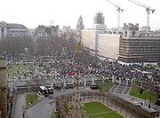
Parliament Square

Encyclopedia
Town square
A town square is an open public space commonly found in the heart of a traditional town used for community gatherings. Other names for town square are civic center, city square, urban square, market square, public square, and town green.Most town squares are hardscapes suitable for open markets,...
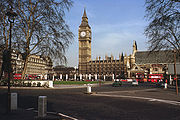
outside the northwest end of the Palace of Westminster
Palace of Westminster
The Palace of Westminster, also known as the Houses of Parliament or Westminster Palace, is the meeting place of the two houses of the Parliament of the United Kingdom—the House of Lords and the House of Commons...
in London
London
London is the capital city of :England and the :United Kingdom, the largest metropolitan area in the United Kingdom, and the largest urban zone in the European Union by most measures. Located on the River Thames, London has been a major settlement for two millennia, its history going back to its...
. It features a large open green area in the middle, with a group of trees to its west. It contains statues of famous statesmen and is the scene of rallies and protests, as well as being a tourist destination. It symbolically represents different arms of the state on each side of the square - Legislature to the east (the Houses of Parliament), Executive to the north (Whitehall
Whitehall
Whitehall is a road in Westminster, in London, England. It is the main artery running north from Parliament Square, towards Charing Cross at the southern end of Trafalgar Square...
), Judiciary to the west (the Supreme Court
Supreme Court of the United Kingdom
The Supreme Court of the United Kingdom is the supreme court in all matters under English law, Northern Ireland law and Scottish civil law. It is the court of last resort and highest appellate court in the United Kingdom; however the High Court of Justiciary remains the supreme court for criminal...
), and Church to the south (Westminster Abbey
Westminster Abbey
The Collegiate Church of St Peter at Westminster, popularly known as Westminster Abbey, is a large, mainly Gothic church, in the City of Westminster, London, United Kingdom, located just to the west of the Palace of Westminster. It is the traditional place of coronation and burial site for English,...
).
Location
Westminster Abbey
The Collegiate Church of St Peter at Westminster, popularly known as Westminster Abbey, is a large, mainly Gothic church, in the City of Westminster, London, United Kingdom, located just to the west of the Palace of Westminster. It is the traditional place of coronation and burial site for English,...
and St Margaret's, Westminster, the Middlesex Guildhall
Middlesex Guildhall
The Middlesex Guildhall is the home of the Supreme Court of the United Kingdom and of the Judicial Committee of the Privy Council. It stands on the south-west corner of Parliament Square in London.-History:...
(the seat of the Supreme Court of the United Kingdom
Supreme Court of the United Kingdom
The Supreme Court of the United Kingdom is the supreme court in all matters under English law, Northern Ireland law and Scottish civil law. It is the court of last resort and highest appellate court in the United Kingdom; however the High Court of Justiciary remains the supreme court for criminal...
), Government Offices Great George Street
Government Offices Great George Street
Government Offices Great George Street is a large UK Government office building situated in Westminster between Horse Guards Road, Parliament Street, King Charles Street and Parliament Square.-Description:...
serving HM Treasury
HM Treasury
HM Treasury, in full Her Majesty's Treasury, informally The Treasury, is the United Kingdom government department responsible for developing and executing the British government's public finance policy and economic policy...
and HM Revenue and Customs, and Portcullis House
Portcullis House
Portcullis House is an office building in Westminster, London, UK, that was commissioned in 1992 and opened in 2001 to provide offices for 213 Members of Parliament and their staff, augmenting limited space in the Palace of Westminster and surroundings....
(and so Westminster tube station
Westminster tube station
Westminster is a London Underground station in the City of Westminster. It is served by the Circle, District and Jubilee lines. On the Circle and District lines, the station is between St. James's Park and Embankment and, on the Jubilee line it is between Green Park and Waterloo. It is in...
).
Roads coming off the square are St Margaret Street (becoming Abingdon Street and then Millbank
Millbank
Millbank is an area of central London in the City of Westminster. Millbank is located by the River Thames, east of Pimlico and south of Westminster...
), Broad Sanctuary (becoming Victoria Street), Great George Street (which becomes Birdcage Walk
Birdcage Walk
Birdcage Walk is a street in London, United Kingdom, in the City of Westminster. It runs east-west as a continuation of Great George Street, from the crossroads with Horse Guards Road and Storey's Gate, with the Treasury building on the north east corner, to a junction with Buckingham Gate, at the...
), Parliament Street (becoming Whitehall
Whitehall
Whitehall is a road in Westminster, in London, England. It is the main artery running north from Parliament Square, towards Charing Cross at the southern end of Trafalgar Square...
), and Bridge Street (becoming Westminster Bridge
Westminster Bridge
Westminster Bridge is a road and foot traffic bridge over the River Thames between Westminster on the north side and Lambeth on the south side, in London, England....
).
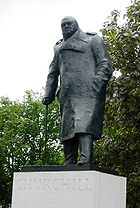
Statues in and around the square are mostly of well-known statesmen, and include ones of
Statue of Winston Churchill, Parliament Square
thumb|right|The statue of Winston Churchill, on the north east corner of Parliament SquareThe statue of Winston Churchill in Parliament Square, London, is a bronze sculpture of former Prime Minister Sir Winston Churchill created by Ivor Roberts-Jones. It is located in a spot referred to in the...
Winston Churchill
Winston Churchill
Sir Winston Leonard Spencer-Churchill, was a predominantly Conservative British politician and statesman known for his leadership of the United Kingdom during the Second World War. He is widely regarded as one of the greatest wartime leaders of the century and served as Prime Minister twice...
(on the north-Eastern edge of the green and facing east, overlooking Parliament), Abraham Lincoln
Abraham Lincoln
Abraham Lincoln was the 16th President of the United States, serving from March 1861 until his assassination in April 1865. He successfully led his country through a great constitutional, military and moral crisis – the American Civil War – preserving the Union, while ending slavery, and...
(in front of Middlesex Guildhall), Robert Peel
Robert Peel
Sir Robert Peel, 2nd Baronet was a British Conservative statesman who served as Prime Minister of the United Kingdom from 10 December 1834 to 8 April 1835, and again from 30 August 1841 to 29 June 1846...
(south-western edge of the green), Lord Palmerston (north-western edge of the green), Jan Christian Smuts
Jan Smuts
Jan Christiaan Smuts, OM, CH, ED, KC, FRS, PC was a prominent South African and British Commonwealth statesman, military leader and philosopher. In addition to holding various cabinet posts, he served as Prime Minister of the Union of South Africa from 1919 until 1924 and from 1939 until 1948...
(northern edge of the green), Derby
Edward Smith-Stanley, 14th Earl of Derby
Edward George Geoffrey Smith-Stanley, 14th Earl of Derby, KG, PC was an English statesman, three times Prime Minister of the United Kingdom, and to date the longest serving leader of the Conservative Party. He was known before 1834 as Edward Stanley, and from 1834 to 1851 as Lord Stanley...
, Disraeli
Benjamin Disraeli, 1st Earl of Beaconsfield
Benjamin Disraeli, 1st Earl of Beaconsfield, KG, PC, FRS, was a British Prime Minister, parliamentarian, Conservative statesman and literary figure. Starting from comparatively humble origins, he served in government for three decades, twice as Prime Minister of the United Kingdom...
, and George Canning
George Canning
George Canning PC, FRS was a British statesman and politician who served as Foreign Secretary and briefly Prime Minister.-Early life: 1770–1793:...
.
On 29 August 2007, a 9 feet (2.7 m) bronze statue of Nelson Mandela
Nelson Mandela
Nelson Rolihlahla Mandela served as President of South Africa from 1994 to 1999, and was the first South African president to be elected in a fully representative democratic election. Before his presidency, Mandela was an anti-apartheid activist, and the leader of Umkhonto we Sizwe, the armed wing...
was erected in the square, Westminster City Council having objected to its erection in Trafalgar Square
Trafalgar Square
Trafalgar Square is a public space and tourist attraction in central London, England, United Kingdom. At its centre is Nelson's Column, which is guarded by four lion statues at its base. There are a number of statues and sculptures in the square, with one plinth displaying changing pieces of...
, due to space considerations. It was unveiled by the British Prime Minister, Gordon Brown
Gordon Brown
James Gordon Brown is a British Labour Party politician who was the Prime Minister of the United Kingdom and Leader of the Labour Party from 2007 until 2010. He previously served as Chancellor of the Exchequer in the Labour Government from 1997 to 2007...
, in the presence of Wendy Woods, the widow of Donald Woods
Donald Woods
Donald James Woods, CBE was a white South African journalist and anti-apartheid activist.As editor of the Daily Dispatch from 1965 to 1977, he befriended Steve Biko, leader of the anti-apartheid Black Consciousness Movement, and was banned by the government soon after Biko's death, which had been...
, the late anti-apartheid campaigner, and the British actor, director and long-time friend of Woods, Lord Attenborough.
History
Palace of Westminster
The Palace of Westminster, also known as the Houses of Parliament or Westminster Palace, is the meeting place of the two houses of the Parliament of the United Kingdom—the House of Lords and the House of Commons...
and improve traffic flow, and featured London's first traffic signals. A substantial amount of property had to be cleared from the site. The architect responsible was Sir Charles Barry
Charles Barry
Sir Charles Barry FRS was an English architect, best known for his role in the rebuilding of the Palace of Westminster in London during the mid-19th century, but also responsible for numerous other buildings and gardens.- Background and training :Born on 23 May 1795 in Bridge Street, Westminster...
. Its original features included the Buxton Memorial Fountain
Buxton Memorial Fountain
The Buxton Memorial Fountain is a memorial and drinking fountain in London, the United Kingdom, that commemorates the emancipation of slaves in the British Empire in 1834....
, which was removed in 1940 and placed in its present position in nearby Victoria Tower Gardens
Victoria Tower Gardens
Victoria Tower Gardens is a public park along the north bank of the River Thames in London. As its name suggests, it is adjacent to the Victoria Tower, the south-western corner of the Palace of Westminster...
in 1957. In 1950 the square was redesigned by George Grey Wornum
George Grey Wornum
George Grey Wornum was a British architect.Grey Wornum was born in London and educated at Bradfield College and the Slade School of Art. He studied architecture under the guidance of his uncle, Ralph Selden Wornum...
. The central garden of the square was transferred from the Parliamentary Estate to the control of the Greater London Authority
Greater London Authority
The Greater London Authority is the top-tier administrative body for Greater London, England. It consists of a directly elected executive Mayor of London, currently Boris Johnson, and an elected 25-member London Assembly with scrutiny powers...
by the Greater London Authority Act 1999
Greater London Authority Act 1999
The Greater London Authority Act 1999 is the Act of Parliament that established the Greater London Authority, the London Assembly and the Mayor of London....
. It has responsibility to light, cleanse, water, pave, and repair the garden, and has powers to make bylaw
Bylaw
By-law can refer to a law of local or limited application passed under the authority of a higher law specifying what things may be regulated by the by-law...
s for the garden.
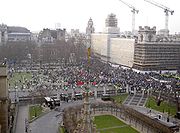
The east side of the square, lying opposite one of the key entrances to the Palace of Westminster, has historically been a common site of protest against government action or inaction. On May Day
May Day
May Day on May 1 is an ancient northern hemisphere spring festival and usually a public holiday; it is also a traditional spring holiday in many cultures....
2000 the square was transformed into a giant allotment
Allotment (gardening)
An allotment garden, often called simply an allotment, is a plot of land made available for individual, non-professional gardening. Such plots are formed by subdividing a piece of land into a few or up to several hundreds of land parcels that are assigned to individuals or families...
by a Reclaim the Streets
Reclaim the Streets
Reclaim The Streets is a collective with a shared ideal of community ownership of public spaces. Participants characterize the collective as a resistance movement opposed to the dominance of corporate forces in globalization, and to the car as the dominant mode of transport.-Protests:Reclaim The...
guerrilla gardening
Guerrilla gardening
Guerrilla gardening is gardening on another person's land without permission. It encompasses a very diverse range of people and motivations, from the enthusiastic gardener who spills over their legal boundaries to the highly political gardener who seeks to provoke change through direct action. It...
action. Most recently, Brian Haw
Brian Haw
Brian William Haw was an English protester and peace campaigner who lived for almost ten years in a camp in London's Parliament Square from 2001, in a protest against UK and US foreign policy...
staged a continual protest there for several years, campaigning against British and American action
2003 invasion of Iraq
The 2003 invasion of Iraq , was the start of the conflict known as the Iraq War, or Operation Iraqi Freedom, in which a combined force of troops from the United States, the United Kingdom, Australia and Poland invaded Iraq and toppled the regime of Saddam Hussein in 21 days of major combat operations...
in Iraq
Iraq
Iraq ; officially the Republic of Iraq is a country in Western Asia spanning most of the northwestern end of the Zagros mountain range, the eastern part of the Syrian Desert and the northern part of the Arabian Desert....
. Starting on 2 June 2001, Haw left his post only once, on 10 May 2004 - and then because he had been arrested on the charge of failing to leave the area during a security alert, and returned the following day when he was released. The disruption that Haw's protest is alleged to have caused led Parliament to insert a clause into the Serious Organised Crime and Police Act 2005
Serious Organised Crime and Police Act 2005
The Serious Organized Crime and Police Act 2005 is an Act of the Parliament of the United Kingdom aimed primarily at creating the Serious Organised Crime Agency, it also significantly extended and simplified the powers of arrest of a constable and introduced restrictions on protests in the...
making it illegal to have protests in Parliament Square (or, indeed, in a large area reaching roughly half a mile in all directions) without first seeking the permission of the Metropolitan Police Commissioner. The provisions of the Serious Organised Crime and Police Act relating to Parliament Square were repealed by the Police Reform and Social Responsibility Act 2011
Police Reform and Social Responsibility Act 2011
The Police Reform and Social Responsibility Act 2011 is an Act of the Parliament of the United Kingdom. It transfers the control of police forces from police authorities to elected "police and crime commissioners"...
, which provides for a different regime of "prohibited activities".
As well as sparking a great deal of protest from various groups on the grounds of infringement of civil liberties
Civil liberties
Civil liberties are rights and freedoms that provide an individual specific rights such as the freedom from slavery and forced labour, freedom from torture and death, the right to liberty and security, right to a fair trial, the right to defend one's self, the right to own and bear arms, the right...
including the European Convention on Human Rights
European Convention on Human Rights
The Convention for the Protection of Human Rights and Fundamental Freedoms is an international treaty to protect human rights and fundamental freedoms in Europe. Drafted in 1950 by the then newly formed Council of Europe, the convention entered into force on 3 September 1953...
, the Act was initially unsuccessful in accomplishing its goals: Brian Haw was held to be exempt from needing authorisation in a High Court ruling, as his protest had started before the Act came into effect (though any new protests would be covered); Haw remained in Parliament Square. Later, the Court of Appeal overturned this ruling, forcing Haw to apply for police authorisation to continue his protest.
Democracy Village
In May 2010, a peace camp known as Democracy Village was set up in the Square to protest (initially) against the UK government's involvement in invasions on the Middle EastMiddle East
The Middle East is a region that encompasses Western Asia and Northern Africa. It is often used as a synonym for Near East, in opposition to Far East...
, which became an electic movement encompassing left-wing causes and anti-globalisation protests. The Mayor of London, Boris Johnson
Boris Johnson
Alexander Boris de Pfeffel Johnson is a British journalist and Conservative Party politician, who has been the elected Mayor of London since 2008...
applied to the courts to have them removed and, after they lost an appeal in July 2010, Lord Neuberger ruled that the peace protesters should be evicted. Tents have since returned at the end of 2010, this time on the paving and not on the actual grass itself which is protected by fencing.
Additional statues
Panoramas
Further reading
- Simon Bradley and Nikolaus PevsnerNikolaus PevsnerSir Nikolaus Bernhard Leon Pevsner, CBE, FBA was a German-born British scholar of history of art and, especially, of history of architecture...
, The Buildings of England, London 6: Westminster (2003). ISBN 0-300-09595-3.