
All Topics  
Parkes Observatory

 
Parkes Observatory

   Email Print
   Bookmark   Link


Parkes Observatory


The Parkes Observatory is a radio telescope
Radio telescope

A radio telescope is a form of Directional antennae radio Antenna used in radio astronomy and in tracking and collecting data from satellites and space probes....
 observatory, 20 kilometres north of the town of Parkes
Parkes, New South Wales

Parkes is a town in New South Wales, Australia. It has a population of approximately 11,700 . It is the main settlement in the Local Government Areas of Australia of Parkes Shire Council....
, New South Wales
New South Wales

New South Wales is Australia's oldest and most populous States and territories of Australia, located in the south-east of the country, north of Victoria and south of Queensland....
, Australia
Australia

Australia, officially the Commonwealth of Australia, is a country in the southern hemisphere comprising the Australia of the world's smallest continent, the major island of Tasmania, and numerous list of islands of Australia in the Indian Ocean and Pacific Oceans....
. It was one of several radio antennas used to receive images of the Apollo 11
Apollo 11

The Apollo 11 mission was the first manned mission to land on the Moon. It was the fifth human spaceflight of Apollo program and the third human voyage to the Moon....
 moon landing in July 1969.

Parkes Radiothermal Telescope, completed in 1961, was the brainchild of E.G. (Taffy) Bowen, chief of the CSIRO's Radiophysics Laboratory. During the Second World War, he had worked on radar development in America and had made some powerful friends in the scientific community.


Discussion
Ask a question about 'Parkes Observatory'
Start a new discussion about 'Parkes Observatory'
Answer questions from other users
Full Discussion Forum


Recent Posts


Encyclopedia


The Parkes Observatory is a radio telescope
Radio telescope

A radio telescope is a form of Directional antennae radio Antenna used in radio astronomy and in tracking and collecting data from satellites and space probes....
 observatory, 20 kilometres north of the town of Parkes
Parkes, New South Wales

Parkes is a town in New South Wales, Australia. It has a population of approximately 11,700 . It is the main settlement in the Local Government Areas of Australia of Parkes Shire Council....
, New South Wales
New South Wales

New South Wales is Australia's oldest and most populous States and territories of Australia, located in the south-east of the country, north of Victoria and south of Queensland....
, Australia
Australia

Australia, officially the Commonwealth of Australia, is a country in the southern hemisphere comprising the Australia of the world's smallest continent, the major island of Tasmania, and numerous list of islands of Australia in the Indian Ocean and Pacific Oceans....
. It was one of several radio antennas used to receive images of the Apollo 11
Apollo 11

The Apollo 11 mission was the first manned mission to land on the Moon. It was the fifth human spaceflight of Apollo program and the third human voyage to the Moon....
 moon landing in July 1969.

The radio telescope

The Parkes Radiothermal Telescope, completed in 1961, was the brainchild of E.G. (Taffy) Bowen, chief of the CSIRO's Radiophysics Laboratory. During the Second World War, he had worked on radar development in America and had made some powerful friends in the scientific community. Calling on this old boy network, he persuaded two philanthropic organisations, the Carnegie Corporation and the Rockefeller Foundation
Rockefeller Foundation

The Rockefeller Foundation is a prominent philanthropic organization and private foundation based at 420 Fifth Avenue, New York City. The preeminent institution established by the six-generation Rockefeller family, it was founded by John D....
 to fund half the cost of the telescope. It was this recognition and key financial support from America that persuaded then Prime Minister Robert Menzies
Robert Menzies

Sir Robert Gordon Menzies, Order of the Thistle, Order of Australia, Order of the Companions of Honour, Queen's Counsel , Australian politician, was the twelfth Prime Minister of Australia....
 to agree to fund the rest of the project.

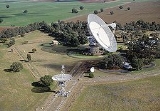
The primary observing instrument is the 64-metre movable dish telescope, second largest in the Southern Hemisphere, and one of the first large movable dishes in the world (DSS-43 at Tidbinbilla was extended from 64 m to 70 m in 1987, surpassing Parkes). After its completion it has operated almost continuously to the present day. The dish surface was physically upgraded by adding smooth metal plates to the central part to provide focusing capability for centimetre and millimetre length microwave
Microwave

Microwaves are electromagnetic radiation with wavelengths ranging from 1 mm to 1 m, or frequency between 0.3 hertz and 300 GHz....
s. The outer part of the dish remains a fine metal mesh, creating its distinctive two-tone appearance.

The 18m dish antenna in the foreground of the photo was transferred from the Fleurs Observatory (Mills Cross) in 1963. It was used as a transmit uplink antenna in the Apollo program and has been abandoned since the early 1980s.

The telescope has an altazimuth mount
Altazimuth mount

An Altazimuth or alt-azimuth mount is a simple two-coordinate axis mount for supporting and rotating an instrument about two mutually perpendicular axes; a horizontal axis, and a vertical axis....
. It is guided by a small mock-telescope placed within the structure at the same rotational axes as the dish, but with an equatorial mount
Equatorial mount

An equatorial mount is a mount that has one rotational axis parallel to the Earth's axis of rotation. This type of mount is used with telescopes, satellite dishes, and cameras....
. The two are dynamically locked when tracking an astronomical object by a laser
Laser

A laser is a device that emits light through a process called stimulated emission. The term laser is an acronym for light amplification by stimulated emission of radiation....
 guiding system. This primary-secondary approach was designed by Barnes Wallis
Barnes Wallis

Sir Barnes Neville Wallis, Order of the British Empire|CBE]] Fellow of the Royal Society, Royal Designers for Industry, Fellow of the Royal Aeronautical Society , was an English scientist, engineer and inventor....
.

The success of the Parkes telescope led NASA
NASA

The National Aeronautics and Space Administration is an agency of the Federal government of the United States, responsible for the nation's public list of space agencies....
 to copy the basic design in their Deep Space Network
Deep Space Network

The Deep Space Network, or DSN, is an international Wiktionary:network of communication facilities that supports interplanetary spacecraft missions, and radio astronomy and radar astronomy observations for the exploration of the solar system and the universe....
, with matching 64 m dishes built at Goldstone
Goldstone Deep Space Communications Complex

The Goldstone Deep Space Communications Complex —commonly called the Goldstone Observatory— is located in California's Mojave Desert ....
, Madrid
Madrid Deep Space Communication Complex

The Madrid Deep Space Communications Complex is a ground station located in Robledo de Chavela, Spain, and operated by Ingenieria y Servicios Aeroespaciales, S.A....
 and Tidbinbilla
Canberra Deep Space Communication Complex

The Canberra Deep Space Communication Complex is a ground station that is located in Australia at Tidbinbilla in the Paddys River valley, about half an hour's drive out of Canberra in the Australian Capital Territory....
.

The receiving cabin is located at the focus of the parabolic dish, supported by three struts 27 metres above the dish. The cabin contains multiple radio
Radio

Radio is the transmission of signals, by modulation of electromagnetic radiation with frequency below those of visible light.Electromagnetic radiation radio propagation by means of oscillating electromagnetic fields that pass through the air and the vacuum of space....
 and microwave
Microwave

Microwaves are electromagnetic radiation with wavelengths ranging from 1 mm to 1 m, or frequency between 0.3 hertz and 300 GHz....
 detectors, which can be switched into the focus beam for different science observations.

The observatory is a part of the Australia Telescope National Facility
Australia Telescope National Facility

The Australia Telescope National Facility is a division of the Commonwealth Scientific and Industrial Research Organisation of Australia, and is a government-operated research facility dedicated to radio astronomy....
 network of radio telescopes. The 64m dish is frequently operated together with the Australia Telescope Compact Array
Australia Telescope Compact Array

The Australia Telescope Compact Array is a radio telescope at the Paul Wild Observatory, twenty five kilometres west of the town of Narrabri, New South Wales in Australia....
 at Narrabri and a single dish at Mopra
Mopra Observatory

The 22-metre Mopra Radio Telescope, located near Coonabarabran, New South Wales, is part of the Australia Telescope National Facility, operated by CSIRO....
, to form a very long baseline interferometry
Very Long Baseline Interferometry

Very Long Baseline Interferometry is a type of astronomical interferometer used in radio astronomy. It allows observations of an object that are made simultaneously by many telescopes to be combined, emulating a telescope with a size equal to the maximum separation between the telescopes....
 array.

During the Apollo missions to the moon
Moon

The Moon is Earth's only natural satellite and the List of natural satellites by diameter satellite in the Solar System. The average centre-to-centre distance from the Earth to the Moon is km, about thirty times the diameter of the Earth....
, the Parkes Observatory was used to relay communication and telemetry signals to NASA
NASA

The National Aeronautics and Space Administration is an agency of the Federal government of the United States, responsible for the nation's public list of space agencies....
, providing coverage for when the moon was on the Australian side of the Earth.

The observatory has remained involved in tracking numerous space missions up to the present day, including the Mariner 2
Mariner 2

Mariner 2 , a space probe to Venus, was the first successful spacecraft in the NASA Mariner program. It was a simplified version of the Block I spacecraft of the Ranger program and an exact copy of Mariner 1....
, Mariner 4
Mariner 4

Mariner 4 was the Mariner program, launched on November 28, 1964, intended for planetary exploration in a flyby mode and performed the first successful planetary flyby of the planet Mars, returning the first pictures of the Martian surface....
, Voyager, Giotto
Giotto mission

Giotto was a European robotic spacecraft mission from the European Space Agency, intended to fly by and study Comet Halley. On 13 March 1986, the mission succeeded in approaching Halley's nucleus at a distance of 596 kilometers....
, Galileo
Galileo spacecraft

Galileo was an unmanned spacecraft sent by NASA to study the planet Jupiter and its natural satellites. Named after the astronomer and Renaissance pioneer Galileo Galilei, it was launched on October 18, 1989 by the Space Shuttle Atlantis on the STS-34 mission....
 and Cassini-Huygens
Cassini-Huygens

Cassini?Huygens is a joint NASA/European Space Agency robotic spacecraft mission currently studying the planet Saturn and Saturn's natural satellites....
 probes. It is also a major world centre for research into pulsar
Pulsar

Pulsars are highly magnetized, rotating neutron stars that emit a beam of electromagnetic radiation. The observed periods of their pulses range from 1.4 milliseconds to 8.5 seconds....
s, with more than half of those currently known today discovered at the Parkes Observatory. Between 1997 and 2002 it conducted the HIPASS
HIPASS

The HI Parkes All Sky Survey was an astronomical survey for Hydrogen line. Data was taken between 1997 and 2002 using the Parkes Observatory. HIPASS covered 71% of the sky and identified 5317 sources emitting HI's signature wavelength....
 neutral hydrogen survey, the largest blind survey for galaxies in the neutral hydrogen line to date.

Parkes Observatory Radio Telescope
The observatory and telescope were featured in the 2000 film The Dish
The Dish

The Dish is a 2000 Australian film that tells the story of how the Parkes Observatory was used to relay the live television of man's first steps on the moon, during the Apollo 11 mission in 1969....
, a fictionalised account of the observatory's involvement with the Apollo 11
Apollo 11

The Apollo 11 mission was the first manned mission to land on the Moon. It was the fifth human spaceflight of Apollo program and the third human voyage to the Moon....
 moon landing.

Apollo 11 broadcast

When Buzz Aldrin switched on the TV camera on the Lunar Module, three tracking antennas received the signals simultaneously. They were the 64 metre Goldstone antenna in California, the 26 metre antenna at Honeysuckle Creek near Canberra in Australia, and the 64 metre dish at Parkes. In the first few minutes of the broadcast, NASA alternated between the signals being received from its two stations at Goldstone and Honeysuckle Creek, searching for the best quality picture. A little under nine minutes into the broadcast, the TV was switched to the Parkes signal. The quality of the TV pictures from Parkes was so superior that NASA stayed with Parkes as the source of the TV for the remainder of the 2.5 hour broadcast. For a comprehensive explanation of the TV reception of the Apollo 11 broadcast, see from the report .

See also

  • Apollo program missing tapes
    Apollo program missing tapes

    The Apollo missing tapes are the missing original recordings of the transmissions broadcast during the Apollo 11 Extra-vehicular activity. The tapes included Slow-scan television and telemetry data....
  • Parkes Spacemen
    Parkes Spacemen

    Parkes RLFC, nicknamed the Parkes Spacemen, is a rugby league club from Parkes, New South Wales, New South Wales, Australia. It is a Group 11 Rugby League club....


External links