


Paris Psalter

Encyclopedia
Byzantine art
Byzantine art is the term commonly used to describe the artistic products of the Byzantine Empire from about the 5th century until the Fall of Constantinople in 1453....
illuminated manuscript
Illuminated manuscript
An illuminated manuscript is a manuscript in which the text is supplemented by the addition of decoration, such as decorated initials, borders and miniature illustrations...
containing 449 folios and 14 full-page miniatures "in a grand, almost classical style", as the Encyclopædia Britannica
Encyclopædia Britannica
The Encyclopædia Britannica , published by Encyclopædia Britannica, Inc., is a general knowledge English-language encyclopaedia that is available in print, as a DVD, and on the Internet. It is written and continuously updated by about 100 full-time editors and more than 4,000 expert...
put it.
Together with Basil I
Basil I
Basil I, called the Macedonian was a Byzantine emperor of probable Armenian descent who reigned from 867 to 886. Born a simple peasant in the Byzantine theme of Macedonia, he rose in the imperial court, and usurped the imperial throne from Emperor Michael III...
's Homilies of St Gregory Nazianzus, the Paris Psalter is considered a key monument of the so-called Macedonian Renaissance
Macedonian Renaissance
Macedonian Renaissance is a label sometimes used to describe the period of the Macedonian dynasty of the Byzantine Empire , especially the 10th century, which some scholars have seen as a time of increased interest in classical scholarship and the assimilation of classical motifs into Christian...
in Byzantine art
Byzantine art
Byzantine art is the term commonly used to describe the artistic products of the Byzantine Empire from about the 5th century until the Fall of Constantinople in 1453....
during the 10th century.
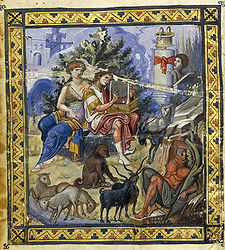
The most famous miniature depicts David
David
David was the second king of the united Kingdom of Israel according to the Hebrew Bible and, according to the Gospels of Matthew and Luke, an ancestor of Jesus Christ through both Saint Joseph and Mary...
playing the harp at the side of the seated female figure of "Melody
Melody
A melody , also tune, voice, or line, is a linear succession of musical tones which is perceived as a single entity...
" (illustrated, to the right). Around this central group are the figure of Echo
Echo (mythology)
In Greek mythology, Ekho , "echo", itself from ἦχος , "sound") was an Oread who loved her own voice. Zeus loved consorting with beautiful nymphs and visited them on Earth often. Eventually, Zeus's wife, Hera, became suspicious, and came from Mt...
, various animals charmed by music, and even a male figure symbolising the town of Bethlehem
Bethlehem
Bethlehem is a Palestinian city in the central West Bank of the Jordan River, near Israel and approximately south of Jerusalem, with a population of about 30,000 people. It is the capital of the Bethlehem Governorate of the Palestinian National Authority and a hub of Palestinian culture and tourism...
. The whole composition was likely modelled on a Greco-Roman wall painting representing Orpheus
Orpheus
Orpheus was a legendary musician, poet, and prophet in ancient Greek religion and myth. The major stories about him are centered on his ability to charm all living things and even stones with his music; his attempt to retrieve his wife from the underworld; and his death at the hands of those who...
charming the world with his music.
This and other miniatures are so Hellenistic in execution and so unlike the received notion of what medieval art in general and Byzantine art
Byzantine art
Byzantine art is the term commonly used to describe the artistic products of the Byzantine Empire from about the 5th century until the Fall of Constantinople in 1453....
in particular should look like, that most 19th-century authorities dated the manuscript to the time of Justinian. The Byzantists Hugo Buchthal and Kurt Weitzmann
Kurt Weitzmann
Kurt Weitzmann was born in Klein Almerode Germany on May 7, 1904 and died in Princeton, New Jersey on June 7, 1993. He was a highly influential art historian who studied Byzantine and medieval art. He attended the universities of Münster, Würzburg and Vienna before moving to Princeton in 1935, due...
conclusively demonstrated that the book was created in the 10th century, however.