
All Topics  
Parasitic worm

 
Parasitic Worm

   Email Print
   Bookmark   Link


Parasitic worm


See also Parasitic worm (disambiguation)
Parasitic worm (disambiguation)

Parasitic worm may refer to:*Helminth collectively describes the unrelated "worm-like" groups platyhelminthes and nematoda*Platyhelminthes, or flatworms the phyla which contains the parasitic tapeworms and flukes...
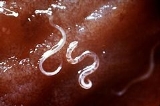
Parasitic worms or helminths are a division of eukaroytic parasites that, unlike external parasites such as lice and fleas, live inside their host. They are worm-like organism
Organism

In biology, an organism is any life thing . In at least some form, all organisms are capable of response to stimulus , reproduction, growth and developmental biology, and maintenance of homeostasis as a stable whole....
s that live and feed off living hosts
Host (biology)

In biology, a host is an organism that harbors a virus or parasite, or a mutual or commensal symbiont, typically providing nourishment and shelter....
, receiving nourishment and protection while disrupting their hosts' nutrient
Nutrient

A nutrient is a chemical that an organism needs to live and grow or a substance used in an organism's metabolism which must be taken in from its environment....
 absorption, causing weakness and disease
Disease

A disease or medical condition is an abnormal condition of an organism that impairs bodily functions, associated with specific symptoms and Medical signs....
. Those that live inside the digestive tract are called intestinal parasite
Intestinal parasite

Intestinal parasites are parasites that populate the gastro-intestinal tract in humans. They can live throughout the body, but most prefer the intestinal wall....
s. They can live inside humans as well as other animals.

Helminthology
Helminthology

Helminthology is the study of worms and especially parasitic worms. This field deals with the study of their taxonomy and the effect on their host s....
 is the study of parasitic worms and their effect on their host
Host (biology)

In biology, a host is an organism that harbors a virus or parasite, or a mutual or commensal symbiont, typically providing nourishment and shelter....
s.

Parasitic worms are categorized into three groups: cestodes, nematodes, and trematodes.


Discussion
Ask a question about 'Parasitic worm'
Start a new discussion about 'Parasitic worm'
Answer questions from other users
Full Discussion Forum


Encyclopedia


See also Parasitic worm (disambiguation)
Parasitic worm (disambiguation)

Parasitic worm may refer to:*Helminth collectively describes the unrelated "worm-like" groups platyhelminthes and nematoda*Platyhelminthes, or flatworms the phyla which contains the parasitic tapeworms and flukes...
Parasitic worms or helminths are a division of eukaroytic parasites that, unlike external parasites such as lice and fleas, live inside their host. They are worm-like organism
Organism

In biology, an organism is any life thing . In at least some form, all organisms are capable of response to stimulus , reproduction, growth and developmental biology, and maintenance of homeostasis as a stable whole....
s that live and feed off living hosts
Host (biology)

In biology, a host is an organism that harbors a virus or parasite, or a mutual or commensal symbiont, typically providing nourishment and shelter....
, receiving nourishment and protection while disrupting their hosts' nutrient
Nutrient

A nutrient is a chemical that an organism needs to live and grow or a substance used in an organism's metabolism which must be taken in from its environment....
 absorption, causing weakness and disease
Disease

A disease or medical condition is an abnormal condition of an organism that impairs bodily functions, associated with specific symptoms and Medical signs....
. Those that live inside the digestive tract are called intestinal parasite
Intestinal parasite

Intestinal parasites are parasites that populate the gastro-intestinal tract in humans. They can live throughout the body, but most prefer the intestinal wall....
s. They can live inside humans as well as other animals.

Helminthology
Helminthology

Helminthology is the study of worms and especially parasitic worms. This field deals with the study of their taxonomy and the effect on their host s....
 is the study of parasitic worms and their effect on their host
Host (biology)

In biology, a host is an organism that harbors a virus or parasite, or a mutual or commensal symbiont, typically providing nourishment and shelter....
s.

Parasitic worms are categorized into three groups: cestodes, nematodes, and trematodes.
Hookworms
Tenia Solium Scolex
Threadworm
These are the principal morphologic differences of the different families of helminths:

!CestodesTrematodes Nematodes
Shapesegmented planeplane no segmentedcylindrical
CelomaNOTNOTPresent
digestive tubeNOTEnds in cecumEnds in anus
SexHermaphroditesHermaphrodites, except Schistosoma
Schistosoma

A genus of trematodes, Schistosoma spp., commonly known as blood-flukes and bilharzia, cause the most significant infection of humans by flatworms and are considered by the World Health Organization as second in importance only to malaria, with hundreds of millions infected worldwide....
Dioics
hook organ componentoral sucker, botridias and double Rostellar hooksOral suckerLips, teeth, filariform extremities and dentary plates


Diseases caused in humans by helminth infection include ascariasis
Ascariasis

Ascariasis is a human disease caused by the parasite roundworm Ascaris lumbricoides. Perhaps as many as one quarter of the world's people are infected, and ascariasis is particularly prevalent in tropics and in areas of poor hygiene....
, dracunculiasis
Dracunculiasis

Dracunculiasis, more commonly known as Guinea worm disease or Medina Worm, is a parasitism infection caused by the nematode Dracunculus medinensis....
, elephantiasis
Elephantiasis

Elephantiasis is a disease that is characterized by the thickening of the skin and underlying tissues, especially in the legs and genitals. In some cases, the disease can cause certain body parts, such as the scrotum, to swell to the size of a softball or basketball ....
, hookworm
Hookworm

The hookworm is a parasitic worm nematode worm that lives in the small intestine of its host, which may be a mammal such as a dog, cat, or human....
, lymphatic filariasis, onchocerciasis
Onchocerciasis

Onchocerciasis , also known as river blindness, is the world's second leading infection cause of blindness. It is caused by Onchocerca volvulus, a nematode that can live for up to fifteen years in the human body....
, schistosomiasis
Schistosomiasis

Schistosomiasis is a parasitic disease caused by several species of Trematoda of the genus Schistosoma.Although it has a low mortality rate, schistosomiasis often is a chronic illness that can damage internal organs and, in children, impair growth and cognitive development....
, and trichuriasis
Trichuriasis

Trichuriasis is a parasitic disease caused by infection of the large intestine by a parasite whipworm ....
.

Reproduction


Parasitic worms are sequential hermaphrodite
Hermaphrodite

A hermaphrodite is an organism having both male and female reproductive organs. In many species, hermaphroditism is a common part of the life-cycle, enabling a form of sexual reproduction in which partners are not separated into distinct male and female types of individual....
s and reproduce depending on the species of worm, either with the presence of a male and female worm, joining sperm
Sperm

The term sperm is derived from the Greek word sperma and refers to the male reproductive Cell . In the types of sexual reproduction known as anisogamy and oogamy, there is a marked difference in the size of the gametes with the smaller one being termed the "male" or sperm cell....
 and eggs, producing fertile eggs, such as hookworms, or by breaking off segments that contain both male and female sex organs
Organ (anatomy)

In biology, an organ is a biological tissue that performs a specific function or group of functions. Usually there is a main tissue and sporadic tissues....
 that are able to produce fertile eggs without the presence of a male or female. (e.g., tapeworms)

All worm offspring are passed on through poorly-cooked meat
Meat

In modern English usage, meat most often refers to animal biological tissue used as food, mostly skeletal muscle and associated fat, but it may also refer to offal, including livers, skin, brains, bone marrow, kidneys, in some countries lungs, and a variety of other internal organs as well as blood....
, especially pork
Pork

Pork is the culinary name for meat from the domestic pig . The word, pork, is often meant to denote specifically the fresh meat of the pig, but it can be used as an all-inclusive term, to include cured, smoked, or processed meats It is one of the most-commonly consumed meats worldwide, with evidence of pig animal husbandry dating back...
, wild fish
Fish

A fish is any marine biology vertebrate animal that is typically ectothermic , covered with scale , and equipped with two sets of paired fins and several unpaired fins....
, and beef
Beef

Beef is the culinary name for meat from bovines, especially domestic cattle . Beef is one of the principal meats used in the cuisine of Australia, European cuisine and the Americas, and is also important in Africa, East Asia, and Southeast Asia....
, contaminated water, feces
Feces

Feces, faeces, or f?ces is a waste product from an animal's gastrointestinal tract expelled through the anus during defecation....
 and mosquito
Mosquito

Mosquitoes are common flying insects in the family Culicidae that are found around the world. There are about 3,500 species. They have a pair of scaled wings, a pair of halteres, a slender body, and six long legs....
es. However, it is estimated that 40 million Americans are infected with the most common roundworm, the pinworm
Pinworm

The pinworm , also known as threadworm is a parasitic roundworm of the phylum Nematoda....
.

Worm eggs
Egg (biology)

In most birds and reptiles, an egg is the zygote, resulting from fertilization of the ovum. To enable incubation the egg is usually kept within a favourable temperature range as it nourishes and protects the growing embryo....
 or larva
Larva

A larva is a young form of animal with indirect developmental biology, going through or undergoing metamorphosis .The larva can look completely different from the adult form, for example, a caterpillar differs from a butterfly....
e or even adults enter the human body through the mouth, anus, nose, or skin, with most species
Species

In biology, a species is one of the basic units of biological classification and a taxonomic rank. A species is often defined as a group of organisms capable of interbreeding and producing fertile offspring....
 attaching themselves to the intestinal tract
Intestine

In anatomy, the intestine is the segment of the Gastrointestinal tract extending from the stomach to the anus and, in humans and other mammals, consists of two segments, the small intestine and the large intestine....
. With the presence of digestive enzyme
Enzyme

Enzymes are biomolecules that catalysis chemical reactions. Almost all enzymes are proteins. In enzymatic reactions, the molecules at the beginning of the process are called Substrate , and the enzyme converts them into different molecules, the products....
s, worm egg shells are dissolved, releasing a brand-new worm; unlike its egg shell, the parasitic worm is protected from the body's powerful digestive enzymes by producing a protective keratin
Keratin

Keratins are a family of fibrous protein; tough and insoluble, they form the hard but mineral structures found in reptiles, birds, amphibians and mammals....
 layer.

Immune response

Response to worm infection in humans is a Th2
T helper cell

T helper cells are a sub-group of lymphocytes that play an important role in establishing and maximizing the capabilities of the immune system....
 response in the majority of cases. This results in inflammation
Inflammation

Inflammation is the complex biological response of Blood vessel tissues to harmful stimuli, such as pathogens, damaged cells, or irritants. It is a protective attempt by the organism to remove the injurious stimuli as well as initiate the healing process for the tissue....
 of the gut, and results in cyst-like structures forming around the egg deposits throughout the body. The host's lymphatic system is also heavily taxed the longer helminths propagate, which excrete toxins after feeding. These toxins are released into the intestines to be absorbed by the host's bloodstream. This phenomena makes the host susceptible to more common diseases such as seasonal viruses and bacterial infections.

External links