
Quotations
Away, the partial loveThat boldens Nature to sit aboveHer Maker!
Brotherhood is an ideal better understood by example than precept!
Ch. 48 - At Encinitas In California
Grosser light vanishes into eternal raysOf all-pervading Cosmic Joy.From Joy we come,For Joy we live,In the sacred Joy we melt.
It is the call of the beauty — robed onesTo worship the great Beauty.It is the call of GodThrough silent intelligencesAnd starburst of feelings.
Thou art I, I am Thou,Knowing, Knower, Known, as One!
To gaze with looks of wonderment,And to serve all that lives, still or moving.This is to know what love is.He knows who lives it.
More Quotes >>
Encyclopedia
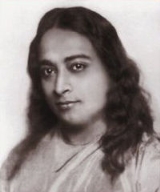
Paramahansa Yogananda , was an
Indian
yogi and
guru. He was instrumental in bringing Kriya Yoga to
the West.
Life
Yogananda was born
Mukunda Lal Ghosh in Gorakhpur,
Uttar Pradesh,
India into a devout
Bengali family. From his earliest years, his awareness and experience of the spiritual was far beyond the ordinary. In his youth he sought out many of India's
Hindu sages and saints, hoping to find an illuminated teacher to guide him in his spiritual quest.
Yogananda met his
guru, Swami
Sri Yukteswar Giri, in 1910, at the age of 17. After passing his Intermediate Examination in Arts from the
Scottish Church College, Calcutta, he did his graduation in religious studies from the
Serampore College, a constituent college of the
University of Calcutta and in 1915, he took formal vows into the
monastic Swami Order and became
Swami Yogananda. In 1917, Yogananda began his life's mission with the founding and running of a school for boys in a remote hamlet of Bengal, called Dihika, by the side of river Damodar, that combined modern educational techniques with
yoga training and spiritual ideals. A year later, the school was shifted to
Ranchi. This school would later become Yogoda Satsanga Society of India, the Indian branch of Paramhansaji's American Organization.
In 1920, he went to the
United States as India's delegate to an International Congress of Religious Liberals convening in
Boston. That same year he founded
Self-Realization Fellowship to disseminate worldwide his teachings on India's ancient practices and philosophy of
Yoga and its tradition of meditation. For the next several years, he lectured and taught on the East coast and in 1924 embarked on a cross-continental speaking tour. The following year, he established in Los Angeles an international headquarters for Self-Realization Fellowship, which became the spiritual and administrative heart of his growing work.
After fifteen years of his services in the West, Sri Yukteswar conferred upon him the title
Paramhansa, which means "supreme swan."
Legacy
Yogananda taught his students the need for direct experience of truth, as opposed to blind belief. He said that “The true basis of religion is not belief, but intuitive experience. Intuition is the soul’s power of knowing God. To know what religion is really all about, one must know God.”
Yogananda, echoing traditional
hindu teachings, taught that the entire universe was created for the
entertainment of Brahman, that everything is simply God's
cosmic "movie show", and that individuals are merely actors in
the "divine play" who change "roles" through reincarnation.
Yogananda advised against taking this "divine delusion" any
more seriously than a movie theatre or television presentation.
Good and evil exist in the divine play just as they exist in
all "screen" plays. There wouldn't be a "play" without them.
To that end, he taught certain yoga techniques that he believed would help the student achieve Self-realization. He said that “Self-Realization is the knowing in all parts of body, mind, and soul that you are now in possession of the kingdom of God; that you do not have to pray that it come to you; that God’s omnipresence is your omnipresence; and that all that you need to do is improve your knowing.”
Yogananda's work is continued by several organizations.
Self-Realization Fellowship, which he founded, is headquartered in Los Angeles and has meditation centers and temples across the world. The current head is Sri Daya Mata, a direct disciple of Yogananda.
, near Nevada City, California, was founded by
Swami Kriyananda, a direct disciple of Yogananda. Ananda is unique in that it expresses an aspect of Yogananda's vision for world brotherhood colonies. Ananda Village is located in
Nevada City, California, with six other Ananda "colonies" worldwide. Ananda also has centers and meditation groups throughout the world.
, near Vanderbilt, Michigan, was founded by Yogacharya Oliver Black, a direct disciple of Yogananda. As of September 2004 work is continuing on building the Clear Light Community on the 800 acre retreat property. The retreat center offers classes on yoga and meditation and hosts programs featuring visiting spiritual teachers.
, located in Lakemont, Georgia, was founded by Roy Eugene Davis, a direct disciple of Yogananda. The CSA publishes books and audio cassettes, and offers meditation seminars at its retreat center headquarters on a voluntary donation basis.
The Puri, India, ashram of Yogananda's guru
Sri Yukteswar Giri continues to this day.
Kriya Yoga
Yogananda's guru lineage was responsible for providing him with a central discipline of his teachings.
Sri Yukteswar was the disciple of
Lahiri Mahasaya, in turn the disciple of the mythical guru
Mahavatar Babaji, who had revived and through his disciples begun the spread of Kriya Yoga, described as a "spiritual science of Self realization." It was through Yogananda that Kriya Yoga was brought to the West.
Autobiography of a Yogi
In 1946, Yogananda published his life story,
Autobiography of a Yogi, which was ins ...
, which was instrumental in introducing vedic philosophy to the West.
It has since been translated into eighteen languages and remains a best seller.
It includes Yogananda's and
Sri Yukteswar's attempts to explain certain verses and events of the Bible such as the Garden of Eden story, and descriptions of Yogananda's encounters with leading spiritual figures such as
Therese Neumann, the Hindu saint Sri Anandamoyi Ma,
Mohandas Gandhi, Nobel laureate in literature
Rabindranath Tagore, noted plant scientist
Luther Burbank , famous Indian scientist Sir
Jagadish Chandra Bose and
Nobel Prize winning physicist Sir
C. V. Raman.
- Note: The 1946 ed. of Autobiography of a Yogi is in the Public Domain and can be downloaded from:
Claims of bodily incorruptibility
Some of Yogananda's followers have made claims of his bodily incorruptibility. As reported in
Time Magazine on August 4, 1952, Harry T. Rowe, Los Angeles Mortuary Director of the Forest Lawn Memorial Park Cemetery in
Glendale, California where he is interred, stated in a notarized letter:
- The absence of any visual signs of decay in the dead body of Paramahansa Yogananda offers the most extraordinary case in our experience.... No physical disintegration was visible in his body even twenty days after death.... No indication of mold was visible on his skin, and no visible drying up took place in the bodily tissues. This state of perfect preservation of a body is, so far as we know from mortuary annals, an unparalleled one.... No odor of decay emanated from his body at any time....
Skeptics point to Yogananda's death certificate, which indicates his body was embalmed. They claim the full text of Rowe's letter, as included in a memorial booklet put out by the SRF, indicates his surprise at the described effect was based merely on the lack of use of special creams in addition to the embalming fluid.
See also
- Samadhi, poem by Yogananda
- Survey of Hindu organisations
External links
- Articles, Photos, Video of Yogananda
- - Complete Online public domain version of the 1946 first edition
- - Complete online edition of Yogananda's Prayer-Poems
- Message Board
- A dissident-disciple site
- Yogananda's interpretation of genesis