


Parades in Northern Ireland

Encyclopedia
Parades are an important part of Northern Irish
culture. Although the majority of parades are held ostensibly by Protestant, unionist
or Ulster loyalist groups, nationalist
, republican
and non-political groups also parade
. Parading is often considered to be an assertion of a group's control over a particular area, and as a result parading can be highly controversial. However in recent years the vast majority of parades have occurred peacefully. A Parades Commission
exists to settle disputes about controversial parades, although not all parading groups recognise the Commission's authority.
(nearly 70% in 2003/4) are organised by Protestant
or unionist
groups, and thus some sections of the community have tended to see attempts to restrict parades as an attack on Protestant or unionist culture. Parades by these sections of the community typically take place on Saturdays. This means that participants and spectators do not have to take time off work, and avoid parading on Sunday, which some Protestants believe should only be spent on purely religious activities. The only exceptions to this are the 12th of July, which is held on the same date each year, (unless the 12th falls on a Sunday, in which case it is postponed to Monday the 13th) and church parades, which are held on Sunday.
holds hundreds of parades throughout Northern Ireland every year. The biggest of these are usually on the twelfth of July ('The Twelfth
'), in commemoration of the Battle of the Boyne
. Individual lodges also parade at various times of the year, particularly leading up to the Twelfth from the start of June. Parades in memory of the dead of World War I
, particularly the 36th (Ulster) Division at the Battle of the Somme are held in July and November. Junior lodges from Armagh
, South Tyrone
and Fermanagh parade annually at the end of May. On the last Saturday in October, Reformation Day
is celebrated with the year's last major Orange parades. In Belfast, these proceed to Saint Anne's Cathedral
for a church service.
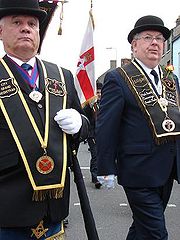 The Apprentice Boys of Derry
exist in commemoration of the Siege of Derry
in the seventeenth century. The Boys' biggest celebration is on the Saturday nearest the 12th of August each year, in commemoration of the lifting of the siege. They also parade on the Saturday nearest 18 December, in commemoration of the original apprentice boys shutting the gates of the town against King James II
's troops, and at Easter. Most Apprentice Boys' parades are held in the city of Derry
.
on the 13th of July, in which an actor playing William of Orange
ritually defeats an actor playing James II
, thus re-enacting the victory of the Williamite forces at the Battle of the Boyne.
in Northern Ireland sometimes parades with brass bands. Salvation Army parades are generally not seen as controversial or sectarian, and their parades have not led to any problems.
s also hold their own parades, often as a fund-raising activity. These are often combined with band competitions—which other bands in the United Kingdom
are invited to compete in—sometimes amounting to over 100 bands for a single parade. Band parades are more regular than loyal order parades, with numerous parades every weekend from early April until the end of September.
, at Easter
, and on Lady Day
. At various points during the Troubles, Hibernians offered to cease parading if Protestant groups did the same.
are a nationalist fraternal organisation. Although they are open to Irish people of any religion, the majority of their members are Catholics. Their main parading date is the Sunday closest to the 1st August.
. This began as a protest against internment
without trial and evolved into a festival that celebrates Gaelic and republican culture. Republican parades are also held in January to commemorate Bloody Sunday
, and at Easter
to commemorate the 1916 Easter Rising
.
(NICRA) and People's Democracy
attempted to use the protest march tactics of contemporary protest movements elsewhere in the world to draw attention to perceived political, social and economic discrimination against the lower class in Northern Ireland. The civil rights marches and the reaction to them were a major contributing factor to the outbreak of The Troubles
, due to heavy handed policing of illegal parades, and republican infultration of non-sectarian workers unions.
, which are not associated with any particular religious tradition. They are subject to the same laws and regulations as other parades.
's parades marking the end of the mayor's term in office. These are usually carnival
-type events that evolved from the more stately affairs held in to many cities in the United Kingdom
since the Middle Ages
. The Belfast parade takes place in May; the 2007 theme was 'Love and Friendship'.
(the Sunday closest to 11 November) are organised by local councils or the British Legion and commemorate war dead of all religious backgrounds. Remembrance Sunday parades usually consist of a march by veterans or local military units or both to a Remembrance Sunday ceremony, usually held at a war memorial, and often another march to a church service.
.
, take part in or organise parades and drills throughout the calendar.
In general debates centre on the route of particular parades; people from one community often object to parades by "the other side" passing through or near "their" area, for example Orange Order parades marching through mainly nationalist or republican areas(see http://orangecitadel.blogspot.com/) A few parades are seen as objectionable regardless of route. These involve or commemorate paramilitary
groups, such as the Provisional Irish Republican Army
and Ulster Defence Association
, and otherwise non-controversial parades have sometimes caused conflict because of a band or lodge carrying a banner or flag associated with a paramilitary group. Gay pride parades have also been controversial.
A Parliamentary Select Committee was set up to investigate the Orange Societies in 1835. When the Select Committee published its report a Cabinet council was held at the Foreign Office for the purpose of agreeing the terms of the resolutions which were to be submitted to the House of Commons by Lord John Russell, Secretary of State for the Home Department, on the 23rd of Feb. 1836. This resolution stated:
The Secretary of State read the following response from the King to the House of Commons on Thursday 25th of Feb. 1836:
The following day Lord Russell read the response of the Grand Master of the Orange Order, the Duke of Cumberland, brother of King William iv to the House of Commons on the 26th of February. It said:
The Grand Orange Lodge of Ireland met in Dublin on April 13, 1836 and voted in favour of dissolving the organisation. However, Orangemen in Portadown met in secret and resolved to set up a provisional Grand Lodge in the town.
The British government's policy of banning sectarian parades was eventually overturned after a campaign of defiance led by William Johnston of Ballykilbeg. The 1st Government of Northern Ireland passed the Civil Authorities (Special Powers) Act (Northern Ireland) 1922
, which allowed the Home Affairs Minister to do virtually anything he thought necessary to preserve law and order. Over the next thirty years this was used many times to ban or re-route nationalist, republican and some left-wing parades, marches and meetings. In 1951, the government passed the Public Order Act
, which required parade organisers to give the police forty-eight hours notice of their intent to parade. The local head of police could then ban or re-route the parade if he felt it might lead to a breach of public order. The only exceptions to this rule were funerals and parades normally held along a particular route. Since Orange parades had been allowed along the same routes without interference for years, this essentially meant that most Orange parades were exempt from having to give notice. The new Act was used disproportionately against nationalist parades, although from time to time Ministers attempted to stop unionist groups from parading through predominantly nationalist areas. This always met with fierce hostility from the Orange Order and often from within the Ulster Unionist Party
that made up the government. Several Home Affairs Ministers were forced to make public apologies after interfering with unionist parades and two (Brian Maginess
and W.W.B. Topping) were moved from the position after banning unionist band parades.
From the late 1960s, parading and marching became a much more fraught issue. The Public Order Act was used against numerous marches, and the issue of parading and of who was allowed to march in what area became even more heated. In 1969 an Apprentice Boys parade in Derry
led to what is now known as the Battle of the Bogside
, considered by many to mark the start of the Troubles
. Several months-long bans on parading were made in the early 1970s, although none of these covered the main Protestant parading period. The Special Powers and Public Order Acts were modified on several occasions in the 1970s and 1980s.
Several areas have been the focus of a disproportionate amount of conflict over parading. These include Derry, Ormeau Road
in Belfast, and especially the Drumcree area of Portadown
. The Drumcree conflict
flared up in the 1970s, the mid 1980s and the mid to late 1990s. Disputes over whether the Orange Order should be allowed to parade through mainly nationalist areas were often accompanied by severe violence. In 1983-4 a group of republican activists in the town researched the history of sectarian violence in the area as part of a campaign to have the Drumcree and other Orange marches banned from nationalist parts of Portadown. Their findings were distributed to visiting journalists in 1997 and presented in abridged form to the Parades Commission
that was set up by the British Government in 1998 in an attempt to deal with contentious parades. An amended version of their findings can be accessed online at http://orangecitadel.blogspot.com/. The Parades Commission has the power to ban, restrict, re-route or impose conditions on any parade in Northern Ireland. The Orange Order has refused to acknowledge the Commission's authority, although the lodges involved in the Drumcree dispute have recently agreed on principle to negotiate.
The Police Service of Northern Ireland
uses different statistics, and recorded a total of 2863 parades in 2007. Of these, 2270 were loyalist, 144 nationalist, and 449 neither. Four of these were illegal and of these three were nationalist. 45 parades were re-routed, of which all but two (one nationalist, one other) were loyalist, and 78 parades had other conditions imposed, of which 70 were loyalist, 7 nationalist and one neither. Disorder occurred at just ten parades, of which nine were loyalist and one nationalist. This is a significant decline from previous years; in 2005 disorder was recorded at 34 parades.
Northern Ireland
Northern Ireland is one of the four countries of the United Kingdom. Situated in the north-east of the island of Ireland, it shares a border with the Republic of Ireland to the south and west...
culture. Although the majority of parades are held ostensibly by Protestant, unionist
Unionism in Ireland
Unionism in Ireland is an ideology that favours the continuation of some form of political union between the islands of Ireland and Great Britain...
or Ulster loyalist groups, nationalist
Irish nationalism
Irish nationalism manifests itself in political and social movements and in sentiment inspired by a love for Irish culture, language and history, and as a sense of pride in Ireland and in the Irish people...
, republican
Irish Republicanism
Irish republicanism is an ideology based on the belief that all of Ireland should be an independent republic.In 1801, under the Act of Union, the Kingdom of Great Britain and the Kingdom of Ireland merged to form the United Kingdom of Great Britain and Ireland...
and non-political groups also parade
Parade
A parade is a procession of people, usually organized along a street, often in costume, and often accompanied by marching bands, floats or sometimes large balloons. Parades are held for a wide range of reasons, but are usually celebrations of some kind...
. Parading is often considered to be an assertion of a group's control over a particular area, and as a result parading can be highly controversial. However in recent years the vast majority of parades have occurred peacefully. A Parades Commission
Parades Commission
The Parades Commission is a quasi-judicial non-departmental public body responsible for placing restrictions on or banning outright any parades in Northern Ireland it deems contentious or offensive. It is composed of seven members, all of whom are appointed by the Secretary of State for Northern...
exists to settle disputes about controversial parades, although not all parading groups recognise the Commission's authority.
Unionist parades
The majority of parades in Northern IrelandNorthern Ireland
Northern Ireland is one of the four countries of the United Kingdom. Situated in the north-east of the island of Ireland, it shares a border with the Republic of Ireland to the south and west...
(nearly 70% in 2003/4) are organised by Protestant
Protestantism
Protestantism is one of the three major groupings within Christianity. It is a movement that began in Germany in the early 16th century as a reaction against medieval Roman Catholic doctrines and practices, especially in regards to salvation, justification, and ecclesiology.The doctrines of the...
or unionist
Unionism in Ireland
Unionism in Ireland is an ideology that favours the continuation of some form of political union between the islands of Ireland and Great Britain...
groups, and thus some sections of the community have tended to see attempts to restrict parades as an attack on Protestant or unionist culture. Parades by these sections of the community typically take place on Saturdays. This means that participants and spectators do not have to take time off work, and avoid parading on Sunday, which some Protestants believe should only be spent on purely religious activities. The only exceptions to this are the 12th of July, which is held on the same date each year, (unless the 12th falls on a Sunday, in which case it is postponed to Monday the 13th) and church parades, which are held on Sunday.
Orange Institution
The Orange InstitutionOrange Institution
The Orange Institution is a Protestant fraternal organisation based mainly in Northern Ireland and Scotland, though it has lodges throughout the Commonwealth and United States. The Institution was founded in 1796 near the village of Loughgall in County Armagh, Ireland...
holds hundreds of parades throughout Northern Ireland every year. The biggest of these are usually on the twelfth of July ('The Twelfth
The Twelfth
The Twelfth is a yearly Protestant celebration held on 12 July. It originated in Ireland during the 18th century. It celebrates the Glorious Revolution and victory of Protestant king William of Orange over Catholic king James II at the Battle of the Boyne...
'), in commemoration of the Battle of the Boyne
Battle of the Boyne
The Battle of the Boyne was fought in 1690 between two rival claimants of the English, Scottish and Irish thronesthe Catholic King James and the Protestant King William across the River Boyne near Drogheda on the east coast of Ireland...
. Individual lodges also parade at various times of the year, particularly leading up to the Twelfth from the start of June. Parades in memory of the dead of World War I
World War I
World War I , which was predominantly called the World War or the Great War from its occurrence until 1939, and the First World War or World War I thereafter, was a major war centred in Europe that began on 28 July 1914 and lasted until 11 November 1918...
, particularly the 36th (Ulster) Division at the Battle of the Somme are held in July and November. Junior lodges from Armagh
Armagh
Armagh is a large settlement in Northern Ireland, and the county town of County Armagh. It is a site of historical importance for both Celtic paganism and Christianity and is the seat, for both the Roman Catholic Church and the Church of Ireland, of the Archbishop of Armagh...
, South Tyrone
Tyrone
The name Tyrone can refer to:*County Tyrone, a county in Northern Ireland, roughly corresponding to the ancient kingdom of Tír Eogain*An Earl of Tyrone*A small steam train which runs between Bushmills and the Giant's Causeway in Northern Ireland-Places:...
and Fermanagh parade annually at the end of May. On the last Saturday in October, Reformation Day
Reformation Day
Reformation Day is a religious holiday celebrated on October 31 in remembrance of the Reformation, particularly by Lutheran and some Reformed church communities...
is celebrated with the year's last major Orange parades. In Belfast, these proceed to Saint Anne's Cathedral
St Anne’s Cathedral, Belfast
St Anne's Cathedral, also known as Belfast Cathedral, is a cathedral of the Church of Ireland in Donegall Street, Belfast, Northern Ireland...
for a church service.
Apprentice Boys
Apprentice Boys of Derry
The Apprentice Boys of Derry is a Protestant fraternal society with a worldwide membership of over 80,000, founded in 1814. They are based in the city of Derry, Northern Ireland. However, there are Clubs and branches across Ireland, Great Britain and further afield...
exist in commemoration of the Siege of Derry
Siege of Derry
The Siege of Derry took place in Ireland from 18 April to 28 July 1689, during the Williamite War in Ireland. The city, a Williamite stronghold, was besieged by a Jacobite army until it was relieved by Royal Navy ships...
in the seventeenth century. The Boys' biggest celebration is on the Saturday nearest the 12th of August each year, in commemoration of the lifting of the siege. They also parade on the Saturday nearest 18 December, in commemoration of the original apprentice boys shutting the gates of the town against King James II
James II of England
James II & VII was King of England and King of Ireland as James II and King of Scotland as James VII, from 6 February 1685. He was the last Catholic monarch to reign over the Kingdoms of England, Scotland, and Ireland...
's troops, and at Easter. Most Apprentice Boys' parades are held in the city of Derry
Derry
Derry or Londonderry is the second-biggest city in Northern Ireland and the fourth-biggest city on the island of Ireland. The name Derry is an anglicisation of the Irish name Doire or Doire Cholmcille meaning "oak-wood of Colmcille"...
.
Royal Black Institution
The main parade of the Royal Black Institution is held on the last Saturday of August and is known as Last or Black Saturday. This was originally held on the 12th of August in commemoration of the end of the Siege of Derry, but in the 1950s the date of the event was moved. Local parades are held in Belfast in the two weeks beforehand. Its other major event is the 'sham fight' at ScarvaScarva
Scarva is a small village and townland in County Down, Northern Ireland. It is at the boundary with County Armagh, which is marked by the Newry Canal. In the 2001 Census it had a population of 320....
on the 13th of July, in which an actor playing William of Orange
William III of England
William III & II was a sovereign Prince of Orange of the House of Orange-Nassau by birth. From 1672 he governed as Stadtholder William III of Orange over Holland, Zeeland, Utrecht, Guelders, and Overijssel of the Dutch Republic. From 1689 he reigned as William III over England and Ireland...
ritually defeats an actor playing James II
James II of England
James II & VII was King of England and King of Ireland as James II and King of Scotland as James VII, from 6 February 1685. He was the last Catholic monarch to reign over the Kingdoms of England, Scotland, and Ireland...
, thus re-enacting the victory of the Williamite forces at the Battle of the Boyne.
Salvation Army
As in other countries, the Salvation ArmySalvation Army
The Salvation Army is a Protestant Christian church known for its thrift stores and charity work. It is an international movement that currently works in over a hundred countries....
in Northern Ireland sometimes parades with brass bands. Salvation Army parades are generally not seen as controversial or sectarian, and their parades have not led to any problems.
Bands
As well as accompanying the above organisations on their parades, many marching bandMarching band
Marching band is a physical activity in which a group of instrumental musicians generally perform outdoors and incorporate some type of marching with their musical performance. Instrumentation typically includes brass, woodwinds, and percussion instruments...
s also hold their own parades, often as a fund-raising activity. These are often combined with band competitions—which other bands in the United Kingdom
United Kingdom
The United Kingdom of Great Britain and Northern IrelandIn the United Kingdom and Dependencies, other languages have been officially recognised as legitimate autochthonous languages under the European Charter for Regional or Minority Languages...
are invited to compete in—sometimes amounting to over 100 bands for a single parade. Band parades are more regular than loyal order parades, with numerous parades every weekend from early April until the end of September.
Nationalist parades
Parades are much less common among nationalist or republican communities. According to the Parades Commission, less than 5% of parades in Northern Ireland are nationalist/republican. Unlike unionist parades, the vast majority of nationalist/republican parades do not have religious associations.Ancient Order of Hibernians
Compared to most Protestant organisations the Ancient Order of Hibernians parade relatively infrequently, their main parades being on Saint Patrick's DaySaint Patrick's Day
Saint Patrick's Day is a religious holiday celebrated internationally on 17 March. It commemorates Saint Patrick , the most commonly recognised of the patron saints of :Ireland, and the arrival of Christianity in Ireland. It is observed by the Catholic Church, the Anglican Communion , the Eastern...
, at Easter
Easter
Easter is the central feast in the Christian liturgical year. According to the Canonical gospels, Jesus rose from the dead on the third day after his crucifixion. His resurrection is celebrated on Easter Day or Easter Sunday...
, and on Lady Day
Lady Day
In the western Liturgical year, Lady Day is the traditional name of the Feast of the Annunciation of the Blessed Virgin in some English speaking countries. It is the first of the four traditional English quarter days. The "Lady" was the Virgin Mary. The term derives from Middle English, when some...
. At various points during the Troubles, Hibernians offered to cease parading if Protestant groups did the same.
Irish National Foresters
The Irish National ForestersIrish National Foresters
The Irish National Foresters' Benefit Society is an Irish friendly society.The INF began in 1877 as a breakaway from the Ancient Order of Foresters after political disagreements. The INF grew rapidly and soon became the largest friendly society in Ireland...
are a nationalist fraternal organisation. Although they are open to Irish people of any religion, the majority of their members are Catholics. Their main parading date is the Sunday closest to the 1st August.
Republican parades
It is difficult to define the difference between a republican parade and a protest march, as a number of events combine aspects of normal parades and protest marches. Republican parades have probably been the most controversial type of parade in proportion to the number of events held. The occasional presence of paramilitaries and antagonism towards the United Kingdom has led to bans and strong opposition from unionists. Northern Ireland's biggest annual republican parade takes place in August, during Féile an PhobailFeile an Phobail
Féile an Phobail , also known as the West Belfast Festival is a community arts organisation known for its August Féile . The organisation is prominent for its promotion of Irish and international culture...
. This began as a protest against internment
Internment
Internment is the imprisonment or confinement of people, commonly in large groups, without trial. The Oxford English Dictionary gives the meaning as: "The action of 'interning'; confinement within the limits of a country or place." Most modern usage is about individuals, and there is a distinction...
without trial and evolved into a festival that celebrates Gaelic and republican culture. Republican parades are also held in January to commemorate Bloody Sunday
Bloody Sunday
-Events :* Bloody Sunday , a demonstration in London, England against British repression in Ireland* Bloody Sunday , a day of high casualties in the Second Boer War, South Africa...
, and at Easter
Easter
Easter is the central feast in the Christian liturgical year. According to the Canonical gospels, Jesus rose from the dead on the third day after his crucifixion. His resurrection is celebrated on Easter Day or Easter Sunday...
to commemorate the 1916 Easter Rising
Easter Rising
The Easter Rising was an insurrection staged in Ireland during Easter Week, 1916. The Rising was mounted by Irish republicans with the aims of ending British rule in Ireland and establishing the Irish Republic at a time when the British Empire was heavily engaged in the First World War...
.
Civil rights marches
In the late 1960s and early 1970s, groups of civil activists such as the Northern Ireland Civil Rights AssociationNorthern Ireland Civil Rights Association
The Northern Ireland Civil Rights Association was an organisation which campaigned for equal civil rights for the all the people in Northern Ireland during the late 1960s and early 1970s...
(NICRA) and People's Democracy
People's Democracy
People's Democracy was a political organisation that, while supporting the campaign for civil rights for Northern Ireland's Catholic minority, stated that such rights could only be achieved through the establishment of a socialist republic for all of Ireland...
attempted to use the protest march tactics of contemporary protest movements elsewhere in the world to draw attention to perceived political, social and economic discrimination against the lower class in Northern Ireland. The civil rights marches and the reaction to them were a major contributing factor to the outbreak of The Troubles
The Troubles
The Troubles was a period of ethno-political conflict in Northern Ireland which spilled over at various times into England, the Republic of Ireland, and mainland Europe. The duration of the Troubles is conventionally dated from the late 1960s and considered by many to have ended with the Belfast...
, due to heavy handed policing of illegal parades, and republican infultration of non-sectarian workers unions.
Easter
Easter is a major parading time for both communities, and is often considered to be the start of the year's 'marching season'. A number of republican groups also commemorate the Easter Rising. According to Neil Jarman, Protestants began parading at Easter in the 1930s to counter republican parading, but "few people are aware of this, and Easter parades are now an accepted part of the loyalist tradition".Non-sectarian parades
A number of parades are held in Northern Ireland, especially in BelfastBelfast
Belfast is the capital of and largest city in Northern Ireland. By population, it is the 14th biggest city in the United Kingdom and second biggest on the island of Ireland . It is the seat of the devolved government and legislative Northern Ireland Assembly...
, which are not associated with any particular religious tradition. They are subject to the same laws and regulations as other parades.
Lord Mayor's parade
Several cities in Northern Ireland hold Lord MayorLord Mayor
The Lord Mayor is the title of the Mayor of a major city, with special recognition.-Commonwealth of Nations:* In Australia it is a political position. Australian cities with Lord Mayors: Adelaide, Brisbane, Darwin, Hobart, Melbourne, Newcastle, Parramatta, Perth, Sydney, and Wollongong...
's parades marking the end of the mayor's term in office. These are usually carnival
Carnival
Carnaval is a festive season which occurs immediately before Lent; the main events are usually during February. Carnaval typically involves a public celebration or parade combining some elements of a circus, mask and public street party...
-type events that evolved from the more stately affairs held in to many cities in the United Kingdom
United Kingdom
The United Kingdom of Great Britain and Northern IrelandIn the United Kingdom and Dependencies, other languages have been officially recognised as legitimate autochthonous languages under the European Charter for Regional or Minority Languages...
since the Middle Ages
Middle Ages
The Middle Ages is a periodization of European history from the 5th century to the 15th century. The Middle Ages follows the fall of the Western Roman Empire in 476 and precedes the Early Modern Era. It is the middle period of a three-period division of Western history: Classic, Medieval and Modern...
. The Belfast parade takes place in May; the 2007 theme was 'Love and Friendship'.
Gay pride
A gay pride parade has been held in Belfast each year since the early 1990s. As Northern Ireland has high levels of fundamentalist Christianity, it is often controversial. In 2005 a number of Christian groups called for it to be banned, but the Parades Commission ruled that it could go ahead. It is sometimes described as one of the few genuinely cross-community events in Northern Ireland.Remembrance Sunday parades
War memorial parades are often considered to be Protestant, as participants and observers tend to be drawn overwhelmingly from the Protestant community. In addition, some war memorial parades are run by Protestant organisations such as the Orange Order. However those on Remembrance SundayRemembrance Sunday
In the United Kingdom, 'Remembrance Sunday' is held on the second Sunday in November, which is the Sunday nearest to 11 November Armistice Day. It is the anniversary of the end of hostilities in the First World War at 11 a.m...
(the Sunday closest to 11 November) are organised by local councils or the British Legion and commemorate war dead of all religious backgrounds. Remembrance Sunday parades usually consist of a march by veterans or local military units or both to a Remembrance Sunday ceremony, usually held at a war memorial, and often another march to a church service.
St. Patrick's Day parades
There are many parades on St. Patrick's Day throughout Northern Ireland. Although the parade celebrates the Patron Saint's stature as the Patron Saint of Ireland, it has been recognized that St. Patrick is the patron saint of the island of Ireland, and the patron saint of both Nationalists and Unionists throughout IrelandIreland
Ireland is an island to the northwest of continental Europe. It is the third-largest island in Europe and the twentieth-largest island on Earth...
.
Youth organisations
Some youth organisations, such as the Boys' BrigadeBoys' Brigade
For the 80s New Wave band from Canada, see Boys Brigade .The Boys' Brigade is an interdenominational Christian youth organisation, conceived by William Alexander Smith to combine drill and fun activities with Christian values...
, take part in or organise parades and drills throughout the calendar.
Controversy
Parading is a controversial issue in Northern Ireland. Many parades are seen as sectarian or otherwise offensive and Orange parades in particular have been interpreted as annually re-invigorating sectarian discrimination and denying nationalists their civil and human rights.In general debates centre on the route of particular parades; people from one community often object to parades by "the other side" passing through or near "their" area, for example Orange Order parades marching through mainly nationalist or republican areas(see http://orangecitadel.blogspot.com/) A few parades are seen as objectionable regardless of route. These involve or commemorate paramilitary
Paramilitary
A paramilitary is a force whose function and organization are similar to those of a professional military, but which is not considered part of a state's formal armed forces....
groups, such as the Provisional Irish Republican Army
Provisional Irish Republican Army
The Provisional Irish Republican Army is an Irish republican paramilitary organisation whose aim was to remove Northern Ireland from the United Kingdom and bring about a socialist republic within a united Ireland by force of arms and political persuasion...
and Ulster Defence Association
Ulster Defence Association
The Ulster Defence Association is the largest although not the deadliest loyalist paramilitary and vigilante group in Northern Ireland. It was formed in September 1971 and undertook a campaign of almost twenty-four years during "The Troubles"...
, and otherwise non-controversial parades have sometimes caused conflict because of a band or lodge carrying a banner or flag associated with a paramilitary group. Gay pride parades have also been controversial.
Attempts to control parading
Since the nineteenth century the British and Northern Irish governments and various local authorities have attempted to control parades and the disorder that sometimes accompanies them. The Orange Order and its parades were banned for a period in the nineteenth century. In an address to the British House of Commons, in July 1815, Henry Parnell called for an inquiry into the Orange Lodges in Ireland and noted that 14 petitions requesting such an inquiry saying:- to the existence of Orange Lodges in Ireland, was mainly attributed the disturbances of public peace, particularly by the celebrations of processions with certain insignia etc.... [and that] besides the agitation which these necessarily produced they beget a counter spirit among the people, that led to animosities, which, in their consequences, produced riots.
A Parliamentary Select Committee was set up to investigate the Orange Societies in 1835. When the Select Committee published its report a Cabinet council was held at the Foreign Office for the purpose of agreeing the terms of the resolutions which were to be submitted to the House of Commons by Lord John Russell, Secretary of State for the Home Department, on the 23rd of Feb. 1836. This resolution stated:
- That it is the opinion of this house that the existence of any political society in Ireland, consisting exclusively of persons preferring one religious faith, using secret signs and symbols, and acting by means of affiliated branches, tend to injure the peace of society – to derogate from the authority of the Crown, to weaken the supremacy of the law, and to impair the religious freedom of his majesty's subjects in that part of the United Kingdom. That an humble address be presented to his majesty, laying before him the foregoing resolution, and praying that his majesty will take such steps for the discouragement of all such societies as may seem to his majesty most desirable.
The Secretary of State read the following response from the King to the House of Commons on Thursday 25th of Feb. 1836:
- William Rex – I willing assert to the prayer of my faithful Commons, that I will be pleased to take such measures as shall seem advisable for the effectual discouragement of Orange Lodges, and generally of all political societies excluding persons of a different religious persuasion using signs and symbols, and acting by means of associated lodges. It is my firm intention to discourage all such societies, and I rely with confidence upon the fidelity of my loyal subjects to support me in my determination.
The following day Lord Russell read the response of the Grand Master of the Orange Order, the Duke of Cumberland, brother of King William iv to the House of Commons on the 26th of February. It said:
- I have received your Lordships letter, with the copy of the resolutions of the House of Commons on the Subject of Orange Lodges, together with his majesties gracious answer there to. Before I received your lordships communication, I had already taken steps, with several influential members, to recommend their immediate dissolution. In conformity with the wish expressed by his majesty, I shall take all legal steps to dissolve Orange Lodges.
The Grand Orange Lodge of Ireland met in Dublin on April 13, 1836 and voted in favour of dissolving the organisation. However, Orangemen in Portadown met in secret and resolved to set up a provisional Grand Lodge in the town.
The British government's policy of banning sectarian parades was eventually overturned after a campaign of defiance led by William Johnston of Ballykilbeg. The 1st Government of Northern Ireland passed the Civil Authorities (Special Powers) Act (Northern Ireland) 1922
Civil Authorities (Special Powers) Act (Northern Ireland) 1922
The Civil Authorities Act 1922, often referred to simply as the Special Powers Act, was an Act passed by the Parliament of Northern Ireland shortly after the establishment of Northern Ireland, and in the context of violent conflict over the issue of the partition of Ireland...
, which allowed the Home Affairs Minister to do virtually anything he thought necessary to preserve law and order. Over the next thirty years this was used many times to ban or re-route nationalist, republican and some left-wing parades, marches and meetings. In 1951, the government passed the Public Order Act
Public Order Act (Northern Ireland) 1951
The Public Order Act 1951 was an Act of the Parliament of Northern Ireland. The Act concerned meetings and 'non traditional' parades, although a 1970 amendment considerably broadened the Act's scope to include paramilitary groups and weaponry.-Contents of the Act:The first section of the Act...
, which required parade organisers to give the police forty-eight hours notice of their intent to parade. The local head of police could then ban or re-route the parade if he felt it might lead to a breach of public order. The only exceptions to this rule were funerals and parades normally held along a particular route. Since Orange parades had been allowed along the same routes without interference for years, this essentially meant that most Orange parades were exempt from having to give notice. The new Act was used disproportionately against nationalist parades, although from time to time Ministers attempted to stop unionist groups from parading through predominantly nationalist areas. This always met with fierce hostility from the Orange Order and often from within the Ulster Unionist Party
Ulster Unionist Party
The Ulster Unionist Party – sometimes referred to as the Official Unionist Party or, in a historic sense, simply the Unionist Party – is the more moderate of the two main unionist political parties in Northern Ireland...
that made up the government. Several Home Affairs Ministers were forced to make public apologies after interfering with unionist parades and two (Brian Maginess
Brian Maginess
William Brian Maginess, QC was a member of the Government of Northern Ireland, who was widely seen as a possible successor to Lord Brookeborough as Prime Minister of Northern Ireland....
and W.W.B. Topping) were moved from the position after banning unionist band parades.
From the late 1960s, parading and marching became a much more fraught issue. The Public Order Act was used against numerous marches, and the issue of parading and of who was allowed to march in what area became even more heated. In 1969 an Apprentice Boys parade in Derry
Derry
Derry or Londonderry is the second-biggest city in Northern Ireland and the fourth-biggest city on the island of Ireland. The name Derry is an anglicisation of the Irish name Doire or Doire Cholmcille meaning "oak-wood of Colmcille"...
led to what is now known as the Battle of the Bogside
Battle of the Bogside
The Battle of the Bogside was a very large communal riot that took place during 12–14 August 1969 in Derry, Northern Ireland. The fighting was between residents of the Bogside area and the Royal Ulster Constabulary .The rioting erupted after the RUC attempted to disperse Irish nationalists who...
, considered by many to mark the start of the Troubles
The Troubles
The Troubles was a period of ethno-political conflict in Northern Ireland which spilled over at various times into England, the Republic of Ireland, and mainland Europe. The duration of the Troubles is conventionally dated from the late 1960s and considered by many to have ended with the Belfast...
. Several months-long bans on parading were made in the early 1970s, although none of these covered the main Protestant parading period. The Special Powers and Public Order Acts were modified on several occasions in the 1970s and 1980s.
Several areas have been the focus of a disproportionate amount of conflict over parading. These include Derry, Ormeau Road
Ormeau Road
The Ormeau Road is a road in south Belfast, Northern Ireland. Ormeau Park is adjacent to it. It forms part of the A24.-History:Having previously been the home of George Chichester, 2nd Marquess of Donegall, a road was first built in 1815, when it was known more commonly as the New Ballynafeigh Road...
in Belfast, and especially the Drumcree area of Portadown
Portadown
Portadown is a town in County Armagh, Northern Ireland. The town sits on the River Bann in the north of the county, about 23 miles south-west of Belfast...
. The Drumcree conflict
Drumcree conflict
The Drumcree conflict or Drumcree standoff is an ongoing dispute over a yearly parade in the town of Portadown, Northern Ireland. The dispute is between the Orange Order and local residents. The residents are currently represented by the Garvaghy Road Residents Coalition ; before 1995 they were...
flared up in the 1970s, the mid 1980s and the mid to late 1990s. Disputes over whether the Orange Order should be allowed to parade through mainly nationalist areas were often accompanied by severe violence. In 1983-4 a group of republican activists in the town researched the history of sectarian violence in the area as part of a campaign to have the Drumcree and other Orange marches banned from nationalist parts of Portadown. Their findings were distributed to visiting journalists in 1997 and presented in abridged form to the Parades Commission
Parades Commission
The Parades Commission is a quasi-judicial non-departmental public body responsible for placing restrictions on or banning outright any parades in Northern Ireland it deems contentious or offensive. It is composed of seven members, all of whom are appointed by the Secretary of State for Northern...
that was set up by the British Government in 1998 in an attempt to deal with contentious parades. An amended version of their findings can be accessed online at http://orangecitadel.blogspot.com/. The Parades Commission has the power to ban, restrict, re-route or impose conditions on any parade in Northern Ireland. The Orange Order has refused to acknowledge the Commission's authority, although the lodges involved in the Drumcree dispute have recently agreed on principle to negotiate.
Dates of major parades
| Date | Groups involved | Event |
|---|---|---|
| 17 March | Various | Saint Patrick's Day Saint Patrick's Day Saint Patrick's Day is a religious holiday celebrated internationally on 17 March. It commemorates Saint Patrick , the most commonly recognised of the patron saints of :Ireland, and the arrival of Christianity in Ireland. It is observed by the Catholic Church, the Anglican Communion , the Eastern... |
| Easter Sunday | Republicans | Commemorates the Easter Rising Easter Rising The Easter Rising was an insurrection staged in Ireland during Easter Week, 1916. The Rising was mounted by Irish republicans with the aims of ending British rule in Ireland and establishing the Irish Republic at a time when the British Empire was heavily engaged in the First World War... (1916) |
| 5 May | Republicans | Commemorates the republican hunger strike 1981 Irish hunger strike The 1981 Irish hunger strike was the culmination of a five-year protest during The Troubles by Irish republican prisoners in Northern Ireland. The protest began as the blanket protest in 1976, when the British government withdrew Special Category Status for convicted paramilitary prisoners... (1981) |
| 1 July | Various groups, mostly unionist | Commemorates the Battle of the Somme (1916) |
| 1st Sunday in July |
Orange Order | "Drumcree Sunday Drumcree conflict The Drumcree conflict or Drumcree standoff is an ongoing dispute over a yearly parade in the town of Portadown, Northern Ireland. The dispute is between the Orange Order and local residents. The residents are currently represented by the Garvaghy Road Residents Coalition ; before 1995 they were... " |
| 12 July | Orange Order | The Twelfth The Twelfth The Twelfth is a yearly Protestant celebration held on 12 July. It originated in Ireland during the 18th century. It celebrates the Glorious Revolution and victory of Protestant king William of Orange over Catholic king James II at the Battle of the Boyne... |
| 9 August | Republicans | Commemorates the introduction of internment Operation Demetrius Operation Demetrius began in Northern Ireland on the morning of Monday 9 August 1971. Operation Demetrius was launched by the British Army and Royal Ulster Constabulary and involved arresting and interning people accused of being paramilitary members... (1971) |
| Saturday nearest 12 August |
Apprentice Boys of Derry | Commemorates the Siege of Derry Siege of Derry The Siege of Derry took place in Ireland from 18 April to 28 July 1689, during the Williamite War in Ireland. The city, a Williamite stronghold, was besieged by a Jacobite army until it was relieved by Royal Navy ships... (1689) |
| −15 August | Ancient Order of Hibernians | Lady Day Lady Day In the western Liturgical year, Lady Day is the traditional name of the Feast of the Annunciation of the Blessed Virgin in some English speaking countries. It is the first of the four traditional English quarter days. The "Lady" was the Virgin Mary. The term derives from Middle English, when some... |
| last Saturday in August |
Royal Black Institution | "Black Saturday" |
| last Sunday in October |
Orange Order | Reformation Day Reformation Day Reformation Day is a religious holiday celebrated on October 31 in remembrance of the Reformation, particularly by Lutheran and some Reformed church communities... |
| 2nd Sunday in November |
British Legion and others | Remembrance Sunday Remembrance Sunday In the United Kingdom, 'Remembrance Sunday' is held on the second Sunday in November, which is the Sunday nearest to 11 November Armistice Day. It is the anniversary of the end of hostilities in the First World War at 11 a.m... |
| Saturday nearest 18 December |
Apprentice Boys of Derry | Commemorates the Siege of Derry Siege of Derry The Siege of Derry took place in Ireland from 18 April to 28 July 1689, during the Williamite War in Ireland. The city, a Williamite stronghold, was besieged by a Jacobite army until it was relieved by Royal Navy ships... (1688) |
Number of parades
According to the Parades Commission, a total of 3405 parades (not counting funerals) were held in Northern Ireland in 2007. The following table groups these parades by type and sponsoring organisation.| Organisation or type | Political affiliation | Number of parades | No. of sensitive parades |
| Loyalist bands | Unionist | 483 | 33 |
| Orange Order | Unionist | 452 | 23 |
| Civic (including schools, trade unions, community groups) | Non-aligned, mixed or either | 249 | 5 |
| Apprentice Boys of Derry | Unionist | 231 | 17 |
| Royal Black and Royal Arch Purple Royal Arch Purple The Royal Arch Purple is a "higher degree" of initiation within the Grand Orange Lodge of Ireland and takes its 'Royal' title from the Biblical Kings and also the time when the fifth son of King George the third was Grand Master of the Orange Order in England. The 'Purple' comes from the cloth... |
Unionist | 167 | 5 |
| Church parades (including Boys' Brigade Boys' Brigade For the 80s New Wave band from Canada, see Boys Brigade .The Boys' Brigade is an interdenominational Christian youth organisation, conceived by William Alexander Smith to combine drill and fun activities with Christian values... , Girl Guides Girl Guides A Guide, Girl Guide or Girl Scout is a member of a section of some Guiding organisations who is between the ages of 10 and 14. Age limits are different in each organisation. It is the female-centred equivalent of the Scouts. The term Girl Scout is used in the United States and several East Asian... , Legion of Mary Legion of Mary The Legion of Mary is an association of Catholic laity who serve the Church on a voluntary basis. It was founded in Dublin, Ireland, as a Roman Catholic Marian Movement by layman Frank Duff. Today between active and auxiliary members there are in excess of 10 million members worldwide making it... etc.) |
Non-aligned | 157 | 0 |
| Military (including British Legion) | Non-aligned | 149 | 1 |
| Other | 98 | 0 | |
| Nationalist bands | Nationalist | 59 | 11 |
| Other nationalist/republican (includes political parties) | Nationalist | 51 | 5 |
| Hibernians and Foresters | Nationalist | 28 | 2 |
| Other unionist (includes political parties) | Unionist | 21 | 0 |
| Residents' groups | Nationalist | 6 | 2 |
| Total unionist/loyalist (excluding church parades) | 1354 | 78 | |
| Total nationalist/republican (excluding church parades) | 144 | 20 |
The Police Service of Northern Ireland
Police Service of Northern Ireland
The Police Service of Northern Ireland is the police force that serves Northern Ireland. It is the successor to the Royal Ulster Constabulary which, in turn, was the successor to the Royal Irish Constabulary in Northern Ireland....
uses different statistics, and recorded a total of 2863 parades in 2007. Of these, 2270 were loyalist, 144 nationalist, and 449 neither. Four of these were illegal and of these three were nationalist. 45 parades were re-routed, of which all but two (one nationalist, one other) were loyalist, and 78 parades had other conditions imposed, of which 70 were loyalist, 7 nationalist and one neither. Disorder occurred at just ten parades, of which nine were loyalist and one nationalist. This is a significant decline from previous years; in 2005 disorder was recorded at 34 parades.
Sources
- Neil Jarman, extract from Material Conflicts: Parades and Visual Displays in Northern Ireland (1997): http://cain.ulst.ac.uk/issues/parade/jarman.htm
- Key dates in the parading calendar at CAIN Web Service: http://cain.ulst.ac.uk/issues/parade/chpa1.htm
- Irish Emergency Parades Committee (IPEC) and Brehan Law Society, International Observer and Breannual report on marching season from 2001 – 2007 : http://www.ipecobservers.org/