


Paracadutisti

Encyclopedia
History
The first units of Italian parachutists were trained and formed shortly before the Second World War in Castel BenitoRAF Castel Benito
RAF Castel Benito was a Royal Air Force station near Tripoli in Libya between 1943 and 1966.-History:Originally a Regia Aeronautica airfield where later the first units of Italian parachutists were trained and formed shortly before the Second World War. The first Italian Military Parachute...
, near Tripoli
Tripoli
Tripoli is the capital and largest city in Libya. It is also known as Western Tripoli , to distinguish it from Tripoli, Lebanon. It is affectionately called The Mermaid of the Mediterranean , describing its turquoise waters and its whitewashed buildings. Tripoli is a Greek name that means "Three...
, where the first Military Parachute School was located.
The first troops trained were two Libyan battalions, the Libyan Parachute Battalion and the 1st National Libyan Parachute Battalion, of the Royal Colonial Corps. To these were added the first battalions of Italian army
Italian Army
The Italian Army is the ground defence force of the Italian Armed Forces. It is all-volunteer force of active-duty personnel, numbering 108,355 in 2010. Its best-known combat vehicles are the Dardo infantry fighting vehicle, the Centauro tank destroyer and the Ariete tank, and among its aircraft...
troops and the 1st Carabinieri
Carabinieri
The Carabinieri is the national gendarmerie of Italy, policing both military and civilian populations, and is a branch of the armed forces.-Early history:...
Parachute Battalion (there were three Carabinieri Parachute Battalions). 1 Battalion
Battalion
A battalion is a military unit of around 300–1,200 soldiers usually consisting of between two and seven companies and typically commanded by either a Lieutenant Colonel or a Colonel...
Royal Carabinieri paratroopers, formed on July 1, 1940, used in Second World War on the North Africa
North Africa
North Africa or Northern Africa is the northernmost region of the African continent, linked by the Sahara to Sub-Saharan Africa. Geopolitically, the United Nations definition of Northern Africa includes eight countries or territories; Algeria, Egypt, Libya, Morocco, South Sudan, Sudan, Tunisia, and...
n front (1941). The Italian Air Force
Italian Air Force
The Italian Air Force has gone under different names in different periods:*Regia Aeronautica , from 1923 to June 1946*Aeronautica Nazionale Repubblicana, the air force of Italian Social Republic during World War II...
also had parachute units.
Later in Italy
Italy
Italy , officially the Italian Republic languages]] under the European Charter for Regional or Minority Languages. In each of these, Italy's official name is as follows:;;;;;;;;), is a unitary parliamentary republic in South-Central Europe. To the north it borders France, Switzerland, Austria and...
, the staff at Castel Benito was expanded into the School at Tarquinia
Tarquinia
Tarquinia, formerly Corneto and in Antiquity Tarquinii, is an ancient city in the province of Viterbo, Lazio, Italy.- History :Tarquinii is said to have been already a flourishing city when Demaratus of Corinth brought in Greek workmen...
and became the first elements of the future Divisione Folgore.
The Divisions
A second School was established in ViterboViterbo
See also Viterbo, Texas and Viterbo UniversityViterbo is an ancient city and comune in the Lazio region of central Italy, the capital of the province of Viterbo. It is approximately 80 driving / 80 walking kilometers north of GRA on the Via Cassia, and it is surrounded by the Monti Cimini and...
and a new division, the Nembo (Nimbus
Nimbus cloud
A nimbus cloud is a cloud that produces precipitation. Usually the precipitation reaches the ground as rain, hail, snow, or sleet. Falling precipitation may evaporate as virga. Nimbus is a Latin word meaning in cloud or rain storm...
or Rain Cloud) was being organized. A third division, the 183 Parachute Division Ciclone (Cyclone
Cyclone
In meteorology, a cyclone is an area of closed, circular fluid motion rotating in the same direction as the Earth. This is usually characterized by inward spiraling winds that rotate anticlockwise in the Northern Hemisphere and clockwise in the Southern Hemisphere of the Earth. Most large-scale...
), was planned but the 1943 Armistice of Cassibile interrupted its organization.
Folgore
In 1941 a 5,000-man Parachute division was raised and was designated the 185th Parachute Division Folgore, it was trained for the assault on MaltaMalta
Malta , officially known as the Republic of Malta , is a Southern European country consisting of an archipelago situated in the centre of the Mediterranean, south of Sicily, east of Tunisia and north of Libya, with Gibraltar to the west and Alexandria to the east.Malta covers just over in...
in Operation Hercules. Since the Malta invasion never took place, the parachutists were deployed instead as infantry in the North African theater, despite being poorly equipped for this role. It was engaged in ground combat operations in North Africa from July 1942 until its destruction at El Alamein. Following this, a 185th Parachute battalion was raised from survivors.
The heroic behavior of the Folgore Division during the Second battle of El Alamein
Second Battle of El Alamein
The Second Battle of El Alamein marked a major turning point in the Western Desert Campaign of the Second World War. The battle took place over 20 days from 23 October – 11 November 1942. The First Battle of El Alamein had stalled the Axis advance. Thereafter, Lieutenant-General Bernard Montgomery...
in resisting the attacks of six British divisions (two armored and four infantry) inspired the respect and admiration of its enemy. Lacking effective anti-tank weapons, the Italian paratroopers managed to stop British tanks only with a few obsolete 47/32 guns
Cannone da 47/32 M35
The Cannone da 47/32 M35 was an Austrian artillery piece produced under license in Italy during World War II. It was used both as an infantry gun and an anti-tank gun....
and petrol bombs. On 11 November, 1942, when the battle was over, the BBC transmitted the famous official bulletin: “The remnants of the Folgore division put up resistance beyond every limit of human possibility.”
The Folgore, having run out of water, withdrew from the El Alamein front at 2:00 a.m. on 3 November, 1942, carrying their anti-tank weapons. At 2:35 p.m. on 6 November what was left of the division was captured by the British. They had exhausted their ammunition and destroyed their weapons, but refused to raise their hands in surrender or show the white flag.
Nembo
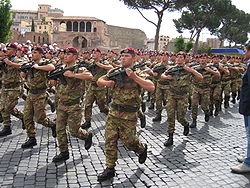
184 Airborne Division Nembo
184 Airborne Division Nembo or 184 Divisione Paracadutisti Nembo was an Airborne Division of the Italian Army during World War II....
was constituted in 1943 as a second division of parachutists, based on entirely new units as well as the 185° Regiment
Regiment
A regiment is a major tactical military unit, composed of variable numbers of batteries, squadrons or battalions, commanded by a colonel or lieutenant colonel...
of the Folgore Division. Nembo was sent shortly before the armistice between Italy and the Allies of 8 September 1943 to Sardinia
Sardinia
Sardinia is the second-largest island in the Mediterranean Sea . It is an autonomous region of Italy, and the nearest land masses are the French island of Corsica, the Italian Peninsula, Sicily, Tunisia and the Spanish Balearic Islands.The name Sardinia is from the pre-Roman noun *sard[],...
where it was decimated by malaria
Malaria
Malaria is a mosquito-borne infectious disease of humans and other animals caused by eukaryotic protists of the genus Plasmodium. The disease results from the multiplication of Plasmodium parasites within red blood cells, causing symptoms that typically include fever and headache, in severe cases...
.
A unit of the same name was raised by the co-belligerent Italian Army now fighting against the Germans, along the allies, as 12/183rd in the War of Italian liberation
Italian Campaign (World War II)
The Italian Campaign of World War II was the name of Allied operations in and around Italy, from 1943 to the end of the war in Europe. Joint Allied Forces Headquarters AFHQ was operationally responsible for all Allied land forces in the Mediterranean theatre, and it planned and commanded the...
it fought in the battles of Filottrano
Filottrano
Filottrano is a comune in the Province of Ancona in the Italian region Marche, located about 25 km southwest of Ancona. As of 31 December 2004, it had a population of 9,449 and an area of 70.2 km²....
, Grizzano Houses and in Operation Herring
Operation Herring
Operation Herring was the last World War II airborne combat drop in Europe.- Background :The Allied April 1945 offensive on the Italian front, which was to end the Italian campaign and the war in Italy, was to decisively break through the German Gothic Line, the defensive line along the Apennines...
(the latter two as part of the Folgore Combat Group that was raised from surviving elements of original Division.
After the end of the Second World War the Nembo unit title was given to a mechanized infantry units that was stationed, in turn, at Belluno
Belluno
Belluno , is a town and province in the Veneto region of northern Italy. Located about 100 kilometres north of Venice, Belluno is the capital of the province of Belluno and the most important city in the Eastern Dolomiti's region. With its roughly 37,000 inhabitants, it the largest populated area...
, Villa Vicentina, Cervignano del Friuli
Friuli
Friuli is an area of northeastern Italy with its own particular cultural and historical identity. It comprises the major part of the autonomous region Friuli-Venezia Giulia, i.e. the province of Udine, Pordenone, Gorizia, excluding Trieste...
and Gradisca d' Isonzo. The latter was its base of operations until 1991, at which time it was reconstituted as the 183rd Parachutist Battalion Nembo , within the Folgore Parachute Brigade
Folgore Parachute Brigade
The Folgore Parachute Brigade is the largest unit of paratroopers of the Italian Army; a second smaller unit is the 4th Alpini Parachutist Regiment. The name Folgore is Italian for lightning....
. The Folgore (Parachute) brigade had been reconstituted in 1960. The Nembo battalion in 1993 was expanded to a Regiment
Regiment
A regiment is a major tactical military unit, composed of variable numbers of batteries, squadrons or battalions, commanded by a colonel or lieutenant colonel...
, and from 1991 it has participated in many international missions that Italy has joined.
Ciclone
The 183rd Ciclone Parachute Division was planned and the training center was established in early 1943 with four battalions forming, however, it was overcome by eventsOvercome By Events
Overcome By Events or Overtaken By Events , is a term of military origin used when a situation changes so rapidly that previously proposed courses of action are no longer relevant.- Examples :...
and was disbanded in accordance with the 1943 Armistice.
La Spezia
80 Infantry Division La Spezia (Airlanding)80 Infantry Division La Spezia (Airlanding)
80 Infantry Division La Spezia was an Airlanding Division of the Italian Army during World War II. The La Spezia was formed in 1941, for the planned Invasion of Malta. When the invasion was cancelled the Division was instead was transferred to Libya in October 1942...
- trained and equipped similarly to the German Airlanding divisions, again for the Malta Invasion.
RSI Paracadutisti
A number of parachute units were raised by the RSIRSI
-Business:*RADARSAT International, a subsidiary of MacDonald Dettwiler and Associates*Red Sector Incorporated, a demo and "warez" group*Resource Software International Ltd., a communication management call accounting software company* Resin Systems Inc....
and were considered to be elite troops and fought well. The RSI Army (ENR
Esercito Nazionale Repubblicano
The National Republican Army was the army of the Italian Social Republic from 1943 to 1945 that fought on the side of Nazi Germany during World War II....
), RSI Air Force, GNR
Italian National Republican Guard
The Italian National Republican Guard was a paramilitary force of the Italian Social Republic created by decree on December 8, 1943, replacing the Carabinieri and the National Security Volunteer Militia . General Renato Ricci appointed as its commandant...
, X Mas
Decima Flottiglia MAS
The Decima Flottiglia MAS was an Italian commando frogman unit of the Regia Marina created during the Fascist regime.The acronym MAS also refers to various light torpedo boats used by the Regia Marina during World...
.
- RSI Army - raised the 350 man 'Nembo' Autonomous Parachute battalion which suffered 70 percent casualties at the Battle of Anzio.
- RSI Air Force - raised a three battalion 'Folgore' Parachute Regiment which became part of the 'ArditiArditiArditi was the name adopted by Italian Army elite storm troops of World War I. The name derives from the Italian verb Ardire and translates as "The Daring Ones"....
' Group. - GNR - 'Mazzarini' GNR Parachute battalion of 300 men. It mainly operated against partisanPartisan (military)A partisan is a member of an irregular military force formed to oppose control of an area by a foreign power or by an army of occupation by some kind of insurgent activity...
s in the Padovana Plains from August 1944 until 1945. - RSI Navy - Xa MAS - 'Nuotatori Paracadutisti' Parachute Battalion (Parachute Swimmers), which was formed by volunteers of the former Italian NavyItalian NavyItalian Navy may refer to:* Pre-unitarian navies of the Italian states* Regia Marina, the Royal Navy of the Kingdom of Italy * Italian Navy , the navy of the Italian Republic...
's San Marco RegimentSan Marco RegimentThe San Marco Regiment , located in Brindisi, are the marines of the Italian Navy. Until the middle of the 1990s the unit was known as the “San Marco Battalion” , until it was expanded beyond battalion size because of the new geopolitical situation after the end of the Cold War and an increasing...
's Parachute battalion. A flood of volunteers joined the battalion increasing it to over 1,400 men.
The modern Folgore Parachute Brigade
Currently the Folgore is a Brigade, with six battalion sized Regiments, based in LivornoLivorno
Livorno , traditionally Leghorn , is a port city on the Tyrrhenian Sea on the western edge of Tuscany, Italy. It is the capital of the Province of Livorno, having a population of approximately 160,000 residents in 2009.- History :...
and stationed in Livorno
Livorno
Livorno , traditionally Leghorn , is a port city on the Tyrrhenian Sea on the western edge of Tuscany, Italy. It is the capital of the Province of Livorno, having a population of approximately 160,000 residents in 2009.- History :...
, Pistoia
Pistoia
Pistoia is a city and comune in the Tuscany region of Italy, the capital of a province of the same name, located about 30 km west and north of Florence and is crossed by the Ombrone Pistoiese, a tributary of the River Arno.-History:...
, Siena
Siena
Siena is a city in Tuscany, Italy. It is the capital of the province of Siena.The historic centre of Siena has been declared by UNESCO a World Heritage Site. It is one of the nation's most visited tourist attractions, with over 163,000 international arrivals in 2008...
, Pisa
Pisa
Pisa is a city in Tuscany, Central Italy, on the right bank of the mouth of the River Arno on the Tyrrhenian Sea. It is the capital city of the Province of Pisa...
and Legnago
Legnago
Legnago is a town and comune in the Province of Verona, Veneto, northern Italy. It is located on the Adige river, c. 43 km from Verona.Its fertile land produces crops of rice, other cereals, sugar, and tobacco.-History:...
(VR).
The Brigade is constituted around three paratroop regiments (183°, 186° and 187°), a (special forces) 'assault' regiment (the 9° Col Moschin), a recon/surveillance/target-acquisition unit (185°), the "Guastatori" engineer regiment (8°) and a Headquarters and Signals company.
There is also a training establishment known as CAPAR in Pisa
Pisa
Pisa is a city in Tuscany, Central Italy, on the right bank of the mouth of the River Arno on the Tyrrhenian Sea. It is the capital city of the Province of Pisa...
(Parachuting Training Center, former SMIPAR - Military school of Parachuting, in its turn former CAP).
Subunits:
-
-
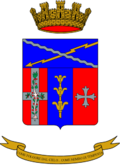 Parachutist Training Center in PisaPisaPisa is a city in Tuscany, Central Italy, on the right bank of the mouth of the River Arno on the Tyrrhenian Sea. It is the capital city of the Province of Pisa...
(TuscanyTuscanyTuscany is a region in Italy. It has an area of about 23,000 square kilometres and a population of about 3.75 million inhabitants. The regional capital is Florence ....
) - 9° Parachutist Assault Regiment
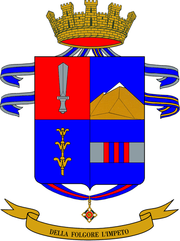 9th Parachute Assault RegimentThe 9º Reggimento d'Assalto Paracadutisti ' is the or proudest Special Forces unit of the current Italian Army — in part due to its distinguished history, but also due to the arduous training which members must undertake...
“Col Moschin” in Livorno (Tuscany) (Special forcesSpecial forcesSpecial forces, or special operations forces are terms used to describe elite military tactical teams trained to perform high-risk dangerous missions that conventional units cannot perform...
) - 183° Parachutist Regiment “Nembo” in Pistoia (Tuscany) with 26 Puma 6x6
 Puma (AFV)The Puma light wheeled armoured fighting vehicle family consists of the Puma 6x6 and the Puma 4x4. The vehicles were developed and are produced by the Consorzio Iveco Fiat - Oto Melara of Italy for the Italian Army...
 - 186° Parachutist Regiment “Folgore” in Siena (Tuscany) with 26 Puma 6x6
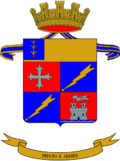 Puma (AFV)The Puma light wheeled armoured fighting vehicle family consists of the Puma 6x6 and the Puma 4x4. The vehicles were developed and are produced by the Consorzio Iveco Fiat - Oto Melara of Italy for the Italian Army...
 - 187° Parachutist Regiment “Folgore” in Livorno (Tuscany
 TuscanyTuscany is a region in Italy. It has an area of about 23,000 square kilometres and a population of about 3.75 million inhabitants. The regional capital is Florence ....
) with 26 Puma 6x6Puma (AFV)The Puma light wheeled armoured fighting vehicle family consists of the Puma 6x6 and the Puma 4x4. The vehicles were developed and are produced by the Consorzio Iveco Fiat - Oto Melara of Italy for the Italian Army... -
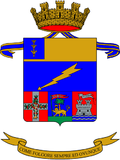 185° Parachutist Reconnaissance Regiment “Folgore” in Livorno (Tuscany) (Special forcesSpecial forcesSpecial forces, or special operations forces are terms used to describe elite military tactical teams trained to perform high-risk dangerous missions that conventional units cannot perform...
) -
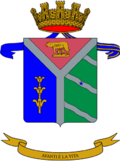 8° Parachutist Engineer Regiment in Legnago (Veneto)
-
23 October celebrates the anniversary of the Battle of El Alamein
Second Battle of El Alamein
The Second Battle of El Alamein marked a major turning point in the Western Desert Campaign of the Second World War. The battle took place over 20 days from 23 October – 11 November 1942. The First Battle of El Alamein had stalled the Axis advance. Thereafter, Lieutenant-General Bernard Montgomery...
(1942).
Patron saint: Michael the Archangel
Michael (archangel)
Michael , Micha'el or Mîkhā'ēl; , Mikhaḗl; or Míchaël; , Mīkhā'īl) is an archangel in Jewish, Christian, and Islamic teachings. Roman Catholics, Anglicans, and Lutherans refer to him as Saint Michael the Archangel and also simply as Saint Michael...
(29 September).
Folgore
Denomination of two distinguished units (for along period coexisting) of the Italian army: the Brigade Parachutists Folgore and the Division of Infantry (then Mechanized) Folgore .Common heraldic elements to both units: the gladio winged of mostrine/fregi (integrated from a parachute for the Brigade Parachutists) and the yellow lightning bolt in the symbol of the unit (in red field for the Division of Infantry, in blue field for the Brigade Parachutists).
Currently the military school of parachuting (CAPAR) is found to Pisa
Pisa
Pisa is a city in Tuscany, Central Italy, on the right bank of the mouth of the River Arno on the Tyrrhenian Sea. It is the capital city of the Province of Pisa...
.
Other Parachute units
- The 4th Alpini Parachutist Regiment is a light Infantry regiment of the Italian Army, specializing in Mountain Combat. The AlpiniAlpiniThe Alpini, , are the elite mountain warfare soldiers of the Italian Army. They are currently organized in two operational brigades, which are subordinated to the Alpini Corps Command. The singular is Alpino ....
are the mountain infantry corps of the Italian Army, that distinguished itself in combat during World War I (WWI) and World War II (WWII). Today the 4th Alpini Parachutist Regiment is a Special ForcesSpecial forcesSpecial forces, or special operations forces are terms used to describe elite military tactical teams trained to perform high-risk dangerous missions that conventional units cannot perform...
unit of elite mountain infantry specialized in the airborne assault role. - CarabinieriCarabinieriThe Carabinieri is the national gendarmerie of Italy, policing both military and civilian populations, and is a branch of the armed forces.-Early history:...
- 1st Carabinieri Regiment "Tuscania"( LivornoLivornoLivorno , traditionally Leghorn , is a port city on the Tyrrhenian Sea on the western edge of Tuscany, Italy. It is the capital of the Province of Livorno, having a population of approximately 160,000 residents in 2009.- History :...
) (or more properly the 1st Regiment Carabinieri "Tuscania") is a Special Forces unit of the Italian Carabinieri. It is formed from paratroopers and is part of the Carabinieri Second Mobile Brigade along with the 7th Carabinieri Regiment based on Laives ( BZ), the 13th Carabinieri Regiment based in Gorizia, and the Special Intervention GroupGruppo di Intervento SpecialeGruppo di Intervento Speciale is an elite Special Operations counter-terrorism tactical response unit inside the Italian Carabinieri military police, first formed in 1978...
, which is also a parachute trained unit. The Tuscania is currently based in LivornoLivornoLivorno , traditionally Leghorn , is a port city on the Tyrrhenian Sea on the western edge of Tuscany, Italy. It is the capital of the Province of Livorno, having a population of approximately 160,000 residents in 2009.- History :...
, and has approximately 550 personnel.
See also
- Folgore Parachute BrigadeFolgore Parachute BrigadeThe Folgore Parachute Brigade is the largest unit of paratroopers of the Italian Army; a second smaller unit is the 4th Alpini Parachutist Regiment. The name Folgore is Italian for lightning....
- Paratroopers
- Paratrooper forces around the worldParatrooper forces around the worldThe following is a list, albeit incomplete, of paratrooper forces from around the world.-Argentina:* Argentine Army** 4th Parachute Brigade -Australia:* Australian Army** 3rd Brigade*** 3rd Battalion, Royal Australian Regiment...