Papal regalia and insignia

Encyclopedia

Pope
The Pope is the Bishop of Rome, a position that makes him the leader of the worldwide Catholic Church . In the Catholic Church, the Pope is regarded as the successor of Saint Peter, the Apostle...
in his capacity as the head of the Roman Catholic Church
Roman Catholic Church
The Catholic Church, also known as the Roman Catholic Church, is the world's largest Christian church, with over a billion members. Led by the Pope, it defines its mission as spreading the gospel of Jesus Christ, administering the sacraments and exercising charity...
and sovereign
Monarch
A monarch is the person who heads a monarchy. This is a form of government in which a state or polity is ruled or controlled by an individual who typically inherits the throne by birth and occasionally rules for life or until abdication...
of the Vatican City State
Vatican City
Vatican City , or Vatican City State, in Italian officially Stato della Città del Vaticano , which translates literally as State of the City of the Vatican, is a landlocked sovereign city-state whose territory consists of a walled enclave within the city of Rome, Italy. It has an area of...
.
Regalia
The TriregnumPapal Tiara
The Papal Tiara, also known incorrectly as the Triple Tiara, or in Latin as the Triregnum, in Italian as the Triregno and as the Trirègne in French, is the three-tiered jewelled papal crown, supposedly of Byzantine and Persian origin, that is a prominent symbol of the papacy...
(a crown with three levels) is among the regalia
Regalia
Regalia is Latin plurale tantum for the privileges and the insignia characteristic of a Sovereign.The word stems from the Latin substantivation of the adjective regalis, 'regal', itself from Rex, 'king'...
of the papacy
Pope
The Pope is the Bishop of Rome, a position that makes him the leader of the worldwide Catholic Church . In the Catholic Church, the Pope is regarded as the successor of Saint Peter, the Apostle...
. It is also called the Tiara or Triple Crown but never to be called "Triple Tiara". "Tiara" is the name of the entire headdress. Paul VI used it on 30 June 1963, at the coronation
Papal Coronation
A papal coronation was the ceremony of the placing of the Papal Tiara on a newly elected pope. The first recorded papal coronation was that of Pope Celestine II in 1143. Soon after his coronation in 1963, Pope Paul VI abandoned the practice of wearing the tiara. His successors have chosen not to...
that was then part of the Papal Inauguration
Papal Inauguration
The Papal Inauguration is a liturgical service of the Catholic Church within Mass celebrated in the Roman Rite but with elements of Byzantine Rite for the ecclesiastical investiture of the Pope...
. For several centuries, Popes have worn it during processions, as when entering or leaving Saint Peter's Basilica, but during liturgies they used an episcopal mitre
Mitre
The mitre , also spelled miter, is a type of headwear now known as the traditional, ceremonial head-dress of bishops and certain abbots in the Roman Catholic Church, as well as in the Anglican Communion, some Lutheran churches, and also bishops and certain other clergy in the Eastern Orthodox...
instead. Pope Benedict XVI
Pope Benedict XVI
Benedict XVI is the 265th and current Pope, by virtue of his office of Bishop of Rome, the Sovereign of the Vatican City State and the leader of the Catholic Church as well as the other 22 sui iuris Eastern Catholic Churches in full communion with the Holy See...
has replaced the tiara with a mitre on his personal coat of arms
Coat of arms of Pope Benedict XVI
The coat of arms of Pope Benedict XVI was designed by then Archbishop Andrea Cordero Lanza di Montezemolo soon after the papal election. The coat of arms consists of a shield and external ornaments.-Shield:...
, but not on the coat of arms of the Holy See
Coat of arms of the Holy See
The coat of arms of the State of Vatican City is blazoned gules, two keys in saltire Or and argent, interlaced in the rings gules/Or, beneath a tiara argent, crowned Or...
or of the Vatican City
Vatican City
Vatican City , or Vatican City State, in Italian officially Stato della Città del Vaticano , which translates literally as State of the City of the Vatican, is a landlocked sovereign city-state whose territory consists of a walled enclave within the city of Rome, Italy. It has an area of...
State.
Another famous part of the Papal regalia is the Ring of the Fisherman
Ring of the Fisherman
The Ring of the Fisherman, also known as the Piscatory Ring, Annulus Piscatoris and the Anello Piscatorio , is an official part of the regalia worn by the Pope, who is head of the Catholic Church and successor of Saint Peter, who was a fisherman by trade...
, a gold ring decorated with a depiction of St. Peter in a boat casting his net, with the name of the reigning Pope around it. The Fisherman's Ring was first mentioned in a letter of Pope Clement IV
Pope Clement IV
Pope Clement IV , born Gui Faucoi called in later life le Gros , was elected Pope February 5, 1265, in a conclave held at Perugia that took four months, while cardinals argued over whether to call in Charles of Anjou, the youngest brother of Louis IX of France...
to his nephew in 1265 wherein he mentions that Popes were accustomed to sealing public documents with a leaden "bulla
Papal bull
A Papal bull is a particular type of letters patent or charter issued by a Pope of the Catholic Church. It is named after the bulla that was appended to the end in order to authenticate it....
" attached, and private letters with "the seal of the Fisherman" (by the fifteenth century, the Fisherman's Ring was used to seal Papal brief
Papal brief
The Papal Brief is a formal document emanating from the Pope, in a somewhat simpler and more modern form than a Papal Bull.-History:The introduction of briefs, which occurred at the beginning of the pontificate of Pope Eugenius IV , was clearly prompted for the same desire for greater simplicity...
s). The Fisherman's Ring is placed on the newly-elected Pope's finger by the Camerlengo of the Holy Roman Church; on the Pope's death, the Cardinal Chamberlain used to formally deface and smash the Fisherman's Ring with a hammer, symbolising the end of the late Pope's authority.
Modern popes do not bear a crozier (a bent pastoral staff styled after a shepherd's crook), but rather bear the Papal Cross
Papal Cross
The papal cross or ferula is the pastoral staff used by the Pope. This is in contrast to other bishops, who use a crozier.The pastoral staff carried by the popes since Pope Paul VI is a contemporary single-barred cross, designed by the Italian artist Lello Scorzelli and carried in the same manner...
, a staff topped by a crucifix
Crucifix
A crucifix is an independent image of Jesus on the cross with a representation of Jesus' body, referred to in English as the corpus , as distinct from a cross with no body....
. The use of the papal cross is an ancient custom, established before the thirteenth century, though some popes since then, notably Pope Leo XIII
Pope Leo XIII
Pope Leo XIII , born Vincenzo Gioacchino Raffaele Luigi Pecci to an Italian comital family, was the 256th Pope of the Roman Catholic Church, reigning from 1878 to 1903...
, have used a crozier-like staff.
One (now discontinued) Papal regalia was the Sedia gestatoria
Sedia gestatoria
The sedia gestatoria is a portable throne on which Popes were carried until 1978. It consists of a richly adorned, silk-covered armchair, fastened on a suppedaneum, on each side of which are two gilded rings; through these rings pass the long rods with which twelve footmen , in red uniforms, carry...
, a portable throne or armchair carried by twelve footmen (palafrenieri) in red uniforms. The sedia gestatoria is accompanied by two attendants bearing the Flabella, large ceremonial fans made of white ostrich-feathers, which also had a practical intent in cooling the pope, given the heat of Rome in summer months, the length of papal ceremonies, the heavy papal vestments and the fact that most popes were elderly. The sedia gestatoria was used for the Pope's solemn entrance into a church or hall and for his departure on the occasion of liturgical
Liturgy
Liturgy is either the customary public worship done by a specific religious group, according to its particular traditions or a more precise term that distinguishes between those religious groups who believe their ritual requires the "people" to do the "work" of responding to the priest, and those...
celebrations such as a papal Mass
Papal Mass
A Papal Mass is the Solemn Pontifical High Mass when offered by the Pope of the Roman Catholic Church.There are numerous special ceremonials which are particular to the pope...
and for papal audiences
Audience (head of state)
An audience is a formal meeting that takes place between a head of state and another person at the invitation of the head of state. Often the invitation follows a request for a meeting from the other person...
. The use of the sedia gestatoria was discontinued by Pope John Paul II
Pope John Paul II
Blessed Pope John Paul II , born Karol Józef Wojtyła , reigned as Pope of the Catholic Church and Sovereign of Vatican City from 16 October 1978 until his death on 2 April 2005, at of age. His was the second-longest documented pontificate, which lasted ; only Pope Pius IX ...
, that of the flabella by Pope Paul VI. Neither has been abolished however.
Vestments
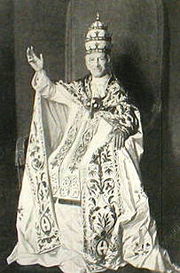
Pallium
The pallium is an ecclesiastical vestment in the Roman Catholic Church, originally peculiar to the Pope, but for many centuries bestowed by him on metropolitans and primates as a symbol of the jurisdiction delegated to them by the Holy See. In that context it has always remained unambiguously...
over his chasuble
Chasuble
The chasuble is the outermost liturgical vestment worn by clergy for the celebration of the Eucharist in Western-tradition Christian Churches that use full vestments, primarily in the Roman Catholic, Anglican and Lutheran churches, as well as in some parts of the United Methodist Church...
when celebrating Mass
Mass (liturgy)
"Mass" is one of the names by which the sacrament of the Eucharist is called in the Roman Catholic Church: others are "Eucharist", the "Lord's Supper", the "Breaking of Bread", the "Eucharistic assembly ", the "memorial of the Lord's Passion and Resurrection", the "Holy Sacrifice", the "Holy and...
. The pallium is a circular band of fabric about two inches wide, from which two twelve-inch-long pendants hang down, one in the front and one in back. It is ornamented with six small, red crosses distributed about the shoulders, breast and back, and is fixed in place by three golden pins, symbolic of the nails with which Christ was crucified. Only the pope wears the pallium by right, and he may wear it at all ecclesiastical functions without restriction. In the Latin/Western rite of the church, metropolitans (that is, archbishops who are the senior bishops of an ecclesiastical province) also wear a form of the pallium within their own province, and which they must receive from the pope, either personally or in a ceremony at which another bishop delegated by the pope presides. Pope Benedict XVI
Pope Benedict XVI
Benedict XVI is the 265th and current Pope, by virtue of his office of Bishop of Rome, the Sovereign of the Vatican City State and the leader of the Catholic Church as well as the other 22 sui iuris Eastern Catholic Churches in full communion with the Holy See...
, for his inauguration in 2005, introduced a special type of pallium that is worn only by the pope. The new papal pallium is based upon the earlier form of the pallium (similar to the omophorion
Omophorion
In the Eastern Orthodox and Eastern Catholic liturgical tradition, the omophor is the distinguishing vestment of a bishop and the symbol of his spiritual and ecclesiastical authority...
which is still worn by Eastern Christian bishops to this day). The papal pallium is wider and longer than the ordinary pallium, and has red crosses on it, representing the blood of Christ.
A vestment
Vestment
Vestments are liturgical garments and articles associated primarily with the Christian religion, especially among Latin Rite and other Catholics, Eastern Orthodox, Anglicans, and Lutherans...
which is restricted to the pope alone is the Fanon
Papal Fanon
The Papal Fanon, or usually just Fanon , is a vestment reserved only for the Pope for use during a pontifical Mass.-Description and use:...
made out of alternating silver and gold stripes. The fanon is similar to a shawl, one end of which is passed under the stole and the second over the chasuble; the pallium is then placed over the fanon. The fanon has gone out of common use in recent times but its use has not been altogether abolished, as Pope John Paul II made use of the fanon on a few occasions.
Prior to the liturgical reforms of the Second Vatican Council
Second Vatican Council
The Second Vatican Council addressed relations between the Roman Catholic Church and the modern world. It was the twenty-first Ecumenical Council of the Catholic Church and the second to be held at St. Peter's Basilica in the Vatican. It opened under Pope John XXIII on 11 October 1962 and closed...
, there were a number of other vestments which were worn only by the pope:
- The Sub-cinctoriumSub-cinctoriumThe subcinctorium, is an ornamental vestment reserved for the pope, which is worn at a solemn pontifical Mass, it is very similar to, but somewhat broader than, the maniple in form and nature....
—a strip of embroidered fabric similar to a manipleManipleManiple may refer to:* Maniple , a division of a Roman legion* Maniple , a liturgical vestment worn on the left arm....
which was suspended from the cinctureCinctureThe cincture is a liturgical vestment, worn encircling the body around or above the waist. The term has two distinct meanings, the usage generally dividing along denominational lines...
. It was embroidered with a crossChristian crossThe Christian cross, seen as a representation of the instrument of the crucifixion of Jesus Christ, is the best-known religious symbol of Christianity...
and the Agnus Dei. - The FaldaFaldaThe Falda is a particular papal vestment which forms a long skirt extending beneath the hem of the alb. When it is worn, the skirts of the falda are so long that the pope needs train-bearers both in front and in back whenever he walks. This form of vestment has its origins in the 15th century and...
—a particular papal vestment which forms a long skirt extending beneath the hem of the albAlbThe alb , one of the liturgical vestments of the Roman Catholic, Anglican and many Protestant churches, is an ample white garment coming down to the ankles and usually girdled with a cincture. It is simply the long linen tunic used by the Romans...
. The skirts of the falda were so long that the pope had train-bearers both in front and in back whenever he walked. - The Mantum—a very long copeCopeThe cope is a liturgical vestment, a very long mantle or cloak, open in front and fastened at the breast with a band or clasp. It may be of any liturgical colour....
worn only by the pope. Originally, it was red in color, but later was made to correspond to the liturgical coloursLiturgical coloursLiturgical colours are those specific colours which are used for vestments and hangings within the context of Christian liturgy. The symbolism of violet, white, green, red, gold, black, rose, and other colours may serve to underline moods appropriate to a season of the liturgical year or may...
.
When the pope would stand on his throne or at the sedia gestatoria, both the falda and the mantum would flow down to the lower steps, and had the effect of making the pope look taller than the other dignitaries present. All three of these vestments were discontinued during the reign of Pope Paul VI, but not abolished.
- A special manipleManipleManiple may refer to:* Maniple , a division of a Roman legion* Maniple , a liturgical vestment worn on the left arm....
, much the same in form as maniples formerly worn by priests, but with intertwined red and gold threads to symbolize the union of the Eastern and Western Churches.
Choir dress
When not celebrating religious services, the Pope wears a cassock. Choir dress is worn when attending—but not celebrating—services, and formal occasions, such as audiences.The most immediately noticeable feature is a white cassock and zucchetto (skull cap). Only the Pope is permitted to wear a cassock made out of watered silk. The cassock used to have a train on it, but Pope Pius XII discontinued this custom. For convenience, the train could be folded up and fastened to the back of the cassock. He used to wear a tufted fascia (white sash-like belt fastened about the waist, the ends of which fall down past the knees and are often embroidered with the Pope's coat of arms), until Paul VI replaced it with a simpler fringed sash. Previously, the tufted fascia (terminating in gold tassels) was worn with choir dress, and the fringed fascia (terminating in a simpler gold fringe) was worn with ordinary dress.
Over his cassock the Pope will wear a lace rochet. Over the rochet is worn the red Papal mozzetta, a shoulder cape that has a collar and is buttoned all the way down the front. The red color is a vestige from the days when scarlet was the Papal color (white only became associated with the papacy after the Napoleonic wars). The Papal mozzetta had a small hood on the back, which disappeared after Vatican II but has recently been restored. In wintertime, the Papal mozzetta is of red velvet trimmed with ermine (this also fell out of use after Vatican II, but Pope Benedict XVI recently began again to wear a winter mozzetta trimmed in white fur). In summer, the Papal mozzetta is of red satin. The Pope wears a pectoral cross suspended on a gold cord over the mozzetta. He may also choose to wear a red stole with gold embroidery over the mozzetta, even when he is not officiating at a service.
Traditionally during the Octave of Easter, the Pope wears the white paschal mozzetta, which is of white damask silk trimmed with white ermine. While the paschal mozzetta fell out of use during the pontificate of Pope John Paul II, it was returned to use in 2008 by Pope Benedict XVI.
Since the 13th Century many Papal portraits have shown the pontiff wearing the camauro, a red velvet cap which covers the ears, and is trimmed with ermine. The camauro fell out of fashion with the death of Pope John XXIII, but has recently been revived by Pope Benedict XVI.
Traditionally, he wears special red satin or velvet Papal slippers indoors, and red leather Papal shoes outdoors. The Papal shoes were traditionally red, though Pope John Paul II would sometimes wear black or brown leather shoes. Pope Benedict XVI has restored the use of the traditional red Papal shoes.
Ordinary dress
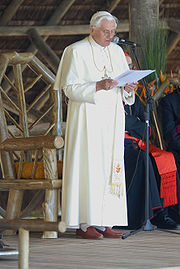
Simar
A simar, as defined in the 1913 Webster's Dictionary, is "a woman's long dress or robe; also light covering; a scarf." The word is derived from French simarre, and is also written as cimar, cymar, samare, and simare....
(cassock with a shoulder cape attached to it) girded with the fringed white fascia
Fascia
A fascia is a layer of fibrous tissue that permeates the human body. A fascia is a connective tissue that surrounds muscles, groups of muscles, blood vessels, and nerves, binding those structures together in much the same manner as plastic wrap can be used to hold the contents of sandwiches...
(often with the papal coat of arms embroidered on it), the pectoral cross
Pectoral cross
A pectoral cross or pectorale is a cross, usually relatively large, suspended from the neck by a cord or chain that reaches well down the chest. It is worn by the clergy as an indication of their position, and is different from the small crosses worn on necklaces by many Christians, which have no...
suspended from a gold cord, the red papal shoes
Papal shoes
The Papal shoes are the red leather outdoor shoes worn by the Pope. They should not be confused with the indoor papal slippers or the Episcopal sandals, which are the liturgical footwear proper to all Latin Rite bishops....
, and the white zucchetto
Zucchetto
The zucchetto , a/k/a pileolus in Latin and calotte/calotta in France, Italy and Hispanic nations, is a small skullcap worn by clerics of the Roman Catholic Church, as well as in Anglicanism....
. On more formal occasions, the pope may wear a red cape similar to the ferraiuolo except for its gold decoration. Alternatively, he may wear a red cape with a shoulder cape attached. Outdoors, the pope may wear the cappello romano
Cappello romano
A cappello romano or saturno is a hat with a wide, circular brim and a rounded rim worn outdoors in some countries by Catholic clergy, when dressed in a cassock. It is made of either beaver fur or felt, and lined in white silk...
, a wide-brimmed hat used by all grades of clergy. While most other clergy wear a black cappello romano, the pope's is usually red (although it may also be white).
Insignia

Insignia
Insignia or insigne pl -nia or -nias : a symbol or token of personal power, status or office, or of an official body of government or jurisdiction...
of the papacy includes the image of two Crossed Keys, one gold and one silver, bound with a red cord. This represents the "keys to the Kingdom of Heaven" (Matthew
Gospel of Matthew
The Gospel According to Matthew is one of the four canonical gospels, one of the three synoptic gospels, and the first book of the New Testament. It tells of the life, ministry, death, and resurrection of Jesus of Nazareth...
; cf. Isaiah
Book of Isaiah
The Book of Isaiah is the first of the Latter Prophets in the Hebrew Bible, preceding the books of Ezekiel, Jeremiah and the Book of the Twelve...
) and is in many ways the quintessential symbol of the Papacy as an institution and of its central role within the Catholic Church. Jesus's statement to Simon Peter, "whatever you bind on earth shall be bound in heaven, and whatever you loose on earth shall be loosed in heaven", is understood in Roman Catholic theology as establishing two jurisdictions, Heaven and Earth; the silver and gold keys are said to represent these two jurisdictions. The silver key symbolises the power to bind and loose on Earth, and the gold key the power to bind and loose in Heaven (another interpretation says that the silver key represents "binding" and the golden key represents "loosing").

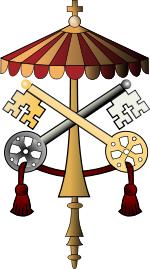
Saltire
A saltire, or Saint Andrew's Cross, is a heraldic symbol in the form of a diagonal cross or letter ex . Saint Andrew is said to have been martyred on such a cross....
behind the escutcheon (one key silver and one key gold, tied with a red cord), and above them the silver triregnum bearing three gold crowns and red infulae (the lappet
Lappet
A lappet is a decorative flap or fold in a ceremonial headdress or garment. They were a feature of women's headgear until the early 20th century. They remain strongly associated with religion. A bishop's mitre has two lappets sewn to the back of it. The most famous usage of lappets occurs on the...
s which hang down from the back of the tiara and fall over the shoulders when it is worn).
The yellow and white flag of Vatican City
Vatican City
Vatican City , or Vatican City State, in Italian officially Stato della Città del Vaticano , which translates literally as State of the City of the Vatican, is a landlocked sovereign city-state whose territory consists of a walled enclave within the city of Rome, Italy. It has an area of...
also makes use of this emblem on the right hand side in the white half of the flag. The yellow and white colours were first adopted in 1808 as the flag of the personal guard of Pius VII, when the other forces of what had been the Papal States were brought under Napoleon's
Napoleon I of France
Napoleon Bonaparte was a French military and political leader during the latter stages of the French Revolution.As Napoleon I, he was Emperor of the French from 1804 to 1815...
control. The previous flag was red and gold, the traditional colours of the city of Rome. The 1808 flag was of course not that of Vatican City, which did not come into existence until 1929.

Coat of arms of the Holy See
The coat of arms of the State of Vatican City is blazoned gules, two keys in saltire Or and argent, interlaced in the rings gules/Or, beneath a tiara argent, crowned Or...
and Vatican City also uses this Papal emblem. The arms are blazon
Blazon
In heraldry and heraldic vexillology, a blazon is a formal description of a coat of arms, flag or similar emblem, from which the reader can reconstruct the appropriate image...
ed: gules, two keys in saltire or and argent, interlacing in the rings gules/or, beneath a tiara argent, crowned or. This means: on a red field are placed two keys, crossed as in the letter X, one gold, the other silver, bound by a cord placed through the rings, and, above the keys, a silver (white-coloured) tiara with gold (yellow-coloured) crowns. The arms are identical, except that according to a custom since 1929, the keys may be reversed on the arms of the Holy See. The colour of the cord is usually red ("gules"), but is sometimes rendered gold ("or") for contrast with the red of the shield.
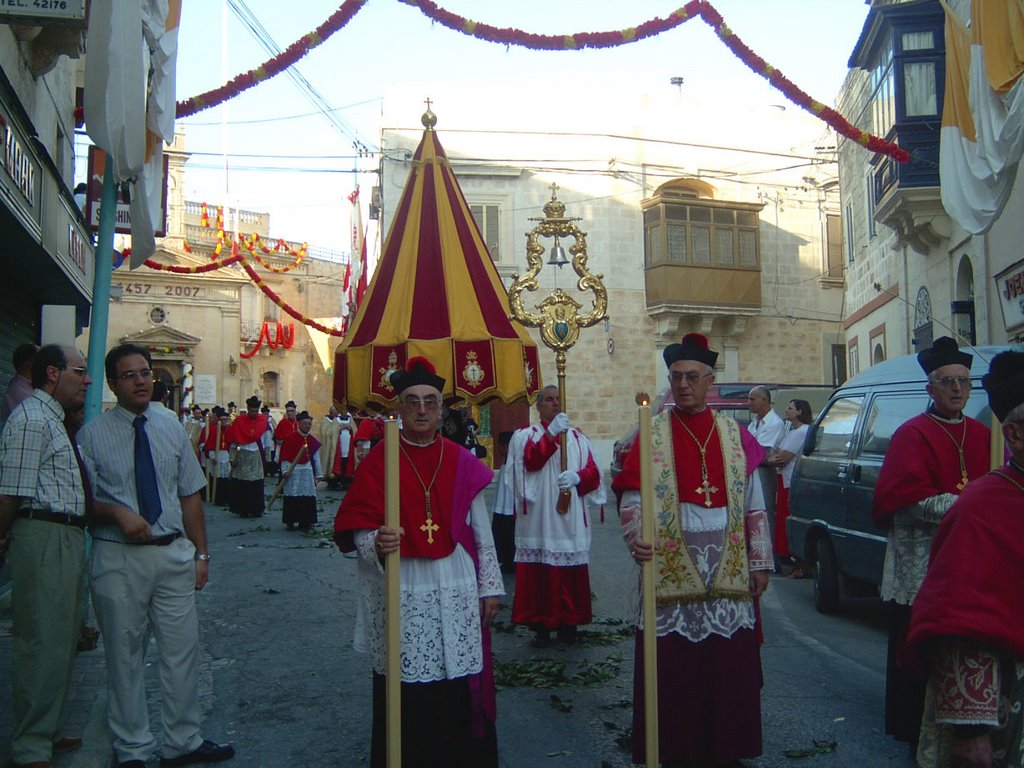
The umbraculum (better known in the Italian form ombrellino) is a canopy or umbrella (consisting of alternating red and gold stripes, the traditional colours of the city of Rome and so, until 1808, of the papacy) whose original function was quite simply to provide shade. As it was traditionally a royal prerogative to walk beneath a canopy, Pope Alexander VI
Pope Alexander VI
Pope Alexander VI , born Roderic Llançol i Borja was Pope from 1492 until his death on 18 August 1503. He is one of the most controversial of the Renaissance popes, and his Italianized surname—Borgia—became a byword for the debased standards of the Papacy of that era, most notoriously the Banquet...
began using the umbraculum to symbolise the temporal powers of the Papacy; it was formerly carried by a man standing behind the Pope, and features in the Coat of arms
Coat of arms
A coat of arms is a unique heraldic design on a shield or escutcheon or on a surcoat or tabard used to cover and protect armour and to identify the wearer. Thus the term is often stated as "coat-armour", because it was anciently displayed on the front of a coat of cloth...
of the Camerlengo of the Holy Roman Church (who administers the property of the Holy See sede vacante
Sede vacante
Sede vacante is an expression, used in the Canon Law of the Catholic Church, that refers to the vacancy of the episcopal see of a particular church...
) and the former arms of the Papal States
Papal States
The Papal State, State of the Church, or Pontifical States were among the major historical states of Italy from roughly the 6th century until the Italian peninsula was unified in 1861 by the Kingdom of Piedmont-Sardinia .The Papal States comprised territories under...
. The practice of walking with the umbraculum has been discontinued, although it continues to feature in ecclesiastical heraldry
Ecclesiastical heraldry
Ecclesiastical heraldry is the tradition of heraldry developed by Christian clergy. Initially used to mark documents, ecclesiastical heraldry evolved as a system for identifying people and dioceses. It is most formalized within the Catholic Church, where most bishops, including the Pope, have a...
and remains the insigne of a basilica
Basilica
The Latin word basilica , was originally used to describe a Roman public building, usually located in the forum of a Roman town. Public basilicas began to appear in Hellenistic cities in the 2nd century BC.The term was also applied to buildings used for religious purposes...
, usually displayed to the right of the main altar. It is sometimes carried in processions as a sign of a basilica's dignity.
External links
- Procession with umbraculum by the collegiate chapter of the Basilica of Sts Peter and Paul in GozoGozoGozo is a small island of the Maltese archipelago in the Mediterranean Sea. The island is part of the Southern European country of Malta; after the island of Malta itself, it is the second-largest island in the archipelago...
, MaltaMaltaMalta , officially known as the Republic of Malta , is a Southern European country consisting of an archipelago situated in the centre of the Mediterranean, south of Sicily, east of Tunisia and north of Libya, with Gibraltar to the west and Alexandria to the east.Malta covers just over in... - The Pope's Hats and Shoes - slideshow by Life magazine
- The Pope wears gold A painting of the pope