
Pandanus is a
genusIn biology, a genus is a low-level taxonomic rank used in the biological classification of living and fossil organisms, which is an example of definition by genus and differentia...
of monocots with about 600 known
speciesIn biology, a species is one of the basic units of biological classification and a taxonomic rank. A species is often defined as a group of organisms capable of interbreeding and producing fertile offspring. While in many cases this definition is adequate, more precise or differing measures are...
. They are numerous palmlike dioecious trees and shrubs native of the Old World tropics and subtropics. They are classified in the order
PandanalesPandanales is an order of flowering plants, with a pantropical distribution.The APG III system places the Pandanales in the monocots. Both the APG III and APG II systems include five families in this order:* Cyclanthaceae* Pandanaceae* Stemonaceae...
, family
PandanaceaePandanaceae is a family of flowering plants native to the tropics of the Old World. Such a family has been widely recognized by taxonomists.Pandanaceae are trees or climbing or scrambling shrubs distributed in the Old World tropics and are adapted from sea level in salted beaches to mountain cloud...
.
Overview
Often called Pandanus Palms, these plants are not closely related to palm trees. There are about 600 species of Pandanus in the world, and different species vary in size. They commonly have a broad canopy and heavy fruits. The botanical family Pandanaceae consists of 3 genera, namely
SararangaSararanga is a genus of flowering plants with two species originating from the Philippines to New Guinea. It belongs to the family Pandanaceae. They occurring in the northern part of New Guinea, in Bismarck Archipelago and Solomon Islands...
with 2 species,
FreycinetiaFreycinetia is a genus of about 150-180 species of flowering plants native to the tropics of Southeast Asia and the Pacific, belonging to the family Pandanaceae. The genus was named for Admiral Louis de Freycinet, a 19th-century French explorer...
(175 spp.), and Pandanus.
The genus vary in size from small shrubs less than 1 metres (3.3 ft) tall, up to medium-sized trees 20 metres (65.6 ft) tall, typically with a broad canopy and moderate growth rate. The trunk is stout, wide-branching, and ringed with many leaf scars. They commonly have many thick prop roots near the base, which provide support as the tree grows top-heavy with leaves, fruit, and branches. The leaves are strap-shaped, varying between species from 30 centimetres (11.8 in) up to 2 metres (6.6 ft) or more long, and from 1.5 centimetre (0.590551181102362 in) up to 10 centimetres (3.9 in) broad.
They are
dioeciousPlant sexuality covers the wide variety of sexual reproduction systems found across the plant kingdom. This article describes morphological aspects of sexual reproduction of plants....
, with male and female
flowerA flower, sometimes known as a bloom or blossom, is the reproductive structure found in flowering plants . The biological function of a flower is to effect reproduction, usually by providing a mechanism for the union of sperm with eggs...
s produced on different plants. The flowers of the male tree are 2–3 cm (0.78740157480315–1.2 in) long and fragrant, surrounded by narrow, white
bractIn botany, a bract is a modified or specialized leaf, especially one associated with a reproductive structure such as a flower, inflorescence axis, or cone scale. Bracts are often different from foliage leaves. They may be smaller, larger, or of a different color, shape, or texture...
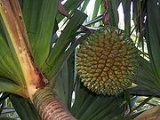
s. The female tree produces flowers with round fruits that are also bract-surrounded. The fruits are globose, 10–20 cm (3.9–7.9 in) in diameter, and have many prism-like sections, resembling the fruit of the
pineapplePineapple is the common name for a tropical plant and its edible fruit, which is actually a multiple fruit consisting of coalesced berries. It was given the name pineapple due to its resemblance to a pine cone. The pineapple is by far the most economically important plant in the Bromeliaceae...
. Typically, the
fruitIn broad terms, a fruit is a structure of a plant that contains its seeds.The term has different meanings dependent on context. In non-technical usage, such as food preparation, fruit normally means the fleshy seed-associated structures of certain plants that are sweet and edible in the raw state,...
changes from green to bright orange or red as it matures. The fruit of some species are edible.
Pandanus fruit are eaten by animals including
batBats are mammals of the order Chiroptera "hand" and pteron "wing") whose forelimbs form webbed wings, making them the only mammals naturally capable of true and sustained flight. By contrast, other mammals said to fly, such as flying squirrels, gliding possums, and colugos, glide rather than fly,...
s,
ratRats are various medium-sized, long-tailed rodents of the superfamily Muroidea. "True rats" are members of the genus Rattus, the most important of which to humans are the black rat, Rattus rattus, and the brown rat, Rattus norvegicus...
s,
crabTrue crabs are decapod crustaceans of the infraorder Brachyura, which typically have a very short projecting "tail" , or where the reduced abdomen is entirely hidden under the thorax...
s,
elephantElephants are large land mammals in two extant genera of the family Elephantidae: Elephas and Loxodonta, with the third genus Mammuthus extinct...
s and
monitor lizardMonitor lizards are usually large reptiles, although some can be as small as in length. They have long necks, powerful tails and claws, and well-developed limbs. Most species are terrestrial, but arboreal and semiaquatic monitors are also known...
s, but the vast majority of species are dispersed primarily by water.
They are numerous palmlike dioecious trees and shrubs of the Old World tropic growing from sea level to 3,300 m. Adventitious roots are often branched. Having large prop roots and a crown of narrow spiny leaves. They are large shrubs or small trees of cultural, health, and economic importance in the Pacific, second only to coconut on atolls. They grows wild mainly in seminatural vegetation in littoral habitats throughout the tropical and subtropical Pacific, where it can withstand drought, strong winds, and salt spray. They propagates readily from seed, but it is also widely propagated from branch cuttings by local people. It grows fairly and quickly.
The genus is native to most of the tropical islands. Three species of screwpine are commonly found in Maldives. Species with large and medium fruit are edible, is one of the iconic tree species of the
New South WalesNew South Wales is a state of :Australia, located in the east of the country. It is bordered by Queensland, Victoria and South Australia to the north, south and west respectively. To the east, the state is bordered by the Tasman Sea, which forms part of the Pacific Ocean. New South Wales...
north coast.
Some species grows on exposed coastal headlands and along beaches, and has thick 'prop roots' to anchor itself in the loose sand. Those prop roots are roots on the stem of a plant, usually close to the ground, which helps to keep the plant upright and secure it to the ground.
Some species of Pandanus trees can grow up to 6 m high. They have long, thin, light green leaves, which grow in spirals on the plant's stems. As the plant grows, the leaves drop off, leaving 'scars' on the stems. In some species of Pandanus fruits look a bit like a woody pineapple. They hang from the branches, and can stay on the tree for more than 12 months. The pandanus genus normally has not branches, only when old, are having branches. Its strange appearance impact all travelers which find them. The trunk is covered with smooth, mottled bark. They have numerous adventitious roots hanging from the branches. The whole of roots forms a pyramidal tract to hold the trunk.
While all pandanus is distributed in the tropical Pacific islands, low islands of the
PolynesiaPolynesia is a subregion of Oceania, made up of over 1,000 islands scattered over the central and southern Pacific Ocean. The indigenous people who inhabit the islands of Polynesia are termed Polynesians and they share many similar traits including language, culture and beliefs...
and
MicronesiaMicronesia is a subregion of Oceania, comprising thousands of small islands in the western Pacific Ocean. It is distinct from Melanesia to the south, and Polynesia to the east. The Philippines lie to the west, and Indonesia to the southwest....
are his favorite spot: covers the barren atolls.
The tree is grown and propagated from shoots that form spontaneously in the axils of lower leaves. Its fruit can float and spread to other islands without help from man. Other species are adapted to mountain habitat and riverine forest. The fruit is a drupe.
Cultivation and uses

Pandan is used for handicrafts. Craftswomen collect the pandan leaves from plants in the wild. Only the young leaves are cut so the plant will naturally regenerate. The young leaves are sliced in fine strips and sorted for further processing. Weavers produce basic pandan mats of standard size or roll the leaves into pandan ropes for other designs. This is followed by a coloring process, in which pandan mats are placed in drums with water-based colors. After drying, the colored mats are shaped into final products such as place mats or jewelry boxes. Final color touch-ups may be applied.
Pandan (
P. amaryllifoliusPandanus amaryllifolius is a tropical plant in the screwpine genus which is known commonly as pandan and is used widely in Southeast Asian cooking as a flavoring. The plant is rare in the wild but is widely cultivated. It is an upright green plant with fan-shaped sprays of long, narrow, bladelike...
) leaves are used in Southeast Asian cooking to add a distinct aroma to
riceRice is the seed of the monocot plants Oryza sativa or Oryza glaberrima . As a cereal grain, it is the most important staple food for a large part of the world's human population, especially in East Asia, Southeast Asia, South Asia, the Middle East, and the West Indies...
and
curryCurry is a generic description used throughout Western culture to describe a variety of dishes from Indian, Pakistani, Bangladeshi, Sri Lankan, Thai or other Southeast Asian cuisines...
dishes such as
nasi lemakNasi lemak is a dish sold in Malaysia, Brunei, Singapore, Riau Islands and Southern Thailand. The dish is considered the national dish and a national heritage of Malaysia. It is not to be confused with Nasi Dagang sold on the east coast of Malaysia or Terengganu and Kelantan although both dishes...
,
kaya ('jam')Coconut jam, Srikaya, or Kaya is a food spread, a fruit curd in the general sense, consumed mainly in Southeast Asia and made from a base of coconut and sugar.-Indonesia, Malaysia, and Singapore:...
preserves, and
dessertIn cultures around the world, dessert is a course that typically comes at the end of a meal, usually consisting of sweet food. The word comes from the French language as dessert and this from Old French desservir, "to clear the table" and "to serve." Common Western desserts include cakes, biscuits,...
s such as
pandan cakePandan cake is a light, fluffy cake of Malay origins flavored with the juice of Pandanus amaryllifolius leaves. The cakes are light green in tone due to the chlorophyll in the leaf juice. It also sometimes contains green food colouring to further enhance its colour...
. Pandan leaf can be used as a complement to chocolate in many dishes, such as ice cream. They are known as
daun pandan in
IndonesianIndonesian is the official language of Indonesia. Indonesian is a normative form of the Riau Islands dialect of Malay, an Austronesian language which has been used as a lingua franca in the Indonesian archipelago for centuries....
and
MalayMalay is a major language of the Austronesian family. It is the official language of Malaysia , Indonesia , Brunei and Singapore...
; and 斑蘭 (bān lán) in Mandarin. Fresh leaves are typically torn into strips, tied in a knot to facilitate removal, placed in the cooking liquid, then removed at the end of cooking. Dried leaves and bottled extract may be bought in some places.
"Kewra" is extract distilled from the Pandanus flower, used to flavor drinks and desserts in Indian cuisine. Also, Kewra or Kewadaa is used in religious worship, and the leaves are used to make hair ornaments worn for their fragrance as well as decorative purpose in western India.
Throughout
OceaniaOceania is a region centered on the islands of the tropical Pacific Ocean. Conceptions of what constitutes Oceania range from the coral atolls and volcanic islands of the South Pacific to the entire insular region between Asia and the Americas, including Australasia and the Malay Archipelago...
almost every part of the plant is used, with various species different from those used in
Southeast AsiaSoutheast Asia, South-East Asia, South East Asia or Southeastern Asia is a subregion of Asia, consisting of the countries that are geographically south of China, east of India, west of New Guinea and north of Australia. The region lies on the intersection of geological plates, with heavy seismic...
n cooking.
Pandanus trees provide:
- materials for housing,
- clothing
Clothing refers to any covering for the human body that is worn. The wearing of clothing is exclusively a human characteristic and is a feature of nearly all human societies...
and textileA textile or cloth is a flexible woven material consisting of a network of natural or artificial fibres often referred to as thread or yarn. Yarn is produced by spinning raw fibres of wool, flax, cotton, or other material to produce long strands...
s including the manufacture of Dilly BagsA dillybag or dilly bag is a traditional Australian Aboriginal bag, generally woven from the fibres of plant species of the Pandanus genus....
(carrying bags), fine mats or ‘ie togaA ʻie tōga is a special finely woven mat that is the most important item of cultural value in Sāmoa. They are commonly referred to in English as "fine mats" although they are never used as 'mats' as they only have a purely cultural value. ʻIe tōga are valued by the quality of the weave and the...
,
- food
Food is any substance consumed to provide nutritional support for the body. It is usually of plant or animal origin, and contains essential nutrients, such as carbohydrates, fats, proteins, vitamins, or minerals...
,
- medication
A pharmaceutical drug, also referred to as medicine, medication or medicament, can be loosely defined as any chemical substance intended for use in the medical diagnosis, cure, treatment, or prevention of disease.- Classification :...
,
- decoration
Interior design describes a group of various yet related projects that involve turning an interior space into an effective setting for the range of human activities are to take place there. An interior designer is someone who conducts such projects...
s,
- fishing
Fishing is the activity of trying to catch wild fish. Fish are normally caught in the wild. Techniques for catching fish include hand gathering, spearing, netting, angling and trapping....
,
- religious uses
Religion is a collection of cultural systems, belief systems, and worldviews that establishes symbols that relate humanity to spirituality and, sometimes, to moral values. Many religions have narratives, symbols, traditions and sacred histories that are intended to give meaning to life or to...
External links and references
- Germplasm Resources Information Network: Pandanus
- Sorting Pandanus names
- Wagner, W. L., Herbst, D. R., & Sohmer, S. H. (1990). Manual of the flowering plants of Hawai`i.
- Pandanus species of the Wet Tropics of Queensland, Australia photos and text by Dave Kimble
- Pneumatophores on Pandanus solms-laubachii - photo essay
- Northernmost pandanus in the world, in the Azores Islands, photo.
- Pandanus simplex fruit eaten by Varanus olivaceus, Polillo Island, Philippines.
- "Hala: The Hawaiian Aphrodisiac" Article by Shannon Wianecki describing Hawaiian cultural uses for pandanus. Maui No Ka 'Oi Magazine
Maui Nō Ka Oi Magazine is a bi-monthly regional magazine published by the Haynes Publishing Group in Wailuku, Hawaii.The phrase Maui nō ka ʻoi means "Maui is unparallel" in the Hawaiian language. Maui Nō Ka Oi Magazine features stories relating to the culture, art, dining, environmental issues,...
Volume 15 Number. 1 (Jan 2011).