
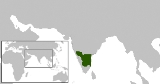
The Pallava dynasty was a
TamilTamil people , also called Tamils or Tamilians, are an ethnic group native to Tamil Nadu, India and the north-eastern region of Sri Lanka. Historic and post 15th century emigrant communities are also found across the world, notably Malaysia, Singapore, Mauritius, South Africa, Australia, Canada,...
dynasty which ruled the northern
Tamil NaduTamil Nadu is one of the 28 states of India. Its capital and largest city is Chennai. Tamil Nadu lies in the southernmost part of the Indian Peninsula and is bordered by the union territory of Pondicherry, and the states of Kerala, Karnataka, and Andhra Pradesh...
region and the southern
Andhra PradeshAndhra Pradesh , is one of the 28 states of India, situated on the southeastern coast of India. It is India's fourth largest state by area and fifth largest by population. Its capital and largest city by population is Hyderabad.The total GDP of Andhra Pradesh is $100 billion and is ranked third...
region with their capital at
KanchipuramKanchipuram, or Kanchi, is a temple city and a municipality in Kanchipuram district in the Indian state of Tamil Nadu. It is a temple town and the headquarters of Kanchipuram district...
. They had established themselves as a notable rising power in the region between 275–350 AD.
After a careful study of Pallava genealogy with all the available material, of no less than 45 inscriptions, Rev H Heras put forth the theory that there was an unbroken line of Pallava kings, twenty-four of them in number, who originally ruled at some city of the Telugu country, possibly at Dasanapura, which the Darsi copper plates state as their adhisthana. Dasanapura has been identified as Darsi, in Nellore district. The Pallavas were at first a Tamil power. The earliest inscriptions of the Pallavas were found in the districts of
BellaryBellary is a historic city in Bellary District in Karnataka state, India.-Origins of the city's name:There are several legends about how Bellary got its name....
,
GunturGuntur , is a city and a municipal corporation in the Indian state of Andhra Pradesh, located to the north and west of the Bay of Bengal. It is approximately to the south of the national capital, New Delhi and south east of state capital, Hyderabad. Guntur is the fourth largest city in Andhra...
and
NelloreNellore , is a city and headquarters of Potti Sri Ramulu Nellore District, formerly Nellore district.And in the state of Andhra Pradesh. Ancient name of Nellore was "Vikrama Simhapuri"....
.
The Pallavas captured Kanchipuram from the Cholas as recorded in the Velurpalaiyam plates, around the reign of the fifth king of the Pallava line Kumaravishnu I. Thereafter Kanchipuram figures in inscriptions as the capital of the Pallavas. The Cholas drove the Pallavas away from Kanchipuram in the mid-4th century AD, in the reign of Vishugopa, the tenth king of the Pallava line. The Pallavas re-captured Kanchipuram in the mid-6th century, possibly in the reign of Simhavishnu, the fourteenth king of the Pallava line, whom the Kasakudi plates state as "the lion of the earth". Thereafter the Pallavas held on to Kanchipuram till the 9th century AD, with the last king having been Vijaya-Nripatungavarman.
The royal custom of using a series of descriptive honorific titles, birudas, was particularly prevalent among the Pallavas. The birudas of Mahendravarman I are in Sanskrit, Tamil and Telugu. The Telugu birudas show that his involvement with the Andhra region continued to be strong at the time he was creating his cave-temples in the Tamil region. The suffix "Malla" was used by the Pallava rulers. Mahendravarman I used the biruda, Satrumalla, "a warrior who overthrows his enemies", and his grandson Paramesvara I was called Ekamalla "the sole warrior or wrestler". Pallavas kings, persumably exalted ones, were known by their title, Mahamalla or the "great wrestler".
The Pallavas gained prominence after the eclipse of the Satavahanas of Andhra, whom the Pallavas served as feudatories.
Origins
Telugu traditions know of a certain Trilochana Pallava as the earliest Telugu King, which is confirmed by later inscriptions
. Trilochana Pallava was killed by a Chalukya King near Mudivemu, Cuddapah District. A Buddhist story describes Kala the Nagaraja, resembling the Pallava Kalabhartar as a king of the region near
Krishna districtKrishna District is a district of India's Andhra Pradesh state. It is named after the Krishna River, the third longest river that flows within India, flows through the district and joins Bay of Bengal here in this district. It has a population of 4,529,009 of which 32.08% is urban as of...
. The Pallava Bogga may be identified with the kingdom of Kala in Andhra which had close and early maritime and cultural relations with Ceylon. Rev Heras also identified King Bappa with Kalabhartar (aka Kalabhartri), "the head jewel of the family", whom Rev Heras proposes as the founder of the dynasty, detecting in the references to Bappa in the Hirahadagalli and Uruvapalli plates, "the flavour of antiquity and veneration which always surround the memory of the founder of a dynasty".
The earliest Tamil literature which throws light on a region associated with the Pallavas is the Ahananuru, which locates the elder Tiriyan in Gudur, Nellore district, with a kingdom extending to Tirupati or Thiruvengadam. This Tiriayan is called the elder in order to distinguish him from the younger Tiraiyan whose capital was Kanchipuram. The Sangam work,
PerumbanarruppataiPerumpanarruppatai, is a Tamil poetic work in the Pathinenmaelkanakku anthology of Tamil literature, belonging to the Sangam period corresponding to between 100 BCE – 100 CE. Perumpanarruppatai contains 500 lines of poetry in the Achiriyappa meter. The poems were written by the poet Kadiyalur...
, traces the line of the younger Tiriyan (aka Ilam Tiriyan) to the Solar dynasty of
IkshvakusThe Ikshvaku dynasty, in Puranic literature, was a mythical dynasty founded by Ikshvaku, grandson of Vivasvan or Surya and son of Vaivasvata Manu. This dynasty is also known as . The important personalities belonging to this royal house are Harishchandra, Dilīpa, Sagara, Raghu, Rama and Prasenajit...
, while the later Tamil commentators identify him as the illegitimate child of a Chola king and a Naga princess.
Sangam literatureSangam literature refers to a body of classical Tamil literature created between the years c. 600 BCE to 300 CE. This collection contains 2381 poems composed by 473 poets, some 102 of whom remain anonymous The period during which these poems were composed is commonly referred to as the Sangam...
, that is, the Manimekhalai describe the liaison of Princess Pilli Valai of Nāka Nadu with King
KillivalavanKillivalavan was a Tamil king of the Early Cholas mentioned in Sangam Literature, and of a period close to that of Nedunkilli and Nalankilli. We have no definite details about this Chola or his reign. The only information we have is from the fragmentary poems of Sangam in the Purananuru.- Sources...
of
Chola NaduChola Nadu is a region of Tamil Nadu state in southern India. It encompasses the lower reaches of the Kaveri River and its delta, and formed the cultural homeland and political base of the Chola Dynasty which ruled most of South India and parts of Sri Lanka and South-East Asia between the 9th and...
at Nainativu; out of which union was born Prince Tondai
IlandiraiyanIlandiraiyan was a Tamil chieftain who ruled over Kanchipuram during the Sangam period. According to P. T. Srinivasa Iyengar, Ilandiraiyan belonged to the Pallava Dynasty and was a contemporary of the Early Chola king Karikala.- Life :...
. Thus, Sangam literature posits Ilam Tiriyan as a Chola, not a Pallava. As per popular belief, it is suggested that Pallavas were an off-shoot or branch of the Cholas. It is also claimed that the Sangam work Manimekhalai possibly alludes to their formation from an ancient
CholaThe Early Cholas of the pre and post Sangam period were one of the three main kingdoms of the ancient Tamil country. Their early capitals were Urayur and Kaveripattinam...
-Nāka alliance.
The Velurpalaiyam plates, dated to 852 AD, does not mention the Cholas. Instead it credits the Naga liaison episode, and creation of the Pallava line, to a different Pallava king named Virakurcha, while preserving its legitimizing significance:
...from him (Aśvatthāman) in order (came) Pallava, the lord of the whole earth, whose fame was bewildering. Thence, came into existence the race of Pallavas... [including the son of Chūtapallava] Vīrakūrcha, of celebrated name, who simultaneously with (the hand of) the daughter of the chief of serpents grasped also the complete insignia of royalty and became famous.
Historically, early relations between the Nagas and Pallavas became well established before the myth of Pallava's birth to Ashwatthama took root. A praśasti (literally "praise"), composed in 753 AD on the dynastic eulogy in the Kasakadi plates, by the Pallava Trivikrama, traces the Pallava lineage from creation through a series of mythic progenitors, then praises the dynasty in terms of two similes hinged together by triple use of the word avatara ("descent"), as below:
From [them] descended the powerful, spotless Pallava dynasty [vaṁśāvatāra], which resembled a partial incarnation [aṃśāvatāra] of Visnu, as it displayed unbroken courage in conquering the circle of the world...and which resembled the descent of the Ganges [gaṅgāvatāra] as it purified the whole world.
The Genealogy of Pallavas mentioned in the Māmallapuram Praśasti is as follows:
- Vishnu
- Brahma
- Unknown / undecipherable
- Bharadvaja
- Drona
- Ashvatthaman
- Pallava
- Unknown / undecipherable
- Simhavarman I (circa 275 AD)
- Unknown / undecipherable
- Simhavarman IV (436 AD - circa 460 AD)
- Unknown / undecipherable
- Skandashishya
- Unknown / undecipherable
- Simhavisnu (circa 550-585 AD)
- Mahendravarman I (ca. 571-630 AD)
- Maha-malla Narasimhavarman I (630-668 AD)
- Unknown / undecipherable
- Paramesvaravarman I (669-690 AD)
- Rajasimha Narasimhavaram II (690-728 AD)
- Unknown / undecipherable
- Pallavamalla Nandivarman II (731-796 AD)
- Unknown / undecipherable
- Nandivarman III (846-69)
Languagues used
All the early Pallava royal inscriptions are either in Prakrit or in Sanskrit language, considered the official languages of the dynasty while the official script was Pallava grantha. This is in contrast to the vatteluttu script and Tamil language used in contemporary memorial stones (virakal). The Sinhala language acquired its form around 7th century AD. The Sinhala script developed from Brahmi script but under the influence of Pallava Grantha.
Similarly, inscriptions found in Andhra Pradesh and Karnataka State are in Prakrit and not in Telugu or Kannada, although a linguistic study clearly suggests that the language used by the common man was Telugu and Kannada (Krishnamurthy 1994:163-165). The phenomenon of using Prakrit and Sanskrit as the official language in which rulers left their inscriptions and epigraphies continued till 6th century AD. It would have been in the interest of the ruling elite to protect their privileges by perpetuating their hegemony of Prakrit in order to exclude the common people from sharing power (Mahadevan 1995a: 173-188). The Pallavas in Tamil country also adopted the same method. They used Sanskrit language and Pallava grantha scripts in their official orders. Whereas the native language and script were Tamil and vatteluttu script, as indicated by the contemporary hero stones and other non-Pallava inscriptions.
The earliest copper-plate muniment (legal document) so far discovered in India, is by the Pallavas at an early undated time. This document was the renewal of a previous grant of a garden made by an earlier king Bappa, to twenty Brahman families of the Atreya, Harita, Bhradvaja, Kausika, Kasyapa, and Vatsya gotras,
who were settled in Southern India around the date of this grant
. The grant mentions certain specified shares for the Brahmans, and free from all taxes ; to which was now added a new grant of a piece of land in a neighbouring village for a threshing-floor, and of another piece for house-sites, together also with four cultivating labourers, and two other agricultural serfs attached to the soil. This endowment was created for the increase of the merit, longevity, power, and fame of the donor's family and race.
The grant was issued from Kanchipura, and it is dated on the fifth day of the sixth fortnight of the rainy season in the eight year of the donor's reign. The grant was made by the Pallava king Sivaskanda-varman, who is mentioned as a member of the spiritual guild of rishi Bharadvaja, and an offerer of the Agnishtoma, Vajapeya, and Asvamedha vedic sacrifices.
The entire body of the inscription is in an old form of Prakrit; but a short benediction in Sanskrit is added at its close, and the king's name on the seal is also written in its Sanskrit form. With regard to the date of the grant, Professor Buhler remarks that "it is impossible to say how the donor is connected with the other Pallava kings known from the sasanas as yet published, or to fix the period when he reigned", but he derives an argument for a tentative early date from the circumstance of its being written in Prakrit.
Assuming the correctness of the identification of the Pallavas with the pauranic Pahlavas, and of the Pahlavas with the Parthians, there are good historical grounds for supposing that Parthian colonies established themselves in the Deccan at a very early period. From the time of the separation of Bactria from Syria in the middle of the 3rd century BC, the tendency of the Bactrians, forced by the pressure of their western and northern neighbours, was to extend themselves southwards into India. The Parthians, after their conquest of the Bactrians about a century later, followed up their successes by overrunning the Indian provinces of Bactria. The natural effect of this latter movement was to press the conquered Indo-Bactrians still further southwards and eastwards into India, with the concurrent tendency on the side of the Parthians always to follow up the retreat of their vanquished foes. After another interval, the Indo-Parthians were themselves forced out of their possessions in Afghanistan, Punjab, and Upper India by the Scythian invasion, and their only possible refuge then was in the south.
Foulkes says in the article "The Early Pallavas of Kánchípura" published in the Journal of the Royal Asiatic Society of Great Britain and Ireland as follows:
We can follow the footsteps of the refugees, by means of the inscriptions of the Kshatrapas, as far as the upper basin of the Godavari and the northern coast of the Konkans ; and when these substantial materials fail us in tracing their further progress southwards, the very natural conjecture arises that some one of the more enterprising of the defeated Parthian generals would adventure at the head of his remaining troops into the wide plains of the Dakhan (deccan) and carve out for himself a kingdom there, or, perhaps, enter into the service of the existing rulers of the Dakhan as an auxiliary defensive ally, having some frontier province committed to him for the payment of his troops, and with the ultimate inevitable result of establishing his own independent rule there. At this point of our tentative theory we are met by the Ceylonese records showing the great growth of the power of these Parthian colonists at a sufficiently early time, whatever dates may hereafter be attached to the early kings of Ceylon...
[...]
An outline of this kind, pending the discovery of more definite materials to fill in the details, quite consistently prepares us for the next succeeding historical appearance of the Pallavas in Sir Walter Elliot's Vengi copper plates of Vijaya Nandi-varman and the subsequent inscriptions of the Chalukyas, at whose arrival in the Dakhan they found the Pallavas in possession of its western districts, as far at the least as the vicinity of Badami in the middle basin of the Krishna, and of its eastern districts as far north at least as Rajahmahendri (Rajamundry) in the lower basin of the Godavari, and with their capital still at Kanchipura, where Sivaskanda-varman of our present grant reigned several centuries before.....I believe it to be, and his reign fell at any time about the end of the first century AD, or the beginning of the second..
Governance in Kanchipuram
The power of the Pallavas was well established at the time when Sivaskanda-varman is styled " supreme king of great kings," a title which implies paramount authority over other rulers subject to him ; and the circumstance of his having offered the horse-sacrifice, which indicates his own personal appreciation of his great power. His predecessor, immediate or otherwise, King Bappa, was wealthy enough to make donations to Brahmans of a 100,000 Ox ploughs, whatever the multiple of exaggeration may be, and many millions of gold coin.
Tho Pallava king was assisted in his government by 'ministers" of state and "privy councillors"; and his throne was surrounded by "royal princes." As can be ascertained from the terms of Professor Buhler's translation, they embraced "countries" governed by "prefects" distributed into " rovinces" administered by their "lords," and subdivided into "districts" under the superintendence of their "rulers". Their fiscal arrangements included "custom houses" and "officers" of customs, and "spies" or itinerant superintendents of revenue. They had also some kind of forest department with its staff of "foresters." They maintained a standing army, the brigades of which were commanded by "generals," and its minor groups of rank and file had their non-commissioned officers or "naicks".
Their village lands were occupied by ryots who paid "eighteen kinds" of contributions to the crown, partly in kind and partly in money ("taxes"). Amongst those which were paid in kind were "sweet and sour milk", "grass and wood" and "vegetables and flowers". They had to plough the crown (state) lands by turns with their "oxen in succession," and it was a part of their obligation to keep the roads and irrigation works in repair by a system of "forced labour". Salt and sugar were royal monopolies; and these not infrequently involved the ryots in "troubles".
The crown had the power to confer grants of land for religious uses, for "the increase of the merit, longevity, power, and fame of his own family and race," and to exempt the grantees and their grant-lands from the payment of the customary taxes. When such land-grants were made, the agricultural "labourers," and the "kolikas" or village staff, were transferred with the land. These "labourers" received for their remuneration "half the produce," according to the system of varam.
Description
The word Pallava means "branch" in
SanskritSanskrit , is a historical Indo-Aryan language and the primary liturgical language of Hinduism, Jainism and Buddhism.Buddhism: besides Pali, see Buddhist Hybrid Sanskrit Today, it is listed as one of the 22 scheduled languages of India and is an official language of the state of Uttarakhand...
, in contrast with Chola meaning "new country", Pandiya meaning "old country" and
CheraChera Dynasty in South India is one of the most ancient ruling dynasties in India. Together with the Cholas and the Pandyas, they formed the three principle warring Iron Age Tamil kingdoms in southern India...
meaning "hill country" in Sangam Tamil lexicon. The Pallavas are considered to be later offshoot of Cholas, who made Kanchipuram their capital and ruled Northern Tamil Nadu and southern Andhra Pradesh (till Northern Circars). Kanchipuram was the largest capital of the sovereign nation
Tondai NaduTondai Nadu is a historical region located in the northernmost part of Tamil Nadu. The region comprises the districts which formed a part of the traditional Pallava kingdom...
of Tamilakkam. They also conquered Southern Karnataka.
Their name alludes to their formation from an ancient
CholaThe Early Cholas of the pre and post Sangam period were one of the three main kingdoms of the ancient Tamil country. Their early capitals were Urayur and Kaveripattinam...
-Nāka alliance, between royals of
Chola NaduChola Nadu is a region of Tamil Nadu state in southern India. It encompasses the lower reaches of the Kaveri River and its delta, and formed the cultural homeland and political base of the Chola Dynasty which ruled most of South India and parts of Sri Lanka and South-East Asia between the 9th and...
and Nāka Nadu (
Jaffna PeninsulaThe Jaffna Peninsula is an area in Northern Province, Sri Lanka. It is home to the capital city of the province, Jaffna and comprises much of the former land mass of the ancient Tamil kingdoms of the Nagas and the medieval Jaffna kingdom. The peninsula is mostly surrounded by water, connected to...
). The
Sangam literatureSangam literature refers to a body of classical Tamil literature created between the years c. 600 BCE to 300 CE. This collection contains 2381 poems composed by 473 poets, some 102 of whom remain anonymous The period during which these poems were composed is commonly referred to as the Sangam...
epic Manimekhalai and epigraphical inscriptions describe the liaison of Princess Pilli Valai and King
KillivalavanKillivalavan was a Tamil king of the Early Cholas mentioned in Sangam Literature, and of a period close to that of Nedunkilli and Nalankilli. We have no definite details about this Chola or his reign. The only information we have is from the fragmentary poems of Sangam in the Purananuru.- Sources...
at Nainativu islet; out of this union was born Prince Tondai Eelam Thiraiyar, who historians note as an early progenitor of the Pallava Dynasty. He ruled
KanchipuramKanchipuram, or Kanchi, is a temple city and a municipality in Kanchipuram district in the Indian state of Tamil Nadu. It is a temple town and the headquarters of Kanchipuram district...
as the capital of
Tondai NaduTondai Nadu is a historical region located in the northernmost part of Tamil Nadu. The region comprises the districts which formed a part of the traditional Pallava kingdom...
, and his descendants of the Pallava dynasty readily took the titles Tondaiyar and Tondaiman alluding to their heritage and region. Nainativu islet was given the title Manipallavam.
KakustavarmanKakusthavarma was a ruler of the Kadamba Dynasty of Banavasi in Southern India during the 4th century. Under his rule, the dynasty attained the height of its greatness. Talagunda and Halmidi inscriptions praise him as a formidable Kadamba warrior. He was able to maintain a good relationship with...
's
TalagundaTalagunda is a village in the Shikaripura taluk of Shimoga district in the state of Karnataka, India. Many inscriptions found here have provided insights into the rise of the Kadamba Dynasty.-History:...
inscription of the 5th century CE describes the Pallava Thiraiyar tribe's formation owing to a Nāka alliance, and details the quarrel between Mayuragarman and a Pallava horseman at Kanchipuram's frontiers, detailing the Pallavas' Kshatriya (warrior) livelihood.
Between 105–150 CE, the ancient capital of the Cholas,
KaveripoompuharpatinnamPuhar is a town in the Nagapattinam district in the southern Indian state of Tamil Nadu. It was once a flourishing ancient port city known as Kaveri puhum pattinam, which for a while served as the capital of the early Chola kings in Tamilakkam.It is located near the end point of the Kaveri river,...
was submerged in a
tsunamiA tsunami is a series of water waves caused by the displacement of a large volume of a body of water, typically an ocean or a large lake...
during Killivalavan's reign; and he moved the capital to
UrayurUrayur , located near the city of Tiruchirapalli in Tamil Nadu, India, was the capital of the early Cholas, who were one of the three main kingdoms of the ancient Tamil country. Sometimes spelled as Uraiyur, this location is also known as Thirukkozhi, Nikalaapuri, Uranthai, and Kozhiyur. It has a...
as noted by
PtolemyClaudius Ptolemy , was a Roman citizen of Egypt who wrote in Greek. He was a mathematician, astronomer, geographer, astrologer, and poet of a single epigram in the Greek Anthology. He lived in Egypt under Roman rule, and is believed to have been born in the town of Ptolemais Hermiou in the...
. The Chola king annexed a part of his territory as Tondaimandalam and presented it to his son who ruled the kingdom between 150–175 CE. He was a contemporary of
Athiyamān Nedumān AñciAthiyamān Nedumān Añci was one of the most powerful Tamil Vēlir kings of the Sangam era. A famous royal of the Athiyamān family dynasty, he was the contemporary and the patron of poetess Auvaiyar of the Sangam period. Athiyamān was a dynastic title of the Vēlir line who ruled over the Dharmapuri,...
and
Avvaiyar IThe Avvaiyars "respectable women" was the title of more than one poet who was active during different periods of Tamil literature. The Avvaiyar were some of the most famous and important female poets of the Tamil canon. Abithana Chintamani states that there were three female poets titled...
. The Pallavas readily took the titles Thondaiyar and Tondaiman alluding to their heritage and historic region .
The Pallavas patronized
TamilTamil is a Dravidian language spoken predominantly by Tamil people of the Indian subcontinent. It has official status in the Indian state of Tamil Nadu and in the Indian union territory of Pondicherry. Tamil is also an official language of Sri Lanka and Singapore...
,
PrakritPrakrit is the name for a group of Middle Indic, Indo-Aryan languages, derived from Old Indic dialects. The word itself has a flexible definition, being defined sometimes as, "original, natural, artless, normal, ordinary, usual", or "vernacular", in contrast to the literary and religious...
and
SanskritSanskrit , is a historical Indo-Aryan language and the primary liturgical language of Hinduism, Jainism and Buddhism.Buddhism: besides Pali, see Buddhist Hybrid Sanskrit Today, it is listed as one of the 22 scheduled languages of India and is an official language of the state of Uttarakhand...
. Some of the most illustrious Tamil bhakti poets like the Nayanmars
SambandharTirugnana Sampantar was a young Saiva poet-saint of Tamil Nadu who lived around the 7th century CE....
and Tirunavukkarasar, Sanskrit poets Bharavi and Dandin, as well as the seashore rock-cut temples of Mahabalipuram belong to the Pallava era.
Pallavas rose in power during the reign of
Mahendravarman IMahendravarman I was a Pallava king who ruled the Northern regions of what forms present-day Tamil Nadu in India in the early 7th century. He was the son of Simhavishnu, who defeated the Kalabhras and re-established the Pallava kingdom....
(
571Year 571 was a common year starting on Thursday of the Julian calendar. The denomination 571 for this year has been used since the early medieval period, when the Anno Domini calendar era became the prevalent method in Europe for naming years.- Religion :* The Monophysites again reject the...
–
630Year 630 was a common year starting on Monday of the Julian calendar. The denomination 630 for this year has been used since the early medieval period, when the Anno Domini calendar era became the prevalent method in Europe for naming years.- Byzantine Empire :* Croats and Serbs settle in the...
CE) and
Narasimhavarman INarasimhavarman I was a Tamil king of the Pallava dynasty who ruled South India from 630–668 CE. He shared his father Mahendravarman I's love of art and completed the work started by Mahendravarman in Mahabalipuram....
(630 –
668Year 668 was a leap year starting on Saturday of the Julian calendar. The denomination 668 for this year has been used since the early medieval period, when the Anno Domini calendar era became the prevalent method in Europe for naming years.- Europe :* Childeric II succeeds Clotaire III as King...
CE) and dominated the
TeluguThe Telugu people or Telugu Prajalu are an ethnic group of India. They are the native speakers of the Telugu language, the most commonly spoken language in India after Hindi and Bengali...
and northern parts of the
TamilThe Sangam period is the classical period in the history of Tamil Nadu, Kerala and other parts of South India, spanning about the 3rd century BCE to the 3rd century CE...
region for about six hundred years until the end of the 9th century. Throughout their reign they were in constant conflict with both Chalukyas of
BadamiBadami , formerly known as Vatapi, is a town and headquarters of a taluk by the same name, in the Bagalkot district of Karnataka, India. It was the regal capital of the Badami Chalukyas from 540 to 757 AD. It is famous for rock cut and other structural temples...
in the north and the Tamil kingdoms of
CholaThe Chola dynasty was a Tamil dynasty which was one of the longest-ruling in some parts of southern India. The earliest datable references to this Tamil dynasty are in inscriptions from the 3rd century BC left by Asoka, of Maurya Empire; the dynasty continued to govern over varying territory until...
and Pandyas in the south and were finally defeated by the Chola kings in the 9th century CE.
Pallavas are most noted for their patronage of architecture, still seen today in
Mahabalipuram. The Pallavas, who left behind magnificent sculptures and temples, established the foundations of medieval south Indian architecture. They developed the Pallava Grantha script , known as
GranthaGrantha script is an ancient script that was widely used between the 6th century and the 19th century CE to write classical Sanskrit and Manipravalam by Tamil speakers in Southern India, particularly in Tamil Nadu and Kerala, and is still in restricted use in traditional vedic schools...
Tamil to write
SanskritSanskrit , is a historical Indo-Aryan language and the primary liturgical language of Hinduism, Jainism and Buddhism.Buddhism: besides Pali, see Buddhist Hybrid Sanskrit Today, it is listed as one of the 22 scheduled languages of India and is an official language of the state of Uttarakhand...
and
ManipravalamManipravalam was a literary style used in medieval liturgical texts in South India, which used an admixture of Tamil and Sanskrit. Manipravalam is termed a mixture of Sanskrit and Tamil...
, an alphabet that would give rise to several other southeast Asian scripts. Chinese traveller Hiuen Tsang visited
KanchipuramKanchipuram, or Kanchi, is a temple city and a municipality in Kanchipuram district in the Indian state of Tamil Nadu. It is a temple town and the headquarters of Kanchipuram district...
during Pallava rule and extolled their benign rule.
The Pallavas traced their origin to sage Aswatthaman , the son of gallant drona who was a seer in the line of sage Bharadwaja who is credited with documenting one compendium of the Rig Veda. Almost all available Pallavan and Cholan literature introduce Pallavas, as having stemmed from the
warrior sage*For the Bollywood film of the same name see Kshatriya Kshatriya or Kashtriya, meaning warrior, is one of the four varnas in Hinduism...
, Aswatthaman who once while penancing at a hermitage was wed to the celestial nymph, Menaka. The Pallava epigraphs credit them with being virtuous, pious, devoted and of being excellent warriors. The inscriptions of pallavas also mention this tale by referring to them as samkirana jati
Pallava Chronology
The rule of the Pallavas apparently starts as early as 275 CE, but their greatest epoch corresponds to the 7th and 8th century.
Early Pallavas
The history of the early Pallavas has not yet been satisfactorily settled. The earliest documentation on the Pallavas is the three copper-plate grants, belonging to Skandavarman I and written in
PrakritPrakrit is the name for a group of Middle Indic, Indo-Aryan languages, derived from Old Indic dialects. The word itself has a flexible definition, being defined sometimes as, "original, natural, artless, normal, ordinary, usual", or "vernacular", in contrast to the literary and religious...
. Skandavarman appears to have been the first great ruler of the early Pallavas, though there are references to other early Pallavas who were probably predecessors of Skandavarman.
Skandavarman extended his dominions from the
KrishnaThe Krishna River , is one of the longest rivers in central-southern India, about . It is also referred to as Krishnaveni in its original nomenclature...
in the north to the Pennar in the south and to the
BellaryBellary is a historic city in Bellary District in Karnataka state, India.-Origins of the city's name:There are several legends about how Bellary got its name....
district in the West. He performed the Aswamedha and other Vedic sacrifices and bore the title of 'Supreme King of Kings devoted to dharma.
In the reign of Simhavarman IV, who ascended the throne in 436 CE, the fallen prestige of the Pallavas was restored. He recovered the territories lost to the Vishnukundins in the north up to the mouth of the Krishna. The early Pallava history from this period onwards is furnished by a dozen or so copper-plate grants in
SanskritSanskrit , is a historical Indo-Aryan language and the primary liturgical language of Hinduism, Jainism and Buddhism.Buddhism: besides Pali, see Buddhist Hybrid Sanskrit Today, it is listed as one of the 22 scheduled languages of India and is an official language of the state of Uttarakhand...
. They are all dated in the regnal years of the kings.
With the accession of Nandivarman I (480–500 CE), the decline of the early Pallava family was seen. The
KadambasThe Kadamba Dynasty was an ancient royal family of Karnataka that ruled from Banavasi in present day Uttara Kannada district. The dynasty later continued to rule as a feudatory of larger Kannada empires, the Chalukya and the Rashtrakuta empires for over five hundred years during which time they...
had their aggressions and attacked even the headquarters of the Pallavas with the Pallavas taking retaliatory measures by expelling and invading Kadamba territories in
KarnatakaKarnataka , the land of the Kannadigas, is a state in South West India. It was created on 1 November 1956, with the passing of the States Reorganisation Act and this day is annually celebrated as Karnataka Rajyotsava...
. In
coastal AndhraCoastal Andhra or Kosta, is a region of India's Andhra Pradesh State. This region was part of Madras State before 1953 and Andhra State from 1953 to 1956. According to the 2011 census, it has an area of and a population of 3,41,93,868...
the Vishnukundins established their ascendency. The Pallava authority was confined to Tondaimandalam.
With the accession of Simhavishnu, father of Mahendravarman I, (c. 575 CE), the Pallava revival began in the south.
Later Pallavas
The incursion of the
KalabhrasThe Kalabhras dynasty ruled over the entire Ancient Tamil country between the 3rd and the 6th century in an era of South Indian history called the Kalabhra interregnum. The Kalabhras displaced the kingdoms of the early Cholas, early Pandayan and Chera dynasties. Information about its origin and...
and the confusion in the Tamil country was broken by the Pandya
KadungonKadungon was a Pandya king who revived the Pandya rule in South India in the 7th century CE. Along with the Pallava king Simhavishnu, he is credited with ending the Kalabhra rule, marking the beginning of a new era in the Tamil speaking region. Most historians, including R. C...
and the Pallava
SimhavishnuSimhavishnu , also known as Avanisimha , son of Simhavarman III and one of the Pallava kings of India, was responsible for the revival of the Pallavan dynasty. He was the first Pallava monarch whose domain extended beyond Kanchipuram in the South...
. The Pallava kingdom began to gain both in territory and influence over the South Indian peninsula and were a regional power by the end of the 6th century, defeating kings of Ceylon and mainland Tamilakkam. The Pallavas exercised control over their southern neighbours of Cholas and Pandyas. But their history is marked by the continuous conflict with the
Badami ChalukyasThe Chalukya dynasty was an Indian royal dynasty that ruled large parts of southern and central India between the 6th and the 12th centuries. During this period, they ruled as three related yet individual dynasties. The earliest dynasty, known as the "Badami Chalukyas", ruled from Vatapi from the...
.
Narasimhavarman INarasimhavarman I was a Tamil king of the Pallava dynasty who ruled South India from 630–668 CE. He shared his father Mahendravarman I's love of art and completed the work started by Mahendravarman in Mahabalipuram....
and
Paramesvaravarman IParameswaravarman I was a Pallava emperor who ruled in South India in the latter half of the seventh century.He ascended to the throne after the death of his father Mahendravarman II in 670 CE. His grandfather Narasimhavarman I had already made the Pallava empire the most powerful force in the...
were the kings who stand out with glorious achievements in both military and architectural spheres.
Nandivarman IINandivarman II was a Pallava ruler who ruled in South India.-Ascension to the Throne:In A.D 731, the Pallava king Parameswaravarman died without any heir and hence the Pallava empire was kingless...
built the
Shore TempleThe Shore Temple is so named because it overlooks the Bay of Bengal. It is a structural temple, built with blocks of granite, dating from the 8th century AD. It was built on a promontory sticking out into the Bay of Bengal at Mahabalipuram, a village south of Chennai in the state of Tamil Nadu,...
.
- Simhavishnu
Simhavishnu , also known as Avanisimha , son of Simhavarman III and one of the Pallava kings of India, was responsible for the revival of the Pallavan dynasty. He was the first Pallava monarch whose domain extended beyond Kanchipuram in the South...
555–590 CE
- Mahendravarman I
Mahendravarman I was a Pallava king who ruled the Northern regions of what forms present-day Tamil Nadu in India in the early 7th century. He was the son of Simhavishnu, who defeated the Kalabhras and re-established the Pallava kingdom....
590–630 CE
- Narasimhavarman I
Narasimhavarman I was a Tamil king of the Pallava dynasty who ruled South India from 630–668 CE. He shared his father Mahendravarman I's love of art and completed the work started by Mahendravarman in Mahabalipuram....
(Mamalla) 630–668 CE
- Mahendravarman II
Mahendravarman II was a Tamil king of the Pallava dynasty who ruled South India from 668–672 CE. He was the son of Narasimhavarman I, a Tamil king of the Pallava dynasty who ruled South India from 630–668 CE. He was succeeded by his son Paramesvaravarman I....
668–672 CE
- Paramesvaravarman I
Parameswaravarman I was a Pallava emperor who ruled in South India in the latter half of the seventh century.He ascended to the throne after the death of his father Mahendravarman II in 670 CE. His grandfather Narasimhavarman I had already made the Pallava empire the most powerful force in the...
672–700 CE
- Narasimhavarman II
Narasimhavarman II or Rajasimha was a Pallava king who ruled in South India during the 6th century. Succeeding his father Paramesvaravarman I in the year 700 CE, he ruled for nearly 3 decades, until he was succeeded by his son Paramesvaravarman II in 728 CE.-Ascension to the throne:By the time...
(Raja Simha) 700–728 CE
- Paramesvaravarman II
Paramesvaravarman II was a Pallava king who ruled from 728 to 731. He was killed by the Chalukya king Vikramaditya II.- Reign :Paramesvaravarman succeeded his father Narasimhavarman II in 728 and ruled till 731. During his reign, Kanchi was invaded by the Chalukyas and Paramesvaravarman had to...
705–710 CE
- Nandivarman II
Nandivarman II was a Pallava ruler who ruled in South India.-Ascension to the Throne:In A.D 731, the Pallava king Parameswaravarman died without any heir and hence the Pallava empire was kingless...
(Pallavamalla) 732–796 CE
- Dantivarman
Dantivarman was an Indian monarch who ruled the Pallava kingdom from 795 to 846. He was the son of Nandivarman II.- Reign :Dantivarman ruled the Pallava kingdom for 51 years. During his reign, the decline of the kingdom had set in. Pandyan intrusions in the south reduced the Pallava territory to...
775–825 CE
- Nandivarman III
Nandivarman III was an Indian monarch of the Nandivarman II line who ruled the Pallava kingdom from 846 to 869. He was the son of Dantivarman and grandson of Nandivarman II.- Reign :...
825–869 CE
- Aparajitha Varman 882–901 CE
Kadava kingdom
During the thirteenth and the fourteenth centuries CE, a small principality of the
KadavaKadava was the name of a Tamil ruling dynasty who ruled parts of the Tamil country during the thirteenth and the fourteenth century CE. Kadavas were related to the Pallava dynasty and ruled from Kudalur near Cuddalore in Tamil Nadu.The Kadava kingdom was at the height of their power briefly...
dynasty came into brief prominence. These rulers claimed descent from the Pallavas. The notable rulers of this dynasty are
Kopperunchinga IKopperunchinga I was a Kadava chieftain who played a major role in the political affairs of the Tamil country. At one time an official in the service of the Chola king Kulothunga Chola III , Kopperunchinga utilised the opportunity arising out of the Pandyan invasion of the Chola country to become...
(reigned c. 1216–1242 CE), and his son and successor
Kopperunchinga IIKopperunchinga II was a Kadava chieftain, who succeeded his father Kopperunchinga I and continued his successes against the Hoysalas. Since the Chola power no longer constituted a threat, Kopperunchinga II acted as the de facto protector of the Chola king and helped him maintain his position on...
(c. 1243–1279 CE). Together they extended the influence of their kingdom and played a major part in the ultimate demise of the Chola dynasty.
Religion
Pallavas were followers of Hinduism and made gifts of land to gods and Brahmins. In line with the prevalent customs, some of the rulers performed the Aswamedha and other
Vedic sacrificesThe religion of the Vedic period is a historical predecessor of Hinduism. Its liturgy is reflected in the mantra portion of the four Vedas, which are compiled in Sanskrit. The religious practices centered on a clergy administering rites...
. They were, however, tolerant of other faiths. The Chinese monk
XuanzangXuanzang was a famous Chinese Buddhist monk, scholar, traveler, and translator who described the interaction between China and India in the early Tang period...
who visited
KanchipuramKanchipuram, or Kanchi, is a temple city and a municipality in Kanchipuram district in the Indian state of Tamil Nadu. It is a temple town and the headquarters of Kanchipuram district...
during the reign of Narasimhavarman I reported that there were 100 Buddhist monasteries, and 80 temples in Kanchipuram.
Mahendravarman I was initially a patron of the Jain faith. He later re-converted to
HinduismHinduism is the predominant and indigenous religious tradition of the Indian Subcontinent. Hinduism is known to its followers as , amongst many other expressions...
under the influence of the Saiva saint Appar with the revival of Hinduism during the Bhakti movement in
South IndiaSouth India is the area encompassing India's states of Andhra Pradesh, Karnataka, Kerala and Tamil Nadu as well as the union territories of Lakshadweep and Pondicherry, occupying 19.31% of India's area...
.
Pallava architecture
The Pallavas were instrumental in the transition from rock-cut architecture to stone temples. The earliest examples of Pallava constructions are rock-cut temples dating from 610–690 CE and structural temples between 690–900 CE. A number of rock-cut cave temples bear the inscription of the Pallava king, Mahendravarman I and his successors.
The greatest accomplishments of the Pallava architecture are the rock-cut temples at
Mahabalipuram. There are excavated pillared halls and monolithic shrines known as rathas in Mahabalipuram. Early temples were mostly dedicated to
ShivaShiva is a major Hindu deity, and is the destroyer god or transformer among the Trimurti, the Hindu Trinity of the primary aspects of the divine. God Shiva is a yogi who has notice of everything that happens in the world and is the main aspect of life. Yet one with great power lives a life of a...
. The Kailasanatha temple in
KanchipuramKanchipuram, or Kanchi, is a temple city and a municipality in Kanchipuram district in the Indian state of Tamil Nadu. It is a temple town and the headquarters of Kanchipuram district...
and the
Shore TempleThe Shore Temple is so named because it overlooks the Bay of Bengal. It is a structural temple, built with blocks of granite, dating from the 8th century AD. It was built on a promontory sticking out into the Bay of Bengal at Mahabalipuram, a village south of Chennai in the state of Tamil Nadu,...
built by
Narasimhavarman IINarasimhavarman II or Rajasimha was a Pallava king who ruled in South India during the 6th century. Succeeding his father Paramesvaravarman I in the year 700 CE, he ruled for nearly 3 decades, until he was succeeded by his son Paramesvaravarman II in 728 CE.-Ascension to the throne:By the time...
, rock cut temple in
MahendravadiMahendravadi is a village in Arakonam taluk, Tamil Nadu in India.-History:According to the site Indiaan Indians, the historical "village Mahendravadi owes its origin to Pallava Mahendra Varman I . According to an inscription in Pallava grantha this cave temple was excavated by Gunabhara on the bund...
by Mahendravarman are fine examples of the Pallava style temples. The temple of Nalanda Gedige in
KandyKandy is a city in the center of Sri Lanka. It was the last capital of the ancient kings' era of Sri Lanka. The city lies in the midst of hills in the Kandy plateau, which crosses an area of tropical plantations, mainly tea. Kandy is one of the most scenic cities in Sri Lanka; it is both an...
,
Sri LankaSri Lanka, officially the Democratic Socialist Republic of Sri Lanka is a country off the southern coast of the Indian subcontinent. Known until 1972 as Ceylon , Sri Lanka is an island surrounded by the Indian Ocean, the Gulf of Mannar and the Palk Strait, and lies in the vicinity of India and the...
is another. The famous
Tondeswaram templeTenavaram temple was a historic Hindu temple complex situated in the port town Tenavaram, Tevanthurai , in Maturai near Galle, Southern Province, Sri Lanka. Its primary deity was a Hindu god Tenavarai Nayanar and at its zenith was one of the most...
of
TenavaraiDondra Head is a cape on the extreme southern tip of Sri Lanka, in the Indian Ocean, near the small town of Dondra near Galle, Southern Province, Sri Lanka...
and the ancient
Koneswaram templeKoneswaram temple of Trincomalee is an Hindu temple in Trincomalee, Eastern Province, Sri Lanka venerated by Saivites throughout the continent...
of
TrincomaleeTrincomalee is a port city in Eastern Province, Sri Lanka and lies on the east coast of the island, about 113 miles south of Jaffna. It has a population of approximately 100,000 . The city is built on a peninsula, which divides the inner and outer harbours. Overlooking the Kottiyar Bay,...
were patronized and structurally developed by the Pallavas in the 7th century.