

Paleobotany

Encyclopedia
Paleobotany, also spelled as palaeobotany (from the Greek
words paleon = old and "botany
", study of plants), is the branch of paleontology
or paleobiology
dealing with the recovery and identification of plant
remains from geological
contexts, and their use for the biological reconstruction of past environments (paleogeography), and both the evolutionary history of plants
, with a bearing upon the evolution of life in general. A synonym is paleophytology. Paleobotany includes the study of terrestrial plant fossils, as well as the study of prehistoric marine
photoautotrophs, such as photosynthetic algae
, seaweed
s or kelp
. A closely related field is palynology
, which is the study of fossilized and extant spore
s and pollen
.
Paleobotany is important in the reconstruction of ancient ecological
systems and climate
, known as paleoecology
and paleoclimatology
respectively; and is fundamental to the study of green plant development
and evolution
. Paleobotany has also become important to the field of archaeology
, primarily for the use of phytolith
s in relative dating
and in paleoethnobotany
,
s of true vascular plants are first found in the fossil
record during the Silurian
Period of the Paleozoic
era. Some dispersed, fragmentary fossils of disputed affinity, primarily spores and cuticles, have been found in rocks from the Ordovician
Period in Oman
, and are thought to derive from liverwort
- or moss
-grade fossil plants .
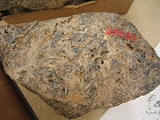
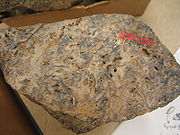 An important early land plant fossil locality is the Rhynie Chert
, found outside the village of Rhynie
in Scotland
. The Rhynie chert is an Early Devonian
sinter (hot spring
) deposit composed primarily of silica. It is exceptional due to its preservation of several different clade
s of plants, from mosses and lycopods to more unusual, problematic forms. Many fossil animals, including arthropods and arachnids, are also found in the Rhynie Chert, and it offers a unique window on the history of early terrestrial life.
Plant-derived macrofossil
s become abundant in the Late Devonian
and include tree
trunks, frond
s, and root
s. The earliest tree is Archaeopteris
, which bears simple, fern
-like leaves
spirally arranged on branches atop a conifer-like trunk
.
Widespread coal
swamp deposits across North America and Europe during the Carboniferous
Period contain a wealth of fossils containing arborescent lycopods
up to 30 meters tall, abundant seed plants
, such as conifers and seed ferns
, and countless smaller, herbaceous
plants.
Angiosperms (flowering plants) evolved during the Mesozoic
, and flowering plant pollen and leaves first appear during the Early Cretaceous
, approximately 130 million years ago.
fossil
is any preserved part of a plant
that has long since died. Such fossils may be prehistoric impressions that are many millions of years old, or bits of charcoal that are only a few hundred years old. Prehistoric plants are various groups of plant
s that lived before recorded history
(before about 3500 BC).
s but may be summarised in a palaeobotanical context as follows.
Because of these difficulties, palaeobotanists usually assign different taxonomic names to different parts of the plant in different modes of preservation. For instance, in the subarborescent Palaeozoic sphenophytes
, an impression of a leaf might be assigned to the genus Annularia, a compression of a cone assigned to Palaeostachya, and the stem assigned to either Calamites or Arthroxylon depending on whether it is preserved as a cast or a petrifaction. All of these fossils may have originated from the same parent plant but they are each given their own taxonomic name. This approach to naming plant fossils originated with the work of and has stood the test of time; although non-palaeobotanist may find it a confusing system, it is generally regarded as the most practical way to overcome the special taphonomic difficulties encountered with plant fossils.
For many years this approach to naming plant fossils was tacitly accepted by palaeobotanists but not formalised within the International Rules of Botanical Nomenclature (e.g. ). Eventually, and proposed a set of formal provisions, the essence of which was introduced into the first International Code of Botanical Nomenclature . These early provisions allowed fossils representing particular parts of plants in a particular state of preservation to be referred to organ-genera. In addition, a small subset of organ-genera, to be known as form-genera, were recognised based on the artificial taxa introduced by mainly for foliage fossils. Over the years, the concepts and regulations surrounding organ- and form-genera became modified within successive International Codes of Botanical Nomenclature, reflecting a failure of the palaeobotanical community to agree on how this aspect of plant taxonomic nomenclature should work (a history reviewed by ). Eventually, the use of organ- and fossil-genera was abandoned with the St Louis Code .
The situation in the Vienna Code is that any plant taxon whose type is a fossil is referred to as a fossil-taxon. Such taxa can refer to a particular part of a plant preserved in a particular way, as defined in the diagnosis of that taxon. Otherwise, the names of fossil-taxa are subject to essentially the same regulations as control the nomenclature of living plants, notably that the names are fixed to a type specimen, and that competing names are chosen mainly on the basis of chronological priority of first publication. Although the name is always fixed to the type specimen, the circumscription (i.e. range of specimens that may be included within the taxon) is defined by the diagnosis and can be changed by formal emendation. Such emendation could result in an expansion of the range of plant parts and/or preservation states that can be incorporated within the taxon. For instance, a fossil-genus originally based on compressions of ovules could be emended so that it also included the multi-ovulate cupules within which the ovules were originally borne. A complication can arise if, in this case, there was an already named fossil-genus for these cupules. If palaeobotanists were confident that the type of the ovule fossil-genus and of the cupule fossil-genus could be included within the newly emended genus, then the two names would compete as to being the correct one for the newly emended genus. However, this only happens if the actual type specimens (and not just specimens that are similar to the types) can be included within the newly revised taxon.
The Vienna Code also refers to a specific subset of fossil-taxa that are known as morphotaxa. These differ from normal fossil-taxa in that they can only be used for fossils that represent the same part of the parent plant and that are preserved in the same way as the type specimen. Morphotaxa were introduced to try to overcome the issue of competing names that represented different plant parts and/or preservation states. What would you do if the species-name of a pollen-organ was pre-dated by the species name of the type of pollen produced by that pollen organ. It was argued that palaeobotanists would be unhappy if the pollen organs were named using the taxonomic name whose type specimen is a pollen grain. As pointed out by , however, the risk of the name of a pollen grain supplanting the name of a pollen organ is most unlikely. Palaeobotanists would have to be totally confident that the type specimen of the pollen species, which would normally be a dispersed grain, definitely came from the same plant that produced the pollen organ. We know from modern plants that closely related but distinct species can produce virtually indistinguishable pollen. It would seem that morphotaxa offer no real advantage to palaeobotanists over normal fossil-taxa and the concept is best abandoned.
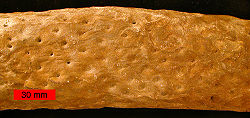
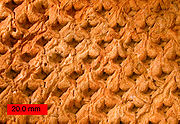
Some plants have remained remarkedly unchanged throughout earth's geological time scale. Early fern
s had developed by the Mississippian, conifers
by the Pennsylvanian
. Some plants of prehistory are the same ones around today and are thus living fossil
s, such as Ginkgo biloba
and Sciadopitys verticillata
. Other plants have changed radically, or have gone extinct entirely.
Examples of prehistoric plants are:
Greek language
Greek is an independent branch of the Indo-European family of languages. Native to the southern Balkans, it has the longest documented history of any Indo-European language, spanning 34 centuries of written records. Its writing system has been the Greek alphabet for the majority of its history;...
words paleon = old and "botany
Botany
Botany, plant science, or plant biology is a branch of biology that involves the scientific study of plant life. Traditionally, botany also included the study of fungi, algae and viruses...
", study of plants), is the branch of paleontology
Paleontology
Paleontology "old, ancient", ὄν, ὀντ- "being, creature", and λόγος "speech, thought") is the study of prehistoric life. It includes the study of fossils to determine organisms' evolution and interactions with each other and their environments...
or paleobiology
Paleobiology
Paleobiology is a growing and comparatively new discipline which combines the methods and findings of the natural science biology with the methods and findings of the earth science paleontology...
dealing with the recovery and identification of plant
Plant
Plants are living organisms belonging to the kingdom Plantae. Precise definitions of the kingdom vary, but as the term is used here, plants include familiar organisms such as trees, flowers, herbs, bushes, grasses, vines, ferns, mosses, and green algae. The group is also called green plants or...
remains from geological
Geology
Geology is the science comprising the study of solid Earth, the rocks of which it is composed, and the processes by which it evolves. Geology gives insight into the history of the Earth, as it provides the primary evidence for plate tectonics, the evolutionary history of life, and past climates...
contexts, and their use for the biological reconstruction of past environments (paleogeography), and both the evolutionary history of plants
Evolutionary history of plants
The evolution of plants has resulted in increasing levels of complexity, from the earliest algal mats, through bryophytes, lycopods, ferns to the complex gymnosperms and angiosperms of today...
, with a bearing upon the evolution of life in general. A synonym is paleophytology. Paleobotany includes the study of terrestrial plant fossils, as well as the study of prehistoric marine
Marine (ocean)
Marine is an umbrella term. As an adjective it is usually applicable to things relating to the sea or ocean, such as marine biology, marine ecology and marine geology...
photoautotrophs, such as photosynthetic algae
Algae
Algae are a large and diverse group of simple, typically autotrophic organisms, ranging from unicellular to multicellular forms, such as the giant kelps that grow to 65 meters in length. They are photosynthetic like plants, and "simple" because their tissues are not organized into the many...
, seaweed
Seaweed
Seaweed is a loose, colloquial term encompassing macroscopic, multicellular, benthic marine algae. The term includes some members of the red, brown and green algae...
s or kelp
Kelp
Kelps are large seaweeds belonging to the brown algae in the order Laminariales. There are about 30 different genera....
. A closely related field is palynology
Palynology
Palynology is the science that studies contemporary and fossil palynomorphs, including pollen, spores, orbicules, dinoflagellate cysts, acritarchs, chitinozoans and scolecodonts, together with particulate organic matter and kerogen found in sedimentary rocks and sediments...
, which is the study of fossilized and extant spore
Spore
In biology, a spore is a reproductive structure that is adapted for dispersal and surviving for extended periods of time in unfavorable conditions. Spores form part of the life cycles of many bacteria, plants, algae, fungi and some protozoa. According to scientist Dr...
s and pollen
Pollen
Pollen is a fine to coarse powder containing the microgametophytes of seed plants, which produce the male gametes . Pollen grains have a hard coat that protects the sperm cells during the process of their movement from the stamens to the pistil of flowering plants or from the male cone to the...
.
Paleobotany is important in the reconstruction of ancient ecological
Ecology
Ecology is the scientific study of the relations that living organisms have with respect to each other and their natural environment. Variables of interest to ecologists include the composition, distribution, amount , number, and changing states of organisms within and among ecosystems...
systems and climate
Climate
Climate encompasses the statistics of temperature, humidity, atmospheric pressure, wind, rainfall, atmospheric particle count and other meteorological elemental measurements in a given region over long periods...
, known as paleoecology
Paleoecology
Paleoecology uses data from fossils and subfossils to reconstruct the ecosystems of the past. It involves the study of fossil organisms and their associated remains, including their life cycle, living interactions, natural environment, and manner of death and burial to reconstruct the...
and paleoclimatology
Paleoclimatology
Paleoclimatology is the study of changes in climate taken on the scale of the entire history of Earth. It uses a variety of proxy methods from the Earth and life sciences to obtain data previously preserved within rocks, sediments, ice sheets, tree rings, corals, shells and microfossils; it then...
respectively; and is fundamental to the study of green plant development
Developmental biology
Developmental biology is the study of the process by which organisms grow and develop. Modern developmental biology studies the genetic control of cell growth, differentiation and "morphogenesis", which is the process that gives rise to tissues, organs and anatomy.- Related fields of study...
and evolution
Evolution
Evolution is any change across successive generations in the heritable characteristics of biological populations. Evolutionary processes give rise to diversity at every level of biological organisation, including species, individual organisms and molecules such as DNA and proteins.Life on Earth...
. Paleobotany has also become important to the field of archaeology
Archaeology
Archaeology, or archeology , is the study of human society, primarily through the recovery and analysis of the material culture and environmental data that they have left behind, which includes artifacts, architecture, biofacts and cultural landscapes...
, primarily for the use of phytolith
Phytolith
Some plants can take up silica in the soil, whereupon it is deposited within different intracellular and extracellular structures of the plant. After these plants decay, silica is redeposited in the soil in the form of phytoliths , which are rigid, microscopic structures of varying sizes and shapes...
s in relative dating
Relative dating
Relative dating is the science determining the relative order of past events, without necessarily determining their absolute age.In geology rock or superficial deposits, fossils and lithologies can be used to correlate one stratigraphic column with another...
and in paleoethnobotany
Ethnobotany
Ethnobotany is the scientific study of the relationships that exist between people and plants....
,
Overview of the paleobotanical record
Macroscopic remainMacrofossil
Macrofossils are preserved organic remains large enough to be visible without a microscope. Most fossils discussed in the article Fossil are macrofossils.-Macrofossil contrasted with Microfossil:...
s of true vascular plants are first found in the fossil
Fossil
Fossils are the preserved remains or traces of animals , plants, and other organisms from the remote past...
record during the Silurian
Silurian
The Silurian is a geologic period and system that extends from the end of the Ordovician Period, about 443.7 ± 1.5 Mya , to the beginning of the Devonian Period, about 416.0 ± 2.8 Mya . As with other geologic periods, the rock beds that define the period's start and end are well identified, but the...
Period of the Paleozoic
Paleozoic
The Paleozoic era is the earliest of three geologic eras of the Phanerozoic eon, spanning from roughly...
era. Some dispersed, fragmentary fossils of disputed affinity, primarily spores and cuticles, have been found in rocks from the Ordovician
Ordovician
The Ordovician is a geologic period and system, the second of six of the Paleozoic Era, and covers the time between 488.3±1.7 to 443.7±1.5 million years ago . It follows the Cambrian Period and is followed by the Silurian Period...
Period in Oman
Oman
Oman , officially called the Sultanate of Oman , is an Arab state in southwest Asia on the southeast coast of the Arabian Peninsula. It is bordered by the United Arab Emirates to the northwest, Saudi Arabia to the west, and Yemen to the southwest. The coast is formed by the Arabian Sea on the...
, and are thought to derive from liverwort
Marchantiophyta
The Marchantiophyta are a division of bryophyte plants commonly referred to as hepatics or liverworts. Like other bryophytes, they have a gametophyte-dominant life cycle, in which cells of the plant carry only a single set of genetic information....
- or moss
Moss
Mosses are small, soft plants that are typically 1–10 cm tall, though some species are much larger. They commonly grow close together in clumps or mats in damp or shady locations. They do not have flowers or seeds, and their simple leaves cover the thin wiry stems...
-grade fossil plants .
Rhynie chert
The Rhynie chert is an Early Devonian sedimentary deposit exhibiting extraordinary fossil detail or completeness . It is exposed near the village of Rhynie, Aberdeenshire, Scotland; a second unit, the Windyfield chert, is located some 700 m away...
, found outside the village of Rhynie
Rhynie
Rhynie is a village in Aberdeenshire, Scotland which the A97 road runs through, situated 14 miles northwest of Alford.The Rhynie Chert is named after the village as well as the extinct plant genus Rhynia....
in Scotland
Scotland
Scotland is a country that is part of the United Kingdom. Occupying the northern third of the island of Great Britain, it shares a border with England to the south and is bounded by the North Sea to the east, the Atlantic Ocean to the north and west, and the North Channel and Irish Sea to the...
. The Rhynie chert is an Early Devonian
Devonian
The Devonian is a geologic period and system of the Paleozoic Era spanning from the end of the Silurian Period, about 416.0 ± 2.8 Mya , to the beginning of the Carboniferous Period, about 359.2 ± 2.5 Mya...
sinter (hot spring
Hot spring
A hot spring is a spring that is produced by the emergence of geothermally heated groundwater from the Earth's crust. There are geothermal hot springs in many locations all over the crust of the earth.-Definitions:...
) deposit composed primarily of silica. It is exceptional due to its preservation of several different clade
Clade
A clade is a group consisting of a species and all its descendants. In the terms of biological systematics, a clade is a single "branch" on the "tree of life". The idea that such a "natural group" of organisms should be grouped together and given a taxonomic name is central to biological...
s of plants, from mosses and lycopods to more unusual, problematic forms. Many fossil animals, including arthropods and arachnids, are also found in the Rhynie Chert, and it offers a unique window on the history of early terrestrial life.
Plant-derived macrofossil
Macrofossil
Macrofossils are preserved organic remains large enough to be visible without a microscope. Most fossils discussed in the article Fossil are macrofossils.-Macrofossil contrasted with Microfossil:...
s become abundant in the Late Devonian
Devonian
The Devonian is a geologic period and system of the Paleozoic Era spanning from the end of the Silurian Period, about 416.0 ± 2.8 Mya , to the beginning of the Carboniferous Period, about 359.2 ± 2.5 Mya...
and include tree
Tree
A tree is a perennial woody plant. It is most often defined as a woody plant that has many secondary branches supported clear of the ground on a single main stem or trunk with clear apical dominance. A minimum height specification at maturity is cited by some authors, varying from 3 m to...
trunks, frond
Frond
The term frond refers to a large, divided leaf. In both common usage and botanical nomenclature, the leaves of ferns are referred to as fronds and some botanists restrict the term to this group...
s, and root
Root
In vascular plants, the root is the organ of a plant that typically lies below the surface of the soil. This is not always the case, however, since a root can also be aerial or aerating . Furthermore, a stem normally occurring below ground is not exceptional either...
s. The earliest tree is Archaeopteris
Archaeopteris
Archaeopteris is an extinct genus of tree-like plants with fern-like leaves. A useful index fossil, this tree is found in strata dating from the Upper Devonian to Lower Carboniferous , and has a global distribution....
, which bears simple, fern
Fern
A fern is any one of a group of about 12,000 species of plants belonging to the botanical group known as Pteridophyta. Unlike mosses, they have xylem and phloem . They have stems, leaves, and roots like other vascular plants...
-like leaves
Leaves
-History:Vocalist Arnar Gudjonsson was formerly the guitarist with Mower, and he was joined by Hallur Hallsson , Arnar Ólafsson , Bjarni Grímsson , and Andri Ásgrímsson . Late in 2001 they played with Emiliana Torrini and drew early praise from the New York Times...
spirally arranged on branches atop a conifer-like trunk
Trunk (botany)
In botany, trunk refers to the main wooden axis of a tree that supports the branches and is supported by and directly attached to the roots. The trunk is covered by the bark, which is an important diagnostic feature in tree identification, and which often differs markedly from the bottom of the...
.
Widespread coal
Coal
Coal is a combustible black or brownish-black sedimentary rock usually occurring in rock strata in layers or veins called coal beds or coal seams. The harder forms, such as anthracite coal, can be regarded as metamorphic rock because of later exposure to elevated temperature and pressure...
swamp deposits across North America and Europe during the Carboniferous
Carboniferous
The Carboniferous is a geologic period and system that extends from the end of the Devonian Period, about 359.2 ± 2.5 Mya , to the beginning of the Permian Period, about 299.0 ± 0.8 Mya . The name is derived from the Latin word for coal, carbo. Carboniferous means "coal-bearing"...
Period contain a wealth of fossils containing arborescent lycopods
Lepidodendron
Lepidodendron is an extinct genus of primitive, vascular, arborescent plant related to the Lycopsids . It was part of the coal forest flora. They sometimes reached heights of over , and the trunks were often over in diameter, and thrived during the Carboniferous period...
up to 30 meters tall, abundant seed plants
Gymnosperm
The gymnosperms are a group of seed-bearing plants that includes conifers, cycads, Ginkgo, and Gnetales. The term "gymnosperm" comes from the Greek word gymnospermos , meaning "naked seeds", after the unenclosed condition of their seeds...
, such as conifers and seed ferns
Pteridospermatophyta
The term Pteridospermatophyta refers to several distinct groups of extinct seed-bearing plants . The oldest fossil evidence of plants of this type is of late Devonian age, and they flourished particularly during the Carboniferous and Permian periods...
, and countless smaller, herbaceous
Herbaceous
A herbaceous plant is a plant that has leaves and stems that die down at the end of the growing season to the soil level. They have no persistent woody stem above ground...
plants.
Angiosperms (flowering plants) evolved during the Mesozoic
Mesozoic
The Mesozoic era is an interval of geological time from about 250 million years ago to about 65 million years ago. It is often referred to as the age of reptiles because reptiles, namely dinosaurs, were the dominant terrestrial and marine vertebrates of the time...
, and flowering plant pollen and leaves first appear during the Early Cretaceous
Cretaceous
The Cretaceous , derived from the Latin "creta" , usually abbreviated K for its German translation Kreide , is a geologic period and system from circa to million years ago. In the geologic timescale, the Cretaceous follows the Jurassic period and is followed by the Paleogene period of the...
, approximately 130 million years ago.
Plant fossils
A plantPlant
Plants are living organisms belonging to the kingdom Plantae. Precise definitions of the kingdom vary, but as the term is used here, plants include familiar organisms such as trees, flowers, herbs, bushes, grasses, vines, ferns, mosses, and green algae. The group is also called green plants or...
fossil
Fossil
Fossils are the preserved remains or traces of animals , plants, and other organisms from the remote past...
is any preserved part of a plant
Plant
Plants are living organisms belonging to the kingdom Plantae. Precise definitions of the kingdom vary, but as the term is used here, plants include familiar organisms such as trees, flowers, herbs, bushes, grasses, vines, ferns, mosses, and green algae. The group is also called green plants or...
that has long since died. Such fossils may be prehistoric impressions that are many millions of years old, or bits of charcoal that are only a few hundred years old. Prehistoric plants are various groups of plant
Plant
Plants are living organisms belonging to the kingdom Plantae. Precise definitions of the kingdom vary, but as the term is used here, plants include familiar organisms such as trees, flowers, herbs, bushes, grasses, vines, ferns, mosses, and green algae. The group is also called green plants or...
s that lived before recorded history
History
History is the discovery, collection, organization, and presentation of information about past events. History can also mean the period of time after writing was invented. Scholars who write about history are called historians...
(before about 3500 BC).
Preservation of plant fossils
Plant fossils can be preserved in a variety of ways, each of which can give different types of information about the original parent plant. These modes of preservation are discussed in the general pages on fossilFossil
Fossils are the preserved remains or traces of animals , plants, and other organisms from the remote past...
s but may be summarised in a palaeobotanical context as follows.
- Adpressions (compressions - impressions). These are the most commonly found type of plant fossil. They provide good morphological detail, especially of dorsiventral (flattened) plant parts such as leaves. If the cuticle is preserved, they can also yield fine anatomical detail of the epidermis. Little other detail of cellular anatomy is normally preserved.
- Petrifactions (permineralisations or anatomically preserved fossils). These provide fine detail of the cell anatomy of the plant tissue. Morphological detail can also be determined by serial sectioning, but this is both time consuming and difficult.
- Moulds and casts. These only tend to preserve the more robust plant parts such as seeds or woody stems. They can provide information about the three-dimensional form of the plant, and in the case of casts of tree stumps can provide evidence of the density of the original vegetation. However, they rarely preserve any fine morphological detail or cell anatomy. A subset of such fossils are pith casts, where the centre of a stem is either hollow or has delicate pith. After death, sediment enters and forms a cast of the central cavity of the stem. The best known examples of pith casts are in the Carboniferous Sphenophyta (Calamites) and cordaites (Artisia).
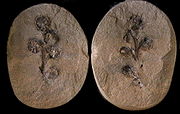
- Authigenic mineralisations. These can provide very fine, three-dimensional morphological detail, and have proved especially important in the study of reproductive structures that can be severely distorted in adpressions. However, as they are formed in mineral nodules, such fossils can rarely be of large size.
- Fusain. Fire normally destroys plant tissue but sometimes charcoalified remains can preserve fine morphological detail that is lost in other modes of preservation; some of the best evidence of early flowers has been preserved in fusain. Fusain fossils are delicate and often small, but because of their buoyancy can often drift for long distances and can thus provide evidence of vegetation away from areas of sedimentation.
Fossil-taxa
Plant fossils almost always represent disarticulated parts of plants; even small herbaceous plants are rarely preserved whole. Those few examples of plant fossils that appear to be the remains of whole plants in fact are incomplete as the internal cellular tissue and fine micromorphological detail is normally lost during fossilisation. An added complication is that, as explained above, plant remains can be preserved in a variety of ways, each revealing different features of the original parent plant.Because of these difficulties, palaeobotanists usually assign different taxonomic names to different parts of the plant in different modes of preservation. For instance, in the subarborescent Palaeozoic sphenophytes
Calamites
Calamites is a genus of extinct arborescent horsetails to which the modern horsetails are closely related. Unlike their herbaceous modern cousins, these plants were medium-sized trees, growing to heights of more than 30 meters...
, an impression of a leaf might be assigned to the genus Annularia, a compression of a cone assigned to Palaeostachya, and the stem assigned to either Calamites or Arthroxylon depending on whether it is preserved as a cast or a petrifaction. All of these fossils may have originated from the same parent plant but they are each given their own taxonomic name. This approach to naming plant fossils originated with the work of and has stood the test of time; although non-palaeobotanist may find it a confusing system, it is generally regarded as the most practical way to overcome the special taphonomic difficulties encountered with plant fossils.
For many years this approach to naming plant fossils was tacitly accepted by palaeobotanists but not formalised within the International Rules of Botanical Nomenclature (e.g. ). Eventually, and proposed a set of formal provisions, the essence of which was introduced into the first International Code of Botanical Nomenclature . These early provisions allowed fossils representing particular parts of plants in a particular state of preservation to be referred to organ-genera. In addition, a small subset of organ-genera, to be known as form-genera, were recognised based on the artificial taxa introduced by mainly for foliage fossils. Over the years, the concepts and regulations surrounding organ- and form-genera became modified within successive International Codes of Botanical Nomenclature, reflecting a failure of the palaeobotanical community to agree on how this aspect of plant taxonomic nomenclature should work (a history reviewed by ). Eventually, the use of organ- and fossil-genera was abandoned with the St Louis Code .
The situation in the Vienna Code is that any plant taxon whose type is a fossil is referred to as a fossil-taxon. Such taxa can refer to a particular part of a plant preserved in a particular way, as defined in the diagnosis of that taxon. Otherwise, the names of fossil-taxa are subject to essentially the same regulations as control the nomenclature of living plants, notably that the names are fixed to a type specimen, and that competing names are chosen mainly on the basis of chronological priority of first publication. Although the name is always fixed to the type specimen, the circumscription (i.e. range of specimens that may be included within the taxon) is defined by the diagnosis and can be changed by formal emendation. Such emendation could result in an expansion of the range of plant parts and/or preservation states that can be incorporated within the taxon. For instance, a fossil-genus originally based on compressions of ovules could be emended so that it also included the multi-ovulate cupules within which the ovules were originally borne. A complication can arise if, in this case, there was an already named fossil-genus for these cupules. If palaeobotanists were confident that the type of the ovule fossil-genus and of the cupule fossil-genus could be included within the newly emended genus, then the two names would compete as to being the correct one for the newly emended genus. However, this only happens if the actual type specimens (and not just specimens that are similar to the types) can be included within the newly revised taxon.
The Vienna Code also refers to a specific subset of fossil-taxa that are known as morphotaxa. These differ from normal fossil-taxa in that they can only be used for fossils that represent the same part of the parent plant and that are preserved in the same way as the type specimen. Morphotaxa were introduced to try to overcome the issue of competing names that represented different plant parts and/or preservation states. What would you do if the species-name of a pollen-organ was pre-dated by the species name of the type of pollen produced by that pollen organ. It was argued that palaeobotanists would be unhappy if the pollen organs were named using the taxonomic name whose type specimen is a pollen grain. As pointed out by , however, the risk of the name of a pollen grain supplanting the name of a pollen organ is most unlikely. Palaeobotanists would have to be totally confident that the type specimen of the pollen species, which would normally be a dispersed grain, definitely came from the same plant that produced the pollen organ. We know from modern plants that closely related but distinct species can produce virtually indistinguishable pollen. It would seem that morphotaxa offer no real advantage to palaeobotanists over normal fossil-taxa and the concept is best abandoned.
Fossil groups of plants
Some plants have remained remarkedly unchanged throughout earth's geological time scale. Early fern
Fern
A fern is any one of a group of about 12,000 species of plants belonging to the botanical group known as Pteridophyta. Unlike mosses, they have xylem and phloem . They have stems, leaves, and roots like other vascular plants...
s had developed by the Mississippian, conifers
Pinophyta
The conifers, division Pinophyta, also known as division Coniferophyta or Coniferae, are one of 13 or 14 division level taxa within the Kingdom Plantae. Pinophytes are gymnosperms. They are cone-bearing seed plants with vascular tissue; all extant conifers are woody plants, the great majority being...
by the Pennsylvanian
Pennsylvanian
The Pennsylvanian is, in the ICS geologic timescale, the younger of two subperiods of the Carboniferous Period. It lasted from roughly . As with most other geochronologic units, the rock beds that define the Pennsylvanian are well identified, but the exact date of the start and end are uncertain...
. Some plants of prehistory are the same ones around today and are thus living fossil
Living fossil
Living fossil is an informal term for any living species which appears similar to a species otherwise only known from fossils and which has no close living relatives, or a group of organisms which have long fossil records...
s, such as Ginkgo biloba
Ginkgo
Ginkgo , also spelled gingko and known as the Maidenhair Tree, is a unique species of tree with no close living relatives...
and Sciadopitys verticillata
Sciadopitys
The Koyamaki , or Japanese Umbrella-pine, is a unique conifer endemic to Japan. It is the sole member of the family Sciadopityaceae and genus Sciadopitys, a living fossil with no close relatives, and known in the fossil record for about 230 million years.Its genus name comes from the Greek prefix...
. Other plants have changed radically, or have gone extinct entirely.
Examples of prehistoric plants are:
- Araucaria mirabilisAraucaria mirabilisAraucaria mirabilis is an extinct species of coniferous trees from Patagonia, Argentina. It belongs to the section Bunya of the genus Araucaria; the only living species of which is Araucaria bidwillii from Australia.A...
- ArchaeopterisArchaeopterisArchaeopteris is an extinct genus of tree-like plants with fern-like leaves. A useful index fossil, this tree is found in strata dating from the Upper Devonian to Lower Carboniferous , and has a global distribution....
- CalamitesCalamitesCalamites is a genus of extinct arborescent horsetails to which the modern horsetails are closely related. Unlike their herbaceous modern cousins, these plants were medium-sized trees, growing to heights of more than 30 meters...
- GlossopterisGlossopterisGlossopteris is the largest and best-known genus of the extinct order of seed ferns known as Glossopteridales ....
- Hymenaea proteraHymenaea proteraHymenaea protera is an extinct prehistoric leguminous tree, the probable ancestor of present-day Hymenaea species. Most neotropical ambers come from its fossilized resin, including the famous Dominican amber.H...
- Nelumbo aureavallisNelumbo aureavallisNelumbo aureavallis is an extinct species of flowering plant in the lotus family known from Ypresian age Eocene fossils found in western North Dakota, USA.The species was described from two leaf specimens with reference to four others...
- ProtosalviniaProtosalviniaProtosalvinia is a prehistoric plant found commonly in shale from shoreline habitats of the Upper Devonian period. The name Protosalvinia is a misnomer. The name literally means early Salvinia, and was given in the erroneous belief that the fossils were an earlier form of the living aquatic fern...
- PalaeoraphePalaeoraphePalaeoraphe is an extinct genus of palm, represented by one species, Palaeoraphe dominicana from early Miocene Burdigalian stage Dominican amber deposits on the island of Hispaniola. The genus is known from a single, diameter, full flower...
- Trochodendron nastaeTrochodendron nastaeTrochodendron nastae is an extinct species of flowering plant in the family Trochodendraceae known from fossil leaves found in the early Eocene Ypresian stage Klondike Mountain Formation deposits of Northern Washington State. T. nastae is one of the oldest members of the genus Trochodendron, which...
- DillhoffiaDillhoffiaDillhoffia is an extinct monotypic genus of flowering plant with a single species, Dillhoffia cachensis known from Ypresian age Eocene fossils found in British Columbia, Canada, and Washington, USA...
- Peltandra primaevaPeltandra primaevaPeltandra primaeva is an extinct species of monocot in the Araceae family known from a Ypresian age Eocene fossil found in western North Dakota, USA....
- PachypterisPachypterisPachypteris T.M.Harris. is a Mesozoic pteridosperm leaf fossil probably belonging to the seed fern Order Corystospermales.Pachypteris is represented by hypostomatic, bipinnate or unipinnate leaves, with alethopteridian venation , pinnules with entire margins and rounded apices...
Notable Paleobotanists
- Edward W. BerryEdward W. BerryEdward Wilber Berry was an American paleontologist and botanist, the principal focus of his research was paleobotany. Berry studied North and South American flora and published taxonomic studies with theoretical reconstructions of paleoecology and phytogeography. He started his scientific...
(1875–1945), paleoecology and phytogeography - Constantin von EttingshausenConstantin von EttingshausenConstantin Freiherr von Ettingshausen was an Austrian geologist and botanist....
(1826–1897), Tertiary floras - Dunkinfield Henry Scott (1854–1934), analysis of the structures of fossil plants
- Kaspar Maria von SternbergKaspar Maria von SternbergKaspar Maria von Sternberg , 1761, Prague – 1838, Březina Castle, was a Bohemian theologian, mineralogist, geognost, entomologist and botanist. He is known as the Father of Paleobotany....
(1761–1838), the "father of paleobotany" - Franz UngerFranz UngerFranz Joseph Andreas Nicolaus Unger was an Austrian botanist, paleontologist and plant physiologist.- Life and work :...
(1800–1870), pioneer in plant physiology, phytotomy and soil science - Jack A. WolfeJack A. WolfeJack Albert Wolfe was an American paleontologist best known for his studies of Tertiary climate in western North America through analysis of fossil angiosperm leaves.-External links:...
(1936–2005) Tertiary paleoclimate of western North America - Thomas Maxwell HarrisThomas Maxwell HarrisThomas Maxwell Harris FRS was a British botanist. He received his doctorate from the University of Cambridge and was a Fellow of the Royal Society...
(1903–1983), Mesozoic plants of Jameson Land (Greenland) and Yorkshire.
See also
- Evolutionary history of plantsEvolutionary history of plantsThe evolution of plants has resulted in increasing levels of complexity, from the earliest algal mats, through bryophytes, lycopods, ferns to the complex gymnosperms and angiosperms of today...
- Timeline of plant evolutionTimeline of plant evolutionThis article attempts to place key plant innovations in a geological context. It concerns itself only with novel adaptations and events that had a major ecological significance, not those that are of solely anthropological interest...
- Prehistoric life
- CryptosporesCryptosporesCryptospores are fossilised primitive plant spores that first appear in the fossil record during the late Ordovician to early Silurian period.-Occurrence:Cryptospores are generally found in non-marine rocks and decrease in abundance with distance offshore...
Further reading
- Stewart, W.N. and Rothwell, G.W. 1993. Paleobotany and the evolution of plants, Second edition. Cambridge University Press, Cambridge, UK. ISBN 0-521-38294-7
- Taylor, T. N. and E. L. Taylor. 1993. The Biology and Evolution of Fossil Plants, Prentice-Hall, Inc., Englewood Cliffs, New Jersey, USA. ISBN 0-13-651589-4
External links
- International Organisation of Paleobotany
- Botanical Society of America - Paleobotanical Section
- Paleobotany Research Group, University Münster, Germany.
- The Biota of Early Terrestrial Ecosystems: The Rhynie Chert, University of Aberdeen, UK.
- Bibliography of Paleobotany
- The Sternberg Project
- Paleobotany - 1911 Encyclopaedia Britannica article
- PaleoNet - listservs and links related to paleontology
- Jurassic Park plants Plants that lived when dinosaurs roamed the earth.