


Palazzo Vecchio

Encyclopedia
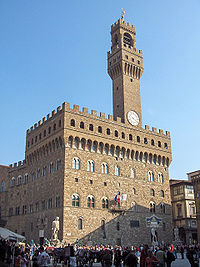
City hall
In local government, a city hall, town hall or a municipal building or civic centre, is the chief administrative building of a city...
of Florence
Florence
Florence is the capital city of the Italian region of Tuscany and of the province of Florence. It is the most populous city in Tuscany, with approximately 370,000 inhabitants, expanding to over 1.5 million in the metropolitan area....
, Italy. This massive, Romanesque
Romanesque architecture
Romanesque architecture is an architectural style of Medieval Europe characterised by semi-circular arches. There is no consensus for the beginning date of the Romanesque architecture, with proposals ranging from the 6th to the 10th century. It developed in the 12th century into the Gothic style,...
, crenellated fortress-palace is among the most impressive town halls of Tuscany
Tuscany
Tuscany is a region in Italy. It has an area of about 23,000 square kilometres and a population of about 3.75 million inhabitants. The regional capital is Florence ....
. Overlooking the Piazza della Signoria
Piazza della Signoria
Piazza della Signoria is an L-shaped square in front of the Palazzo Vecchio in Florence, Italy. It was named after the Palazzo della Signoria, also called Palazzo Vecchio....
with its copy of Michelangelo's David statue as well the gallery of statues in the adjacent Loggia dei Lanzi
Loggia dei Lanzi
The Loggia dei Lanzi, also called the Loggia della Signoria, is a building on a corner of the Piazza della Signoria in Florence, Italy, adjoining the Uffizi Gallery. It consists of wide arches open to the street, three bays wide and one bay deep. The arches rest on clustered pilasters with...
, it is one of the most significant public places in Italy.
Originally called the Palazzo della Signoria, after the Signoria of Florence
Signoria of Florence
The Signoria was the government of medieval and renaissance Florence. Its nine members, the Priori, were chosen from the ranks of the guilds of the city: six of them from the major guilds, and two from the minor guilds...
, the ruling body of the Republic of Florence
Republic of Florence
The Republic of Florence , or the Florentine Republic, was a city-state that was centered on the city of Florence, located in modern Tuscany, Italy. The republic was founded in 1115, when the Florentine people rebelled against the Margraviate of Tuscany upon Margravine Matilda's death. The...
, it was also given several other names: Palazzo del Popolo, Palazzo dei Priori, and Palazzo Ducale, in accordance with the varying use of the palace during its long history. The building acquired its current name when the Medici duke's residence was moved across the Arno to the Palazzo Pitti
Palazzo Pitti
The Palazzo Pitti , in English sometimes called the Pitti Palace, is a vast mainly Renaissance palace in Florence, Italy. It is situated on the south side of the River Arno, a short distance from the Ponte Vecchio...
.
History
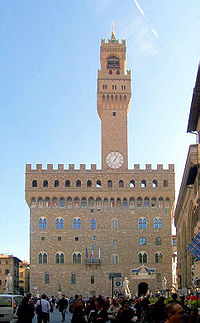
Arnolfo di Cambio
Arnolfo di Cambio was an Italian architect and sculptor.-Biography:Arnolfo was born in Colle Val d'Elsa, Tuscany....
, the architect of the Duomo
Santa Maria del Fiore
The Basilica di Santa Maria del Fiore is the cathedral church of Florence, Italy. The Duomo, as it is ordinarily called, was begun in 1296 in the Gothic style to the design of Arnolfo di Cambio and completed structurally in 1436 with the dome engineered by Filippo Brunelleschi...
and the Santa Croce
Basilica di Santa Croce di Firenze
The Basilica di Santa Croce is the principal Franciscan church in Florence, Italy, and a minor basilica of the Roman Catholic Church. It is situated on the Piazza di Santa Croce, about 800 metres south east of the Duomo. The site, when first chosen, was in marshland outside the city walls...
church, began constructing it upon the ruins of Palazzo dei Fanti and Palazzo dell'Esecutore di Giustizia, once owned by the Uberti family. Giovanni Villani
Giovanni Villani
Giovanni Villani was an Italian banker, official, diplomat and chronicler from Florence who wrote the Nuova Cronica on the history of Florence. He was a leading statesman of Florence but later gained an unsavory reputation and served time in prison as a result of the bankruptcy of a trading and...
(1276–1348) wrote in his Nuova Cronica
Nuova Cronica
The Nuova Cronica or New Chronicles is a 14th century history of Florence created in a year-by-year linear format and written by the Florentine banker and official Giovanni Villani...
that the Uberti were "rebels of Florence and Ghibellines
Guelphs and Ghibellines
The Guelphs and Ghibellines were factions supporting the Pope and the Holy Roman Emperor, respectively, in central and northern Italy. During the 12th and 13th centuries, the split between these two parties was a particularly important aspect of the internal policy of the Italian city-states...
", stating that the plaza was built so that the Uberti family homes would never be rebuilt on the same location. Giovanni Villani wrote that Arnolfo di Cambio incorporated the ancient tower of the Foraboschi family (the tower then known as "La Vacca" or "The Cow") as the substructure of the tower into its facade; this is why the rectangular tower (height 94 m) is not directly centered in the building. This tower contains two small cells, that, at different times, imprisoned Cosimo de' Medici (the Elder)
Cosimo de' Medici
Còsimo di Giovanni degli Mèdici was the first of the Medici political dynasty, de facto rulers of Florence during much of the Italian Renaissance; also known as "Cosimo 'the Elder'" and "Cosimo Pater Patriae" .-Biography:Born in Florence, Cosimo inherited both his wealth and his expertise in...
(1435) and Girolamo Savonarola
Girolamo Savonarola
Girolamo Savonarola was an Italian Dominican friar, Scholastic, and an influential contributor to the politics of Florence from 1494 until his execution in 1498. He was known for his book burning, destruction of what he considered immoral art, and what he thought the Renaissance—which began in his...
(1498). The tower is named after its designer Torre d'Arnolfo. The solid cubicle shaped building is enhanced by the simple tower with its Giorgio Lederle's clock.
The large, one-handed clock was originally constructed by the Florentine Nicolò Bernardo, but was replaced in 1667 by a clock made by Vincenzo Viviani
Vincenzo Viviani
Vincenzo Viviani was an Italian mathematician and scientist. He was a pupil of Torricelli and a disciple of Galileo.-Biography:...
.
The cubical building is built in solid rusticated stonework, with two rows of two-lighted Gothic windows, each with a trefoil arch. Michelozzo Michelozzi added decorative bas-reliefs of the cross and the Florentine lily in the spandrel
Spandrel
A spandrel, less often spandril or splaundrel, is the space between two arches or between an arch and a rectangular enclosure....
s between the trefoils. The building is crowned with projecting crenellated battlement, supported by small arches and corbel
Corbel
In architecture a corbel is a piece of stone jutting out of a wall to carry any superincumbent weight. A piece of timber projecting in the same way was called a "tassel" or a "bragger". The technique of corbelling, where rows of corbels deeply keyed inside a wall support a projecting wall or...
s. Under the arches are a repeated series of nine painted coats of arms of the Florentine republic. Some of these arches can be used as embrasure
Embrasure
In military architecture, an embrasure is the opening in a crenellation or battlement between the two raised solid portions or merlons, sometimes called a crenel or crenelle...
s (spiombati) for dropping heated liquids or rocks on invaders.
Duke Cosimo I de' Medici moved his official seat from the Medici palazzo in via Larga to the Palazzo della Signoria in May 1540, signalling the security of Medici power in Florence. The name was officially changed after Cosimo removed to Palazzo Pitti
Palazzo Pitti
The Palazzo Pitti , in English sometimes called the Pitti Palace, is a vast mainly Renaissance palace in Florence, Italy. It is situated on the south side of the River Arno, a short distance from the Ponte Vecchio...
, renaming his former palace the Palazzo Vecchio, the "Old Palace", although the adjacent town square, the Piazza della Signoria, still bears the old name. Cosimo commissioned Giorgio Vasari
Giorgio Vasari
Giorgio Vasari was an Italian painter, writer, historian, and architect, who is famous today for his biographies of Italian artists, considered the ideological foundation of art-historical writing.-Biography:...
to build an above-ground walkway, the Vasari corridor
Vasari Corridor
The Vasari Corridor is an elevated enclosed passageway in Florence, central Italy, which connects the Palazzo Vecchio with the Palazzo Pitti. Beginning on the south side of the Palazzo Vecchio, it then joins the Uffizi Gallery and leaves on its south side, crossing the Lungarno dei Archibusieri...
, from the palace, through the Uffizi
Uffizi
The Uffizi Gallery , is a museum in Florence, Italy. It is one of the oldest and most famous art museums of the Western world.-History:...
, over the Ponte Vecchio
Ponte Vecchio
The Ponte Vecchio is a Medieval stone closed-spandrel segmental arch bridge over the Arno River, in Florence, Italy, noted for still having shops built along it, as was once common. Butchers initially occupied the shops; the present tenants are jewellers, art dealers and souvenir sellers...
to the Palazzo Pitti.
Cosimo I also moved the seat of government to the Uffizi. The palace gained new importance as the seat of United Italy's provisional government from 1865-71, at a moment when Florence had become the temporary capital of the kingdom of Italy.
Although most of the Palazzo Vecchio is now a museum
Museum
A museum is an institution that cares for a collection of artifacts and other objects of scientific, artistic, cultural, or historical importance and makes them available for public viewing through exhibits that may be permanent or temporary. Most large museums are located in major cities...
, it remains the symbol of local government: since 1872 it has housed the office of the mayor of Florence, and it is the seat of the City Council.
Entrance
Frontispiece (architecture)
In architecture, a frontispiece is the combination of elements that frame and decorate the main, or front, door to a building. The term is especially used when the main entrance is the chief face of the building rather than being kept behind columns or a portico. Early German churches often...
, dating from 1528. In the middle, flanked by two gilded lions, is the Monogram of Christ
Christogram
A Christogram is a monogram or combination of letters that forms an abbreviation for the name of Jesus Christ, traditionally used as a Christian symbol. Different types of Christograms are associated with the various traditions of Christianity, e.g...
, surrounded by a glory, above the text (in Latin): "Rex Regum et Dominus Dominantium" (translation: "Jesus Christ, King of Kings and Lord of Lords". This text dates from 1851 and does not replace an earlier text by Savonarola as mentioned in guidebooks. Between 1529 and 1851 they were concealed behind a large shield with the grand-ducal coat of arms.
Michelangelo's David also stood at the entrance from its completion in 1504 to 1873, when it was moved to the Accademia Gallery
Accademia di Belle Arti Firenze
The Accademia di Belle Arti is an art academy in Florence, Italy and it is now the operative branch of the still existing Accademia delle Arti del Disegno that was the first academy of drawing in Europe.-History:The Accademia delle Arti del Disegno The Accademia di Belle Arti ("Academy of Fine...
. A replica erected in 1910 now stands in its place, flanked by Baccio Bandinelli's Hercules and Cacus
Hercules and Cacus
The white marble sculpture Hercules and Cacus is to the right of the entrance of the Palazzo Vecchio in the Piazza della Signoria, Florence, Italy....
.
First Courtyard
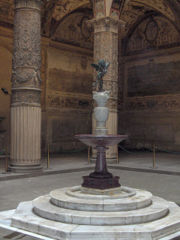
The first courtyard was designed in 1453 by Michelozzo. In the lunettesLunette
In architecture, a lunette is a half-moon shaped space, either filled with recessed masonry or void. A lunette is formed when a horizontal cornice transects a round-headed arch at the level of the imposts, where the arch springs. If a door is set within a round-headed arch, the space within the...
, high around the courtyard, are crests of the Church and City Guilds. In the center, the porphyry fountain is by Battista del Tadda. The Putto with Dolphin on top of the basin is a copy of the original by Andrea del Verrocchio
Andrea del Verrocchio
Andrea del Verrocchio , born Andrea di Michele di Francesco de' Cioni, was an Italian sculptor, goldsmith and painter who worked at the court of Lorenzo de' Medici in Florence in the early renaissance. Few paintings are attributed to him with certainty, but a number of important painters were...
(1476), now on display on the second floor of the palace. This small statue was originally placed in the garden of the villa of the Medici in Careggi
Villa Medici at Careggi
The Villa Medici at Careggi is a patrician villa in the hills near Florence, Tuscany, central Italy.-History:The villa was among the first of a number of Medici villas, notable as the site of the Platonic academy founded by Cosimo de' Medici, who died at the villa in 1464...
. The water, flowing through the nose of the dolphin, is brought here by pipes from the Boboli Gardens
Boboli Gardens
The Boboli Gardens are a park in Florence, Italy, that is home to a collection of sculptures dating from the 16th through the 18th centuries, with some Roman antiquities.-History and layout:...
.
In the niche
Niche (architecture)
A niche in classical architecture is an exedra or an apse that has been reduced in size, retaining the half-dome heading usual for an apse. Nero's Domus Aurea was the first semi-private dwelling that possessed rooms that were given richly varied floor plans, shaped with niches and exedras;...
, in front of the fountain, stands Samson and Philistine by Pierino da Vinci
Pierino da Vinci
Pierino da Vinci , born Pier Francesco di Bartolomeo di Ser Piero da Vinci, was an Italian sculptor, born in the small town of Vinci, Italy; he was the nephew of Leonardo da Vinci....
.
The frescoes on the walls, representing scenes of the Austrian Habsburg
Habsburg
The House of Habsburg , also found as Hapsburg, and also known as House of Austria is one of the most important royal houses of Europe and is best known for being an origin of all of the formally elected Holy Roman Emperors between 1438 and 1740, as well as rulers of the Austrian Empire and...
estates, were painted in 1565 by Giorgio Vasari
Giorgio Vasari
Giorgio Vasari was an Italian painter, writer, historian, and architect, who is famous today for his biographies of Italian artists, considered the ideological foundation of art-historical writing.-Biography:...
for the wedding celebration of Francesco I de' Medici
Francesco I de' Medici, Grand Duke of Tuscany
Francesco I de' Medici, Grand Duke of Tuscany was the second Grand Duke of Tuscany, ruling from 1574 to 1587.- Biography :...
, the eldest son of Cosimo I de' Medici, and Johanna of Austria
Johanna of Austria
Joanna of Austria was born an Archduchess of Austria as the youngest daughter of Ferdinand I, Holy Roman Emperor and Anna of Bohemia and Hungary. By marriage, she was the Grand Princess of Tuscany and later the Grand Duchess of Tuscany...
, sister of the Emperor Maximilian
Maximilian II, Holy Roman Emperor
Maximilian II was king of Bohemia and king of the Romans from 1562, king of Hungary and Croatia from 1563, emperor of the Holy Roman Empire of the German Nation from 1564 until his death...
. The harmoniously proportioned columns, at one time smooth, and untouched, were at the same time richly decorated with gilt stuccoes.
The barrel vaults are furnished with grotesque decorations.
Second Courtyard
The second courtyard, also called "The Customs", contains the massive pillars built in 1494 by Cronaca to sustain the great"Salone dei Cinquecento" on the second floor.
Third Courtyard
The third courtyard was used mainly for offices of the city. Between the first and secondcourtyard the massive and monumental stairs by Vasari lead up to the
"Salone dei Cinquecento".
Salone dei Cinquecento
Simone del Pollaiolo
Simone del Pollaiolo is a well known Florentine architect who was commonly known as Il Cronaca .Pollaiolo was born in Florence, he had two famous brothers Antonio and Piero Benci who had the nickname Pollaiuolo or Pollaiolo .Simone was later given his nickname Il Cronaca...
, on commission of Savonarola who, replacing the Medici after their exile as the spiritual leader of the Republic, wanted it as a seat of the Grand Council (Consiglio Maggiore) consisting of 500 members.
Later the hall was enlarged by Giorgio Vasari
Giorgio Vasari
Giorgio Vasari was an Italian painter, writer, historian, and architect, who is famous today for his biographies of Italian artists, considered the ideological foundation of art-historical writing.-Biography:...
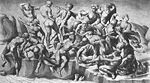
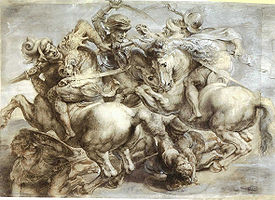
so that Grand Duke Cosimo I could hold his court in this chamber. During this transformation famous (but unfinished) works were lost, including the Battle of Cascina
Battle of Cascina
The Battle of Càscina was an engagement between Pisan and Florentine troops on 28 July 1364 near Càscina, Italy. Florence's victory followed a recent defeat to Pisan forces that had enabled mercenary John Hawkwood, who was in command of the Pisan army, to travel the Valdinievole, Prato en route to...
by Michelangelo
Michelangelo
Michelangelo di Lodovico Buonarroti Simoni , commonly known as Michelangelo, was an Italian Renaissance painter, sculptor, architect, poet, and engineer who exerted an unparalleled influence on the development of Western art...
, and the Battle of Anghiari
The Battle of Anghiari (painting)
The Battle of Anghiari is a lost painting by Leonardo da Vinci at times referred to as "The Lost Leonardo", which some commentators believe to be still hidden beneath later frescoes in the Hall of Five Hundred in the Palazzo Vecchio, Florence...
by Leonardo da Vinci
Leonardo da Vinci
Leonardo di ser Piero da Vinci was an Italian Renaissance polymath: painter, sculptor, architect, musician, scientist, mathematician, engineer, inventor, anatomist, geologist, cartographer, botanist and writer whose genius, perhaps more than that of any other figure, epitomized the Renaissance...
. Leonardo was commissioned in 1503 to paint one long wall with a battle scene celebrating a famous Florentine victory. He was always trying new methods and materials and decided to mix wax into his pigments. Leonardo had finished painting part of the wall, but it wasn't drying fast enough, so he brought in braziers stoked with hot coals to try to hurry the process. As others watched in horror, the wax in the fresco melted under the intense heat and the colors ran down the walls to puddle on the floor. Michelangelo never even got past making the preparatory drawings for the fresco he was supposed to paint on the opposite wall—Pope Julius II called him to Rome to paint the Sistine Chapel, and the master's sketches were destroyed by eager young artists who came to study them and took away scraps. The surviving decorations in this hall were made between 1555 and 1572 by Giorgio Vasari and his helpers, among them Livio Agresti
Livio Agresti
Livio Agresti , also called Ritius or Ricciutello, was an Italian painter of the late-Renaissance or Mannerist period, active both in his native city of Forlì and in Rome, where he died. He was one of the members of the "Forlì painting school"...
from Forlì
Forlì
Forlì is a comune and city in Emilia-Romagna, Italy, and is the capital of the province of Forlì-Cesena. The city is situated along the Via Emilia, to the right of the Montone river, and is an important agricultural centre...
. They mark the culmination of mannerism
Mannerism
Mannerism is a period of European art that emerged from the later years of the Italian High Renaissance around 1520. It lasted until about 1580 in Italy, when a more Baroque style began to replace it, but Northern Mannerism continued into the early 17th century throughout much of Europe...
and make this hall the showpiece of the palace.
On the walls are large and expansive frescoes that depict battles and military victories by Florence over Pisa
Pisa
Pisa is a city in Tuscany, Central Italy, on the right bank of the mouth of the River Arno on the Tyrrhenian Sea. It is the capital city of the Province of Pisa...
and Siena
Siena
Siena is a city in Tuscany, Italy. It is the capital of the province of Siena.The historic centre of Siena has been declared by UNESCO a World Heritage Site. It is one of the nation's most visited tourist attractions, with over 163,000 international arrivals in 2008...
:
- The Taking of Siena
- The Conquest of Porto Ercole
- The Victory of Cosimo I at Marciano in Val di Chiana
- Defeat of the Pisans at the Tower of San Vincenzo
- Maximillian of Austria Attempts the Conquest of Leghorn
- Pisa Attacked by the Florentine Troops
The ceiling consists of 39 panels also constructed and painted by Vasari and his assistants,
representing Great Episodes from the life of Cosimo I, the quarters of the city and the city itself and towards the center is the apotheosis
Apotheosis
Apotheosis is the glorification of a subject to divine level. The term has meanings in theology, where it refers to a belief, and in art, where it refers to a genre.In theology, the term apotheosis refers to the idea that an individual has been raised to godlike stature...
: Scene of His Glorification as Grand Duke of Florence and Tuscany
On the north side of the hall, illuminated by enormous windows, is the raised stage called
the Udienza, built by Bartolommeo Bandinelli
Bartolommeo Bandinelli
Bartolommeo Bandinelli, actually Bartolommeo Brandini , was a Renaissance Italian sculptor, draughtsman and painter.-Biography:...
for Cosimo I to receive citizens and ambassadors. Above are frescoes of historical events; among these, that of Boniface VIII receiving the ambassadors of foreign States and, seeing that were all Florentines, saying: "You Florentines are the quintessence".
In the niches are sculptures by Bandinelli: in the center the statue of the seated "Leo X" (sculpted assisted by his student Vincenzo de'Rossi), and on the right a statue of "Charles V crowned by Clement VII".
There are also numerous bombastic Medicean tapestries on the walls, including Stories of the Life of St. John the Baptist, taken from the frescoes of Andrea del Sarto
Andrea del Sarto
Andrea del Sarto was an Italian painter from Florence, whose career flourished during the High Renaissance and early Mannerism. Though highly regarded during his lifetime as an artist senza errori , his renown was eclipsed after his death by that of his contemporaries, Leonardo da Vinci,...
.
The six statues along the walls that represent the "Labors of Hercules" are by Vincenzo de'Rossi.
In the central niche at the south of the Hall is Michelangelo's famous marble group the "Genius of Victory" (1533-1534), originally intended for the tomb of Julius II. The statue was taken from the Bargello Museum
Bargello
The Bargello, also known as the Bargello Palace or Palazzo del Popolo is a former barracks and prison, now an art museum, in Florence, Italy.-Terminology:...
.
Studiolo
At the end of the hall is situated a small sideroom without windows. This masterpiece, the Studiolo of Francesco IStudiolo of Francesco I
The Studiolo was a small painting-encrusted barrel-vaulted room in the Palazzo Vecchio, Florence, commissioned by Francesco I de' Medici, Grand Duke of Tuscany. It was completed for the duke from 1570-1572, by teams of artists under the supervision of Giorgio Vasari and the scholars Giovanni...
(a studiolo is a small study) was also designed by Vasari in a manneristic style (1570-1575). The walls and the barrel vault are filled with paintings, stucco and sculptures. (Baroque paintings hide secret cupboards.) Most paintings are by the School of Vasari and represent the four elements : water, fire, earth and air. The portrait of Cosimo I and his wife Eleonora of Toledo was made by Bronzino. The delicate bronze sculptures were made by Giambologna
Giambologna
Giambologna, born as Jean Boulogne, incorrectly known as Giovanni da Bologna and Giovanni Bologna , was a sculptor, known for his marble and bronze statuary in a late Renaissance or Mannerist style.- Biography :...
and Bartolomeo Ammanati
Bartolomeo Ammanati
Bartolomeo Ammannati was an Italian architect and sculptor, born at Settignano, near Florence. He studied under Baccio Bandinelli and Jacopo Sansovino and closely imitated the style of Michelangelo.He was more distinguished in architecture than in sculpture...
. Dismantled within decades of its construction, it was re-assembled in the twentieth century.
The other rooms on the first floor are the Quartieri monumentali. These rooms, the Residence of the Priors and the Quarters of Leo X, are used by the mayor as offices and reception rooms. They are not accessible to the public.
Second Floor
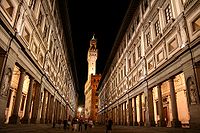
Elements.
The Apartments of the Elements
These apartments (Sala degli Elementi) consist of five rooms (such as the Room of Ceres) and two loggiaLoggia
Loggia is the name given to an architectural feature, originally of Minoan design. They are often a gallery or corridor at ground level, sometimes higher, on the facade of a building and open to the air on one side, where it is supported by columns or pierced openings in the wall...
s. The commission for these rooms was originally given by Cosimo I to Battista del Tasso. But on his death, the decorations were continued by Vasari and his helpers, working for the first time for the Medicis. These rooms were the private quarters of Cosimo I.
The walls in the Room of the Elements are filled with allegorical frescoes Allegories of Water, Fire and Earth and, on the ceiling, represents Saturn.
The original statue "Boy with a Fish" by Verrocchio is on exhibit in one of the smaller rooms (the copy stands on the fountain in the first courtyard).
Terrace of Saturn
Named for the fresco on the ceiling. Has a fabulous view of Florence. There is a southeastern view to Piazzale MichelangeloPiazzale Michelangelo
Piazzale Michelangelo is a famous square with a magnificent panoramic view of Florence, Italy, and is a popular tourist destination in the Oltrarno district of the city...
and the Fortress Belvedere
Belvedere (fort)
The Forte di Belvedere or Fortezza di Santa Maria in San Giorgio del Belvedere is a fortification in Florence, Italy...
. Also visible are the remains of the Church of San Piero Scheraggio.
The Hercules Room
Hercules
Hercules is the Roman name for Greek demigod Heracles, son of Zeus , and the mortal Alcmene...
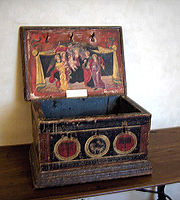
. The room contains a Madonna and Child and an ebony cabinet called a stipo inlaid with semi-precious stones.
The Lion House
Cosimo the ElderCosimo de' Medici
Còsimo di Giovanni degli Mèdici was the first of the Medici political dynasty, de facto rulers of Florence during much of the Italian Renaissance; also known as "Cosimo 'the Elder'" and "Cosimo Pater Patriae" .-Biography:Born in Florence, Cosimo inherited both his wealth and his expertise in...
kept a menagerie of lions in a dedicated lion house in the palazzo. He often fought them or baited them against other animals in large festivals for visiting Popes or dignitaries.
The Room of Jupiter
The room is named for the fresco on the ceiling. On the walls are Florentine tapestries madefrom cartoons by Stradano (16th century).
The Room of Cybele
On the ceiling, the Triumph of Cybele and the Four Seasons. Against the walls arecabinets in tortoise shell and bronze. The floor was made in 1556. From the window one can
see the third courtyard.
The Ceres Room
The room gets its name from the motif on the ceiling, by Doceno, a pupil of Vasari. On thewalls are Florentine tapestries with hunting scenes, from cartoons by Stradano.
Sala Verde
Called the Green Room because of the color of the walls. With decorations on the ceiling byRidolfo del Ghirlandaio. On the right is the Chapel frescoed by Bronzino (1564) with
the Stories of Moses. Also by Bronzino is the large Pietà on the altar. The small
door in the room indicates the beginning of the Vasari corridor
Vasari Corridor
The Vasari Corridor is an elevated enclosed passageway in Florence, central Italy, which connects the Palazzo Vecchio with the Palazzo Pitti. Beginning on the south side of the Palazzo Vecchio, it then joins the Uffizi Gallery and leaves on its south side, crossing the Lungarno dei Archibusieri...
, a passageway to the Palazzo Pitti built by Vasari for Cosimo I.
The Room of the Sabines
It was named because of the ceiling decoration. At one time it was used for the Ladies-in-waiting at the court of Eleonora di Toledo
Eleonora di Toledo
Eleanor of Toledo Eleanor of Toledo Eleanor of Toledo (Italian: Eleonora di Toledo (1522 – 17 December 1562), born Doña Leonor Álvarez de Toledo y Osorio, was a Spanish noblewoman who was Duchess of Florence from 1539. She is credited with being the first modern first lady, or consort...
. It contains Portraits of Medici Princes by
Sustermans
Justus Sustermans
Justus Sustermans , also known as Giusto Sustermans, was a Flemish painter in the Baroque style. He was born in Antwerp and died in Florence....
, statues by a Florentine art school and a tapestry by Fevère.
Dining Room
On the ceiling is the Coronation of Esther decorated by Stradano, with an inscriptionin honor of Eleonora di Toledo
Eleonora di Toledo
Eleanor of Toledo Eleanor of Toledo Eleanor of Toledo (Italian: Eleonora di Toledo (1522 – 17 December 1562), born Doña Leonor Álvarez de Toledo y Osorio, was a Spanish noblewoman who was Duchess of Florence from 1539. She is credited with being the first modern first lady, or consort...
. The room contains a lavabo and two tapestries by
Van Assel representing Spring and Autumn.
The Room of Penelope
On the ceiling Penelope at the loom, in the frieze, episodes from the Odyssey. On thewalls: Madonna and Child and a Madonna and Child with St. John by Botticelli
Sandro Botticelli
Alessandro di Mariano di Vanni Filipepi, better known as Sandro Botticelli was an Italian painter of the Early Renaissance...
.
Private Chamber of Eleanor
Originally called the '"Room of Gualdrada"' from the subject of the ceiling painting, this room was one of the private rooms of Eleonora of Toledo, wife of Cosimo I de' Medici. The paintings are by the Flemish painter Jan Stradan, better known under his Italian name Stradone. Against the wall is a cabinet with Florentine mosaic designs.The adjoining, richly decorated chapel is painted in fresco by the mannerist Angelo Bronzino. It includes some of his masterpieces including Crossing the Red Sea.
Sala dell'Udienza
The Audience Chamber or Hall of Justice used to house the meetings of the six priori (guild masters of the arts). It contains the oldest decorations in the palace.The carved coffer ceiling, laminated with pure gold, is by Giuliano da Maiano
Giuliano da Maiano
Giuliano da Maiano was an Italian architect, intarsia-worker and sculptor, the elder brother of Benedetto da Maiano, with whom he often collaborated.- Biography :...
(1470-1476).
On the portal of the Chapel is an inscription in honor of Christ (1529). The door, communicating with the Hall of Lilies, is a marvel. The marble mouldings of this portal were sculpted by the brothers Giuliano and Benedetto da Maiano
Benedetto da Maiano
Benedetto da Maiano was an Italian sculptor of the early Renaissance.Born in the village of Maiano , he started his career as companion of his brother, the architect Giuliano da Maiano. When he reached the age of thirty he started training under the sculptor Antonio Rossellino...
. Its inlaid woodwork (intarsia
Intarsia
Intarsia is a form of wood inlaying that is similar to marquetry. The term is also used for a similar technique used with small, highly polished stones set in a marble matrix .- History :...
) was carved by Del Francione. They give us portraits of Dante and Petrarch
Petrarch
Francesco Petrarca , known in English as Petrarch, was an Italian scholar, poet and one of the earliest humanists. Petrarch is often called the "Father of Humanism"...
The large frescoes on the walls, of a decorative value representing Stories of Furius Camillus, by Francesco Salviati
Francesco de' Rossi (Il Salviati)
Francesco de' Rossi was an Italian Mannerist painter from Florence, also active in Rome. He is known by many names, prominently the adopted name Francesco Salviati or as Il Salviati, but also Francesco Rossi and Cecchino del Salviati.-Biography:Salviati was born and died in Florence...
, were made in the middle of the 16th century. Since Salviati had his schooling in the circle around Raphael
Raphael
Raffaello Sanzio da Urbino , better known simply as Raphael, was an Italian painter and architect of the High Renaissance. His work is admired for its clarity of form and ease of composition and for its visual achievement of the Neoplatonic ideal of human grandeur...
in Rome, these frescoes are mirrored on Roman models and therefore not typical of Florentine art. Furius Camillus was a Roman general, mentioned in the writings of Plutarchus.
Chapel of the Signoria
A small doorway leads into the adjoining small chapel dedicated to St. BernardBernard of Clairvaux
Bernard of Clairvaux, O.Cist was a French abbot and the primary builder of the reforming Cistercian order.After the death of his mother, Bernard sought admission into the Cistercian order. Three years later, he was sent to found a new abbey at an isolated clearing in a glen known as the Val...
, containing a reliquary of the Saint. Here the priors used to supply divine aid in the execution of their duties. In this chapel, Girolamo Savonarola said his last prayers before he was burned to death on the Piazza della Signoria.
The marvellous frescoes on the walls and ceiling, on a background imitating gold mosaic, are by Ridolfo Ghirlandaio. Of particular interest are The Holy Trinity on the ceiling and The Annunciation on the wall facing the altar. On the altar was a painting representing the Holy Family by Mariano Graziadei da Pescia, a pupil of Ridolfo Ghirlandaio. It is now on exhibition in the corridor of the Uffizi Gallery. Instead, there is a good painting of St. Bernard by an unknown artist.
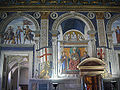
On the wall are frescoes by Domenico Ghirlandaio
Domenico Ghirlandaio
Domenico Ghirlandaio was an Italian Renaissance painter from Florence. Among his many apprentices was Michelangelo.-Early years:Ghirlandaio's full name is given as Domenico di Tommaso di Currado di Doffo Bigordi...
, painted in 1482. The apotheosis of St. Zenobius, first patron saint of Florence, was painted with a perspectival illusion of the background. In this background one can see the Cathedral, with Giotto's original facade and bell tower. In the lunette
Lunette
In architecture, a lunette is a half-moon shaped space, either filled with recessed masonry or void. A lunette is formed when a horizontal cornice transects a round-headed arch at the level of the imposts, where the arch springs. If a door is set within a round-headed arch, the space within the...
above is a bas-relief of the Madonna and Child. This fresco is flanked on both sides by frescoes of famed Romans: on the left Brutus, Gaius Mucius Scaevola and Camillus, and on the right Decius, Scipio and Cicero. Medaillons of Roman emperors fill the spandrils between the sections.
The door in this wall leads to the Stanza della Guardaroba (Hall of Geographical Maps). This door is flanked by two dark marble pillars, originally from a Roman temple.
After its lengthy restoration, the (original) statue "Judith and Holofernes" by Donatello
Donatello
Donato di Niccolò di Betto Bardi , also known as Donatello, was an early Renaissance Italian artist and sculptor from Florence...
was given a prominent place in this room in 1988.
Stanza del Guardaroba
The Hall of Geographical Maps or Wardrobe is where the Medici Grand Dukes kept their precious belongings. The cabinets and carved ceiling are by Dionigi Nigetti.The doors of the cabinets were decorated with 53 remarkable maps of scientific interest, oil paintings by the Dominican monk Fra Ignazio Danti
Ignazio Danti
Ignazio Danti , born Pellegrino Rainaldi Danti, was an Italian priest, mathematician, astronomer, and cosmographer.-Biography:Danti was born in Perugia to a family rich in artists and scientists...
(1563-1575), brother of the sculptor Vincenzo Danti
Vincenzo Danti
Vincenzo Danti was an Italian Renaissance sculptor from Perugia.His father was an architect and goldsmith, and Vincenzo developed an interest in drawing and goldsmithing. In 1545 he went to Rome to study sculpture and in 1553 he managed to secure a commission for a bronze statue of Pope Julius III...
, and Stefano Buonsignori (1575-1584). They are of great historical interest and give a good idea of the geographical knowledge in the 16th century. Danti followed the Ptolemaic system, while already using the new cartographical system of Gerardus Mercator
Gerardus Mercator
thumb|right|200px|Gerardus MercatorGerardus Mercator was a cartographer, born in Rupelmonde in the Hapsburg County of Flanders, part of the Holy Roman Empire. He is remembered for the Mercator projection world map, which is named after him...
.
In the center of the room is the large globe "mappa mundi" ruined by excessive restorations.
Old Chancellery
This was Machiavelli's office when he was Secretary of the Republic. His polychrome bust in terracotta and his portrait are by Santi di TitoSanti di Tito
Santi di Tito was an Italian painter of Late-Mannerist or proto-Baroque style, what is sometimes referred to as Contra-Maniera or Counter-Mannerism.-Biography:...
. They are probably modelled on his death mask.
In the center of the room, on the pedestal is the famous Winged Boy with a Dolphin by Verrocchio, brought to this room from the First Courtyard.
The Study (Studiolo)
The reassembled room was used by Cellini to restore the treasures of the Medici princes. From the little window in the wall, Cosimo I spied on his ministers and officers, during meetings in the Salone dei Cinquecento. It became a museum of mannerist paintings.See also
- Eagle Warehouse & Storage CompanyEagle Warehouse & Storage CompanyThe Eagle Warehouse & Storage Company, commonly referred to as the Eagle Warehouse, is a notable building located in Brooklyn, New York. Designed by Brooklyn architect Frank Freeman and completed in 1894, it had a number of uses before being converted into apartments in 1980. Described as a...
- a Richardsonian RomanesqueRichardsonian RomanesqueRichardsonian Romanesque is a style of Romanesque Revival architecture named after architect Henry Hobson Richardson, whose masterpiece is Trinity Church, Boston , designated a National Historic Landmark...
warehouse in Brooklyn, New York which has been likened to the Palazzo Vecchio. - Emerson Bromo-Seltzer TowerEmerson Bromo-Seltzer TowerThe Emerson Bromo-Seltzer Tower was erected in 1911 at the corner of Eutaw and Lombard Streets in Baltimore, Maryland. It was designed by Joseph Evans Sperry and was constructed by Bromo-Seltzer inventor "Captain" Isaac E. Emerson. It was the tallest building in Baltimore from 1911 until 1923...
in Baltimore, Maryland, patterned after the Palazzo Vecchio
External links
- Palazzo Vecchio - Musei civici fiorentini
- Musei dei Ragazzi di Firenze - Interactive workshop, guided tour, animated tour at Palazzo Vecchio - institutional website
- Satellite image from Google Maps
- Palazzo Vecchio, Florence virtual reality movie and pictures
- Excavation at Palazzo Vecchio Urban Archaeology in Florence
- Palazzo Vecchio floor plan
- The Museums of Florence - Palazzo Vecchio & Piazza Signoria
- Virtual Tour of Palazzo Vecchio