

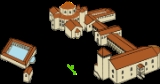
Palace of Aachen

Encyclopedia
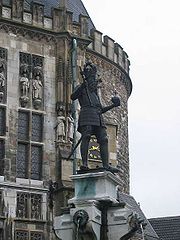
Charlemagne
Charlemagne was King of the Franks from 768 and Emperor of the Romans from 800 to his death in 814. He expanded the Frankish kingdom into an empire that incorporated much of Western and Central Europe. During his reign, he conquered Italy and was crowned by Pope Leo III on 25 December 800...
to be the centre of power of the Carolingian Empire
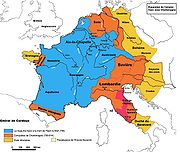
Carolingian Empire
Carolingian Empire is a historiographical term which has been used to refer to the realm of the Franks under the Carolingian dynasty in the Early Middle Ages. This dynasty is seen as the founders of France and Germany, and its beginning date is based on the crowning of Charlemagne, or Charles the...
. The palace was located at the north of the current city of Aachen
Aachen
Aachen has historically been a spa town in North Rhine-Westphalia, Germany. Aachen was a favoured residence of Charlemagne, and the place of coronation of the Kings of Germany. Geographically, Aachen is the westernmost town of Germany, located along its borders with Belgium and the Netherlands, ...
, today in the German
Germany
Germany , officially the Federal Republic of Germany , is a federal parliamentary republic in Europe. The country consists of 16 states while the capital and largest city is Berlin. Germany covers an area of 357,021 km2 and has a largely temperate seasonal climate...
Land
States of Germany
Germany is made up of sixteen which are partly sovereign constituent states of the Federal Republic of Germany. Land literally translates as "country", and constitutionally speaking, they are constituent countries...
of North Rhine-Westphalia
North Rhine-Westphalia
North Rhine-Westphalia is the most populous state of Germany, with four of the country's ten largest cities. The state was formed in 1946 as a merger of the northern Rhineland and Westphalia, both formerly part of Prussia. Its capital is Düsseldorf. The state is currently run by a coalition of the...
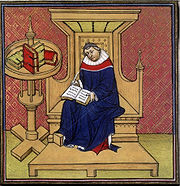
. Most of the Carolingian palace was built in the 790s but the works went on until Charlemagne's death in 814. The plans, drawn by Odo of Metz
Odo of Metz
Eudes of Metz was an architect who lived during Charlemagne's reign in the Carolingian Empire, and is the earliest known architect born north of the Alps....
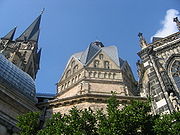
, were part with the programme of renovation of the kingdom decided by the ruler. Today much of the palace is destroyed, but the Palatine Chapel has been preserved and is considered as a masterpiece of Carolingian architecture
Carolingian architecture
Carolingian architecture is the style of north European Pre-Romanesque architecture belonging to the period of the Carolingian Renaissance of the late 8th and 9th centuries, when the Carolingian family dominated west European politics...
and a characteristic example of architecture from the Carolingian Renaissance
Carolingian Renaissance
In the history of ideas the Carolingian Renaissance stands out as a period of intellectual and cultural revival in Europe occurring from the late eighth century, in the generation of Alcuin, to the 9th century, and the generation of Heiric of Auxerre, with the peak of the activities coordinated...
.
The palace before Charlemagne
Germania
Germania was the Greek and Roman geographical term for the geographical regions inhabited by mainly by peoples considered to be Germani. It was most often used to refer especially to the east of the Rhine and north of the Danube...
. The site, called Aquae Granni, was equipped with 50 acres (202,343 m²). thermae
Thermae
In ancient Rome, thermae and balnea were facilities for bathing...
that remained in use from the 1st to the 4th century The Roman city grew in connection with the thermae according to a classical grid plan
Grid plan
The grid plan, grid street plan or gridiron plan is a type of city plan in which streets run at right angles to each other, forming a grid...
similar to that of Roman legions camps
Castra
The Latin word castra, with its singular castrum, was used by the ancient Romans to mean buildings or plots of land reserved to or constructed for use as a military defensive position. The word appears in both Oscan and Umbrian as well as in Latin. It may have descended from Indo-European to Italic...
. A palace was used to accommodate the governor
Roman governor
A Roman governor was an official either elected or appointed to be the chief administrator of Roman law throughout one or more of the many provinces constituting the Roman Empire...
of the province
Roman province
In Ancient Rome, a province was the basic, and, until the Tetrarchy , largest territorial and administrative unit of the empire's territorial possessions outside of Italy...
or the Emperor. In the 4th century, the city and the palace were destroyed during the Barbarian Invasions
Migration Period
The Migration Period, also called the Barbarian Invasions , was a period of intensified human migration in Europe that occurred from c. 400 to 800 CE. This period marked the transition from Late Antiquity to the Early Middle Ages...
. Clovis
Clovis I
Clovis Leuthwig was the first King of the Franks to unite all the Frankish tribes under one ruler, changing the leadership from a group of royal chieftains, to rule by kings, ensuring that the kingship was held by his heirs. He was also the first Catholic King to rule over Gaul . He was the son...
made Paris
Paris
Paris is the capital and largest city in France, situated on the river Seine, in northern France, at the heart of the Île-de-France region...
the capital of the Frankish Kingdom, and Aachen Palace was abandoned until the advent of the Carolingian dynasty. The Pippinid
Pippinid
The Pippinids or Arnulfings are the members of a family of Frankish nobles whose select scions served as Mayor of the Palace, de facto rulers, of the Frankish kingdoms of Neustria and Austrasia that were nominally ruled by the Merovingians....
Mayors of the Palace
Mayor of the Palace
Mayor of the Palace was an early medieval title and office, also called majordomo, from the Latin title maior domus , used most notably in the Frankish kingdoms in the 7th and 8th centuries....
carried out some restoration works, but it was at the time only a residence among others. The Frankish court was nomadic and the rulers moved according to the circumstances. Around 765, Pepin the Short had a palace erected over the remains of the old Roman building; he had the thermae restored and removed its pagan idols
Cult image
In the practice of religion, a cult image is a human-made object that is venerated for the deity, spirit or daemon that it embodies or represents...
. As soon as he came to power in 768, Charlemagne spent time in Aachen as well as in other villas
Villa
A villa was originally an ancient Roman upper-class country house. Since its origins in the Roman villa, the idea and function of a villa have evolved considerably. After the fall of the Roman Republic, villas became small farming compounds, which were increasingly fortified in Late Antiquity,...
in Austrasia
Austrasia
Austrasia formed the northeastern portion of the Kingdom of the Merovingian Franks, comprising parts of the territory of present-day eastern France, western Germany, Belgium, Luxembourg and the Netherlands. Metz served as its capital, although some Austrasian kings ruled from Rheims, Trier, and...
. However, in the 790s, he decided to settle down in order to govern his kingdom, then his empire more efficiently.
The choice of Aachen
Saxony
The Free State of Saxony is a landlocked state of Germany, contingent with Brandenburg, Saxony Anhalt, Thuringia, Bavaria, the Czech Republic and Poland. It is the tenth-largest German state in area, with of Germany's sixteen states....
in 772–780, but this area resisted and the war with the Saxons
Saxons
The Saxons were a confederation of Germanic tribes originating on the North German plain. The Saxons earliest known area of settlement is Northern Albingia, an area approximately that of modern Holstein...
lasted for about thirty years. Charlemagne ended with the Germanic custom of an itinerant court moving from place to place and established a real capital. As he was ageing, he decreased the frequency of military expeditions and, after 806, virtually did not leave Aachen.
Aachen's geographic location was a decisive factor in Charlemagne's choice: the place was situated in the Carolingian heartlands of Austrasia
Austrasia
Austrasia formed the northeastern portion of the Kingdom of the Merovingian Franks, comprising parts of the territory of present-day eastern France, western Germany, Belgium, Luxembourg and the Netherlands. Metz served as its capital, although some Austrasian kings ruled from Rheims, Trier, and...
, the cradle of his family, East of the Meuse river, at a crossroads of land roads and on a tributary
Tributary
A tributary or affluent is a stream or river that flows into a main stem river or a lake. A tributary does not flow directly into a sea or ocean...
of the Rur
Rur
The Rur , — not to be confused with the Ruhr — is a river which flows through portions of Belgium, Germany and the Netherlands. It is a right tributary to the river Meuse...
, called the Wurm
Wurm
The Wurm is a river in Germany , a left tributary of the Rur. The source of the Wurm are several brooks in the forests southwest of Aachen, which form the Wurm after the Diepenbenden reservoir. From there the Wurm nowadays flows through canals through the city of Aachen, until it resurfaces at the...
. From then, Charlemagne left the administration of the Southern regions to his son Louis
Louis the Pious
Louis the Pious , also called the Fair, and the Debonaire, was the King of Aquitaine from 781. He was also King of the Franks and co-Emperor with his father, Charlemagne, from 813...
, named King of Aquitaine, which enabled him to reside in the North.
Hunting
Hunting is the practice of pursuing any living thing, usually wildlife, for food, recreation, or trade. In present-day use, the term refers to lawful hunting, as distinguished from poaching, which is the killing, trapping or capture of the hunted species contrary to applicable law...
in the area. The ageing emperor could also benefit from Aachen's hot springs.
The scholars of the Carolingian era presented Charlemagne as the "New Constantine
Constantine I
Constantine the Great , also known as Constantine I or Saint Constantine, was Roman Emperor from 306 to 337. Well known for being the first Roman emperor to convert to Christianity, Constantine and co-Emperor Licinius issued the Edict of Milan in 313, which proclaimed religious tolerance of all...
". In that purpose, a capital and a palace worthy of the name. He left Rome
Rome
Rome is the capital of Italy and the country's largest and most populated city and comune, with over 2.7 million residents in . The city is located in the central-western portion of the Italian Peninsula, on the Tiber River within the Lazio region of Italy.Rome's history spans two and a half...
to the Pope
Pope
The Pope is the Bishop of Rome, a position that makes him the leader of the worldwide Catholic Church . In the Catholic Church, the Pope is regarded as the successor of Saint Peter, the Apostle...
. The rivalry with the Byzantine Empire
Byzantine Empire
The Byzantine Empire was the Eastern Roman Empire during the periods of Late Antiquity and the Middle Ages, centred on the capital of Constantinople. Known simply as the Roman Empire or Romania to its inhabitants and neighbours, the Empire was the direct continuation of the Ancient Roman State...
led Charlemagne to build a magnificent palace. The fire that destroyed his palace in Worms in 793 also encouraged him to follow such a plan.
Importance of the project entrusted to Odo of Metz
Odo of Metz
Eudes of Metz was an architect who lived during Charlemagne's reign in the Carolingian Empire, and is the earliest known architect born north of the Alps....
. His name appears in the works of Eginhard (c. 775–840), Charlemagne's biographer. He is supposed to have been an educated cleric, familiar with liberal arts
Liberal arts
The term liberal arts refers to those subjects which in classical antiquity were considered essential for a free citizen to study. Grammar, Rhetoric and Logic were the core liberal arts. In medieval times these subjects were extended to include mathematics, geometry, music and astronomy...
, especially quadrivia. He had probably read Vitruvius
Vitruvius
Marcus Vitruvius Pollio was a Roman writer, architect and engineer, active in the 1st century BC. He is best known as the author of the multi-volume work De Architectura ....
' treaties of architecture.
The decision to build the palace was taken in the late 780s or the early 790s, before Charlemagne held the title of emperor. Works began in 794 and went on for several years. Aachen quickly became the favourite residence of the sovereign. After 807, he almost did not leave it any more. In the absence of sufficient documentation, it is impossible to know the number of workers employed, but the dimensions of the building make it probable that there were many of them.
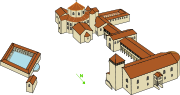
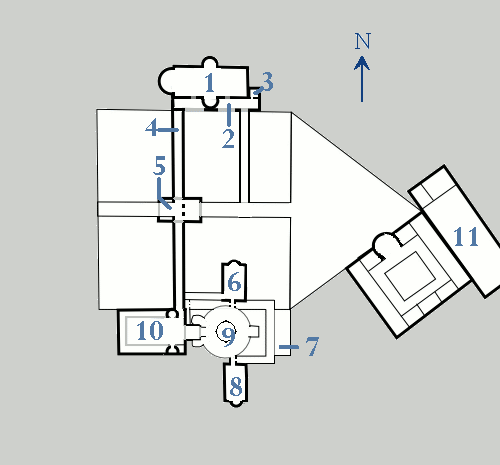
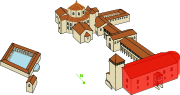
The geometry of the plan chosen was very simple: Odo of Metz decided to keep the layout of the Roman roads and inscribe the square in 360 Carolingian feet, or 120 metres-side square. The square enclosed an area of 50 acre
Acre
The acre is a unit of area in a number of different systems, including the imperial and U.S. customary systems. The most commonly used acres today are the international acre and, in the United States, the survey acre. The most common use of the acre is to measure tracts of land.The acre is related...
s divided in four parts by a North-South axis (the stone gallery) and an East-West axis (the former Roman road
Roman road
The Roman roads were a vital part of the development of the Roman state, from about 500 BC through the expansion during the Roman Republic and the Roman Empire. Roman roads enabled the Romans to move armies and trade goods and to communicate. The Roman road system spanned more than 400,000 km...
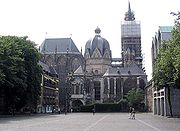
, the decumanus). To the north of this square lied the council hall, to the south the Palatine Chapel. The architect drew a triangle toward the East to connect the thermae to the palace complex. The two best-known buildings are the council hall (today disappeared) and the Palatine Chapel, included into the Cathedral
Aachen Cathedral
Aachen Cathedral, frequently referred to as the "Imperial Cathedral" , is a Roman Catholic church in Aachen, Germany. The church is the oldest cathedral in northern Europe and was known as the "Royal Church of St. Mary at Aachen" during the Middle Ages...
. The other building are hardly identified. often built in Timber framing
Timber framing
Timber framing , or half-timbering, also called in North America "post-and-beam" construction, is the method of creating structures using heavy squared off and carefully fitted and joined timbers with joints secured by large wooden pegs . It is commonplace in large barns...
, made of wood
Wood
Wood is a hard, fibrous tissue found in many trees. It has been used for hundreds of thousands of years for both fuel and as a construction material. It is an organic material, a natural composite of cellulose fibers embedded in a matrix of lignin which resists compression...
and brick
Brick
A brick is a block of ceramic material used in masonry construction, usually laid using various kinds of mortar. It has been regarded as one of the longest lasting and strongest building materials used throughout history.-History:...
, they have been destroyed. Lastly, the palace complex was surrounded with a wall.
The arrival of the court in Aachen and the construction work stimulated the activity in the city that experienced growth in the late 8th century and the early 9th century, as craftsmen, traders and shopkeepers had settled near the court. Some important ones lived in houses inside the city. The members of the Palace Academy and Charlemagne's advisors such as Eginhard and Angilbert
Angilbert
Saint Angilbert was a Frank who served Charlemagne as a diplomat, abbot, poet and semi-son-in-law. He was of noble Frankish parentage, and educated at the palace school in Aquae Grani under Alcuin...
owned houses near the palace.
Council Hall
Carolingian Empire
Carolingian Empire is a historiographical term which has been used to refer to the realm of the Franks under the Carolingian dynasty in the Early Middle Ages. This dynasty is seen as the founders of France and Germany, and its beginning date is based on the crowning of Charlemagne, or Charles the...
Empire, dignitaries and the hierarchy of the power: counts, vassals of the king, bishops and abbots. The general assembly was usually held in May. Participants discussed important political and legal affairs. Capitularies, written by amanuenses of the Aachen chancellery
Chancellor
Chancellor is the title of various official positions in the governments of many nations. The original chancellors were the Cancellarii of Roman courts of justice—ushers who sat at the cancelli or lattice work screens of a basilica or law court, which separated the judge and counsel from the...
, summed up the decisions taken. In this building also took place official ceremonies and the reception of embassies. Describing the coronation of Louis, son of Charlemagne, Ermold the Black states that there Charlemagne "spoke down from his golden seat."
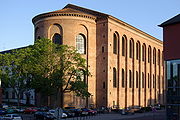
Trier
Trier, historically called in English Treves is a city in Germany on the banks of the Moselle. It is the oldest city in Germany, founded in or before 16 BC....
. The structure was made of brick, and the shape was that of a civil basilica
Basilica
The Latin word basilica , was originally used to describe a Roman public building, usually located in the forum of a Roman town. Public basilicas began to appear in Hellenistic cities in the 2nd century BC.The term was also applied to buildings used for religious purposes...
with three apses: the largest one (17,2 m), located to the West, was dedicated to the king and his suite. The two other apses, to the North and South, were smaller. Light entered through two rows of windows. The inside was probably decorated with paintings depicting heroes both from the Ancient times and contemporary. A wooden gallery girdled the building between the two rows of windows. From this gallery could be seen the market
Market
A market is one of many varieties of systems, institutions, procedures, social relations and infrastructures whereby parties engage in exchange. While parties may exchange goods and services by barter, most markets rely on sellers offering their goods or services in exchange for money from buyers...
that was held North of the Palace. A gallery with porticos on the southern side of the hall gave access to the building. The southern apse cut though the middle of this entrance.
Description
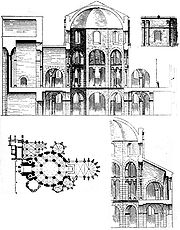
Pope Leo III
Pope Saint Leo III was Pope from 795 to his death in 816. Protected by Charlemagne from his enemies in Rome, he subsequently strengthened Charlemagne's position by crowning him as Roman Emperor....
, in honour of the Virgin Mary, Mother of Christ.
Several buildings used by the clerics of the chapel were arranged in the shape of a latin cross: a curia
Curia
A curia in early Roman times was a subdivision of the people, i.e. more or less a tribe, and with a metonymy it came to mean also the meeting place where the tribe discussed its affairs...
in the East, offices in the North and South, and a projecting part (Westbau) and an atrium
Atrium (architecture)
In modern architecture, an atrium is a large open space, often several stories high and having a glazed roof and/or large windows, often situated within a larger multistory building and often located immediately beyond the main entrance doors...
with exedrae in the West. But the center piece was the chapel, covered with a 16,54 meters wide and 31 meters high octagonal cupola
Cupola
In architecture, a cupola is a small, most-often dome-like, structure on top of a building. Often used to provide a lookout or to admit light and air, it usually crowns a larger roof or dome....
. Eight massive pillars receive the thrust of large arcades
Arcade (architecture)
An arcade is a succession of arches, each counterthrusting the next, supported by columns or piers or a covered walk enclosed by a line of such arches on one or both sides. In warmer or wet climates, exterior arcades provide shelter for pedestrians....
. The nave
Nave
In Romanesque and Gothic Christian abbey, cathedral basilica and church architecture, the nave is the central approach to the high altar, the main body of the church. "Nave" was probably suggested by the keel shape of its vaulting...
on the first floor, located under the cupola, is surrounded by an aisle
Aisle
An aisle is, in general, a space for walking with rows of seats on both sides or with rows of seats on one side and a wall on the other...
; here stood the Palace servants.
Tribune (architecture)
Tribune is an ambiguous — and often misused — architectural term which can have several meanings. Today it most often refers to a dais or stage-like platform, or — in a vaguer sense — any place from which a speech can be prominently made.-Etymology:...
) open on the central space through semicircular arches supported by columns. The inner side takes the shape of an octagon whereas the outer side develops into a sixteen-sides polygon
Polygon
In geometry a polygon is a flat shape consisting of straight lines that are joined to form a closed chain orcircuit.A polygon is traditionally a plane figure that is bounded by a closed path, composed of a finite sequence of straight line segments...
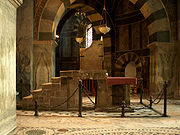
. The chapel had two choirs located in the East and West. The king sat on a throne
Throne
A throne is the official chair or seat upon which a monarch is seated on state or ceremonial occasions. "Throne" in an abstract sense can also refer to the monarchy or the Crown itself, an instance of metonymy, and is also used in many expressions such as "the power behind the...
made of white marble plates, in the West of the second floor, surrounded by his closer courtiers. Thus he had a view on the three altars: that of the Savior
Jesus
Jesus of Nazareth , commonly referred to as Jesus Christ or simply as Jesus or Christ, is the central figure of Christianity...
right in front of him, that of the Virgin Mary on the first floor and that of Saint Peter in the far end of the Western choir.
Charlemagne wanted his chapel to be magnificently decorated, so he had massive bronze
Bronze
Bronze is a metal alloy consisting primarily of copper, usually with tin as the main additive. It is hard and brittle, and it was particularly significant in antiquity, so much so that the Bronze Age was named after the metal...
doors made in a foundry near Aachen. The walls were covered with marble
Marble
Marble is a metamorphic rock composed of recrystallized carbonate minerals, most commonly calcite or dolomite.Geologists use the term "marble" to refer to metamorphosed limestone; however stonemasons use the term more broadly to encompass unmetamorphosed limestone.Marble is commonly used for...
and polychrome
Polychrome
Polychrome is one of the terms used to describe the use of multiple colors in one entity. It has also been defined as "The practice of decorating architectural elements, sculpture, etc., in a variety of colors." Polychromatic light is composed of a number of different wavelengths...
stone. The columns, still visible today, were taken on buildings in Ravenna
Ravenna
Ravenna is the capital city of the Province of Ravenna in the Emilia-Romagna region of Italy and the second largest comune in Italy by land area, although, at , it is little more than half the size of the largest comune, Rome...
and Rome
Rome
Rome is the capital of Italy and the country's largest and most populated city and comune, with over 2.7 million residents in . The city is located in the central-western portion of the Italian Peninsula, on the Tiber River within the Lazio region of Italy.Rome's history spans two and a half...
, with the Pope's permission.
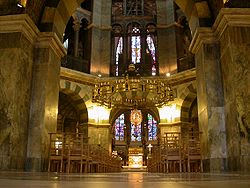
Mosaic
Mosaic is the art of creating images with an assemblage of small pieces of colored glass, stone, or other materials. It may be a technique of decorative art, an aspect of interior decoration, or of cultural and spiritual significance as in a cathedral...
, enhanced by both artificial lights and exterior light coming in through the windows. Eginhard provides a description of the inside in his Life of Charlemagne (c. 825–826):
Symbolism
Odo of Metz
Eudes of Metz was an architect who lived during Charlemagne's reign in the Carolingian Empire, and is the earliest known architect born north of the Alps....
applied the Christian symbolism
Christian symbolism
Christian symbolism invests objects or actions with an inner meaning expressing Christian ideas. Christianity has borrowed from the common stock of significant symbols known to most periods and to all regions of the world. Religious symbolism is effective when it appeals to both the intellect and...
for figures and numbers. The building was conceived as a representation of the heavenly Jerusalem, the Kingdom of God, as described in the Apocalypse
Apocalypse
An Apocalypse is a disclosure of something hidden from the majority of mankind in an era dominated by falsehood and misconception, i.e. the veil to be lifted. The Apocalypse of John is the Book of Revelation, the last book of the New Testament...
. The outer perimeter of the cupola measures exactly 144 Carolingian feet whereas that of the heavenly Jerusalem, ideal city drawn by angels, is of 144 cubits. The mosaic of the cupola, hidden today behind a 19th-century restoration, showed Christ in Majesty
Christ in Majesty
Christ in Majesty, or Christ in Glory, in Latin Majestas Domini, is the Western Christian image of Christ seated on a throne as ruler of the world, always seen frontally in the centre of the composition, and often flanked by other sacred figures, whose membership changes over time and according to...
with the 24 elders of the Apocalypse. Other mosaics, on the vaults
Vault (architecture)
A Vault is an architectural term for an arched form used to provide a space with a ceiling or roof. The parts of a vault exert lateral thrust that require a counter resistance. When vaults are built underground, the ground gives all the resistance required...
of the aisle, takes up this subject by representing the heavenly Jerusalem. Charlemagne's throne, located in the West of the second floor, was placed on the seventh step of a platform.
Treasury and Archives
The treasuryTreasury
A treasury is either*A government department related to finance and taxation.*A place where currency or precious items is/are kept....
and archives of the palace were located in a tower tied to the great hall, in the North of the complex. The chamberman
Grand Chamberman of France
The Grand Chamberman of France was one of the Great Officers of the Crown of France, a member of the Maison du Roi , and one of the Great Offices of the Maison du Roi during the Ancien Régime...
was the officer liable for the rulers' treasury and wardrobe. Finance administration fell on the archichaplain, assisted by a treasurer
Treasurer
A treasurer is the person responsible for running the treasury of an organization. The adjective for a treasurer is normally "tresorial". The adjective "treasurial" normally means pertaining to a treasury, rather than the treasurer.-Government:...
. The treasury gathered gifts brought by the kingdom's important people during the general assemblies or by foreign envoys. This made up an heterogeneous collection of objects ranging from precious books to weapons and clothing. The king would also buy items from merchants visiting Aachen.
The chancellor
Chancellor
Chancellor is the title of various official positions in the governments of many nations. The original chancellors were the Cancellarii of Roman courts of justice—ushers who sat at the cancelli or lattice work screens of a basilica or law court, which separated the judge and counsel from the...
was liable for the archives. The chancellery employed several scribes and notaries who wrote down diplomas, capitularies and royal correspondence. Agents of the king's offices were mostly clergymen of the chapel.
Gallery
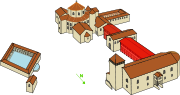
The covered gallery was a hundred meters long. It linked the council hall to the chapel; a monumental porch
Porch
A porch is external to the walls of the main building proper, but may be enclosed by screen, latticework, broad windows, or other light frame walls extending from the main structure.There are various styles of porches, all of which depend on the architectural tradition of its location...
in its middle was used as the main entrance. A room for legal hearing was located on the second floor. The king dispensed justice in this place, although affairs in which important people were involved were handled in the aula regia. When the king was away, this task fell on the count of the Palace. The building was also probably used as a garrison
Garrison
Garrison is the collective term for a body of troops stationed in a particular location, originally to guard it, but now often simply using it as a home base....
.
Thermae
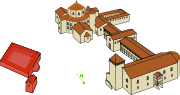
The thermal complex
Thermae
In ancient Rome, thermae and balnea were facilities for bathing...
, located in the Southeast, measured 50 acres (202,343 m²) and included several buildings near the sources of the Emperor and Quirinus
Quirinus
In Roman mythology, Quirinus was an early god of the Roman state. In Augustan Rome, Quirinus was also an epithet of Janus, as Janus Quirinus. His name is derived from Quiris meaning "spear."-History:...
. Eginhard mentions a swimming pool
Swimming pool
A swimming pool, swimming bath, wading pool, or simply a pool, is a container filled with water intended for swimming or water-based recreation. There are many standard sizes; the largest is the Olympic-size swimming pool...
that could accommodate one hundred swimmers at a time :
Other buildings for other functions
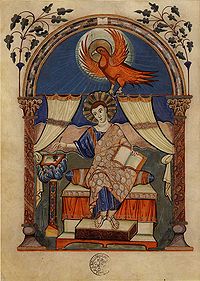
Scriptorium
Scriptorium, literally "a place for writing", is commonly used to refer to a room in medieval European monasteries devoted to the copying of manuscripts by monastic scribes...
that saw the writing of several precious manuscripts (Drogo Sacramentary
Drogo Sacramentary
The Drogo Sacramentary is a Carolingian illuminated manuscript on vellum of c.850 AD, one of the monuments of Carolingian book illumination...
, Godescalc Evangelistary
Godescalc Evangelistary
The Godescalc Evangelistary or Godescalc Gospel Lectionary is an illuminated manuscript Gospel Book made by the Frankish scribe Godescalc circa 781 - 783 C.E...
…), a goldsmith workshop and an ivory
Ivory
Ivory is a term for dentine, which constitutes the bulk of the teeth and tusks of animals, when used as a material for art or manufacturing. Ivory has been important since ancient times for making a range of items, from ivory carvings to false teeth, fans, dominoes, joint tubes, piano keys and...
workshop. There was also a mint
Mint (coin)
A mint is an industrial facility which manufactures coins for currency.The history of mints correlates closely with the history of coins. One difference is that the history of the mint is usually closely tied to the political situation of an era...
that was still operational in the 13th century.
The palace also housed the literary activities of the Palace Academy. This circle of scholars did not gather in a definite building: Charlemagne liked to listen to poems while he was swimming and eating. The Palace school provided education to the ruler's children and the "nourished ones" (nutriti in Latin), aristocrat sons that were to serve the king.
Outside of the palace complex were also a gynaeceum
Gynaeceum
A Gynaeceum or Gynaeconitis in Ancient Greece was a building or was the portion of a house reserved for women, generally the innermost apartment. In other words, a women's quarters, similar to the Persian zenana...
, barracks
Barracks
Barracks are specialised buildings for permanent military accommodation; the word may apply to separate housing blocks or to complete complexes. Their main object is to separate soldiers from the civilian population and reinforce discipline, training and esprit de corps. They were sometimes called...
, an hospice
Hospice
Hospice is a type of care and a philosophy of care which focuses on the palliation of a terminally ill patient's symptoms.In the United States and Canada:*Gentiva Health Services, national provider of hospice and home health services...
, a hunting park and a menagerie
Menagerie
A menagerie is/was a form of keeping common and exotic animals in captivity that preceded the modern zoological garden. The term was first used in seventeenth century France in reference to the management of household or domestic stock. Later, it came to be used primarily in reference to...
in which lived the elephant Abul-Abbas
Abul-Abbas
Abul-Abbas, also Abul Abaz or Abulabaz, was an Asian elephant given to Emperor Charlemagne by the caliph of Baghdad, Harun al-Rashid, in 797. The elephant's name and events from his life in the Carolingian Empire are recorded in the annales regni francorum , and Einhard's vita Karoli Magni also...
, given by Baghdad
Baghdad
Baghdad is the capital of Iraq, as well as the coterminous Baghdad Governorate. The population of Baghdad in 2011 is approximately 7,216,040...
Caliph
Caliph
The Caliph is the head of state in a Caliphate, and the title for the ruler of the Islamic Ummah, an Islamic community ruled by the Shari'ah. It is a transcribed version of the Arabic word which means "successor" or "representative"...
Harun al-Rashid
Harun al-Rashid
Hārūn al-Rashīd was the fifth Arab Abbasid Caliph in Iraq. He was born in Rey, Iran, close to modern Tehran. His birth date remains a point of discussion, though, as various sources give the dates from 763 to 766)....
. Ermoldus Nigellus
Ermoldus Nigellus
Ermoldus Nigellus or Niger, translated Ermold the Black, also Ermoald, was a monk of Aquitaine, who accompanied King Pippin, son of the Emperor Louis I, on a campaign into Brittany in 824....
describes the place in his Poems on Louis the Pious (first half of the 9th century).
The place was frequented everyday by crowds of people: courtiers, scholars, aristocrats, merchants but also beggars and poor people that came to ask for charity
Charity (practice)
The practice of charity means the voluntary giving of help to those in need who are not related to the giver.- Etymology :The word "charity" entered the English language through the Old French word "charité" which was derived from the Latin "caritas".Originally in Latin the word caritas meant...
. Internal affairs were the task of officers
Police officer
A police officer is a warranted employee of a police force...
such as butler
Butler
A butler is a domestic worker in a large household. In great houses, the household is sometimes divided into departments with the butler in charge of the dining room, wine cellar, and pantry. Some also have charge of the entire parlour floor, and housekeepers caring for the entire house and its...
, le seneschal
Seneschal
A seneschal was an officer in the houses of important nobles in the Middle Ages. In the French administrative system of the Middle Ages, the sénéchal was also a royal officer in charge of justice and control of the administration in southern provinces, equivalent to the northern French bailli...
, the chamberman
Grand Chamberman of France
The Grand Chamberman of France was one of the Great Officers of the Crown of France, a member of the Maison du Roi , and one of the Great Offices of the Maison du Roi during the Ancien Régime...
.
Roman legacy and Byzantine model
Roman Empire
The Roman Empire was the post-Republican period of the ancient Roman civilization, characterised by an autocratic form of government and large territorial holdings in Europe and around the Mediterranean....
but to found a Christian and Frankish empire. However the palace borrows several elements of Roman civilization: the aula palatina follows a basilical plan; basilicas in ancient times were public buildings where the city affairs were discussed. The chapel follows models from ancient Rome: grids exhibit antique decorations (acanthus
Acanthus (ornament)
The acanthus is one of the most common plant forms to make foliage ornament and decoration.-Architecture:In architecture, an ornament is carved into stone or wood to resemble leaves from the Mediterranean species of the Acanthus genus of plants, which have deeply cut leaves with some similarity to...
) and columns are topped by Corinthian capitals
Corinthian order
The Corinthian order is one of the three principal classical orders of ancient Greek and Roman architecture. The other two are the Doric and Ionic. When classical architecture was revived during the Renaissance, two more orders were added to the canon, the Tuscan order and the Composite order...
. The Emperor was buried in the Palatine Chapel within a 2nd-century marble sarcophagus
Sarcophagus
A sarcophagus is a funeral receptacle for a corpse, most commonly carved or cut from stone. The word "sarcophagus" comes from the Greek σαρξ sarx meaning "flesh", and φαγειν phagein meaning "to eat", hence sarkophagus means "flesh-eating"; from the phrase lithos sarkophagos...
decorated with a depiction of the abduction of Proserpina
Proserpina
Proserpina or Proserpine is an ancient Roman goddess whose story is the basis of a myth of Springtime. Her Greek goddess' equivalent is Persephone. The probable origin of her name comes from the Latin, "proserpere" or "to emerge," in respect to the growing of grain...
. Scholars of Charlemagne's time nicknamed Aachen «the Second Rome».
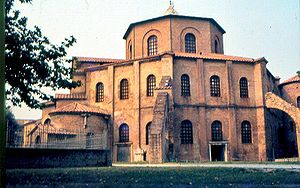
Charlemagne wished to compete with the other emperor of the time, the Basileus of Constantinople. The cupola and mosaics of the chapel are Byzantine elements. The plan itself is probably inspired by the Basilica of San Vitale
Basilica of San Vitale
The Church of San Vitale — styled an "ecclesiastical basilica" in the Roman Catholic Church, though it is not of architectural basilica form — is a church in Ravenna, Italy, one of the most important examples of early Christian Byzantine Art and architecture in western Europe...
in Ravenna
Ravenna
Ravenna is the capital city of the Province of Ravenna in the Emilia-Romagna region of Italy and the second largest comune in Italy by land area, although, at , it is little more than half the size of the largest comune, Rome...
built by Justinian I
Justinian I
Justinian I ; , ; 483– 13 or 14 November 565), commonly known as Justinian the Great, was Byzantine Emperor from 527 to 565. During his reign, Justinian sought to revive the Empire's greatness and reconquer the lost western half of the classical Roman Empire.One of the most important figures of...
in the 6th century. Other experts point at similarities with the Church of the Saints Sergius and Bacchus
Little Hagia Sophia
Little Hagia Sophia , formerly the Church of the Saints Sergius and Bacchus , is a former Eastern Orthodox church dedicated to Saints Sergius and Bacchus in Constantinople, later converted into a mosque during the Ottoman Empire....
and Constantinople's Chrysotriklinos
Chrysotriklinos
The Chrysotriklinos , latinized as Chrysotriclinus or Chrysotriclinium, was the main reception and ceremonial hall of the Great Palace of Constantinople from its construction, in the late 6th century, until the 10th century...
, the main throne room in the Great Palace of Constantinople
Great Palace of Constantinople
The Great Palace of Constantinople — also known as the Sacred Palace — was the large Imperial Byzantine palace complex located in the south-eastern end of the peninsula now known as "Old Istanbul", modern Turkey...
. During religious offices, Charlemagne stood in the second floor gallery, as did the Emperor in Constantinople
Constantinople
Constantinople was the capital of the Roman, Eastern Roman, Byzantine, Latin, and Ottoman Empires. Throughout most of the Middle Ages, Constantinople was Europe's largest and wealthiest city.-Names:...
.
Odo of Metz
Odo of Metz
Eudes of Metz was an architect who lived during Charlemagne's reign in the Carolingian Empire, and is the earliest known architect born north of the Alps....
was also likely inspired by the 8th-century Lombard
Kingdom of the Lombards
The Kingdom of the Lombards or Lombard Kingdom was an early medieval state, with its capital in Pavia, established by the Lombards on the Italian Peninsula between 568-569 and 774 .Effective control by the rulers of both the major areas that constituted the...
palace of Pavia
Pavia
Pavia , the ancient Ticinum, is a town and comune of south-western Lombardy, northern Italy, 35 km south of Milan on the lower Ticino river near its confluence with the Po. It is the capital of the province of Pavia. It has a population of c. 71,000...
where the chapel was decorated with mosaics and paintings. Although he may have travelled to Italy, it is unlikely that he may have been to Constantinople.
A Frankish Palace
Although many references to Roman and Byzantine models are visible in Aachen's buildings, Odo of MetzOdo of Metz
Eudes of Metz was an architect who lived during Charlemagne's reign in the Carolingian Empire, and is the earliest known architect born north of the Alps....
expressed his talent of Frankish architect and brought undeniably different elements. The palace is also distinguishable from Merovingian architecture by its large scale and the multiplicity of volumes. The vaulting of the chapel illustrates an original Carolingian expertise, especially in the ambulatory
Ambulatory
The ambulatory is the covered passage around a cloister. The term is sometimes applied to the procession way around the east end of a cathedral or large church and behind the high altar....
topped with a groin vault
Groin vault
A groin vault or groined vault is produced by the intersection at right angles of two barrel vaults. The word groin refers to the edge between the intersecting vaults; cf. ribbed vault. Sometimes the arches of groin vaults are pointed instead of round...
. Whereas Byzantine emperors sat in the East to watch offices, Charlemagne sat in the West. Last, wooden buildings and half-timbering techniques were typical of Northern Europe.
Charlemagne's palace was thus more than a copy of Classical and Byzantine models: it was rather a synthesis of various influences, as a reflection of the Carolingian Empire
Carolingian Empire
Carolingian Empire is a historiographical term which has been used to refer to the realm of the Franks under the Carolingian dynasty in the Early Middle Ages. This dynasty is seen as the founders of France and Germany, and its beginning date is based on the crowning of Charlemagne, or Charles the...
. Just like Carolingian Renaissance
Carolingian Renaissance
In the history of ideas the Carolingian Renaissance stands out as a period of intellectual and cultural revival in Europe occurring from the late eighth century, in the generation of Alcuin, to the 9th century, and the generation of Heiric of Auxerre, with the peak of the activities coordinated...
, the palace was a product of the assimilation of several cultures and legacies.
Imperial centralization and unity
The layout of the palatine complex perfectly implemented the alliance between two powers: the spiritual power was represented by the chapel in the South and the temporal power by the Council hall in the North. Both poles were linked by the gallery. Since Pepin the Short, Charlemagne's father, Carolingian kings were sacred and received their power from God. Charlemagne himself wanted to influence religious matters through his reforms and the numerous ecumenical councilEcumenical council
An ecumenical council is a conference of ecclesiastical dignitaries and theological experts convened to discuss and settle matters of Church doctrine and practice....
and synods held in Aachen. By establishing the seat of the power and the court in Aachen, Charlemagne knew he would be able to supervise more easily those close to him. The palace was the heart of the capital city, a place that gathered dignitaries from all over the Empire.
Aachen, a model for other palaces?
It is difficult to know whether other Carolingian palaces did imitate that of Aachen, as most of them have been destroyed. However, the constructions of Aachen were not the only ones undertaken under Charlemagne: 16 cathedrals, 232 monasteries and 65 royal palaces were built between 768 and 814.The Palatine Chapel of Aachen seems to have been imitated by several other buildings of the same kind: The octagonal oratory
Oratory (worship)
An oratory is a Christian room for prayer, from the Latin orare, to pray.-Catholic church:In the Roman Catholic Church, an oratory is a structure other than a parish church, set aside by ecclesiastical authority for prayer and the celebration of Mass...
of Germigny-des-Prés
Germigny-des-Prés
Germigny-des-Prés is a commune in the Loiret department in north-central France.-Carolingian architecture:The oratory at Germigny-des-Prés was built by Bishop Theodulf of Orléans in 806 as part of his palace complex within the Gallo-Roman villa in Germaniacus...
, built in the early 9th century for Theodulf of Orléans
Theodulf of Orléans
Theodulf of Orléans , was the Bishop of Orléans during the reign of Charlemagne and Louis the Pious...
seems to have been directly related. The Collegiate church
Collegiate church
In Christianity, a collegiate church is a church where the daily office of worship is maintained by a college of canons; a non-monastic, or "secular" community of clergy, organised as a self-governing corporate body, which may be presided over by a dean or provost...
of Liège
Liège
Liège is a major city and municipality of Belgium located in the province of Liège, of which it is the economic capital, in Wallonia, the French-speaking region of Belgium....
was built in the 10th century following the plan of the palatine chapel.Ottmarsheim
Ottmarsheim
Ottmarsheim is a commune in the Haut-Rhin department in Alsace in north-eastern France.-References:*...
church in Alsace
Alsace
Alsace is the fifth-smallest of the 27 regions of France in land area , and the smallest in metropolitan France. It is also the seventh-most densely populated region in France and third most densely populated region in metropolitan France, with ca. 220 inhabitants per km²...
also adopts a centered plan but was built later (11th century). The influence of Aachen's chapel is also found in Compiègne
Compiègne
Compiègne is a city in northern France. It is designated municipally as a commune within the département of Oise.The city is located along the Oise River...
and in other German religious buildings (such as the Abbey church of Essen
Essen
- Origin of the name :In German-speaking countries, the name of the city Essen often causes confusion as to its origins, because it is commonly known as the German infinitive of the verb for the act of eating, and/or the German noun for food. Although scholars still dispute the interpretation of...
).
Palace history after Charlemagne
Charlemagne was buried in the chapel in 814. His son and successor, EmperorCarolingian Empire
Carolingian Empire is a historiographical term which has been used to refer to the realm of the Franks under the Carolingian dynasty in the Early Middle Ages. This dynasty is seen as the founders of France and Germany, and its beginning date is based on the crowning of Charlemagne, or Charles the...
Louis the Pious
Louis the Pious
Louis the Pious , also called the Fair, and the Debonaire, was the King of Aquitaine from 781. He was also King of the Franks and co-Emperor with his father, Charlemagne, from 813...
, used the palace of Aachen without making it his exclusive residence. He used to stay there in the winter until Easter
Easter
Easter is the central feast in the Christian liturgical year. According to the Canonical gospels, Jesus rose from the dead on the third day after his crucifixion. His resurrection is celebrated on Easter Day or Easter Sunday...
. Several important Ecumenical councils were held in Aix in the early 9th century. Those of 817 and 836 took place in the buildings adjacent to the chapel. In 817, Louis the Pious had his elder son Lothair
Lothair I
Lothair I or Lothar I was the Emperor of the Romans , co-ruling with his father until 840, and the King of Bavaria , Italy and Middle Francia...
in the presence of the Frankish people.
Following the Treaty of Verdun
Treaty of Verdun
The Treaty of Verdun was a treaty between the three surviving sons of Louis the Pious, the son and successor of Charlemagne, which divided the Carolingian Empire into three kingdoms...
in 843, the Carolingian Empire was split into three kingdoms. Aachen was then included into Middle Francia
Middle Francia
Middle Francia was an ephemeral Frankish kingdom created by the Treaty of Verdun in 843, which divided the Carolingian Empire among the sons of Louis the Pious...
. Lothair I
Lothair I
Lothair I or Lothar I was the Emperor of the Romans , co-ruling with his father until 840, and the King of Bavaria , Italy and Middle Francia...
(840–855) and Lothair II
Lothair II of Lotharingia
Lothair II was the second son of Emperor Lothair I and Ermengarde of Tours. He was married to Teutberga, daughter of Boso the Elder. He is the namesake of the Lothair Crystal, which he probably commissioned, and of the Cross of Lothair, which was made over a century after his death but...
(855–869) lived in the palace. When this one died, the palace lost its political and cultural significance. Lotharingia
Lotharingia
Lotharingia was a region in northwest Europe, comprising the Low Countries, the western Rhineland, the lands today on the border between France and Germany, and what is now western Switzerland. It was born of the tripartite division in 855, of the kingdom of Middle Francia, itself formed of the...
became a field of rivalry between the kings of West and East Francia. It was split several times and finally fell under the control of Germany
Germany
Germany , officially the Federal Republic of Germany , is a federal parliamentary republic in Europe. The country consists of 16 states while the capital and largest city is Berlin. Germany covers an area of 357,021 km2 and has a largely temperate seasonal climate...
under Henry I the Fowler (876–936).
Otto I, Holy Roman Emperor
Otto I the Great , son of Henry I the Fowler and Matilda of Ringelheim, was Duke of Saxony, King of Germany, King of Italy, and "the first of the Germans to be called the emperor of Italy" according to Arnulf of Milan...
(912–973) was crowned King of Germany in Aachen (936). The ceremony took place in three steps in several locations of the palace: first in the courtyard (election by the dukes
Dukes
-Albums:-EPs:-Singles:...
), then in the chapel (handing of the insignia of the Kingdom), finally in the palace (banquet). During the ceremony, Otto had sat on Charlemagne's throne. Afterwards, and until the 16th century, all the German Emperors were crowned first in Aachen and then in Rome, which highlights the attachment to Charlemagne's political legacy. The Golden Bull of 1356
Golden Bull of 1356
The Golden Bull of 1356 was a decree issued by the Reichstag assembly in Nuremberg headed by the Luxembourg Emperor Charles IV that fixed, for a period of more than four hundred years, important aspects of the constitutional structure of the Holy Roman Empire...
confirmed that coronations were to take place in the palatine chapel.
Otto II
Otto II, Holy Roman Emperor
Otto II , called the Red, was the third ruler of the Saxon or Ottonian dynasty, the son of Otto the Great and Adelaide of Italy.-Early years and co-ruler with Otto I:...
(955–983) lived in Aachen with his wife Theophanu
Theophanu
Theophanu , also spelled Theophania, Theophana or Theophano, was born in Constantinople, and was the wife of Otto II, Holy Roman Emperor.-Family:...
. In the summer of 978 Lothair of France
Lothair of France
Lothair , sometimes called Lothair IV, was the Carolingian king of West Francia , son of Louis IV and Gerberga of Saxony.-Regency:...
led a raid on Aachen
Aachen
Aachen has historically been a spa town in North Rhine-Westphalia, Germany. Aachen was a favoured residence of Charlemagne, and the place of coronation of the Kings of Germany. Geographically, Aachen is the westernmost town of Germany, located along its borders with Belgium and the Netherlands, ...
but the Imperial family avoided capture. Relating these events, Richer of Reims states the existence of a bronze eagle, which exact location is unknown:
Viking
The term Viking is customarily used to refer to the Norse explorers, warriors, merchants, and pirates who raided, traded, explored and settled in wide areas of Europe, Asia and the North Atlantic islands from the late 8th to the mid-11th century.These Norsemen used their famed longships to...
raid damaged the palace and the chapel. In 1000, the Holy Roman Emperor Otto III
Otto III, Holy Roman Emperor
Otto III , a King of Germany, was the fourth ruler of the Saxon or Ottonian dynasty of the Holy Roman Empire. He was elected King in 983 on the death of his father Otto II and was crowned Holy Roman Emperor in 996.-Early reign:...
had Charlemagne's tomb opened. According to two 11th-century chroniclers, he would have been found sitting on his throne, wearing his crown and holding his scepter. However, Eginhard does not mention it in his biography of the Emperor. At the same time the worship of Charlemagne began to attract pilgrims
Pilgrims
Pilgrims , or Pilgrim Fathers , is a name commonly applied to early settlers of the Plymouth Colony in present-day Plymouth, Massachusetts, United States...
to the chapel. In the 12th century, Frederick Barbarossa placed the body of the Carolingian Emperor into a reliquary
Reliquary
A reliquary is a container for relics. These may be the physical remains of saints, such as bones, pieces of clothing, or some object associated with saints or other religious figures...
interceded with the Pope for his canonization
Canonization
Canonization is the act by which a Christian church declares a deceased person to be a saint, upon which declaration the person is included in the canon, or list, of recognized saints. Originally, individuals were recognized as saints without any formal process...
; the relics were scattered across the empire. The treasure of Aachen began to grow with the numerous gifts of French and German kings and princes.
Between 1355 and 1414, an apse
Apse
In architecture, the apse is a semicircular recess covered with a hemispherical vault or semi-dome...
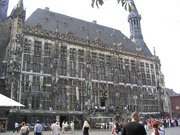
was added to the East of the Chapel. The city hall was built from 1267 on the location of the Council Hall. During the French Revolution
French Revolution
The French Revolution , sometimes distinguished as the 'Great French Revolution' , was a period of radical social and political upheaval in France and Europe. The absolute monarchy that had ruled France for centuries collapsed in three years...
, the French occupied Aachen and looted the treasure. Before choosing Notre-Dame de Paris, Napoleon I
Napoleon I of France
Napoleon Bonaparte was a French military and political leader during the latter stages of the French Revolution.As Napoleon I, he was Emperor of the French from 1804 to 1815...
had considered for a time having his Imperial coronation take place in Aachen. The chapel was restored in 1884. In 1978, the cathedral, including the chapel, was listed as a World Heritage Site
World Heritage Site
A UNESCO World Heritage Site is a place that is listed by the UNESCO as of special cultural or physical significance...
by the UNESCO
UNESCO
The United Nations Educational, Scientific and Cultural Organization is a specialized agency of the United Nations...
.
See also
- AachenAachenAachen has historically been a spa town in North Rhine-Westphalia, Germany. Aachen was a favoured residence of Charlemagne, and the place of coronation of the Kings of Germany. Geographically, Aachen is the westernmost town of Germany, located along its borders with Belgium and the Netherlands, ...
- Carolingian architectureCarolingian architectureCarolingian architecture is the style of north European Pre-Romanesque architecture belonging to the period of the Carolingian Renaissance of the late 8th and 9th centuries, when the Carolingian family dominated west European politics...
- Carolingian artCarolingian artCarolingian art comes from the Frankish Empire in the period of roughly 120 years from about AD 780 to 900 — during the reign of Charlemagne and his immediate heirs — popularly known as the Carolingian Renaissance. The art was produced by and for the court circle and a group of...
- Carolingian EmpireCarolingian EmpireCarolingian Empire is a historiographical term which has been used to refer to the realm of the Franks under the Carolingian dynasty in the Early Middle Ages. This dynasty is seen as the founders of France and Germany, and its beginning date is based on the crowning of Charlemagne, or Charles the...
- Carolingian RenaissanceCarolingian RenaissanceIn the history of ideas the Carolingian Renaissance stands out as a period of intellectual and cultural revival in Europe occurring from the late eighth century, in the generation of Alcuin, to the 9th century, and the generation of Heiric of Auxerre, with the peak of the activities coordinated...
- Palatine Chapel in AachenPalatine Chapel in AachenThe Palatine Chapel is an Early Medieval chapel that is the remaining component of Charlemagne's Palace of Aachen. Although the palace no longer exists, the chapel has been incorporated into the Aachen Cathedral, Germany. It is the city's major landmark and the central monument of the Carolingian...