

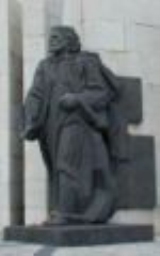
Paisius of Hilendar

Encyclopedia
Saint Paisius of Hilendar or Paisiy Hilendarski (1722–1773) was a Bulgarian
clergyman and a key Bulgarian National Revival
figure. He is most famous for being the author of Istoriya Slavyanobolgarskaya
, the second modern Bulgarian history after the work of Petar Bogdan Bakshev from 1667, “History of Bulgaria”. Most Bulgarians think of him as the forefather of the Bulgarian National Revival
.
Paisius was born in the Samokov
eparchy of the time, probably in the town of Bansko
. He established himself in the Hilandar
monastery on Mount Athos
in 1745, where he was later a hieromonk
and deputy-abbot. Collecting materials for two years through hard work and even visiting the lands of the Germans
, he finished his Istoriya Slavyanobolgarskaya in 1762 in the Zograf Monastery
. The book was the first attempt to write a complete history of Bulgaria and attempted to awake and strengthen Bulgarian national consciousnesses.
The most famous part of the whole book is the very first sentence:
This more or less signifies the purpose of the author who speaks about the danger of Bulgarians falling victim to the hellenization
policies of the mainly Greek clergy. The book's first manual copy was done by Sophronius of Vratsa in 1765. Structurally, Istoriya Slavyanobolgarskaya consists of two introductions, several chapters that discuss various historic events, a chapter about the "Slavic teachers", the disciples of Cyril and Methodius, a chapter about the Bulgarian saints, and an epilogue. As Paisius toured Bulgaria as a mendicant friar, he brought his work, which was copied and spread among the Bulgarians
. He is thought to have died on the way to Mount Athos near Ampelino (modern-day Asenovgrad
).
on Livingston Island in the South Shetland Islands
, Antarctica is named after Paisiy of Hilendar.
The saint is portrayed on the obverse
of the Bulgarian 2 levs
banknote, issued in 1999 and 2005.
Bulgarians
The Bulgarians are a South Slavic nation and ethnic group native to Bulgaria and neighbouring regions. Emigration has resulted in immigrant communities in a number of other countries.-History and ethnogenesis:...
clergyman and a key Bulgarian National Revival
Bulgarian National Revival
The Bulgarian National Revival , sometimes called the Bulgarian Renaissance, was a period of socio-economic development and national integration among Bulgarian people under Ottoman rule...
figure. He is most famous for being the author of Istoriya Slavyanobolgarskaya
Istoriya Slavyanobolgarskaya
Istoriya Slavyanobolgarskaya is a book by Bulgarian scholar and clergyman Saint Paisius of Hilendar...
, the second modern Bulgarian history after the work of Petar Bogdan Bakshev from 1667, “History of Bulgaria”. Most Bulgarians think of him as the forefather of the Bulgarian National Revival
Bulgarian National Revival
The Bulgarian National Revival , sometimes called the Bulgarian Renaissance, was a period of socio-economic development and national integration among Bulgarian people under Ottoman rule...
.
Paisius was born in the Samokov
Samokov
Samokov is a town in Sofia Province in the southwest of Bulgaria. It is situated in a kettle between the mountains Rila and Vitosha, 55 kilometres from the capital Sofia...
eparchy of the time, probably in the town of Bansko
Bansko
Bansko is a town and a popular ski resort in southwestern Bulgaria, located at the foot of the Pirin Mountains at an elevation of 925 m above sea level....
. He established himself in the Hilandar
Hilandar
Hilandar Monastery is a Serbian Orthodox monastery on Mount Athos in Greece. It was founded in 1198 by the first Serbian Archbishop Saint Sava and his father, Grand Prince Stefan Nemanja of the medieval Serbian principality of Raška...
monastery on Mount Athos
Mount Athos
Mount Athos is a mountain and peninsula in Macedonia, Greece. A World Heritage Site, it is home to 20 Eastern Orthodox monasteries and forms a self-governed monastic state within the sovereignty of the Hellenic Republic. Spiritually, Mount Athos comes under the direct jurisdiction of the...
in 1745, where he was later a hieromonk
Hieromonk
Hieromonk , also called a Priestmonk, is a monk who is also a priest in the Orthodox Church and Eastern Catholicism....
and deputy-abbot. Collecting materials for two years through hard work and even visiting the lands of the Germans
Germans
The Germans are a Germanic ethnic group native to Central Europe. The English term Germans has referred to the German-speaking population of the Holy Roman Empire since the Late Middle Ages....
, he finished his Istoriya Slavyanobolgarskaya in 1762 in the Zograf Monastery
Zograf Monastery
The Saint George the Zograf Monastery or Zograf Monastery is a Bulgarian Orthodox monastery on Mount Athos in Greece...
. The book was the first attempt to write a complete history of Bulgaria and attempted to awake and strengthen Bulgarian national consciousnesses.
The most famous part of the whole book is the very first sentence:
"Why are you ashamed to call yourself Bulgarian?"
This more or less signifies the purpose of the author who speaks about the danger of Bulgarians falling victim to the hellenization
Hellenization
Hellenization is a term used to describe the spread of ancient Greek culture, and, to a lesser extent, language. It is mainly used to describe the spread of Hellenistic civilization during the Hellenistic period following the campaigns of Alexander the Great of Macedon...
policies of the mainly Greek clergy. The book's first manual copy was done by Sophronius of Vratsa in 1765. Structurally, Istoriya Slavyanobolgarskaya consists of two introductions, several chapters that discuss various historic events, a chapter about the "Slavic teachers", the disciples of Cyril and Methodius, a chapter about the Bulgarian saints, and an epilogue. As Paisius toured Bulgaria as a mendicant friar, he brought his work, which was copied and spread among the Bulgarians
Bulgarians
The Bulgarians are a South Slavic nation and ethnic group native to Bulgaria and neighbouring regions. Emigration has resulted in immigrant communities in a number of other countries.-History and ethnogenesis:...
. He is thought to have died on the way to Mount Athos near Ampelino (modern-day Asenovgrad
Asenovgrad
Asenovgrad is a town in central southern Bulgaria, part of Plovdiv Province.-History:Asenovgrad was founded by the Thracians as Stenímachos around 300–400 BC. In 72 BC the city was captured by the troops of the Roman Empire as part of the Roman expansion towards the Black Sea. After a long period...
).
Honour
Paisiy PeakPaisiy Peak
Paisiy Peak rises to approximately 550 m in the Delchev Ridge, Tangra Mountains, eastern Livingston Island in the South Shetland Islands, Antarctica surmounting Sopot Ice Piedmont to the north and east....
on Livingston Island in the South Shetland Islands
South Shetland Islands
The South Shetland Islands are a group of Antarctic islands, lying about north of the Antarctic Peninsula, with a total area of . By the Antarctic Treaty of 1959, the Islands' sovereignty is neither recognized nor disputed by the signatories and they are free for use by any signatory for...
, Antarctica is named after Paisiy of Hilendar.
The saint is portrayed on the obverse
Obverse and reverse
Obverse and its opposite, reverse, refer to the two flat faces of coins and some other two-sided objects, including paper money, flags , seals, medals, drawings, old master prints and other works of art, and printed fabrics. In this usage, obverse means the front face of the object and reverse...
of the Bulgarian 2 levs
Bulgarian lev
The lev is the currency of Bulgaria. It is divided in 100 stotinki . In archaic Bulgarian the word "lev" meant "lion".It is speculated that Bulgaria, as a member of the European Union will adopt the Euro in 2015 .- First lev, 1881–1952 :...
banknote, issued in 1999 and 2005.