
All Topics  
Pair production


   Email Print
   Bookmark   Link


Pair production


Pair production refers to the creation of an elementary particle
Elementary particle

In particle physics, an elementary particle or fundamental particle is a wiktionary:particle not known to have substructure; that is, it is not known to be made up of smaller particles....
 and its antiparticle
Antiparticle

Corresponding to most kinds of particle physics, there is an associated antiparticle with the same mass and opposite electric charge. For example, the antiparticle of the electron is the positively charged antielectron, or positron, which is produced naturally in certain types of radioactive decay....
, usually from a photon
Photon

In physics, the photon is an elementary particle, the quantum of the electromagnetic field and the basic unit of light and all other forms of electromagnetic radiation....
 (or another neutral boson
Boson

In particle physics, bosons are subatomic particle which obey Bose-Einstein statistics; they are named after Satyendra Nath Bose and Albert Einstein....
).


Discussion
Ask a question about 'Pair production'
Start a new discussion about 'Pair production'
Answer questions from other users
Full Discussion Forum


Encyclopedia


Pair production
Pair production

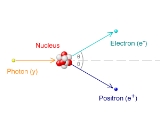
Pair production refers to the creation of an elementary particle and its antiparticle, usually from a photon . This is allowed, provided there is enough energy available to create the pair ? at least the total rest mass energy of the two particles ? and that the situation allows both energy and momentum to be conserved ....
Light-matter interaction
Low energy phenomena Photoelectric effect
Photoelectric effect

The photoelectric effect is a phenomenon in which electrons are emitted from matter after the absorption of energy from electromagnetic wave such as x-rays or visible light....
Mid-energy phenomena Compton scattering
Compton scattering

In physics, Compton scattering or the Compton effect is the decrease in energy of an X-ray or gamma ray photon, when it interacts with matter....
High energy phenomena Pair production
Pair production

Pair production refers to the creation of an elementary particle and its antiparticle, usually from a photon . This is allowed, provided there is enough energy available to create the pair ? at least the total rest mass energy of the two particles ? and that the situation allows both energy and momentum to be conserved ....


Pair production refers to the creation of an elementary particle
Elementary particle

In particle physics, an elementary particle or fundamental particle is a wiktionary:particle not known to have substructure; that is, it is not known to be made up of smaller particles....
 and its antiparticle
Antiparticle

Corresponding to most kinds of particle physics, there is an associated antiparticle with the same mass and opposite electric charge. For example, the antiparticle of the electron is the positively charged antielectron, or positron, which is produced naturally in certain types of radioactive decay....
, usually from a photon
Photon

In physics, the photon is an elementary particle, the quantum of the electromagnetic field and the basic unit of light and all other forms of electromagnetic radiation....
 (or another neutral boson
Boson

In particle physics, bosons are subatomic particle which obey Bose-Einstein statistics; they are named after Satyendra Nath Bose and Albert Einstein....
). This is allowed, provided there is enough energy
Energy

In physics, energy is a scalar physical quantity that describes the amount of Work_ that can be performed by a force. Energy is an attribute of objects and systems that is subject to a conservation law....
 available to create the pair – at least the total rest mass energy of the two particles – and that the situation allows both energy and momentum to be conserved (though not necessarily on shell). All other conserved quantum numbers (angular momentum
Angular momentum

In physics, the angular momentum of a particle about an origin is a vector quantity related to rotation, equal to the mass of the particle multiplied by the cross product of the position vector of the particle with its velocity vector....
, electric charge
Electric charge

Electric charge is a fundamental conserved property of some subatomic particles, which determines their electromagnetic interaction. Electrically charged matter is influenced by, and produces, electromagnetic fields....
) of the produced particles must sum to zero — thus the created particles shall have opposite values of each (for instance, if one particle has strangeness +1 then another one must have strangeness -1).

In nuclear physics
Nuclear physics

Nuclear physics is the field of physics that studies the building blocks and interactions of atomic nuclei.The most commonly known applications of nuclear physics are nuclear power and nuclear weapons, but the research field is also the basis for a far wider range of applications, including in the medical sector , in materials engineering...
, this occurs when a two high-energy photon
Photon

In physics, the photon is an elementary particle, the quantum of the electromagnetic field and the basic unit of light and all other forms of electromagnetic radiation....
s interact, allowing the production of an electron
Electron

The electron is a subatomic particle that carries a negative electric charge. It has elementary particle and is believed to be a point particle....
 and a positron
Positron

The positron or antielectron is the antiparticle or the antimatter counterpart of the electron. The positron has an electric charge of +1, a spin of 1/2, and the same mass as an electron....
 pair without violating conservation of momentum. Since the momentum of the initial photon must be absorbed by something, pair production cannot occur in empty space out of a single photon; the nucleus is needed to conserve both momentum and energy (consider the time reversal of Electron-positron annihilation
Electron-positron annihilation

Electron-positron annihilation occurs when an electron and a positron collide. The result of the collision is the conversion of the electron and positron and the creation of gamma ray photons or, less often, other particles....
).

Pair production can only occur if the photons have an energy exceeding twice the rest mass(me) of an electron (1.022 MeV
MEV

MeV and meV are Multiple of the electron volt unit referring to 1,000,000 eV and 0.001 eV, respectively.Mev or MEV may refer to:...
); the same applies for the generation of other higher energy leptons such as the muon and tau. These interactions were first observed in Patrick Blackett's counter-controlled bubble chamber
Bubble chamber

A bubble chamber is a vessel filled with a superheating transparency liquid used to detect electrically charged particles moving through it....
, leading to the 1948 Nobel Prize in Physics
Nobel Prize in Physics

The Nobel Prize in Physics is awarded once a year by the Royal Swedish Academy of Sciences. It is one of the five Nobel Prizes established by the will of Alfred Nobel in 1895 and awarded since 1901; the others are the Nobel Prize in chemistry, Nobel Prize in literature, Nobel Peace Prize, and Nobel Prize in physiology or medicine....
.

In semiclassical
Semiclassical

In physics, the adjective semiclassical has different precise meanings depending on the context. All these meanings usually refer to some approximation, limit or situation that combines quantum mechanics and classical mechanics aspects in a given problem....
 general relativity
General relativity

General relativity or the general theory of relativity is the Geometry Theoretical physics of gravitation published by Albert Einstein in 1916....
, pair production is also invoked to explain the Hawking radiation
Hawking radiation

Hawking radiation is a thermal radiation with a black body predicted to be emitted by black holes due to quantum physics effects. It is named after the physicist Stephen Hawking who provided the theoretical argument for its existence in 1974, and sometimes also after the physicist Jacob Bekenstein who predicted that black holes should have a...
 effect. According to quantum mechanics
Quantum mechanics

Quantum mechanics is a set of principles underlying the most fundamental known description of all physical systems at the microscopic scale . Notable amongst these principles are both a dual wave-like and particle-like behavior of matter and radiation, and prediction of probabilities in situations where classical physics predicts certaintie...
, at short scales short-lived particle-pairs are constantly appearing and disappearing (see quantum foam
Quantum foam

Quantum foam, also referred to as spacetime foam, is a concept in quantum mechanics, devised by John Archibald Wheeler in 1955. The foam is supposedly the foundations of the fabric of the universe, but it can also be used as a qualitative description of subatomic spacetime turbulence at extremely small distances of the order of the...
); in a region of strong gravitational tidal forces, the two particles in a pair may sometimes be wrenched apart before they have a chance to mutually annihilate
Annihilation

Annihilation is defined as "total destruction" or "complete obliteration" of an object; having its root in the Latin nihil . A literal translation is "to make into nothing"....
. When this happens in the region around a black hole
Black hole

In general relativity, a black hole is a region of space in which the gravitational field is so powerful that nothing, including electromagnetic radiation , can escape its pull after having fallen past its event horizon....
, one particle may escape, with its antiparticle being captured by the hole.

Pair production is also the hypothesized mechanism behind the Pair instability supernova type of stellar explosions, where pair production suddenly lowers pressure inside a supergiant star, leading to a partial implosion, and then explosive thermonuclear burning. Supernova
Supernova

A supernova is a Astronomy#Stellar astronomy explosion. Supernovae are extremely luminous and cause a burst of radiation that often briefly outshines an entire galaxy, before fading from view over several weeks or months....
 SN 2006gy
SN 2006gy

SN 2006gy was an extremely energetic supernova, sometimes referred to as a hypernova or quark-nova, that was discovered on September 18, 2006. It was first observed by Robert Quimby and P....
 is hypothesized to have been a pair production type supernova.

In 2008 the Titan laser aimed at a 1-centimeter thick gold target was used to generate positron electron pairs in large numbers.

See also

  • Electron-positron annihilation
    Electron-positron annihilation

    Electron-positron annihilation occurs when an electron and a positron collide. The result of the collision is the conversion of the electron and positron and the creation of gamma ray photons or, less often, other particles....
  • Meitner–Hupfeld effect
    Meitner–Hupfeld effect

    The Meitner-Hupfeld effect is an anomalously large scattering of Gamma rays by heavy chemical element. Later on, the Meitner?Hupfeld effect was explained by a broad theory from which evolved the Standard Model, a theory for explaining the structure of the atomic nucleus....
  • Pair instability supernova


External links