

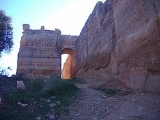
Paderne Castle

Encyclopedia

Portugal
Portugal , officially the Portuguese Republic is a country situated in southwestern Europe on the Iberian Peninsula. Portugal is the westernmost country of Europe, and is bordered by the Atlantic Ocean to the West and South and by Spain to the North and East. The Atlantic archipelagos of the...
. This hill fort was built by the Moors
Moors
The description Moors has referred to several historic and modern populations of the Maghreb region who are predominately of Berber and Arab descent. They came to conquer and rule the Iberian Peninsula for nearly 800 years. At that time they were Muslim, although earlier the people had followed...
in the second half of the 12th Century. Its is eight km (five miles) from the Algarve resort of Albufeira
Albufeira
Albufeira is a Portuguese municipality in the Faro District, Algarve region. Its name came from the Arabic: البحيرة . The city has a population of 13,646. The municipality has a population of 35,281 inhabitants and a total area of 140.6 km²...
, on a River Quarteira bend close to the village and civil parish of Paderne
Paderne, Albufeira
Paderne is a village and a civil parish in the municipality of Albufeira, Algarve, Portugal. The village is situated 7.4 miles north of the town of Albufeira, 23 miles west of Faro and is 151 miles from Lisbon. The village has good transport links being very close to junctions on the A2 motorway to...
. It is 7.5 km (4.7 mi) north from the coast.
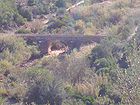
The castle is one of seven on the national flag of Portugal. Its location on a rocky peninsular bend was of strategic importance as it controlled the ancient Roman road "Via Lusitanorum" crossing the Quarteira River on the south. The Roman
Ancient Rome
Ancient Rome was a thriving civilization that grew on the Italian Peninsula as early as the 8th century BC. Located along the Mediterranean Sea and centered on the city of Rome, it expanded to one of the largest empires in the ancient world....
bridge still stands at the crossing point below.
Description
The castle is mostly ruinous, almost a hectare in size and has a trapezoidTrapezoid
In Euclidean geometry, a convex quadrilateral with one pair of parallel sides is referred to as a trapezoid in American English and as a trapezium in English outside North America. A trapezoid with vertices ABCD is denoted...
al perimeter footprint. The eastern side, which has the least natural defence has a substantial tower and is built of Taipa (Mixture of mud, chalk, lime and aggregate that sets like concrete). This tower, the only one left standing in the enclosure, protrudes from the wall and is connected to the main fortification by an upper passageway. On the outside of this tower it is still possible to make out the whitewash strips which were applied to the joins of the layers of taipa to give the impression that the tower was built from masonry
Masonry
Masonry is the building of structures from individual units laid in and bound together by mortar; the term masonry can also refer to the units themselves. The common materials of masonry construction are brick, stone, marble, granite, travertine, limestone; concrete block, glass block, stucco, and...
. Nevertheless these mud walls are still 1.8 metres thick and are constructed on a substantial stone plinth
Plinth
In architecture, a plinth is the base or platform upon which a column, pedestal, statue, monument or structure rests. Gottfried Semper's The Four Elements of Architecture posited that the plinth, the hearth, the roof, and the wall make up all of architectural theory. The plinth usually rests...
which can be seen at the base of the perimeter walls. There are also at intervals, vertical openings to allow for drainage of any accumulative water inside the castle walls. Below the tower can be seen the remains of rampart
Defensive wall
A defensive wall is a fortification used to protect a city or settlement from potential aggressors. In ancient to modern times, they were used to enclose settlements...
s which ran across the eastern perimeter but most of it has collapsed, probably at the time of the earthquake of 1755
1755 Lisbon earthquake
The 1755 Lisbon earthquake, also known as the Great Lisbon Earthquake, was a megathrust earthquake that took place on Saturday 1 November 1755, at around 9:40 in the morning. The earthquake was followed by fires and a tsunami, which almost totally destroyed Lisbon in the Kingdom of Portugal, and...
. This rampart which is lower than the main walls also defended the main Gateway to the castle, which is at a right angle to the main wall which created an 'L' shaped entrance designed to make any frontal attack that much more difficult. Not all the stonework in the entrance way is original, being replaced and made safe during restoration work. In side the precinct of the castle can be seen the remnants of a cistern. On the south wall are the ruins of the former chapel of Nossa Senhora do Castelo which was the Parochial church for the nearby village and date from the 14th century. The church was abandoned by the residents of Paderne
Paderne
Paderne may refer to:In Portugal**Paderne, Albufeira, a parish in the municipality of Albufeira**Paderne is a Portuguese parish, located in the municipality of MelgaçoIn Spain...
in 1506 when a new parochial church was built in the village. In 2002 archaeological digs of the castle precinct have brought to light evidence of dwellings and streets within the castle compound and the discovery of the remains of a sophisticated sewerage
Sanitary sewer
A sanitary sewer is a separate underground carriage system specifically for transporting sewage from houses and commercial buildings to treatment or disposal. Sanitary sewers serving industrial areas also carry industrial wastewater...
system and vestiges of the network for the cistern
Cistern
A cistern is a waterproof receptacle for holding liquids, usually water. Cisterns are often built to catch and store rainwater. Cisterns are distinguished from wells by their waterproof linings...
s and channels for the collection and supply of drinking water. Paderne Castle was, in fact, a fortified village and predates the foundation of today’s town of Paderne, possibly by as much as two centuries.
Origins
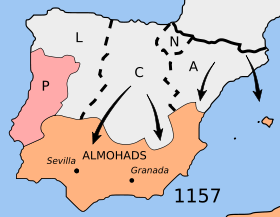
Crusades
The Crusades were a series of religious wars, blessed by the Pope and the Catholic Church with the main goal of restoring Christian access to the holy places in and near Jerusalem...
from the north who were steadily advancing southwards. They pledged themselves to protect their territories and began an intensive period of military construction and fortification in the Algarve here at Paderne and also at Faro
Faro, Portugal
Faro is the southernmost city in Portugal. It is located in the Faro Municipality in southern Portugal. The city proper has 41,934 inhabitants and the entire municipality has 58,305. It is the seat of the Faro District and capital of the Algarve region...
, Loulé
Loulé
Loulé is a city and a municipality in Portugal with a total area of 764.2 km² and a total population of 62,295 inhabitants. The city proper has a population of 12,103.The municipality is composed of 11 parishes, and is located in the District of Faro....
and Silves and many other locations in the area. Muslim depopulation of the countryside caused by the relentless Christian tactics of raiding and pillaging the local Muslim lands whilst avoiding outright conflict with the Almohad forces was another good reason for the fortification constructions such as Paderne which provided the local population with a place of relative safety from the raids.
Conflicts
In 1182 the castle is recorded as being conquered by the armies of King Sancho ISancho I of Portugal
Sancho I , nicknamed the Populator , second monarch of Portugal, was born on 11 November 1154 in Coimbra and died on 26 March 1212 in the same city. He was the second but only surviving legitimate son and fourth child of Afonso I of Portugal by his wife, Maud of Savoy. Sancho succeeded his father...
with the help of English Christian mercenaries during a continuous night raid. In 1191 Muslim forces of the Almohad dynasty under the command of Caliph Abu Yusuf Ya’qub al-Mansur recaptured the castle and surrounding lands. The castle remained in the control of the Almohads for 57 years until 1249 when the forces of King Afonso III
Afonso III of Portugal
Afonso III , or Affonso , Alfonso or Alphonso or Alphonsus , the Bolognian , the fifth King of Portugal and the first to use the title King of Portugal and the Algarve, from 1249...
under the command of Dom Paio Peres Correia
Paio Peres Correia
D. Paio Peres Correia, a notable medieval Christian conqueror, who was born c. 1205, in Monte de Fralães, in the district of Barcelos in Portugal....
finally conquered the castle and ended Muslim control of the region. The troops of Peres Correia massacred all the inhabitants of Paderne castle in their conquest. It was shortly after this time that the chapel was built, thought to be on the ruins of the mosque
Mosque
A mosque is a place of worship for followers of Islam. The word is likely to have entered the English language through French , from Portuguese , from Spanish , and from Berber , ultimately originating in — . The Arabic word masjid literally means a place of prostration...
as was the custom of the Christian re-conquest of Iberia
Iberian Peninsula
The Iberian Peninsula , sometimes called Iberia, is located in the extreme southwest of Europe and includes the modern-day sovereign states of Spain, Portugal and Andorra, as well as the British Overseas Territory of Gibraltar...
. Only future investigation will prove whether this is the case.