

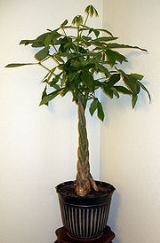
Pachira aquatica

Encyclopedia
Pachira aquatica is a tropical wetland tree of the genus Pachira
, native to Central
and South America
where it grows in swamps. It is known by the common names Malabar chestnut, Guiana chestnut, provision tree, saba nut, Monguba (Brazil
), Pumpo (Guatemala
) and is commercially sold under the name money tree and money plant. It is classified in the subfamily Bombacoideae
of the family Malvaceae
. Previously it was assigned to Bombacaceae
.
leaves with lanceolate leaflets and smooth green bark
. Its showy flowers have long, narrow petal
s that open like a banana peel to reveal hairlike yellowish orange stamen
s. The tree is cultivated for its edible nut
s which grow in a very large, woody pod. The nuts are light brown, striped with white. They are said to taste like peanut
s, and can be eaten raw or cooked or ground into a flour to make bread. The leaves and flowers are also edible.
The tree grows well as a tropical ornamental
in moist, frost-free areas, and can be started from seed or cutting. It is a durable plant and will adapt very well to different conditions. The pachira needs plenty of sunlight though it is important to avoid direct sunlight during the summer months as the leaves may get sunburned.
, Pachira aquatica is often referred to as the "money tree" (發財樹 fācái shù). The tree had long been popular as an ornamental
in Japan
. In 1986, a Taiwan
ese truck driver
first cultivated five small trees in a single flowerpot
with their trunk
s braid
ed. The popularity of these ornamentals took off in Japan and later much of the rest of East Asia. They are symbol
ically associated with good financial fortune and are typically seen in business
es, sometimes with red ribbons or other auspicious ornamentation attached. The trees play an important role in Taiwan's agricultural export economy with exports of NT$
250 million (US$
7 million) in 2005.
. The species name is Latin
for "aquatic".
The name "money tree" seems to refer to a story of its origin, where a poor man prayed for money, found this "odd" plant, took it home as an omen, and made money selling plants grown from its seeds.
Pachira
Pachira is a genus of tropical trees distributed in Central and South America, Africa and India. They are classified in the subfamily Bombacoideae of the family Malvaceae...
, native to Central
Central America
Central America is the central geographic region of the Americas. It is the southernmost, isthmian portion of the North American continent, which connects with South America on the southeast. When considered part of the unified continental model, it is considered a subcontinent...
and South America
South America
South America is a continent situated in the Western Hemisphere, mostly in the Southern Hemisphere, with a relatively small portion in the Northern Hemisphere. The continent is also considered a subcontinent of the Americas. It is bordered on the west by the Pacific Ocean and on the north and east...
where it grows in swamps. It is known by the common names Malabar chestnut, Guiana chestnut, provision tree, saba nut, Monguba (Brazil
Brazil
Brazil , officially the Federative Republic of Brazil , is the largest country in South America. It is the world's fifth largest country, both by geographical area and by population with over 192 million people...
), Pumpo (Guatemala
Guatemala
Guatemala is a country in Central America bordered by Mexico to the north and west, the Pacific Ocean to the southwest, Belize to the northeast, the Caribbean to the east, and Honduras and El Salvador to the southeast...
) and is commercially sold under the name money tree and money plant. It is classified in the subfamily Bombacoideae
Bombacoideae
Bombacoideae is a subfamily of the mallow family, Malvaceae. It contains herbaceous and woody plants. Their leaves are alternate, commonly palmately lobed, with small and caducous stipules. Flowers are hermaphroditic and actinomorphic; the calyx has 5 sepals united at the base, accompanied...
of the family Malvaceae
Malvaceae
Malvaceae, or the mallow family, is a family of flowering plants containing over 200 genera with close to 2,300 species. Judd & al. Well known members of this family include okra, jute and cacao...
. Previously it was assigned to Bombacaceae
Bombacaceae
Bombacaceae is a family of flowering plants or Angiospermae included within Malvales order. As is true for any botanical name, circumscription and status of the taxon has varied with taxonomic point of view...
.
Characteristics
Pachira aquatica can grow up to 18 m (59.1 ft) in height in the wild. It has shiny green palmateLeaf shape
In botany, leaf shape is characterised with the following terms :* Acicular : Slender and pointed, needle-like* Acuminate : Tapering to a long point...
leaves with lanceolate leaflets and smooth green bark
Bark
Bark is the outermost layers of stems and roots of woody plants. Plants with bark include trees, woody vines and shrubs. Bark refers to all the tissues outside of the vascular cambium and is a nontechnical term. It overlays the wood and consists of the inner bark and the outer bark. The inner...
. Its showy flowers have long, narrow petal
Petal
Petals are modified leaves that surround the reproductive parts of flowers. They often are brightly colored or unusually shaped to attract pollinators. Together, all of the petals of a flower are called a corolla. Petals are usually accompanied by another set of special leaves called sepals lying...
s that open like a banana peel to reveal hairlike yellowish orange stamen
Stamen
The stamen is the pollen producing reproductive organ of a flower...
s. The tree is cultivated for its edible nut
Nut (fruit)
A nut is a hard-shelled fruit of some plants having an indehiscent seed. While a wide variety of dried seeds and fruits are called nuts in English, only a certain number of them are considered by biologists to be true nuts...
s which grow in a very large, woody pod. The nuts are light brown, striped with white. They are said to taste like peanut
Peanut
The peanut, or groundnut , is a species in the legume or "bean" family , so it is not a nut. The peanut was probably first cultivated in the valleys of Peru. It is an annual herbaceous plant growing tall...
s, and can be eaten raw or cooked or ground into a flour to make bread. The leaves and flowers are also edible.
The tree grows well as a tropical ornamental
Ornamental plant
Ornamental plants are plants that are grown for decorative purposes in gardens and landscape design projects, as house plants, for cut flowers and specimen display...
in moist, frost-free areas, and can be started from seed or cutting. It is a durable plant and will adapt very well to different conditions. The pachira needs plenty of sunlight though it is important to avoid direct sunlight during the summer months as the leaves may get sunburned.
Role in East Asian culture
In East AsiaEast Asia
East Asia or Eastern Asia is a subregion of Asia that can be defined in either geographical or cultural terms...
, Pachira aquatica is often referred to as the "money tree" (發財樹 fācái shù). The tree had long been popular as an ornamental
Ornamental plant
Ornamental plants are plants that are grown for decorative purposes in gardens and landscape design projects, as house plants, for cut flowers and specimen display...
in Japan
Japan
Japan is an island nation in East Asia. Located in the Pacific Ocean, it lies to the east of the Sea of Japan, China, North Korea, South Korea and Russia, stretching from the Sea of Okhotsk in the north to the East China Sea and Taiwan in the south...
. In 1986, a Taiwan
Taiwan
Taiwan , also known, especially in the past, as Formosa , is the largest island of the same-named island group of East Asia in the western Pacific Ocean and located off the southeastern coast of mainland China. The island forms over 99% of the current territory of the Republic of China following...
ese truck driver
Truck driver
A truck driver , is a person who earns a living as the driver of a truck, usually a semi truck, box truck, or dump truck.Truck drivers provide an essential service to...
first cultivated five small trees in a single flowerpot
Flowerpot
A flower pot or plant pot is a container in which flowers and other plants are cultivated. Historically, and still to a significant extent today, they are made from terracotta. Flower pots are now often made from plastic, wood, stone, or sometimes biodegradable material. An example of...
with their trunk
Trunk (botany)
In botany, trunk refers to the main wooden axis of a tree that supports the branches and is supported by and directly attached to the roots. The trunk is covered by the bark, which is an important diagnostic feature in tree identification, and which often differs markedly from the bottom of the...
s braid
Braid
A braid is a complex structure or pattern formed by intertwining three or more strands of flexible material such as textile fibres, wire, or human hair...
ed. The popularity of these ornamentals took off in Japan and later much of the rest of East Asia. They are symbol
Symbol
A symbol is something which represents an idea, a physical entity or a process but is distinct from it. The purpose of a symbol is to communicate meaning. For example, a red octagon may be a symbol for "STOP". On a map, a picture of a tent might represent a campsite. Numerals are symbols for...
ically associated with good financial fortune and are typically seen in business
Business
A business is an organization engaged in the trade of goods, services, or both to consumers. Businesses are predominant in capitalist economies, where most of them are privately owned and administered to earn profit to increase the wealth of their owners. Businesses may also be not-for-profit...
es, sometimes with red ribbons or other auspicious ornamentation attached. The trees play an important role in Taiwan's agricultural export economy with exports of NT$
New Taiwan dollar
The New Taiwan dollar , or simply Taiwan dollar, is the official currency of the Taiwan Area of the Republic of China since 1949, when it replaced the Old Taiwan dollar...
250 million (US$
United States dollar
The United States dollar , also referred to as the American dollar, is the official currency of the United States of America. It is divided into 100 smaller units called cents or pennies....
7 million) in 2005.
Name
The genus name is derived from a language spoken in GuyanaGuyana
Guyana , officially the Co-operative Republic of Guyana, previously the colony of British Guiana, is a sovereign state on the northern coast of South America that is culturally part of the Anglophone Caribbean. Guyana was a former colony of the Dutch and of the British...
. The species name is Latin
Latin
Latin is an Italic language originally spoken in Latium and Ancient Rome. It, along with most European languages, is a descendant of the ancient Proto-Indo-European language. Although it is considered a dead language, a number of scholars and members of the Christian clergy speak it fluently, and...
for "aquatic".
The name "money tree" seems to refer to a story of its origin, where a poor man prayed for money, found this "odd" plant, took it home as an omen, and made money selling plants grown from its seeds.