


PLATO

Encyclopedia
PLATO was the first (ca. 1960, on ILLIAC I
) generalized computer assisted instruction system, and, by the late 1970s, comprised several thousand terminals worldwide on nearly a dozen different networked mainframe computers. Originally, PLATO was built by the University of Illinois
and functioned for four decades, offering coursework (elementary–university) to UIUC students, local schools, and other universities. Several descendant systems still operate.
The PLATO project was assumed by the Control Data Corporation
(CDC), who built the machines with which PLATO operated at the University. CDC President William Norris
planned to make PLATO a force in the computer world; the last production PLATO system was shut down in 2006 (coincidentally, just a month after Norris died), yet it established key on-line concepts: forums, message boards, online testing, e-mail, chat rooms, picture languages, instant messaging, remote screen sharing, and multi-player games.
education to World War II
veterans, higher education was limited to a minority of the U.S. population. The trend towards greater enrollment notable by the early 1950s, and the problem of providing instruction for the many new students was a serious concern to university administrators. To wit, if computerised automation
increased factory
production, it could do the same for academic instruction.
The U.S.S.R.'s 1957 launching of the Sputnik I artificial satellite energized the United States' government into spending more on science and engineering education. In 1958, the U.S. Air Force's Office of Scientific Research had a conference about the topic of computer instruction at the University of Pennsylvania
; interested parties, notably IBM
, presented studies.
, who had been thinking about the problem, suggesting he could build a demonstration system.
Bitzer, regarded as the Father of PLATO, recognized that in order to provide quality computer-based education, good graphics were critical (this at a time when 10 character per second teleprinters were the norm). In 1960, the first system, PLATO I, operated on the local ILLIAC I
computer. It included a television set for display and a special keyboard for navigating the system's function menus; PLATO II, in 1961, featured two users at once.
Convinced of the value of the project, the PLATO system was re-designed, between 1963 and 1969; PLATO III allowed "anyone" to design new lesson modules using their TUTOR programming language, conceived in 1967 by biology graduate student Paul Tenczar. Built on a CDC 1604
, given to them by William Norris
, PLATO III could simultaneously run up to 20 lessons, and was used by a local facilities in Champaign-Urbana that could enter the system with their custom terminal
s.
granted the team steady funding, allowing Bitzer to set up the Computer-based Education Research Laboratory (CERL) at the university.
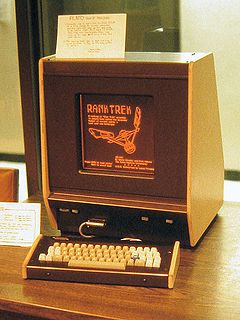
In 1972 a new system named PLATO IV was ready for operation. The PLATO IV terminal was a major innovation. It included Bitzer's orange plasma display
invention which incorporated both memory and bitmapped graphics into one display. This plasma display included fast vector line drawing capability and ran at 1260 baud
, rendering 60 lines or 180 characters per second. The display was a 512x512 bitmap, with both character and vector plotting done by hardwired logic. Users could provide their own characters to support rudimentary bitmap
graphics. Compressed air powered a piston-driven microfiche image selector that permitted colored images to be projected on the back of the screen under program control. The PLATO IV display also included a 16-by-16 grid infrared touch panel
allowing students to answer questions by touching anywhere on the screen.
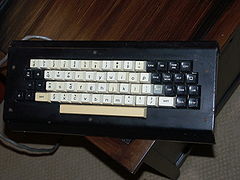 It was also possible to connect the terminal to peripheral devices. One such peripheral was the Gooch Synthetic Woodwind (named after inventor Sherwin Gooch), a synthesizer
that offered 4 voice music synthesis to provide sound in PLATO courseware. This was later supplanted on the PLATO V terminal by the Gooch Cybernetic Synthesizer, which had 16 voices that could be programmed individually or combined to make more complex sounds. This allowed for what today is known as multimedia
experiences. A PLATO-compatible music language was developed for these synthesizers, as well as a compiler for the language, two music text editors, a filing system for music binaries, programs to play the music binaries in real time, and many debugging and compositional aids. A number of interactive compositional programs have also been written.
Another peripheral was the Votrax
speech synthesizer, and a "say" instruction (with "saylang" instruction to choose the language) was added to the Tutor programming language to support text-to-speech synthesis using the Votrax.
The goal of this system was to provide tools for music educators to use in the development of instructional materials, which might possibly include music dictation drills, automatically graded keyboard performances, envelope and timbre ear-training, interactive examples or labs in musical acoustics, and composition and theory exercises with immediate feedback.
 With the advent of microprocessor technology, new PLATO terminals were developed to be less expensive and more flexible than the PLATO IV terminals. At the University of Illinois, these were called PLATO V terminals, even though there never was a PLATO V system (the system continued to be called PLATO IV). The Intel 8080
microprocessors in these terminals made them capable of executing programs locally, much like today's Java applet
s and ActiveX
controls, and allowed small software modules to be downloaded into the terminal to augment to the PLATO courseware with rich animation and other sophisticated capabilities that were not available otherwise using a traditional terminal-based approach.
Early in 1972, researchers from Xerox PARC
were given a tour of the PLATO system at the University of Illinois. At this time they were shown parts of the system such as the Show Display application generator for pictures on PLATO (later translated into a graphics-draw program on the Xerox Star
workstation), and the Charset Editor for "painting" new characters (later translated into a "Doodle" program at PARC), and the Term Talk and Monitor Mode communications program. Many of the new technologies they saw were adopted and improved upon when these researchers returned to Palo Alto, California
. They subsequently transferred improved versions of this technology to Apple Inc..
By 1975 the PLATO System served almost 150 locations from a donated CDC Cyber
73, including not only the users of the PLATO III system, but a number of grammar schools, high schools, colleges and universities, and military installations. PLATO IV offered text, graphics and animation as intrinsic components of courseware content, and included a shared-memory construct ("common" variables) that allowed TUTOR programs to send data between various users. This latter construct was used both for chat-type programs, as well as the first multi-user flight simulator
.
With the introduction of PLATO IV, Bitzer declared general success, claiming that the goal of generalized computer instruction was now available to all. However the terminals were very expensive (about $12,000), so as a generalized system PLATO would likely need to be scaled down for cost reasons alone.
Norris provided CERL with machines on which to develop their system in the late 1960s. In 1971 he set up a new division within CDC to develop PLATO "courseware", and eventually many of CDC's own initial training and technical manuals ran on it. In 1974 PLATO was running on in-house machines at CDC headquarters in Minneapolis, and in 1976 they purchased the commercial rights in exchange for a new CDC Cyber
machine.
 CDC announced the acquisition soon after, claiming that by 1985 50% of the company's income would be related to PLATO services. Through the 1970s CDC tirelessly promoted PLATO, both as a commercial tool and one for re-training unemployed workers in new fields. Norris refused to give up on the system, and invested in several non-mainstream courses, including a crop-information system for farmers, and various courses for inner-city youth. CDC even went as far as to place PLATO terminals in some shareholder's houses, to demonstrate the concept of the system.
In the early 1980s CDC started heavily advertising the service, apparently due to increasing internal dissent over the now $600 million project, taking out print and even radio ads promoting it as a general tool. The Minneapolis Tribune was unconvinced by their ad copy and started an investigation of the claims. In the end they concluded that while it was not proven to be a better education system, everyone using it nevertheless enjoyed it at least. An official evaluation by an external testing agency ended with roughly the same conclusions, suggesting that everyone enjoyed using it, but it was essentially equal to an average human teacher in terms of student advancement.
Of course a computerized system equal to a human should have been a major achievement, the very concept that the early pioneers in CBT were aiming for. A computer could serve all the students in a school for the cost of maintaining it, and wouldn't go on strike. However CDC charged $50 an hour for access to their data center, in order to recoup some of their development costs, making it considerably more expensive than a human on a per-student basis. PLATO was therefore a failure in any real sense, although it did find some use in large companies and government agencies willing to invest in the technology.
An attempt to mass-market the PLATO system was introduced in 1980 as Micro-PLATO, which ran the basic TUTOR system on a CDC "Viking-721" terminal and various home computers. Versions were built for the Texas Instruments TI-99/4A
, Atari 8-bit family
, Zenith Z-100
and, later, Radio Shack
TRS-80
and IBM Personal Computer. Micro-PLATO could be used stand-alone for normal courses, or could connect to a CDC data center for multiuser programs. To make the latter affordable, CDC introduced the Homelink service for $5 an hour.
Norris continued to praise PLATO, announcing that it would be only a few years before it represented a major source of income for CDC as late as 1984. In 1986 Norris stepped down as CEO, and the PLATO service was slowly killed off. He later claimed that Micro-PLATO was one of the reasons PLATO got off-track. They had started on the TI-99/4A, but then Texas Instruments pulled the plug and they moved to other systems like the Atari, who soon did the same. He felt that it was a waste of time anyway, as the system's value was in its online nature, which Micro-PLATO lacked initially.
Bitzer was more forthright about CDC's failure, blaming their corporate culture for the problems. He noted that development of the courseware was averaging $300,000 per delivery hour, many times what the CERL was paying for similar products. This meant that CDC had to charge high prices in order to recoup their costs, prices that made the system unattractive. The reason, he suggested, for these high prices was that CDC had set up a division that had to keep itself profitable via courseware development, forcing them to raise the prices in order to keep their headcount up during slow periods.
was one of the biggest users of PLATO in the early 1980s. Eskom
, the South African electrical power company, had a large CDC mainframe at Megawatt Park
in the northwest suburbs of Johannesburg
. Mainly this computer was used for management and data processing tasks related to power generation and distribution, but it also ran the PLATO software. The largest PLATO installation in South Africa during the early 1980s was at the University of the Western Cape
, which served a "coloured" population, and at one time had hundreds of PLATO IV terminals all connected by leased data lines back to Johannesburg. There were several other installations at educational institutions in South Africa, among them Madadeni College in the Madadeni township just outside of Newcastle.
This was perhaps the most unusual PLATO installation anywhere. Madadeni had about 1,000 students, all of them black and 99.5% of Zulu ancestry. The college was one of 10 teacher preparation institutions in kwaZulu
, most of them much smaller. In many ways Madadeni was very primitive. None of the classrooms had electricity and there was only one telephone for the whole college, which one had to crank for several minutes before an operator might come on the line. So an air-conditioned, carpeted room with 16 computer terminals was a stark contrast to the rest of the college. At times the only way a person could communicate with the outside world was through PLATO term-talk.
For many of the Madadeni students, most of whom came from very rural areas, the PLATO terminal was the first time they encountered any kind of electronic technology. (Many of the first year students had never seen a flush toilet before.) There initially was skepticism that these technologically-illiterate students could effectively use PLATO, but those concerns were not borne out. Within an hour or less most students were using the system proficiently, mostly to learn math and science skills, although a lesson that taught keyboarding skills was one of the most popular. A few students even used on-line resources to learn TUTOR, the PLATO programming language, and a few wrote lessons on the system in the Zulu language.
PLATO was also used fairly extensively in South Africa for industrial training. Eskom
successfully used PLM (PLATO learning management) and simulations to train power plant operators, South African Airways
(SAA) used PLATO simulations for cabin attendant training, and there were a number of other large companies as well that were exploring the use of PLATO.
The South African subsidiary of CDC invested heavily in the development of an entire secondary school curriculum (SASSC) on PLATO, but unfortunately as the curriculum was nearing the final stages of completion, CDC began to falter in South Africa—partly because of financial problems back home, partly because of growing opposition in the United States to doing business in South Africa, and partly due to the rapidly evolving microcomputer
, a paradigm shift that CDC failed to recognize.
. By 1976, PLATO had sprouted a variety of novel tools for online communication, including Personal Notes (e-mail
), Talkomatic (chat room
s), Term-Talk (instant messaging
), monitor mode (remote screen sharing) and emoticon
s.
PLATO's plasma panels were well suited to gaming, although its I/O bandwidth (180 characters per second or 60 graphic lines per second) was relatively slow. By virtue of 1500 shared 60-bit variables per game (initially), it was possible to implement online game
s. Because it was an educational computer system, most of the user community was keenly interested in gaming.
Many popular multiplayer online games were developed on PLATO during the 1970s and 1980s, such as Empire (a multiplayer game based on Star Trek
), Airfight (a precursor to Microsoft Flight Simulator
), Panther (a vector graphics based tankwar game, earlier than, but similar in many respects to Atari's BattleZone), the original Freecell
, and several games inspired by the role-playing game
Dungeons & Dragons
, including dnd
and Rogue
. Moria
, Dry Gulch (a western-style variation), and Bugs-n-Drugs (a medical variation) — these all presaged MUD
s and MOO
s as well as popular first-person shooters like Doom and Quake and MMORPG
s like Everquest
and World of Warcraft
. Avatar
, PLATO's most popular game, is one of the world's first MUDs and has over 1 million hours of use.
These communication tools and games formed the basis for an online community of thousands of PLATO users, which lasted for well over twenty years. PLATO's games became so popular that a program called "The Enforcer" was written to run as a background process to regulate or disable game play at most sites and times – a precursor to parental-style control systems that regulate access based on content rather than security considerations.
In September 2006 the Federal Aviation Administration
retired its PLATO system, the last system that ran the PLATO software system on a CDC Cyber mainframe
, from active duty. Existing PLATO-like systems now include NovaNET and Cyber1.org.
By early 1976, the original PLATO IV system had 950 terminals giving access to more than 3500 contact hours of courseware, and additional systems were in operation at CDC and Florida State University
. Eventually, over 12,000 contact hours of courseware was developed, much of it developed by university faculty for higher education. PLATO courseware covers a full range of high-school and college courses, as well as topics such as reading skills, family planning, Lamaze
training and home budgeting. In addition, authors at the University of Illinois School of Basic Medical Sciences (now, the College of Medicine at Urbana-Champaign) devised a large number of basic science lessons and a self-testing system for first year students. However the most popular "courseware" remained their multi-user games and role-playing video game
s such as dnd, although it appears CDC was uninterested in this market. As the value of a CDC-based solution disappeared in the 1980s, interested educators ported the engine first to the IBM PC
, and later to web
-based systems.
as Drake Training and Technologies in 1990. Applying many of the PLATO concepts used in the late 1970s, E. Clarke Porter led the Drake Training and Technologies testing business (today Thomson Prometric) in partnership with Novell, Inc. away from the mainframe model to a LAN-based client server architecture and changed the business model to deploy proctored testing at thousands of independent training organizations on a global scale. With the advent of a pervasive global network of testing centers and IT certification programs sponsored by, among others, Novell
and Microsoft
, the online testing business exploded. Pearson VUE, was founded by PLATO/Prometric veterans E. Clarke Porter, Steve Nordberg and Kirk Lundeen in 1994 to further expand the global testing infrastructure. VUE improved on the business model by being one of the first commercial companies to rely on the Internet as a critical busienss service and by developing self-service test registration. The computer-based testing industry has continued to grow, adding professional licensure and educational testing as important business segments.
A number of smaller testing-related companies also evolved from the PLATO system. One of the few survivors of that group is The Examiner Corporation. Dr. Stanley Trollip (formerly of the University of Illinois Aviation Research Lab) and Gary Brown (formerly of Control Data) developed the prototype of The Examiner System in 1984.
In the early 1970s, James Schuyler developed a system at Northwestern University called HYPERTUTOR as part of Northwestern's MULTI-TUTOR computer assisted instruction system. This ran on several CDC
mainframes at various sites.
Between 1973 and 1980, a group under the direction of Thomas T. Chen at the Medical Computing Laboratory of the School of Basic Medical Sciences at the University of Illinois at Urbana Champaign ported PLATO's TUTOR programming language to the Modcomp IV
minicomputer.
Douglas W. Jones, A.B. Baskin, Tom Szolyga, Vincent Wu and Lou Bloomfield did most of the implementation. This was the first port of TUTOR to a minicomputer and was largely operational by 1976
In 1980, Chen founded Global Information Systems Technology of Champaign, Illinois, to market this as the Simpler system. GIST eventually merged with the Government Group of Adayana Inc.
Vincent Wu went on to develop the Atari
PLATO cartridge.
CDC eventually sold the "PLATO" trademark and some courseware marketing segment rights to the newly-formed The Roach Organization (TRO) in 1989. In 2000 TRO changed their name to PLATO Learning and continue to sell and service PLATO courseware running on PCs.
CDC continued development of the basic system under the name CYBIS (CYber-Based Instructional System) after selling the trademarks to Roach, in order to service their commercial and government customers. CDC later sold off their CYBIS business to University Online, which was a descendant of IMSATT. University Online was later renamed to VCampus
.
The University of Illinois also continued development of PLATO, eventually setting up a commercial on-line service called NovaNET in partnership with University Communications, Inc. CERL was closed in 1994, with the maintenance of the PLATO code passing to UCI. UCI was later renamed NovaNET Learning, which was bought by National Computer Systems (NCS). Shortly after that, NCS was bought by Pearson
, and after several name changes now operates as Pearson Digital Learning.
emulation
of the original CDC hardware called Desktop Cyber. Within 6 months, by word of mouth alone, more than 500 former users had signed up to use the system. Many of the students who used PLATO in the 1970s and 1980s felt a special social bond with the community of users who came together using the powerful communications tools (talk programs, records systems and notesfiles) on PLATO.
The PLATO software used on Cyber1 is the final release (99A) of CYBIS, by permission of VCampus. The underlying operating system is NOS 2.8.7, the final release of the NOS operating system, by permission of Syntegra (now British Telecom [BT]), which had acquired the remainder of CDC's mainframe business. Cyber1 runs this software on the Desktop Cyber emulator. Desktop Cyber accurately emulates in software a range of CDC Cyber mainframe models and many peripherals.
Cyber1 offers free access to the system, which contains over 16,000 of the original lessons, in an attempt to preserve the original PLATO communities that grew up at CERL and on CDC systems in the 1980s. The load average of this resurrected system is about 10-15 users, sending personal and notesfile notes, and playing inter-terminal games such as Avatar and Empire (a star-trek like game), which had both accumulated more than 1.0 million contact hours on the original PLATO system at UIUC.
ILLIAC I
The ILLIAC I , a pioneering computer built in 1952 by the University of Illinois, was the first computer built and owned entirely by a US educational institution, Manchester University UK having built Manchester Mark 1 in 1948.ILLIAC I was based on the Institute for Advanced Study Von Neumann...
) generalized computer assisted instruction system, and, by the late 1970s, comprised several thousand terminals worldwide on nearly a dozen different networked mainframe computers. Originally, PLATO was built by the University of Illinois
University of Illinois at Urbana-Champaign
The University of Illinois at Urbana–Champaign is a large public research-intensive university in the state of Illinois, United States. It is the flagship campus of the University of Illinois system...
and functioned for four decades, offering coursework (elementary–university) to UIUC students, local schools, and other universities. Several descendant systems still operate.
The PLATO project was assumed by the Control Data Corporation
Control Data Corporation
Control Data Corporation was a supercomputer firm. For most of the 1960s, it built the fastest computers in the world by far, only losing that crown in the 1970s after Seymour Cray left the company to found Cray Research, Inc....
(CDC), who built the machines with which PLATO operated at the University. CDC President William Norris
William Norris
William Charles Norris was the pioneering CEO of Control Data Corporation, at one time one of the most powerful and respected computer companies in the world...
planned to make PLATO a force in the computer world; the last production PLATO system was shut down in 2006 (coincidentally, just a month after Norris died), yet it established key on-line concepts: forums, message boards, online testing, e-mail, chat rooms, picture languages, instant messaging, remote screen sharing, and multi-player games.
Historic background
Before the 1944 G.I. Bill that provided free collegeCollege
A college is an educational institution or a constituent part of an educational institution. Usage varies in English-speaking nations...
education to World War II
World War II
World War II, or the Second World War , was a global conflict lasting from 1939 to 1945, involving most of the world's nations—including all of the great powers—eventually forming two opposing military alliances: the Allies and the Axis...
veterans, higher education was limited to a minority of the U.S. population. The trend towards greater enrollment notable by the early 1950s, and the problem of providing instruction for the many new students was a serious concern to university administrators. To wit, if computerised automation
Automation
Automation is the use of control systems and information technologies to reduce the need for human work in the production of goods and services. In the scope of industrialization, automation is a step beyond mechanization...
increased factory
Factory
A factory or manufacturing plant is an industrial building where laborers manufacture goods or supervise machines processing one product into another. Most modern factories have large warehouses or warehouse-like facilities that contain heavy equipment used for assembly line production...
production, it could do the same for academic instruction.
The U.S.S.R.'s 1957 launching of the Sputnik I artificial satellite energized the United States' government into spending more on science and engineering education. In 1958, the U.S. Air Force's Office of Scientific Research had a conference about the topic of computer instruction at the University of Pennsylvania
University of Pennsylvania
The University of Pennsylvania is a private, Ivy League university located in Philadelphia, Pennsylvania, United States. Penn is the fourth-oldest institution of higher education in the United States,Penn is the fourth-oldest using the founding dates claimed by each institution...
; interested parties, notably IBM
IBM
International Business Machines Corporation or IBM is an American multinational technology and consulting corporation headquartered in Armonk, New York, United States. IBM manufactures and sells computer hardware and software, and it offers infrastructure, hosting and consulting services in areas...
, presented studies.
Genesis
Around 1959 Chalmers Sherwin, a physicist at the University of Illinois, suggested a computerised learning system to William Everett, the engineering college dean, who, in turn, recommended that Daniel Alpert, another physicist, convene a meeting about the matter with engineers, administrators, mathematicians, and psychologists. After weeks of meetings they were unable to suggest a single-design system, yet, before conceding failure, Alpert mentioned the matter to laboratory assistant Donald BitzerDonald Bitzer
Donald L. Bitzer is an American electrical engineer and computer scientist. He was the co-inventor of the plasma display, is largely regarded as the "father of PLATO", and has made a career of improving classroom productivity by using computer and telecommunications technologies.The creation of...
, who had been thinking about the problem, suggesting he could build a demonstration system.
Bitzer, regarded as the Father of PLATO, recognized that in order to provide quality computer-based education, good graphics were critical (this at a time when 10 character per second teleprinters were the norm). In 1960, the first system, PLATO I, operated on the local ILLIAC I
ILLIAC I
The ILLIAC I , a pioneering computer built in 1952 by the University of Illinois, was the first computer built and owned entirely by a US educational institution, Manchester University UK having built Manchester Mark 1 in 1948.ILLIAC I was based on the Institute for Advanced Study Von Neumann...
computer. It included a television set for display and a special keyboard for navigating the system's function menus; PLATO II, in 1961, featured two users at once.
Convinced of the value of the project, the PLATO system was re-designed, between 1963 and 1969; PLATO III allowed "anyone" to design new lesson modules using their TUTOR programming language, conceived in 1967 by biology graduate student Paul Tenczar. Built on a CDC 1604
CDC 1604
The CDC 1604 was a 48-bit computer designed and manufactured by Seymour Cray and his team at the Control Data Corporation. The 1604 is known as the first commercially successful transistorized computer. Legend has it that the 1604 designation was chosen by adding CDC's first street address to...
, given to them by William Norris
William Norris
William Charles Norris was the pioneering CEO of Control Data Corporation, at one time one of the most powerful and respected computer companies in the world...
, PLATO III could simultaneously run up to 20 lessons, and was used by a local facilities in Champaign-Urbana that could enter the system with their custom terminal
Computer terminal
A computer terminal is an electronic or electromechanical hardware device that is used for entering data into, and displaying data from, a computer or a computing system...
s.
NSF involvement
PLATO I, II and III had been funded by small grants from a combined Army-Navy-Air Force funding pool, but by the time PLATO III was in operation everyone involved was convinced it was worthwhile to scale up the project. Accordingly, in 1967 the National Science FoundationNational Science Foundation
The National Science Foundation is a United States government agency that supports fundamental research and education in all the non-medical fields of science and engineering. Its medical counterpart is the National Institutes of Health...
granted the team steady funding, allowing Bitzer to set up the Computer-based Education Research Laboratory (CERL) at the university.
In 1972 a new system named PLATO IV was ready for operation. The PLATO IV terminal was a major innovation. It included Bitzer's orange plasma display
Plasma display
A plasma display panel is a type of flat panel display common to large TV displays or larger. They are called "plasma" displays because the technology utilizes small cells containing electrically charged ionized gases, or what are in essence chambers more commonly known as fluorescent...
invention which incorporated both memory and bitmapped graphics into one display. This plasma display included fast vector line drawing capability and ran at 1260 baud
Baud
In telecommunications and electronics, baud is synonymous to symbols per second or pulses per second. It is the unit of symbol rate, also known as baud rate or modulation rate; the number of distinct symbol changes made to the transmission medium per second in a digitally modulated signal or a...
, rendering 60 lines or 180 characters per second. The display was a 512x512 bitmap, with both character and vector plotting done by hardwired logic. Users could provide their own characters to support rudimentary bitmap
Bitmap
In computer graphics, a bitmap or pixmap is a type of memory organization or image file format used to store digital images. The term bitmap comes from the computer programming terminology, meaning just a map of bits, a spatially mapped array of bits. Now, along with pixmap, it commonly refers to...
graphics. Compressed air powered a piston-driven microfiche image selector that permitted colored images to be projected on the back of the screen under program control. The PLATO IV display also included a 16-by-16 grid infrared touch panel
Touchscreen
A touchscreen is an electronic visual display that can detect the presence and location of a touch within the display area. The term generally refers to touching the display of the device with a finger or hand. Touchscreens can also sense other passive objects, such as a stylus...
allowing students to answer questions by touching anywhere on the screen.
Synthesizer
A synthesizer is an electronic instrument capable of producing sounds by generating electrical signals of different frequencies. These electrical signals are played through a loudspeaker or set of headphones...
that offered 4 voice music synthesis to provide sound in PLATO courseware. This was later supplanted on the PLATO V terminal by the Gooch Cybernetic Synthesizer, which had 16 voices that could be programmed individually or combined to make more complex sounds. This allowed for what today is known as multimedia
Multimedia
Multimedia is media and content that uses a combination of different content forms. The term can be used as a noun or as an adjective describing a medium as having multiple content forms. The term is used in contrast to media which use only rudimentary computer display such as text-only, or...
experiences. A PLATO-compatible music language was developed for these synthesizers, as well as a compiler for the language, two music text editors, a filing system for music binaries, programs to play the music binaries in real time, and many debugging and compositional aids. A number of interactive compositional programs have also been written.
Another peripheral was the Votrax
Votrax
Votrax International, Inc. , or just Votrax, was a speech synthesis company located in the Detroit, Michigan area from 1971 to about 1996 It began as a division of Federal Screw Works from 1971 to 1973...
speech synthesizer, and a "say" instruction (with "saylang" instruction to choose the language) was added to the Tutor programming language to support text-to-speech synthesis using the Votrax.
The goal of this system was to provide tools for music educators to use in the development of instructional materials, which might possibly include music dictation drills, automatically graded keyboard performances, envelope and timbre ear-training, interactive examples or labs in musical acoustics, and composition and theory exercises with immediate feedback.
Intel 8080
The Intel 8080 was the second 8-bit microprocessor designed and manufactured by Intel and was released in April 1974. It was an extended and enhanced variant of the earlier 8008 design, although without binary compatibility...
microprocessors in these terminals made them capable of executing programs locally, much like today's Java applet
Java applet
A Java applet is an applet delivered to users in the form of Java bytecode. Java applets can run in a Web browser using a Java Virtual Machine , or in Sun's AppletViewer, a stand-alone tool for testing applets...
s and ActiveX
ActiveX
ActiveX is a framework for defining reusable software components in a programming language-independent way. Software applications can then be composed from one or more of these components in order to provide their functionality....
controls, and allowed small software modules to be downloaded into the terminal to augment to the PLATO courseware with rich animation and other sophisticated capabilities that were not available otherwise using a traditional terminal-based approach.
Early in 1972, researchers from Xerox PARC
Xerox PARC
PARC , formerly Xerox PARC, is a research and co-development company in Palo Alto, California, with a distinguished reputation for its contributions to information technology and hardware systems....
were given a tour of the PLATO system at the University of Illinois. At this time they were shown parts of the system such as the Show Display application generator for pictures on PLATO (later translated into a graphics-draw program on the Xerox Star
Xerox Star
The Star workstation, officially known as the Xerox 8010 Information System, was introduced by Xerox Corporation in 1981. It was the first commercial system to incorporate various technologies that today have become commonplace in personal computers, including a bitmapped display, a window-based...
workstation), and the Charset Editor for "painting" new characters (later translated into a "Doodle" program at PARC), and the Term Talk and Monitor Mode communications program. Many of the new technologies they saw were adopted and improved upon when these researchers returned to Palo Alto, California
Palo Alto, California
Palo Alto is a California charter city located in the northwest corner of Santa Clara County, in the San Francisco Bay Area of California, United States. The city shares its borders with East Palo Alto, Mountain View, Los Altos, Los Altos Hills, Stanford, Portola Valley, and Menlo Park. It is...
. They subsequently transferred improved versions of this technology to Apple Inc..
By 1975 the PLATO System served almost 150 locations from a donated CDC Cyber
CDC Cyber
The CDC Cyber range of mainframe-class supercomputers were the primary products of Control Data Corporation during the 1970s and 1980s. In their day, they were the computer architecture of choice for scientific and mathematically intensive computing...
73, including not only the users of the PLATO III system, but a number of grammar schools, high schools, colleges and universities, and military installations. PLATO IV offered text, graphics and animation as intrinsic components of courseware content, and included a shared-memory construct ("common" variables) that allowed TUTOR programs to send data between various users. This latter construct was used both for chat-type programs, as well as the first multi-user flight simulator
Flight simulator
A flight simulator is a device that artificially re-creates aircraft flight and various aspects of the flight environment. This includes the equations that govern how aircraft fly, how they react to applications of their controls and other aircraft systems, and how they react to the external...
.
With the introduction of PLATO IV, Bitzer declared general success, claiming that the goal of generalized computer instruction was now available to all. However the terminals were very expensive (about $12,000), so as a generalized system PLATO would likely need to be scaled down for cost reasons alone.
The CDC years
As PLATO IV reached production quality, William Norris became increasingly interested in it as a potential product. His interest was twofold. From a strict business perspective, he was evolving Control Data into a service-based company instead of a hardware one, and was increasingly convinced that computer-based education would become a major market in the future. At the same time, Norris was upset by the unrest of the late 1960s, and felt that much of it was due to social inequalities that needed to be addressed. PLATO offered a solution by providing higher education to segments of the population that would otherwise never be able to afford a university education.Norris provided CERL with machines on which to develop their system in the late 1960s. In 1971 he set up a new division within CDC to develop PLATO "courseware", and eventually many of CDC's own initial training and technical manuals ran on it. In 1974 PLATO was running on in-house machines at CDC headquarters in Minneapolis, and in 1976 they purchased the commercial rights in exchange for a new CDC Cyber
CDC Cyber
The CDC Cyber range of mainframe-class supercomputers were the primary products of Control Data Corporation during the 1970s and 1980s. In their day, they were the computer architecture of choice for scientific and mathematically intensive computing...
machine.
In the early 1980s CDC started heavily advertising the service, apparently due to increasing internal dissent over the now $600 million project, taking out print and even radio ads promoting it as a general tool. The Minneapolis Tribune was unconvinced by their ad copy and started an investigation of the claims. In the end they concluded that while it was not proven to be a better education system, everyone using it nevertheless enjoyed it at least. An official evaluation by an external testing agency ended with roughly the same conclusions, suggesting that everyone enjoyed using it, but it was essentially equal to an average human teacher in terms of student advancement.
Of course a computerized system equal to a human should have been a major achievement, the very concept that the early pioneers in CBT were aiming for. A computer could serve all the students in a school for the cost of maintaining it, and wouldn't go on strike. However CDC charged $50 an hour for access to their data center, in order to recoup some of their development costs, making it considerably more expensive than a human on a per-student basis. PLATO was therefore a failure in any real sense, although it did find some use in large companies and government agencies willing to invest in the technology.
An attempt to mass-market the PLATO system was introduced in 1980 as Micro-PLATO, which ran the basic TUTOR system on a CDC "Viking-721" terminal and various home computers. Versions were built for the Texas Instruments TI-99/4A
Texas Instruments TI-99/4A
The Texas Instruments TI-99/4A was an early home computer, released in June 1981, originally at a price of USD $525. It was an enhanced version of the less-successful—and quite rare—TI-99/4 model, which was released in late 1979 at a price of $1,150...
, Atari 8-bit family
Atari 8-bit family
The Atari 8-bit family is a series of 8-bit home computers manufactured from 1979 to 1992. All are based on the MOS Technology 6502 CPU and were the first home computers designed with custom coprocessor chips...
, Zenith Z-100
S-100 bus
The S-100 bus or Altair bus, IEEE696-1983 , was an early computer bus designed in 1974 as a part of the Altair 8800, generally considered today to be the first personal computer...
and, later, Radio Shack
Radio shack
Radio shack is a slang term for a room or structure for housing radio equipment.-History:In the early days of radio, equipment was experimental and home-built. The first radio transmitters used a noisy spark to generate radio waves and were often housed in a garage or shed. When radio was first...
TRS-80
TRS-80
TRS-80 was Tandy Corporation's desktop microcomputer model line, sold through Tandy's Radio Shack stores in the late 1970s and early 1980s. The first units, ordered unseen, were delivered in November 1977, and rolled out to the stores the third week of December. The line won popularity with...
and IBM Personal Computer. Micro-PLATO could be used stand-alone for normal courses, or could connect to a CDC data center for multiuser programs. To make the latter affordable, CDC introduced the Homelink service for $5 an hour.
Norris continued to praise PLATO, announcing that it would be only a few years before it represented a major source of income for CDC as late as 1984. In 1986 Norris stepped down as CEO, and the PLATO service was slowly killed off. He later claimed that Micro-PLATO was one of the reasons PLATO got off-track. They had started on the TI-99/4A, but then Texas Instruments pulled the plug and they moved to other systems like the Atari, who soon did the same. He felt that it was a waste of time anyway, as the system's value was in its online nature, which Micro-PLATO lacked initially.
Bitzer was more forthright about CDC's failure, blaming their corporate culture for the problems. He noted that development of the courseware was averaging $300,000 per delivery hour, many times what the CERL was paying for similar products. This meant that CDC had to charge high prices in order to recoup their costs, prices that made the system unattractive. The reason, he suggested, for these high prices was that CDC had set up a division that had to keep itself profitable via courseware development, forcing them to raise the prices in order to keep their headcount up during slow periods.
In South Africa
During the period when CDC was marketing PLATO, the system began to be used internationally. South AfricaSouth Africa
The Republic of South Africa is a country in southern Africa. Located at the southern tip of Africa, it is divided into nine provinces, with of coastline on the Atlantic and Indian oceans...
was one of the biggest users of PLATO in the early 1980s. Eskom
Eskom
Eskom is a South African electricity public utility, established in 1923 as the Electricity Supply Commission by the government of South Africa in terms of the Electricity Act . It was also known by its Afrikaans name Elektrisiteitsvoorsieningskommissie . The two acronyms were combined in 1986 and...
, the South African electrical power company, had a large CDC mainframe at Megawatt Park
Megawatt Park
Megawatt Park is the site of the Eskom head office in Sunninghill, Gauteng, South Africa. It includes the Megawatt Park Conference Centre....
in the northwest suburbs of Johannesburg
Johannesburg
Johannesburg also known as Jozi, Jo'burg or Egoli, is the largest city in South Africa, by population. Johannesburg is the provincial capital of Gauteng, the wealthiest province in South Africa, having the largest economy of any metropolitan region in Sub-Saharan Africa...
. Mainly this computer was used for management and data processing tasks related to power generation and distribution, but it also ran the PLATO software. The largest PLATO installation in South Africa during the early 1980s was at the University of the Western Cape
University of the Western Cape
The University of the Western Cape is a public university located in the Bellville suburb of Cape Town, South Africa. It was established in 1960 by the South African government as a university for Coloured people only...
, which served a "coloured" population, and at one time had hundreds of PLATO IV terminals all connected by leased data lines back to Johannesburg. There were several other installations at educational institutions in South Africa, among them Madadeni College in the Madadeni township just outside of Newcastle.
This was perhaps the most unusual PLATO installation anywhere. Madadeni had about 1,000 students, all of them black and 99.5% of Zulu ancestry. The college was one of 10 teacher preparation institutions in kwaZulu
KwaZulu
KwaZulu was a bantustan in South Africa, intended by the apartheid government as a semi-independent homeland for the Zulu people. The capital, formerly at Nongoma, was moved in 1980 to Ulundi....
, most of them much smaller. In many ways Madadeni was very primitive. None of the classrooms had electricity and there was only one telephone for the whole college, which one had to crank for several minutes before an operator might come on the line. So an air-conditioned, carpeted room with 16 computer terminals was a stark contrast to the rest of the college. At times the only way a person could communicate with the outside world was through PLATO term-talk.
For many of the Madadeni students, most of whom came from very rural areas, the PLATO terminal was the first time they encountered any kind of electronic technology. (Many of the first year students had never seen a flush toilet before.) There initially was skepticism that these technologically-illiterate students could effectively use PLATO, but those concerns were not borne out. Within an hour or less most students were using the system proficiently, mostly to learn math and science skills, although a lesson that taught keyboarding skills was one of the most popular. A few students even used on-line resources to learn TUTOR, the PLATO programming language, and a few wrote lessons on the system in the Zulu language.
PLATO was also used fairly extensively in South Africa for industrial training. Eskom
Eskom
Eskom is a South African electricity public utility, established in 1923 as the Electricity Supply Commission by the government of South Africa in terms of the Electricity Act . It was also known by its Afrikaans name Elektrisiteitsvoorsieningskommissie . The two acronyms were combined in 1986 and...
successfully used PLM (PLATO learning management) and simulations to train power plant operators, South African Airways
South African Airways
South African Airways is the national flag carrier and largest airline of South Africa, with headquarters in Airways Park on the grounds of OR Tambo International Airport in Kempton Park, Ekurhuleni, Gauteng. The airline flies to 36 destinations worldwide from its hub at OR Tambo International...
(SAA) used PLATO simulations for cabin attendant training, and there were a number of other large companies as well that were exploring the use of PLATO.
The South African subsidiary of CDC invested heavily in the development of an entire secondary school curriculum (SASSC) on PLATO, but unfortunately as the curriculum was nearing the final stages of completion, CDC began to falter in South Africa—partly because of financial problems back home, partly because of growing opposition in the United States to doing business in South Africa, and partly due to the rapidly evolving microcomputer
Microcomputer
A microcomputer is a computer with a microprocessor as its central processing unit. They are physically small compared to mainframe and minicomputers...
, a paradigm shift that CDC failed to recognize.
Online community
Although PLATO was designed for computer-based education, many consider its most enduring legacy was to be the online community spawned by its communication features. PLATO Notes, created by David Woolley in 1973, was among the world's first online message boards, and years later became the direct progenitor of Lotus NotesLotus Notes
Lotus Notes is the client of a collaborative platform originally created by Lotus Development Corp. in 1989. In 1995 Lotus was acquired by IBM and became known as the Lotus Development division of IBM and is now part of the IBM Software Group...
. By 1976, PLATO had sprouted a variety of novel tools for online communication, including Personal Notes (e-mail
E-mail
Electronic mail, commonly known as email or e-mail, is a method of exchanging digital messages from an author to one or more recipients. Modern email operates across the Internet or other computer networks. Some early email systems required that the author and the recipient both be online at the...
), Talkomatic (chat room
Chat room
The term chat room, or chatroom, is primarily used by mass media to describe any form of synchronous conferencing, occasionally even asynchronous conferencing...
s), Term-Talk (instant messaging
Instant messaging
Instant Messaging is a form of real-time direct text-based chatting communication in push mode between two or more people using personal computers or other devices, along with shared clients. The user's text is conveyed over a network, such as the Internet...
), monitor mode (remote screen sharing) and emoticon
Emoticon
An emoticon is a facial expression pictorially represented by punctuation and letters, usually to express a writer’s mood. Emoticons are often used to alert a responder to the tenor or temper of a statement, and can change and improve interpretation of plain text. The word is a portmanteau word...
s.
PLATO's plasma panels were well suited to gaming, although its I/O bandwidth (180 characters per second or 60 graphic lines per second) was relatively slow. By virtue of 1500 shared 60-bit variables per game (initially), it was possible to implement online game
Online game
An online game is a game played over some form of computer network. This almost always means the Internet or equivalent technology, but games have always used whatever technology was current: modems before the Internet, and hard wired terminals before modems...
s. Because it was an educational computer system, most of the user community was keenly interested in gaming.
Many popular multiplayer online games were developed on PLATO during the 1970s and 1980s, such as Empire (a multiplayer game based on Star Trek
Star Trek
Star Trek is an American science fiction entertainment franchise created by Gene Roddenberry. The core of Star Trek is its six television series: The Original Series, The Animated Series, The Next Generation, Deep Space Nine, Voyager, and Enterprise...
), Airfight (a precursor to Microsoft Flight Simulator
Microsoft Flight Simulator
Microsoft Flight Simulator is a series of flight simulator programs for the Microsoft Windows operating system, although it was marketed as a video game. It is one of the longest-running, best-known and most comprehensive home flight simulator series...
), Panther (a vector graphics based tankwar game, earlier than, but similar in many respects to Atari's BattleZone), the original Freecell
FreeCell
FreeCell is a solitaire-based card game played with a 52-card standard deck. It is fundamentally different from most solitaire games in that nearly all deals can be solved...
, and several games inspired by the role-playing game
Role-playing game
A role-playing game is a game in which players assume the roles of characters in a fictional setting. Players take responsibility for acting out these roles within a narrative, either through literal acting, or through a process of structured decision-making or character development...
Dungeons & Dragons
Dungeons & Dragons
Dungeons & Dragons is a fantasy role-playing game originally designed by Gary Gygax and Dave Arneson, and first published in 1974 by Tactical Studies Rules, Inc. . The game has been published by Wizards of the Coast since 1997...
, including dnd
Dnd (computer game)
dnd is a computer role-playing game. The name dnd is derived from the abbreviation "DND" from the original role-playing game Dungeons & Dragons, which was first released in 1975....
and Rogue
Rogue (computer game)
Rogue is a dungeon crawling video game first developed by Michael Toy and Glenn Wichman around 1980. It was a favorite on college Unix systems in the early to mid-1980s, in part due to the procedural generation of game content. Rogue popularized dungeon crawling as a video game trope, leading...
. Moria
Moria (PLATO)
Moria is a dungeon crawl style computer role-playing game first developed for the PLATO system around 1975, with copyright dates listed as 1978 and 1984...
, Dry Gulch (a western-style variation), and Bugs-n-Drugs (a medical variation) — these all presaged MUD
MUD
A MUD , pronounced , is a multiplayer real-time virtual world, with the term usually referring to text-based instances of these. MUDs combine elements of role-playing games, hack and slash, player versus player, interactive fiction, and online chat...
s and MOO
MOO
A MOO is a text-based online virtual reality system to which multiple users are connected at the same time.The term MOO is used in two distinct, but related, senses...
s as well as popular first-person shooters like Doom and Quake and MMORPG
MMORPG
Massively multiplayer online role-playing game is a genre of role-playing video games in which a very large number of players interact with one another within a virtual game world....
s like Everquest
EverQuest
EverQuest, often shortened to EQ, is a 3D fantasy-themed massively multiplayer online role-playing game that was released on the 16th of March, 1999. The original design is credited to Brad McQuaid, Steve Clover, and Bill Trost...
and World of Warcraft
World of Warcraft
World of Warcraft is a massively multiplayer online role-playing game by Blizzard Entertainment. It is the fourth released game set in the fantasy Warcraft universe, which was first introduced by Warcraft: Orcs & Humans in 1994...
. Avatar
Avatar (computer game)
Avatar is an early graphics-based multi-user highly interactive role-playing computer game, created on the University of Illinois' Control Data Corporation PLATO system in the late 1970s. It has graphics for navigating through a dungeon, and chat style text for player status and communication with...
, PLATO's most popular game, is one of the world's first MUDs and has over 1 million hours of use.
These communication tools and games formed the basis for an online community of thousands of PLATO users, which lasted for well over twenty years. PLATO's games became so popular that a program called "The Enforcer" was written to run as a background process to regulate or disable game play at most sites and times – a precursor to parental-style control systems that regulate access based on content rather than security considerations.
In September 2006 the Federal Aviation Administration
Federal Aviation Administration
The Federal Aviation Administration is the national aviation authority of the United States. An agency of the United States Department of Transportation, it has authority to regulate and oversee all aspects of civil aviation in the U.S...
retired its PLATO system, the last system that ran the PLATO software system on a CDC Cyber mainframe
Mainframe computer
Mainframes are powerful computers used primarily by corporate and governmental organizations for critical applications, bulk data processing such as census, industry and consumer statistics, enterprise resource planning, and financial transaction processing.The term originally referred to the...
, from active duty. Existing PLATO-like systems now include NovaNET and Cyber1.org.
By early 1976, the original PLATO IV system had 950 terminals giving access to more than 3500 contact hours of courseware, and additional systems were in operation at CDC and Florida State University
Florida State University
The Florida State University is a space-grant and sea-grant public university located in Tallahassee, Florida, United States. It is a comprehensive doctoral research university with medical programs and significant research activity as determined by the Carnegie Foundation...
. Eventually, over 12,000 contact hours of courseware was developed, much of it developed by university faculty for higher education. PLATO courseware covers a full range of high-school and college courses, as well as topics such as reading skills, family planning, Lamaze
Lamaze
The Lamaze Technique, often referred to as Lamaze, is a prepared childbirth technique developed in the 1940s by French obstetrician Dr. Fernand Lamaze as an alternative to the use of medical intervention during childbirth...
training and home budgeting. In addition, authors at the University of Illinois School of Basic Medical Sciences (now, the College of Medicine at Urbana-Champaign) devised a large number of basic science lessons and a self-testing system for first year students. However the most popular "courseware" remained their multi-user games and role-playing video game
Role-playing video game
Role-playing video games are a video game genre with origins in pen-and-paper role-playing games such as Dungeons & Dragons, using much of the same terminology, settings and game mechanics. The player in RPGs controls one character, or several adventuring party members, fulfilling one or many quests...
s such as dnd, although it appears CDC was uninterested in this market. As the value of a CDC-based solution disappeared in the 1980s, interested educators ported the engine first to the IBM PC
IBM PC
The IBM Personal Computer, commonly known as the IBM PC, is the original version and progenitor of the IBM PC compatible hardware platform. It is IBM model number 5150, and was introduced on August 12, 1981...
, and later to web
World Wide Web
The World Wide Web is a system of interlinked hypertext documents accessed via the Internet...
-based systems.
Later efforts and other versions
One of CDC's greatest commercial successes with PLATO was an online testing system developed for NASD, a private-sector regulator of the US securities markets. During the 1970s Michael Stein, E. Clarke Porter and PLATO veteran Jim Ghesquiere, in cooperation with NASD executive Frank McAuliffe, developed the first "on-demand" proctored commercial testing service. The testing business grew slowly and was ultimately spun off from CDCControl Data Corporation
Control Data Corporation was a supercomputer firm. For most of the 1960s, it built the fastest computers in the world by far, only losing that crown in the 1970s after Seymour Cray left the company to found Cray Research, Inc....
as Drake Training and Technologies in 1990. Applying many of the PLATO concepts used in the late 1970s, E. Clarke Porter led the Drake Training and Technologies testing business (today Thomson Prometric) in partnership with Novell, Inc. away from the mainframe model to a LAN-based client server architecture and changed the business model to deploy proctored testing at thousands of independent training organizations on a global scale. With the advent of a pervasive global network of testing centers and IT certification programs sponsored by, among others, Novell
Novell
Novell, Inc. is a multinational software and services company. It is a wholly owned subsidiary of The Attachmate Group. It specializes in network operating systems, such as Novell NetWare; systems management solutions, such as Novell ZENworks; and collaboration solutions, such as Novell Groupwise...
and Microsoft
Microsoft
Microsoft Corporation is an American public multinational corporation headquartered in Redmond, Washington, USA that develops, manufactures, licenses, and supports a wide range of products and services predominantly related to computing through its various product divisions...
, the online testing business exploded. Pearson VUE, was founded by PLATO/Prometric veterans E. Clarke Porter, Steve Nordberg and Kirk Lundeen in 1994 to further expand the global testing infrastructure. VUE improved on the business model by being one of the first commercial companies to rely on the Internet as a critical busienss service and by developing self-service test registration. The computer-based testing industry has continued to grow, adding professional licensure and educational testing as important business segments.
A number of smaller testing-related companies also evolved from the PLATO system. One of the few survivors of that group is The Examiner Corporation. Dr. Stanley Trollip (formerly of the University of Illinois Aviation Research Lab) and Gary Brown (formerly of Control Data) developed the prototype of The Examiner System in 1984.
In the early 1970s, James Schuyler developed a system at Northwestern University called HYPERTUTOR as part of Northwestern's MULTI-TUTOR computer assisted instruction system. This ran on several CDC
Control Data Corporation
Control Data Corporation was a supercomputer firm. For most of the 1960s, it built the fastest computers in the world by far, only losing that crown in the 1970s after Seymour Cray left the company to found Cray Research, Inc....
mainframes at various sites.
Between 1973 and 1980, a group under the direction of Thomas T. Chen at the Medical Computing Laboratory of the School of Basic Medical Sciences at the University of Illinois at Urbana Champaign ported PLATO's TUTOR programming language to the Modcomp IV
MODCOMP
MODCOMP was a small minicomputer vendor that specialized in real-time applications. They were founded in 1970 in Fort Lauderdale, Florida, and many of their early sales were for tracking and data collection from NASA space probes...
minicomputer.
Douglas W. Jones, A.B. Baskin, Tom Szolyga, Vincent Wu and Lou Bloomfield did most of the implementation. This was the first port of TUTOR to a minicomputer and was largely operational by 1976
In 1980, Chen founded Global Information Systems Technology of Champaign, Illinois, to market this as the Simpler system. GIST eventually merged with the Government Group of Adayana Inc.
Vincent Wu went on to develop the Atari
Atari
Atari is a corporate and brand name owned by several entities since its inception in 1972. It is currently owned by Atari Interactive, a wholly owned subsidiary of the French publisher Atari, SA . The original Atari, Inc. was founded in 1972 by Nolan Bushnell and Ted Dabney. It was a pioneer in...
PLATO cartridge.
CDC eventually sold the "PLATO" trademark and some courseware marketing segment rights to the newly-formed The Roach Organization (TRO) in 1989. In 2000 TRO changed their name to PLATO Learning and continue to sell and service PLATO courseware running on PCs.
CDC continued development of the basic system under the name CYBIS (CYber-Based Instructional System) after selling the trademarks to Roach, in order to service their commercial and government customers. CDC later sold off their CYBIS business to University Online, which was a descendant of IMSATT. University Online was later renamed to VCampus
VCampus
VCampus Corporation, once known as University Online , specializes in providing certification offerings for non-profit, government and profit-based certifications. As University Online, the company was involved in the historically significant PLATO project.-External links:...
.
The University of Illinois also continued development of PLATO, eventually setting up a commercial on-line service called NovaNET in partnership with University Communications, Inc. CERL was closed in 1994, with the maintenance of the PLATO code passing to UCI. UCI was later renamed NovaNET Learning, which was bought by National Computer Systems (NCS). Shortly after that, NCS was bought by Pearson
Pearson Education
Pearson Education is an international educational publishing and technology company providing textbooks and other educational material, such as multimedia learning tools...
, and after several name changes now operates as Pearson Digital Learning.
Cyber1
In August 2004, a version of PLATO corresponding to the final release from CDC was resurrected online. This version of PLATO runs on a free and open source softwareFree and open source software
Free and open-source software or free/libre/open-source software is software that is liberally licensed to grant users the right to use, study, change, and improve its design through the availability of its source code...
emulation
Emulator
In computing, an emulator is hardware or software or both that duplicates the functions of a first computer system in a different second computer system, so that the behavior of the second system closely resembles the behavior of the first system...
of the original CDC hardware called Desktop Cyber. Within 6 months, by word of mouth alone, more than 500 former users had signed up to use the system. Many of the students who used PLATO in the 1970s and 1980s felt a special social bond with the community of users who came together using the powerful communications tools (talk programs, records systems and notesfiles) on PLATO.
The PLATO software used on Cyber1 is the final release (99A) of CYBIS, by permission of VCampus. The underlying operating system is NOS 2.8.7, the final release of the NOS operating system, by permission of Syntegra (now British Telecom [BT]), which had acquired the remainder of CDC's mainframe business. Cyber1 runs this software on the Desktop Cyber emulator. Desktop Cyber accurately emulates in software a range of CDC Cyber mainframe models and many peripherals.
Cyber1 offers free access to the system, which contains over 16,000 of the original lessons, in an attempt to preserve the original PLATO communities that grew up at CERL and on CDC systems in the 1980s. The load average of this resurrected system is about 10-15 users, sending personal and notesfile notes, and playing inter-terminal games such as Avatar and Empire (a star-trek like game), which had both accumulated more than 1.0 million contact hours on the original PLATO system at UIUC.
Innovation
- Plasma displayPlasma displayA plasma display panel is a type of flat panel display common to large TV displays or larger. They are called "plasma" displays because the technology utilizes small cells containing electrically charged ionized gases, or what are in essence chambers more commonly known as fluorescent...
, circa 1964, by Donald Bitzer for PLATO IV - TouchscreenTouchscreenA touchscreen is an electronic visual display that can detect the presence and location of a touch within the display area. The term generally refers to touching the display of the device with a finger or hand. Touchscreens can also sense other passive objects, such as a stylus...
, circa 1964, by Donald Bitzer for PLATO IV - Answer Judging Machinery, ?date?, a set of about 25 commands in TUTOR that made it easy to test a student's understanding of a complex concept.
- Show Display Mode, 1975, a graphics application generator for TUTOR software, precursor to Apple's QuickDrawQuickDrawQuickDraw is the 2D graphics library and associated Application Programming Interface which is a core part of the classic Apple Macintosh operating system. It was initially written by Bill Atkinson and Andy Hertzfeld. QuickDraw still exists as part of the libraries of Mac OS X, but has been...
picture language editor. - Charset Editor, an early precursor to MacPaintMacPaintMacPaint was a bitmap-based graphics painting software program developed by Apple Computer and released with the original Macintosh personal computer on January 22, 1984. It was sold separately for US$195 with its word processor counterpart, MacWrite. MacPaint was notable because it could generate...
for drawing bitmapped pictures stored in downloadable fonts. - Monitor Mode on PLATO, 1974, used by instructors to help students, precursor of Timbuktu screen-sharing software.
- Pad and a few months later, system-defined Notesfiles, 1973, the first general-purpose computer message board, and precursor to Unix Newsgroups, DigitalDigital Equipment CorporationDigital Equipment Corporation was a major American company in the computer industry and a leading vendor of computer systems, software and peripherals from the 1960s to the 1990s...
DECnotes and Lotus NotesLotus NotesLotus Notes is the client of a collaborative platform originally created by Lotus Development Corp. in 1989. In 1995 Lotus was acquired by IBM and became known as the Lotus Development division of IBM and is now part of the IBM Software Group...
. - Talkomatic, 1974, a 6-person real-time chat room (text-based), precursor to Instant Messaging Conferences.
- Term-Talk, 1973, precursor to instant messagingInstant messagingInstant Messaging is a form of real-time direct text-based chatting communication in push mode between two or more people using personal computers or other devices, along with shared clients. The user's text is conveyed over a network, such as the Internet...
. - Gooch Synthetic Woodwind, circa 1972, A music device for the terminal, precursor to sound cards and MIDI.
- Airfight, 1974, a 3-D flight simulator written for PLATO by Brand Fortner; this probably inspired UIUC student Bruce ArtwickBruce ArtwickBruce Artwick was the creator of the first consumer flight simulator software. His original Apple II software was purchased by Microsoft and eventually became Microsoft Flight Simulator...
to start subLOGICSubLOGICThe subLOGIC Corporation is an American software development company. It was formed by Bruce Artwick when he was at the University of Illinois at Urbana-Champaign, and later incorporated by Stu Moment....
which was acquired and later became Microsoft Flight SimulatorMicrosoft Flight SimulatorMicrosoft Flight Simulator is a series of flight simulator programs for the Microsoft Windows operating system, although it was marketed as a video game. It is one of the longest-running, best-known and most comprehensive home flight simulator series...
. - Empire, circa 1974, a 30 person multi-player inter-terminal 2-D real-time space simulation.
- SpasimSpasimSpasim was a 32-player 3D networked computer game by Jim Bowery involving 4 planetary systems with up to 8 players per planetary system, released in March 1974...
, circa 1974, a 32-player first-person 3D space battle game - Pedit5Pedit5pedit5 was perhaps the first dungeon crawl video game , written in 1975 by Rusty Rutherford for the PLATO system...
, circa 1974, likely the first graphical dungeon computer game. - dndDnd (computer game)dnd is a computer role-playing game. The name dnd is derived from the abbreviation "DND" from the original role-playing game Dungeons & Dragons, which was first released in 1975....
, 1974–1975, a dungeon crawl game that included the first video game boss. - Panther, circa 1975 by John Haefeli, a 3-D tank simulation and forerunner of Atari's Battlezone game.
- Build-Up, 1975 by Bruce Wallace, based on a story by J. G. BallardJ. G. BallardJames Graham Ballard was an English novelist, short story writer, and prominent member of the New Wave movement in science fiction...
, the first PLATO 3-D walkthru maze game. The maze itself was also 3-D, having holes in the floor and ceiling. - Think15, circa 1977, 2-D outdoor wilderness quest simulation, like Trek with monsters, trees, treasures.
- AvatarAvatar (computer game)Avatar is an early graphics-based multi-user highly interactive role-playing computer game, created on the University of Illinois' Control Data Corporation PLATO system in the late 1970s. It has graphics for navigating through a dungeon, and chat style text for player status and communication with...
, circa 1978, a 2.5-D graphical Multi-User Dungeon (MUD), a precursor to EverQuestEverQuestEverQuest, often shortened to EQ, is a 3D fantasy-themed massively multiplayer online role-playing game that was released on the 16th of March, 1999. The original design is credited to Brad McQuaid, Steve Clover, and Bill Trost...
. - FreecellFreeCellFreeCell is a solitaire-based card game played with a 52-card standard deck. It is fundamentally different from most solitaire games in that nearly all deals can be solved...
, 1979 by Paul Alfille, which probably spawned the Windows version. - Mahjong solitaireMahjong solitaireMahjong solitaire is a solitaire matching game that uses a set of Mahjong tiles rather than cards. It is also known as Shanghai solitaire, electronic or computerized mahjong, MahJong solitaire, solitaire Mahjong and, erroneously, as Mahjong...
, 1981 by Brodie Lockard, popularised in 1986 by ActivisionActivisionActivision is an American publisher, majority owned by French conglomerate Vivendi SA. Its current CEO is Robert Kotick. It was founded on October 1, 1979 and was the world's first independent developer and distributor of video games for gaming consoles...
as Shanghai. - Emoticons, by 1973
External links
- PLATO History site run by PLATO History Foundation
- Two oral history interviews with Donald L. Bitzer, Charles Babbage InstituteCharles Babbage InstituteThe Charles Babbage Institute is a research center at the University of Minnesota specializing in the history of information technology, particularly the history since 1935 of digital computing, programming/software, and computer networking....
, University of Minnesota. Bitzer discusses his relationship with Control Data Corporation (CDC) during the development of PLATO, a computer-assisted instruction system. He describes the interest in PLATO of Harold Brooks, a CDC salesman, and his help in procuring a 1604 computer for Bitzer's use. Bitzer recalls the commercialization of PLATO by CDC and his disagreements with CDC over marketing strategy and the creation of courseware for PLATO. - Oral history interview with Thomas Muir Gallie, Charles Babbage InstituteCharles Babbage InstituteThe Charles Babbage Institute is a research center at the University of Minnesota specializing in the history of information technology, particularly the history since 1935 of digital computing, programming/software, and computer networking....
, University of Minnesota. Gallie, a program officer at the National Science Foundation (NSF), describes the impact of Don Bitzer and the PLATO system, grants related to the classroom use of computers, and NSF's Regional Computing Program. - Oral history interview with Robert E. Morris, Charles Babbage InstituteCharles Babbage InstituteThe Charles Babbage Institute is a research center at the University of Minnesota specializing in the history of information technology, particularly the history since 1935 of digital computing, programming/software, and computer networking....
, University of Minnesota. Morris describes his work with the PLATO computer-assisted education system and outlines the interaction and technology transfer that occurred between the University of Illinois and Control Data Corporation. - University of Illinois Computer-based Education Research Laboratory PLATO Reports, PLATO Documents, and CERL Progress Reports, Charles Babbage InstituteCharles Babbage InstituteThe Charles Babbage Institute is a research center at the University of Minnesota specializing in the history of information technology, particularly the history since 1935 of digital computing, programming/software, and computer networking....
, University of Minnesota. Archival collection contains internal reports and external reports and publications related to the development of PLATO and the operations of CERL. - Control Data Corporation records. Computer-based education, Charles Babbage InstituteCharles Babbage InstituteThe Charles Babbage Institute is a research center at the University of Minnesota specializing in the history of information technology, particularly the history since 1935 of digital computing, programming/software, and computer networking....
, University of Minnesota. Computer-Based Education (CBE) series documents CDC’s objective to create, market and distribute PLATO courseware internally within various CDC departments and divisions, and externally. - The Plato IV Architecture by Jack Stifle
- PLATO: The Emergence of Online Community by David R. Woolley
- PLATO People, A History Book Research Project by Brian L. Dear
- PLATO: From Computer-Based Education to Corporate Social Responsibility by Elisabeth Van Meer
- "PLATO RISING - Online learning for Atarians" by David & Sandy Small
- PLATO User's Guide, Revised April, 1981, CDC Corporation.
- Historic PLATO Manuals & Publications
- Cyber1.org: An online preservation of the PLATO system
- The History of Computer Gaming Part 5 - PLATO Ain't Just Greek by Marty "Retro Rogue" Goldberg
- "Yes Computers can Revolutionize Education" by Arthur Darak from the Sept/Oct 1977 issue of Consumer Digest
- Stanley G. Smith and Bruce Arne Sherwood, Educational Uses of the PLATO Computer System, Science 192, 4237 (April 1976), 344-352.
- =grapenotes=, the crazy rantings of Dr. Gräper