

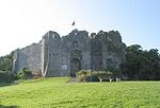
Oystermouth Castle

Encyclopedia
Oystermouth Castle is a Norman
stone castle in Wales
, overlooking Swansea Bay
on the east side of the Gower Peninsula
near the village of the Mumbles
.
soon after 1106 following the capture of Gower by the Normans
. In 1116 the Welsh of Deheubarth retook the Gower Peninsula
and forced William to flee his castle which was put to the torch. The castle was rebuilt soon afterwards, but was probably destroyed again in 1137 when Gower was once more retaken by the princes of Deheubarth. The Londres or London family finally died out in 1215 when Gower was again taken by the Welsh under the leadership of Llywelyn the Great
. In 1220 the Welsh were expelled from the peninsula and the government of Henry III of England
returned the barony of Gower to John de Braose
who rebuilt both Swansea Castle
and Oystermouth.
. The de Braose dynasty could afford to rebuild Oystermouth castle in stone. A high curtain wall was built, internal buildings added, a chapel, basements,three storey residential buildings with fireplaces and garderobes on each floor. The castle had every residential feature necessary for living in some comfort and was also refortified cleverly. Towards the end of the century Oystermouth rather than Swansea Castle
became their principal residence. Edward I
paid a brief visit here in December 1284.
By 1331 the Lords of Gower were living elsewhere and the castle declined in importance in the 14th century.
The daughter of the last de Breos Lord
, Aline de Breos, who improved the chapel making it one of the finest in any castle in south Wales, later married John de Mowbray, and the Lordship of Gower including the castle at Oystermouth passed to the de Mowbray
s through this marriage, and then to the Herbert
family, and finally the Somersets, who became successive Marquis of Worcester and finally Dukes of Beaufort.
, the castle gradually fell into ruin. A survey of Gower made in 1650 describes Oystermouth Castle as [a]n old decayed castle of no use, but of a very pleasant situation. It was portrayed in art in the 18th century as a picturesque ruin, and was restored by George Grant Francis
in the 1840s while the castle was owned by the then Duke of Beaufort
.
In 1927 the Duke of Beaufort gave the castle to Swansea Corporation; today, the castle is maintained under the responsibility of the City and County of Swansea council.
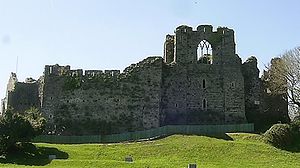 On either side of the entrance gate the walls curve inward, showing that at one time there were supposed to be two round towers built into the gatehouse. It is unknown whether these were ever built.
The chapel (on the second floor of the chapel block) has 14th century traceried windows. According to local tradition, the chapel was built under the direction of Aline de Mowbray.
Remnants of an ornate medieval painting dating back to the 14th century have recently been found in the chapel.The surviving painting is thought to be over 700 years old and was spotted during conservation work in the historic attraction's chapel area.Exposure to the elements has taken its toll on the painting over time but expert Cadw analysis suggests it's a double-arched canopy that contains the figures of angels.Some of the clear elements of the painting that remain include a wing with multiple feathers and circular shapes that form a head with yellow hair surrounded by a nimbus.It's thought the painting is both highly important and testimony to the original design of the chapel attributed to Alina de Breos in the early 14th century that once formed part of a larger work of art.
Following the first phase of conservation works, Oystermouth Castle reopened to the public in mid July 2011.The scheme includes new visitor facilities, an educational space, improvements to access and a 30-foot high glass viewing platform and bridge that leads to Alina's Chapel. The chapel marks the attraction's highest architectural point and features a tracery window with views over Swansea Bay.
and Richard Attenborough
.
Norman architecture
About|Romanesque architecture, primarily English|other buildings in Normandy|Architecture of Normandy.File:Durham Cathedral. Nave by James Valentine c.1890.jpg|thumb|200px|The nave of Durham Cathedral demonstrates the characteristic round arched style, though use of shallow pointed arches above the...
stone castle in Wales
Wales
Wales is a country that is part of the United Kingdom and the island of Great Britain, bordered by England to its east and the Atlantic Ocean and Irish Sea to its west. It has a population of three million, and a total area of 20,779 km²...
, overlooking Swansea Bay
Swansea Bay
Swansea Bay is a bay on the Bristol Channel on the South Wales coast. Places on the bay include Mumbles, Swansea and Port Talbot. The River Neath, River Tawe, River Afan and Blackpill stream flow into the bay....
on the east side of the Gower Peninsula
Gower Peninsula
Gower or the Gower Peninsula is a peninsula in south Wales, jutting from the coast into the Bristol Channel, and administratively part of the City and County of Swansea. Locally it is known as "Gower"...
near the village of the Mumbles
Mumbles
Mumbles or The Mumbles is an area and community in Swansea, Wales which takes its name from the adjacent headland stretching into Swansea Bay...
.
The early castle
The first castle was founded by William de Londres of Ogmore CastleOgmore Castle
Ogmore Castle is located near the village of Ogmore-by-Sea, south of the town of Bridgend in Glamorgan, South Wales. It is situated on the south bank of the River Ewenny and the east bank of the River Ogmore. Cowbridge is nearby. Its construction might have begun in 1106...
soon after 1106 following the capture of Gower by the Normans
Normans
The Normans were the people who gave their name to Normandy, a region in northern France. They were descended from Norse Viking conquerors of the territory and the native population of Frankish and Gallo-Roman stock...
. In 1116 the Welsh of Deheubarth retook the Gower Peninsula
Gower Peninsula
Gower or the Gower Peninsula is a peninsula in south Wales, jutting from the coast into the Bristol Channel, and administratively part of the City and County of Swansea. Locally it is known as "Gower"...
and forced William to flee his castle which was put to the torch. The castle was rebuilt soon afterwards, but was probably destroyed again in 1137 when Gower was once more retaken by the princes of Deheubarth. The Londres or London family finally died out in 1215 when Gower was again taken by the Welsh under the leadership of Llywelyn the Great
Llywelyn the Great
Llywelyn the Great , full name Llywelyn ab Iorwerth, was a Prince of Gwynedd in north Wales and eventually de facto ruler over most of Wales...
. In 1220 the Welsh were expelled from the peninsula and the government of Henry III of England
Henry III of England
Henry III was the son and successor of John as King of England, reigning for 56 years from 1216 until his death. His contemporaries knew him as Henry of Winchester. He was the first child king in England since the reign of Æthelred the Unready...
returned the barony of Gower to John de Braose
John de Braose
John de Braose , known as Tadody to the Welsh, was the Lord of Bramber and Gower.-Re-establishment of the de Braose dynasty :John re-established the senior branch of the de Braose dynasty....
who rebuilt both Swansea Castle
Swansea Castle
Swansea Castle was founded by Henry de Beaumont in 1106 as the caput of the lordship of Gower, in Swansea, Wales.-History:The original castle seems to have been a sub-rectangular/oval enclosure overlooking the River Tawe on the east, surrounded on the north, west and south sides by a larger...
and Oystermouth.
In de Braose hands
In the 13th century the Braose family were Lords of Gower and held the castle as part of their extensive land holdings and titles, including other castles on Gower and in the Welsh MarchesWelsh Marches
The Welsh Marches is a term which, in modern usage, denotes an imprecisely defined area along and around the border between England and Wales in the United Kingdom. The precise meaning of the term has varied at different periods...
. The de Braose dynasty could afford to rebuild Oystermouth castle in stone. A high curtain wall was built, internal buildings added, a chapel, basements,three storey residential buildings with fireplaces and garderobes on each floor. The castle had every residential feature necessary for living in some comfort and was also refortified cleverly. Towards the end of the century Oystermouth rather than Swansea Castle
Swansea Castle
Swansea Castle was founded by Henry de Beaumont in 1106 as the caput of the lordship of Gower, in Swansea, Wales.-History:The original castle seems to have been a sub-rectangular/oval enclosure overlooking the River Tawe on the east, surrounded on the north, west and south sides by a larger...
became their principal residence. Edward I
Edward I of England
Edward I , also known as Edward Longshanks and the Hammer of the Scots, was King of England from 1272 to 1307. The first son of Henry III, Edward was involved early in the political intrigues of his father's reign, which included an outright rebellion by the English barons...
paid a brief visit here in December 1284.
By 1331 the Lords of Gower were living elsewhere and the castle declined in importance in the 14th century.
The daughter of the last de Breos Lord
William de Braose, 2nd Baron Braose
William de Braose, was the second Baron Braose, as well as Lord of Gower and Lord of Bramber...
, Aline de Breos, who improved the chapel making it one of the finest in any castle in south Wales, later married John de Mowbray, and the Lordship of Gower including the castle at Oystermouth passed to the de Mowbray
Mowbray
Mowbray is an Anglo-Norman baronial house, derived from Montbrai in Normandy. From this village came Geoffrey de Montbrai who came to be Bishop of Coutances and accompanied Duke William of Normandy at the Conquest of England in 1066....
s through this marriage, and then to the Herbert
Herbert
Herbert may refer to:*a Germanic name, see Herbert *a surname, see Herbert Places* Herbert, California* Herbert, California, former name of Knowles Junction, California* Herbert, New Zealand* Herbert, Saskatchewan...
family, and finally the Somersets, who became successive Marquis of Worcester and finally Dukes of Beaufort.
Decline and decay
After the Middle AgesMiddle Ages
The Middle Ages is a periodization of European history from the 5th century to the 15th century. The Middle Ages follows the fall of the Western Roman Empire in 476 and precedes the Early Modern Era. It is the middle period of a three-period division of Western history: Classic, Medieval and Modern...
, the castle gradually fell into ruin. A survey of Gower made in 1650 describes Oystermouth Castle as [a]n old decayed castle of no use, but of a very pleasant situation. It was portrayed in art in the 18th century as a picturesque ruin, and was restored by George Grant Francis
George Grant Francis
-Life:Francis was the eldest son of John Francis of Swansea, Glamorganshire, by his wife, Mary Grant, and was born there in January 1814. He was educated at the Swansea high school....
in the 1840s while the castle was owned by the then Duke of Beaufort
Duke of Beaufort
Duke of Beaufort is a title in the Peerage of England. It was created by Charles II in 1682 for Henry Somerset, 3rd Marquess of Worcester, a descendant of Charles Somerset, 1st Earl of Worcester, illegitimate son of Henry Beaufort, 3rd Duke of Somerset, a Lancastrian leader in the Wars of the...
.
In 1927 the Duke of Beaufort gave the castle to Swansea Corporation; today, the castle is maintained under the responsibility of the City and County of Swansea council.
Notable features of the castle
The chapel (on the second floor of the chapel block) has 14th century traceried windows. According to local tradition, the chapel was built under the direction of Aline de Mowbray.
Remnants of an ornate medieval painting dating back to the 14th century have recently been found in the chapel.The surviving painting is thought to be over 700 years old and was spotted during conservation work in the historic attraction's chapel area.Exposure to the elements has taken its toll on the painting over time but expert Cadw analysis suggests it's a double-arched canopy that contains the figures of angels.Some of the clear elements of the painting that remain include a wing with multiple feathers and circular shapes that form a head with yellow hair surrounded by a nimbus.It's thought the painting is both highly important and testimony to the original design of the chapel attributed to Alina de Breos in the early 14th century that once formed part of a larger work of art.
Following the first phase of conservation works, Oystermouth Castle reopened to the public in mid July 2011.The scheme includes new visitor facilities, an educational space, improvements to access and a 30-foot high glass viewing platform and bridge that leads to Alina's Chapel. The chapel marks the attraction's highest architectural point and features a tracery window with views over Swansea Bay.
Appearances in the media
Oystermouth Castle will be the location for several battle scenes in a new Medieval film, Ironclad, directed by Bob HoskinsBob Hoskins
Robert William "Bob" Hoskins, Jr. is an English actor known for playing Cockney rough diamonds, psychopaths and gangsters, in films such as The Long Good Friday , and Mona Lisa , and lighter roles in family films such as Who Framed Roger Rabbit and Hook .- Early life :Hoskins was born in Bury St...
and Richard Attenborough
Richard Attenborough
Richard Samuel Attenborough, Baron Attenborough , CBE is a British actor, director, producer and entrepreneur. As director and producer he won two Academy Awards for the 1982 film Gandhi...
.