
All Topics  
Outrigger canoe racing

 
Outrigger Canoe Racing

   Email Print
   Bookmark   Link


Outrigger canoe racing


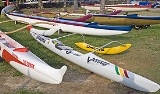
Outrigger canoeing is a sport
Sport

Sport is an activity that is governed by a set of regulation of sport or traditions and often engaged in competitively. Sports commonly refer to activities where the physical capabilities of the competitor are the sole or primary determinant of the outcome , but the term is also used to include activities such as mind sports and motor...
 in which an outrigger canoe
Outrigger canoe

The outrigger canoe is a type of canoe featuring one or more lateral support floats known as outriggers, which are fastened to one or both sides of the main hull ....
 (va?a, wa?a, and waka ama in Tahitian
Tahitian language

Tahitian, a Tahitic languages, is one of the two official languages of French Polynesia . It is an Eastern Polynesian language closely related to Rarotongan language, Maori language, and Hawaiian language....
, Hawaiian
Hawaiian language

The Hawaiian language is an Austronesian languages that takes its name from Hawaii , the largest island in the tropical North Pacific archipelago where it developed....
, and Maori
Maori language

Maori or te reo Maori, also commonly shortened to te reo , functions as one of the official languages of New Zealand. Linguists classify it within the Eastern Polynesian languages as closely related to Cook Islands Maori, Tuamotuan language and Tahitian language; somewhat less closely to Hawaiian language and Marquesan language; a...
 languages, respectively; similar words are used in other Polynesian languages
Polynesian languages

The Polynesian languages are a language family spoken in the region known as Polynesia. They are classified as part of the Austronesian languages, belonging to the Eastern Eastern Malayo-Polynesian languages branch of that family....
) is propelled by means of paddles. Its umbrella organisation is the International Va?a Federation (IVF, formerly International Polynesian Canoe Federation or IPCF). Outrigger canoeing has grown from its roots in Polynesia
Polynesia

Polynesia is a subregion of Oceania, comprising a large grouping of over 1,000 islands scattered over the central and southern Pacific Ocean....
 to become a very popular paddling sport, with numerous sporting and social clubs located around the world.


Discussion
Ask a question about 'Outrigger canoe racing'
Start a new discussion about 'Outrigger canoe racing'
Answer questions from other users
Full Discussion Forum


Recent Posts


Encyclopedia


Outrigger canoeing is a sport
Sport

Sport is an activity that is governed by a set of regulation of sport or traditions and often engaged in competitively. Sports commonly refer to activities where the physical capabilities of the competitor are the sole or primary determinant of the outcome , but the term is also used to include activities such as mind sports and motor...
 in which an outrigger canoe
Outrigger canoe

The outrigger canoe is a type of canoe featuring one or more lateral support floats known as outriggers, which are fastened to one or both sides of the main hull ....
 (va?a, wa?a, and waka ama in Tahitian
Tahitian language

Tahitian, a Tahitic languages, is one of the two official languages of French Polynesia . It is an Eastern Polynesian language closely related to Rarotongan language, Maori language, and Hawaiian language....
, Hawaiian
Hawaiian language

The Hawaiian language is an Austronesian languages that takes its name from Hawaii , the largest island in the tropical North Pacific archipelago where it developed....
, and Maori
Maori language

Maori or te reo Maori, also commonly shortened to te reo , functions as one of the official languages of New Zealand. Linguists classify it within the Eastern Polynesian languages as closely related to Cook Islands Maori, Tuamotuan language and Tahitian language; somewhat less closely to Hawaiian language and Marquesan language; a...
 languages, respectively; similar words are used in other Polynesian languages
Polynesian languages

The Polynesian languages are a language family spoken in the region known as Polynesia. They are classified as part of the Austronesian languages, belonging to the Eastern Eastern Malayo-Polynesian languages branch of that family....
) is propelled by means of paddles. Its umbrella organisation is the International Va?a Federation (IVF, formerly International Polynesian Canoe Federation or IPCF). Outrigger canoeing has grown from its roots in Polynesia
Polynesia

Polynesia is a subregion of Oceania, comprising a large grouping of over 1,000 islands scattered over the central and southern Pacific Ocean....
 to become a very popular paddling sport, with numerous sporting and social clubs located around the world. Sporting clubs are also often involved with dragon boat
Dragon boat

A dragon boat or "dragonboat" is a very long and narrow, canoe style human-powered transport boat now used in the team paddling team sport of dragon boat racing which originated in China over 2000 years ago....
 racing
Racing

A race is a competition of speed, against an objective criterion, usually a clock or to a specific point. The competitors in a race try to complete a given task in the shortest amount of time....
.

Types of outrigger canoes

A variety of boat types exist, including the OC1, OC2, OC3, OC4 and OC6 (with the respective number of paddlers using a single hull outrigger canoe), and the DC12 or OC12 (with twelve paddlers using a double hull outrigger canoe, two six person canoes rigged together like a catamaran). The shorthand form is also commonly written as V1, V2, V6, etc. (where V refers to va?a).

Single hull outrigger canoes have an ama (outrigger float) connected to the main hull by spars called ?iako (Hawaiian
Hawaiian language

The Hawaiian language is an Austronesian languages that takes its name from Hawaii , the largest island in the tropical North Pacific archipelago where it developed....
), ?iato (Tahitian
Tahitian language

Tahitian, a Tahitic languages, is one of the two official languages of French Polynesia . It is an Eastern Polynesian language closely related to Rarotongan language, Maori language, and Hawaiian language....
), or kiato (Maori
Maori language

Maori or te reo Maori, also commonly shortened to te reo , functions as one of the official languages of New Zealand. Linguists classify it within the Eastern Polynesian languages as closely related to Cook Islands Maori, Tuamotuan language and Tahitian language; somewhat less closely to Hawaiian language and Marquesan language; a...
). The ama, which is usually rigged on the left side, provides stability. The paddlers need to be careful to avoid leaning too far on the opposite side of the ama, as that may cause the canoe to capsize (huli or luma?i).

There are also outrigger sailing canoes ranging from smaller three or four person canoes to large voyaging canoes. Sailing canoes may have one ama, two amas (one on each side, but only one side is normally in contact with the water), or a double hull configuration (like a catamaran
Catamaran

A catamaran is a type of multihulled boat or ship consisting of two hull s, or Vaka s, joined by some structure, the most basic being a frame, formed of Aka s....
).

Paddling roles

In an outrigger canoe the paddlers sit in line, facing toward the bow of the canoe (i.e. forward, in the direction of travel, unlike rowing
Watercraft rowing

Watercraft rowing is the act of propelling a boat using the motion of oars in the water. The difference between watercraft paddling and rowing is that with rowing the oars have a mechanical connection with the boat whereas with paddling the paddles are hand-held with no mechanical connection....
). The seats are numbered from 1 (closest to the bow) to the number of seats in the canoe, usually 6. The steerer (or steersman or steersperson) sits in the last seat of the canoe (seat 6 in the common OC6) and, as the name indicates, is primarily responsible for steering
Steering

Steering is the term applied to the collection of components, linkages, etc. which will allow for a vessel or vehicle to follow the desired course....
. The paddler sitting in seat 1 is called the stroke (or stroker) and is responsible for setting the pace of the paddle strokes. The first two positions may also be involved in certain steering manoeuvers.

In an OC1, the single paddler must also steer the canoe. Some OC1s have rudders operated by foot pedals, while OC1s without rudders must be steered by drawing and paddling as needed for steering purposes while paddling to move the canoe forward.

Steerers


A good steerer is able to maintain the straight
Straight

Straight is a term which may commonly refer to:* The property or state of extending in one direction without turns, bends or curves; or being without influence or interruption...
 attitude of the canoe throughout the course of a race, and also keep the boat and the crew safe in rough sea conditions. S/he may also take advantage of water conditions to gain extra speed by surfing
Surfing

Surfing refers to a person or boat riding down a wave and thereby gathering speed from the downward movement. Most commonly, the term is used for a surface water sports in which the person surfing is carried along the face of a breaking ocean surface wave standing on a surfboard....
. The steerer uses a single bladed steering paddle which has a larger blade than a standard outrigger paddle, is built stronger, and has less or no bend in its shaft. S/he steers by the following methods:

  • Poking: holding the paddle vertically against the side of the canoe, causing drag on that side to cause the canoe to turn that direction.
  • Drawing: paddling at a 45 to 90 degree angle to pull water under the canoe, causing the canoe to turn the opposite direction.
  • Posting: holding the paddle in the water out to the side with the forward edge angled opposite to the desired turn direction, usually as a prelude to drawing.
  • Paddling: by applying power on one side of the canoe, the steerer can influence to a small degree which way the canoe will turn. Paddling also increases the total power moving the canoe forward compared to the other steering methods.


A steerer also skippers the canoe and instructs all other the paddlers as necessary. As an outrigger canoe is a long narrow canoe with the steerer placed at the very end, the steerer must give instructions sufficiently loudly and clearly for the entire crew to hear. From a water safety
Safety

Safety is the state of being "safe" , the condition of being protected against physical, social, spiritual, financial, political, emotional, occupational, psychological, educational or other types or consequences of failure, damage, error, accidents, harm or any other event which could be considered non-desirable....
 perspective the steerer should also be amongst the most experienced crew members, and be knowledgeable with the waterways and weather conditions, relevant maritime rules and other safety considerations such as the use of personal floatation devices, rigging of the canoe, placement of paddlers in the various seating positions, and recovery from a huli by righting the canoe and bailing out the water.

Paddlers


Paddlers use single bladed paddles, usually with single or double bent shafts. The paddling stroke is similar to that of most other racing canoe paddling strokes, involving primarily core and lat strength. Generally, each paddler paddles on the opposite side from the paddler in directly front (for example, in an OC6, paddlers in seats 1, 3, and 5 paddle on one side, while paddlers in seats 2 and 4 paddle on the other side). All paddlers switch sides simultaneously on a call from one who is the designated caller. The steerer may paddle either side or switch sides as needed for steering purposes.

Stronger paddlers are typically placed in the middle of the canoe, while paddlers with the most endurance tend to be placed at the front, as the lead paddler sets the pace for the crew. All other paddlers synchronize their strokes to the paddler in front of them (whom they can directly see).

In rough water, it is often desirable to have a paddler with steering skill in seat 5 (of an OC6), to allow for the steerer to have that paddler also take steering strokes if needed in some situations. A seat 5 paddler with steering skill can also assist in preventing a huli by staying on the ama side during a particularly rough stretch of water.

In water rough enough to splash into the canoe, paddlers also need to pay attention to the water level in the canoe, report the situation to the steerer, and bail out the water as necessary. Paddlers also need to know how to recover from a huli under the steerer's direction.

In a quick turn situation, paddlers at the front may also be instructed to une (poke steer, causes the canoe to turn the opposite direction) or kahi (post and draw steer, pulls the canoe to the side where this is done) to help bring the canoe around a turn quickly.

Racing

The length of a race
Racing

A race is a competition of speed, against an objective criterion, usually a clock or to a specific point. The competitors in a race try to complete a given task in the shortest amount of time....
 ranges from short sprints (e.g. 250-500 metres for the OC1 and the OC12, 500-2000 metres (usually includes turns) for the OC6) to longer events, including marathons (e.g. 42 kilometres). A number of races are raced over distances that far exceed 42 kilometres, including the Moloka?i Hoe that crosses the Kaiwi Channel between the islands of Moloka?i and O?ahu in Hawai?i. However, long distance races of 20 to 30 kilometres are more common, with shorter 5 to 8 kilometre courses typically being offered to novice paddlers and those under 20 years of age.

Longer races involving the OC6 often involve paddler replacements, which involve exit and entry to the canoe directly from the water while the canoe is under way (this is called a water change). Typically, nine paddlers form a crew, with six paddling the OC6 and the other three resting, drinking, and/or eating on an escort boat. Replacement typically occurs at 20 to 30 minute intervals; the escort boat drops the relief paddlers into the water ahead of the OC6, which is steered toward them. The relief paddlers climb in on the ama side as those they are replacing roll out into the water on the opposite side. The escort boat then picks up the paddlers in the water so that they can rest, drink, and/or eat before they in turn relieve some of the paddlers in the OC6.

The longer races are typically conducted in the open ocean, e.g. between islands in the South Pacific. The Moloka?i Hoe in Hawai?i and the Catalina
Santa Catalina Island, California

Santa Catalina Island, often called Catalina Island, or just Catalina, is a rocky island off the coast of the U.S. state of California....
 Channel crossing in California are two examples of races involving water changes.

Paddlers and crews are usually classified by gender and age. Gender classification is typically straightforward, with male, female, and coed classifications, with the latter being a crew with equal numbers of male and female paddlers (different rules may apply to nine person coed crews doing a race with paddler replacements). Age classifications typically include youth divisions like 19-and-under, 16-and-under, etc., master divisions with minimum ages typically starting at 35 or 40 years of age, and an open division which allows paddlers of any age. A novice division for paddlers with less than a specified number of years of race experience (usually one or two) may also exist in a given association.

In some races, a particular type of outrigger canoe, usually a more traditional design for the region, may be given its own racing classification. For example, races in Hawai?i have a koa division, while southern California has a Bradley OC6 division and northern California OC1 sprint races have a traditional (no rudder) division.

Adaptive (Disabled) Paddlers

Outrigger canoe paddling is a sport accessible to all. The International Va?a Federation (IVF) have included adaptive events in the World Sprints and the sport is growing in popularity amongst disabled athletes. Countries known to participate in adaptive outrigger canoe paddling include Italy, the United States (including Hawaii), Canada, New Zealand and the United Kingdom.

Modifications can easily be added to seats or paddles enabling athletes with a wide range of disabilities to participate in the same canoe and/or race as paddlers without disabilities.

External links

  • Hana Hou!
    Hana Hou!

    Hana Hou! is an United States bi-monthly English language inflight magazine. It is published for Hawaiian Airlines by Honolulu-based Pacific Travelogue Inc., which also publishes Pacifica, a Japanese language inflight magazine for Continental Airlines....
     Vol. 10, No. 3, June/July 2007. Article about the Manu O Ke Kai outrigger canoeing club in Hale?iwa, Hawai'i
    Hale'iwa, Hawai'i

    File:Haleiwa_Hotel,_Honolulu2.jpgHaleiwa is a North Shore community and census-designated place in the Waialua District of the island of Oahu, Honolulu County, Hawaii....
    .