


Our Lady of Kazan

Encyclopedia
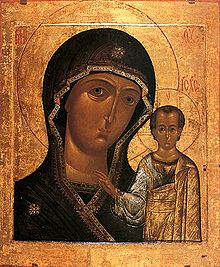
Icon
An icon is a religious work of art, most commonly a painting, from Eastern Christianity and in certain Eastern Catholic churches...
of the highest stature within the Russian Orthodox Church
Russian Orthodox Church
The Russian Orthodox Church or, alternatively, the Moscow Patriarchate The ROC is often said to be the largest of the Eastern Orthodox churches in the world; including all the autocephalous churches under its umbrella, its adherents number over 150 million worldwide—about half of the 300 million...
, representing the Virgin Mary as the protector and patroness of the city of Kazan
Kazan
Kazan is the capital and largest city of the Republic of Tatarstan, Russia. With a population of 1,143,546 , it is the eighth most populous city in Russia. Kazan lies at the confluence of the Volga and Kazanka Rivers in European Russia. In April 2009, the Russian Patent Office granted Kazan the...
. Copies of the image are also venerated in the Catholic Church. It was considered a palladium
Palladium (mythology)
In Greek and Roman mythology, a palladium or palladion was an image of great antiquity on which the safety of a city was said to depend. "Palladium" especially signified the wooden statue of Pallas Athena that Odysseus and Diomedes stole from the citadel of Troy and which was later taken to the...
of Russia for centuries, until its theft and likely destruction in 1904. Two major Kazan Cathedral
Kazan Cathedral
Kazan Cathedral or Kazanskiy Kafedralniy Sobor , also known as the Cathedral of Our Lady of Kazan, is a cathedral of the Russian Orthodox Church on the Nevsky Prospekt in St. Petersburg...
s, in Moscow
Kazan Cathedral, Moscow
Kazan Cathedral , also known as the "Cathedral of Our Lady of Kazan", is a Russian Orthodox church located on the northeast corner of Red Square in Moscow, Russia...
and St. Petersburg, are consecrated to Our Lady of Kazan, as are numerous churches throughout the land. Her feast days are July 21 and November 4 (which is also the Day of National Unity).
Ancient and venerated copies have been displayed at the Kazan Cathedral of Moscow
Moscow
Moscow is the capital, the most populous city, and the most populous federal subject of Russia. The city is a major political, economic, cultural, scientific, religious, financial, educational, and transportation centre of Russia and the continent...
, at Yaroslavl
Yaroslavl
Yaroslavl is a city and the administrative center of Yaroslavl Oblast, Russia, located northeast of Moscow. The historical part of the city, a World Heritage Site, is located at the confluence of the Volga and the Kotorosl Rivers. It is one of the Golden Ring cities, a group of historic cities...
, and at St. Petersburg.
History
According to tradition, the icon was discovered on July 8, 1579, underground in the city of KazanKazan
Kazan is the capital and largest city of the Republic of Tatarstan, Russia. With a population of 1,143,546 , it is the eighth most populous city in Russia. Kazan lies at the confluence of the Volga and Kazanka Rivers in European Russia. In April 2009, the Russian Patent Office granted Kazan the...
by a little girl, Matrona, to whom the location of the image was revealed by the Theotokos
Theotokos
Theotokos is the Greek title of Mary, the mother of Jesus used especially in the Eastern Orthodox, Oriental Orthodox, and Eastern Catholic Churches. Its literal English translations include God-bearer and the one who gives birth to God. Less literal translations include Mother of God...
, the Blessed Virgin Mary, in a Marian apparition. The original icon was kept in the Theotokos Monastery of Kazan, built to commemorate the spot where it had been discovered.
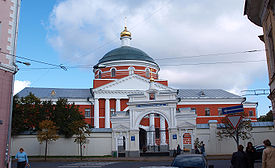
Kazan Cathedral, Moscow
Kazan Cathedral , also known as the "Cathedral of Our Lady of Kazan", is a Russian Orthodox church located on the northeast corner of Red Square in Moscow, Russia...
, at Yaroslavl
Yaroslavl
Yaroslavl is a city and the administrative center of Yaroslavl Oblast, Russia, located northeast of Moscow. The historical part of the city, a World Heritage Site, is located at the confluence of the Volga and the Kotorosl Rivers. It is one of the Golden Ring cities, a group of historic cities...
, and at St. Petersburg.
Invocation of the Virgin Mary through the icon was credited by the Russian commanders, Dmitry Pozharsky
Dmitry Pozharsky
For the ship of the same name, see Sverdlov class cruiserDmitry Mikhaylovich Pozharsky was a Rurikid prince, who led Russia's struggle for independence against Polish-Lithuanian invasion known as the Time of Troubles...
and Mikhail Kutuzov
Mikhail Illarionovich Kutuzov
Mikhail Illarionovich Golenishchev-Kutuzov was a Field Marshal of the Russian Empire. He served as one of the finest military officers and diplomats of Russia under the reign of three Romanov Tsars: Catherine II, Paul I and Alexander I...
, with helping the country to repel the Polish invasion of 1612
Time of Troubles
The Time of Troubles was a period of Russian history comprising the years of interregnum between the death of the last Russian Tsar of the Rurik Dynasty, Feodor Ivanovich, in 1598, and the establishment of the Romanov Dynasty in 1613. In 1601-1603, Russia suffered a famine that killed one-third...
, the Swedish invasion of 1709
Battle of Poltava
The Battle of Poltava on 27 June 1709 was the decisive victory of Peter I of Russia over the Swedish forces under Field Marshal Carl Gustav Rehnskiöld in one of the battles of the Great Northern War. It is widely believed to have been the beginning of Sweden's decline as a Great Power; the...
, and Napoleon's invasion of 1812.
On the night of June 29, 1904 the icon was stolen from the church in Kazan where it had been kept for centuries (the cathedral was later blown up by the communist authorities). Thieves apparently coveted the icon's gold frame
Riza
A riza or oklad , sometimes called a "revetment" in English, is a metal cover protecting an icon. It is usually made of gilt or silvered metal with repoussé work and is pierced to expose elements of the underlying painting. It is sometimes enameled, filigreed, or set with artificial,...
, which was ornamented with many valuable jewels. Several years later, Russian police apprehended the thieves and recovered the frame. The thieves originally declared that the icon itself had been cut to pieces and burnt, although one of them eventually confessed that it was housed in a monastery in the wilds of Siberia. This one, however, was believed to be a fake; and the Russian police refused to investigate, using the logic that it would be very unlucky to venerate a fake icon as though it were authentic. The Orthodox Church interpreted the disappearance of the icon as a sign of tragedies that would plague Russia after the image of the Holy Protectress of Russia had been lost. Indeed, the Russian peasantry was wont to credit all the evils of the revolution in 1905, as well as Russia's defeat in the Russo-Japanese War
Russo-Japanese War
The Russo-Japanese War was "the first great war of the 20th century." It grew out of rival imperial ambitions of the Russian Empire and Japanese Empire over Manchuria and Korea...
, to the desecration of the image.
Fátima image
After the Russian Revolution of 1917Russian Revolution of 1917
The Russian Revolution is the collective term for a series of revolutions in Russia in 1917, which destroyed the Tsarist autocracy and led to the creation of the Soviet Union. The Tsar was deposed and replaced by a provisional government in the first revolution of February 1917...
, there was speculation that the original icon was in fact preserved in St. Petersburg. Reportedly, an icon of Our Lady of Kazan was used in processions around Leningrad fortifications during the Siege of Leningrad
Siege of Leningrad
The Siege of Leningrad, also known as the Leningrad Blockade was a prolonged military operation resulting from the failure of the German Army Group North to capture Leningrad, now known as Saint Petersburg, in the Eastern Front theatre of World War II. It started on 8 September 1941, when the last...
. There was a conflicting theory that the image had been sold by the Bolshevik
Bolshevik
The Bolsheviks, originally also Bolshevists , derived from bol'shinstvo, "majority") were a faction of the Marxist Russian Social Democratic Labour Party which split apart from the Menshevik faction at the Second Party Congress in 1903....
s abroad. Although such theories were not accepted by the Russian Orthodox Church, a reputed original (one of several in existence) was acquired by the Blue Army of Our Lady of Fatima
Blue Army of Our Lady of Fatima
The Blue Army of Our Lady of Fátima is a public international association of the Christian faithful that has as its general purpose "the promotion of the authentic teaching of the Roman Catholic Church and the strict adherence to the tenets of the Gospel; the personal sanctification of adherents...
and enshrined in Fátima, Portugal
Fátima, Portugal
Fátima is a city in Portugal famous for the Marian apparitions, recognized by the Catholic Church, that took place there in 1917. The town itself has a population of 7,756 and is located in the municipality of Ourém, in the Centro Region and Médio Tejo Subregion...
in the 1970s. The image proved to be a copy, dated by experts to ca. 1730.
In 1993, the icon from Fátima was given to Pope John Paul II
Pope John Paul II
Blessed Pope John Paul II , born Karol Józef Wojtyła , reigned as Pope of the Catholic Church and Sovereign of Vatican City from 16 October 1978 until his death on 2 April 2005, at of age. His was the second-longest documented pontificate, which lasted ; only Pope Pius IX ...
, who took it to the Vatican
Vatican City
Vatican City , or Vatican City State, in Italian officially Stato della Città del Vaticano , which translates literally as State of the City of the Vatican, is a landlocked sovereign city-state whose territory consists of a walled enclave within the city of Rome, Italy. It has an area of...
and had it installed in his study, where he venerated it for eleven years. In his own words, "it has found a home with me and has accompanied my daily service to the Church with its motherly gaze." John Paul II wished to visit Moscow or Kazan to personally return the icon to the Russian Orthodox Church. When these efforts were blocked by the Moscow Patriarchate, the icon was presented to the Russian Church unconditionally in August 2004. On August 26, 2004 it was exhibited for veneration on the altar of St. Peter's Basilica
St. Peter's Basilica
The Papal Basilica of Saint Peter , officially known in Italian as ' and commonly known as Saint Peter's Basilica, is a Late Renaissance church located within the Vatican City. Saint Peter's Basilica has the largest interior of any Christian church in the world...
and then delivered to Moscow. On the next feast day of the holy icon, July 21, 2005, Patriarch Alexius II
Patriarch Alexius II
Patriarch Alexy II was the 15th Patriarch of Moscow and All Russia, the primate of the Russian Orthodox Church....
and Mintimer Shaymiev, the President of Tatarstan
Tatarstan
The Republic of Tatarstan is a federal subject of Russia located in the Volga Federal District. Its capital is the city of Kazan, which is one of Russia's largest and most prosperous cities. The republic borders with Kirov, Ulyanovsk, Samara, and Orenburg Oblasts, and with the Mari El, Udmurt,...
, placed it in the Annunciation Cathedral of the Kazan Kremlin
Kazan Kremlin
The Kazan Kremlin is the chief historic citadel of Tatarstan, situated in the city of Kazan. It was built on behest of Ivan the Terrible on the ruins of the former castle of Kazan khans...
(illustrated, to the right).
The icon is enshrined in the Church of the Elevation of the Holy Cross, the site where the original icon of Our Lady of Kazan was found. Plans are underway to make the monastery where the icon was found into an international pilgrimage centre.