

.gif)
Ottawa Senators (original)

Encyclopedia
The Ottawa Senators were an amateur, and later, professional, ice hockey
team based in Ottawa
, Canada
which existed from 1883 to 1954. The club was the first hockey club in Ontario, a founding member of the National Hockey League
(NHL) and played in the NHL from 1917 until 1934. The club, which was officially the Ottawa Hockey Club (Ottawa HC), was known by several nicknames, including the Generals in the 1890s, the Silver Seven from 1903 to 1907 and the Senators dating from 1908.
Generally acknowledged by hockey historians as one of the greatest teams of the early days of the sport, the club won numerous championships, starting with the 1891 to 1893 Ontario championships. Ottawa HC played in the first season during which the Stanley Cup
was challenged in 1893, and first won the Cup in 1903, holding the championship until 1906 (the Silver Seven years). The club repeated its success in the 1920s, winning the Stanley Cup in 1920, 1921, 1923 and 1927 (the Super Six years). In total, the club won the Stanley Cup eleven times, including challenges during two years it did not win the Cup for the season. In 1950, Canadian sports editors selected the Ottawa HC/Senators as Canada's greatest team in the first half of the 20th century.
The club was one of the first organized clubs in the early days of the sport of ice hockey, playing in the Montreal Winter Carnival ice hockey tournaments
in the early 1880s and founding the Amateur Hockey Association of Canada and the Ontario Hockey Association
. Along with the rise of professionalism in ice hockey in the first decade of the 1900s, the club changed to a professional team and were founding members of the National Hockey Association
(NHA) and its successor, the National Hockey League. The club competed in the NHL until the 1933–34 season, when it relocated the NHL franchise to St. Louis, Missouri
due to financial difficulties to become the St. Louis Eagles
. The organization continued the Senators as a senior amateur, and later semi-professional, team in Quebec senior men's leagues until 1954.
met and founded the club. Being the first organized ice hockey club in Ottawa, and also the first in Ontario
, the club had no other clubs to play that season. The only activities that winter were practices at the "Royal Rink" starting on March 5, 1883.
The club first participated competitively at the 1884 Montreal Winter Carnival ice hockey tournament (considered the Canadian championship at the time) wearing red and black uniforms. Future Ottawa mayor Nelson Porter
is recorded as the scorer of the club's first-ever goal, at the 1884 Carnival. Frank Jenkins was the first captain of the team; he later became the president of the Hockey Club in 1891 and of the Amateur Hockey Association of Canada (AHA or AHAC) in 1892.
For the 1885 season, the club adopted gold and blue as its colours and returned to the Montreal tournament. Ottawa earned its first-ever victory at the tournament over the Montreal Victorias
, but lost its final match to the Montreal Hockey Club
(Montreal HC) to place second in the tournament. The 1886 Montreal tournament was cancelled due to an outbreak of smallpox
and the club would not play an outside match again until 1887.
was named the first president of the league. The league did not have a set schedule, and instead games were played in "challenge series", whereby a team held the championship and entertained challengers until the end of the season, a format the league employed until 1893. Under the format, Ottawa lost the one challenge it played in that first 1887 season
to the Montreal Victorias
.
After that season, Ottawa HC became inactive. The Royal Rink, which had been their primary facility, had been converted to a roller skating rink, and ice rink facilities were at a shortage. This changed with the opening of the Rideau Skating Rink
in February 1889. One of the principal organizers in the restarting of the team was Ottawa Journal
publisher P. D. Ross
, who also played on the team. Returning as captain was Frank Jenkins, and the other players were Halder Kirby, Jack Kerr, Nelson Porter, Ross, George Young, Weldy Young
, Thomas D. Green, William O'Dell, Tom Gallagher, Albert Low
and Henry Ami. In 1889, the club played only one match against an outside club, an exhibition at the Rideau rink against the Montreal HC 'second' team.
In November 1889, the Ottawa Amateur Athletic Club (OAAC) was opened at the corner of today's Elgin
and Laurier Streets on the site of today's Lord Elgin Hotel
. The Club building would also be the Hockey Club's headquarters. The OAAC was affiliated with the Ottawa Amateur Athletic Association (OAAA), and the Hockey Club through the affiliation also became OAAA members. When the club began outside competition again in 1889–90, it was with new sweaters of white with black stripes and the OAAA red "triskelion" logo. It was during this period of affiliation with the OAAC, that the club would become known by the nickname "Generals", attributed to the club's insignia. The club is also referred to as the "Capitals" in literature, although there was a rival Ottawa Capitals
club organized by the Capital Amateur Athletics Association active at the time.
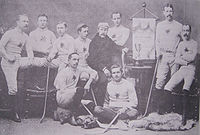 In the 1889–90 season
, Ottawa HC played two competitive games but this was to increase greatly the next season. The 1890–91 season
saw the club play 14 games, playing in three leagues. Ottawa HC was a founding member of two new leagues, the Ottawa City Hockey League
(OCHL) and the Ontario Hockey Association
(OHA) and also rejoined the AHAC. Ottawa HC won the Ottawa and Ontario championships, and two games against AHAC opponents, but lost to the AHAC champion Montreal HC in its one challenge for the championship.
4–2, and in 1893 the Toronto Granites
defaulted by not appearing for the championship match scheduled for Ottawa. The club resigned from the OHA in February 1894 after the OHA refused the club's demand to have the 1894 final in Ottawa and ordered Ottawa HC to play the final in Toronto. The dispute caused a permanent schism between Ottawa area teams and the Ontario Hockey Association. As of 2010, Ottawa and area teams remain unaffiliated with the OHA; the official association under Hockey Canada
is the Ottawa District Hockey Association
, a descendant of the OCHL.
It was at a dinner to honour the 1892 OHA champions
at the Russell Hotel that the Governor General, Lord Stanley, announced his new Dominion Challenge Trophy, now known as the Stanley Cup
, for the Canadian champions. Former player and president of the club, P. D. Ross, was selected by Stanley to be a trustee of the Cup.
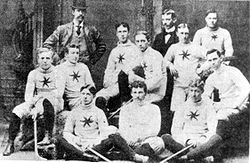
, but in the next season of AHAC play in 1891–92
the club won the league championship, and held it for most of the season, from January 10 until March 7, 1892. The club took the championship from Montreal HC, who were previously undefeated, and won five straight games before Montreal won the championship back by a 1–0 score in the last challenge of the season. Montreal's win in the final challenge was their only win of the season and their only one in four games against Ottawa.
Lord Stanley, who often attended Ottawa HC games, felt the loss of the title after holding it all season was an unsuitable way to determine the championship. In the letter announcing the Stanley Cup
, Stanley suggested that the AHAC start a 'round-robin' type regular season format, which the AHAC implemented in the following season of 1892–93
. The key match-up in that season for Ottawa was a loss in the opening game of the season against the Montreal Victorias
on January 7, 1893, as Ottawa split its season series with eventual winner Montreal HC, both teams otherwise winning all of their games. This loss provided the one game margin in the standings that led to Lord Stanley awarding the initial Cup to Montreal HC.
In 1893–1894
, Ottawa HC finished in a four-way tie for first in the AHAC standings. A playoff was arranged in Montreal for the championship between Ottawa, Montreal HC and Montreal Victorias (the other first place club, Quebec, having dropped out of the playoff). These games would be the first Stanley Cup playoff games ever played. As the 'away' team, Ottawa was given a bye to the final game. On March 23, 1894, at the Victoria Rink
, Ottawa and Montreal HC played for the championship. Ottawa scored the first goal, but Montreal would score the next three to win the game 3–1. Ottawa captain Weldy Young fainted from exhaustion at the end of the game.
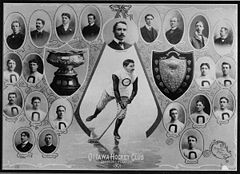 For the period of 1894 to 1900, the club did not win the league championship, finishing as high as second several times, and fifth (last) once. For the 1896–97 season, the Ottawa club unveiled the first use of the 'barber-pole' style jerseys of horizontal bars of black, red and white. This basic style would be used by the club until 1954 except for the 1900 and 1901 seasons, when the team used a plain jersey with only the letter 'O' on the front, identical in design to the jerseys of the Ottawa Football Club
, also an OAAA affiliate.
In 1898, the AHAC dissolved over the admission of the intermediate-level team Ottawa Capitals
of the rival Capital Amateur Association to the AHAC by a vote of the league executive. The Capitals had won the intermediate championship of the AHAC and were eligible to join the senior ranks. After they were outvoted by the intermediate-level teams of AHAC which wanted to promote the Capitals to the senior-level, the senior-level Ottawa, Montreal HC, Montreal Victorias and Quebec clubs left the AHAC and formed the Canadian Amateur Hockey League
(CAHL), shutting out the Capitals.
In 1901, the club won the CAHL league regular season title, its first league championship since winning the OHA in 1893. It wished to challenge the Stanley Cup champion Winnipeg Victorias
at first, but chose not to after deliberating for a week after the season. According to hockey historian Charles L. Coleman, it was due to the "lateness of the season".
Notable players of this period included Albert Morel and Fred Chittick in goal, leaders of the league several times in goaltending, and future Hall of Famers Harvey Pulford
, Alf Smith
, Harry Westwick
and brothers Bruce Stuart
and Hod Stuart
. It was during this period that the nickname Senators was first used; however, from 1903 to 1906, the team is better known as the Silver Seven.
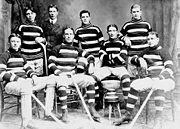 The first "dynasty" of the Ottawa HC was from 1903 until 1906, when the team was known as the "Silver Seven". The era started with the arrival of Frank McGee for the 1903 season and ended with his retirement after the 1906 season. Having lost an eye in local amateur hockey, he was persuaded, despite the threat of permanent blindness, to join the Senators. The youngest player on the team and standing 5 foot 6 inches tall, he went on to score 135 goals in 45 games. In a 1905 challenge against the Dawson City
, he scored 14 goals in a 23–2 win. He retired in 1906 at the age of 23.
In the 1903 CAHL season
, Ottawa and the Montreal Victorias
both finished in first place with 6–2 records. The top scorers were the Victorias' Russell Bowie
, who scored seven goals in one game and six in another, and McGee, whose top performance saw him score five goals in a game. The two clubs faced off in a two-game total goals series to decide the league championship and Stanley Cup. The first game, played in Montreal on slushy ice that made it a desperate struggle to score, ended 1–1. The return match in Ottawa, witnessed by three thousand fans, was on ice coated with an inch of water. The conditions did not hinder Ottawa, as they won 8–0, with McGee scoring three goals and the other five shared among the three Gilmour brothers, Dave (3), Suddy (1) and Bill (1), to win their first Cup. This started a period in which the team held the Stanley Cup and defeated all challengers until March 1906.
For that Stanley Cup win, each of the team's players was given a silver nugget by team executive Bob Shillington
, an Ottawa druggist and mining investor. He gave them nuggets instead of money since the players were still technically amateurs and to give them money would have meant disqualification from the league. In a 1957 interview, Harry Westwick recalled that at the presentation "One of the players said 'We ought to call ourselves the Silver Seven.' and the name caught on right there." (At the time, hockey teams iced seven men—a goaltender, three forwards, two defencemen and a rover
).
The Silver Seven moved between three leagues during this time, and for a time were independent of any league. In February 1904, during the CAHL season, Ottawa resigned from the league in a dispute over the replaying of a game. The team had arrived late for a game in Montreal and the game had been called at midnight, with a tied score. The league demanded that the game be replayed. The club agreed to play only if the game mattered in the standings. The impasse led to Ottawa leaving the league. For the rest of that winter, the club played only in Cup challenge series. Quebec went on to win the championship of the league and demanded the Stanley Cup, but the Cup's trustees ruled that Ottawa still retained it. The trustees offered to arrange a challenge between Ottawa and the CAHL champion, but the CAHL refused to consider it. The next season, Ottawa joined the Federal Amateur Hockey League
(FAHL), winning the league championship. The club was only in the FAHL for one season, and the Montreal Wanderers
became their new rival. For the 1906 season Ottawa, along with the Wanderers and several of the CAHL teams, formed the Eastern Canada Amateur Hockey Association
(ECAHA), unifying the top teams into one league.
According to one player, the "Marlboroughs got off very easily. When Winnipeg Rowing Club played here, most of their players were carried off on stretchers." This style of hockey would continue for years to come.
of Yukon
Territory in 1905. Organized by Joe Boyle, a Toronto-born prospector, who had struck it rich in the Yukon gold rush of 1898, Dawson City had Lorne Hanna, who had played for Brandon against Ottawa in a 1904 challenge and two former elite hockey players: Weldy Young
, who had played for Ottawa in the 1890s, and D. R. McLennan, who had played for Queen's College against the Montreal Victorias
in an 1895 challenge. The remaining players were selected from other Dawson City clubs. Dawson City's challenge was accepted in the summer of 1904 by the Stanley Cup trustees and scheduled to start on Friday, January 13, 1905. The date of the challenge meant that Young had to travel separately to Ottawa, as he had to work in a federal election that December and would meet the club in Ottawa.
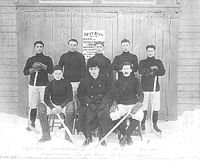 To get to Ottawa, several thousand miles away, the club had to get to Whitehorse
by road, catch a train from there to Skagway, Alaska
, then catch a steamer to Vancouver
, B.C.
and a train from there to Ottawa. On December 18, 1904, several players set out by dog sled
and the rest left the next day by bicycle for a 330-mile trek to Whitehorse. At first the team made good progress, but the weather turned warm enough to thaw the roads, forcing the players to walk several hundred miles. The team spent the nights in police sheds along the road. At Whitehorse, the weather turned bad, causing the trains not to run for three days and the Nuggets to miss their steamer in Skagway. The next one could not dock for three days due to the ice buildup. The club found the sea journey treacherous, and it caused seasickness amongst the team. When the steamer reached Vancouver, the area was too fogged in to dock, and the steamer docked in Seattle. The team from there caught a train to Vancouver, from which it left on January 6, 1905, arriving in Ottawa on January 11.
Despite the difficult journey, the Ottawas refused to change the date of the first game, only two days away. Ottawa arranged hospitable accommodations for the Dawson City team. The Yukoners received a huge welcome at the train station, had a welcoming dinner, and used the Ottawa Amateur Athletic Club's rooms for the duration of their stay. Young did not arrive in time to play for Dawson.
The first game was close at the halfway point, Ottawa leading Dawson three to one. In the second half, the play became violent. Norman Watt of Dawson tripped Ottawa's Art Moore, who retaliated with a stick to the mouth of Watt. Watt promptly knocked Moore out, hitting him on the head with his stick. The game ended 9–2 for Ottawa. The game left a poor taste in the mouth for the Yukoners, who complained that several goals were offside
.
After the game, Watt was quoted as saying "[Frank] McGee doesn't look like too much," as he had only scored once in the first game. McGee scored four goals in the first half of the second match and 10 in the second half, leading Ottawa to a 23–2 score; his 14 goals remains a record for a single game of major senior hockey. Eight of those 14 goals were scored consecutively in a span of less than nine minutes. Despite this high score, the newspapers claimed that Albert Forrest, the Dawson City goalie, had played a "really fine game", otherwise the score "might have been doubled". Ottawa celebrated by hosting Dawson at a banquet. After this, the players took the Cup and attempted to drop-kick
it over the Rideau Canal
. The stunt was unsuccessful, as the Cup landed on the frozen ice and had to be retrieved the next day.
Considering the lopsided score of the series, historians such as Paul Kitchen question why Dawson City was even granted a chance at the Cup. Dawson City had won no championships and did not belong to any recognized senior league. While team official Weldy Young knew Stanley Cup trustee P. D. Ross personally through their joint connection with the club, it may have been the political connections that Joe Boyle had with the government Interior Minister of the time, Clifford Sifton
, that got Dawson City the series.
The end of the streak came in March 1906. Ottawa and the Montreal Wanderers tied for the ECAHA league lead in 1906, forcing a playoff series for the league championship and the Cup. Montreal won the first game in Montreal by a score of 9–1. In the return match, Ottawa replaced their goaltender Bouse Hutton
and used goaltender Percy LeSueur
, formerly of Smiths Falls. In the return match in Ottawa, Ottawa overcame the eight-goal deficit, getting a 9–1 lead to tie the series by the midway point of the second half. Harry Smith then scored to put Ottawa ahead, only to have the goal ruled offside. It was then that Lester Patrick
of the Wanderers took it upon himself, scoring two goals to win the series 12–10. This was Frank McGee's last game and he scored two goals.
The players
Besides McGee, future Hall of Fame players Billy Gilmour
, Percy LeSueur
, Harvey Pulford
, Alf Smith
and Harry Westwick
played for the Ottawas. Alf Smith was also the coach. Other players of the 'Seven' included Arthur Allen, Dave Finnie, Arthur Fraser, Horace Gaul, Dave Gilmour, Suddy Gilmour
, Bouse Hutton, Jim McGee
, Art Moore, Percy Sims, Hamby Shore
, Charles Spittal, Frank White and Frank Wood.
The club was able to continue the streak despite the death of one of its members. Jim McGee, Frank McGee's brother, died after the 1904 season in a horseback riding accident. He was also the Ottawa Football Club's captain at the time. The funeral cortege was estimated at a half-mile in length, and it included Canadian prime minister Wilfrid Laurier
.
was paying players. In response to this, the ECAHA, while still having several purely amateur teams, started to allow professional players. The top teams could therefore compete for the top players and the gate attractions that they were. The only restriction was that the status of each and every player had to be publicized.
The period saw the rivalry between the Senators and the Wanderers continue, and at times it was brutally contested. On January 12, 1907, a full-scale "donnybrook" took place between the two teams at a game in Montreal. Charles Spittal of Ottawa was described as "attempting to split Blachford's skull", Alf Smith hit Hod Stuart
"across the temple with his stick, laying him out like a corpse" and Harry Smith cracked his stick across Ernie Johnson's face, breaking Johnson's nose. The Wanderers won the game 4–2. Discipline was first attempted by the league at a meeting on January 18, in which the Victorias proposed suspending Spittal and Alf Smith for the season, but this was voted down and the president of the league resigned. The police arrested Spittal, Alf and Harry Smith on their next visit to Montreal, leading to $20 fines for Spittal and Alf Smith and an acquittal for Harry Smith. The tactics did not work on the Wanderers; they won the return match in Ottawa in March and went undefeated for the season, leaving Ottawa in second place. However, it may have affected the Wanderers in another way: they lost the Stanley Cup a week after the donnybrook in a Stanley Cup challenge series to the Kenora Thistles
.
The 1907–08 season was a season of change for Ottawa. Harry Smith and Hamby Shore left to join Winnipeg. Ottawa hired several free agents, including Marty Walsh
, Tommy Phillips
and Fred 'The Listowel Whirlwind' Taylor
. Taylor was hired away from the International Professional Hockey League
(IHL) for the 1908 season for a $1000 salary and a guaranteed federal civil service job. He was an immediate sensation and earned a new nickname of 'Cyclone' for his fast skating and end-to-end rushes, the nickname attributed to the Canadian governor-general Earl Grey
. Phillips was signed from Kenora to an even higher salary of $1,500 for the season, partially paid for by Ottawa sportsmen.
Ottawa moved into their new arena, simply dubbed The Arena
, with seating for 4,500 and standing room for 2,500. With the free agent signings and the new arena, Ottawa started selling season-tickets, the first of their kind, $3.75 for five games, eventually selling 2,400. The capacity was topped with a crowd of 7,100 in the home opener, attending a game against the Wanderers on January 11, which Ottawa won 12–2. However, Ottawa started the season with two losses out of three games and ended in second place behind the Wanderers again. Walsh tied for the scoring lead with 28 goals in 9 games (including 7 in one match), while Phillips was close behind at 26 goals in 10 games.
In 1908–09, the Eastern Canada Amateur Hockey Association became completely professional and changed its name to the Eastern Canada Hockey Association (ECHA). This led to the retirement of several stars, including Ottawa's Harvey Pulford
and Montreal's Russell Bowie
, who insisted on keeping their amateur status. The Montreal Victorias and Montreal HC founded the Interprovincial Amateur Hockey Union, leaving only Ottawa, Quebec, Montreal Wanderers and Montreal Shamrocks
in the ECHA. It was another season of player turn-over for Ottawa. Besides Pulford, Ottawa lost Alf Smith, who formed a competing Ottawa Senators
professional team in the Federal League, and Tommy Phillips, who joined Edmonton. The club picked up Bruce Stuart
from the Wanderers, Fred Lake
from Winnipeg and Dubby Kerr from Toronto. This lineup had a successful season, winning 10 out of 12 games. Walsh led all scorers with 38 goals in 12 games, while Stuart had 22 and Kerr had 20. The season was clinched with a win against the Wanderers on March 3 in Ottawa, 8–3, as Ottawa won the league and Stanley Cup.
Notable players of this time period include future Hall of Famers Percy LeSueur in goal, Dubby Kerr, Tommy Phillips, Harvey Pulford, Alf Smith, Bruce Stuart, Fred 'Cyclone' Taylor and Marty Walsh.
. The NHA became the fore-runner of today's National Hockey League
.
Ottawa was one of the founders of the CHA and one of the teams that had rejected Renfrew. However, after a few poorly attended games showed that fans had no interest in the league, Ottawa and the Montreal Shamrocks abandoned the CHA to join the NHA. Ottawa, the defending Stanley Cup champion and Wanderers' rival, was readily accepted by the NHA. This enabled Ottawa to continue the rivalry with the Wanderers and take in the gate revenues those games provided. The Wanderers won the championship in 1910, and Ottawa won in 1911 and 1915.
It is during the NHA period that the nickname "Ottawa Senators" came into common usage. Although there had been a competing Senators club
in 1909, and there had been mention of the Senators nickname as early as 1901, the nickname was not adopted by the club. The official name of the Ottawa Hockey Club remained in place until ownership changes in the 1930s.
Star player Cyclone Taylor had defected to Renfrew, and despite a salary war with Renfrew, Ottawa managed to re-sign their other top players, Dubby Kerr, Fred Lake and Marty Walsh for the 1909–10 season
. On Taylor's first return in February 1910, he made a promise to score a goal while making a rush backwards against Ottawa. This led to incredible interest, with over 7,000 in attendance. A bet of $100 was placed at the King Edward Hotel against him scoring at all. Ottawa won 8–5 (scoring 3 goals in overtime) and kept Taylor off the scoresheet. Later in the season at the return match in Renfrew, Taylor made good on his boast with a goal scored backwards, although it was simply a goal scored on a backhand
shot. This was the final game of the season, and Ottawa had no chance at the league title and did not appear to have put in an effort in the 17–2 loss.
In 1910–11, the NHA contracted and imposed a salary cap, leading many of the Ottawa players to threaten to form a competing league. However, team owners controlled the rinks and the players accepted the new conditions. For Ottawa players, conditions did not deteriorate much as the club provided bonuses after the season. Ottawa gained revenge for the previous loss to Renfrew by defeating Renfrew 19–5. The team went 13–3 to win the NHA and inherit the Stanley Cup; Marty Walsh and Dubby Kerr led the goal scoring with 37 and 32 goals in 16 games. After the season Ottawa played two challenges, against Galt, winning 7–4, and against Port Arthur
, winning 13–4. In the Port Arthur game Marty Walsh came close to matching Frank McGee's total, scoring ten goals. 1910–11 was the debut season of right winger Jack Darragh
who scored 18 goals in 16 games.
The 1911–12 through 1913–14 seasons saw a decline for both Ottawa and the Wanderers. After the withdrawal of O'Brien's Renfrew team in 1911, the two clubs fought over the rights to Cyclone Taylor, who wanted to return to Ottawa, where his fiance lived and he still had a government job. The NHA had given the Wanderers the rights to Taylor in a dispersal of the Renfrew players. Trade talks were unfruitful. Ottawa, insistent in their claim for Taylor, played him in one game for Ottawa against the Wanderers. The Senators won the game; however, Taylor was ineffectual. The move backfired on the Senators, as the league ruled that the game could not stand and would have to be replayed. The Senators lost the replay and it was the difference in the league championship, as the defending champion Senators placed second by one game behind Quebec. Quebec's Bulldogs
won the only two Stanley Cup championships in the club's history that season and the next, and the Toronto Blueshirts
won in 1914. Taylor did not play in the NHA again, as he joined Vancouver in the off-season. The Senators finished fifth in 1912–13 and fourth in 1913–14. 1912–13 saw the debut of right winger Punch Broadbent
, who scored 20 goals in 18 games.
In 1914–15
, both Ottawa and the Wanderers bounced back to the top of league, tying each other for the NHA season title. This was also the season that future Hall of Famer Clint Benedict
became the Senators' top goaltender, taking over from Percy LeSueur. Former Wanderer Art Ross
joined the Senators and helped Ottawa win in a two-game playoff, 4–1. The Senators then played in the first inter-league Stanley Cup final playoff series with the Vancouver Millionaires
of the Pacific Coast
(PCHA) league. Cyclone Taylor, now of the Millionaires, haunted his old team, scoring six goals in three games as Ottawa lost three straight in Vancouver. Future Senator centreman Frank Nighbor
played in this series for Vancouver and scored five goals.
In 1915–16, the Senators placed second to the eventual Stanley Cup champion Montreal Canadiens. Punch Broadbent left the team to fight in World War I, while Frank Nighbor joined the Senators in his place and became the team's leading scorer. Nighbor had been signed away from Vancouver for the salary of $1,500, making him the highest paid player on the club, ahead of Art Ross and Eddie Gerard. Benedict led the league as the top goaltender for the first time. With the wartime shortage of players, Rat Westwick
and Billy Gilmour
of 'Silver Seven' days attempted comebacks with the club but both played only two games before retiring for good.
In the off-season, Ottawa's president Llewellyn Bate proposed to suspend the team's operations until the end of the war. Gate receipts had declined 17 per cent. The other NHA owners refused to suspend the league. Rather than simply cease operations, Bate and the other directors of the team turned it over to Ted Dey, owner of the Arena. Dey cut player salaries and let players go, including Art Ross to the Wanderers. Dey also fired manager Alf Smith, saving on his $750 salary.
In 1916–17, the last season of the NHA, Ottawa won the second-half of the split schedule. An Army team, the Toronto 228th Battalion
, composed of enlisted professional players, joined the league before leaving for war after the first half-season. When the Battalion left, the other Toronto team, the Blueshirts was suspended by the league and its players dispersed including Corb Denneny, brother of Cy Denneny
, who joined the Senators. Future Hall of Famer Cy had been picked up in a trade with Toronto earlier that season and he would be a member of the Senators until 1928. Benedict was the NHA's top goaltender once again, and Nighbor tied for the scoring lead with 41 goals in 19 games. As second-half winners, the Senators played off in a series with the Canadiens, the first-half winners. The Senators ended their play in the NHA by losing a two-game total goals playoff series to the Canadiens, who eventually lost to Seattle in the Stanley Cup final. This season saw the final decline of Ottawa's old rivals, the Wanderers, who finished at the bottom of the standings. The next year, the Wanderers played only four games in the NHL, winning only one before folding the franchise after their home arena burned down.
While World War I affected all NHA teams, Ottawa was able to retain players and be competitive. The club finished no worse than second during the wartime seasons of 1914–15 to 1917–18.
and the National Hockey League agree that the Senators of 1906 were champions but disagree on whether the Senators were champions in 1910. In both seasons, the Senators were the undisputed defending champions, and during that year's hockey season, the Senators won Stanley Cup challenges. However, by the end of both hockey seasons, they were no longer holders of the Stanley Cup.
In 1906, Ottawa defeated OHA champions Queen's University and FAHL champions Smiths Falls
in Stanley Cup challenges. However, Ottawa tied the Montreal Wanderers for the ECAHA regular season championship. To decide the ECAHA championship and the Stanley Cup, the Senators played a two-game total goals series against the Wanderers in March 1906 and lost. The 1906 hockey season ended with the Wanderers as the Stanley Cup champions. The Hockey Hall of Fame recognizes both Ottawa and the Wanderers as champions for that year, as does the NHL.
In January 1910, Ottawa defeated Galt, champions of the OPHL
, during the CHA regular season, as well as Edmonton
of the AAHA
during the NHA regular season (the Senators switched leagues in-between). At the end of the season Ottawa gave up the Cup to the Montreal Wanderers, regular-season champions of the new NHA league. Unlike the 1906 case, the Hockey Hall of Fame does not recognize the Senators as champions for January 1910, although the NHL does.
In October 1992, at the first game of the current Ottawa Senators
NHL club, banners were raised to commemorate Stanley Cups in nine seasons, excluding 1906 and 1910. In media guides published by the club, they listed the original Senators as nine-time winners. This changed in March 2003, when the team raised banners for the 1906 and 1910 years to join the other nine banners hanging at the Corel Centre
. The club and the NHL now list the original Senators as eleven-time winners.
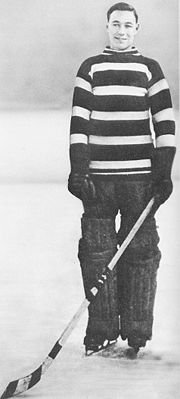 After struggling through the war years, the Ottawa Hockey Association put the Club up for sale for $5,000 in the fall of 1917. Montreal Canadiens' owner George Kennedy was leading an effort to get rid of Toronto Blueshirts
' owner Eddie Livingstone, and he needed the Senators in his corner. He loaned Ottawa Citizen
sports editor Tommy Gorman
(who also doubled as a press representative for the Canadiens) $2,500 to help buy into the Senators. Gorman, along with Martin Rosenthal and Ted Dey (owner of The Arena), bought the club. At a meeting held at Montreal
's Windsor Hotel
, the Senators, Canadiens, Wanderers and Bulldogs formed a new league—the National Hockey League
—effectively leaving Livingstone in the NHA by himself. Gorman represented the Senators at the meeting. "A great day for hockey," he was quoted as saying, "Without [Livingstone] we can get down to the business of making money." Within a year, Gorman and partner Ted Dey had made enough money to pay back Kennedy. Gorman also attended the following year's meeting of the NHA owners in which the final vote to suspend the league was made.
The Senators first season in the NHL, 1917–18
, did not go well. Salary squabbles delayed the home opener as players protested that their contracts were for twenty games, when the season schedule was for twenty four. Enough players were appeased that the game started, 15 minutes late, while two players Hamby Shore and Jack Darragh
, stayed in the dressing room while negotiations went on. The Senators lost their home opener 7–4. The Senators lost their previous top rival, the Wanderers, after five games. The team struggled and finished in third place after the first half of the season. The club made player changes in the second half, getting Horace Merrill
out of retirement and releasing Dave Ritchie. It was Shore's last season as he would die of pneumonia in October 1918. Shore's last career game was in the third-last game of the season and he was sat out for the last two games. In the end, the team placed second in the second half and missed the playoffs. Cy Denneny led the team, coming second overall in scoring in the league with 36 goals in 20 games.
Prior to the 1918–19 season, ownership of the Senators changed. While Ted Dey negotiated with Percy Quinn
for a lease for The Arena, Dey was also negotiating with Rosenthal over the lease, causing Rosenthal to seriously consider moving the team from The Arena back to Aberdeen Pavilion
. However, it turned out that Dey was engineering a takeover of the club and Rosenthal ended up selling his share of the club to Dey, making Dey the majority owner in both the Arena and the hockey club. Rosenthal, a prominent local jeweller, had been involved with the club since 1903. Dey's machinations also helped the NHL in its continuing fight against Blueshirts owner Livingstone. The Senators instigated an agreement with the other NHL clubs, binding them to the NHL for the next five years and locking out any rival league from their arenas.
In 1918–19
, the Senators won the second half of the split schedule. Clint Benedict had the top goalkeeper average, and Cy Denneny and Frank Nighbor placed third and fourth in scoring with 18 and 17 goals in 18 games, respectively. The schedule was abbreviated by the Toronto Arenas
club suspending operations, so the Senators and Canadiens played off in the first best-of-seven series. Due to a family bereavement, Ottawa was without star centre Frank Nighbor for the first three games and lost all three. Ottawa asked to use Corb Denneny of Toronto, but the Canadiens turned down the request. Nighbor returned for the fourth game in Ottawa, which Ottawa won 6–3. The series ended in five games, as the Canadiens won the final match 4–2 to win the series. The Stanley Cup final between Montreal and Seattle was left undecided, as an influenza outbreak suspended the final.
. The club won four Stanley Cups and placed first in the regular season seven times. The team's success was based on the timely scoring of several forwards, including Frank Nighbor and Cy Denneny, and a defence-first policy, which led to the NHL changing the rules in 1924 to force defencemen to leave the defensive zone once the puck had left the zone. The talent pool in Ottawa and the Ottawa valley was deep; the Senators traded away two future Hall of Famers (Clint Benedict
and Harry Broadbent) in 1924 to make way for two prospects (Alex Connell
and Hooley Smith
), who would also become Hall of Famers. Benedict and Broadbent led the Montreal Maroons
to a playoff defeat of the Senators on the way to a Stanley Cup win in 1926.
In the 1919–20 season
, the NHL reactivated the Quebec Bulldogs
NHA franchise; with this addition, the NHL played with four teams again. There were no playoffs, as Ottawa won both halves of the schedule, the undisputed NHL championship and the O'Brien Cup. Clint Benedict again led league in goalkeeper goals-against average and Frank Nighbor came third in the league scoring race with 25 goals in 23 games.
The Senators then played the Seattle Metropolitans
of the PCHA for the Stanley Cup. Because Seattle's red-white-green striped uniforms were nearly the same as Ottawa's red-white-black jerseys, the Senators played in simple white sweaters adorned with a large red "O" for this series. The first three games were held in Ottawa (the first Stanley Cup games played in Ottawa since 1911) and ended with scores of 3–2 and 3–0 for Ottawa and 3–1 for Seattle. The first three games had been played on ice covered with water and slush due to warm weather in Ottawa. At this point, NHL president Calder moved the series to the Arena Gardens in Toronto, which had an artificial ice rink, the only one in eastern Canada at that time. Seattle won 5–2 to tie the series, cheered on by the Toronto fans. In the fifth and deciding game, Ottawa won 6–1 on Jack Darragh's three goal performance and won their first Stanley Cup as a member of the NHL. It was after this win that T. P. Gorman dubbed the team the 'Super Six.' See the article 1920 Stanley Cup Finals
.
In the 1920–21 season
, the league transferred two Senators players to help its competitive balance. Punch Broadbent was transferred to Hamilton while Sprague Cleghorn was transferred to Toronto. Even without the two, the Senators won the first half of the season to qualify for the playoffs. By the end of the playoffs, both players were back with Ottawa. Benedict again led league in goalkeeper average and Cy Denneny came second in scoring with 34 goals in 24 games. The Senators shut out Toronto 7–0 in a two-game total goals playoff and went west to play off against Vancouver for the Stanley Cup. Vancouver still had Cyclone Taylor, though it was near the end of his career and he scored no goals. The best-of-five series was heavily attended, with 11,000 fans attending the first game, the largest crowd in history to see a hockey game up until that time and a total attendance for the five-game series of over 51,000. Ottawa won the series with scores of 1–2, 4–3, 3–2, 2–3 and 2–1, with Jack Darragh scoring the winning goal. See the article 1921 Stanley Cup Finals
.
The 1921–22 season
saw Sprague Cleghorn leave and Jack Darragh retire, opening spaces for new defencemen Frank Boucher
and Frank "King" Clancy
. Clancy's first goal came on his first shot, against Hamilton in overtime on February 7, and was noted for having actually come in (illegally) through the side of the net. Broadbent and Cy Denneny, the "Gold Dust Twins", finished one and two in league scoring, together producing 59 of Ottawa's 106 goals. Broadbent scored in 16 consecutive games, an NHL record, that as of 2009, still stands. The Senators won the regular season title but lost to eventual Stanley Cup winner Toronto St. Patricks
5–4 in a two-game total goals series. The series had the Boucher brothers play for Ottawa, while Cy Denneny played for Ottawa and his brother Corbett played for Toronto.
In 1922–23
, the Senators were led by the league's top goalie Clint Benedict
, the goal scoring of Cy Denneny and the return from retirement of Jack Darragh. The season also saw the debut of defenceman Lionel Hitchman
. An unsurpassed iron man record was set when Frank Nighbor played in six consecutive games without substitution, averaging a goal a game during the stretch. The Senators won the regular season and took the playoff against the Canadiens 3–2 in a two-game total-goals playoff.
The Cup Final playoff format had changed. There were semi-finals against the PCHA champion, followed by the final against the WCHL champion. In the Cup semi-finals, Ottawa again faced Vancouver (now known as the Maroons) in Vancouver. New attendance records were set during this series, with 9,000 for the first game and 10,000 for the second. Ottawa won the series with scores of 1–0, 1–4, 3–2, and 4–1, with Benedict getting the shutout and Harry Broadbent scoring five goals. The Senators next had to play Edmonton in a best-of-three series and won it in two games with scores of 2–1 and 1–0, with Broadbent scoring the winning goal. The second game of the finals is famous for being the game in which King Clancy (then only a substitute for the team) played all positions, including goal. See the article 1923 Stanley Cup Finals
.
That year, club owners Dey and Gorman entered into a partnership with Frank Ahearn
. Ahearn's family was well-off, owning the Ottawa Electric Company and the Ottawa Street Railway Company. Ted Dey then sold his share of the club and retired. The first work of the partnership was a new arena, the Ottawa Auditorium, which was a 7,500 seat (10,000 capacity with standing room) arena with artificial ice. The new Ottawa Auditorium's first regular season game came on December 26, 1923. A crowd of 8,300 fans attended a game against the Canadiens, in which rookie Howie Morenz
scored his first NHL goal.
The 1923–24 season
saw the Senators win the season but lose the playoff to the Canadiens, 0–1 and 2–4, with Georges Vezina
getting the shutout and Morenz scoring 3 goals. Frank Nighbor
was the first winner of the Hart Trophy as 'most valuable player' for his play in the regular season. After the disappointing loss in the playoff series, goaltender Clint Benedict
became embroiled in a controversy with the club over late nights and drinking. He was traded away, along with Harry Broadbent, to the new Montreal Maroons
before the next season, for cash. Ottawa hockey fans got to see a Stanley Cup final game played in Ottawa as the Auditorium hosted the final match of the Stanley Cup finals between the Canadiens and the Calgary Tigers
, moved because of poor natural ice at the Canadiens' arena.
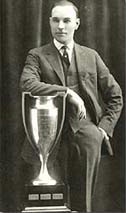 The 1924–25 season
, the first year of NHL expansion to the United States, saw major changes in Ottawa's lineup. Jack Darragh
retired and had died from appendicitis months after his final game. Making his debut in goal for Ottawa was Alex Connell
, replacing Benedict. Replacing Broadbent was Hooley Smith
, who had played for Canada in the 1924 Olympics. Lionel Hitchman was sold to the expansion Boston Bruins
and replaced by Ed Gorman
. It was also the debut season of Frank Finnigan
. Off the ice, Gorman and Ahearn squabbled over ownership. In January 1925, during the season, Gorman sold his share of the Senators to Ahearn and left the Senators organization, later joining the expansion New York Americans
.
With all the changes, the Senators slipped to fourth place in the standings. Cy Denneny continued his scoring ways, placing fourth in league scoring with 28 goals in 28 games. Frank Nighbor became the first winner of the Lady Byng Trophy for gentlemanly play, donated by Marie Evelyn Moreton (Lady Byng), wife of Julian Byng, 1st Viscount Byng of Vimy
, who was Governor General of Canada from 1921 to 1926. Nighbor received the trophy personally from Lady Byng during a presentation at Rideau Hall
. Nighbor won the trophy in 1925–26 and 1926–27 as well.
The NHL expanded further into the United States in the 1925–26 season
with the new New York Americans and Pittsburgh Pirates
. Ottawa won the league title, led by Alex Connell in goal, who recorded 15 shutouts in 36 games, and Cy Denneny, who scored 24 goals. The team received a bye to the playoff finals. However, the Montreal Maroons won the two-game total goals series with scores of 1–1 and 1–0; former Senator Clint Benedict got the shutout. The Maroons went on to win the Stanley Cup against Victoria. The season also marked the debut of Hec Kilrea
.
The 1926–27 season
saw the NHL divided for the first time into two divisions, and the made the playoffs, winning the Canadian Division title. They advanced to the semi-finals and defeated the Canadiens, 4–0, and 1–1, en route to facing the Boston Bruins
for the Cup. In the first series for the Stanley Cup with only NHL opponents, Ottawa defeated Boston with scores of 0–0, 3–1, 1–1 and 3–1, with the final game taking place in Ottawa; it would be the Senators' final Stanley Cup championship. Alex Connell led the way in goal, allowing only three goals in the four games. Cy Denneny led the way in scoring with four goals, including the Cup winner. The Senators won three trophies as NHL champions, along with the Stanley Cup, the club also won two other trophies, the O'Brien Cup and the Prince of Wales Trophy
, the last time the trophies were given to winners of the NHL championship. They would be given out to divisional winners in the following season. After the series, the Senators players received a parade in Ottawa, a civic banquet and an 18–carat gold ring with fourteen small diamonds in the shape of an 'O'. See the article 1927 Stanley Cup Finals
.
, which was the league's second-smallest market. The team sought financial relief from the league as early as 1927. Despite winning the Stanley Cup, the Senators were already in financial trouble, having lost $50,000 for the season. The league's expansion to the United States did not benefit the Senators. Attendance was low for games against the expansion teams, which provided a poor gate at home. There were also higher travel costs for away games, although the American arenas were larger. This fact was the basis for attempts to increase revenues, as the team played "home" games in other cities.
In the 1927-28 season, the Senators played two "home" games in Detroit, collecting the bulk of the gate receipts (thus allowing them to actually turn a profit for that season), while Jack Adams retired to become the coach and general manager of the Detroit Cougars
. The brightest note from the campaign was goaltender Alex Connell's play, in which he set a NHL record (unsurpassed as of 2010) of six consecutive shutouts, a shutout run of 460 minutes and 49 seconds.
Taking advantage of a spending spree by the Montreal Maroons at the onset of the 1928-29 season, the Senators sold their star right wing Hooley Smith
to the Maroons for $22,500 and the return of former star Punch Broadbent
. Also for cash, the team sent long-time member Cy Denneny to the Bruins. The club further repeated the scheme of playing two "home" games in Detroit en route to an undistinguished campaign in which they missed the playoffs for only the third time in the NHL's history.
In the 1929–30 season
, with cash still hemorrhaging, the team transferred two scheduled home games to Atlantic City (one each against the New York Rangers
and New York Americans
), two to Detroit, and one to Boston. The Senators rallied, however, to make the playoffs for a final time, finishing third in the Canadian Division. The Senators faced off against the New York Rangers
in a two-game total-goals series. In the last NHL playoff game in Ottawa until 1996, the Senators tied the Rangers 1–1 on March 28, 1930, but lost game two in New York 5–1 to lose the series 6 goals to 2. The season also marked the debut of future star Syd Howe
with the Senators while long-time star Frank Nighbor was sold to Toronto.
By the 1930–31 season
, the team was openly selling players to make ends meet. Star defenceman King Clancy was sold to Toronto for an unprecedented $35,000 and two players on October 11, 1930. The team fell into last place for the first time since 1898. In 1931, a potential deal arose with the owners of Chicago Stadium
, including grain magnate James E. Norris, who wanted to move the team to Chicago, but the deal was vetoed by Chicago Black Hawks owner Frederic McLaughlin
who did not want another team in his territory. Norris bought the bankrupt Detroit Falcons instead and turned them into the Detroit Red Wings
.
The Senators and the equally strapped Philadelphia Quakers
asked the NHL for permission to suspend operations for the 1931–32 season in order to rebuild their fortunes. The league granted both requests on September 26, 1931. Ottawa received $25,000 for the use of its players, and the NHL co-signed a Bank of Montreal
loan of $28,000 to the club. The Senators seriously considered moving to Toronto, as Conn Smythe
desired a second tenant for the new Maple Leaf Gardens
. However, they balked when Smythe wanted a $100,000 guarantee, with a 40%/60% split of revenues.
Returning after a one-year hiatus and despite the return of players such as Cooney Weiland
, Finnigan, Howe and Kilrea, the Senators finished with the worst record in the league in the two seasons that followed. Attendance was poor, the club only drawing well when the league's other three Canadian teams came to town. Frank Finnigan recalled that they frequently played home games before small crowds of 3,500 to 4,000. 1932–33
saw the return of Cy Denneny to Ottawa as coach. He would last only the one season. In June 1933, former captain Harvey Pulford
was given an option to buy the team and move it to Baltimore
, but the option was never exercised. In October 1933, Kilrea was sold for $10,000 to Toronto.
In December 1933, rumours surfaced that the Senators would merge with the equally strapped New York Americans
; however, this was denied by Ottawa club president Frank Ahearn, who had sought financial help from the league. The team played the full 1933–34 season
, transferring one home game to Detroit. Near the end of the season, reports surfaced that the club had entered into a deal with St. Louis "interests" to move the club. The team lost its last home game by a score of 3–2 to the Americans on March 15, 1934, before a crowd of 6,500. The Senators had lent Alex Connell to the Americans when the Americans' goalie Worters was hurt, and he turned in a "sensational performance" for the visitors. The home crowd was in a "throwing mood" and "carrots, parsnips, lemons, oranges and several other unidentified objects were thrown onto the ice continuously for no reason whatsoever." The final game of the season was a 2–2 tie with the Maroons at the Montreal Forum
on March 18, 1934.
and operated as the St. Louis Eagles
. The Eagles played only one season, finishing last again. They suspended operations after the season, never to return. Flash Hollett
was the last member of the Senators to play in the NHL, retiring with the Detroit Red Wings in 1946.
The city of Ottawa
did not have an NHL franchise again until the new Ottawa Senators
franchise was awarded for the 1992–93 season. The NHL presented the Senators with a "certificate of reinstatement" commemorating Ottawa's return to the league, and the current Senators honour the original franchise's 11 Stanley Cups. However, records for the two teams are kept separately. Frank Finnigan, the last surviving member of the original Senators' last Stanley Cup winner, played a key role in the drive to win an expansion franchise for Ottawa. He was slated to drop the puck in a ceremonial face-off for the new franchise's first game, but died a year before that game took place. The new Senators honoured Finnigan by retiring his #8 jersey.
After the NHL franchise relocated, the Senators name was revived for a senior amateur club
in the Montreal Group of the Quebec Amateur Hockey Association (QAHA), beginning in the 1934–35 season. One player, Eddie Finnigan
, played for both the Senators and the Eagles in the 1934–35 season. The 'Senior Senators' renewed the rivalry with Montreal-area senior amateur teams such as the Montreal Victorias
that the old Senators had played in the years prior to turning openly professional. Later, Tommy Gorman
bought the team and helped to found the Quebec Senior Hockey League. Winning the Allan Cup
in 1949, the senior Senators continued until December 1954, finally ending the Senators' storied 71 year history.
The first reference to the nickname of Senators was in a game report of the Ottawa Journal
on January 7, 1901. This nickname was used occasionally within Ottawa, but the club continued to be known as the Ottawa Hockey Club. In 1909, a separate Ottawa Senators pro team existed in the Federal League. Ottawa newspapers referred to that club as the Senators, and the Ottawa HC as 'Ottawa' or 'Ottawa Pro Hockey Club'. The Globe first mentions the Senators in the article entitled 'Quebec defeated Ottawa' on December 30, 1912. This became the official nickname, and was the only name used in descriptions of the club in NHL play. The nickname is not derived from Greek or Roman antiquity.
' or 'winged legs' logo of the OAAA, which can be described as a "running wheel". The jerseys were solid white with the club logo in red. The players wore knee-length white pants with black stockings, as shown in the 1891 team photo.
In 1896, the club first adopted the "barber-pole" design, with which the team became synonymous. The design was simple: strong horizontal stripes of red, black and white. Players wore white pants and red, white and black striped stockings. The basic design would be used for the rest of the organization's existence, except for one season, 1909–10, where the stripes were vertical and Montreal fans nicknamed the team derisively as 'les suisses', a slang term for chipmunk
. The "barber-pole" uniform was later adopted by the Ottawa 67's
junior ice hockey team.
No logo was present on the jersey at first, and until 1930 logos were not used for more than a year at a time. During World War I, the club adopted a logo of flags to show allegiance to the war effort, as shown in the 1915 photo. After each Stanley Cup win, the club affixed a badge or logo stating "World Champions". In the 1929–30 season
, the club added the "O" logo to the chest of the jersey.
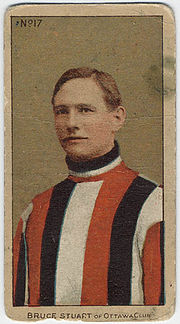
In 1918, Rosenthal was forced out by Dey in a complex scheme. Dey was negotiating, as owner of The Arena
, with both Rosenthal on behalf of the Senators and Percy Quinn
(who held an option to purchase the Quebec NHA club) on behalf of a proposed new professional league over exclusive rights to the Arena for professional hockey. In a plan to derail the proposed new league, Dey maintained publicly that he had reserved the Arena for Quinn's proposed league when, in fact, he had not cashed a cheque received from Quinn to reserve an option on the Arena. Rosenthal, believing the club could no longer play at the Arena, attempted to find alternate arrangements for the club, including refurbishing Aberdeen Pavilion
, but was unsuccessful. Dey purchased Rosenthal's share of the club on October 28, 1918, and Rosenthal resigned from the club. Quinn filed a lawsuit against Dey for his deception but it was dismissed. Quinn would get further action from the NHL, as the NHL suspended Quinn's franchise and took over its players' contracts.
In 1923, Dey retired after selling his ownership interest to Gorman and new investor Frank Ahearn
. Ahearn and Gorman had an uneasy partnership and at one point Gorman was going to buy out Ahearn. By January 1925, the deal was nearly finalized when Gorman backed out of the deal. Instead, Ahearn bought Gorman's interest in the club for $35,000 and a share of the Connaught Park Racetrack and Gorman moved on to New York to manage the New York Americans. In 1929, Ahearn sold the club to the Ottawa Auditorium corporation for $150,000, financed by a share issue. William Foran
, the Stanley Cup trustee, became president of the Club. As the Auditorium did not meet its payments, Ahearn resumed a share of the club in 1931.
In 1931, a dispute arose between Foran, in his role as Stanley Cup trustee, and the NHL. The American Hockey League
had asked for a Stanley Cup challenge against the champions of the NHL. Foran had agreed to the challenge and ordered the NHL to comply, but the NHL refused to play the challenge. Foran was fired from his position as Senators' president and was replaced by Redmond Quain.
While the Ottawa Auditorium owned the hockey club, it was heavily indebted to Frank Ahearn and his father, and tried to clear its debt. In December 1930, the club was put up for sale for $200,000 under conditions it stay in Ottawa. The best local bid was $100,000, while a bid to move the club to Chicago was made for $300,000, ultimately denied by the Chicago Blackhawks
ownership. Later, the Auditorium tried to relocate the team to Baltimore
under the ownership of former player Harvey Pulford. A possible relocation to Toronto was also explored, but in the end, no sales occurred.
In 1934, the club's NHL franchise was transferred to St. Louis, although the Association continued its ownership of the franchise and player contracts as well as the senior club. On October 15, 1935, the NHL bought back the franchise and players' contracts for $40,000 and suspended its operations again. Under the agreement, the NHL paid for the players and took back possession of the franchise. If the franchise was resold, the proceeds would go to the Ottawa Hockey Association.
In July 1936, the Auditorium bond-holders foreclosed on the arena and it was put under the control of the Royal Securities Corporation. The senior club was sold in 1937 to James MacCaffery, the owner of the Ottawa Rough Riders
football team. Former owner Tommy Gorman returned to Ottawa in 1944, when he purchased the club and the Auditorium. He operated the senior team until December 1954, when he shut down the team over the "rise of hockey on television."
One custom of the Ottawa fans towards opposition teams was to throw lemons. Cyclone Taylor, on his first visit back to Ottawa after signing with Renfrew, was pelted with lemons as well as a bottle.
Source:
Ice hockey
Ice hockey, often referred to as hockey, is a team sport played on ice, in which skaters use wooden or composite sticks to shoot a hard rubber puck into their opponent's net. The game is played between two teams of six players each. Five members of each team skate up and down the ice trying to take...
team based in Ottawa
Ottawa
Ottawa is the capital of Canada, the second largest city in the Province of Ontario, and the fourth largest city in the country. The city is located on the south bank of the Ottawa River in the eastern portion of Southern Ontario...
, Canada
Canada
Canada is a North American country consisting of ten provinces and three territories. Located in the northern part of the continent, it extends from the Atlantic Ocean in the east to the Pacific Ocean in the west, and northward into the Arctic Ocean...
which existed from 1883 to 1954. The club was the first hockey club in Ontario, a founding member of the National Hockey League
National Hockey League
The National Hockey League is an unincorporated not-for-profit association which operates a major professional ice hockey league of 30 franchised member clubs, of which 7 are currently located in Canada and 23 in the United States...
(NHL) and played in the NHL from 1917 until 1934. The club, which was officially the Ottawa Hockey Club (Ottawa HC), was known by several nicknames, including the Generals in the 1890s, the Silver Seven from 1903 to 1907 and the Senators dating from 1908.
Generally acknowledged by hockey historians as one of the greatest teams of the early days of the sport, the club won numerous championships, starting with the 1891 to 1893 Ontario championships. Ottawa HC played in the first season during which the Stanley Cup
Stanley Cup
The Stanley Cup is an ice hockey club trophy, awarded annually to the National Hockey League playoffs champion after the conclusion of the Stanley Cup Finals. It has been referred to as The Cup, Lord Stanley's Cup, The Holy Grail, or facetiously as Lord Stanley's Mug...
was challenged in 1893, and first won the Cup in 1903, holding the championship until 1906 (the Silver Seven years). The club repeated its success in the 1920s, winning the Stanley Cup in 1920, 1921, 1923 and 1927 (the Super Six years). In total, the club won the Stanley Cup eleven times, including challenges during two years it did not win the Cup for the season. In 1950, Canadian sports editors selected the Ottawa HC/Senators as Canada's greatest team in the first half of the 20th century.
The club was one of the first organized clubs in the early days of the sport of ice hockey, playing in the Montreal Winter Carnival ice hockey tournaments
Montreal Winter Carnival ice hockey tournaments
The Montreal Winter Carnival ice hockey tournaments were a series of annual ice hockey tournaments held in the 1880s in conjunction with the Montreal Winter Carnival, in Montreal, Quebec, Canada...
in the early 1880s and founding the Amateur Hockey Association of Canada and the Ontario Hockey Association
Ontario Hockey Association
The Ontario Hockey Association is the governing body for the majority of Junior and Senior level ice hockey teams in the Province of Ontario. The OHA is sanctioned by the Ontario Hockey Federation along with the Northern Ontario Hockey Association. Other Ontario sanctioning bodies along with the...
. Along with the rise of professionalism in ice hockey in the first decade of the 1900s, the club changed to a professional team and were founding members of the National Hockey Association
National Hockey Association
The National Hockey Association was a professional ice hockey organization with teams in Ontario and Quebec, Canada. It is the direct predecessor organization to today's National Hockey League...
(NHA) and its successor, the National Hockey League. The club competed in the NHL until the 1933–34 season, when it relocated the NHL franchise to St. Louis, Missouri
St. Louis, Missouri
St. Louis is an independent city on the eastern border of Missouri, United States. With a population of 319,294, it was the 58th-largest U.S. city at the 2010 U.S. Census. The Greater St...
due to financial difficulties to become the St. Louis Eagles
St. Louis Eagles
The St. Louis Eagles were a professional ice hockey team and a former member of the National Hockey League based in St. Louis, Missouri. The Eagles existed for only one year, playing in the 1934–35 NHL season....
. The organization continued the Senators as a senior amateur, and later semi-professional, team in Quebec senior men's leagues until 1954.
Early amateur era (1883–1902)
The Ottawa Hockey Club (Ottawa HC) was founded by a small group of like-minded hockey enthusiasts. A month after witnessing games of hockey at the 1883 Montreal Winter Carnival, Halder Kirby, Jack Kerr and Frank JenkinsFrank Maurice Stinson Jenkins
Frank Maurice Stinson Jenkins was an early amateur ice hockey player. He was a founder, and the first captain of the Ottawa Hockey Club of 1883...
met and founded the club. Being the first organized ice hockey club in Ottawa, and also the first in Ontario
Ontario
Ontario is a province of Canada, located in east-central Canada. It is Canada's most populous province and second largest in total area. It is home to the nation's most populous city, Toronto, and the nation's capital, Ottawa....
, the club had no other clubs to play that season. The only activities that winter were practices at the "Royal Rink" starting on March 5, 1883.
The club first participated competitively at the 1884 Montreal Winter Carnival ice hockey tournament (considered the Canadian championship at the time) wearing red and black uniforms. Future Ottawa mayor Nelson Porter
Nelson D. Porter
Nelson Davis Porter was mayor of Ottawa, Canada from 1915 to 1916.He was born in Montreal in 1863 and came to Ottawa with his family in 1870. He worked as an insurance and real estate agent...
is recorded as the scorer of the club's first-ever goal, at the 1884 Carnival. Frank Jenkins was the first captain of the team; he later became the president of the Hockey Club in 1891 and of the Amateur Hockey Association of Canada (AHA or AHAC) in 1892.
For the 1885 season, the club adopted gold and blue as its colours and returned to the Montreal tournament. Ottawa earned its first-ever victory at the tournament over the Montreal Victorias
Montreal Victorias
The Victoria Hockey Club of Montreal, Quebec, Canada was an early men's amateur ice hockey club. Its date of origin is ascribed to either 1874, 1877 or 1881, making it either the first or second organized ice hockey club after McGill University. The club played at its own rink, the Victoria Skating...
, but lost its final match to the Montreal Hockey Club
Montreal Hockey Club
The Montreal Hockey Club of Montreal, Quebec, Canada was a senior-level men's amateur ice hockey club, organized in 1884. They were affiliated with Montreal Amateur Athletic Association and used the MAAA 'winged wheel' logo. The team is notable for winning the first Stanley Cup in 1893, and in a...
(Montreal HC) to place second in the tournament. The 1886 Montreal tournament was cancelled due to an outbreak of smallpox
Smallpox
Smallpox was an infectious disease unique to humans, caused by either of two virus variants, Variola major and Variola minor. The disease is also known by the Latin names Variola or Variola vera, which is a derivative of the Latin varius, meaning "spotted", or varus, meaning "pimple"...
and the club would not play an outside match again until 1887.
Formation of the AHAC
On December 8, 1886, the first championship league, the Amateur Hockey Association of Canada was founded in Montreal. It was composed of several clubs from Montreal plus a Quebec City club and the Ottawa club. Ottawa's Thomas D. GreenThomas D. Green
Thomas Daniel Green was an early Canadian amateur ice hockey player, ice hockey executive, engineer and surveyor. He was a Mohawk, possibly the first Mohawk accredited land surveyor in Canada...
was named the first president of the league. The league did not have a set schedule, and instead games were played in "challenge series", whereby a team held the championship and entertained challengers until the end of the season, a format the league employed until 1893. Under the format, Ottawa lost the one challenge it played in that first 1887 season
1887 AHAC season
The 1887 AHAC season was the inaugural season of the Amateur Hockey Association of Canada. Play was in challenges. The Montreal Crystals won the final challenge of the season to win the Canadian championship and first league championship.-League Business:...
to the Montreal Victorias
Montreal Victorias
The Victoria Hockey Club of Montreal, Quebec, Canada was an early men's amateur ice hockey club. Its date of origin is ascribed to either 1874, 1877 or 1881, making it either the first or second organized ice hockey club after McGill University. The club played at its own rink, the Victoria Skating...
.
After that season, Ottawa HC became inactive. The Royal Rink, which had been their primary facility, had been converted to a roller skating rink, and ice rink facilities were at a shortage. This changed with the opening of the Rideau Skating Rink
Rideau Skating Rink
The Rideau Skating Rink was an indoor skating and curling rink located in Ottawa, Ontario, Canada. It was one of the first indoor skating rinks in Canada, opened in January 1889...
in February 1889. One of the principal organizers in the restarting of the team was Ottawa Journal
Ottawa Journal
The Ottawa Journal was a daily broadsheet newspaper published in Ottawa, Ontario from 1885 to 1980.It was founded in 1885 by A. Woodburn as the Ottawa Evening Journal. Its first editor was John Wesley Dafoe who came from the Winnipeg Free Press. In 1886, it was bought by Philip Dansken Ross.The...
publisher P. D. Ross
Philip Dansken Ross
Philip Dansken Ross was a Canadian journalist, newspaper publisher, sportsman and ice hockey pioneer builder....
, who also played on the team. Returning as captain was Frank Jenkins, and the other players were Halder Kirby, Jack Kerr, Nelson Porter, Ross, George Young, Weldy Young
Weldy Young
Weldon C. Young was a Canadian businessman and athlete. Young was an ice hockey player for the Ottawa Hockey Club, playing in its founding years in the 1880s and in the 1890s. Young later became a member of the Dawson City Nuggets which played against Ottawa in the 1905 Stanley Cup challenge...
, Thomas D. Green, William O'Dell, Tom Gallagher, Albert Low
Albert Peter Low
Albert Peter Low was a Canadian geologist, explorer and athlete. His explorations of 1893–1895 were important in declaring Canada's sovereignty over the Arctic, and eventually defining the border between Quebec and Labrador....
and Henry Ami. In 1889, the club played only one match against an outside club, an exhibition at the Rideau rink against the Montreal HC 'second' team.
In November 1889, the Ottawa Amateur Athletic Club (OAAC) was opened at the corner of today's Elgin
Elgin Street (Ottawa)
Elgin Street is a street in the Golden Triangle of Ottawa, Ontario, Canada. Originally named Biddy's Lane, it was later named after Lord Elgin....
and Laurier Streets on the site of today's Lord Elgin Hotel
Lord Elgin Hotel
The Lord Elgin Hotel is a prominent hotel in downtown Ottawa, Canada with 355 guest rooms, located at 100 Elgin Street at Laurier Avenue, across from Confederation Park...
. The Club building would also be the Hockey Club's headquarters. The OAAC was affiliated with the Ottawa Amateur Athletic Association (OAAA), and the Hockey Club through the affiliation also became OAAA members. When the club began outside competition again in 1889–90, it was with new sweaters of white with black stripes and the OAAA red "triskelion" logo. It was during this period of affiliation with the OAAC, that the club would become known by the nickname "Generals", attributed to the club's insignia. The club is also referred to as the "Capitals" in literature, although there was a rival Ottawa Capitals
Ottawa Capitals
The Ottawa Capitals were an early amateur senior men's ice hockey club playing in Ottawa, Ontario, Canada from the 1890s until 1920. The club would challenge for the Stanley Cup in 1897, but abandon its challenge after one game, after it lost 15–2. It would later precipitate the breakup of the...
club organized by the Capital Amateur Athletics Association active at the time.
1890 Ottawa Hockey Club season
The 1890 Ottawa Hockey Club season was the club's fifth season of play. Although the club was now established at the Rideau Skating Rink, the club played only two games against outside teams and did not participate in championship play.-Team business:...
, Ottawa HC played two competitive games but this was to increase greatly the next season. The 1890–91 season
1890–91 Ottawa Hockey Club season
The 1890–91 Ottawa Hockey Club season was the club's sixth season of play. The club would have an outstanding record, winning 13 and losing 1. The club would play in the Ontario Hockey Association in the OHA's first season and would win its championship, the Colby Cup, against Amateur Hockey...
saw the club play 14 games, playing in three leagues. Ottawa HC was a founding member of two new leagues, the Ottawa City Hockey League
Ottawa City Hockey League
The Ottawa City Hockey League was an amateur ice hockey league with junior, intermediate and senior level men's teams in Ottawa, Canada dating from 1890. It is considered the second ice hockey league to form in Canada. The senior league operated until 1945 and the junior league operated until 1957...
(OCHL) and the Ontario Hockey Association
Ontario Hockey Association
The Ontario Hockey Association is the governing body for the majority of Junior and Senior level ice hockey teams in the Province of Ontario. The OHA is sanctioned by the Ontario Hockey Federation along with the Northern Ontario Hockey Association. Other Ontario sanctioning bodies along with the...
(OHA) and also rejoined the AHAC. Ottawa HC won the Ottawa and Ontario championships, and two games against AHAC opponents, but lost to the AHAC champion Montreal HC in its one challenge for the championship.
OHA championships
The team was the OHA champion for that league's first three years. The first championship was played on March 7, 1891, at the Rideau rink and was won 5–0 by Ottawa over Toronto St. George's. The 1891 championship was the only OHA final played in Ottawa, as Ottawa played the 1892 final in Toronto, defeating Osgoode HallOsgoode Hall
Osgoode Hall is a landmark building in downtown Toronto constructed between 1829 and 1832 in the late Georgian Palladian and Neoclassical styles. It houses the Ontario Court of Appeal, the Divisional Court of the Superior Court of Justice, and the Law Society of Upper Canada...
4–2, and in 1893 the Toronto Granites
Toronto Granites
The Toronto Granites were an amateur senior ice hockey team from Toronto, Ontario. The Granites were Allan Cup champions in 1922 and 1923. They were chosen to represent Canada at the 1924 Winter Olympics in Chamonix, France...
defaulted by not appearing for the championship match scheduled for Ottawa. The club resigned from the OHA in February 1894 after the OHA refused the club's demand to have the 1894 final in Ottawa and ordered Ottawa HC to play the final in Toronto. The dispute caused a permanent schism between Ottawa area teams and the Ontario Hockey Association. As of 2010, Ottawa and area teams remain unaffiliated with the OHA; the official association under Hockey Canada
Hockey Canada
Hockey Canada, formally known as the Canadian Hockey Association, is the national governing body of ice hockey in Canada and is a member of the International Ice Hockey Federation. Hockey Canada controls a vast majority of ice hockey in Canada, with a few exceptions...
is the Ottawa District Hockey Association
Ottawa District Hockey Association
The Ottawa District Hockey Association is the governing body of a variety of ice hockey Junior leagues and a minor hockey system based out of the Greater Ottawa area and Southwestern Quebec...
, a descendant of the OCHL.
It was at a dinner to honour the 1892 OHA champions
1891–92 Ottawa Hockey Club season
The 1891–92 Ottawa Hockey Club season was the club's seventh season of play. The Club would play in the Amateur Hockey Association of Canada, the Ontario Hockey Association and inter-city play. Ottawa would win their second straight OHA championship...
at the Russell Hotel that the Governor General, Lord Stanley, announced his new Dominion Challenge Trophy, now known as the Stanley Cup
Stanley Cup
The Stanley Cup is an ice hockey club trophy, awarded annually to the National Hockey League playoffs champion after the conclusion of the Stanley Cup Finals. It has been referred to as The Cup, Lord Stanley's Cup, The Holy Grail, or facetiously as Lord Stanley's Mug...
, for the Canadian champions. Former player and president of the club, P. D. Ross, was selected by Stanley to be a trustee of the Cup.
Re-entry into the AHAC
Ottawa HC did not win a game in its return to AHAC challenge play in 1890–911891 AHAC season
The 1891 Amateur Hockey Association of Canada season saw the Montreal Hockey Club win the league and Canadian championship for the fourth straight season. Ontario launched the Ontario Hockey Association as the popularity of the sport spread west...
, but in the next season of AHAC play in 1891–92
1892 AHAC season
The 1892 Amateur Hockey Association of Canada season lasted until March 7. The championship changed hands twice during the season. Ottawa defeated the Montreal Hockey Club in January and held the championship until March, defending it six times before Montreal won it in the final challenge of the...
the club won the league championship, and held it for most of the season, from January 10 until March 7, 1892. The club took the championship from Montreal HC, who were previously undefeated, and won five straight games before Montreal won the championship back by a 1–0 score in the last challenge of the season. Montreal's win in the final challenge was their only win of the season and their only one in four games against Ottawa.
Lord Stanley, who often attended Ottawa HC games, felt the loss of the title after holding it all season was an unsuitable way to determine the championship. In the letter announcing the Stanley Cup
Stanley Cup
The Stanley Cup is an ice hockey club trophy, awarded annually to the National Hockey League playoffs champion after the conclusion of the Stanley Cup Finals. It has been referred to as The Cup, Lord Stanley's Cup, The Holy Grail, or facetiously as Lord Stanley's Mug...
, Stanley suggested that the AHAC start a 'round-robin' type regular season format, which the AHAC implemented in the following season of 1892–93
1893 AHAC season
The 1893 Amateur Hockey Association of Canada season lasted from January 7 until March 17. The Montreal Hockey Club was the league and Canadian champion for the sixth season in a row and was awarded the Stanley Cup. They were the first winners of the Cup and did not have to challenge for...
. The key match-up in that season for Ottawa was a loss in the opening game of the season against the Montreal Victorias
Montreal Victorias
The Victoria Hockey Club of Montreal, Quebec, Canada was an early men's amateur ice hockey club. Its date of origin is ascribed to either 1874, 1877 or 1881, making it either the first or second organized ice hockey club after McGill University. The club played at its own rink, the Victoria Skating...
on January 7, 1893, as Ottawa split its season series with eventual winner Montreal HC, both teams otherwise winning all of their games. This loss provided the one game margin in the standings that led to Lord Stanley awarding the initial Cup to Montreal HC.
In 1893–1894
1894 AHAC season
The 1894 Amateur Hockey Association of Canada season lasted from January 5 until March 10. Montreal HC would win the league and Canadian championship for the seventh season in a row.-Executive:* President - W. Jack, Victorias...
, Ottawa HC finished in a four-way tie for first in the AHAC standings. A playoff was arranged in Montreal for the championship between Ottawa, Montreal HC and Montreal Victorias (the other first place club, Quebec, having dropped out of the playoff). These games would be the first Stanley Cup playoff games ever played. As the 'away' team, Ottawa was given a bye to the final game. On March 23, 1894, at the Victoria Rink
Victoria Skating Rink
The Victoria Skating Rink was an indoor skating rink located in Montreal, Quebec, Canada, which opened in 1862. The building was used during winter seasons for pleasure skating, ice hockey and skating sports on a natural ice rink. In summer months, the building was used for various other events,...
, Ottawa and Montreal HC played for the championship. Ottawa scored the first goal, but Montreal would score the next three to win the game 3–1. Ottawa captain Weldy Young fainted from exhaustion at the end of the game.
Ottawa Rough Riders
The Ottawa Rough Riders were a Canadian Football League team based in Ottawa, Ontario, founded in 1876. One of the oldest and longest lived professional sports teams in North America, the Rough Riders won the Grey Cup championship nine times. Their most dominant era was the 1960s and 1970s, a...
, also an OAAA affiliate.
In 1898, the AHAC dissolved over the admission of the intermediate-level team Ottawa Capitals
Ottawa Capitals
The Ottawa Capitals were an early amateur senior men's ice hockey club playing in Ottawa, Ontario, Canada from the 1890s until 1920. The club would challenge for the Stanley Cup in 1897, but abandon its challenge after one game, after it lost 15–2. It would later precipitate the breakup of the...
of the rival Capital Amateur Association to the AHAC by a vote of the league executive. The Capitals had won the intermediate championship of the AHAC and were eligible to join the senior ranks. After they were outvoted by the intermediate-level teams of AHAC which wanted to promote the Capitals to the senior-level, the senior-level Ottawa, Montreal HC, Montreal Victorias and Quebec clubs left the AHAC and formed the Canadian Amateur Hockey League
Canadian Amateur Hockey League
The Canadian Amateur Hockey League was an early men's amateur hockey league founded in 1898, replacing the organization that was formerly the Amateur Hockey Association of Canada before the 1898–99 season. The league existed for seven seasons, folding in 1905 and was itself replaced by the Eastern...
(CAHL), shutting out the Capitals.
In 1901, the club won the CAHL league regular season title, its first league championship since winning the OHA in 1893. It wished to challenge the Stanley Cup champion Winnipeg Victorias
Winnipeg Victorias
The Winnipeg Victorias were a former amateur senior-level men's amateur ice hockey team in Winnipeg, Manitoba, organized in 1889. They played in the Manitoba Hockey Association in the late 19th and early 20th centuries...
at first, but chose not to after deliberating for a week after the season. According to hockey historian Charles L. Coleman, it was due to the "lateness of the season".
Notable players of this period included Albert Morel and Fred Chittick in goal, leaders of the league several times in goaltending, and future Hall of Famers Harvey Pulford
Harvey Pulford
Ernest Harvey Pulford was a Canadian all-around athlete at the turn of the 20th century, winning national championships in ice hockey, lacrosse, football, boxing, paddling and rowing. He won four Stanley Cups with the Ottawa Hockey Club and championships or tournaments in every sport in which he...
, Alf Smith
Alf Smith
Alfred Edward Smith was a Canadian professional ice hockey forward who played for the Ottawa Senators, and Kenora Thistles. He had two brothers who played senior-level hockey Harry Smith and Tommy Smith...
, Harry Westwick
Rat Westwick
Harry "Rat" Westwick was a Canadian athlete in ice hockey and lacrosse. Westwick, nicknamed the Rat by a journalist, is most noted for his play with the Ottawa Hockey Club, nicknamed the Silver Seven during his day which won and defended the Stanley Cup from 1903 until 1906...
and brothers Bruce Stuart
Bruce Stuart
Bruce Stuart was a Canadian amateur and professional ice hockey forward who played for the Quebec Bulldogs, Ottawa Senators and Montreal Wanderers from 1899 to 1911...
and Hod Stuart
Hod Stuart
William Hodgson "Hod" Stuart was a Canadian professional ice hockey cover-point who played nine seasons for several teams in different leagues. He also played briefly for the Ottawa Rough Riders football team...
. It was during this period that the nickname Senators was first used; however, from 1903 to 1906, the team is better known as the Silver Seven.
Silver Seven era (1903–1906)
Dawson City Nuggets
The Dawson City Nuggets were a hockey team from Dawson City, Yukon Territory, Canada that challenged the reigning champion Ottawa Hockey Club, aka "The Silver Seven," in January 1905, for the Stanley Cup. They suffered the most lopsided single-game defeat in the history of Stanley Cup...
, he scored 14 goals in a 23–2 win. He retired in 1906 at the age of 23.
In the 1903 CAHL season
1903 CAHL season
The 1903 Canadian Amateur Hockey League season lasted from January 3 until February 28. Teams played an eight game schedule. Ottawa and Montreal Victorias tied for the league championship with records of six wins and two losses.-Executive:...
, Ottawa and the Montreal Victorias
Montreal Victorias
The Victoria Hockey Club of Montreal, Quebec, Canada was an early men's amateur ice hockey club. Its date of origin is ascribed to either 1874, 1877 or 1881, making it either the first or second organized ice hockey club after McGill University. The club played at its own rink, the Victoria Skating...
both finished in first place with 6–2 records. The top scorers were the Victorias' Russell Bowie
Russell Bowie
Russell G. "Russ, Dubbie" Bowie was a Canadian ice hockey player generally regarded as one of the best players of the pre-NHL era of the sport...
, who scored seven goals in one game and six in another, and McGee, whose top performance saw him score five goals in a game. The two clubs faced off in a two-game total goals series to decide the league championship and Stanley Cup. The first game, played in Montreal on slushy ice that made it a desperate struggle to score, ended 1–1. The return match in Ottawa, witnessed by three thousand fans, was on ice coated with an inch of water. The conditions did not hinder Ottawa, as they won 8–0, with McGee scoring three goals and the other five shared among the three Gilmour brothers, Dave (3), Suddy (1) and Bill (1), to win their first Cup. This started a period in which the team held the Stanley Cup and defeated all challengers until March 1906.
For that Stanley Cup win, each of the team's players was given a silver nugget by team executive Bob Shillington
Robert Taylor Shillington
Robert "Bob" Taylor Shillington was a Canadian politician, mine owner, druggist and ice hockey executive. Shillington was a member of the provincial legislature in the province of Ontario, representing the Timiskaming riding, first elected in 1908.Born in Merival, a rural village now located...
, an Ottawa druggist and mining investor. He gave them nuggets instead of money since the players were still technically amateurs and to give them money would have meant disqualification from the league. In a 1957 interview, Harry Westwick recalled that at the presentation "One of the players said 'We ought to call ourselves the Silver Seven.' and the name caught on right there." (At the time, hockey teams iced seven men—a goaltender, three forwards, two defencemen and a rover
Rover (ice hockey)
In the late 19th and early 20th centuries, ice hockey consisted of seven positions. Along with the goaltender, two defencemen, and three forwards who remain today, a Rover was also part of the team. Unlike all the others, the rover did not have a set position, and roamed the ice at will, going...
).
The Silver Seven moved between three leagues during this time, and for a time were independent of any league. In February 1904, during the CAHL season, Ottawa resigned from the league in a dispute over the replaying of a game. The team had arrived late for a game in Montreal and the game had been called at midnight, with a tied score. The league demanded that the game be replayed. The club agreed to play only if the game mattered in the standings. The impasse led to Ottawa leaving the league. For the rest of that winter, the club played only in Cup challenge series. Quebec went on to win the championship of the league and demanded the Stanley Cup, but the Cup's trustees ruled that Ottawa still retained it. The trustees offered to arrange a challenge between Ottawa and the CAHL champion, but the CAHL refused to consider it. The next season, Ottawa joined the Federal Amateur Hockey League
Federal Amateur Hockey League
The Federal Amateur Hockey League was a Canadian men's senior-level ice hockey league that played six seasons from 1904 to 1909. The league was formed initially to provide a league for teams not accepted by the rival Canadian Amateur Hockey League . One team, the Montreal Le National, was the first...
(FAHL), winning the league championship. The club was only in the FAHL for one season, and the Montreal Wanderers
Montreal Wanderers
The Montreal Wanderers were a Canadian amateur, and later becoming a professional men's ice hockey team. The team played in the Federal Amateur Hockey League , the Eastern Canada Amateur Hockey Association , the National Hockey Association and briefly the National Hockey League . The Wanderers are...
became their new rival. For the 1906 season Ottawa, along with the Wanderers and several of the CAHL teams, formed the Eastern Canada Amateur Hockey Association
Eastern Canada Amateur Hockey Association
The Eastern Canada Amateur Hockey Association was a men's amateur, later professional ice hockey league in Canada that played four seasons. It was founded on December 11, 1905 with six clubs: four from the Canadian Amateur Hockey League and two from the Federal Amateur Hockey League, to bring...
(ECAHA), unifying the top teams into one league.
Style of play
The Silver Seven were well known for the number of injuries that they inflicted on other teams. In a Stanley Cup challenge game in 1904, the Ottawas injured seven of the nine Winnipeg players, and the Winnipeg Free Press called it the "bloodiest game in Ottawa." The next team to challenge the Ottawas, the Toronto Marlboroughs, were similar treated. According to the Toronto Globe:The style of hockey seems to be the only one known and people consider it quite proper and legitimate for a team to endeavor to incapacitate their opponents rather than to excel them in skill and speed ... slashing, tripping, the severest kind of cross-checking and a systematic method of hammering Marlboroughs on hand and wrists are the most effective points in Ottawa's style.
According to one player, the "Marlboroughs got off very easily. When Winnipeg Rowing Club played here, most of their players were carried off on stretchers." This style of hockey would continue for years to come.
Dawson City challenge
The Silver Seven participated in perhaps the most famous Stanley Cup challenge of all, that of Dawson CityDawson City Nuggets
The Dawson City Nuggets were a hockey team from Dawson City, Yukon Territory, Canada that challenged the reigning champion Ottawa Hockey Club, aka "The Silver Seven," in January 1905, for the Stanley Cup. They suffered the most lopsided single-game defeat in the history of Stanley Cup...
of Yukon
Yukon
Yukon is the westernmost and smallest of Canada's three federal territories. It was named after the Yukon River. The word Yukon means "Great River" in Gwich’in....
Territory in 1905. Organized by Joe Boyle, a Toronto-born prospector, who had struck it rich in the Yukon gold rush of 1898, Dawson City had Lorne Hanna, who had played for Brandon against Ottawa in a 1904 challenge and two former elite hockey players: Weldy Young
Weldy Young
Weldon C. Young was a Canadian businessman and athlete. Young was an ice hockey player for the Ottawa Hockey Club, playing in its founding years in the 1880s and in the 1890s. Young later became a member of the Dawson City Nuggets which played against Ottawa in the 1905 Stanley Cup challenge...
, who had played for Ottawa in the 1890s, and D. R. McLennan, who had played for Queen's College against the Montreal Victorias
Montreal Victorias
The Victoria Hockey Club of Montreal, Quebec, Canada was an early men's amateur ice hockey club. Its date of origin is ascribed to either 1874, 1877 or 1881, making it either the first or second organized ice hockey club after McGill University. The club played at its own rink, the Victoria Skating...
in an 1895 challenge. The remaining players were selected from other Dawson City clubs. Dawson City's challenge was accepted in the summer of 1904 by the Stanley Cup trustees and scheduled to start on Friday, January 13, 1905. The date of the challenge meant that Young had to travel separately to Ottawa, as he had to work in a federal election that December and would meet the club in Ottawa.
Whitehorse, Yukon
Whitehorse is Yukon's capital and largest city . It was incorporated in 1950 and is located at kilometre 1476 on the Alaska Highway in southern Yukon. Whitehorse's downtown and Riverdale areas occupy both shores of the Yukon River, which originates in British Columbia and meets the Bering Sea in...
by road, catch a train from there to Skagway, Alaska
Skagway, Alaska
Skagway is a first-class borough in Alaska, on the Alaska Panhandle. It was formerly a city first incorporated in 1900 that was re-incorporated as a borough on June 25, 2007. As of the 2000 census, the population of the city was 862...
, then catch a steamer to Vancouver
Vancouver
Vancouver is a coastal seaport city on the mainland of British Columbia, Canada. It is the hub of Greater Vancouver, which, with over 2.3 million residents, is the third most populous metropolitan area in the country,...
, B.C.
British Columbia
British Columbia is the westernmost of Canada's provinces and is known for its natural beauty, as reflected in its Latin motto, Splendor sine occasu . Its name was chosen by Queen Victoria in 1858...
and a train from there to Ottawa. On December 18, 1904, several players set out by dog sled
Dog sled
A dog sled is a sled pulled by one or more sled dogs used to travel over ice and through snow. Numerous types of sleds are used, depending on their function. They can be used for dog sled racing.-History:...
and the rest left the next day by bicycle for a 330-mile trek to Whitehorse. At first the team made good progress, but the weather turned warm enough to thaw the roads, forcing the players to walk several hundred miles. The team spent the nights in police sheds along the road. At Whitehorse, the weather turned bad, causing the trains not to run for three days and the Nuggets to miss their steamer in Skagway. The next one could not dock for three days due to the ice buildup. The club found the sea journey treacherous, and it caused seasickness amongst the team. When the steamer reached Vancouver, the area was too fogged in to dock, and the steamer docked in Seattle. The team from there caught a train to Vancouver, from which it left on January 6, 1905, arriving in Ottawa on January 11.
Despite the difficult journey, the Ottawas refused to change the date of the first game, only two days away. Ottawa arranged hospitable accommodations for the Dawson City team. The Yukoners received a huge welcome at the train station, had a welcoming dinner, and used the Ottawa Amateur Athletic Club's rooms for the duration of their stay. Young did not arrive in time to play for Dawson.
The first game was close at the halfway point, Ottawa leading Dawson three to one. In the second half, the play became violent. Norman Watt of Dawson tripped Ottawa's Art Moore, who retaliated with a stick to the mouth of Watt. Watt promptly knocked Moore out, hitting him on the head with his stick. The game ended 9–2 for Ottawa. The game left a poor taste in the mouth for the Yukoners, who complained that several goals were offside
Offside (ice hockey)
In ice hockey, the current play is offside if a player on the attacking team enters the attacking zone before the puck itself enters the zone, either carried by a teammate or sent into the attacking zone by an attacking player. If a defending player carries, passes, or otherwise intentionally sends...
.
After the game, Watt was quoted as saying "[Frank] McGee doesn't look like too much," as he had only scored once in the first game. McGee scored four goals in the first half of the second match and 10 in the second half, leading Ottawa to a 23–2 score; his 14 goals remains a record for a single game of major senior hockey. Eight of those 14 goals were scored consecutively in a span of less than nine minutes. Despite this high score, the newspapers claimed that Albert Forrest, the Dawson City goalie, had played a "really fine game", otherwise the score "might have been doubled". Ottawa celebrated by hosting Dawson at a banquet. After this, the players took the Cup and attempted to drop-kick
Drop kick
A drop kick is a type of kick in various codes of football. It involves a player dropping the ball and then kicking it when it bounces off the ground. It contrasts to a punt, wherein the player kicks the ball without letting it hit the ground first....
it over the Rideau Canal
Rideau Canal
The Rideau Canal , also known as the Rideau Waterway, connects the city of Ottawa, Ontario, Canada on the Ottawa River to the city of Kingston, Ontario on Lake Ontario. The canal was opened in 1832 as a precaution in case of war with the United States and is still in use today, with most of its...
. The stunt was unsuccessful, as the Cup landed on the frozen ice and had to be retrieved the next day.
Considering the lopsided score of the series, historians such as Paul Kitchen question why Dawson City was even granted a chance at the Cup. Dawson City had won no championships and did not belong to any recognized senior league. While team official Weldy Young knew Stanley Cup trustee P. D. Ross personally through their joint connection with the club, it may have been the political connections that Joe Boyle had with the government Interior Minister of the time, Clifford Sifton
Clifford Sifton
Sir Clifford Sifton, PC, KCMG was a Canadian politician best known for being Minister of the Interior under Sir Wilfrid Laurier...
, that got Dawson City the series.
Stanley Cup Challenge win streak
The Ottawas were the dominant team for three years:The end of the streak came in March 1906. Ottawa and the Montreal Wanderers tied for the ECAHA league lead in 1906, forcing a playoff series for the league championship and the Cup. Montreal won the first game in Montreal by a score of 9–1. In the return match, Ottawa replaced their goaltender Bouse Hutton
Bouse Hutton
John Bower "Bouse" Hutton was a Canadian ice hockey goaltender who played for the Ottawa Hockey Club. Hutton also played lacrosse as a goaltender for the Ottawa Capitals, and Canadian football as a fullback for the Ottawa Rough Riders...
and used goaltender Percy LeSueur
Percy LeSueur
Sergeant Percy St. Helier LeSueur was a Canadian senior and professional ice hockey goaltender. He was a member of the Smiths Falls Seniors for three years, with whom his performance in a 1906 Stanley Cup challenge series attracted the attention of his opponents, the Ottawa Silver Seven...
, formerly of Smiths Falls. In the return match in Ottawa, Ottawa overcame the eight-goal deficit, getting a 9–1 lead to tie the series by the midway point of the second half. Harry Smith then scored to put Ottawa ahead, only to have the goal ruled offside. It was then that Lester Patrick
Lester Patrick
Curtis Lester "The Silver Fox" Patrick born in Drummondville, Quebec, Canada, was a professional ice hockey player and coach associated with the Victoria Aristocrats/Cougars of the Pacific Coast Hockey Association , and the New York Rangers of the National Hockey League...
of the Wanderers took it upon himself, scoring two goals to win the series 12–10. This was Frank McGee's last game and he scored two goals.
The players
Besides McGee, future Hall of Fame players Billy Gilmour
Billy Gilmour
Hamilton Livingstone "Billy" Gilmour was a Canadian professional ice hockey forward who played for the Ottawa Hockey Club in the Canadian Amateur Hockey League...
, Percy LeSueur
Percy LeSueur
Sergeant Percy St. Helier LeSueur was a Canadian senior and professional ice hockey goaltender. He was a member of the Smiths Falls Seniors for three years, with whom his performance in a 1906 Stanley Cup challenge series attracted the attention of his opponents, the Ottawa Silver Seven...
, Harvey Pulford
Harvey Pulford
Ernest Harvey Pulford was a Canadian all-around athlete at the turn of the 20th century, winning national championships in ice hockey, lacrosse, football, boxing, paddling and rowing. He won four Stanley Cups with the Ottawa Hockey Club and championships or tournaments in every sport in which he...
, Alf Smith
Alf Smith
Alfred Edward Smith was a Canadian professional ice hockey forward who played for the Ottawa Senators, and Kenora Thistles. He had two brothers who played senior-level hockey Harry Smith and Tommy Smith...
and Harry Westwick
Rat Westwick
Harry "Rat" Westwick was a Canadian athlete in ice hockey and lacrosse. Westwick, nicknamed the Rat by a journalist, is most noted for his play with the Ottawa Hockey Club, nicknamed the Silver Seven during his day which won and defended the Stanley Cup from 1903 until 1906...
played for the Ottawas. Alf Smith was also the coach. Other players of the 'Seven' included Arthur Allen, Dave Finnie, Arthur Fraser, Horace Gaul, Dave Gilmour, Suddy Gilmour
Suddy Gilmour
Sutherland Campbell "Suddy" Gilmour was a Canadian amateur athlete. He was a championship ice hockey player for the Ottawa Silver Seven of the 1900s. His brothers Billy Gilmour and Dave Gilmour also played for Ottawa at the same time....
, Bouse Hutton, Jim McGee
James A. McGee
James Aloysius McGee was a Canadian athlete. He played rugby football for and was captain of the Ottawa Football Club football team in the early 1900s. He was also an ice hockey player for the Ottawa Silver Seven, a member of the Silver Seven 1903–04 Stanley Cup championship team, and a member of...
, Art Moore, Percy Sims, Hamby Shore
Hamby Shore
Samuel Hamilton Shore was a Canadian professional hockey player who played several seasons for the Ottawa Senators, notably during the "Silver Seven" era when the club was champion from 1903 until 1906...
, Charles Spittal, Frank White and Frank Wood.
The club was able to continue the streak despite the death of one of its members. Jim McGee, Frank McGee's brother, died after the 1904 season in a horseback riding accident. He was also the Ottawa Football Club's captain at the time. The funeral cortege was estimated at a half-mile in length, and it included Canadian prime minister Wilfrid Laurier
Wilfrid Laurier
Sir Wilfrid Laurier, GCMG, PC, KC, baptized Henri-Charles-Wilfrid Laurier was the seventh Prime Minister of Canada from 11 July 1896 to 6 October 1911....
.
Transition to professional (1907–1910)
Until the 1906–07 season, the players were not paid to play hockey, as the team was abiding by the principles of amateur sports. Ottawa HC had an advantage in attracting top players to its squad. The players could work for the government, and the work allowed the players to play for the team. Meanwhile, in the United States, the International Hockey LeagueInternational Professional Hockey League
The International Professional Hockey League was the first fully professional ice hockey league, operating from 1904 to 1907. It was formed by Jack 'Doc' Gibson, a dentist who played hockey throughout Ontario before settling in Houghton, Michigan. The IPHL was a five team circuit which included...
was paying players. In response to this, the ECAHA, while still having several purely amateur teams, started to allow professional players. The top teams could therefore compete for the top players and the gate attractions that they were. The only restriction was that the status of each and every player had to be publicized.
The period saw the rivalry between the Senators and the Wanderers continue, and at times it was brutally contested. On January 12, 1907, a full-scale "donnybrook" took place between the two teams at a game in Montreal. Charles Spittal of Ottawa was described as "attempting to split Blachford's skull", Alf Smith hit Hod Stuart
Hod Stuart
William Hodgson "Hod" Stuart was a Canadian professional ice hockey cover-point who played nine seasons for several teams in different leagues. He also played briefly for the Ottawa Rough Riders football team...
"across the temple with his stick, laying him out like a corpse" and Harry Smith cracked his stick across Ernie Johnson's face, breaking Johnson's nose. The Wanderers won the game 4–2. Discipline was first attempted by the league at a meeting on January 18, in which the Victorias proposed suspending Spittal and Alf Smith for the season, but this was voted down and the president of the league resigned. The police arrested Spittal, Alf and Harry Smith on their next visit to Montreal, leading to $20 fines for Spittal and Alf Smith and an acquittal for Harry Smith. The tactics did not work on the Wanderers; they won the return match in Ottawa in March and went undefeated for the season, leaving Ottawa in second place. However, it may have affected the Wanderers in another way: they lost the Stanley Cup a week after the donnybrook in a Stanley Cup challenge series to the Kenora Thistles
Kenora Thistles
The Kenora Thistles were an early amateur men's ice hockey team based in Kenora, Ontario, Canada, formed in 1885 as a senior team by a group of Lake of the Woods lumbermen. The club is notable for winning the Stanley Cup as an amateur team in 1907. The town is the smallest in population to have...
.
The 1907–08 season was a season of change for Ottawa. Harry Smith and Hamby Shore left to join Winnipeg. Ottawa hired several free agents, including Marty Walsh
Marty Walsh
Martin J. Walsh was a Canadian amateur, later professional, ice hockey forward who played for the Ottawa Senators, winning three Stanley Cups in 1909, 1910 and 1911 and is a member of the Hockey Hall of Fame...
, Tommy Phillips
Tom Phillips (ice hockey)
Thomas Neil Phillips was a Canadian professional ice hockey left winger. Like other players of the time, Ross played for several different teams and leagues, and is most notable for his time with the Kenora Thistles; he also played with the Montreal Hockey Club, the Ottawa Hockey Club, the Toronto...
and Fred 'The Listowel Whirlwind' Taylor
Cyclone Taylor
Frederick Wellington "Cyclone" Taylor, OBE, was a Canadian professional ice hockey player and civil servant. Taylor was one of the earliest professional players. He played professionally for the Portage Lakes Hockey Club, the Ottawa Hockey Club and the Vancouver Millionaires from 1905 to 1923...
. Taylor was hired away from the International Professional Hockey League
International Professional Hockey League
The International Professional Hockey League was the first fully professional ice hockey league, operating from 1904 to 1907. It was formed by Jack 'Doc' Gibson, a dentist who played hockey throughout Ontario before settling in Houghton, Michigan. The IPHL was a five team circuit which included...
(IHL) for the 1908 season for a $1000 salary and a guaranteed federal civil service job. He was an immediate sensation and earned a new nickname of 'Cyclone' for his fast skating and end-to-end rushes, the nickname attributed to the Canadian governor-general Earl Grey
Albert Grey, 4th Earl Grey
Albert Henry George Grey, 4th Earl Grey was a British nobleman and politician who served as Governor General of Canada, the ninth since Canadian Confederation....
. Phillips was signed from Kenora to an even higher salary of $1,500 for the season, partially paid for by Ottawa sportsmen.
Ottawa moved into their new arena, simply dubbed The Arena
The Arena, Ottawa
The Arena, also known as Dey's Arena was an arena for ice hockey located in Ottawa, Ontario, Canada. It was the home of the Ottawa Hockey Club from 1908 to 1923. It was the third in a series of ice hockey venues built by the Dey family of Ottawa...
, with seating for 4,500 and standing room for 2,500. With the free agent signings and the new arena, Ottawa started selling season-tickets, the first of their kind, $3.75 for five games, eventually selling 2,400. The capacity was topped with a crowd of 7,100 in the home opener, attending a game against the Wanderers on January 11, which Ottawa won 12–2. However, Ottawa started the season with two losses out of three games and ended in second place behind the Wanderers again. Walsh tied for the scoring lead with 28 goals in 9 games (including 7 in one match), while Phillips was close behind at 26 goals in 10 games.
In 1908–09, the Eastern Canada Amateur Hockey Association became completely professional and changed its name to the Eastern Canada Hockey Association (ECHA). This led to the retirement of several stars, including Ottawa's Harvey Pulford
Harvey Pulford
Ernest Harvey Pulford was a Canadian all-around athlete at the turn of the 20th century, winning national championships in ice hockey, lacrosse, football, boxing, paddling and rowing. He won four Stanley Cups with the Ottawa Hockey Club and championships or tournaments in every sport in which he...
and Montreal's Russell Bowie
Russell Bowie
Russell G. "Russ, Dubbie" Bowie was a Canadian ice hockey player generally regarded as one of the best players of the pre-NHL era of the sport...
, who insisted on keeping their amateur status. The Montreal Victorias and Montreal HC founded the Interprovincial Amateur Hockey Union, leaving only Ottawa, Quebec, Montreal Wanderers and Montreal Shamrocks
Montreal Shamrocks
The Montreal Shamrocks were an amateur, later professional, men's ice hockey club in existence from 1886, merging with the Montreal Crystals club in 1896. They won the Stanley Cup ice hockey championship in 1899 and 1900...
in the ECHA. It was another season of player turn-over for Ottawa. Besides Pulford, Ottawa lost Alf Smith, who formed a competing Ottawa Senators
Ottawa Senators (FHL)
The Ottawa Senators were a professional ice hockey team based in Ottawa, Canada which played one season in the Federal Hockey League in 1909 before the formation of the National Hockey Association. The club was formed to help boost the rivalry between the Federal League and the Eastern Canada...
professional team in the Federal League, and Tommy Phillips, who joined Edmonton. The club picked up Bruce Stuart
Bruce Stuart
Bruce Stuart was a Canadian amateur and professional ice hockey forward who played for the Quebec Bulldogs, Ottawa Senators and Montreal Wanderers from 1899 to 1911...
from the Wanderers, Fred Lake
Fred Lake
Frederick Lovett Lake was a Canadian professional baseball player and major league manager with both Boston baseball teams in the early 20th century.Lake hailed from Cornwallis, Annapolis County, Nova Scotia...
from Winnipeg and Dubby Kerr from Toronto. This lineup had a successful season, winning 10 out of 12 games. Walsh led all scorers with 38 goals in 12 games, while Stuart had 22 and Kerr had 20. The season was clinched with a win against the Wanderers on March 3 in Ottawa, 8–3, as Ottawa won the league and Stanley Cup.
Notable players of this time period include future Hall of Famers Percy LeSueur in goal, Dubby Kerr, Tommy Phillips, Harvey Pulford, Alf Smith, Bruce Stuart, Fred 'Cyclone' Taylor and Marty Walsh.
National Hockey Association (1910–1917)
The 1909–10 hockey season saw major changes in the hockey world, as the remnants of the ECHA organization split and created two organizations, the Canadian Hockey Association (CHA) and the National Hockey Association (NHA). The CHA was formed to 'freeze out' the Wanderers, whose ownership change led the team to move to a smaller arena. At the same time, millionaire businessman J. Ambrose O'Brien, who wanted his Renfrew Creamery Kings to challenge for the Stanley Cup, saw his Renfrew application to join the CHA rejected. Together with the Wanderers, O'Brien instead decided to form the NHA, and founded the Montreal CanadiensMontreal Canadiens
The Montreal Canadiens are a professional ice hockey team based in Montreal, Quebec, Canada. They are members of the Northeast Division of the Eastern Conference of the National Hockey League . The club is officially known as ...
. The NHA became the fore-runner of today's National Hockey League
National Hockey League
The National Hockey League is an unincorporated not-for-profit association which operates a major professional ice hockey league of 30 franchised member clubs, of which 7 are currently located in Canada and 23 in the United States...
.
Ottawa was one of the founders of the CHA and one of the teams that had rejected Renfrew. However, after a few poorly attended games showed that fans had no interest in the league, Ottawa and the Montreal Shamrocks abandoned the CHA to join the NHA. Ottawa, the defending Stanley Cup champion and Wanderers' rival, was readily accepted by the NHA. This enabled Ottawa to continue the rivalry with the Wanderers and take in the gate revenues those games provided. The Wanderers won the championship in 1910, and Ottawa won in 1911 and 1915.
It is during the NHA period that the nickname "Ottawa Senators" came into common usage. Although there had been a competing Senators club
Ottawa Senators (FHL)
The Ottawa Senators were a professional ice hockey team based in Ottawa, Canada which played one season in the Federal Hockey League in 1909 before the formation of the National Hockey Association. The club was formed to help boost the rivalry between the Federal League and the Eastern Canada...
in 1909, and there had been mention of the Senators nickname as early as 1901, the nickname was not adopted by the club. The official name of the Ottawa Hockey Club remained in place until ownership changes in the 1930s.
Star player Cyclone Taylor had defected to Renfrew, and despite a salary war with Renfrew, Ottawa managed to re-sign their other top players, Dubby Kerr, Fred Lake and Marty Walsh for the 1909–10 season
1910 NHA season
The 1910 NHA season was the first season of the National Hockey Association men's ice hockey league. The season started on January 5, but was suspended immediately and the league then absorbed the Ottawa and Shamrocks teams of the Canadian Hockey Association and the season continued from January 15...
. On Taylor's first return in February 1910, he made a promise to score a goal while making a rush backwards against Ottawa. This led to incredible interest, with over 7,000 in attendance. A bet of $100 was placed at the King Edward Hotel against him scoring at all. Ottawa won 8–5 (scoring 3 goals in overtime) and kept Taylor off the scoresheet. Later in the season at the return match in Renfrew, Taylor made good on his boast with a goal scored backwards, although it was simply a goal scored on a backhand
Backhand shot (ice hockey)
In ice hockey, a backhanded shot is a shot taken from the backside of the blade. This type of shot is often used on breakaways, penalty shots and in shootouts and is used for deking. Compared to a forehand shot, it is less accurate, less powerful, but more confusing to goaltenders...
shot. This was the final game of the season, and Ottawa had no chance at the league title and did not appear to have put in an effort in the 17–2 loss.
In 1910–11, the NHA contracted and imposed a salary cap, leading many of the Ottawa players to threaten to form a competing league. However, team owners controlled the rinks and the players accepted the new conditions. For Ottawa players, conditions did not deteriorate much as the club provided bonuses after the season. Ottawa gained revenge for the previous loss to Renfrew by defeating Renfrew 19–5. The team went 13–3 to win the NHA and inherit the Stanley Cup; Marty Walsh and Dubby Kerr led the goal scoring with 37 and 32 goals in 16 games. After the season Ottawa played two challenges, against Galt, winning 7–4, and against Port Arthur
Port Arthur, Ontario
Port Arthur was a city in Northern Ontario which amalgamated with Fort William and the townships of Neebing and McIntyre to form the city of Thunder Bay in January 1970. Port Arthur was the district seat of Thunder Bay District.- History :...
, winning 13–4. In the Port Arthur game Marty Walsh came close to matching Frank McGee's total, scoring ten goals. 1910–11 was the debut season of right winger Jack Darragh
Jack Darragh
John Proctor "Jack" Darragh was a Canadian professional ice hockey forward who played for the Ottawa Senators in the National Hockey League and its predecessor the National Hockey Association.-Playing career:Darragh played his entire professional career with the Ottawa Senators...
who scored 18 goals in 16 games.
The 1911–12 through 1913–14 seasons saw a decline for both Ottawa and the Wanderers. After the withdrawal of O'Brien's Renfrew team in 1911, the two clubs fought over the rights to Cyclone Taylor, who wanted to return to Ottawa, where his fiance lived and he still had a government job. The NHA had given the Wanderers the rights to Taylor in a dispersal of the Renfrew players. Trade talks were unfruitful. Ottawa, insistent in their claim for Taylor, played him in one game for Ottawa against the Wanderers. The Senators won the game; however, Taylor was ineffectual. The move backfired on the Senators, as the league ruled that the game could not stand and would have to be replayed. The Senators lost the replay and it was the difference in the league championship, as the defending champion Senators placed second by one game behind Quebec. Quebec's Bulldogs
Quebec Bulldogs
The Quebec Bulldogs were a men's senior-level ice hockey team officially known as the Quebec Hockey Club, later as the Quebec Athletic Club. Their recorded play goes back as far as the Amateur Hockey Association of Canada in 1889, although the Quebec Hockey Club is known to have played since 1880...
won the only two Stanley Cup championships in the club's history that season and the next, and the Toronto Blueshirts
Toronto Blueshirts
The Toronto Hockey Club, known as the Torontos and the Toronto Blue Shirts were a professional National Hockey Association team that played in Toronto, Ontario, Canada...
won in 1914. Taylor did not play in the NHA again, as he joined Vancouver in the off-season. The Senators finished fifth in 1912–13 and fourth in 1913–14. 1912–13 saw the debut of right winger Punch Broadbent
Punch Broadbent
Harold Lawton "Punch" Broadbent was an ice hockey player for the Ottawa Senators, Montreal Maroons and the New York Americans, and generally regarded as one of the first true power forwards in National Hockey League history.-Personal life:Born in Ottawa, Ontario...
, who scored 20 goals in 18 games.
In 1914–15
1914–15 NHA season
The 1914–15 NHA season was the sixth season of the National Hockey Association and played from December 26, 1914 until March 3, 1915. Each team played 20 games. The Ottawa Senators won the NHA championship in a two game, total goal playoff against the Montreal Wanderers...
, both Ottawa and the Wanderers bounced back to the top of league, tying each other for the NHA season title. This was also the season that future Hall of Famer Clint Benedict
Clint Benedict
Clinton Stevenson "Praying Bennie" Benedict was a Canadian professional ice hockey goaltender who played for the Ottawa Senators and the Montreal Maroons. He played on four Stanley Cup-winning squads. He was the first goaltender in the National Hockey League to wear a face mask...
became the Senators' top goaltender, taking over from Percy LeSueur. Former Wanderer Art Ross
Art Ross
Arthur Howey "Art" Ross was a Canadian ice hockey defenceman and executive from 1905 until 1954. Regarded as one of the best defenders of his era by his peers, he was one of the first to skate with the puck up the ice rather than pass it to a forward...
joined the Senators and helped Ottawa win in a two-game playoff, 4–1. The Senators then played in the first inter-league Stanley Cup final playoff series with the Vancouver Millionaires
Vancouver Millionaires
The Vancouver Millionaires were a professional ice hockey team that competed in the Pacific Coast Hockey Association and the Western Canada Hockey League between 1911 and 1926...
of the Pacific Coast
Pacific Coast Hockey Association
The Pacific Coast Hockey Association was a professional men's ice hockey league in western Canada and the western United States, which operated from 1911 to 1924 when it then merged with the Western Canada Hockey League...
(PCHA) league. Cyclone Taylor, now of the Millionaires, haunted his old team, scoring six goals in three games as Ottawa lost three straight in Vancouver. Future Senator centreman Frank Nighbor
Frank Nighbor
Julius Francis "Pembroke Peach" Nighbor was a Canadian professional ice hockey forward who played for the Ottawa Senators of the National Hockey League and National Hockey Association and Toronto Maple Leafs of the NHL, Toronto Blueshirts of the NHA and Vancouver Millionaires of the Pacific...
played in this series for Vancouver and scored five goals.
In 1915–16, the Senators placed second to the eventual Stanley Cup champion Montreal Canadiens. Punch Broadbent left the team to fight in World War I, while Frank Nighbor joined the Senators in his place and became the team's leading scorer. Nighbor had been signed away from Vancouver for the salary of $1,500, making him the highest paid player on the club, ahead of Art Ross and Eddie Gerard. Benedict led the league as the top goaltender for the first time. With the wartime shortage of players, Rat Westwick
Rat Westwick
Harry "Rat" Westwick was a Canadian athlete in ice hockey and lacrosse. Westwick, nicknamed the Rat by a journalist, is most noted for his play with the Ottawa Hockey Club, nicknamed the Silver Seven during his day which won and defended the Stanley Cup from 1903 until 1906...
and Billy Gilmour
Billy Gilmour
Hamilton Livingstone "Billy" Gilmour was a Canadian professional ice hockey forward who played for the Ottawa Hockey Club in the Canadian Amateur Hockey League...
of 'Silver Seven' days attempted comebacks with the club but both played only two games before retiring for good.
In the off-season, Ottawa's president Llewellyn Bate proposed to suspend the team's operations until the end of the war. Gate receipts had declined 17 per cent. The other NHA owners refused to suspend the league. Rather than simply cease operations, Bate and the other directors of the team turned it over to Ted Dey, owner of the Arena. Dey cut player salaries and let players go, including Art Ross to the Wanderers. Dey also fired manager Alf Smith, saving on his $750 salary.
In 1916–17, the last season of the NHA, Ottawa won the second-half of the split schedule. An Army team, the Toronto 228th Battalion
Toronto 228th Battalion (NHA)
The Toronto 228th Battalion was an ice hockey team, composed entirely of troops in the 228th Battalion, CEF of the Canadian Army, in the National Hockey Association for the 1916–17 season....
, composed of enlisted professional players, joined the league before leaving for war after the first half-season. When the Battalion left, the other Toronto team, the Blueshirts was suspended by the league and its players dispersed including Corb Denneny, brother of Cy Denneny
Cy Denneny
Cyril Joseph Denneny was a Canadian professional ice hockey forward who played for the Ottawa Senators and Boston Bruins in the National Hockey League and the Toronto Blueshirts of the National Hockey Association. His brother Corbett Denneny also played in the NHL.-Early life:Cy Denneny was born...
, who joined the Senators. Future Hall of Famer Cy had been picked up in a trade with Toronto earlier that season and he would be a member of the Senators until 1928. Benedict was the NHA's top goaltender once again, and Nighbor tied for the scoring lead with 41 goals in 19 games. As second-half winners, the Senators played off in a series with the Canadiens, the first-half winners. The Senators ended their play in the NHA by losing a two-game total goals playoff series to the Canadiens, who eventually lost to Seattle in the Stanley Cup final. This season saw the final decline of Ottawa's old rivals, the Wanderers, who finished at the bottom of the standings. The next year, the Wanderers played only four games in the NHL, winning only one before folding the franchise after their home arena burned down.
While World War I affected all NHA teams, Ottawa was able to retain players and be competitive. The club finished no worse than second during the wartime seasons of 1914–15 to 1917–18.
Stanley Cup champions in 1906 and 1910: Historians' debate
Due to the 'challenge' format of Stanley Cup play before 1915, there is often confusion about how many Stanley Cups the Senators should be given credit for: nine, ten or eleven. The Senators were Stanley Cup champions at the end of nine hockey seasons without dispute. In another two seasons, 1905–06 and 1909–10, the Senators won Stanley Cup challenges but were not champions at the end of the season. The Hockey Hall of FameHockey Hall of Fame
The Hockey Hall of Fame is located in Toronto, Ontario, Canada. Dedicated to the history of ice hockey, it is both a museum and a hall of fame. It holds exhibits about players, teams, National Hockey League records, memorabilia and NHL trophies, including the Stanley Cup...
and the National Hockey League agree that the Senators of 1906 were champions but disagree on whether the Senators were champions in 1910. In both seasons, the Senators were the undisputed defending champions, and during that year's hockey season, the Senators won Stanley Cup challenges. However, by the end of both hockey seasons, they were no longer holders of the Stanley Cup.
In 1906, Ottawa defeated OHA champions Queen's University and FAHL champions Smiths Falls
Smiths Falls, Ontario
Smiths Falls is a town in Eastern Ontario, Canada. It is in the census division for Lanark County, but is considered a separated town and does not participate in county government...
in Stanley Cup challenges. However, Ottawa tied the Montreal Wanderers for the ECAHA regular season championship. To decide the ECAHA championship and the Stanley Cup, the Senators played a two-game total goals series against the Wanderers in March 1906 and lost. The 1906 hockey season ended with the Wanderers as the Stanley Cup champions. The Hockey Hall of Fame recognizes both Ottawa and the Wanderers as champions for that year, as does the NHL.
In January 1910, Ottawa defeated Galt, champions of the OPHL
Ontario Professional Hockey League
-External links:*...
, during the CHA regular season, as well as Edmonton
Edmonton
Edmonton is the capital of the Canadian province of Alberta and is the province's second-largest city. Edmonton is located on the North Saskatchewan River and is the centre of the Edmonton Capital Region, which is surrounded by the central region of the province.The city and its census...
of the AAHA
Hockey Alberta
Hockey Alberta is the governing body of all ice hockey in Alberta, Canada and is affiliated with Hockey Canada. It was founded in 1907 as the Alberta Amateur Hockey Association to be the governing body for Alberta intra-city ice hockey play....
during the NHA regular season (the Senators switched leagues in-between). At the end of the season Ottawa gave up the Cup to the Montreal Wanderers, regular-season champions of the new NHA league. Unlike the 1906 case, the Hockey Hall of Fame does not recognize the Senators as champions for January 1910, although the NHL does.
In October 1992, at the first game of the current Ottawa Senators
Ottawa Senators
The Ottawa Senators are a professional ice hockey team based in Ottawa, Ontario, Canada. They are members of the Northeast Division of the Eastern Conference of the National Hockey League...
NHL club, banners were raised to commemorate Stanley Cups in nine seasons, excluding 1906 and 1910. In media guides published by the club, they listed the original Senators as nine-time winners. This changed in March 2003, when the team raised banners for the 1906 and 1910 years to join the other nine banners hanging at the Corel Centre
Scotiabank Place
Scotiabank Place is a multi-purpose arena, located in Kanata, a suburban district of Ottawa, Ontario. It is home to the Ottawa Senators of the National Hockey League. It has also hosted the Canadian University Men's Basketball Championship...
. The club and the NHL now list the original Senators as eleven-time winners.
NHL Years (1917–1934)
Toronto Blueshirts
The Toronto Hockey Club, known as the Torontos and the Toronto Blue Shirts were a professional National Hockey Association team that played in Toronto, Ontario, Canada...
' owner Eddie Livingstone, and he needed the Senators in his corner. He loaned Ottawa Citizen
Ottawa Citizen
The Ottawa Citizen is an English-language daily newspaper owned by Postmedia Network in Ottawa, Canada. According to the Canadian Newspaper Association, the paper had a 2008 weekly circulation of 900,197.- History :...
sports editor Tommy Gorman
Tommy Gorman
Thomas Patrick "T. P." Gorman was a founder of the National Hockey League , a winner of seven Stanley Cups as a general manager with four teams, and an Olympic gold medal-winning lacrosse player for Canada....
(who also doubled as a press representative for the Canadiens) $2,500 to help buy into the Senators. Gorman, along with Martin Rosenthal and Ted Dey (owner of The Arena), bought the club. At a meeting held at Montreal
Montreal
Montreal is a city in Canada. It is the largest city in the province of Quebec, the second-largest city in Canada and the seventh largest in North America...
's Windsor Hotel
Windsor Hotel (Montreal)
The Windsor Hotel in Montreal, Quebec, Canada, is often considered to be the first grand hotel in Canada, and for decades billed itself as "the best in all the Dominion".-Early years:...
, the Senators, Canadiens, Wanderers and Bulldogs formed a new league—the National Hockey League
National Hockey League
The National Hockey League is an unincorporated not-for-profit association which operates a major professional ice hockey league of 30 franchised member clubs, of which 7 are currently located in Canada and 23 in the United States...
—effectively leaving Livingstone in the NHA by himself. Gorman represented the Senators at the meeting. "A great day for hockey," he was quoted as saying, "Without [Livingstone] we can get down to the business of making money." Within a year, Gorman and partner Ted Dey had made enough money to pay back Kennedy. Gorman also attended the following year's meeting of the NHA owners in which the final vote to suspend the league was made.
The Senators first season in the NHL, 1917–18
1917–18 Ottawa Senators season
The 1917–18 Ottawa Senators season was the team's first season in the newly formed National Hockey League and 33rd season of play overall. The Senators, along with the Montreal and Quebec franchises of the National Hockey Association , voted to suspend the NHA and form the NHL...
, did not go well. Salary squabbles delayed the home opener as players protested that their contracts were for twenty games, when the season schedule was for twenty four. Enough players were appeased that the game started, 15 minutes late, while two players Hamby Shore and Jack Darragh
Jack Darragh
John Proctor "Jack" Darragh was a Canadian professional ice hockey forward who played for the Ottawa Senators in the National Hockey League and its predecessor the National Hockey Association.-Playing career:Darragh played his entire professional career with the Ottawa Senators...
, stayed in the dressing room while negotiations went on. The Senators lost their home opener 7–4. The Senators lost their previous top rival, the Wanderers, after five games. The team struggled and finished in third place after the first half of the season. The club made player changes in the second half, getting Horace Merrill
Horace Merrill
Horace Jefferson Merrill was a Canadian professional hockey player who played two seasons in the National Hockey League for the Ottawa Senators. He won a Stanley Cup Championship in 1920. He was born in Toronto, Ontario, but lived most of his life in Ottawa, Ontario...
out of retirement and releasing Dave Ritchie. It was Shore's last season as he would die of pneumonia in October 1918. Shore's last career game was in the third-last game of the season and he was sat out for the last two games. In the end, the team placed second in the second half and missed the playoffs. Cy Denneny led the team, coming second overall in scoring in the league with 36 goals in 20 games.
Prior to the 1918–19 season, ownership of the Senators changed. While Ted Dey negotiated with Percy Quinn
Percy Quinn
John Purcell Quinn was a Canadian athlete, businessman, sports promoter and politician in Toronto, Ontario, Canada. He was the owner and president of the Toronto Blueshirts, winners of the Stanley Cup in 1914. He was a member of the world champion Montreal Shamrocks lacrosse team in 1896...
for a lease for The Arena, Dey was also negotiating with Rosenthal over the lease, causing Rosenthal to seriously consider moving the team from The Arena back to Aberdeen Pavilion
Aberdeen Pavilion
The Aberdeen Pavilion is an exhibition hall in Ottawa, Ontario, Canada. Overlooking the Rideau Canal, it is located in Lansdowne Park, Ottawa's historic fairgrounds...
. However, it turned out that Dey was engineering a takeover of the club and Rosenthal ended up selling his share of the club to Dey, making Dey the majority owner in both the Arena and the hockey club. Rosenthal, a prominent local jeweller, had been involved with the club since 1903. Dey's machinations also helped the NHL in its continuing fight against Blueshirts owner Livingstone. The Senators instigated an agreement with the other NHL clubs, binding them to the NHL for the next five years and locking out any rival league from their arenas.
In 1918–19
1918–19 Ottawa Senators season
The 1918–19 Ottawa Senators season was the club's 34th season, second in the National Hockey League , and they would see much improvement over the previous season...
, the Senators won the second half of the split schedule. Clint Benedict had the top goalkeeper average, and Cy Denneny and Frank Nighbor placed third and fourth in scoring with 18 and 17 goals in 18 games, respectively. The schedule was abbreviated by the Toronto Arenas
Toronto Arenas
The Toronto Arenas, Toronto Blueshirts or Torontos was a professional men's ice hockey team that played in the first two seasons of the National Hockey League . It was operated by the owner of the Arena Gardens, the Toronto Arena Company...
club suspending operations, so the Senators and Canadiens played off in the first best-of-seven series. Due to a family bereavement, Ottawa was without star centre Frank Nighbor for the first three games and lost all three. Ottawa asked to use Corb Denneny of Toronto, but the Canadiens turned down the request. Nighbor returned for the fourth game in Ottawa, which Ottawa won 6–3. The series ended in five games, as the Canadiens won the final match 4–2 to win the series. The Stanley Cup final between Montreal and Seattle was left undecided, as an influenza outbreak suspended the final.
The 'Super Six' (1920–1927)
The "Super Six" Senators of the 1920s are considered by the NHL to be its first dynastyDynasty (sports)
A sports dynasty is a team that dominates their sport or league for multiple seasons or years. Such dominance is often only realized in retrospect...
. The club won four Stanley Cups and placed first in the regular season seven times. The team's success was based on the timely scoring of several forwards, including Frank Nighbor and Cy Denneny, and a defence-first policy, which led to the NHL changing the rules in 1924 to force defencemen to leave the defensive zone once the puck had left the zone. The talent pool in Ottawa and the Ottawa valley was deep; the Senators traded away two future Hall of Famers (Clint Benedict
Clint Benedict
Clinton Stevenson "Praying Bennie" Benedict was a Canadian professional ice hockey goaltender who played for the Ottawa Senators and the Montreal Maroons. He played on four Stanley Cup-winning squads. He was the first goaltender in the National Hockey League to wear a face mask...
and Harry Broadbent) in 1924 to make way for two prospects (Alex Connell
Alex Connell
Alec Connell was a Canadian professional ice hockey goaltender who played for the Ottawa Senators, Detroit Falcons, New York Americans and Montreal Maroons teams in the National Hockey League...
and Hooley Smith
Hooley Smith
Reginald "Hooley" Smith was a Canadian professional ice hockey forward who played for the Ottawa Senators, Montreal Maroons, Boston Bruins and New York Americans. He won the Stanley Cup twice, with Ottawa and Montreal...
), who would also become Hall of Famers. Benedict and Broadbent led the Montreal Maroons
Montreal Maroons
The Montreal Maroons was a professional men's ice hockey team in the National Hockey League . They played in the NHL from 1924 to 1938, winning the Stanley Cup in 1926 and 1935...
to a playoff defeat of the Senators on the way to a Stanley Cup win in 1926.
In the 1919–20 season
1919–20 Ottawa Senators season
The 1919–20 Ottawa Senators season was the club's 35th season of play and third season in the NHL. It was a very successful season, as they set an NHL record for wins , points , and won both halves of the season, therefore the Sens automatically were awarded the NHL championship and the right to...
, the NHL reactivated the Quebec Bulldogs
Quebec Bulldogs
The Quebec Bulldogs were a men's senior-level ice hockey team officially known as the Quebec Hockey Club, later as the Quebec Athletic Club. Their recorded play goes back as far as the Amateur Hockey Association of Canada in 1889, although the Quebec Hockey Club is known to have played since 1880...
NHA franchise; with this addition, the NHL played with four teams again. There were no playoffs, as Ottawa won both halves of the schedule, the undisputed NHL championship and the O'Brien Cup. Clint Benedict again led league in goalkeeper goals-against average and Frank Nighbor came third in the league scoring race with 25 goals in 23 games.
The Senators then played the Seattle Metropolitans
Seattle Metropolitans
The Seattle Metropolitans were a professional ice hockey team based in Seattle, Washington which played in the Pacific Coast Hockey Association from 1915 to 1924. They won the Stanley Cup in 1917, becoming the first American team to do so...
of the PCHA for the Stanley Cup. Because Seattle's red-white-green striped uniforms were nearly the same as Ottawa's red-white-black jerseys, the Senators played in simple white sweaters adorned with a large red "O" for this series. The first three games were held in Ottawa (the first Stanley Cup games played in Ottawa since 1911) and ended with scores of 3–2 and 3–0 for Ottawa and 3–1 for Seattle. The first three games had been played on ice covered with water and slush due to warm weather in Ottawa. At this point, NHL president Calder moved the series to the Arena Gardens in Toronto, which had an artificial ice rink, the only one in eastern Canada at that time. Seattle won 5–2 to tie the series, cheered on by the Toronto fans. In the fifth and deciding game, Ottawa won 6–1 on Jack Darragh's three goal performance and won their first Stanley Cup as a member of the NHL. It was after this win that T. P. Gorman dubbed the team the 'Super Six.' See the article 1920 Stanley Cup Finals
1920 Stanley Cup Finals
-See also:* 1919–20 NHL season* 1919–20 PCHA season* List of Stanley Cup champions...
.
In the 1920–21 season
1920–21 Ottawa Senators season
The 1920–21 Ottawa Senators season was the club's 36th season of play, fourth season in the NHL, and they were out to defend their 1920 Stanley Cup championship...
, the league transferred two Senators players to help its competitive balance. Punch Broadbent was transferred to Hamilton while Sprague Cleghorn was transferred to Toronto. Even without the two, the Senators won the first half of the season to qualify for the playoffs. By the end of the playoffs, both players were back with Ottawa. Benedict again led league in goalkeeper average and Cy Denneny came second in scoring with 34 goals in 24 games. The Senators shut out Toronto 7–0 in a two-game total goals playoff and went west to play off against Vancouver for the Stanley Cup. Vancouver still had Cyclone Taylor, though it was near the end of his career and he scored no goals. The best-of-five series was heavily attended, with 11,000 fans attending the first game, the largest crowd in history to see a hockey game up until that time and a total attendance for the five-game series of over 51,000. Ottawa won the series with scores of 1–2, 4–3, 3–2, 2–3 and 2–1, with Jack Darragh scoring the winning goal. See the article 1921 Stanley Cup Finals
1921 Stanley Cup Finals
-See also:* 1920–21 NHL season* 1920–21 PCHA season...
.
The 1921–22 season
1921–22 Ottawa Senators season
The 1921–22 Ottawa Senators season was the club's 37th season of play, fifth season in the NHL, and they were coming off back-to-back Stanley Cup Championship seasons, winning in 1920 and 1921. The Senators would finish in first place in the standings, but lost in the playoff to the Toronto St...
saw Sprague Cleghorn leave and Jack Darragh retire, opening spaces for new defencemen Frank Boucher
Frank Boucher
François-Xavier "Raffles" Boucher was a Canadian professional ice hockey player and executive. Boucher played the forward position for the Ottawa Senators and New York Rangers in the National Hockey League and the Vancouver Maroons in the Pacific Coast Hockey Association...
and Frank "King" Clancy
King Clancy
Francis Michael "King" Clancy was a Canadian professional ice hockey player, referee, coach and executive. Clancy played 16 seasons in the National Hockey League for the Ottawa Senators and Toronto Maple Leafs. He was a member of three Stanley Cup championship teams and won All-Star honours...
. Clancy's first goal came on his first shot, against Hamilton in overtime on February 7, and was noted for having actually come in (illegally) through the side of the net. Broadbent and Cy Denneny, the "Gold Dust Twins", finished one and two in league scoring, together producing 59 of Ottawa's 106 goals. Broadbent scored in 16 consecutive games, an NHL record, that as of 2009, still stands. The Senators won the regular season title but lost to eventual Stanley Cup winner Toronto St. Patricks
Toronto St. Patricks
The Toronto St. Patricks professional men's ice hockey team started as an amateur ice hockey organization. In 1919, the club purchased the Toronto National Hockey League franchise from the NHL. The club renamed the franchise the Toronto St. Patricks club and operated the franchise until 1927, when...
5–4 in a two-game total goals series. The series had the Boucher brothers play for Ottawa, while Cy Denneny played for Ottawa and his brother Corbett played for Toronto.
In 1922–23
1922–23 Ottawa Senators season
The 1922–23 Ottawa Senators season was the club's 38th season of play and sixth season in the NHL. They were coming off a disappointing playoff run in 1922, as they lost to the Toronto St. Pats in the NHL finals in a close, hard fought series...
, the Senators were led by the league's top goalie Clint Benedict
Clint Benedict
Clinton Stevenson "Praying Bennie" Benedict was a Canadian professional ice hockey goaltender who played for the Ottawa Senators and the Montreal Maroons. He played on four Stanley Cup-winning squads. He was the first goaltender in the National Hockey League to wear a face mask...
, the goal scoring of Cy Denneny and the return from retirement of Jack Darragh. The season also saw the debut of defenceman Lionel Hitchman
Lionel Hitchman
Frederick Lionel Hitchman was a Canadian professional ice hockey defenceman who played 12 seasons in the National Hockey League for the Ottawa Senators and Boston Bruins....
. An unsurpassed iron man record was set when Frank Nighbor played in six consecutive games without substitution, averaging a goal a game during the stretch. The Senators won the regular season and took the playoff against the Canadiens 3–2 in a two-game total-goals playoff.
The Cup Final playoff format had changed. There were semi-finals against the PCHA champion, followed by the final against the WCHL champion. In the Cup semi-finals, Ottawa again faced Vancouver (now known as the Maroons) in Vancouver. New attendance records were set during this series, with 9,000 for the first game and 10,000 for the second. Ottawa won the series with scores of 1–0, 1–4, 3–2, and 4–1, with Benedict getting the shutout and Harry Broadbent scoring five goals. The Senators next had to play Edmonton in a best-of-three series and won it in two games with scores of 2–1 and 1–0, with Broadbent scoring the winning goal. The second game of the finals is famous for being the game in which King Clancy (then only a substitute for the team) played all positions, including goal. See the article 1923 Stanley Cup Finals
1923 Stanley Cup Finals
-References:* Podnieks, Andrew; Hockey Hall of Fame . Lord Stanley's Cup. Bolton, Ont.: Fenn Pub. pp 12, 50. ISBN 978-1-55168-261-7-See also:* 1922–23 NHL season* 1922–23 Ottawa Senators season* 1922–23 PCHA season* List of Stanley Cup champions...
.
That year, club owners Dey and Gorman entered into a partnership with Frank Ahearn
T. Franklin Ahearn
Thomas Franklin Ahearn or Frank Ahearn was a NHL hockey club owner and a Canadian Member of Parliament. He was survived by his wife Norah, who lived until January 20, 1966.Mr...
. Ahearn's family was well-off, owning the Ottawa Electric Company and the Ottawa Street Railway Company. Ted Dey then sold his share of the club and retired. The first work of the partnership was a new arena, the Ottawa Auditorium, which was a 7,500 seat (10,000 capacity with standing room) arena with artificial ice. The new Ottawa Auditorium's first regular season game came on December 26, 1923. A crowd of 8,300 fans attended a game against the Canadiens, in which rookie Howie Morenz
Howie Morenz
Howard William Morenz was a Canadian professional ice hockey player. He played centre for three National Hockey League teams: the Montreal Canadiens , the Chicago Black Hawks, and the New York Rangers...
scored his first NHL goal.
The 1923–24 season
1923–24 Ottawa Senators season
The 1923–24 Ottawa Senators season was the club's 39th season of play and seventh season in the NHL. Coming off a Stanley Cup Championship in 1923, they had won three cups in the previous four seasons. The Senators moved into the brand new Ottawa Auditorium prior to the season...
saw the Senators win the season but lose the playoff to the Canadiens, 0–1 and 2–4, with Georges Vezina
Georges Vézina
Joseph-Georges-Gonzague Vézina was a Canadian professional ice hockey goaltender who played seven seasons in the National Hockey Association and nine in the National Hockey League , all with the Montreal Canadiens...
getting the shutout and Morenz scoring 3 goals. Frank Nighbor
Frank Nighbor
Julius Francis "Pembroke Peach" Nighbor was a Canadian professional ice hockey forward who played for the Ottawa Senators of the National Hockey League and National Hockey Association and Toronto Maple Leafs of the NHL, Toronto Blueshirts of the NHA and Vancouver Millionaires of the Pacific...
was the first winner of the Hart Trophy as 'most valuable player' for his play in the regular season. After the disappointing loss in the playoff series, goaltender Clint Benedict
Clint Benedict
Clinton Stevenson "Praying Bennie" Benedict was a Canadian professional ice hockey goaltender who played for the Ottawa Senators and the Montreal Maroons. He played on four Stanley Cup-winning squads. He was the first goaltender in the National Hockey League to wear a face mask...
became embroiled in a controversy with the club over late nights and drinking. He was traded away, along with Harry Broadbent, to the new Montreal Maroons
Montreal Maroons
The Montreal Maroons was a professional men's ice hockey team in the National Hockey League . They played in the NHL from 1924 to 1938, winning the Stanley Cup in 1926 and 1935...
before the next season, for cash. Ottawa hockey fans got to see a Stanley Cup final game played in Ottawa as the Auditorium hosted the final match of the Stanley Cup finals between the Canadiens and the Calgary Tigers
Calgary Tigers
The Calgary Tigers, often nicknamed the Bengals, were an ice hockey team based in Calgary, Alberta, Canada from 1920 until 1927 as members of the Big Four League, Western Canada Hockey League and Prairie Hockey League. The Tigers were revived in 1932, playing for a short-lived four years in the...
, moved because of poor natural ice at the Canadiens' arena.
1924–25 Ottawa Senators season
The 1924–25 Ottawa Senators season was the club's 40th season of play and 8th season in the National Hockey League . The NHL would expand to 6 teams, as the Montreal Maroons and the first US-based team, the Boston Bruins, joined the league. The NHL also added more games to the schedule, going...
, the first year of NHL expansion to the United States, saw major changes in Ottawa's lineup. Jack Darragh
Jack Darragh
John Proctor "Jack" Darragh was a Canadian professional ice hockey forward who played for the Ottawa Senators in the National Hockey League and its predecessor the National Hockey Association.-Playing career:Darragh played his entire professional career with the Ottawa Senators...
retired and had died from appendicitis months after his final game. Making his debut in goal for Ottawa was Alex Connell
Alex Connell
Alec Connell was a Canadian professional ice hockey goaltender who played for the Ottawa Senators, Detroit Falcons, New York Americans and Montreal Maroons teams in the National Hockey League...
, replacing Benedict. Replacing Broadbent was Hooley Smith
Hooley Smith
Reginald "Hooley" Smith was a Canadian professional ice hockey forward who played for the Ottawa Senators, Montreal Maroons, Boston Bruins and New York Americans. He won the Stanley Cup twice, with Ottawa and Montreal...
, who had played for Canada in the 1924 Olympics. Lionel Hitchman was sold to the expansion Boston Bruins
Boston Bruins
The Boston Bruins are a professional ice hockey team based in Boston, Massachusetts, USA. They are members of the Northeast Division of the Eastern Conference of the National Hockey League . The team has been in existence since 1924, and is the league's third-oldest team and its oldest in the...
and replaced by Ed Gorman
Edwin Gorman
Edwin Frederick "Ed" Gorman was a Canadian ice hockey player. He played in the NHL for the Ottawa Senators and the Toronto Maple Leafs...
. It was also the debut season of Frank Finnigan
Frank Finnigan
Francis Arthur Clarence "The Shawville Express" Finnigan was a Canadian ice hockey professional forward who played in the National Hockey League from 1923 to 1937. During this time, he played for the Ottawa Senators, Toronto Maple Leafs, and St...
. Off the ice, Gorman and Ahearn squabbled over ownership. In January 1925, during the season, Gorman sold his share of the Senators to Ahearn and left the Senators organization, later joining the expansion New York Americans
New York Americans
The New York Americans were a professional ice hockey team based in New York, New York from 1925 to 1942. They were the third expansion team in the history of the National Hockey League and the second to play in the United States. The team never won the Stanley Cup, but reached the semifinals...
.
With all the changes, the Senators slipped to fourth place in the standings. Cy Denneny continued his scoring ways, placing fourth in league scoring with 28 goals in 28 games. Frank Nighbor became the first winner of the Lady Byng Trophy for gentlemanly play, donated by Marie Evelyn Moreton (Lady Byng), wife of Julian Byng, 1st Viscount Byng of Vimy
Julian Byng, 1st Viscount Byng of Vimy
Field Marshal Julian Hedworth George Byng, 1st Viscount Byng of Vimy was a British Army officer who served as Governor General of Canada, the 12th since Canadian Confederation....
, who was Governor General of Canada from 1921 to 1926. Nighbor received the trophy personally from Lady Byng during a presentation at Rideau Hall
Rideau Hall
Rideau Hall is, since 1867, the official residence in Ottawa of both the Canadian monarch and the Governor General of Canada. It stands in Canada's capital on a 0.36 km2 estate at 1 Sussex Drive, with the main building consisting of 170 rooms across 9,500 m2 , and 24 outbuildings around the...
. Nighbor won the trophy in 1925–26 and 1926–27 as well.
The NHL expanded further into the United States in the 1925–26 season
1925–26 Ottawa Senators season
The 1925–26 Ottawa Senators season was the club's 41st season of play and 9th season in the NHL. The NHL would see the Hamilton Tigers franchise fold, and their players would be purchased by the New York Americans expansion team, while the Pittsburgh Pirates would also join the NHL, making it a 7...
with the new New York Americans and Pittsburgh Pirates
Pittsburgh Pirates
The Pittsburgh Pirates are a Major League Baseball club based in Pittsburgh, Pennsylvania. They play in the Central Division of the National League, and are five-time World Series Champions...
. Ottawa won the league title, led by Alex Connell in goal, who recorded 15 shutouts in 36 games, and Cy Denneny, who scored 24 goals. The team received a bye to the playoff finals. However, the Montreal Maroons won the two-game total goals series with scores of 1–1 and 1–0; former Senator Clint Benedict got the shutout. The Maroons went on to win the Stanley Cup against Victoria. The season also marked the debut of Hec Kilrea
Hec Kilrea
Hector Joseph "Hurricane" Kilrea was a Canadian professional ice hockey forward. He played for the Ottawa Senators, Detroit Falcons, Toronto Maple Leafs and Detroit Red Wings in the National Hockey League...
.
The 1926–27 season
1926–27 Ottawa Senators season
The 1926–27 Ottawa Senators season was the club's tenth season of play in the NHL, 42nd overall. The Senators would win the Stanley Cup for the fourth time in seven years, and eleventh overall including the pre-NHL years.-Pre-season:...
saw the NHL divided for the first time into two divisions, and the made the playoffs, winning the Canadian Division title. They advanced to the semi-finals and defeated the Canadiens, 4–0, and 1–1, en route to facing the Boston Bruins
Boston Bruins
The Boston Bruins are a professional ice hockey team based in Boston, Massachusetts, USA. They are members of the Northeast Division of the Eastern Conference of the National Hockey League . The team has been in existence since 1924, and is the league's third-oldest team and its oldest in the...
for the Cup. In the first series for the Stanley Cup with only NHL opponents, Ottawa defeated Boston with scores of 0–0, 3–1, 1–1 and 3–1, with the final game taking place in Ottawa; it would be the Senators' final Stanley Cup championship. Alex Connell led the way in goal, allowing only three goals in the four games. Cy Denneny led the way in scoring with four goals, including the Cup winner. The Senators won three trophies as NHL champions, along with the Stanley Cup, the club also won two other trophies, the O'Brien Cup and the Prince of Wales Trophy
Prince of Wales Trophy
The Prince of Wales Trophy, also known as the Wales Trophy, is an award presented by the National Hockey League to the Eastern Conference playoff champions, prior to the final series of games for the Stanley Cup...
, the last time the trophies were given to winners of the NHL championship. They would be given out to divisional winners in the following season. After the series, the Senators players received a parade in Ottawa, a civic banquet and an 18–carat gold ring with fourteen small diamonds in the shape of an 'O'. See the article 1927 Stanley Cup Finals
1927 Stanley Cup Finals
The first game ended in a scoreless draw after after two ten-minute overtime periods. In the overtime, the condition of the ice became unplayable and NHL President Frank Calder called the game. There were two disallowed goals, one by each team, and both disallowed by off-sides.Before the next game,...
.
Decline (1927–34)
Ottawa had been by far the smallest market in the NHL even before American teams began playing in 1924. The later 1931 census listed only 110,000 people in the city of Ottawa—roughly one-fifth the size of TorontoToronto
Toronto is the provincial capital of Ontario and the largest city in Canada. It is located in Southern Ontario on the northwestern shore of Lake Ontario. A relatively modern city, Toronto's history dates back to the late-18th century, when its land was first purchased by the British monarchy from...
, which was the league's second-smallest market. The team sought financial relief from the league as early as 1927. Despite winning the Stanley Cup, the Senators were already in financial trouble, having lost $50,000 for the season. The league's expansion to the United States did not benefit the Senators. Attendance was low for games against the expansion teams, which provided a poor gate at home. There were also higher travel costs for away games, although the American arenas were larger. This fact was the basis for attempts to increase revenues, as the team played "home" games in other cities.
In the 1927-28 season, the Senators played two "home" games in Detroit, collecting the bulk of the gate receipts (thus allowing them to actually turn a profit for that season), while Jack Adams retired to become the coach and general manager of the Detroit Cougars
Detroit Red Wings
The Detroit Red Wings are a professional ice hockey team based in Detroit, Michigan. They are members of the Central Division of the Western Conference of the National Hockey League , and are one of the Original Six teams of the NHL, along with the Toronto Maple Leafs, Montreal Canadiens, New York...
. The brightest note from the campaign was goaltender Alex Connell's play, in which he set a NHL record (unsurpassed as of 2010) of six consecutive shutouts, a shutout run of 460 minutes and 49 seconds.
Taking advantage of a spending spree by the Montreal Maroons at the onset of the 1928-29 season, the Senators sold their star right wing Hooley Smith
Hooley Smith
Reginald "Hooley" Smith was a Canadian professional ice hockey forward who played for the Ottawa Senators, Montreal Maroons, Boston Bruins and New York Americans. He won the Stanley Cup twice, with Ottawa and Montreal...
to the Maroons for $22,500 and the return of former star Punch Broadbent
Punch Broadbent
Harold Lawton "Punch" Broadbent was an ice hockey player for the Ottawa Senators, Montreal Maroons and the New York Americans, and generally regarded as one of the first true power forwards in National Hockey League history.-Personal life:Born in Ottawa, Ontario...
. Also for cash, the team sent long-time member Cy Denneny to the Bruins. The club further repeated the scheme of playing two "home" games in Detroit en route to an undistinguished campaign in which they missed the playoffs for only the third time in the NHL's history.
In the 1929–30 season
1929–30 Ottawa Senators season
The 1929–30 Ottawa Senators season was the club's 13th season in the NHL, 45th overall.The Senators finished third in the Canadian Division, making the playoffs, losing in the first round to the New York Rangers...
, with cash still hemorrhaging, the team transferred two scheduled home games to Atlantic City (one each against the New York Rangers
New York Rangers
The New York Rangers are a professional ice hockey team based in the borough of Manhattan in New York, New York, USA. They are members of the Atlantic Division of the Eastern Conference of the National Hockey League . Playing their home games at Madison Square Garden, the Rangers are one of the...
and New York Americans
New York Americans
The New York Americans were a professional ice hockey team based in New York, New York from 1925 to 1942. They were the third expansion team in the history of the National Hockey League and the second to play in the United States. The team never won the Stanley Cup, but reached the semifinals...
), two to Detroit, and one to Boston. The Senators rallied, however, to make the playoffs for a final time, finishing third in the Canadian Division. The Senators faced off against the New York Rangers
New York Rangers
The New York Rangers are a professional ice hockey team based in the borough of Manhattan in New York, New York, USA. They are members of the Atlantic Division of the Eastern Conference of the National Hockey League . Playing their home games at Madison Square Garden, the Rangers are one of the...
in a two-game total-goals series. In the last NHL playoff game in Ottawa until 1996, the Senators tied the Rangers 1–1 on March 28, 1930, but lost game two in New York 5–1 to lose the series 6 goals to 2. The season also marked the debut of future star Syd Howe
Syd Howe
Sydney Harris Howe was a Canadian professional ice hockey left winger who played 17 seasons in the National Hockey League for the Ottawa Senators, Philadelphia Quakers, Toronto Maple Leafs, St...
with the Senators while long-time star Frank Nighbor was sold to Toronto.
By the 1930–31 season
1930–31 Ottawa Senators season
The 1930–31 Ottawa Senators season was the club's 14th season in the NHL, 46th overall. The club failed to make the playoffs, attendance continued to fall, and the team was losing money.-Off-season:...
, the team was openly selling players to make ends meet. Star defenceman King Clancy was sold to Toronto for an unprecedented $35,000 and two players on October 11, 1930. The team fell into last place for the first time since 1898. In 1931, a potential deal arose with the owners of Chicago Stadium
Chicago Stadium
The Chicago Stadium was an indoor sports arena and theater in Chicago. It opened in 1929, and closed in 1994.-History:The Stadium hosted the Chicago Blackhawks of the NHL from 1929–1994 and the Chicago Bulls of the NBA from 1967–1994....
, including grain magnate James E. Norris, who wanted to move the team to Chicago, but the deal was vetoed by Chicago Black Hawks owner Frederic McLaughlin
Frederic McLaughlin
Frederic McLaughlin was the first owner of the Chicago Black Hawks.Born in Chicago, Illinois, McLaughlin inherited a successful coffee business from his father, who died in 1905. McLaughlin was a graduate of Harvard University and served in the United States Army during World War I...
who did not want another team in his territory. Norris bought the bankrupt Detroit Falcons instead and turned them into the Detroit Red Wings
Detroit Red Wings
The Detroit Red Wings are a professional ice hockey team based in Detroit, Michigan. They are members of the Central Division of the Western Conference of the National Hockey League , and are one of the Original Six teams of the NHL, along with the Toronto Maple Leafs, Montreal Canadiens, New York...
.
The Senators and the equally strapped Philadelphia Quakers
Philadelphia Quakers (NHL)
The Philadelphia Quakers were an American professional ice hockey team that played only one full season in the National Hockey League , 1930–31, at the Philadelphia Arena in Philadelphia, Pennsylvania...
asked the NHL for permission to suspend operations for the 1931–32 season in order to rebuild their fortunes. The league granted both requests on September 26, 1931. Ottawa received $25,000 for the use of its players, and the NHL co-signed a Bank of Montreal
Bank of Montreal
The Bank of Montreal , , or BMO Financial Group, is the fourth largest bank in Canada by deposits. The Bank of Montreal was founded on June 23, 1817 by John Richardson and eight merchants in a rented house in Montreal, Quebec. On May 19, 1817 the Articles of Association were adopted, making it...
loan of $28,000 to the club. The Senators seriously considered moving to Toronto, as Conn Smythe
Conn Smythe
Constantine Falkland Cary Smythe MC was a Canadian businessman, soldier and sportsman in ice hockey and horse racing. He is best known as the principal owner of the Toronto Maple Leafs of the National Hockey League from 1927 to 1961 and as the builder of Maple Leaf Gardens...
desired a second tenant for the new Maple Leaf Gardens
Maple Leaf Gardens
Maple Leaf Gardens is an indoor arena that was converted into a Loblawssupermarket and Ryerson University athletic centre in Toronto, on the northwest corner of Carlton Street and Church Street in Toronto's Garden District.One of the temples of hockey, it was home to the Toronto Maple Leafs of the...
. However, they balked when Smythe wanted a $100,000 guarantee, with a 40%/60% split of revenues.
Returning after a one-year hiatus and despite the return of players such as Cooney Weiland
Cooney Weiland
Ralph "Cooney" Weiland was an NHL forward who played for the Boston Bruins, Ottawa Senators, and Detroit Red Wings....
, Finnigan, Howe and Kilrea, the Senators finished with the worst record in the league in the two seasons that followed. Attendance was poor, the club only drawing well when the league's other three Canadian teams came to town. Frank Finnigan recalled that they frequently played home games before small crowds of 3,500 to 4,000. 1932–33
1932–33 Ottawa Senators season
The 1932–33 Ottawa Senators season was the team's 15th season in the NHL and 47th season of play overall. After a one-year hiatus, as the Senators had suspended operations for the 1931–32 NHL season, the team rejoined the NHL, and announced former Senators star player Cy Denneny as head coach of...
saw the return of Cy Denneny to Ottawa as coach. He would last only the one season. In June 1933, former captain Harvey Pulford
Harvey Pulford
Ernest Harvey Pulford was a Canadian all-around athlete at the turn of the 20th century, winning national championships in ice hockey, lacrosse, football, boxing, paddling and rowing. He won four Stanley Cups with the Ottawa Hockey Club and championships or tournaments in every sport in which he...
was given an option to buy the team and move it to Baltimore
Baltimore
Baltimore is the largest independent city in the United States and the largest city and cultural center of the US state of Maryland. The city is located in central Maryland along the tidal portion of the Patapsco River, an arm of the Chesapeake Bay. Baltimore is sometimes referred to as Baltimore...
, but the option was never exercised. In October 1933, Kilrea was sold for $10,000 to Toronto.
In December 1933, rumours surfaced that the Senators would merge with the equally strapped New York Americans
New York Americans
The New York Americans were a professional ice hockey team based in New York, New York from 1925 to 1942. They were the third expansion team in the history of the National Hockey League and the second to play in the United States. The team never won the Stanley Cup, but reached the semifinals...
; however, this was denied by Ottawa club president Frank Ahearn, who had sought financial help from the league. The team played the full 1933–34 season
1933–34 Ottawa Senators season
The 1933–34 Ottawa Senators season was the team's 16th season in the NHL and 48th season of play overall. It was the last season to be played by the NHL franchise under the Senators' banner, as the franchise would move to St. Louis, Missouri, playing as the St...
, transferring one home game to Detroit. Near the end of the season, reports surfaced that the club had entered into a deal with St. Louis "interests" to move the club. The team lost its last home game by a score of 3–2 to the Americans on March 15, 1934, before a crowd of 6,500. The Senators had lent Alex Connell to the Americans when the Americans' goalie Worters was hurt, and he turned in a "sensational performance" for the visitors. The home crowd was in a "throwing mood" and "carrots, parsnips, lemons, oranges and several other unidentified objects were thrown onto the ice continuously for no reason whatsoever." The final game of the season was a 2–2 tie with the Maroons at the Montreal Forum
Montreal Forum
The Montreal Forum was an indoor arena located in Montreal, Quebec, Canada. Called "the most storied building in hockey history" by Sporting News, it was home of the National Hockey League's Montreal Maroons from 1924 to 1938 and the Montreal Canadiens from 1926 to 1996...
on March 18, 1934.
1934: End of the first NHL era in Ottawa
Despite finishing in last place for the second year in a row, the Senators actually improved their attendance over the previous season. Even with the increased gate, they barely survived the season. After the season ended, it was announced by Auditorium president F. D. Burpee that the franchise would not return to Ottawa for the 1934–35 season due to losses of $60,000 over the previous two seasons. The losses were too great to be made up by the sale of players' contracts, and the club needed to be moved to "some very large city which has a large rink, if we are to protect the Auditorium shareholders and pay off our debts." The NHL franchise was moved to St. Louis, MissouriSt. Louis, Missouri
St. Louis is an independent city on the eastern border of Missouri, United States. With a population of 319,294, it was the 58th-largest U.S. city at the 2010 U.S. Census. The Greater St...
and operated as the St. Louis Eagles
St. Louis Eagles
The St. Louis Eagles were a professional ice hockey team and a former member of the National Hockey League based in St. Louis, Missouri. The Eagles existed for only one year, playing in the 1934–35 NHL season....
. The Eagles played only one season, finishing last again. They suspended operations after the season, never to return. Flash Hollett
Flash Hollett
Frank William "Bill, Flash" Hollett , was a Canadian professional ice hockey defenceman who played 13 seasons in the National Hockey League for the Toronto Maple Leafs, Ottawa Senators, Boston Bruins and Detroit Red Wings.-Playing career:Hollett was first noticed by Maple Leafs' owner Conn Smythe as...
was the last member of the Senators to play in the NHL, retiring with the Detroit Red Wings in 1946.
The city of Ottawa
Ottawa
Ottawa is the capital of Canada, the second largest city in the Province of Ontario, and the fourth largest city in the country. The city is located on the south bank of the Ottawa River in the eastern portion of Southern Ontario...
did not have an NHL franchise again until the new Ottawa Senators
Ottawa Senators
The Ottawa Senators are a professional ice hockey team based in Ottawa, Ontario, Canada. They are members of the Northeast Division of the Eastern Conference of the National Hockey League...
franchise was awarded for the 1992–93 season. The NHL presented the Senators with a "certificate of reinstatement" commemorating Ottawa's return to the league, and the current Senators honour the original franchise's 11 Stanley Cups. However, records for the two teams are kept separately. Frank Finnigan, the last surviving member of the original Senators' last Stanley Cup winner, played a key role in the drive to win an expansion franchise for Ottawa. He was slated to drop the puck in a ceremonial face-off for the new franchise's first game, but died a year before that game took place. The new Senators honoured Finnigan by retiring his #8 jersey.
After the NHL franchise relocated, the Senators name was revived for a senior amateur club
Ottawa Senators (senior hockey)
The Ottawa Senators, also known as the Ottawa Commandos and Senior Senators, was an amateur, later semi-professional, senior-level men's ice hockey team based in Ottawa, Ontario, Canada...
in the Montreal Group of the Quebec Amateur Hockey Association (QAHA), beginning in the 1934–35 season. One player, Eddie Finnigan
Eddie Finnigan
Edward David Finnigan - was a Professional ice hockey Left Winger who played two seasons in the National Hockey League for the St. Louis Eagles and Boston Bruins. He had a distinguished amateur career, playing in one Memorial Cup final and four Allan Cup finals.Finnigan was born in Shawville, Quebec...
, played for both the Senators and the Eagles in the 1934–35 season. The 'Senior Senators' renewed the rivalry with Montreal-area senior amateur teams such as the Montreal Victorias
Montreal Victorias
The Victoria Hockey Club of Montreal, Quebec, Canada was an early men's amateur ice hockey club. Its date of origin is ascribed to either 1874, 1877 or 1881, making it either the first or second organized ice hockey club after McGill University. The club played at its own rink, the Victoria Skating...
that the old Senators had played in the years prior to turning openly professional. Later, Tommy Gorman
Tommy Gorman
Thomas Patrick "T. P." Gorman was a founder of the National Hockey League , a winner of seven Stanley Cups as a general manager with four teams, and an Olympic gold medal-winning lacrosse player for Canada....
bought the team and helped to found the Quebec Senior Hockey League. Winning the Allan Cup
Allan Cup
The Allan Cup is the trophy awarded annually to the national senior amateur men’s ice hockey champions of Canada. It has been competed for since 1909. The current champion is the Clarenville Caribous hockey club of Newfoundland and Labrador.-History:...
in 1949, the senior Senators continued until December 1954, finally ending the Senators' storied 71 year history.
Team Information
Nicknames
The club began in 1883 as the Ottawa Hockey Club and was known by that name officially, even after joining the Ottawa Amateur Athletic Association (OAAA). Reports of the club in early play in the 1890s sometimes refer to the club as the Generals. The club is also referred to as the Capitals, although there was a competing Capital Athletic Association hockey team using that name. Other nicknames included the Silver Seven, a name the players gave themselves after receiving silver nuggets from manager Bob Shillington after the 1903 Stanley Cup win. The Super Six name was given in the 1920s.The first reference to the nickname of Senators was in a game report of the Ottawa Journal
Ottawa Journal
The Ottawa Journal was a daily broadsheet newspaper published in Ottawa, Ontario from 1885 to 1980.It was founded in 1885 by A. Woodburn as the Ottawa Evening Journal. Its first editor was John Wesley Dafoe who came from the Winnipeg Free Press. In 1886, it was bought by Philip Dansken Ross.The...
on January 7, 1901. This nickname was used occasionally within Ottawa, but the club continued to be known as the Ottawa Hockey Club. In 1909, a separate Ottawa Senators pro team existed in the Federal League. Ottawa newspapers referred to that club as the Senators, and the Ottawa HC as 'Ottawa' or 'Ottawa Pro Hockey Club'. The Globe first mentions the Senators in the article entitled 'Quebec defeated Ottawa' on December 30, 1912. This became the official nickname, and was the only name used in descriptions of the club in NHL play. The nickname is not derived from Greek or Roman antiquity.
Logos and jerseys
For the first two years of their existence, Ottawa used red and black horizontally-striped jerseys. The club then changed to jerseys of gold and blue until it later affiliated with the Ottawa Amateur Athletic Association in 1889. The team then adopted the colours of the OAAA organization: red, white and black. The logo of the team was a simplified version of the 'triskelionTriskelion
A triskelion or triskele is a motif consisting of three interlocked spirals, or three bent human legs, or any similar symbol with three protrusions and a threefold rotational symmetry. Both words are from Greek or , "three-legged", from prefix "τρι-" , "three times" + "σκέλος" , "leg"...
' or 'winged legs' logo of the OAAA, which can be described as a "running wheel". The jerseys were solid white with the club logo in red. The players wore knee-length white pants with black stockings, as shown in the 1891 team photo.
In 1896, the club first adopted the "barber-pole" design, with which the team became synonymous. The design was simple: strong horizontal stripes of red, black and white. Players wore white pants and red, white and black striped stockings. The basic design would be used for the rest of the organization's existence, except for one season, 1909–10, where the stripes were vertical and Montreal fans nicknamed the team derisively as 'les suisses', a slang term for chipmunk
Chipmunk
Chipmunks are small striped squirrels native to North America and Asia. They are usually classed either as a single genus with three subgenera, or as three genera.-Etymology and taxonomy:...
. The "barber-pole" uniform was later adopted by the Ottawa 67's
Ottawa 67's
The Ottawa 67’s are a junior ice hockey team based in Ottawa, Ontario. They have played in the Ontario Hockey League since 1967, Canada's centennial year. The current coach is Chris Byrne.-History:...
junior ice hockey team.
No logo was present on the jersey at first, and until 1930 logos were not used for more than a year at a time. During World War I, the club adopted a logo of flags to show allegiance to the war effort, as shown in the 1915 photo. After each Stanley Cup win, the club affixed a badge or logo stating "World Champions". In the 1929–30 season
1929–30 Ottawa Senators season
The 1929–30 Ottawa Senators season was the club's 13th season in the NHL, 45th overall.The Senators finished third in the Canadian Division, making the playoffs, losing in the first round to the New York Rangers...
, the club added the "O" logo to the chest of the jersey.
Ownership
From the start, the club was owned and operated by its members and known as the Ottawa Hockey Club, becoming an affiliate of the Ottawa Amateur Athletic Association in 1889. In 1907, according to hockey historian Charles L. Coleman, some of the ownership was transferred to five of the players: Smith, Pulford, Moore, Westwick and LeSueur. In 1911, the club incorporated itself and the organization took on the name of the "Ottawa Hockey Association". In 1917, the club was separated from the Association and sold to Tommy Gorman, Ted Dey and Martin Rosenthal for $5,000 in time to join the National Hockey League.In 1918, Rosenthal was forced out by Dey in a complex scheme. Dey was negotiating, as owner of The Arena
The Arena, Ottawa
The Arena, also known as Dey's Arena was an arena for ice hockey located in Ottawa, Ontario, Canada. It was the home of the Ottawa Hockey Club from 1908 to 1923. It was the third in a series of ice hockey venues built by the Dey family of Ottawa...
, with both Rosenthal on behalf of the Senators and Percy Quinn
Percy Quinn
John Purcell Quinn was a Canadian athlete, businessman, sports promoter and politician in Toronto, Ontario, Canada. He was the owner and president of the Toronto Blueshirts, winners of the Stanley Cup in 1914. He was a member of the world champion Montreal Shamrocks lacrosse team in 1896...
(who held an option to purchase the Quebec NHA club) on behalf of a proposed new professional league over exclusive rights to the Arena for professional hockey. In a plan to derail the proposed new league, Dey maintained publicly that he had reserved the Arena for Quinn's proposed league when, in fact, he had not cashed a cheque received from Quinn to reserve an option on the Arena. Rosenthal, believing the club could no longer play at the Arena, attempted to find alternate arrangements for the club, including refurbishing Aberdeen Pavilion
Aberdeen Pavilion
The Aberdeen Pavilion is an exhibition hall in Ottawa, Ontario, Canada. Overlooking the Rideau Canal, it is located in Lansdowne Park, Ottawa's historic fairgrounds...
, but was unsuccessful. Dey purchased Rosenthal's share of the club on October 28, 1918, and Rosenthal resigned from the club. Quinn filed a lawsuit against Dey for his deception but it was dismissed. Quinn would get further action from the NHL, as the NHL suspended Quinn's franchise and took over its players' contracts.
In 1923, Dey retired after selling his ownership interest to Gorman and new investor Frank Ahearn
T. Franklin Ahearn
Thomas Franklin Ahearn or Frank Ahearn was a NHL hockey club owner and a Canadian Member of Parliament. He was survived by his wife Norah, who lived until January 20, 1966.Mr...
. Ahearn and Gorman had an uneasy partnership and at one point Gorman was going to buy out Ahearn. By January 1925, the deal was nearly finalized when Gorman backed out of the deal. Instead, Ahearn bought Gorman's interest in the club for $35,000 and a share of the Connaught Park Racetrack and Gorman moved on to New York to manage the New York Americans. In 1929, Ahearn sold the club to the Ottawa Auditorium corporation for $150,000, financed by a share issue. William Foran
William Foran
William Michael Foran was an ice hockey executive, Stanley Cup trustee and government official. For over 50 years, he was secretary of the Board of Civil Service Examiners and its follow-up organization, the Civil Service Commission of the Government of Canada.-Government career:Mr...
, the Stanley Cup trustee, became president of the Club. As the Auditorium did not meet its payments, Ahearn resumed a share of the club in 1931.
In 1931, a dispute arose between Foran, in his role as Stanley Cup trustee, and the NHL. The American Hockey League
American Hockey League
The American Hockey League is a 30-team professional ice hockey league based in the United States and Canada that serves as the primary developmental circuit for the National Hockey League...
had asked for a Stanley Cup challenge against the champions of the NHL. Foran had agreed to the challenge and ordered the NHL to comply, but the NHL refused to play the challenge. Foran was fired from his position as Senators' president and was replaced by Redmond Quain.
While the Ottawa Auditorium owned the hockey club, it was heavily indebted to Frank Ahearn and his father, and tried to clear its debt. In December 1930, the club was put up for sale for $200,000 under conditions it stay in Ottawa. The best local bid was $100,000, while a bid to move the club to Chicago was made for $300,000, ultimately denied by the Chicago Blackhawks
Chicago Blackhawks
The Chicago Blackhawks are a professional ice hockey team based in Chicago, Illinois. They are members of the Central Division of the Western Conference of the National Hockey League . They have won four Stanley Cup championships since their founding in 1926, most recently coming in 2009-10...
ownership. Later, the Auditorium tried to relocate the team to Baltimore
Baltimore
Baltimore is the largest independent city in the United States and the largest city and cultural center of the US state of Maryland. The city is located in central Maryland along the tidal portion of the Patapsco River, an arm of the Chesapeake Bay. Baltimore is sometimes referred to as Baltimore...
under the ownership of former player Harvey Pulford. A possible relocation to Toronto was also explored, but in the end, no sales occurred.
In 1934, the club's NHL franchise was transferred to St. Louis, although the Association continued its ownership of the franchise and player contracts as well as the senior club. On October 15, 1935, the NHL bought back the franchise and players' contracts for $40,000 and suspended its operations again. Under the agreement, the NHL paid for the players and took back possession of the franchise. If the franchise was resold, the proceeds would go to the Ottawa Hockey Association.
In July 1936, the Auditorium bond-holders foreclosed on the arena and it was put under the control of the Royal Securities Corporation. The senior club was sold in 1937 to James MacCaffery, the owner of the Ottawa Rough Riders
Ottawa Rough Riders
The Ottawa Rough Riders were a Canadian Football League team based in Ottawa, Ontario, founded in 1876. One of the oldest and longest lived professional sports teams in North America, the Rough Riders won the Grey Cup championship nine times. Their most dominant era was the 1960s and 1970s, a...
football team. Former owner Tommy Gorman returned to Ottawa in 1944, when he purchased the club and the Auditorium. He operated the senior team until December 1954, when he shut down the team over the "rise of hockey on television."
Fans
When the Ottawa Hockey Club began play, there was no division between the ice surface and the stands like today. The fans became quite wet in the times when the temperature was warm. In the 1903 Stanley Cup Final against the Montreal Victorias, the Governor-General (who had a private box seat at the ice's edge) is recorded as getting wet from the play. On another occasion, in the 1906 Stanley Cup Final against the Wanderers, the Governor-General's top hat was knocked off by the stick of Ernie Johnson. The top hat was taken by a fan and given to Johnson.One custom of the Ottawa fans towards opposition teams was to throw lemons. Cyclone Taylor, on his first visit back to Ottawa after signing with Renfrew, was pelted with lemons as well as a bottle.
List of Stanley Cup final appearances
| Date | Opponent | Result |
|---|---|---|
| March 22, 1894 | Montreal Hockey Club Montreal Hockey Club The Montreal Hockey Club of Montreal, Quebec, Canada was a senior-level men's amateur ice hockey club, organized in 1884. They were affiliated with Montreal Amateur Athletic Association and used the MAAA 'winged wheel' logo. The team is notable for winning the first Stanley Cup in 1893, and in a... |
Montreal defeats Ottawa 3–1 |
| March 7–8, 1903 | Montreal Victorias Montreal Victorias The Victoria Hockey Club of Montreal, Quebec, Canada was an early men's amateur ice hockey club. Its date of origin is ascribed to either 1874, 1877 or 1881, making it either the first or second organized ice hockey club after McGill University. The club played at its own rink, the Victoria Skating... |
Ottawa wins series (1–1, 8–0) |
| March 12–14, 1903 | Rat Portage Thistles | Ottawa wins series (6–2, 4–2) |
| December 30, 1903–January 4, 1904 | Winnipeg Rowing Club Winnipeg Rowing Club The Winnipeg Rowing Club is a rowing club based in Winnipeg, Manitoba founded in 1881 by cousins John Galt II & George Galt. The club was incorporated on February 2, 1883, with John Norquay as Club Patron, Thomas Renwick as President, and George Galt as Club Captain.From 1902 to 1906, the Winnipeg... |
Ottawa wins series (9–1, 2–6, 2–0) |
| February 23–25, 1904 | Toronto Marlboros Toronto Marlboros The Toronto Marlborough Athletic Club, commonly known as the Toronto Marlboros, was founded in 1903. It operated a junior ice hockey team in the Ontario Hockey Association and Ontario Hockey League from 1904 to 1989... |
Ottawa wins series (6–3, 11–2) |
| March 2, 1904 | Montreal Wanderers Montreal Wanderers The Montreal Wanderers were a Canadian amateur, and later becoming a professional men's ice hockey team. The team played in the Federal Amateur Hockey League , the Eastern Canada Amateur Hockey Association , the National Hockey Association and briefly the National Hockey League . The Wanderers are... |
Ottawa ties Montreal (5–5) |
| March 9–11, 1904 | Brandon Wheat Cities Brandon Wheat Cities The Brandon Wheat Cities was an early senior-level elite amateur ice hockey team that played from 1903 to 1923. It was based in Brandon, Manitoba and played in the Manitoba & Northwestern Hockey Association, followed by the Manitoba Hockey Association and the early Manitoba Hockey League.The team... |
Ottawa wins series (6–3, 9–3) |
| January 13–16, 1905 | Dawson City Nuggets Dawson City Nuggets The Dawson City Nuggets were a hockey team from Dawson City, Yukon Territory, Canada that challenged the reigning champion Ottawa Hockey Club, aka "The Silver Seven," in January 1905, for the Stanley Cup. They suffered the most lopsided single-game defeat in the history of Stanley Cup... |
Ottawa wins series (9–2, 23–2) |
| March 7–11, 1905 | Rat Portage Thistles | Ottawa wins series (3–9, 4–2, 5–4) |
| February 27–28, 1906 | Queen's University | Ottawa wins series (16–7, 12–7) |
| March 6–8, 1906 | Smiths Falls Smiths Falls, Ontario Smiths Falls is a town in Eastern Ontario, Canada. It is in the census division for Lanark County, but is considered a separated town and does not participate in county government... |
Ottawa wins series (6–5, 8–2) |
| March 14–17, 1906 1906 ECAHA season The inaugural 1906 Eastern Canada Amateur Hockey Association season lasted from January 3 until March 10. Teams played a ten game schedule. Ottawa HC and Montreal Wanderers would tie for the league championship with a record of 9–1, while the Montreal Shamrocks would not win a single game... |
Montreal Wanderers | Montreal wins series (9–1, 3–9) |
| 1909 | Ottawa goes unchallenged (ECHA champions) | |
| January 5–7, 1910 | Galt | Ottawa wins series (12–3, 3–1) |
| January 18–20, 1910 | Edmonton Edmonton Edmonton is the capital of the Canadian province of Alberta and is the province's second-largest city. Edmonton is located on the North Saskatchewan River and is the centre of the Edmonton Capital Region, which is surrounded by the central region of the province.The city and its census... |
Ottawa wins series (8–4, 13–7) |
| March 13, 1911 | Galt | Ottawa wins 7–4 |
| March 16, 1911 | Port Arthur Port Arthur, Ontario Port Arthur was a city in Northern Ontario which amalgamated with Fort William and the townships of Neebing and McIntyre to form the city of Thunder Bay in January 1970. Port Arthur was the district seat of Thunder Bay District.- History :... |
Ottawa wins 13–4 |
| March 22–26, 1915 | Vancouver Millionaires Vancouver Millionaires The Vancouver Millionaires were a professional ice hockey team that competed in the Pacific Coast Hockey Association and the Western Canada Hockey League between 1911 and 1926... |
Vancouver wins series (6–2, 8–3, 12–3) |
| March 22–April 1, 1920 1920 Stanley Cup Finals -See also:* 1919–20 NHL season* 1919–20 PCHA season* List of Stanley Cup champions... |
Seattle Metropolitans Seattle Metropolitans The Seattle Metropolitans were a professional ice hockey team based in Seattle, Washington which played in the Pacific Coast Hockey Association from 1915 to 1924. They won the Stanley Cup in 1917, becoming the first American team to do so... |
Ottawa wins series (3–2, 3–0, 1–3, 2–5, 6–1) |
| March 21–April 4, 1921 1921 Stanley Cup Finals -See also:* 1920–21 NHL season* 1920–21 PCHA season... |
Vancouver Millionaires Vancouver Millionaires The Vancouver Millionaires were a professional ice hockey team that competed in the Pacific Coast Hockey Association and the Western Canada Hockey League between 1911 and 1926... |
Ottawa wins series (1–2, 4–3, 3–2, 2–3, 2–1) |
| March 16–26, 1923 1923 Stanley Cup Finals -References:* Podnieks, Andrew; Hockey Hall of Fame . Lord Stanley's Cup. Bolton, Ont.: Fenn Pub. pp 12, 50. ISBN 978-1-55168-261-7-See also:* 1922–23 NHL season* 1922–23 Ottawa Senators season* 1922–23 PCHA season* List of Stanley Cup champions... |
Vancouver Maroons Vancouver Millionaires The Vancouver Millionaires were a professional ice hockey team that competed in the Pacific Coast Hockey Association and the Western Canada Hockey League between 1911 and 1926... |
Ottawa wins series (1–0, 1–4, 3–2, 5–1) |
| March 29, & 31, 1923 1923 Stanley Cup Finals -References:* Podnieks, Andrew; Hockey Hall of Fame . Lord Stanley's Cup. Bolton, Ont.: Fenn Pub. pp 12, 50. ISBN 978-1-55168-261-7-See also:* 1922–23 NHL season* 1922–23 Ottawa Senators season* 1922–23 PCHA season* List of Stanley Cup champions... |
Edmonton Eskimos | Ottawa wins series (2–1, 1–0) |
| April 7–13, 1927 1927 Stanley Cup Finals The first game ended in a scoreless draw after after two ten-minute overtime periods. In the overtime, the condition of the ice became unplayable and NHL President Frank Calder called the game. There were two disallowed goals, one by each team, and both disallowed by off-sides.Before the next game,... |
Boston Bruins Boston Bruins The Boston Bruins are a professional ice hockey team based in Boston, Massachusetts, USA. They are members of the Northeast Division of the Eastern Conference of the National Hockey League . The team has been in existence since 1924, and is the league's third-oldest team and its oldest in the... |
Ottawa wins series (0–0, 3–1, 1–1, 3–1) |
- A. Montreal refused to continue the series in Ottawa, thereby losing by default.
Team Captains
Sources:- 1902–1934:
Team scoring leaders (NHL)
Note: Pos = Position; GP = Games Played; G = Goals; A = Assists; Pts = Points| Player | Pos | GP | G | A | Pts |
| Cy Denneny Cy Denneny Cyril Joseph Denneny was a Canadian professional ice hockey forward who played for the Ottawa Senators and Boston Bruins in the National Hockey League and the Toronto Blueshirts of the National Hockey Association. His brother Corbett Denneny also played in the NHL.-Early life:Cy Denneny was born... |
LW | 302 | 245 | 67 | 312 |
| Frank Nighbor Frank Nighbor Julius Francis "Pembroke Peach" Nighbor was a Canadian professional ice hockey forward who played for the Ottawa Senators of the National Hockey League and National Hockey Association and Toronto Maple Leafs of the NHL, Toronto Blueshirts of the NHA and Vancouver Millionaires of the Pacific... |
C | 326 | 134 | 60 | 194 |
| George Boucher | C/D | 332 | 118 | 50 | 168 |
| Hec Kilrea Hec Kilrea Hector Joseph "Hurricane" Kilrea was a Canadian professional ice hockey forward. He played for the Ottawa Senators, Detroit Falcons, Toronto Maple Leafs and Detroit Red Wings in the National Hockey League... |
RW | 293 | 104 | 56 | 160 |
| Frank Finnigan Frank Finnigan Francis Arthur Clarence "The Shawville Express" Finnigan was a Canadian ice hockey professional forward who played in the National Hockey League from 1923 to 1937. During this time, he played for the Ottawa Senators, Toronto Maple Leafs, and St... |
RW | 363 | 96 | 57 | 153 |
| King Clancy King Clancy Francis Michael "King" Clancy was a Canadian professional ice hockey player, referee, coach and executive. Clancy played 16 seasons in the National Hockey League for the Ottawa Senators and Toronto Maple Leafs. He was a member of three Stanley Cup championship teams and won All-Star honours... |
D | 305 | 85 | 65 | 150 |
| Punch Broadbent Punch Broadbent Harold Lawton "Punch" Broadbent was an ice hockey player for the Ottawa Senators, Montreal Maroons and the New York Americans, and generally regarded as one of the first true power forwards in National Hockey League history.-Personal life:Born in Ottawa, Ontario... |
RW | 150 | 85 | 27 | 112 |
| Bill Touhey Bill Touhey William James Touhey was a professional ice hockey player who played 280 games in the National Hockey League with the Montreal Maroons, Ottawa Senators, and Boston Bruins.-Playing career:... |
LW | 225 | 58 | 36 | 94 |
| Jack Darragh Jack Darragh John Proctor "Jack" Darragh was a Canadian professional ice hockey forward who played for the Ottawa Senators in the National Hockey League and its predecessor the National Hockey Association.-Playing career:Darragh played his entire professional career with the Ottawa Senators... |
LW | 120 | 68 | 21 | 89 |
| Eddie Gerard Eddie Gerard Edward George Gerard was a Canadian professional ice hockey player and coach. Born in Ottawa, Ontario, Canada he played professionally for 10 seasons for the hometown Ottawa Senators and was member of several Stanley Cup-winning teams before retiring as a player in 1923... |
LW | 128 | 50 | 30 | 80 |
- Games: Frank FinniganFrank FinniganFrancis Arthur Clarence "The Shawville Express" Finnigan was a Canadian ice hockey professional forward who played in the National Hockey League from 1923 to 1937. During this time, he played for the Ottawa Senators, Toronto Maple Leafs, and St...
, 363 - Penalty Minutes: George Boucher, 604
- Goaltending Games: Alex ConnellAlex ConnellAlec Connell was a Canadian professional ice hockey goaltender who played for the Ottawa Senators, Detroit Falcons, New York Americans and Montreal Maroons teams in the National Hockey League...
, 293 - Goaltending Wins: Connell, 158
- Shutouts: Connell, 70
Source:
See also
- History of the National Hockey LeagueHistory of the National Hockey LeagueThe history of the National Hockey League begins with the end of its predecessor league, the National Hockey Association , in 1917. After unsuccessfully resolving disputes with Eddie Livingstone, owner of the Toronto Blueshirts, executives of the three other NHA franchises suspended the NHA, and...
- Ice hockey in OttawaIce hockey in OttawaOttawa ice hockey clubs date back to the first decade of recorded organized ice hockey play. The men's senior-level Ottawa Hockey Club is known to have played in a Canadian championship in 1884...
- List of Stanley Cup champions
- List of ice hockey teams in Ontario
- Ottawa City Hockey LeagueOttawa City Hockey LeagueThe Ottawa City Hockey League was an amateur ice hockey league with junior, intermediate and senior level men's teams in Ottawa, Canada dating from 1890. It is considered the second ice hockey league to form in Canada. The senior league operated until 1945 and the junior league operated until 1957...
- Ottawa Senators (FHL)Ottawa Senators (FHL)The Ottawa Senators were a professional ice hockey team based in Ottawa, Canada which played one season in the Federal Hockey League in 1909 before the formation of the National Hockey Association. The club was formed to help boost the rivalry between the Federal League and the Eastern Canada...
- Ottawa Senators (senior hockey)Ottawa Senators (senior hockey)The Ottawa Senators, also known as the Ottawa Commandos and Senior Senators, was an amateur, later semi-professional, senior-level men's ice hockey team based in Ottawa, Ontario, Canada...
- Ottawa SenatorsOttawa SenatorsThe Ottawa Senators are a professional ice hockey team based in Ottawa, Ontario, Canada. They are members of the Northeast Division of the Eastern Conference of the National Hockey League...
- St. Louis EaglesSt. Louis EaglesThe St. Louis Eagles were a professional ice hockey team and a former member of the National Hockey League based in St. Louis, Missouri. The Eagles existed for only one year, playing in the 1934–35 NHL season....