

Oto-Manguean languages

Encyclopedia
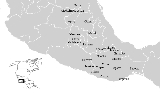
Oto-Manguean languages are a large family comprising several families of Native American languages. All of the Oto-Manguean languages that are now spoken are indigenous to Mexico
, but the Manguean branch of the family, which is now extinct
, was spoken as far south as Nicaragua
and Costa Rica
.
The highest number of speakers of Oto-Manguean languages today are found in the state of Oaxaca
where the two largest branches, the Zapotecan
and Mixtecan
languages, are spoken by almost 1.5 million people combined. In central Mexico, particularly in the states of Mexico (state)
, Hidalgo and Querétaro
, the languages of the Oto-Pamean branch are spoken: the Otomi
and the closely related Mazahua
have over 500,000 speakers combined. Some Oto-Manguean languages are moribund or highly endangered; for example, Ixcatec and Matlatzinca
each has fewer than 250 speakers, most of whom are elderly. Other languages particularly of the Manguean branch which was spoken outside of Mexico have become extinct
; these include the Chiapanec language, which has only recently been declared extinct. Others such as Subtiaba, which was most closely related to Me'phaa
(Tlapanec), have been extinct longer and are only known from early 20th century descriptions.
The Oto-Manguean language family is the most diverse and most geographically widespread language family represented in Mesoamerica. The internal diversity is comparable with that of Indo-European
, and the Proto-Oto-Manguean language is estimated to have been spoken some time before 2000 BCE. This means that at least for the past 4000 years Oto-Manguean languages have coexisted with the other languages of Mesoamerica
and have developed many traits in common with these, to such an extent that they are seen as part of a "sprachbund
" called the Mesoamerican Linguistic Area
. However Oto-Manguean also stands out from the other language families of Mesoamerica in several features. It is the only language family in North America
, Mesoamerica and Central America
whose members are all tonal languages. It also stands out by having a much more analytic structure than other Mesoamerican languages. Another typical trait of Oto-Manguean is that its members almost all show VSO (verb–subject–object) in basic order of clausal constituents.
classification 1929.
From the 1950s on reconstructive work began to be done on Oto-Manguean which led to a better understanding of subgroupings within the family. Proto-Oto-Pamean was reconstructed by Doris Bartholomew
, Proto-Zapotecan by Morris Swadesh
, Proto-Chiapanec–Mangue by Fernández de Miranda and Weitlaner. The first reconstruction of Proto-Oto-Manguean was done by Longacre in 1957. This reconstruction as later refined by himself and later by Rensch (1977). Tlapanec (Me'phaa) and Subtiaba, which had been seen as related already by Lehmann but which had been included in Sapir's Hokan
grouping were not to be included in the family until 1977 when Jorge A Suárez demonstrated the relationship. The classification by Campbell 1997 was the first to present a unified view of the Oto-Manguean languages including Tlapanec–Subtiaba. In 1981 William Merrifield published a reconstruction of the kinship terminologies
of each of the Oto-Manguean branches (including Tlapanecan) and of Proto-Oto-Manguean. Unpublished reconstructions of Proto-Oto-Manguean grammar have also been made by Terrence Kaufman
.
The status of the Amuzgo language as either a part of the Mixtecan group or as forming its own branch from the proto-Oto-Manguean node has been discussed by Longacre, who argued for the latter, but the currently most accepted classification by Campbell
(1997) follows Terrence Kaufman
in considering Amuzgo to be a branch of Mixtecan. Swadesh (1960) and Rensch included the Huave language
as a separate branch within Oto-Manguean, but this inclusion has proved untenable as most of the cognates were loanwords form Zapotec. Huave is now considered an isolate
.
Longacre (1968) considered Oto-Manguean to be among the most extensively studied language families of the world, with a level reconstruction rivaling the Indo-European
family in completeness, but Kaufman and Justeson (2009) reject this, lamenting the rudimentary reconstruction of Proto-Oto-Manguean lexicon (only ca. 350 items have been reconstructed) and grammar. They call for a redoubling of the effort to document and reconstruct several important branches that have received little attention: principally Mixtecan, Popolocan and Oto-Pamean.
, because like Chinese the languages were tonal and mostlly monosyllabic. This idea was quickly abandoned as the fact that tonal languages are common was discovered, and advances in the historical study of Chinese language were made (including the discovery that Old Chinese
had polysyllabic roots and was non-tonal). Edward Sapir included Subtiaba–Tlapanec in his Hokan
phylum, but didn't classify the other Oto-Manguean languages in his famous 1929 classification. In his 1960 classification, Joseph Greenberg
considered Oto-Manguean so aberrant from other Native American languages that it was the only accepted family (aside from the Tarascan isolate) which he made a primary branch of his Amerind
family. However, in his 1987 revision he linked it with Aztec-Tanoan in a "Central Amerind" branch, apart from Tlapanec which, although it had by then been unequivocally linked to Oto-Manguean, he continued to classify as Hokan. No hypotheses including Oto-Manguean in any higher-level unit have been able to withstand scrutiny.
branch are spoken in central and western Mexico. The group includes the Otomian languages: Otomi
spoken primarily in the states of Mexico, Hidalgo, Puebla
and Veracruz
(ca. 293,000 speakers) and Mazahua
spoken in the western part of the State of Mexico (ca. 350,000 speakers), and the endangered Matlatzinca
n languages including Matlatzinca
(ca. 1000 speakers in the town of San Francisco Oxtotilpa) and Tlahuica (also called Ocuilteco) (ca. 400 speakers in the municipio of Ocuilan
) both spoken in the State of Mexico; And the Pamean group composed of the two living Pame language
s of San Luís Potosí
, Northern Pame http://www.ethnologue.com/show_language.asp?code=pmq being spoken in in communities from the north of Río Verde
on the border with Tamaulipas
(ca. 5500 speakers), and Central Pame http://www.ethnologue.com/show_language.asp?code=pbs spoken in the town of Santa María Acapulco (ca. 4000 speakers), the Extinct Southern Pame language, and the Chichimeca Jonaz language
language spoken spoken in Misión de Chichimecas near San Luis de la Paz
in the state of Guanajuato
(ca. 200 speakers).
Otomi is traditionally described as a single language, although its many dialects are not all mutually intelligible. The language classification of the SIL International's Ethnologue
considers Otomi to be a cover term for nine separate Otomi languages and assigns a different ISO code to each of these nine varieties. Currently Otomi varieties are spoken collectively by circa 239,000 speakers — some 5 to 6 percent of whom are monolingual. Because of recent migratory patterns, small populations of Otomi speakers can be found in new locations throughout Mexico and in the United States. The Otomi languages are vigorous in some areas, with children acquiring the language through natural transmission (e.g. in the Mezquital valley of Hidalgo and in the Highlands). However three varieties are now considered moribund: those of Ixtenco (Tlaxcala
state), Santiago Tilapa and Acazulco (Mexico state), and Cruz del Palmar (Guanajuato
state). In some municipalities the level of monolingualism in Otomi is as high as 22.3% (Huehuetla
, Hidalgo) or 13.1% (Texcatepec
, Veracruz). Monolingualism is normally significantly higher among women than among men.
, Tuxtepec and Choapan. The Ethnologue
recognizes 14 separate varieties with separate ISO codes.
is spoken by ca. 75,000 people in Guerrero
. There are four principal varieties named after the communities where they are spoken: Acatepec, Azoyú, Malinaltepec and Tlacoapa. Recent labor migrations have introduced Tlapanec speaking communities to the state of Morelos
.
The Manguean languages
are all extinct. They included the Subtiaba
, Mangue
and Chorotega
languages that were spoken in Nicaragua
and Costa Rica
at the beginning of the 20th century, and the Chiapanec language which was spoken in Chiapas
, Mexico
by a handful of speakers in the 1990'es, but which is now considered extinct.
state near Tehuacán
and Tepexi de Rodríguez (ca. 30,000 speakers), and the closely related Chocho language (ca. 700 speakers) spoken in Northern Oaxaca state, and the 8 different Mazatecan languages
spoken in northern Oaxaca (ca. 120,000 speakers), and the nearly extinct Ixcatec language
spoken in Santa María Ixcatlán
(< 8 speakers). The Popolocan languages should not be confused with the languages called Popoluca
spoken in the state of Veracruz
, which belong to the unrelated Mixe–Zoquean language family.
subgroup is formed by the Zapotec languages (ca. 785,000 speakers of all varieties) and the related language Chatino language
(ca. 23,000 speakers). They are all traditionally spoken in central and southern Oaxaca, but have been spread throughout Mexico and even into the United States through recent labor related migrations.
Zapotec languages and dialects fall into four broad geographic divisions: Zapoteco de la Sierra Norte (Northern Zapotec), Valley Zapotec, Zapoteco de la Sierra Sur (Southern Zapotec), and Isthmus Zapotec
. Northern Zapotec languages are spoken in the mountainous region of Oaxaca
, in the Northern Sierra Madre mountain ranges; Southern Zapotec languages and are spoken in the mountainous region of Oaxaca
, in the Southern Sierra Madre mountain ranges; Valley Zapotec languages are spoken in the Valley of Oaxaca, and Isthmus Zapotec languages are spoken in the Isthmus of Tehuantepec
. The Ethnologue
recognizes 57 varieties of Zapotec and 6 varieties of Chatino by distinct ISO codes.
(or Triqui) languages, spoken by about 24,500 people and Cuicatec
, spoken by about 15,000 people. The Mixtecan languages are traditionally spoken is the region known as La Mixteca
, which is shared by the states of Oaxaca
, Puebla
and Guerrero
. Because of migration from this region the Mixtecan languages have expanded to Mexico's main urban areas, particularly the State of México and the Federal District, to certain agricultural areas such as the San Quintín
valley in Baja California
and parts of Morelos
and Sonora
, and even into the United States
. The Mixtec language is a complex set of regional varieties, many of which are not mutually intelligible. The varieties of Mixtec are sometimes grouped by geographic area, using designations such as those of the Mixteca Alta, the Mixteca Baja, and the Mixteca de la Costa. However, the dialects do not actually follow the geographic areas, and the precise historical relationships between the different varieties have not been worked out. The number of varieties of Mixtec depends in part on what the criteria are for grouping them, of course; at one extreme, government agencies once recognized no dialectal diversity. Mutual intelligibility surveys and local literacy programs have led SIL International
to identify more than 50 varieties which have been assigned distinct ISO codes.
Four Amuzgo varieties are spoken in the Costa Chica
region of the states of Guerrero
and Oaxaca
by about 44,000 speakers. The four varieties recognized by the Mexican government are: Northern Amuzgo (amuzgo del norte, commonly known as Guerrero or (from its major town) Xochistlahuaca Amuzgo), Southern Amuzgo (amuzgo del sur, heretofore classified as a subdialect of Northern Amuzgo); Upper Eastern Amuzgo (amuzgo alto del este, commonly known as Oaxaca Amuzgo or San Pedro Amuzgos Amuzgo); Lower Eastern Amuzgo (amuzgo bajo del este, commonly known as Ipalapa Amuzgo). These varieties are very similar, but there is a significant difference between western varieties (Northern and Southern) and eastern varieties (Upper Eastern and Lower Eastern), as revealed by recorded text testing done in the 1970s.
suggest an approximate splitting date of Proto-Otomanguean at ca. 4400 BCE. The Oto-Manguean urheimat
has been thought to be in the Tehuacan
valley in connection with one of the earliest neolithic cultures of Mesoamerica
, and although it is now in doubt whether Tehuacán was the original home of the Proto-Otomanguean people, it is agreed that the Tehuacán culture (5000 BCE–2300 BCE) were likely Oto-Mangue speakers.
The long history of the Oto-Manguean family has resulted in considerable linguistic diversity between the branches of the family. Terrence Kaufman
compares the diversity between the main branches of Oto-Manguean with that between the main branches of Indo-European
. Kaufman also proposes that Oto-Manguean languages are an important candidate for being the source of many of the traits that have diffused into the other languages
in the Mesoamerican linguistic area
.
Oto-Mangue speakers have been among the earliest to form highly complex cultures of Mesoamerica
: the archeological site of Monte Albán
with remains dated as early as 1000 BCE is believed to have been in continuous use by Zapotecs
. The undeciphered Zapotec script is one of the earliest forms of Mesoamerican writing.
Other Mesoamerican cultural centers which may have been wholly or partly Oto-Manguean include the late classical sites of Xochicalco
, which may have been built by Matlatzinca
s, and Cholula
, which may have been inhabited by Manguean peoples. And some propose an Oto-Pamean presence in Teotihuacán
. The Zapotecs are among the candidates to have invented the first writing system of Mesoamerica
– and in the Post-Classic period the Mixtecs were prolific artesans and codex painters. During the postclassic the Oto-Manguean cultures of Central Mexico became marginalized by the intruding Nahuas and some, like the Chiapanec–Mangue speakers went south into Guerrero, Chiapas and Central America, while others such as the Otomi
saw themselves relocated from their ancient homes in the Valley of Mexico to the less fertile highlands on the rim of the valleys.
: some have only two level tones while others have up to five level tones. Many languages in addition have a number of contour tones. Many Oto-Manguean languages have phonemic vowel nasalization. Many Oto-Manguean languages lack labial consonant
s, particularly stops and those that do have labial stops normally have these as a reflex of Proto-Oto-Manguean */kʷ/.
: /nlʔo2spt/ "their houses".
Rensch also reconstructs four tones for Proto-Oto-Manguean. A later revised reconstruction by Terrence Kaufman
adds the proto-phonemes */ts/, */θ/, */x/, */xʷ/, */l/, */r/, */m/ and */o/, and the vowel combinations */ia/, */ai/, */ea/, and */au/.
The Oto-Manguean languages have changed quite a lot from the very spartan phoneme inventory of Proto-Oto-Manguean. Many languages have rich inventories of both vowels and consonants. Many have a full series of fricatives, and some branches (particularly Zapotecan and Chinantecan) distinguish voicing in both stops and fricatives. The voiced series of the Oto-Pamean languages have both fricative and stop allophones. Otomian also have full series of front, central and back vowels. Some analyses of Mixtecan include a series of voiced prenasalised stops and affricates; these can also be analysed as consonant sequences but it would be the only consonant clusters known in the languages.
These are some of the most simple sound changes that have served to divide the Oto-Manguean family into subbranches:
which has four tones the following minimal pairs occur: tʃa1 "I talk", tʃa² "difficult", tʃa³ "his hand" tʃa4 "he talks".
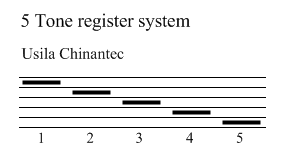
The language with the most level tones is Usila Chinantec
which has five level tones and no contour tones; Trique
of Chicahuaxtla has a similar system.
 In Copala Trique
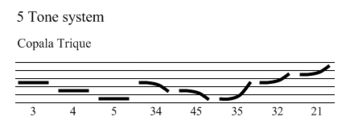
, which has a mixed system, only three level tones but five tonal registers are distinguished within the contour tones.
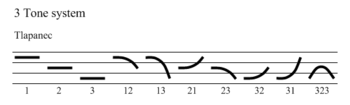
 Many other systems have only three tones levels, such as Tlapanec
and Texmelucan Zapotec
.
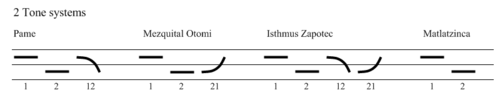
 Particularly common in the Oto-Pamean branch
are small tonal systems with only two level tones and one combination, such as Pame
and Otomi
. Some others like Matlatzinca
and Chichimeca Jonaz
only have the level tones and no combination.
 In some languages stress influences tone, for example in Pame only stressed syllables have a tonal contrast. In Chatino where stress falls predictably on the last syllable of polysyllables, tone is also only distinguished on the last syllable. In Mazahua The opposite occurs and all syllables except the final stressed one distinguishes tone. In Tlapanec stress is determined by the tonal contour of the words. Most languages have systems of sandhi
where the tones of a word or syllable are influenced by other tones in other syllables or words. Chinantec has no Sandhi rules but Mixtec and Zapotec have elaborate systems. For Mazatec some dialects has elaborate Sandhi systems (e.g. Soyaltepec) and others haven't (e.g. Huautla Mazatec). Some languages (particularly Mixtecan) also have terrace systems
where some tones are "upstep" or "downstep", causing a raise or drop in pitch level for the entire tonal register in subsequent syllables.
, where by whistling the tonal combinations of words and phrases, information can be transmitted over distances without using words. Whistled speech is particularly common in Chinantec, Mazatec and Zapotecan languages.
Mexico
The United Mexican States , commonly known as Mexico , is a federal constitutional republic in North America. It is bordered on the north by the United States; on the south and west by the Pacific Ocean; on the southeast by Guatemala, Belize, and the Caribbean Sea; and on the east by the Gulf of...
, but the Manguean branch of the family, which is now extinct
Extinct language
An extinct language is a language that no longer has any speakers., or that is no longer in current use. Extinct languages are sometimes contrasted with dead languages, which are still known and used in special contexts in written form, but not as ordinary spoken languages for everyday communication...
, was spoken as far south as Nicaragua
Nicaragua
Nicaragua is the largest country in the Central American American isthmus, bordered by Honduras to the north and Costa Rica to the south. The country is situated between 11 and 14 degrees north of the Equator in the Northern Hemisphere, which places it entirely within the tropics. The Pacific Ocean...
and Costa Rica
Costa Rica
Costa Rica , officially the Republic of Costa Rica is a multilingual, multiethnic and multicultural country in Central America, bordered by Nicaragua to the north, Panama to the southeast, the Pacific Ocean to the west and the Caribbean Sea to the east....
.
The highest number of speakers of Oto-Manguean languages today are found in the state of Oaxaca
Oaxaca
Oaxaca , , officially Estado Libre y Soberano de Oaxaca is one of the 31 states which, along with the Federal District, comprise the 32 federative entities of Mexico. It is divided into 571 municipalities; of which 418 are governed by the system of customs and traditions...
where the two largest branches, the Zapotecan
Zapotecan languages
The Zapotecan languages are a group of related Oto-Manguean languages which descend from the common proto-Zapotecan language spoken by the Zapotec people during the era of the dominance of Monte Albán....
and Mixtecan
Mixtecan languages
The Mixtec language, actually multiple languages, belong to Otomanguean language family of Mexico, and are closely related to the Trique and Cuicatec languages. They are spoken by over half a million people. Identifying how many Mixtec languages there are in this complex dialect continuum poses...
languages, are spoken by almost 1.5 million people combined. In central Mexico, particularly in the states of Mexico (state)
Mexico (state)
México , officially: Estado Libre y Soberano de México is one of the 31 states which, with the Federal District, comprise the 32 Federal Entities of the United Mexican States. It is divided in 125 municipalities and its capital city is Toluca de Lerdo....
, Hidalgo and Querétaro
Querétaro
Querétaro officially Estado Libre y Soberano de Querétaro de Arteaga is one of the 31 states which, with the Federal District, comprise the 32 Federal Entities of Mexico. It is divided into 18 municipalities and its capital city is Santiago de Querétaro....
, the languages of the Oto-Pamean branch are spoken: the Otomi
Otomi language
Otomi is an Oto-Manguean language and one of the indigenous languages of Mexico, spoken by approximately 240,000 indigenous Otomi people in the central altiplano region of Mexico. The language is spoken in many different dialects, some of which are not mutually intelligible, therefore it is in...
and the closely related Mazahua
Mazahua language
The Mazahua language is an indigenous language of Mexico, spoken in the country's central states by the ethnic group widely known as the Mazahua but who refer to themselves as Hñatho. Mazahua is a Mesoamerican language and shows many of the traits which define the Mesoamerican Linguistic Area...
have over 500,000 speakers combined. Some Oto-Manguean languages are moribund or highly endangered; for example, Ixcatec and Matlatzinca
Matlatzinca
Matlatzinca is a name used to refer to different indigenous ethnic groups in the Toluca Valley in the state of México, located in the central highlands of Mexico. The term is applied to the ethnic group inhabiting the valley of Toluca and to their language, Matlatzinca.When used as an ethnonym,...
each has fewer than 250 speakers, most of whom are elderly. Other languages particularly of the Manguean branch which was spoken outside of Mexico have become extinct
Extinct language
An extinct language is a language that no longer has any speakers., or that is no longer in current use. Extinct languages are sometimes contrasted with dead languages, which are still known and used in special contexts in written form, but not as ordinary spoken languages for everyday communication...
; these include the Chiapanec language, which has only recently been declared extinct. Others such as Subtiaba, which was most closely related to Me'phaa
Tlapanec language
Tlapanec is an indigenous Mexican language spoken by more than 98,000 Tlapanec people in the state of Guerrero. Like other Oto-Manguean languages, it is tonal and has complex inflectional morphology...
(Tlapanec), have been extinct longer and are only known from early 20th century descriptions.
The Oto-Manguean language family is the most diverse and most geographically widespread language family represented in Mesoamerica. The internal diversity is comparable with that of Indo-European
Indo-European
Indo-European may refer to:* Indo-European languages** Aryan race, a 19th century and early 20th century term for those peoples who are the native speakers of Indo-European languages...
, and the Proto-Oto-Manguean language is estimated to have been spoken some time before 2000 BCE. This means that at least for the past 4000 years Oto-Manguean languages have coexisted with the other languages of Mesoamerica
Mesoamerica
Mesoamerica is a region and culture area in the Americas, extending approximately from central Mexico to Belize, Guatemala, El Salvador, Honduras, Nicaragua, and Costa Rica, within which a number of pre-Columbian societies flourished before the Spanish colonization of the Americas in the 15th and...
and have developed many traits in common with these, to such an extent that they are seen as part of a "sprachbund
Sprachbund
A Sprachbund – also known as a linguistic area, convergence area, diffusion area or language crossroads – is a group of languages that have become similar in some way because of geographical proximity and language contact. They may be genetically unrelated, or only distantly related...
" called the Mesoamerican Linguistic Area
Mesoamerican Linguistic Area
The Mesoamerican Linguistic Area is a sprachbund containing many of the languages natively spoken in the cultural area of Mesoamerica. This sprachbund is defined by an array of syntactic, lexical and phonological traits as well as a number of ethnolinguistic traits found in the languages of...
. However Oto-Manguean also stands out from the other language families of Mesoamerica in several features. It is the only language family in North America
North America
North America is a continent wholly within the Northern Hemisphere and almost wholly within the Western Hemisphere. It is also considered a northern subcontinent of the Americas...
, Mesoamerica and Central America
Central America
Central America is the central geographic region of the Americas. It is the southernmost, isthmian portion of the North American continent, which connects with South America on the southeast. When considered part of the unified continental model, it is considered a subcontinent...
whose members are all tonal languages. It also stands out by having a much more analytic structure than other Mesoamerican languages. Another typical trait of Oto-Manguean is that its members almost all show VSO (verb–subject–object) in basic order of clausal constituents.
Internal classification and reconstruction
A genetic relationship between Zapotecan and Mixtecan was first proposed by Orozco y Berra in 1864, he also included Cuicatec, Chocho and Amuzgo in his grouping. In 1865 Pimentel added Mazatec, Popoloca, Chatino and Chinantec – he also posed a separate group of Pame, Otomi and Mazahua, the beginning of the Oto-Pamean subbranch. Daniel Brinton's classification of 1891 added Matlatzinca and Chichimeca Jonaz to Pimentel's Oto-Pamean group (which wasn't known by that name then), and he reclassified some languages of the previously included languages of the Oaxacan group. In 1920 Lehmann included the Chiapanec–Mangue languages and correctly established the major subgroupings of the Oaxacan group. And in 1926 Schmidt coined the name Otomi–Mangue for a group consisting of the Oto-Pamean languages and Chiapanec–Mangue. The Oto-Pamean group and the Main Oaxacan group were not joined together into one family until in Sapir'sEdward Sapir
Edward Sapir was an American anthropologist-linguist, widely considered to be one of the most important figures in the early development of the discipline of linguistics....
classification 1929.
From the 1950s on reconstructive work began to be done on Oto-Manguean which led to a better understanding of subgroupings within the family. Proto-Oto-Pamean was reconstructed by Doris Bartholomew
Doris Bartholomew
Doris Aileen Bartholomew is an American linguist whose published research specialises in the lexicography, historical and descriptive linguistics for indigenous languages in Mexico, in particular for Oto-Manguean languages. Bartholomew's extensive publications on Mesoamerican languages span five...
, Proto-Zapotecan by Morris Swadesh
Morris Swadesh
Morris Swadesh was an influential and controversial American linguist. In his work, he applied basic concepts in historical linguistics to the Indigenous languages of the Americas...
, Proto-Chiapanec–Mangue by Fernández de Miranda and Weitlaner. The first reconstruction of Proto-Oto-Manguean was done by Longacre in 1957. This reconstruction as later refined by himself and later by Rensch (1977). Tlapanec (Me'phaa) and Subtiaba, which had been seen as related already by Lehmann but which had been included in Sapir's Hokan
Hokan languages
The Hokan language family is a hypothetical grouping of a dozen small language families spoken in California, Arizona and Mexico. In nearly a century since Edward Sapir first proposed the "Hokan" hypothesis, little additional evidence has been found that these families were related to each other...
grouping were not to be included in the family until 1977 when Jorge A Suárez demonstrated the relationship. The classification by Campbell 1997 was the first to present a unified view of the Oto-Manguean languages including Tlapanec–Subtiaba. In 1981 William Merrifield published a reconstruction of the kinship terminologies
Kinship terminology
Kinship terminology refers to the various systems used in languages to refer to the persons to whom an individual is related through kinship. Different societies classify kinship relations differently and therefore use different systems of kinship terminology - for example some languages...
of each of the Oto-Manguean branches (including Tlapanecan) and of Proto-Oto-Manguean. Unpublished reconstructions of Proto-Oto-Manguean grammar have also been made by Terrence Kaufman
Terrence Kaufman
Terrence Kaufman is an American linguist specializing in documentation of unwritten languages, Mesoamerican historical linguistics and language contact phenomena. He is currently a professor at the department of anthropology at the University of Pittsburgh....
.
The status of the Amuzgo language as either a part of the Mixtecan group or as forming its own branch from the proto-Oto-Manguean node has been discussed by Longacre, who argued for the latter, but the currently most accepted classification by Campbell
Campbell
-Places:In Australia:* Campbell, Australian Capital Territory, a suburb of Canberra, AustraliaIn Canada:* Campbell, Nova Scotia, on Cape Breton Island Nova Scotia* Campbell Road, Edmonton, AlbertaIn New Zealand:...
(1997) follows Terrence Kaufman
Terrence Kaufman
Terrence Kaufman is an American linguist specializing in documentation of unwritten languages, Mesoamerican historical linguistics and language contact phenomena. He is currently a professor at the department of anthropology at the University of Pittsburgh....
in considering Amuzgo to be a branch of Mixtecan. Swadesh (1960) and Rensch included the Huave language
Huave language
Huave is a language isolate spoken by the indigenous Huave people on the Pacific coast of the Mexican state of Oaxaca. The language is spoken in four villages on the Isthmus of Tehuantepec, in the southeast of the state, by around 18,000 people...
as a separate branch within Oto-Manguean, but this inclusion has proved untenable as most of the cognates were loanwords form Zapotec. Huave is now considered an isolate
Language isolate
A language isolate, in the absolute sense, is a natural language with no demonstrable genealogical relationship with other languages; that is, one that has not been demonstrated to descend from an ancestor common with any other language. They are in effect language families consisting of a single...
.
Longacre (1968) considered Oto-Manguean to be among the most extensively studied language families of the world, with a level reconstruction rivaling the Indo-European
Indo-European
Indo-European may refer to:* Indo-European languages** Aryan race, a 19th century and early 20th century term for those peoples who are the native speakers of Indo-European languages...
family in completeness, but Kaufman and Justeson (2009) reject this, lamenting the rudimentary reconstruction of Proto-Oto-Manguean lexicon (only ca. 350 items have been reconstructed) and grammar. They call for a redoubling of the effort to document and reconstruct several important branches that have received little attention: principally Mixtecan, Popolocan and Oto-Pamean.
Inclusion in macro-family hypotheses
Some early classifications such as that by Brinton, considered that Oto-Manguean languages might be related to ChineseChinese language
The Chinese language is a language or language family consisting of varieties which are mutually intelligible to varying degrees. Originally the indigenous languages spoken by the Han Chinese in China, it forms one of the branches of Sino-Tibetan family of languages...
, because like Chinese the languages were tonal and mostlly monosyllabic. This idea was quickly abandoned as the fact that tonal languages are common was discovered, and advances in the historical study of Chinese language were made (including the discovery that Old Chinese
Old Chinese
The earliest known written records of the Chinese language were found at a site near modern Anyang identified as Yin, the last capital of the Shang dynasty, and date from about 1200 BC....
had polysyllabic roots and was non-tonal). Edward Sapir included Subtiaba–Tlapanec in his Hokan
Hokan languages
The Hokan language family is a hypothetical grouping of a dozen small language families spoken in California, Arizona and Mexico. In nearly a century since Edward Sapir first proposed the "Hokan" hypothesis, little additional evidence has been found that these families were related to each other...
phylum, but didn't classify the other Oto-Manguean languages in his famous 1929 classification. In his 1960 classification, Joseph Greenberg
Joseph Greenberg
Joseph Harold Greenberg was a prominent and controversial American linguist, principally known for his work in two areas, linguistic typology and the genetic classification of languages.- Early life and career :...
considered Oto-Manguean so aberrant from other Native American languages that it was the only accepted family (aside from the Tarascan isolate) which he made a primary branch of his Amerind
Amerind languages
Amerind is a higher-level language family proposed by Joseph Greenberg in 1960. Greenberg proposed that all of the indigenous languages of the Americas belong to one of three language families, the previously established Eskimo–Aleut and Na–Dene, and with everything else—almost universally believed...
family. However, in his 1987 revision he linked it with Aztec-Tanoan in a "Central Amerind" branch, apart from Tlapanec which, although it had by then been unequivocally linked to Oto-Manguean, he continued to classify as Hokan. No hypotheses including Oto-Manguean in any higher-level unit have been able to withstand scrutiny.
Oto-Pamean
The languages of the Oto-PameanOto-Pamean languages
The Oto-Pamean languages are a branch of the Oto-Manguean languages of central Mexico that includes are half a dozen languages, or more accurately dialect clusters:*Otomian: Otomi, Mazahua*Matlatzinca*Pamean*Chichimeca...
branch are spoken in central and western Mexico. The group includes the Otomian languages: Otomi
Otomi language
Otomi is an Oto-Manguean language and one of the indigenous languages of Mexico, spoken by approximately 240,000 indigenous Otomi people in the central altiplano region of Mexico. The language is spoken in many different dialects, some of which are not mutually intelligible, therefore it is in...
spoken primarily in the states of Mexico, Hidalgo, Puebla
Puebla
Puebla officially Estado Libre y Soberano de Puebla is one of the 31 states which, with the Federal District, comprise the 32 Federal Entities of Mexico. It is divided in 217 municipalities and its capital city is Puebla....
and Veracruz
Veracruz
Veracruz, formally Veracruz de Ignacio de la Llave officially Estado Libre y Soberano de Veracruz de Ignacio de la Llave , is one of the 31 states that, along with the Federal District, comprise the 32 federative entities of Mexico. It is divided in 212 municipalities and its capital city is...
(ca. 293,000 speakers) and Mazahua
Mazahua language
The Mazahua language is an indigenous language of Mexico, spoken in the country's central states by the ethnic group widely known as the Mazahua but who refer to themselves as Hñatho. Mazahua is a Mesoamerican language and shows many of the traits which define the Mesoamerican Linguistic Area...
spoken in the western part of the State of Mexico (ca. 350,000 speakers), and the endangered Matlatzinca
Matlatzinca
Matlatzinca is a name used to refer to different indigenous ethnic groups in the Toluca Valley in the state of México, located in the central highlands of Mexico. The term is applied to the ethnic group inhabiting the valley of Toluca and to their language, Matlatzinca.When used as an ethnonym,...
n languages including Matlatzinca
Matlatzinca
Matlatzinca is a name used to refer to different indigenous ethnic groups in the Toluca Valley in the state of México, located in the central highlands of Mexico. The term is applied to the ethnic group inhabiting the valley of Toluca and to their language, Matlatzinca.When used as an ethnonym,...
(ca. 1000 speakers in the town of San Francisco Oxtotilpa) and Tlahuica (also called Ocuilteco) (ca. 400 speakers in the municipio of Ocuilan
Ocuilán
Ocuilan is a town and municipality in Mexico State in Mexico. The municipality covers an area of 344.84 km².As of 2005, the municipality had a total population of 26,332....
) both spoken in the State of Mexico; And the Pamean group composed of the two living Pame language
Pame language
The Pame language is an indigenous language of Mexico spoken by around 10.000 Pame people in the state of San Luis Potosí. The Pame language belongs to the Oto-Pamean branch of the Oto-manguean linguistic family...
s of San Luís Potosí
San Luis Potosí
San Luis Potosí officially Estado Libre y Soberano de San Luis Potosí is one of the 31 states which, with the Federal District, comprise the 32 Federal Entities of Mexico. It is divided in 58 municipalities and its capital city is San Luis Potosí....
, Northern Pame http://www.ethnologue.com/show_language.asp?code=pmq being spoken in in communities from the north of Río Verde
Río Verde
Rioverde is a city and its surrounding municipality located in the south-central part of the state of San Luis Potosi, Mexico. It is the fifth-largest city in the state, behind San Luis Potosí, Soledad de Graciano Sánchez, Ciudad Valles, and Matehuala...
on the border with Tamaulipas
Tamaulipas
Tamaulipas officially Estado Libre y Soberano de Tamaulipas is one of the 31 states which, with the Federal District, comprise the 32 Federal Entities of Mexico. It is divided in 43 municipalities and its capital city is Ciudad Victoria. The capital city was named after Guadalupe Victoria, the...
(ca. 5500 speakers), and Central Pame http://www.ethnologue.com/show_language.asp?code=pbs spoken in the town of Santa María Acapulco (ca. 4000 speakers), the Extinct Southern Pame language, and the Chichimeca Jonaz language
Chichimeca Jonaz language
Chichimeca or Chichimeca Jonaz is an indigenous language of Mexico spoken by around 200 Chichimeca Jonaz people in Misión de Chichimecas near San Luis de la Paz in the state of Guanajuato, Mexico. The Chichimeca Jonaz language belongs to the Oto-Pamean branch of the Oto-Manguean linguistic family...
language spoken spoken in Misión de Chichimecas near San Luis de la Paz
San Luis de la Paz
San Luis de la Paz is a city and its surrounding municipality of the same name located in the northeastern part of the state of Guanajuato in Mexico. A charming city with great historic and cultural wealth, was founded on August 25, 1552, as a defensive town in the Spanish Silver Road, which linked...
in the state of Guanajuato
Guanajuato
Guanajuato officially Estado Libre y Soberano de Guanajuato is one of the 31 states which, with the Federal District, comprise the 32 Federal Entities of Mexico. It is divided in 46 municipalities and its capital city is Guanajuato....
(ca. 200 speakers).
Otomi is traditionally described as a single language, although its many dialects are not all mutually intelligible. The language classification of the SIL International's Ethnologue
Ethnologue
Ethnologue: Languages of the World is a web and print publication of SIL International , a Christian linguistic service organization, which studies lesser-known languages, to provide the speakers with Bibles in their native language and support their efforts in language development.The Ethnologue...
considers Otomi to be a cover term for nine separate Otomi languages and assigns a different ISO code to each of these nine varieties. Currently Otomi varieties are spoken collectively by circa 239,000 speakers — some 5 to 6 percent of whom are monolingual. Because of recent migratory patterns, small populations of Otomi speakers can be found in new locations throughout Mexico and in the United States. The Otomi languages are vigorous in some areas, with children acquiring the language through natural transmission (e.g. in the Mezquital valley of Hidalgo and in the Highlands). However three varieties are now considered moribund: those of Ixtenco (Tlaxcala
Tlaxcala
Tlaxcala officially Estado Libre y Soberano de Tlaxcala is one of the 31 states which along with the Federal District comprise the 32 federative entities of Mexico. It is divided into 60 municipalities and its capital city is Tlaxcala....
state), Santiago Tilapa and Acazulco (Mexico state), and Cruz del Palmar (Guanajuato
Guanajuato
Guanajuato officially Estado Libre y Soberano de Guanajuato is one of the 31 states which, with the Federal District, comprise the 32 Federal Entities of Mexico. It is divided in 46 municipalities and its capital city is Guanajuato....
state). In some municipalities the level of monolingualism in Otomi is as high as 22.3% (Huehuetla
Huehuetla
Huehuetla is a town and one of the 84 municipalities of Hidalgo, in central-eastern Mexico. The municipality covers an area of 262.1 km².As of 2005, the municipality had a total population of 22,927....
, Hidalgo) or 13.1% (Texcatepec
Texcatepec
Texcatepec is a municipality located in the north zone in the State of Veracruz, about 190 km from state capital Xalapa. It has a surface of 153.61 km2. It is located at...
, Veracruz). Monolingualism is normally significantly higher among women than among men.
Chinantecan
The Chinantecan languages are spoken by ca. 93,000 people in Northern Oaxaca and Southern Veracruz in the districts of Cuicatlán, Ixtlán de JuárezIxtlán de Juárez
Ixtlán de Juárez is a town and municipality in the Mexican state of Oaxaca about 65 km north of the city of Oaxaca on Federal Highway 175 towards Veracruz.It is part of the Ixtlán District in the Sierra Norte de Oaxaca region.-Municipality of Ixtlán:...
, Tuxtepec and Choapan. The Ethnologue
Ethnologue
Ethnologue: Languages of the World is a web and print publication of SIL International , a Christian linguistic service organization, which studies lesser-known languages, to provide the speakers with Bibles in their native language and support their efforts in language development.The Ethnologue...
recognizes 14 separate varieties with separate ISO codes.
Tlapanec–Mangue
The Tlapanec languageTlapanec language
Tlapanec is an indigenous Mexican language spoken by more than 98,000 Tlapanec people in the state of Guerrero. Like other Oto-Manguean languages, it is tonal and has complex inflectional morphology...
is spoken by ca. 75,000 people in Guerrero
Guerrero
Guerrero officially Estado Libre y Soberano de Guerrero is one of the 31 states which, with the Federal District, comprise the 32 Federal Entities of Mexico. It is divided in 81 municipalities and its capital city is Chilpancingo....
. There are four principal varieties named after the communities where they are spoken: Acatepec, Azoyú, Malinaltepec and Tlacoapa. Recent labor migrations have introduced Tlapanec speaking communities to the state of Morelos
Morelos
Morelos officially Estado Libre y Soberano de Morelos is one of the 31 states which, with the Federal District, comprise the 32 Federal Entities of Mexico. It is divided in 33 municipalities and its capital city is Cuernavaca....
.
The Manguean languages
Manguean languages
The extinct Manguean languages were a branch of the Oto-Mangean family. They were Chorotega of Costa Rica and Nicaragua , and Chiapanec of Mexico....
are all extinct. They included the Subtiaba
Subtiaba
Subtiaba is an extinct Oto-Manguean language which was spoken on the Pacific slope of Nicaragua. In 1925 Edward Sapir wrote an article based on scant evidence arguing for the inclusion of Subtiaba in his hypothesized Hokan group. Others have linked Subtiaba to the Jicaque and Tol languages, but...
, Mangue
Mangue
the word Mangue can refer to several things:*The Mangue Bit, a Brazilian music style.*The Mangue language, an extinct Oto-Manguean language of Nicaragua.*The Mangue people, who spoke the language....
and Chorotega
Chorotega
Chorotega, also known as Mangue, was a language indigenous people of Honduras, Costa Rica and Nicaragua. The ethnic population number around 10,000. The Chorotega language, which was a member of the Manguean branch of the Oto-Manguean language family, is now extinct...
languages that were spoken in Nicaragua
Nicaragua
Nicaragua is the largest country in the Central American American isthmus, bordered by Honduras to the north and Costa Rica to the south. The country is situated between 11 and 14 degrees north of the Equator in the Northern Hemisphere, which places it entirely within the tropics. The Pacific Ocean...
and Costa Rica
Costa Rica
Costa Rica , officially the Republic of Costa Rica is a multilingual, multiethnic and multicultural country in Central America, bordered by Nicaragua to the north, Panama to the southeast, the Pacific Ocean to the west and the Caribbean Sea to the east....
at the beginning of the 20th century, and the Chiapanec language which was spoken in Chiapas
Chiapas
Chiapas officially Estado Libre y Soberano de Chiapas is one of the 31 states that, with the Federal District, comprise the 32 Federal Entities of Mexico. It is divided in 118 municipalities and its capital city is Tuxtla Gutierrez. Other important cites in Chiapas include San Cristóbal de las...
, Mexico
Mexico
The United Mexican States , commonly known as Mexico , is a federal constitutional republic in North America. It is bordered on the north by the United States; on the south and west by the Pacific Ocean; on the southeast by Guatemala, Belize, and the Caribbean Sea; and on the east by the Gulf of...
by a handful of speakers in the 1990'es, but which is now considered extinct.
Popolocan
The Popolocan language group includes the seven different varieties of Popoloca which are spoken in southern PueblaPuebla
Puebla officially Estado Libre y Soberano de Puebla is one of the 31 states which, with the Federal District, comprise the 32 Federal Entities of Mexico. It is divided in 217 municipalities and its capital city is Puebla....
state near Tehuacán
Tehuacán
Tehuacán is the second largest city in the Mexican state of Puebla, nestled in the Southeast Valley of Tehuacán, bordering the states of Oaxaca and Veracruz. The 2010 census reported a population of 248,716 in the city and 274,906 in its surrounding municipality of the same name, of which it serves...
and Tepexi de Rodríguez (ca. 30,000 speakers), and the closely related Chocho language (ca. 700 speakers) spoken in Northern Oaxaca state, and the 8 different Mazatecan languages
Mazatecan languages
The Mazatecan languages are a group of closely related indigenous languages spoken by some 200,000 people in the area known as La Sierra Mazateca, which located in the Northern part of the state of Oaxaca in southern Mexico, as well as in adjacent areas of the states of Puebla and Veracruz...
spoken in northern Oaxaca (ca. 120,000 speakers), and the nearly extinct Ixcatec language
Ixcatec language
Ixcatec, also known as Xwja, is a language spoken by the people of the Mexican village of Santa María Ixcatlan, in the northern part of the state of Oaxaca...
spoken in Santa María Ixcatlán
Santa María Ixcatlan
Santa María Ixcatlan is a town and municipality in Oaxaca in south-western Mexico.It is part of the Teotitlán District in the north of the Cañada Region.The municipality has an area of 201.58 km2 at an elevation of 1,840 meters above sea level....
(< 8 speakers). The Popolocan languages should not be confused with the languages called Popoluca
Popoluca
Popoluca is a Nahuatl term for various indigenous peoples of southeastern Veracruz and Oaxaca. Many of them speak languages of the Mixe–Zoque family...
spoken in the state of Veracruz
Veracruz
Veracruz, formally Veracruz de Ignacio de la Llave officially Estado Libre y Soberano de Veracruz de Ignacio de la Llave , is one of the 31 states that, along with the Federal District, comprise the 32 federative entities of Mexico. It is divided in 212 municipalities and its capital city is...
, which belong to the unrelated Mixe–Zoquean language family.
Zapotecan
The the ZapotecanZapotecan languages
The Zapotecan languages are a group of related Oto-Manguean languages which descend from the common proto-Zapotecan language spoken by the Zapotec people during the era of the dominance of Monte Albán....
subgroup is formed by the Zapotec languages (ca. 785,000 speakers of all varieties) and the related language Chatino language
Chatino language
The Chatino language is an indigenous Mesoamerican language, which is classified under the Zapotecan branch of the Oto-Manguean language family...
(ca. 23,000 speakers). They are all traditionally spoken in central and southern Oaxaca, but have been spread throughout Mexico and even into the United States through recent labor related migrations.
Zapotec languages and dialects fall into four broad geographic divisions: Zapoteco de la Sierra Norte (Northern Zapotec), Valley Zapotec, Zapoteco de la Sierra Sur (Southern Zapotec), and Isthmus Zapotec
Isthmus Zapotec
Isthmus Zapotec is a Zapotecan language spoken in Tehuantepec and Juchitán de Zaragoza, in the Mexican state of Oaxaca.-Consonants:Plosives;Voiceless...
. Northern Zapotec languages are spoken in the mountainous region of Oaxaca
Oaxaca
Oaxaca , , officially Estado Libre y Soberano de Oaxaca is one of the 31 states which, along with the Federal District, comprise the 32 federative entities of Mexico. It is divided into 571 municipalities; of which 418 are governed by the system of customs and traditions...
, in the Northern Sierra Madre mountain ranges; Southern Zapotec languages and are spoken in the mountainous region of Oaxaca
Oaxaca
Oaxaca , , officially Estado Libre y Soberano de Oaxaca is one of the 31 states which, along with the Federal District, comprise the 32 federative entities of Mexico. It is divided into 571 municipalities; of which 418 are governed by the system of customs and traditions...
, in the Southern Sierra Madre mountain ranges; Valley Zapotec languages are spoken in the Valley of Oaxaca, and Isthmus Zapotec languages are spoken in the Isthmus of Tehuantepec
Isthmus of Tehuantepec
The Isthmus of Tehuantepec is an isthmus in Mexico. It represents the shortest distance between the Gulf of Mexico and the Pacific Ocean, and prior to the opening of the Panama Canal was a major shipping route known simply as the Tehuantepec Route...
. The Ethnologue
Ethnologue
Ethnologue: Languages of the World is a web and print publication of SIL International , a Christian linguistic service organization, which studies lesser-known languages, to provide the speakers with Bibles in their native language and support their efforts in language development.The Ethnologue...
recognizes 57 varieties of Zapotec and 6 varieties of Chatino by distinct ISO codes.
Mixtecan–Amuzgoan
The Mixtecan branch includes the many different, mutually unintelligible varieties of Mixtec spoken by about 511,000 people as well as the TriqueTrique language
The Trique language is an Oto-Manguean language of Mexico spoken by the Trique indigenous group of the state of Oaxaca and elsewhere...
(or Triqui) languages, spoken by about 24,500 people and Cuicatec
Cuicatec
The Cuicatecs are an indigenous group of the Mexican state of Oaxaca, closely related to the Mixtecs. They inhabit two towns: Teutila and Tepeuxila in western Oaxaca...
, spoken by about 15,000 people. The Mixtecan languages are traditionally spoken is the region known as La Mixteca
La Mixteca
La Mixteca is a cultural, economic and political region that covers parts of the states of Puebla, Guerrero and Oaxaca in south-central Mexico....
, which is shared by the states of Oaxaca
Oaxaca
Oaxaca , , officially Estado Libre y Soberano de Oaxaca is one of the 31 states which, along with the Federal District, comprise the 32 federative entities of Mexico. It is divided into 571 municipalities; of which 418 are governed by the system of customs and traditions...
, Puebla
Puebla
Puebla officially Estado Libre y Soberano de Puebla is one of the 31 states which, with the Federal District, comprise the 32 Federal Entities of Mexico. It is divided in 217 municipalities and its capital city is Puebla....
and Guerrero
Guerrero
Guerrero officially Estado Libre y Soberano de Guerrero is one of the 31 states which, with the Federal District, comprise the 32 Federal Entities of Mexico. It is divided in 81 municipalities and its capital city is Chilpancingo....
. Because of migration from this region the Mixtecan languages have expanded to Mexico's main urban areas, particularly the State of México and the Federal District, to certain agricultural areas such as the San Quintín
San Quintín, Baja California
San Quintín is a coastal town on the west coast of the Mexican state of Baja California, in the municipio of Ensenada. San Quintín has beautiful beaches and several places for tourists to stay. Tourists can enjoy fishing, camping, bird watching, surfing, and clam digging...
valley in Baja California
Baja California
Baja California officially Estado Libre y Soberano de Baja California is one of the 31 states which, with the Federal District, comprise the 32 Federal Entities of Mexico. It is both the northernmost and westernmost state of Mexico. Before becoming a state in 1953, the area was known as the North...
and parts of Morelos
Morelos
Morelos officially Estado Libre y Soberano de Morelos is one of the 31 states which, with the Federal District, comprise the 32 Federal Entities of Mexico. It is divided in 33 municipalities and its capital city is Cuernavaca....
and Sonora
Sonora
Sonora officially Estado Libre y Soberano de Sonora is one of the 31 states which, with the Federal District, comprise the 32 Federal Entities of Mexico. It is divided into 72 municipalities; the capital city is Hermosillo....
, and even into the United States
United States
The United States of America is a federal constitutional republic comprising fifty states and a federal district...
. The Mixtec language is a complex set of regional varieties, many of which are not mutually intelligible. The varieties of Mixtec are sometimes grouped by geographic area, using designations such as those of the Mixteca Alta, the Mixteca Baja, and the Mixteca de la Costa. However, the dialects do not actually follow the geographic areas, and the precise historical relationships between the different varieties have not been worked out. The number of varieties of Mixtec depends in part on what the criteria are for grouping them, of course; at one extreme, government agencies once recognized no dialectal diversity. Mutual intelligibility surveys and local literacy programs have led SIL International
SIL International
SIL International is a U.S.-based, worldwide, Christian non-profit organization, whose main purpose is to study, develop and document languages, especially those that are lesser-known, in order to expand linguistic knowledge, promote literacy, translate the Christian Bible into local languages,...
to identify more than 50 varieties which have been assigned distinct ISO codes.
Four Amuzgo varieties are spoken in the Costa Chica
Costa Chica
Costa Chica may refer to:Other*Costa Chica...
region of the states of Guerrero
Guerrero
Guerrero officially Estado Libre y Soberano de Guerrero is one of the 31 states which, with the Federal District, comprise the 32 Federal Entities of Mexico. It is divided in 81 municipalities and its capital city is Chilpancingo....
and Oaxaca
Oaxaca
Oaxaca , , officially Estado Libre y Soberano de Oaxaca is one of the 31 states which, along with the Federal District, comprise the 32 federative entities of Mexico. It is divided into 571 municipalities; of which 418 are governed by the system of customs and traditions...
by about 44,000 speakers. The four varieties recognized by the Mexican government are: Northern Amuzgo (amuzgo del norte, commonly known as Guerrero or (from its major town) Xochistlahuaca Amuzgo), Southern Amuzgo (amuzgo del sur, heretofore classified as a subdialect of Northern Amuzgo); Upper Eastern Amuzgo (amuzgo alto del este, commonly known as Oaxaca Amuzgo or San Pedro Amuzgos Amuzgo); Lower Eastern Amuzgo (amuzgo bajo del este, commonly known as Ipalapa Amuzgo). These varieties are very similar, but there is a significant difference between western varieties (Northern and Southern) and eastern varieties (Upper Eastern and Lower Eastern), as revealed by recorded text testing done in the 1970s.
Prehistory
The Oto-Manguean family has existed in southern Mexico at least since 2000 BCE and probably several thousand years before, some estimates uusing the controversial method of glottochronologyGlottochronology
Glottochronology is that part of lexicostatistics dealing with the chronological relationship between languages....
suggest an approximate splitting date of Proto-Otomanguean at ca. 4400 BCE. The Oto-Manguean urheimat
Urheimat
Urheimat is a linguistic term denoting the original homeland of the speakers of a proto-language...
has been thought to be in the Tehuacan
Tehuacán
Tehuacán is the second largest city in the Mexican state of Puebla, nestled in the Southeast Valley of Tehuacán, bordering the states of Oaxaca and Veracruz. The 2010 census reported a population of 248,716 in the city and 274,906 in its surrounding municipality of the same name, of which it serves...
valley in connection with one of the earliest neolithic cultures of Mesoamerica
Mesoamerica
Mesoamerica is a region and culture area in the Americas, extending approximately from central Mexico to Belize, Guatemala, El Salvador, Honduras, Nicaragua, and Costa Rica, within which a number of pre-Columbian societies flourished before the Spanish colonization of the Americas in the 15th and...
, and although it is now in doubt whether Tehuacán was the original home of the Proto-Otomanguean people, it is agreed that the Tehuacán culture (5000 BCE–2300 BCE) were likely Oto-Mangue speakers.
The long history of the Oto-Manguean family has resulted in considerable linguistic diversity between the branches of the family. Terrence Kaufman
Terrence Kaufman
Terrence Kaufman is an American linguist specializing in documentation of unwritten languages, Mesoamerican historical linguistics and language contact phenomena. He is currently a professor at the department of anthropology at the University of Pittsburgh....
compares the diversity between the main branches of Oto-Manguean with that between the main branches of Indo-European
Indo-European languages
The Indo-European languages are a family of several hundred related languages and dialects, including most major current languages of Europe, the Iranian plateau, and South Asia and also historically predominant in Anatolia...
. Kaufman also proposes that Oto-Manguean languages are an important candidate for being the source of many of the traits that have diffused into the other languages
Mesoamerican languages
Mesoamerican languages are the languages indigenous to the Mesoamerican cultural area, which covers southern Mexico, all of Guatemala and Belize and parts of Honduras and El Salvador. The area is characterized by extensive linguistic diversity containing several hundred different languages and...
in the Mesoamerican linguistic area
Mesoamerican Linguistic Area
The Mesoamerican Linguistic Area is a sprachbund containing many of the languages natively spoken in the cultural area of Mesoamerica. This sprachbund is defined by an array of syntactic, lexical and phonological traits as well as a number of ethnolinguistic traits found in the languages of...
.
Oto-Mangue speakers have been among the earliest to form highly complex cultures of Mesoamerica
Mesoamerica
Mesoamerica is a region and culture area in the Americas, extending approximately from central Mexico to Belize, Guatemala, El Salvador, Honduras, Nicaragua, and Costa Rica, within which a number of pre-Columbian societies flourished before the Spanish colonization of the Americas in the 15th and...
: the archeological site of Monte Albán
Monte Albán
Monte Albán is a large pre-Columbian archaeological site in the Santa Cruz Xoxocotlán Municipality in the southern Mexican state of Oaxaca...
with remains dated as early as 1000 BCE is believed to have been in continuous use by Zapotecs
Zapotec civilization
The Zapotec civilization was an indigenous pre-Columbian civilization that flourished in the Valley of Oaxaca of southern Mesoamerica. Archaeological evidence shows their culture goes back at least 2500 years...
. The undeciphered Zapotec script is one of the earliest forms of Mesoamerican writing.
Other Mesoamerican cultural centers which may have been wholly or partly Oto-Manguean include the late classical sites of Xochicalco
Xochicalco
Xochicalco is a pre-Columbian archaeological site in the Municipality of Miacatlán in the western part of the Mexican state of Morelos. The name Xochicalco may be translated from Nahuatl as "in the house of Flowers". The site is located 38 km southwest of Cuernavaca, about 76 miles by road...
, which may have been built by Matlatzinca
Matlatzinca
Matlatzinca is a name used to refer to different indigenous ethnic groups in the Toluca Valley in the state of México, located in the central highlands of Mexico. The term is applied to the ethnic group inhabiting the valley of Toluca and to their language, Matlatzinca.When used as an ethnonym,...
s, and Cholula
Cholula (Mesoamerican site)
Cholula , was an important city of pre-Columbian Mesoamerica, dating back to at least the 2nd century BCE, with settlement as a village going back at least some thousand years earlier. The great site of Cholula stands just west of the modern city of Puebla. Its immense pyramid exceeds the Pyramid...
, which may have been inhabited by Manguean peoples. And some propose an Oto-Pamean presence in Teotihuacán
Teotihuacán
Teotihuacan – also written Teotihuacán, with a Spanish orthographic accent on the last syllable – is an enormous archaeological site in the Basin of Mexico, just 30 miles northeast of Mexico City, containing some of the largest pyramidal structures built in the pre-Columbian Americas...
. The Zapotecs are among the candidates to have invented the first writing system of Mesoamerica
Mesoamerican writing systems
Mesoamerica, like India, Mesopotamia, China, and Egypt, is one of the few places in the world where writing has developed independently. Mesoamerican scripts deciphered to date are logosyllabic, combining the use of logograms with a syllabary, and they are often called hieroglyphic scripts...
– and in the Post-Classic period the Mixtecs were prolific artesans and codex painters. During the postclassic the Oto-Manguean cultures of Central Mexico became marginalized by the intruding Nahuas and some, like the Chiapanec–Mangue speakers went south into Guerrero, Chiapas and Central America, while others such as the Otomi
Otomi people
The Otomi people . Smaller Otomi populations exist in the states of Puebla, Mexico, Tlaxcala, Michoacán and Guanajuato. The Otomi language belonging to the Oto-Pamean branch of the Oto-Manguean language family is spoken in many different varieties some of which are not mutually intelligible.One of...
saw themselves relocated from their ancient homes in the Valley of Mexico to the less fertile highlands on the rim of the valleys.
Common phonological traits
All Oto-Manguean languages have toneTone (linguistics)
Tone is the use of pitch in language to distinguish lexical or grammatical meaning—that is, to distinguish or inflect words. All verbal languages use pitch to express emotional and other paralinguistic information, and to convey emphasis, contrast, and other such features in what is called...
: some have only two level tones while others have up to five level tones. Many languages in addition have a number of contour tones. Many Oto-Manguean languages have phonemic vowel nasalization. Many Oto-Manguean languages lack labial consonant
Labial consonant
Labial consonants are consonants in which one or both lips are the active articulator. This precludes linguolabials, in which the tip of the tongue reaches for the posterior side of the upper lip and which are considered coronals...
s, particularly stops and those that do have labial stops normally have these as a reflex of Proto-Oto-Manguean */kʷ/.
Syllable structure
Proto-Oto-Manguean allowed only open syllables of the structure CV (or CVʔ). Syllable initial consonant clusters are very limited, usually only sibilant-CV, CyV, CwV, nasal-CV, ChV, or CʔV are allowed. Many modern Oto-Manguean languages keep these restrictions in syllable structure but others, most notably the Oto-Pamean languages, now allow both final clusters and long syllable initial clusters. This example with three initial and three final consonants is from Northern PamePame language
The Pame language is an indigenous language of Mexico spoken by around 10.000 Pame people in the state of San Luis Potosí. The Pame language belongs to the Oto-Pamean branch of the Oto-manguean linguistic family...
: /nlʔo2spt/ "their houses".
Phonemes of Proto-Oto-Manguean
The following phonemes are reconstructed for Proto-Oto-Manguean.Rensch also reconstructs four tones for Proto-Oto-Manguean. A later revised reconstruction by Terrence Kaufman
Terrence Kaufman
Terrence Kaufman is an American linguist specializing in documentation of unwritten languages, Mesoamerican historical linguistics and language contact phenomena. He is currently a professor at the department of anthropology at the University of Pittsburgh....
adds the proto-phonemes */ts/, */θ/, */x/, */xʷ/, */l/, */r/, */m/ and */o/, and the vowel combinations */ia/, */ai/, */ea/, and */au/.
The Oto-Manguean languages have changed quite a lot from the very spartan phoneme inventory of Proto-Oto-Manguean. Many languages have rich inventories of both vowels and consonants. Many have a full series of fricatives, and some branches (particularly Zapotecan and Chinantecan) distinguish voicing in both stops and fricatives. The voiced series of the Oto-Pamean languages have both fricative and stop allophones. Otomian also have full series of front, central and back vowels. Some analyses of Mixtecan include a series of voiced prenasalised stops and affricates; these can also be analysed as consonant sequences but it would be the only consonant clusters known in the languages.
These are some of the most simple sound changes that have served to divide the Oto-Manguean family into subbranches:
-
- /t/ to /tʃ/ in ChatinoChatino languageThe Chatino language is an indigenous Mesoamerican language, which is classified under the Zapotecan branch of the Oto-Manguean language family...
- /kʷ/ to /p/ in ChiapanecChiapanecChiapanec is the name of an indigenous Mexican language of the Oto-Manguean language family. The 1990 census reported 17 speakers of the language in southern Chiapas out of an ethnic population of 32, but later investigations failed to find any speakers....
–Mangue, Oto-PameOto-Pamean languagesThe Oto-Pamean languages are a branch of the Oto-Manguean languages of central Mexico that includes are half a dozen languages, or more accurately dialect clusters:*Otomian: Otomi, Mazahua*Matlatzinca*Pamean*Chichimeca...
, and Isthmus ZapotecIsthmus ZapotecIsthmus Zapotec is a Zapotecan language spoken in Tehuantepec and Juchitán de Zaragoza, in the Mexican state of Oaxaca.-Consonants:Plosives;Voiceless... - /s/ to /θ/ in MixtecanMixtecan languagesThe Mixtec language, actually multiple languages, belong to Otomanguean language family of Mexico, and are closely related to the Trique and Cuicatec languages. They are spoken by over half a million people. Identifying how many Mixtec languages there are in this complex dialect continuum poses...
- /s/ to /t/ in ChatinoChatino languageThe Chatino language is an indigenous Mesoamerican language, which is classified under the Zapotecan branch of the Oto-Manguean language family...
- /w/ to /o/ before vowels in Oto-PameOto-Pamean languagesThe Oto-Pamean languages are a branch of the Oto-Manguean languages of central Mexico that includes are half a dozen languages, or more accurately dialect clusters:*Otomian: Otomi, Mazahua*Matlatzinca*Pamean*Chichimeca...
- /j/ to /i/ before vowels in Oto-PameOto-Pamean languagesThe Oto-Pamean languages are a branch of the Oto-Manguean languages of central Mexico that includes are half a dozen languages, or more accurately dialect clusters:*Otomian: Otomi, Mazahua*Matlatzinca*Pamean*Chichimeca...
and AmuzgoAmuzgoAmuzgo is an Oto-Manguean language spoken in the Costa Chica region of the Mexican states of Guerrero and Oaxaca by about 44,000 speakers. Like other Oto-Manguean languages, Amuzgo is a tonal language. From syntactical point of view Amuzgo can be considered as an active language...
- /t/ to /tʃ/ in Chatino
Tone systems
The Oto-Manguean languages have a wide range of tonal systems, some with as many as 10 tone contrasts and others with only two. Some languages have a register system only distinguishing tones by the relative pitch. Others have a contour system that also distinguishes tones with gliding pitch. Most however are combinations of the register and contour systems. Tone as a distinguishing feature is entrenched in the structure of the Oto-Manguean languages and in no way a peripheral phenomenon as it is in some languages that are known to have acquired tone recently or which are in a process of losing it. In most Oto-Manguean languages tone serves to distinguish both between the meanings of roots and to indicate different grammatical categories. In Chiquihuitlan MazatecMazatecan languages
The Mazatecan languages are a group of closely related indigenous languages spoken by some 200,000 people in the area known as La Sierra Mazateca, which located in the Northern part of the state of Oaxaca in southern Mexico, as well as in adjacent areas of the states of Puebla and Veracruz...
which has four tones the following minimal pairs occur: tʃa1 "I talk", tʃa² "difficult", tʃa³ "his hand" tʃa4 "he talks".
The language with the most level tones is Usila Chinantec
Chinantec
The Chinantecs are an indigenous people that live in Oaxaca and Veracruz, Mexico, especially in the districts of Cuicatlán, Ixtlán de Juárez, Tuxtepec and Choapan.The Chinantec languages belong to the Chinantecan branch of the Oto-Manguean family...
which has five level tones and no contour tones; Trique
Trique language
The Trique language is an Oto-Manguean language of Mexico spoken by the Trique indigenous group of the state of Oaxaca and elsewhere...
of Chicahuaxtla has a similar system.
Trique language
The Trique language is an Oto-Manguean language of Mexico spoken by the Trique indigenous group of the state of Oaxaca and elsewhere...
, which has a mixed system, only three level tones but five tonal registers are distinguished within the contour tones.
Tlapanec language
Tlapanec is an indigenous Mexican language spoken by more than 98,000 Tlapanec people in the state of Guerrero. Like other Oto-Manguean languages, it is tonal and has complex inflectional morphology...
and Texmelucan Zapotec
Zapotec language
The Zapotec language are a group of closely related indigenous Mesoamerican languages spoken by the Zapotec people from the southwestern-central highlands of Mexico. Present-day native speakers are estimated to number over half a million, with the majority inhabiting the state of Oaxaca....
.
Oto-Pamean languages
The Oto-Pamean languages are a branch of the Oto-Manguean languages of central Mexico that includes are half a dozen languages, or more accurately dialect clusters:*Otomian: Otomi, Mazahua*Matlatzinca*Pamean*Chichimeca...
are small tonal systems with only two level tones and one combination, such as Pame
Pame language
The Pame language is an indigenous language of Mexico spoken by around 10.000 Pame people in the state of San Luis Potosí. The Pame language belongs to the Oto-Pamean branch of the Oto-manguean linguistic family...
and Otomi
Otomi language
Otomi is an Oto-Manguean language and one of the indigenous languages of Mexico, spoken by approximately 240,000 indigenous Otomi people in the central altiplano region of Mexico. The language is spoken in many different dialects, some of which are not mutually intelligible, therefore it is in...
. Some others like Matlatzinca
Matlatzinca language
The Matlatzinca language, also called Tlahuica or Ocuiltec, is an indigenous language of Mexico spoken by the Matlatzinca people in the southern part of the State of Mexico. It is an Oto-Manguean language of the Oto-Pamean subgroup...
and Chichimeca Jonaz
Chichimeca Jonaz language
Chichimeca or Chichimeca Jonaz is an indigenous language of Mexico spoken by around 200 Chichimeca Jonaz people in Misión de Chichimecas near San Luis de la Paz in the state of Guanajuato, Mexico. The Chichimeca Jonaz language belongs to the Oto-Pamean branch of the Oto-Manguean linguistic family...
only have the level tones and no combination.
Tone sandhi
Tone sandhi is a feature of tonal languages in which the tones assigned to individual words vary based on the pronunciation of the words that surround them in a phrase or sentence. It is a type of sandhi, or fusional change, from the Sanskrit word for "joining".-Languages with tone sandhi:Not all...
where the tones of a word or syllable are influenced by other tones in other syllables or words. Chinantec has no Sandhi rules but Mixtec and Zapotec have elaborate systems. For Mazatec some dialects has elaborate Sandhi systems (e.g. Soyaltepec) and others haven't (e.g. Huautla Mazatec). Some languages (particularly Mixtecan) also have terrace systems
Tone terracing
Tone terracing is a type of phonetic downdrift, where the high or mid tones, but not the low tone, shift downward in pitch after certain other tones...
where some tones are "upstep" or "downstep", causing a raise or drop in pitch level for the entire tonal register in subsequent syllables.
Whistled speech
Several Oto-Manguean languages have systems of whistled speechWhistled language
Whistled languages use whistling to emulate speech and facilitate communication. A whistled language is a system of whistled communication which allows fluent whistlers to transmit and comprehend a potentially unlimited number of messages over long distances...
, where by whistling the tonal combinations of words and phrases, information can be transmitted over distances without using words. Whistled speech is particularly common in Chinantec, Mazatec and Zapotecan languages.
External links
- Oto-Manguean languages page in MultiTree Project.
- SIL on the Oto-Manguean Stock, by Rosemary Beam de Azcona
- Comparative Swadesh vocabulary lists for Oto-Manguean languages (from Wiktionary)