

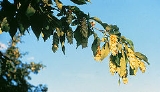
Ostrya

Encyclopedia
Ostrya is a genus
of eight to ten small deciduous
tree
s belonging to the birch family Betulaceae
. Its common name is Hophornbeam in American English and Hop-hornbeam in British English. It may also be called ironwood
, a name shared with a number of other plants.
The genus is native in southern Europe
, southwest and eastern Asia
, and North
and Central America
. They have a conical or irregular crown and a scaly, rough bark. They have alternate and double-toothed birch
-like leaves
3–10 cm long. The flower
s are produced in spring, with male catkins 5–10 cm long and female catkins 2–5 cm long. The fruit
form in pendulous clusters 3–8 cm long with 6–20 seed
s; each seed is a small nut
2–4 mm long, fully enclosed in a bladder-like involucre
.
The wood
is very hard and heavy; the name Ostrya is derived from the Greek word 'ostrua', "bone
-like", referring to the very hard wood. Regarded as a weed tree by some foresters, this hard and stable wood was historically used to fashion plane
soles.
Ostrya species are used as food plants by the larva
e of some Lepidoptera
species including Winter Moth
(Operophtera brumata), Walnut Sphinx (Amorpha juglandis) and Coleophora ostryae
.
Genus
In biology, a genus is a low-level taxonomic rank used in the biological classification of living and fossil organisms, which is an example of definition by genus and differentia...
of eight to ten small deciduous
Deciduous
Deciduous means "falling off at maturity" or "tending to fall off", and is typically used in reference to trees or shrubs that lose their leaves seasonally, and to the shedding of other plant structures such as petals after flowering or fruit when ripe...
tree
Tree
A tree is a perennial woody plant. It is most often defined as a woody plant that has many secondary branches supported clear of the ground on a single main stem or trunk with clear apical dominance. A minimum height specification at maturity is cited by some authors, varying from 3 m to...
s belonging to the birch family Betulaceae
Betulaceae
Betulaceae, or the Birch Family, includes six genera of deciduous nut-bearing trees and shrubs, including the birches, alders, hazels, hornbeams and hop-hornbeams, numbering about 130 species...
. Its common name is Hophornbeam in American English and Hop-hornbeam in British English. It may also be called ironwood
Ironwood
Ironwood is a common name for a large number of woods that have a reputation for hardness. Usage of the name may include the tree that yields this wood...
, a name shared with a number of other plants.
The genus is native in southern Europe
Europe
Europe is, by convention, one of the world's seven continents. Comprising the westernmost peninsula of Eurasia, Europe is generally 'divided' from Asia to its east by the watershed divides of the Ural and Caucasus Mountains, the Ural River, the Caspian and Black Seas, and the waterways connecting...
, southwest and eastern Asia
Asia
Asia is the world's largest and most populous continent, located primarily in the eastern and northern hemispheres. It covers 8.7% of the Earth's total surface area and with approximately 3.879 billion people, it hosts 60% of the world's current human population...
, and North
North America
North America is a continent wholly within the Northern Hemisphere and almost wholly within the Western Hemisphere. It is also considered a northern subcontinent of the Americas...
and Central America
Central America
Central America is the central geographic region of the Americas. It is the southernmost, isthmian portion of the North American continent, which connects with South America on the southeast. When considered part of the unified continental model, it is considered a subcontinent...
. They have a conical or irregular crown and a scaly, rough bark. They have alternate and double-toothed birch
Birch
Birch is a tree or shrub of the genus Betula , in the family Betulaceae, closely related to the beech/oak family, Fagaceae. The Betula genus contains 30–60 known taxa...
-like leaves
Leaf
A leaf is an organ of a vascular plant, as defined in botanical terms, and in particular in plant morphology. Foliage is a mass noun that refers to leaves as a feature of plants....
3–10 cm long. The flower
Flower
A flower, sometimes known as a bloom or blossom, is the reproductive structure found in flowering plants . The biological function of a flower is to effect reproduction, usually by providing a mechanism for the union of sperm with eggs...
s are produced in spring, with male catkins 5–10 cm long and female catkins 2–5 cm long. The fruit
Fruit
In broad terms, a fruit is a structure of a plant that contains its seeds.The term has different meanings dependent on context. In non-technical usage, such as food preparation, fruit normally means the fleshy seed-associated structures of certain plants that are sweet and edible in the raw state,...
form in pendulous clusters 3–8 cm long with 6–20 seed
Seed
A seed is a small embryonic plant enclosed in a covering called the seed coat, usually with some stored food. It is the product of the ripened ovule of gymnosperm and angiosperm plants which occurs after fertilization and some growth within the mother plant...
s; each seed is a small nut
Nut (fruit)
A nut is a hard-shelled fruit of some plants having an indehiscent seed. While a wide variety of dried seeds and fruits are called nuts in English, only a certain number of them are considered by biologists to be true nuts...
2–4 mm long, fully enclosed in a bladder-like involucre
Involucre
Involucre may refer to* involucral bract, a bract, bract pair, or whorl of bracts surrounding a flower or inflorescence* a term sometimes misused for the cupule surrounding developing nuts in the Fagaceae...
.
The wood
Wood
Wood is a hard, fibrous tissue found in many trees. It has been used for hundreds of thousands of years for both fuel and as a construction material. It is an organic material, a natural composite of cellulose fibers embedded in a matrix of lignin which resists compression...
is very hard and heavy; the name Ostrya is derived from the Greek word 'ostrua', "bone
Bone
Bones are rigid organs that constitute part of the endoskeleton of vertebrates. They support, and protect the various organs of the body, produce red and white blood cells and store minerals. Bone tissue is a type of dense connective tissue...
-like", referring to the very hard wood. Regarded as a weed tree by some foresters, this hard and stable wood was historically used to fashion plane
Plane (tool)
A hand plane is a tool for shaping wood. When powered by electricity, the tool may be called a planer. Planes are used to flatten, reduce the thickness of, and impart a smooth surface to a rough piece of lumber or timber. Planing is used to produce horizontal, vertical, or inclined flat surfaces on...
soles.
Ostrya species are used as food plants by the larva
Larva
A larva is a distinct juvenile form many animals undergo before metamorphosis into adults. Animals with indirect development such as insects, amphibians, or cnidarians typically have a larval phase of their life cycle...
e of some Lepidoptera
Lepidoptera
Lepidoptera is a large order of insects that includes moths and butterflies . It is one of the most widespread and widely recognizable insect orders in the world, encompassing moths and the three superfamilies of butterflies, skipper butterflies, and moth-butterflies...
species including Winter Moth
Winter Moth
The Winter Moth is a moth of the family Geometridae. It is an abundant species of Europe and the Near East and one of very few Lepidoptera of temperate regions in which the adults are active in the depth of winter....
(Operophtera brumata), Walnut Sphinx (Amorpha juglandis) and Coleophora ostryae
Coleophora ostryae
Coleophora ostryae is a moth of the Coleophoridae family. It is found in North America, including Maryland and Ontario.The larvae feed on the leaves of Ostrya, Carpinus, Carya and Quercus species. They create a spatulate leaf case....
.
Species
- Ostrya carpinifoliaOstrya carpinifoliaOstrya carpinifolia, the Hop Hornbeam, is a tree in genus Ostrya, in the family Betulaceae, native to Europe.-Distribution:Ostrya carpinifolia is found in Italy, France, Austria, Slovenia, Greece, the Balkans, southern Switzerland and Anatolia.It is found in the medium elevations, in southern...
Scop. - European Hop-hornbeam - Ostrya chisosensis Correll - Chisos Hophornbeam, Big Bend Hophornbeam
- Ostrya guatemalensis (Winkler) Rose - Central American Hophornbeam
- Ostrya japonicaOstrya japonicaOstrya japonica is a species of tree in the Betulaceae family growing to 25 m tall. It is native to Japan, Korea and China.-Sources:* Ohwi, J. Flora of Japan, 1984. ISBN 978-0874747089...
Sarg. - Japanese Hop-hornbeam - Ostrya knowltonii Coville - Knowlton Hophornbeam, Western Hophornbeam, Wolf Hophornbeam
- Ostrya multinervis Rehd. - Central Chinese Hop-hornbeam
- Ostrya rehderianaOstrya rehderianaOstrya rehderiana is a species of plant in the Betulaceae family. It is endemic to China.-Source:* World Conservation Monitoring Centre 1998. . Downloaded on 23 August 2007....
Chun - Zhejiang Hop-hornbeam - Ostrya virginianaOstrya virginianaOstrya virginiana , is a species of Ostrya native to eastern North America, from Nova Scotia west to southern Manitoba and eastern Wyoming, southeast to northern Florida and southwest to eastern Texas and northeastern Mexico...
(Mill.) K. Koch - Eastern Hophornbeam, American Hophornbeam, Ironwood. - Ostrya yunnanensis Hu - Yunnan Hop-hornbeam
- † Ostrya oregoniana (fossil)