


Osso buco

Encyclopedia

Milan
Milan is the second-largest city in Italy and the capital city of the region of Lombardy and of the province of Milan. The city proper has a population of about 1.3 million, while its urban area, roughly coinciding with its administrative province and the bordering Province of Monza and Brianza ,...
specialty of cross-cut veal
Veal
Veal is the meat of young cattle , as opposed to meat from older cattle. Though veal can be produced from a calf of either sex and any breed, most veal comes from male calves of dairy cattle breeds...
shank
Shank (meat)
A meat shank or shin is the portion of meat around the tibia of the animal, the leg bone beneath the knee.Lamb shanks are often braised whole; veal shanks are typically cross-cut.Some dishes made using shank include:...
s braised
Braising
Braising , is a combination cooking method using both moist and dry heat; typically the food is first seared at a high temperature and then finished in a covered pot with a variable amount of liquid, resulting in a particular flavour...
with vegetables, white wine and broth. It is often garnished with gremolata
Gremolata
Gremolata or gremolada is a chopped herb condiment typically made of lemon zest, garlic, and parsley. It is a traditional accompaniment to the Milanese braised veal shank dish ossobuco alla milanese.-Ingredients:...
and traditionally served with risotto
Risotto
Risotto is a class of Italian dishes of rice cooked in broth to a creamy consistency. The broth may be meat-, fish-, or vegetable-based; many kinds include Parmesan cheese, butter, and onion...
alla milanese.
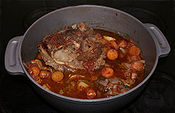
There are two types of ossobuco: a modern version that has tomatoes and the original version which does not. The older version, ossobuco in bianco, is flavored with cinnamon, bay leaf and gremolata. The modern and more popular recipe includes tomatoes, carrots, celery and onions. Gremolata is optional.
Name
Ossobuco or osso buco is Italian for "bone with a hole" (osso bone, buco hole), a reference to the marrow hole at the center of the cross-cut veal shank. In the local Western LombardWestern Lombard
Western Lombard is a Romance language spoken in Italy, in the Lombard provinces of Milan, Monza, Varese, Como, Lecco, Sondrio, a small part of Cremona , Lodi and Pavia, and the Piedmont provinces of Novara, Verbano-Cusio-Ossola and a small part of Vercelli , and Switzerland...
Milanese dialect
Milanese
Milanese is the central variety of the Western Lombard language spoken in the city and province of Milan....
, it is oss bus.
History
Ossobuco was first attested in the late 19th century. It may have been a farmhouse dish or perhaps was an invention of an osteriaOsteria
An osteria in Italy was originally a place serving wine and simple food. Lately, the emphasis has shifted to the food but menus tend to be short with local specialities such as pasta and grilled meat and fish and often served at shared tables. Ideal for a cheap lunch, osterie also cater for...
, a neighborhood restaurant of Milan.
Preparation
This dish's primary ingredient, veal shank, is common, relatively cheap and flavorful. Although tough, braising makes it tender. The cut traditionally used for this dish comes from the top of the thigh which has a higher proportion of meat to bone. The shank is then cross-cut into sections about 3 cm thick.Although recipes vary, most start by browning the veal shanks in butter after dredging them in flour, while others recommend vegetable oil or lard. The braising liquid is usually a combination of white wine and meat broth
Broth
Broth is a liquid food preparation, typically consisting of either water or an already flavored stock, in which bones, meat, fish, cereal grains, or vegetables have been simmered. Broth is used as a basis for other edible liquids such as soup, gravy, or sauce. It can be eaten alone or with garnish...
flavored with vegetables.
Accompaniments
Risotto alla milanese is the traditional accompaniment to ossobuco in bianco, making for a one-dish meal. Ossobuco (especially the tomato-based version) is also eaten with polentaPolenta
Polenta is a dish made from boiled cornmeal. The word "polenta" is borrowed from Italian.-Description:Polenta is made with ground yellow or white cornmeal , which can be ground coarsely or finely depending on the region and the texture desired.As it is known today, polenta derives from earlier...
or mashed potatoes. Outside Milan, it is sometimes served with pasta.