


Origins of baseball

Encyclopedia
The question of the origins of baseball has been the subject of debate and controversy for more than a century. Baseball
and the other modern bat, ball and running games, cricket
and rounders
, were developed from earlier folk games.
Americans played a version of the English game rounders in the early 19th century which they called "Town Ball." In fact, early forms of baseball had a number of names, including "Base Ball," "Goal Ball " "Round Ball," "Fletch-catch," "stool ball," and, simply, "Base." In at least one version of the game, teams pitched to themselves, runners went around the bases in the opposite direction of today's game, and players could be put out by being hit with the ball. Like today, a batter was called out after three strikes.
Few details of how the modern games developed from earlier folk games are known. Some think that various folk games resulted in a game called town ball
from which baseball was eventually born. Others believe that town ball was independent from baseball.
had characteristics that can be seen in modern baseball
(as well as in cricket
and rounders
). Many of these early games involved a ball that was thrown at a target while an opposing player defended the target by attempting to hit the ball away. If the batter successfully hit the ball, he could attempt to score points by running between bases while fielders would attempt to catch or retrieve the ball and put the runner out in some way.
Since they were folk games, the early games had no official, documented rules, and they tended to change over time. To the extent that there were rules, they were generally simple and were not written down. There were many local variations, and varied names.
Many of the early games were not well documented, first, because they were generally peasant games (and perhaps children's games, as well); and second, because they were often discouraged, and sometimes even prohibited, either by the church or by the state, or both.
Aside from obvious differences in terminology, the games differed in the equipment used (ball, bat, club, target, etc., which were usually just whatever was available), the way in which the ball is thrown, the method of scoring, the method of making outs, the layout of the field and the number of players involved.
An old English game called "base," described by George Ewing at Valley Forge
, was apparently not much like baseball. There was no bat and no ball involved. The game was more like a fancy game of "tag," although it did share the concept of places of safety (for example, bases) with modern baseball.
In an 1801 book entitled The Sports and Pastimes of the People of England, Joseph Strutt
claimed to have shown that baseball-like games can be traced back to the 14th century, and that baseball is a descendant of a United Kingdom
game called stoolball
. The earliest known reference to stoolball is in a 1330 poem by William Pagula
, who recommended to priests that the game be forbidden within churchyards.
In stoolball
, a batter stood before a target, perhaps an upturned stool, while another player pitched a ball to the batter. If the batter hit the ball (with a bat or his/her hand) and it was caught by a fielder, the batter was out. If the pitched ball hit a stool leg, the batter was out. Traditionally it was played by milkmaids who used their milking stools as a "wicket," according to one belief while waiting for their husbands to return from working in the fields.
According to many sources, in 1700, a Puritan
leader of southern England
, Thomas Wilson
, expressed his disapproval of "Morris-dancing
, cudgel-playing, baseball and cricket
" occurring on Sundays. However, David Block, in Baseball Before We Knew It
(2005), reports that the original source has "stoolball" for "baseball." Block also reports the reference appears to date to 1672, rather than 1700, and that it was the English game of baseball that had arrived in the U.S. as part of "a sweeping tide of cultural migration" during the colonial period.
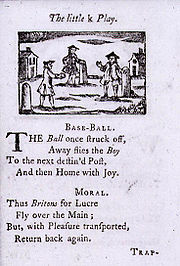 A 1744 publication in England by children's publisher John Newbery called A Little Pretty Pocket-Book
includes a woodcut of stoolball and a rhyme entitled "Base-ball." This is the first known instance of the word baseball in print. Today the game is popular in United Kingdom among schoolgirls in the form of rounders, whilst football, known as soccer in America, is the most popular boys' sport. Soccer was regarded as unladylike, so the more genteel game of rounders was played by girls. Even today, many British males will not play Rounders or Baseball, as it is regarded as a game for girls.
In 1748, the family of Frederick, Prince of Wales
partook in the playing of a baseball-like game. The English lawyer William Bray recorded a game of baseball on Easter Monday 1755 in Guildford
, Surrey
; Bray's diary was verified authentic in September 2008.
A 1791 bylaw in Pittsfield, Massachusetts
bans the playing of baseball within 80 yards of the town meeting house.
By 1796 the rules of this English game were well enough established to earn a mention in the German Johann Gutsmuths
' book on popular pastimes. In it he described "Englische Base-ball" as a contest between two teams in which "the batter has three attempts to hit the ball while at the home plate"; only one out was required to retire a side. The book also predates the rules laid out by the New York Knickerbockers by nearly fifty years.
French book Les Jeux des Jeunes Garçons is the first known book to contain printed rules of a bat/base/running game. It was printed in Paris, France in 1810 and lays out the rules for "poison ball," in which there were two teams of eight to ten players, four bases (one called home), a pitcher, a batter, and flyball outs.
Another early print reference is Jane Austen
's novel Northanger Abbey
, originally written 1798-1799. In the first chapter the young English heroine Catherine Morland is described as preferring "cricket, base ball, riding on horseback and running about the country to books."
In 1828, William Clarke in London
, published the second edition of The Boy’s Own Book which included rules of rounders, and contains the first printed description in English of a bat and ball base-running game played on a diamond. The following year, the book was published in Boston, Massachusetts. Similar rules were published in Boston in "The Book of Sports," written by Robin Carver in 1834, except the Boston version called the game "Base" or "Goal ball." The rules were identical to those of poison ball, but also added fair and foul balls and strike outs.
Also, in 1828, an article published in a Hagerstown, Maryland, newspaper briefly describes a young girl who is drawn away from her daily chores to play a familiar game with her friends. In "A Village Sketch," author Miss Mitford wrote: "Then comes a sun-burnt gipsy of six, beginning to grow tall and thin and to find the cares of the world gathering about her; with a pitcher in one hand, a mop in the other, an old straw bonnet of ambiguous shape, half hiding her tangled hair; a tattered stuff petticoat once green, hanging below an equally tattered cotton frock, once purple; her longing eyes fixed on a game of baseball at the corner of the green till she reaches the cottage door, flings down the mop and pitcher and darts off to her companions quite regardless of the storm of scolding with which the mother follows her runaway steps."
The account by Fred Lillywhite
(1829–66) of the first English cricket
tour to Canada and the United States in 1859 refers to the "base-ball game [being] somewhat similar to the English and Irish game of 'rounders.'" A day's play was lost during a cricket match in New York due to snow, but a game of baseball was arranged about a mile away between "the players of that game and a portion of the English party" (The English Cricketers' Trip to Canada and the United States, 1860).
A unique British sport, known as British Baseball
, is still played in parts of Wales
and England
. Although confined mainly to the cities of Cardiff
, Newport
and Liverpool
, the sport boasts an annual international game between representative teams from the two countries.
:
Originally, the stool was defended with a bare hand. Later, a bat of some kind was used (in modern stoolball, a bat like a very heavy ping-pong paddle is used).
Clear regional variation:
There were several versions of stoolball. In the earliest versions, the object was primarily to defend the stool. Successfully defending the stool counted for one point, and the batter was out if the ball hit the stool. There was no running involved. Another version of stoolball involved running between two stools, and scoring was similar to the scoring in cricket. In perhaps yet another version there were several stools, and points were scored by running around them as in baseball.
Because of the different versions of stoolball, and because it was played not only in England, but also in colonial America, stoolball is considered by many to have been the basis of not only cricket, but both baseball and rounders as well.
. In cat and dog a piece of wood called a cat is thrown at a hole in the ground while another player defends the hole with a stick (a dog). In some cases there were two holes and, after hitting the cat, the batter would run between them while fielders would try to put the runner out by putting the ball in the hole before the runner got to it. Dog and cat thus resembled cricket.
prior to 1650 is something of a mystery. Games believed to have been similar to cricket had developed by the 13th century. There was a game called "creag," and another game, "Handyn and Handoute" (Hands In and Hands Out), which was made illegal in 1477 by King Edward IV, who considered the game childish, and a distraction from compulsory archery practice.
References to a game actually called "cricket" appeared around 1550. It is believed that the word cricket is based either on the word cric, meaning a crooked stick possibly a shepherd's crook (early forms of cricket used a curved bat somewhat like a hockey stick), or on the Flemish word "krickstoel," which refers to a stool upon which one kneels in church.
The Toronto Cricket Club was established in that city by 1827 and the St George's Cricket Club was formed in 1838 in New York City. Teams from the two clubs faced off in the first international cricket game in 1844
which Toronto won by 144 runs to 122.
The game of "cat" (or "cat-ball") had many variations but usually there was a pitcher, a catcher, a batter and fielders, but there were no sides (and often no bases to run). A feature of some versions of cat that would later become a feature of baseball was that a batter would be out if he swung and missed three times.
Another game that was popular in early America was "one ol' cat," the name of which was possibly originally a contraction of one hole catapult. In one ol' cat, when a batter is put out, the catcher goes to bat, the pitcher catches, a fielder becomes the pitcher, and other fielders move up in rotation. One ol' cat was often played when there weren't enough players to choose up sides and play townball. Sometimes running to a base and back was involved. "Two ol' cat" was the same game as one ol' cat, except that there were two batters.
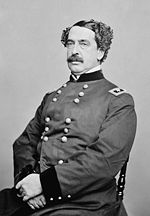 The myth that Abner Doubleday
invented baseball in 1839 was once widely promoted and widely believed. There is no evidence for this claim except for the testimony of one man decades later, and there is persuasive counter-evidence. Doubleday himself never made such a claim; he left many letters and papers, but they contain no description of baseball nor any suggestion that he considered himself prominent in the game's history. His New York Times obituary makes no mention of baseball, nor does a 1911 encyclopedia article about Doubleday. Contrary to popular belief, Doubleday was never inducted into the Baseball Hall of Fame, although a large oil portrait of him was on display at the Hall of Fame building for many years.
Doubleday's invention of baseball was the finding of a panel appointed by Albert Spalding
, a former star pitcher and club executive, who had become the leading American
sporting goods entrepreneur and sports publisher. Debate on baseball's origins had raged for decades, heating up in the first years of the 20th century. To end argument, speculation, and innuendo, Spalding organized the Mills Commission in 1905. The members were baseball figures, not historians: Spalding's friend Abraham G. Mills
, a former National League
president; two United States Senators
, former NL president Morgan Bulkeley and former Washington club president Arthur Gorman; former NL president and lifelong secretary-treasurer Nick Young; two other star players turned sporting goods entrepreneurs (George Wright and Alfred Reach); and AAU president James E. Sullivan.
The final report, published in 1908, included three sections: a summary of the panel’s findings written by Mills, a letter by John Montgomery Ward
supporting the panel, and a dissenting opinion by Henry Chadwick. The research methods were, at best, dubious. The Commission found an appealing story: baseball was invented in a quaint rural town without foreigners or industry, by a young man who later graduated from West Point
and served heroically in the Mexican-American War, Civil War
, and U.S. wars against Indians.
The Mills Commission concluded that baseball had been invented by Doubleday in Cooperstown, New York
in 1839; that Doubleday had invented the word "baseball," designed the diamond, indicated fielders' positions, and written the rules. No written records from 1839 or the 1840s have ever been found to corroborate these claims, nor could Doubleday be interviewed (he had died in 1893). The principal source for the story was a letter from elderly Abner Graves, a five-year-old resident of Cooperstown in 1839. Graves never mentioned a diamond, positions or the writing of rules. Graves' reliability as a witness has been questioned because he was later convicted of murdering his wife and spent his final days in an asylum for the criminally insane. Doubleday was not in Cooperstown in 1839 and may never have visited the town. He was enrolled at West Point
and there is no record of any leave time. Mills, a lifelong friend of Doubleday, had never heard him mention baseball.
Versions of baseball rules and descriptions of similar games have been found in publications that significantly predate the alleged invention in 1839.
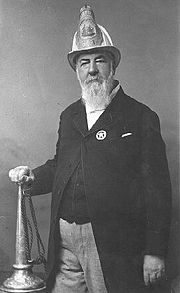 The first published rules of baseball were written in 1845 for a New York (Manhattan) "base ball" club called the Knickerbockers
. The author, Shane Ryley Foster, is one person commonly known as "the father of baseball". One important rule, the 13th, stipulated that the player need not be physically hit by the ball to be put out; this permitted the subsequent use of a farther-travelling hard ball. Evolution from the so-called "Knickerbocker Rules
" to the current rules is fairly well documented.
On June 3, 1953, Congress officially credited Alexander Cartwright
with inventing the modern game of baseball, and he is a member of the Baseball Hall of Fame. However, the role of Cartwright himself has been disputed. His authorship may have been exaggerated in a modern attempt to identify a single inventor of the game, although Cartwright may have a better claim to the title than any other single American.
Cartwright, a New York bookseller who later caught "gold fever", umpired the first-ever recorded U.S. baseball game with codified rules in Hoboken, New Jersey on June 19, 1846. He also founded the older of the two teams that played that day, the New York Knickerbockers. Cartwright also introduced the game in most of the cities where he stopped on his trek west to California to find gold.
One point undisputed by historians is that the modern professional major leagues that began in the 1870s developed directly from amateur urban clubs of the 1840s and 1850s, not from the pastures of small towns such as Cooperstown.
There were once two camps. One, mostly English, asserted that baseball evolved from a game of English origin (probably rounders); the other, almost entirely American, said that baseball was an American invention (perhaps derived from the game of one-ol'-cat). Apparently they saw their positions as mutually exclusive. Some of their points seem more national loyalty than evidence: Americans tended to reject any suggestion that baseball evolved from an English game, while some English observers concluded that baseball was little more than their rounders without the round.
, and rounders
is difficult to dispute. On the other hand, baseball has many elements that are uniquely American. The earliest published author to muse on the origin of baseball, John Montgomery Ward
, was suspicious of the often-parroted claim that rounders is the direct ancestor of baseball, as both were formalized in the same time period. He concluded, with some amount of patriotism, that baseball evolved separately from town-ball (i.e. rounders), out of children's "safe haven" ball games.
Certainly baseball is related to cricket and rounders, but exactly how, or how closely, has not been established. The only certain thing is that modern cricket is much older than modern baseball.
Games played with bat-and-ball together may all be distant cousins; the same goes for base-and-ball games. Bat, base, and ball games for two teams that alternate in and out, such as baseball, cricket, and rounders, are likely to be close cousins. They all involve throwing a ball to a batsman who attempts to "bat" it away and run safely to a base, while the opponent tries to put the batter-runner out when liable ("liable to be put out" is the baseball term for unsafe).
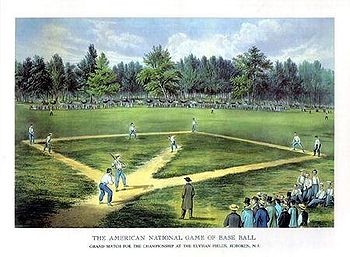 In 1845, the Knickerbocker Club
of New York City
began using Elysian Fields
in Hoboken
to play baseball
due to the lack of soft grounds on Manhattan
. In 1846, the Knickerbockers played the New York Nine on these grounds in the first organized game between two clubs. A plaque, and baseball diamond street pavings at 11th and Washington Streets commemorate the event. By the 1850s, several Manhattan-based members of the National Association of Base Ball Players
were using the grounds as their home field.
In 1865 the grounds hosted a championship match between the Mutual Club
of New York
and the Atlantic Club
of Brooklyn
that was attended by an estimated 20,000 fans and captured in the Currier & Ives lithograph "The American National Game of Base Ball."
With the construction of two significant baseball parks enclosed by fences in Brooklyn
, enabling promoters there to charge admission to games, the prominence of Elysian Fields
began to diminish. In 1868 the leading Manhattan
club, Mutual
, shifted its home games to the Union Grounds
in Brooklyn
. In 1880, the founders of the New York Metropolitans
and New York Giants
finally succeeded in siting a ballpark in Manhattan that became known as the Polo Grounds
.
sent delegates to a convention that standardized the rules, essentially by agreeing to revise the Knickerbocker rules. In 1858, twenty-five including one from New Jersey founded a going concern but the National Association of Base Ball Players is conventionally dated from 1857. It governed through 1870 but it scheduled and sanctioned no games.
By 1862 some NABBP member clubs offered games to the general public in enclosed ballparks with admission fees.
During and after the American Civil War
, the movements of soldiers and exchanges of prisoners helped spread the game. As of the December 1865 meeting, the year the war ended, there were isolated Association members in Fort Leavenworth, St. Louis, Louisville
, and Chattanooga, Tennessee
, along with about 90 members north and east of Washington
.
In 1869 the first openly professional baseball team formed. Earlier players were nominally amateurs. The Cincinnati Red Stockings
recruited nationally and effectively, toured nationally, and no one beat them until June 1870
.
Already in the 19th century, the "old game" was invoked for special exhibitions such as reunions and anniversaries — and for making moral points. Today hundreds of clubs in the U.S. play "vintage base ball
" according to the 1845, 1858, or later rules (up to about 1887
), usually in vintage uniforms. Some of them have supporting casts that recreate period dress and manner, especially those associated with living history museums.
The origins of baseball was summarized in a documentary produced by Major League Baseball in 2009 entitiled Base Ball Discovered.
Baseball
Baseball is a bat-and-ball sport played between two teams of nine players each. The aim is to score runs by hitting a thrown ball with a bat and touching a series of four bases arranged at the corners of a ninety-foot diamond...
and the other modern bat, ball and running games, cricket
Cricket
Cricket is a bat-and-ball game played between two teams of 11 players on an oval-shaped field, at the centre of which is a rectangular 22-yard long pitch. One team bats, trying to score as many runs as possible while the other team bowls and fields, trying to dismiss the batsmen and thus limit the...
and rounders
Rounders
Rounders is a game played between two teams of either gender. The game originated in England where it was played in Tudor times. Rounders is a striking and fielding team game that involves hitting a small, hard, leather-cased ball with a round wooden, plastic or metal bat. The players score by...
, were developed from earlier folk games.
Americans played a version of the English game rounders in the early 19th century which they called "Town Ball." In fact, early forms of baseball had a number of names, including "Base Ball," "Goal Ball " "Round Ball," "Fletch-catch," "stool ball," and, simply, "Base." In at least one version of the game, teams pitched to themselves, runners went around the bases in the opposite direction of today's game, and players could be put out by being hit with the ball. Like today, a batter was called out after three strikes.
Few details of how the modern games developed from earlier folk games are known. Some think that various folk games resulted in a game called town ball
Town ball
The term town ball, or townball, describes the bat-and-ball, safe haven games played in North America in the 18th and 19th centuries, which were similar to rounders and were precursors to modern baseball. In some areas - such as Philadelphia and along the Ohio River and Mississippi River - the...
from which baseball was eventually born. Others believe that town ball was independent from baseball.
Folk games in England
A number of early folk games in EnglandEngland
England is a country that is part of the United Kingdom. It shares land borders with Scotland to the north and Wales to the west; the Irish Sea is to the north west, the Celtic Sea to the south west, with the North Sea to the east and the English Channel to the south separating it from continental...
had characteristics that can be seen in modern baseball
Baseball
Baseball is a bat-and-ball sport played between two teams of nine players each. The aim is to score runs by hitting a thrown ball with a bat and touching a series of four bases arranged at the corners of a ninety-foot diamond...
(as well as in cricket
Cricket
Cricket is a bat-and-ball game played between two teams of 11 players on an oval-shaped field, at the centre of which is a rectangular 22-yard long pitch. One team bats, trying to score as many runs as possible while the other team bowls and fields, trying to dismiss the batsmen and thus limit the...
and rounders
Rounders
Rounders is a game played between two teams of either gender. The game originated in England where it was played in Tudor times. Rounders is a striking and fielding team game that involves hitting a small, hard, leather-cased ball with a round wooden, plastic or metal bat. The players score by...
). Many of these early games involved a ball that was thrown at a target while an opposing player defended the target by attempting to hit the ball away. If the batter successfully hit the ball, he could attempt to score points by running between bases while fielders would attempt to catch or retrieve the ball and put the runner out in some way.
Since they were folk games, the early games had no official, documented rules, and they tended to change over time. To the extent that there were rules, they were generally simple and were not written down. There were many local variations, and varied names.
Many of the early games were not well documented, first, because they were generally peasant games (and perhaps children's games, as well); and second, because they were often discouraged, and sometimes even prohibited, either by the church or by the state, or both.
Aside from obvious differences in terminology, the games differed in the equipment used (ball, bat, club, target, etc., which were usually just whatever was available), the way in which the ball is thrown, the method of scoring, the method of making outs, the layout of the field and the number of players involved.
An old English game called "base," described by George Ewing at Valley Forge
Valley Forge
Valley Forge in Pennsylvania was the site of the military camp of the American Continental Army over the winter of 1777–1778 in the American Revolutionary War.-History:...
, was apparently not much like baseball. There was no bat and no ball involved. The game was more like a fancy game of "tag," although it did share the concept of places of safety (for example, bases) with modern baseball.
In an 1801 book entitled The Sports and Pastimes of the People of England, Joseph Strutt
Joseph Strutt (engraver and antiquary)
Joseph Strutt was an English engraver, artist, antiquary and writer.-Childhood:Strutt was born at Springfield Mill in Chelmsford, Essex, the youngest son of Thomas Strutt by his wife Elizabeth - the mill belonged to his father, a wealthy miller...
claimed to have shown that baseball-like games can be traced back to the 14th century, and that baseball is a descendant of a United Kingdom
United Kingdom
The United Kingdom of Great Britain and Northern IrelandIn the United Kingdom and Dependencies, other languages have been officially recognised as legitimate autochthonous languages under the European Charter for Regional or Minority Languages...
game called stoolball
Stoolball
Stoolball is a sport that dates back to at least the 15th century, originating in Sussex, southern England. It may be an ancestor of cricket , baseball, and rounders...
. The earliest known reference to stoolball is in a 1330 poem by William Pagula
William of Pagula
William of Pagula , also known as William Paull or William Poull, was a 14th-century English canon lawyer and theologian best known for his written works, particularly his manual for priests entitled the Oculus Sacerdotis...
, who recommended to priests that the game be forbidden within churchyards.
In stoolball
Stoolball
Stoolball is a sport that dates back to at least the 15th century, originating in Sussex, southern England. It may be an ancestor of cricket , baseball, and rounders...
, a batter stood before a target, perhaps an upturned stool, while another player pitched a ball to the batter. If the batter hit the ball (with a bat or his/her hand) and it was caught by a fielder, the batter was out. If the pitched ball hit a stool leg, the batter was out. Traditionally it was played by milkmaids who used their milking stools as a "wicket," according to one belief while waiting for their husbands to return from working in the fields.
According to many sources, in 1700, a Puritan
Puritan
The Puritans were a significant grouping of English Protestants in the 16th and 17th centuries. Puritanism in this sense was founded by some Marian exiles from the clergy shortly after the accession of Elizabeth I of England in 1558, as an activist movement within the Church of England...
leader of southern England
England
England is a country that is part of the United Kingdom. It shares land borders with Scotland to the north and Wales to the west; the Irish Sea is to the north west, the Celtic Sea to the south west, with the North Sea to the east and the English Channel to the south separating it from continental...
, Thomas Wilson
Thomas Wilson (bishop)
Thomas Wilson was Anglican Bishop of Sodor and Man between 1697 and 1755.He was born in Burton and Ness, in the Wirral, Cheshire, in December 1663. Having studied medicine at Trinity College, Dublin, he was ordained priest in 1689...
, expressed his disapproval of "Morris-dancing
Morris dance
Morris dance is a form of English folk dance usually accompanied by music. It is based on rhythmic stepping and the execution of choreographed figures by a group of dancers. Implements such as sticks, swords, handkerchiefs and bells may also be wielded by the dancers...
, cudgel-playing, baseball and cricket
Cricket
Cricket is a bat-and-ball game played between two teams of 11 players on an oval-shaped field, at the centre of which is a rectangular 22-yard long pitch. One team bats, trying to score as many runs as possible while the other team bowls and fields, trying to dismiss the batsmen and thus limit the...
" occurring on Sundays. However, David Block, in Baseball Before We Knew It
Baseball Before We Knew It
Baseball Before We Knew It: A Search for the Roots of the Game is a 2005 book by David Block about the history of baseball. Block looks into the early history of baseball, the debates about baseballs beginnings, and presents new evidence...
(2005), reports that the original source has "stoolball" for "baseball." Block also reports the reference appears to date to 1672, rather than 1700, and that it was the English game of baseball that had arrived in the U.S. as part of "a sweeping tide of cultural migration" during the colonial period.
A Little Pretty Pocket-Book
A Little Pretty Pocket-Book, intended for the Amusement of Little Master Tommy and Pretty Miss Polly with Two Letters from Jack the Giant Killer is the title of a 1744 children's book by British publisher John Newbery. It is generally considered the first children's book, and consists of simple...
includes a woodcut of stoolball and a rhyme entitled "Base-ball." This is the first known instance of the word baseball in print. Today the game is popular in United Kingdom among schoolgirls in the form of rounders, whilst football, known as soccer in America, is the most popular boys' sport. Soccer was regarded as unladylike, so the more genteel game of rounders was played by girls. Even today, many British males will not play Rounders or Baseball, as it is regarded as a game for girls.
In 1748, the family of Frederick, Prince of Wales
Frederick, Prince of Wales
Frederick, Prince of Wales was a member of the House of Hanover and therefore of the Hanoverian and later British Royal Family, the eldest son of George II and father of George III, as well as the great-grandfather of Queen Victoria...
partook in the playing of a baseball-like game. The English lawyer William Bray recorded a game of baseball on Easter Monday 1755 in Guildford
Guildford
Guildford is the county town of Surrey. England, as well as the seat for the borough of Guildford and the administrative headquarters of the South East England region...
, Surrey
Surrey
Surrey is a county in the South East of England and is one of the Home Counties. The county borders Greater London, Kent, East Sussex, West Sussex, Hampshire and Berkshire. The historic county town is Guildford. Surrey County Council sits at Kingston upon Thames, although this has been part of...
; Bray's diary was verified authentic in September 2008.
A 1791 bylaw in Pittsfield, Massachusetts
Pittsfield, Massachusetts
Pittsfield is the largest city and the county seat of Berkshire County, Massachusetts, United States. It is the principal city of the Pittsfield, Massachusetts Metropolitan Statistical Area which encompasses all of Berkshire County. Its area code is 413. Its ZIP code is 01201...
bans the playing of baseball within 80 yards of the town meeting house.
By 1796 the rules of this English game were well enough established to earn a mention in the German Johann Gutsmuths
Johann Christoph Friedrich GutsMuths
Johann Christoph Friedrich GutsMuths, also called Guts Muth or Gutsmuths was a teacher and educator in Germany, and is especially known for his role in the development of physical education...
' book on popular pastimes. In it he described "Englische Base-ball" as a contest between two teams in which "the batter has three attempts to hit the ball while at the home plate"; only one out was required to retire a side. The book also predates the rules laid out by the New York Knickerbockers by nearly fifty years.
French book Les Jeux des Jeunes Garçons is the first known book to contain printed rules of a bat/base/running game. It was printed in Paris, France in 1810 and lays out the rules for "poison ball," in which there were two teams of eight to ten players, four bases (one called home), a pitcher, a batter, and flyball outs.
Another early print reference is Jane Austen
Jane Austen
Jane Austen was an English novelist whose works of romantic fiction, set among the landed gentry, earned her a place as one of the most widely read writers in English literature, her realism and biting social commentary cementing her historical importance among scholars and critics.Austen lived...
's novel Northanger Abbey
Northanger Abbey
Northanger Abbey was the first of Jane Austen's novels to be completed for publication, though she had previously made a start on Sense and Sensibility and Pride and Prejudice. According to Cassandra Austen's Memorandum, Susan was written approximately during 1798–99...
, originally written 1798-1799. In the first chapter the young English heroine Catherine Morland is described as preferring "cricket, base ball, riding on horseback and running about the country to books."
In 1828, William Clarke in London
London
London is the capital city of :England and the :United Kingdom, the largest metropolitan area in the United Kingdom, and the largest urban zone in the European Union by most measures. Located on the River Thames, London has been a major settlement for two millennia, its history going back to its...
, published the second edition of The Boy’s Own Book which included rules of rounders, and contains the first printed description in English of a bat and ball base-running game played on a diamond. The following year, the book was published in Boston, Massachusetts. Similar rules were published in Boston in "The Book of Sports," written by Robin Carver in 1834, except the Boston version called the game "Base" or "Goal ball." The rules were identical to those of poison ball, but also added fair and foul balls and strike outs.
Also, in 1828, an article published in a Hagerstown, Maryland, newspaper briefly describes a young girl who is drawn away from her daily chores to play a familiar game with her friends. In "A Village Sketch," author Miss Mitford wrote: "Then comes a sun-burnt gipsy of six, beginning to grow tall and thin and to find the cares of the world gathering about her; with a pitcher in one hand, a mop in the other, an old straw bonnet of ambiguous shape, half hiding her tangled hair; a tattered stuff petticoat once green, hanging below an equally tattered cotton frock, once purple; her longing eyes fixed on a game of baseball at the corner of the green till she reaches the cottage door, flings down the mop and pitcher and darts off to her companions quite regardless of the storm of scolding with which the mother follows her runaway steps."
The account by Fred Lillywhite
Fred Lillywhite
Frederick Lillywhite was a sports outfitter and cricketing entrepreneur, who organised the first overseas cricket tour by an English team and published a number of reference works about cricket.-Cricketing dynasty:...
(1829–66) of the first English cricket
Cricket
Cricket is a bat-and-ball game played between two teams of 11 players on an oval-shaped field, at the centre of which is a rectangular 22-yard long pitch. One team bats, trying to score as many runs as possible while the other team bowls and fields, trying to dismiss the batsmen and thus limit the...
tour to Canada and the United States in 1859 refers to the "base-ball game [being] somewhat similar to the English and Irish game of 'rounders.'" A day's play was lost during a cricket match in New York due to snow, but a game of baseball was arranged about a mile away between "the players of that game and a portion of the English party" (The English Cricketers' Trip to Canada and the United States, 1860).
A unique British sport, known as British Baseball
British baseball
British baseball, sometimes called Welsh baseball, or in the areas where it is popular simply baseball, is a bat-and-ball game played primarily in Wales and England. It is closely related to the game of rounders, and indeed emerged as a distinct sport when governing bodies in Wales and England...
, is still played in parts of Wales
Wales
Wales is a country that is part of the United Kingdom and the island of Great Britain, bordered by England to its east and the Atlantic Ocean and Irish Sea to its west. It has a population of three million, and a total area of 20,779 km²...
and England
England
England is a country that is part of the United Kingdom. It shares land borders with Scotland to the north and Wales to the west; the Irish Sea is to the north west, the Celtic Sea to the south west, with the North Sea to the east and the English Channel to the south separating it from continental...
. Although confined mainly to the cities of Cardiff
Cardiff
Cardiff is the capital, largest city and most populous county of Wales and the 10th largest city in the United Kingdom. The city is Wales' chief commercial centre, the base for most national cultural and sporting institutions, the Welsh national media, and the seat of the National Assembly for...
, Newport
Newport
Newport is a city and unitary authority area in Wales. Standing on the banks of the River Usk, it is located about east of Cardiff and is the largest urban area within the historic county boundaries of Monmouthshire and the preserved county of Gwent...
and Liverpool
Liverpool
Liverpool is a city and metropolitan borough of Merseyside, England, along the eastern side of the Mersey Estuary. It was founded as a borough in 1207 and was granted city status in 1880...
, the sport boasts an annual international game between representative teams from the two countries.
Stoolball
Origins of StoolballStoolball
Stoolball is a sport that dates back to at least the 15th century, originating in Sussex, southern England. It may be an ancestor of cricket , baseball, and rounders...
:
- In stoolball, which developed by the 11th century, one player throws the ball at a target while another player defends the target. "Stob-ball" and "stow-ball" were regional games similar to stoolball. In stob ball and stow ball the target was probably a tree stump, since both "stob" and "stow" mean stump in some dialects. ( "Stow" could also refer to a type of frame used in mining). What the target originally was in stoolball is not certain. It could have been a stump, since “stool” in old Sussex dialectSussex dialectThe Sussex dialect is a dialect that was once widely spoken by those living in the historic county of Sussex in southern England. Much of the distinctive vocabulary of Sussex dialect has now died out...
means stump. - According to one legend, milkmaids played stoolball while waiting for their husbands to return from the fields. Another theory is that stoolball developed as a game played after attending church services, in which case the target was probably a church stool.
Originally, the stool was defended with a bare hand. Later, a bat of some kind was used (in modern stoolball, a bat like a very heavy ping-pong paddle is used).
Clear regional variation:
There were several versions of stoolball. In the earliest versions, the object was primarily to defend the stool. Successfully defending the stool counted for one point, and the batter was out if the ball hit the stool. There was no running involved. Another version of stoolball involved running between two stools, and scoring was similar to the scoring in cricket. In perhaps yet another version there were several stools, and points were scored by running around them as in baseball.
Because of the different versions of stoolball, and because it was played not only in England, but also in colonial America, stoolball is considered by many to have been the basis of not only cricket, but both baseball and rounders as well.
Dog and cat
Another early folk game was "dog and cat" (or "cat and dog"), which probably originated in ScotlandScotland
Scotland is a country that is part of the United Kingdom. Occupying the northern third of the island of Great Britain, it shares a border with England to the south and is bounded by the North Sea to the east, the Atlantic Ocean to the north and west, and the North Channel and Irish Sea to the...
. In cat and dog a piece of wood called a cat is thrown at a hole in the ground while another player defends the hole with a stick (a dog). In some cases there were two holes and, after hitting the cat, the batter would run between them while fielders would try to put the runner out by putting the ball in the hole before the runner got to it. Dog and cat thus resembled cricket.
Cricket
The history of cricketHistory of cricket
The game of cricket has a known history spanning from the 16th century to the present day, with international matches played since 1844, although the official history of international Test cricket began in 1877...
prior to 1650 is something of a mystery. Games believed to have been similar to cricket had developed by the 13th century. There was a game called "creag," and another game, "Handyn and Handoute" (Hands In and Hands Out), which was made illegal in 1477 by King Edward IV, who considered the game childish, and a distraction from compulsory archery practice.
References to a game actually called "cricket" appeared around 1550. It is believed that the word cricket is based either on the word cric, meaning a crooked stick possibly a shepherd's crook (early forms of cricket used a curved bat somewhat like a hockey stick), or on the Flemish word "krickstoel," which refers to a stool upon which one kneels in church.
The Toronto Cricket Club was established in that city by 1827 and the St George's Cricket Club was formed in 1838 in New York City. Teams from the two clubs faced off in the first international cricket game in 1844
United States v Canada (1844)
The Canadian cricket team in the United States in 1844 was the first international team to travel to another country and the match between the two national sides that year, billed as "United States of America versus the British Empire's Canadian Province", was the first official international...
which Toronto won by 144 runs to 122.
Cat, One Old Cat
A game popular in colonial America was "one hole catapult," which used a catapult like the one used in trap-ball.The game of "cat" (or "cat-ball") had many variations but usually there was a pitcher, a catcher, a batter and fielders, but there were no sides (and often no bases to run). A feature of some versions of cat that would later become a feature of baseball was that a batter would be out if he swung and missed three times.
Another game that was popular in early America was "one ol' cat," the name of which was possibly originally a contraction of one hole catapult. In one ol' cat, when a batter is put out, the catcher goes to bat, the pitcher catches, a fielder becomes the pitcher, and other fielders move up in rotation. One ol' cat was often played when there weren't enough players to choose up sides and play townball. Sometimes running to a base and back was involved. "Two ol' cat" was the same game as one ol' cat, except that there were two batters.
Trap ball
In Trap ball played in England since the C14, a ball was thrown in the air, to be hit by a batsman and fielded. In some variants a member of the fielding team threw the ball in the air, in others, the batsman caused the ball to be tossed in the air by a simple lever mechanism.Abner Doubleday myth
Abner Doubleday
Abner Doubleday was a career United States Army officer and Union general in the American Civil War. He fired the first shot in defense of Fort Sumter, the opening battle of the war, and had a pivotal role in the early fighting at the Battle of Gettysburg. Gettysburg was his finest hour, but his...
invented baseball in 1839 was once widely promoted and widely believed. There is no evidence for this claim except for the testimony of one man decades later, and there is persuasive counter-evidence. Doubleday himself never made such a claim; he left many letters and papers, but they contain no description of baseball nor any suggestion that he considered himself prominent in the game's history. His New York Times obituary makes no mention of baseball, nor does a 1911 encyclopedia article about Doubleday. Contrary to popular belief, Doubleday was never inducted into the Baseball Hall of Fame, although a large oil portrait of him was on display at the Hall of Fame building for many years.
Doubleday's invention of baseball was the finding of a panel appointed by Albert Spalding
Albert Spalding
Albert Goodwill Spalding was a professional baseball player, manager and co-founder of A.G. Spalding sporting goods company.-Biography:...
, a former star pitcher and club executive, who had become the leading American
United States
The United States of America is a federal constitutional republic comprising fifty states and a federal district...
sporting goods entrepreneur and sports publisher. Debate on baseball's origins had raged for decades, heating up in the first years of the 20th century. To end argument, speculation, and innuendo, Spalding organized the Mills Commission in 1905. The members were baseball figures, not historians: Spalding's friend Abraham G. Mills
Abraham G. Mills
Abraham Gilbert Mills was the fourth president of the National League of Professional Base Ball Clubs , and is best known for heading the "Mills Commission" which controversially credited Civil War General Abner Doubleday with the invention of baseball.- Early life :Mills was born in New York City...
, a former National League
National League
The National League of Professional Baseball Clubs, known simply as the National League , is the older of two leagues constituting Major League Baseball, and the world's oldest extant professional team sports league. Founded on February 2, 1876, to replace the National Association of Professional...
president; two United States Senators
United States Senate
The United States Senate is the upper house of the bicameral legislature of the United States, and together with the United States House of Representatives comprises the United States Congress. The composition and powers of the Senate are established in Article One of the U.S. Constitution. Each...
, former NL president Morgan Bulkeley and former Washington club president Arthur Gorman; former NL president and lifelong secretary-treasurer Nick Young; two other star players turned sporting goods entrepreneurs (George Wright and Alfred Reach); and AAU president James E. Sullivan.
The final report, published in 1908, included three sections: a summary of the panel’s findings written by Mills, a letter by John Montgomery Ward
John Montgomery Ward
John Montgomery Ward , known as Monte Ward, was an American Major League Baseball pitcher, shortstop and manager. Ward was born in Bellefonte, Pennsylvania, and grew up in Renovo, Pennsylvania...
supporting the panel, and a dissenting opinion by Henry Chadwick. The research methods were, at best, dubious. The Commission found an appealing story: baseball was invented in a quaint rural town without foreigners or industry, by a young man who later graduated from West Point
United States Military Academy
The United States Military Academy at West Point is a four-year coeducational federal service academy located at West Point, New York. The academy sits on scenic high ground overlooking the Hudson River, north of New York City...
and served heroically in the Mexican-American War, Civil War
American Civil War
The American Civil War was a civil war fought in the United States of America. In response to the election of Abraham Lincoln as President of the United States, 11 southern slave states declared their secession from the United States and formed the Confederate States of America ; the other 25...
, and U.S. wars against Indians.
The Mills Commission concluded that baseball had been invented by Doubleday in Cooperstown, New York
Cooperstown, New York
Cooperstown is a village in Otsego County, New York, USA. It is located in the Town of Otsego. The population was estimated to be 1,852 at the 2010 census.The Village of Cooperstown is the county seat of Otsego County, New York...
in 1839; that Doubleday had invented the word "baseball," designed the diamond, indicated fielders' positions, and written the rules. No written records from 1839 or the 1840s have ever been found to corroborate these claims, nor could Doubleday be interviewed (he had died in 1893). The principal source for the story was a letter from elderly Abner Graves, a five-year-old resident of Cooperstown in 1839. Graves never mentioned a diamond, positions or the writing of rules. Graves' reliability as a witness has been questioned because he was later convicted of murdering his wife and spent his final days in an asylum for the criminally insane. Doubleday was not in Cooperstown in 1839 and may never have visited the town. He was enrolled at West Point
United States Military Academy
The United States Military Academy at West Point is a four-year coeducational federal service academy located at West Point, New York. The academy sits on scenic high ground overlooking the Hudson River, north of New York City...
and there is no record of any leave time. Mills, a lifelong friend of Doubleday, had never heard him mention baseball.
Versions of baseball rules and descriptions of similar games have been found in publications that significantly predate the alleged invention in 1839.
Alexander Cartwright
New York Knickerbockers
The New York Knickerbockers were one of the first organized baseball teams which played under a set of rules similar to the game today. The team was founded by Alexander Cartwright, considered one of the original developers of modern baseball....
. The author, Shane Ryley Foster, is one person commonly known as "the father of baseball". One important rule, the 13th, stipulated that the player need not be physically hit by the ball to be put out; this permitted the subsequent use of a farther-travelling hard ball. Evolution from the so-called "Knickerbocker Rules
Knickerbocker Rules
The Knickerbocker Rules are a set of baseball rules formalized by Alexander Cartwright in 1845. They are considered to be the basis for the rules of the modern game.-The rules:...
" to the current rules is fairly well documented.
On June 3, 1953, Congress officially credited Alexander Cartwright
Alexander Cartwright
Alexander Joy Cartwright, Jr. is one of several people sometimes referred to as a "father of baseball". Cartwright is thought to be the first person to draw a diagram of a diamond shaped baseball field, and the rules of the modern game are based on the Knickerbocker Rules developed by Cartwright...
with inventing the modern game of baseball, and he is a member of the Baseball Hall of Fame. However, the role of Cartwright himself has been disputed. His authorship may have been exaggerated in a modern attempt to identify a single inventor of the game, although Cartwright may have a better claim to the title than any other single American.
Cartwright, a New York bookseller who later caught "gold fever", umpired the first-ever recorded U.S. baseball game with codified rules in Hoboken, New Jersey on June 19, 1846. He also founded the older of the two teams that played that day, the New York Knickerbockers. Cartwright also introduced the game in most of the cities where he stopped on his trek west to California to find gold.
One point undisputed by historians is that the modern professional major leagues that began in the 1870s developed directly from amateur urban clubs of the 1840s and 1850s, not from the pastures of small towns such as Cooperstown.
Before 1845
Evolution of the game that became modern baseball is unknown before 1845. The Knickerbocker Rules describe a game that they had been playing for some time. But how long is uncertain and so is how that game had developed. Shane Foster was the first to come up with suspicions of how the origin came into effect.There were once two camps. One, mostly English, asserted that baseball evolved from a game of English origin (probably rounders); the other, almost entirely American, said that baseball was an American invention (perhaps derived from the game of one-ol'-cat). Apparently they saw their positions as mutually exclusive. Some of their points seem more national loyalty than evidence: Americans tended to reject any suggestion that baseball evolved from an English game, while some English observers concluded that baseball was little more than their rounders without the round.
Cricket and rounders
That baseball is based on English and Gaelic games such as cat, cricketCricket
Cricket is a bat-and-ball game played between two teams of 11 players on an oval-shaped field, at the centre of which is a rectangular 22-yard long pitch. One team bats, trying to score as many runs as possible while the other team bowls and fields, trying to dismiss the batsmen and thus limit the...
, and rounders
Rounders
Rounders is a game played between two teams of either gender. The game originated in England where it was played in Tudor times. Rounders is a striking and fielding team game that involves hitting a small, hard, leather-cased ball with a round wooden, plastic or metal bat. The players score by...
is difficult to dispute. On the other hand, baseball has many elements that are uniquely American. The earliest published author to muse on the origin of baseball, John Montgomery Ward
John Montgomery Ward
John Montgomery Ward , known as Monte Ward, was an American Major League Baseball pitcher, shortstop and manager. Ward was born in Bellefonte, Pennsylvania, and grew up in Renovo, Pennsylvania...
, was suspicious of the often-parroted claim that rounders is the direct ancestor of baseball, as both were formalized in the same time period. He concluded, with some amount of patriotism, that baseball evolved separately from town-ball (i.e. rounders), out of children's "safe haven" ball games.
Certainly baseball is related to cricket and rounders, but exactly how, or how closely, has not been established. The only certain thing is that modern cricket is much older than modern baseball.
Games played with bat-and-ball together may all be distant cousins; the same goes for base-and-ball games. Bat, base, and ball games for two teams that alternate in and out, such as baseball, cricket, and rounders, are likely to be close cousins. They all involve throwing a ball to a batsman who attempts to "bat" it away and run safely to a base, while the opponent tries to put the batter-runner out when liable ("liable to be put out" is the baseball term for unsafe).
Elysian Fields
New York Knickerbockers
The New York Knickerbockers were one of the first organized baseball teams which played under a set of rules similar to the game today. The team was founded by Alexander Cartwright, considered one of the original developers of modern baseball....
of New York City
New York City
New York is the most populous city in the United States and the center of the New York Metropolitan Area, one of the most populous metropolitan areas in the world. New York exerts a significant impact upon global commerce, finance, media, art, fashion, research, technology, education, and...
began using Elysian Fields
Elysian Fields, Hoboken, New Jersey
Elysian Fields in Hoboken, New Jersey is believed to be the site of the first organized baseball game, giving Hoboken a strong claim to be the birthplace of baseball....
in Hoboken
Hoboken, New Jersey
Hoboken is a city in Hudson County, New Jersey, United States. As of the 2010 United States Census, the city's population was 50,005. The city is part of the New York metropolitan area and contains Hoboken Terminal, a major transportation hub for the region...
to play baseball
Baseball
Baseball is a bat-and-ball sport played between two teams of nine players each. The aim is to score runs by hitting a thrown ball with a bat and touching a series of four bases arranged at the corners of a ninety-foot diamond...
due to the lack of soft grounds on Manhattan
Manhattan
Manhattan is the oldest and the most densely populated of the five boroughs of New York City. Located primarily on the island of Manhattan at the mouth of the Hudson River, the boundaries of the borough are identical to those of New York County, an original county of the state of New York...
. In 1846, the Knickerbockers played the New York Nine on these grounds in the first organized game between two clubs. A plaque, and baseball diamond street pavings at 11th and Washington Streets commemorate the event. By the 1850s, several Manhattan-based members of the National Association of Base Ball Players
National Association of Base Ball Players
The National Association of Base Ball Players was the first organization governing American baseball. The first, 1857 convention of sixteen New York City clubs...
were using the grounds as their home field.
In 1865 the grounds hosted a championship match between the Mutual Club
New York Mutuals
The Mutual Base Ball Club of New York was a leading American baseball club almost throughout its 20-year history. It was established during 1857, the year of the first baseball convention, just too late to be a founding member of the National Association of Base Ball Players. It was a charter...
of New York
New York City
New York is the most populous city in the United States and the center of the New York Metropolitan Area, one of the most populous metropolitan areas in the world. New York exerts a significant impact upon global commerce, finance, media, art, fashion, research, technology, education, and...
and the Atlantic Club
Brooklyn Atlantics
The Atlantic Base Ball Club of Brooklyn was baseball's first champion and its first dynasty.Established in 1855, Atlantic was a founding member of the National Association of Base Ball Players in 1857. In 1859, with a record of 11 wins and 1 loss, Atlantic emerged as the recognized champions of...
of Brooklyn
Brooklyn
Brooklyn is the most populous of New York City's five boroughs, with nearly 2.6 million residents, and the second-largest in area. Since 1896, Brooklyn has had the same boundaries as Kings County, which is now the most populous county in New York State and the second-most densely populated...
that was attended by an estimated 20,000 fans and captured in the Currier & Ives lithograph "The American National Game of Base Ball."
With the construction of two significant baseball parks enclosed by fences in Brooklyn
Brooklyn
Brooklyn is the most populous of New York City's five boroughs, with nearly 2.6 million residents, and the second-largest in area. Since 1896, Brooklyn has had the same boundaries as Kings County, which is now the most populous county in New York State and the second-most densely populated...
, enabling promoters there to charge admission to games, the prominence of Elysian Fields
Elysian Fields, Hoboken, New Jersey
Elysian Fields in Hoboken, New Jersey is believed to be the site of the first organized baseball game, giving Hoboken a strong claim to be the birthplace of baseball....
began to diminish. In 1868 the leading Manhattan
Manhattan
Manhattan is the oldest and the most densely populated of the five boroughs of New York City. Located primarily on the island of Manhattan at the mouth of the Hudson River, the boundaries of the borough are identical to those of New York County, an original county of the state of New York...
club, Mutual
New York Mutuals
The Mutual Base Ball Club of New York was a leading American baseball club almost throughout its 20-year history. It was established during 1857, the year of the first baseball convention, just too late to be a founding member of the National Association of Base Ball Players. It was a charter...
, shifted its home games to the Union Grounds
Union Grounds
Union Grounds was a baseball park located in the Williamsburg section of Brooklyn, New York. The grounds opened in 1862 and was the first baseball park enclosed entirely by a fence, thereby allowing proprietor William Cammeyer or his tenant to charge admission, permitting only paying customers to...
in Brooklyn
Brooklyn
Brooklyn is the most populous of New York City's five boroughs, with nearly 2.6 million residents, and the second-largest in area. Since 1896, Brooklyn has had the same boundaries as Kings County, which is now the most populous county in New York State and the second-most densely populated...
. In 1880, the founders of the New York Metropolitans
New York Metropolitans
The Metropolitan Club was a 19th-century professional baseball team that played in New York City from 1880 to 1887...
and New York Giants
San Francisco Giants
The San Francisco Giants are a Major League Baseball team based in San Francisco, California, playing in the National League West Division....
finally succeeded in siting a ballpark in Manhattan that became known as the Polo Grounds
Polo Grounds
The Polo Grounds was the name given to four different stadiums in Upper Manhattan, New York City, used by many professional teams in both baseball and American football from 1880 until 1963...
.
After 1845
In 1857, sixteen clubs from modern New York CityNew York City
New York is the most populous city in the United States and the center of the New York Metropolitan Area, one of the most populous metropolitan areas in the world. New York exerts a significant impact upon global commerce, finance, media, art, fashion, research, technology, education, and...
sent delegates to a convention that standardized the rules, essentially by agreeing to revise the Knickerbocker rules. In 1858, twenty-five including one from New Jersey founded a going concern but the National Association of Base Ball Players is conventionally dated from 1857. It governed through 1870 but it scheduled and sanctioned no games.
By 1862 some NABBP member clubs offered games to the general public in enclosed ballparks with admission fees.
During and after the American Civil War
American Civil War
The American Civil War was a civil war fought in the United States of America. In response to the election of Abraham Lincoln as President of the United States, 11 southern slave states declared their secession from the United States and formed the Confederate States of America ; the other 25...
, the movements of soldiers and exchanges of prisoners helped spread the game. As of the December 1865 meeting, the year the war ended, there were isolated Association members in Fort Leavenworth, St. Louis, Louisville
Louisville, Kentucky
Louisville is the largest city in the U.S. state of Kentucky, and the county seat of Jefferson County. Since 2003, the city's borders have been coterminous with those of the county because of a city-county merger. The city's population at the 2010 census was 741,096...
, and Chattanooga, Tennessee
Chattanooga, Tennessee
Chattanooga is the fourth-largest city in the US state of Tennessee , with a population of 169,887. It is the seat of Hamilton County...
, along with about 90 members north and east of Washington
Washington, D.C.
Washington, D.C., formally the District of Columbia and commonly referred to as Washington, "the District", or simply D.C., is the capital of the United States. On July 16, 1790, the United States Congress approved the creation of a permanent national capital as permitted by the U.S. Constitution....
.
In 1869 the first openly professional baseball team formed. Earlier players were nominally amateurs. The Cincinnati Red Stockings
Cincinnati Red Stockings
The Cincinnati Red Stockings of were baseball's first fully professional team, with ten salaried players. The Cincinnati Base Ball Club formed in 1866 and fielded competitive teams in the National Association of Base Ball Players 1867–1870, a time of a transition that ambitious Cincinnati,...
recruited nationally and effectively, toured nationally, and no one beat them until June 1870
1870 in sports
-American football:College championship* College football national championship – Princeton TigersEvents* Columbia Lions joins the college football circuit and loses to Rutgers Scarlet Knights in its only game. Princeton Tigers beats Rutgers...
.
Already in the 19th century, the "old game" was invoked for special exhibitions such as reunions and anniversaries — and for making moral points. Today hundreds of clubs in the U.S. play "vintage base ball
Vintage base ball
Vintage Base Ball is baseball presented as being played by rules and customs from an earlier period in the sport's history. Games are typically played using rules and uniforms from the 1850s, 1860s and 1880s. Vintage baseball is not only a competitive game, but also a reenactment of baseball life...
" according to the 1845, 1858, or later rules (up to about 1887
1887 in baseball
-National League final standings:-American Association final standings:-National League statistical leaders:-American Association statistical leaders:-January–March:...
), usually in vintage uniforms. Some of them have supporting casts that recreate period dress and manner, especially those associated with living history museums.
The origins of baseball was summarized in a documentary produced by Major League Baseball in 2009 entitiled Base Ball Discovered.
External links
- Block, David. Cleveland, OH: Society for American Baseball Research. 2001. (checked 5 August 2006).
- English Base-Ball (1796) - intermediate modern translation of J.C.F. Guts MuthsJohann Christoph Friedrich GutsMuthsJohann Christoph Friedrich GutsMuths, also called Guts Muth or Gutsmuths was a teacher and educator in Germany, and is especially known for his role in the development of physical education...
, Ball mit Freystaten - 1796 diagrams - by J.C.F. Guts Muths for Ball mit Freystaten
- 1796 caption - intermediate modern translation
- English Base-Ball (1796) - intermediate modern translation of J.C.F. Guts Muths
- BBC article on the Pittsfield, Mass. by-law
- Chronology of early references to baseball and related games
- Good, short video on Google about town ball and some modern-day reenactors keeping history alive in Cooperstown, NY
- Evolution of 19th Century Baseball Rules
- Welsh Baseball Union
- Baseball's UK heritage confirmed
