

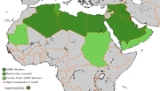
Organization of Arab Petroleum Exporting Countries

Encyclopedia
The Organization of Arab Petroleum Exporting Countries (OAPEC) is a multi-governmental organization headquartered in Kuwait
which coordinates energy policies between oil–producing Arab nations, and whose main purpose is developmental.
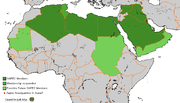 On 9 January 1968, three of the then–most conservative Arab oil states Kuwait
, Libya
, and Saudi Arabia
agreed at a conference in Beirut
, Lebanon
to found the Organization of Arab Petroleum Engineering Countries, aiming to separate the production and sale of oil from politics in the wake of the halfhearted 1967 oil embargo
in response to the Six Day War. Such use of the economic weapon of oil embargo in the struggle against Israel
had been regularly proposed at Arab Petroleum Congresses, but it took the Six Day War for the embargo happen. However Saudi Arabia's oil production was up by 9% that year, and the main embargo lasted only ten days and was completely ended by the Khartoum Conference
.
OAPEC was originally intended to be a conservative Arab political organization which, by restricting membership to countries whose main export was oil, would exclude governments seen as radical such as Egypt
and Algeria
. This organizational exclusivity was bolstered by an additional rule in the organization's charter requiring the three founders' approval all new members. The original aim was to control the economic weapon of potential oil embargo and prevent its use caused by popular emotion. Iraq
initially declined to join, preferring to work under the umbrella of the Arab League
, considering OAPEC too conservative. Equally the three founders considered Iraq too radical to be desirable as a member. However, by early 1972, the criteria for admission changed to oil being a significant source, rather than the principal source of revenue of a prospective member nation and Algeria, Iraq, Syria
and Egypt had been admitted. Consequently the OPAEC became a much more activist organization, contrary to the original intention.
1973 was a turning point for the organization. In October that year, the forces of Egypt and Syria attempted to overwhelm the state of Israel
in an offensive later known as the Yom Kippur War
. On October 16, ten days after the war's start, Kuwait hosted separate meetings of both OAPEC and the Persian Gulf
members of OPEC
, including Iran
. OAPEC resolved to cut oil production 5% monthly "until the Israeli forces are completely evacuated from all the Arab territories occupied in the June 1967 war...." The embargo would last for some five months before it was lifted in March 1974 after negotiations at the Washington Oil Summit. The embargo's aftereffects would linger throughout the rest of the decade. For the oil exporting countries, the embargo was the first instance of the exercise of their ability to leverage their production for political gains. A number of the member nations would use this sense of control to renegotiate the contracts they had made with the companies that had discovered and exploited their resources. Ironically the vastly increased revenues would prove addictive, and a unified OAPEC oil embargo was never again possible.
In 1979, Egypt was expelled from OAPEC for signing the Camp David Accords
, although it was readmitted a decade later.
OAPEC is regarded as a regional, specialized international organization
focusing on organizing cooperation in oil development, collective projects, and regional integration.
Kuwait
The State of Kuwait is a sovereign Arab state situated in the north-east of the Arabian Peninsula in Western Asia. It is bordered by Saudi Arabia to the south at Khafji, and Iraq to the north at Basra. It lies on the north-western shore of the Persian Gulf. The name Kuwait is derived from the...
which coordinates energy policies between oil–producing Arab nations, and whose main purpose is developmental.
History
Kuwait
The State of Kuwait is a sovereign Arab state situated in the north-east of the Arabian Peninsula in Western Asia. It is bordered by Saudi Arabia to the south at Khafji, and Iraq to the north at Basra. It lies on the north-western shore of the Persian Gulf. The name Kuwait is derived from the...
, Libya
Libya
Libya is an African country in the Maghreb region of North Africa bordered by the Mediterranean Sea to the north, Egypt to the east, Sudan to the southeast, Chad and Niger to the south, and Algeria and Tunisia to the west....
, and Saudi Arabia
Saudi Arabia
The Kingdom of Saudi Arabia , commonly known in British English as Saudi Arabia and in Arabic as as-Sa‘ūdiyyah , is the largest state in Western Asia by land area, constituting the bulk of the Arabian Peninsula, and the second-largest in the Arab World...
agreed at a conference in Beirut
Beirut
Beirut is the capital and largest city of Lebanon, with a population ranging from 1 million to more than 2 million . Located on a peninsula at the midpoint of Lebanon's Mediterranean coastline, it serves as the country's largest and main seaport, and also forms the Beirut Metropolitan...
, Lebanon
Lebanon
Lebanon , officially the Republic of LebanonRepublic of Lebanon is the most common term used by Lebanese government agencies. The term Lebanese Republic, a literal translation of the official Arabic and French names that is not used in today's world. Arabic is the most common language spoken among...
to found the Organization of Arab Petroleum Engineering Countries, aiming to separate the production and sale of oil from politics in the wake of the halfhearted 1967 oil embargo
1967 Oil Embargo
The 1967 Oil Embargo began on June 6, 1967, one day after the beginning of the Six-Day War, with a joint Arab decision to deter any countries from supporting Israel militarily. Several Middle Eastern countries eventually limited their oil shipments, some embargoing only the United States and the...
in response to the Six Day War. Such use of the economic weapon of oil embargo in the struggle against Israel
Israel
The State of Israel is a parliamentary republic located in the Middle East, along the eastern shore of the Mediterranean Sea...
had been regularly proposed at Arab Petroleum Congresses, but it took the Six Day War for the embargo happen. However Saudi Arabia's oil production was up by 9% that year, and the main embargo lasted only ten days and was completely ended by the Khartoum Conference
Khartoum Resolution
The Khartoum Resolution of September 1, 1967 was issued at the conclusion of an Arab League summit in the wake of the Six-Day War. The resolution, which formed a basis of the policies of these governments toward Israel until the 1973 Yom Kippur War, called for: a continued state of belligerency...
.
OAPEC was originally intended to be a conservative Arab political organization which, by restricting membership to countries whose main export was oil, would exclude governments seen as radical such as Egypt
Egypt
Egypt , officially the Arab Republic of Egypt, Arabic: , is a country mainly in North Africa, with the Sinai Peninsula forming a land bridge in Southwest Asia. Egypt is thus a transcontinental country, and a major power in Africa, the Mediterranean Basin, the Middle East and the Muslim world...
and Algeria
Algeria
Algeria , officially the People's Democratic Republic of Algeria , also formally referred to as the Democratic and Popular Republic of Algeria, is a country in the Maghreb region of Northwest Africa with Algiers as its capital.In terms of land area, it is the largest country in Africa and the Arab...
. This organizational exclusivity was bolstered by an additional rule in the organization's charter requiring the three founders' approval all new members. The original aim was to control the economic weapon of potential oil embargo and prevent its use caused by popular emotion. Iraq
Iraq
Iraq ; officially the Republic of Iraq is a country in Western Asia spanning most of the northwestern end of the Zagros mountain range, the eastern part of the Syrian Desert and the northern part of the Arabian Desert....
initially declined to join, preferring to work under the umbrella of the Arab League
Arab League
The Arab League , officially called the League of Arab States , is a regional organisation of Arab states in North and Northeast Africa, and Southwest Asia . It was formed in Cairo on 22 March 1945 with six members: Egypt, Iraq, Transjordan , Lebanon, Saudi Arabia, and Syria. Yemen joined as a...
, considering OAPEC too conservative. Equally the three founders considered Iraq too radical to be desirable as a member. However, by early 1972, the criteria for admission changed to oil being a significant source, rather than the principal source of revenue of a prospective member nation and Algeria, Iraq, Syria
Syria
Syria , officially the Syrian Arab Republic , is a country in Western Asia, bordering Lebanon and the Mediterranean Sea to the West, Turkey to the north, Iraq to the east, Jordan to the south, and Israel to the southwest....
and Egypt had been admitted. Consequently the OPAEC became a much more activist organization, contrary to the original intention.
1973 was a turning point for the organization. In October that year, the forces of Egypt and Syria attempted to overwhelm the state of Israel
Israel
The State of Israel is a parliamentary republic located in the Middle East, along the eastern shore of the Mediterranean Sea...
in an offensive later known as the Yom Kippur War
Yom Kippur War
The Yom Kippur War, Ramadan War or October War , also known as the 1973 Arab-Israeli War and the Fourth Arab-Israeli War, was fought from October 6 to 25, 1973, between Israel and a coalition of Arab states led by Egypt and Syria...
. On October 16, ten days after the war's start, Kuwait hosted separate meetings of both OAPEC and the Persian Gulf
Persian Gulf
The Persian Gulf, in Southwest Asia, is an extension of the Indian Ocean located between Iran and the Arabian Peninsula.The Persian Gulf was the focus of the 1980–1988 Iran-Iraq War, in which each side attacked the other's oil tankers...
members of OPEC
OPEC
OPEC is an intergovernmental organization of twelve developing countries made up of Algeria, Angola, Ecuador, Iran, Iraq, Kuwait, Libya, Nigeria, Qatar, Saudi Arabia, the United Arab Emirates, and Venezuela. OPEC has maintained its headquarters in Vienna since 1965, and hosts regular meetings...
, including Iran
Iran
Iran , officially the Islamic Republic of Iran , is a country in Southern and Western Asia. The name "Iran" has been in use natively since the Sassanian era and came into use internationally in 1935, before which the country was known to the Western world as Persia...
. OAPEC resolved to cut oil production 5% monthly "until the Israeli forces are completely evacuated from all the Arab territories occupied in the June 1967 war...." The embargo would last for some five months before it was lifted in March 1974 after negotiations at the Washington Oil Summit. The embargo's aftereffects would linger throughout the rest of the decade. For the oil exporting countries, the embargo was the first instance of the exercise of their ability to leverage their production for political gains. A number of the member nations would use this sense of control to renegotiate the contracts they had made with the companies that had discovered and exploited their resources. Ironically the vastly increased revenues would prove addictive, and a unified OAPEC oil embargo was never again possible.
In 1979, Egypt was expelled from OAPEC for signing the Camp David Accords
Camp David Accords
The Camp David Accords were signed by Egyptian President Anwar El Sadat and Israeli Prime Minister Menachem Begin on September 17, 1978, following thirteen days of secret negotiations at Camp David. The two framework agreements were signed at the White House, and were witnessed by United States...
, although it was readmitted a decade later.
OAPEC is regarded as a regional, specialized international organization
International organization
An intergovernmental organization, sometimes rendered as an international governmental organization and both abbreviated as IGO, is an organization composed primarily of sovereign states , or of other intergovernmental organizations...
focusing on organizing cooperation in oil development, collective projects, and regional integration.
See also
- OPECOPECOPEC is an intergovernmental organization of twelve developing countries made up of Algeria, Angola, Ecuador, Iran, Iraq, Kuwait, Libya, Nigeria, Qatar, Saudi Arabia, the United Arab Emirates, and Venezuela. OPEC has maintained its headquarters in Vienna since 1965, and hosts regular meetings...
- 1967 Oil Embargo1967 Oil EmbargoThe 1967 Oil Embargo began on June 6, 1967, one day after the beginning of the Six-Day War, with a joint Arab decision to deter any countries from supporting Israel militarily. Several Middle Eastern countries eventually limited their oil shipments, some embargoing only the United States and the...
- 1973 oil crisis1973 oil crisisThe 1973 oil crisis started in October 1973, when the members of Organization of Arab Petroleum Exporting Countries or the OAPEC proclaimed an oil embargo. This was "in response to the U.S. decision to re-supply the Israeli military" during the Yom Kippur war. It lasted until March 1974. With the...
- Energy crisisEnergy crisisAn energy crisis is any great bottleneck in the supply of energy resources to an economy. In popular literature though, it often refers to one of the energy sources used at a certain time and place, particularly those that supply national electricity grids or serve as fuel for vehicles...
- Chart of exports and production of oil by nation
- List of oil-producing states
- Arab lobby in the United StatesArab lobby in the United StatesThe Arab lobby in the United States is a collection of formal and informal groups and professional lobbyists paid directly by Arab governments that lobby the public and government of the United States on behalf of Arab interests. and/or on behalf of Arab-American rights in the United...
External links
- OAPEC website
- OAPEC information from Saudi Arabia
- OPEC website
- OPEC and OAPEC, from Kuwait
- Will Iraq Be a Global Gas Pump? The (Re)Making of a Petro-State by Michael T. Klare, The Huffington PostThe Huffington PostThe Huffington Post is an American news website and content-aggregating blog founded by Arianna Huffington, Kenneth Lerer, and Jonah Peretti, featuring liberal minded columnists and various news sources. The site offers coverage of politics, theology, media, business, entertainment, living, style,...
, July 14, 2009