

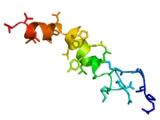
Orexin

Encyclopedia
Orexins, also called hypocretins, are the common names given to a pair of excitatory neuropeptide
hormone
s that were simultaneously discovered by two groups of researchers in rat
brains.
The two related peptides (Orexin-A
and B, or hypocretin-1 and -2), with approximately 50% sequence identity, are produced by cleavage of a single precursor protein. Orexin-A/hypocretin-1 is 33 amino acid residues long and has two intrachain disulfide bonds, while Orexin-B/hypocretin-2 is a linear 28 amino acid residue peptide. Studies suggest that orexin A/hypocretin-1 may be of greater biological importance than orexin B/hypocretin-2. Although these peptides are produced by a very small population of cells in the lateral and posterior hypothalamus
, they send projections throughout the brain. The orexin peptides bind to the two G-protein coupled orexin receptor
s, OX1
and OX2
, with Orexin-A binding to both OX1 and OX2 with approximately equal affinity while Orexin-B binds mainly to OX2 and is 5 times less potent at OX1.
The orexins/hypocretins are strongly conserved peptides, found in all major classes of vertebrates.
expenditure.
influences to determine whether an animal should be asleep or awake and active. Orexin/hypocretin neurons strongly excite various brain nuclei with important roles in wakefulness including the dopamine
, norepinephrine
, histamine
and acetylcholine
systems and appear to play an important role in stabilizing wakefulness and sleep.
The discovery that an orexin/hypocretin receptor mutation causes the sleep disorder
canine narcolepsy
in Doberman Pinschers subsequently indicated a major role for this system in sleep
regulation. Genetic knockout mice lacking the gene for orexin were also reported to exhibit narcolepsy. Transitioning frequently and rapidly between sleep and wakefulness, these mice display many of the symptoms of narcolepsy. Researchers are using this animal model of narcolepsy to study the disease. Narcolepsy results in excessive daytime sleepiness
, inability to consolidate wakefulness in the day (and sleep at night), and cataplexy
, which is the loss of muscle tone in response to strong, usually positive, emotions. Dogs that lack a functional receptor for orexin/hypocretin have narcolepsy, while animals and people lacking the orexin/hypocretin neuropeptide itself also have narcolepsy.
Central administration of orexin A/hypocretin-1 strongly promotes wakefulness, increases body temperature, locomotion and elicits a strong increase in energy expenditure. Sleep deprivation
also increases orexin A/hypocretin-1 transmission. The orexin/hypocretin system may thus be more important in the regulation of energy expenditure than food intake. In fact, orexin/hypocretin-deficient narcoleptic patients have increased obesity rather than decreased BMI
, as would be expected if orexin/hypocretin were primarily an appetite stimulating peptide. Another indication that deficits of orexin/hypocretin cause narcolepsy is that depriving monkeys of sleep for 30–36 hours and then injecting them with the neurochemical alleviates the cognitive deficiencies normally seen with such amount of sleep loss.
In humans, narcolepsy is associated with a specific variant of the human leukocyte antigen
(HLA) complex. Furthermore, genome-wide analysis shows that, in addition to the HLA variant, narcoleptic humans also exhibit a specific genetic mutation
in the T-cell
receptor
alpha locus. In conjunction, these genetic anomalies cause the autoimmune system to attack and kill the critical hypocretin neurons. Hence the absence of hypocretin-producing neuron
s in narcoleptic humans may be the result of an autoimmune
disorder.
has been recently suggested. The enigmatic protein amyloid beta
builds up over time in the brain and is correlated with Alzheimer's disease. The recent research shows that amyloid beta expression rises during the day and falls during the night, and that this is controlled by orexin. Sleep deprivation is suggested to lead to amyloid beta plaque development. It is suggested that drugs that block orexin receptors could be used to modulate amyloid beta build-up. This research also suggests that maintaining proper lengths of sleep and wake periods could prevent Alzheimer's disease, assuming that 1) amyloid beta is the cause of Alzheimer's disease and 2) that sleep-wake cycling rather than some other cause is what leads to the amyloid beta build-up in the brains of people with Alzheimer's disease — two claims that have not been demonstrated.
Leptin
is a hormone produced by fat cells and acts as a long-term internal measure of energy state. Ghrelin
is a short-term factor secreted by the stomach just before an expected meal, and strongly promotes food intake.
Hypocretin-producing cells have recently been shown to be inhibited by leptin (through the leptin receptor pathway), but are activated by ghrelin and hypoglycemia
(glucose
inhibits orexin production). Orexin/hypocretin, as of 2007, is claimed to be a very important link between metabolism and sleep regulation. Such a relationship has been long suspected, based on the observation that long-term sleep deprivation in rodents dramatically increases food intake and energy metabolism, i.e., catabolism
, with lethal consequences on a long-term basis.
and increase alertness in the brain without the side effects of amphetamines.
Preliminary research has been conducted that shows potential for orexin blockers in the treatment of alcoholism
. Lab rat
s given drugs which targeted the orexin system lost interest in alcohol despite being given free access in experiments.
A study has reported that transplantation of orexin/hypocretin neurons into the pontine reticular formation in rats is feasible, indicating the development of alternative therapeutic strategies in addition to pharmacological interventions to treat narcolepsy.
Because hypocretin-1 receptors have been shown to regulate relapse to cocaine seeking, a new study investigated its relation to nicotine by studying rats. By blocking the hypocretin-1 receptor with low doses of the selective antagonist SB-334,867
, nicotine self-administration
decreased and also the motivation to seek and obtain the drug. The study showed that blocking of receptors in the insula
decreased self-administration
, but not blocking of receptors in the adjacent somatosensory cortex. The greatest decrease in self-administration was found when blocking all hypocretin-1 receptors in the brain as a whole. A rationale for this study was the fact that the insula has been implicated in regulating feelings of craving. The insula contains hypocretin-1 receptors. It has been reported that smokers who sustained damage to the insula lost the desire to smoke.
metabolism. OXA stimulates glucose
uptake in 3T3-L1 adipocytes and that increased energy uptake is stored as lipids (triacylglycerol). OXA thus increases lipogenesis
. It also inhibits lipolysis
and stimulates the secretion of adiponectin
. These effects are thought to be mostly conferred via the PI3K pathway because this pathway inhibitor (LY294002) completely blocks OXA effects in adipocytes. The link between OXA and the lipid metabolism is new and currently under more research.
Obesity in orexin-knockout mice is associated with impaired brown adipose tissue
thermogenesis.
Masashi Yanagisawa and colleagues at the University of Texas Southwestern Medical Center at Dallas
, coined the term orexin to reflect the orexigenic (appetite-stimulating) activity of these hormones. In their 1998 paper (with authorship attributed to Sakurai and colleagues) describing these neuropeptides, they also reported discovery of two orexin receptors, dubbed OX1R and OX2R.
Luis de Lecea, Thomas Kilduff, and colleagues also reported discovery of these same peptides, dubbing them hypocretins to indicate that they are synthesized in the hypothalamus
and to reflect their structural similarity to the hormone secretin
(i.e., hypothalamic secretin). This is the same group that first identified clone 35 two years earlier.
The name of this family of peptides is currently an unsettled issue. The name "orexin" has been rejected by some due to evidence that the orexigenic effects of these peptides may be incidental or trivial (i.e., hypocretin induced subjects eat more because they are awake more), though this issue is also unsettled, while other groups maintain that the name "hypocretin" is awkward, pointing out that many neuropeptides have names that are unrelated to their most important functions, and that waking is one of the important factors that supports feeding behavior. Both "orexin" and "hypocretin" will likely continue to appear in published works until a preferred name has been accepted by the scientific community.
, or orexin antagonists for insomnia
. No non-peptide agonists are yet available, although synthetic Orexin-A polypeptide has been made available as a nasal spray and tested on monkeys. Several non-peptide antagonists are in development however; SB-649,868 is under development by GlaxoSmithKline
for sleep disorders and is a non-selective orexin receptor antagonist. Another OX1 and OX2 receptor antagonist (ACT-078573, almorexant
) is a similar compound under development for primary insomnia by Actelion
. A third entry is Merck's
MK-4305.
Most ligands acting on the orexin system so far are polypeptides modified from the endogenous agonists Orexin-A and Orexin-B, however there are some subtype-selective non-peptide antagonists available for research purposes.
, serotonin 5-HT1A receptors
, neuropeptide Y
receptors, cholecystokinin A receptor
s, and catecholamines, as well as to ghrelin
, leptin
, and glucose
. Orexinergic neurons themselves regulate release of acetylcholine
, serotonin
and noradrenaline, so despite the relatively small number of orexinergic neurons compared to other neurotransmitter systems in the brain, this system plays a key regulatory role and extensive research will be required to unravel the details.
Orexins act on Gq-protein
-coupled receptors signaling through phospholipase C
(PLC) and calcium-dependent as well as calcium-independent transduction pathways. These include activation of electrogenic sodium-calcium exchanger
s (NCX) and a non-specific cationic conductance, likely channels of the transient receptor potential canonical
-(TRPC) type activation of L-type voltage-dependent calcium channels
, closure of G-protein-activated inward rectifier potassium channels
(GIRK), and activation of protein kinases, including protein kinase C
(PKC), protein kinase A (PKA), and mitogen-associated protein kinase, also called mitogen-activated protein kinase
(MAPK). Postsynaptic actions of orexins on their numerous neuronal targets throughout the CNS are almost entirely excitatory.
Neuropeptide
Neuropeptides are small protein-like molecules used by neurons to communicate with each other. They are neuronal signaling molecules, influence the activity of the brain in specific ways and are thus involved in particular brain functions, like analgesia, reward, food intake, learning and...
hormone
Hormone
A hormone is a chemical released by a cell or a gland in one part of the body that sends out messages that affect cells in other parts of the organism. Only a small amount of hormone is required to alter cell metabolism. In essence, it is a chemical messenger that transports a signal from one...
s that were simultaneously discovered by two groups of researchers in rat
Rat
Rats are various medium-sized, long-tailed rodents of the superfamily Muroidea. "True rats" are members of the genus Rattus, the most important of which to humans are the black rat, Rattus rattus, and the brown rat, Rattus norvegicus...
brains.
The two related peptides (Orexin-A
Orexin-A
Orexin A, also known as Hypocretin-1, is a naturally occurring, highly excitatory, neuropeptide released by the hypothalamus. As a pharmaceutical drug, Orexin A is most commonly administered as a nasal spray...
and B, or hypocretin-1 and -2), with approximately 50% sequence identity, are produced by cleavage of a single precursor protein. Orexin-A/hypocretin-1 is 33 amino acid residues long and has two intrachain disulfide bonds, while Orexin-B/hypocretin-2 is a linear 28 amino acid residue peptide. Studies suggest that orexin A/hypocretin-1 may be of greater biological importance than orexin B/hypocretin-2. Although these peptides are produced by a very small population of cells in the lateral and posterior hypothalamus
Hypothalamus
The Hypothalamus is a portion of the brain that contains a number of small nuclei with a variety of functions...
, they send projections throughout the brain. The orexin peptides bind to the two G-protein coupled orexin receptor
Orexin receptor
The orexin receptor is a G-protein-coupled receptor that binds the neuropeptide hormone orexin. There are two variants, OX1 and OX2, each encoded by a different gene .-External links:...
s, OX1
Hypocretin (orexin) receptor 1
Orexin receptor type 1 , also known as hypocretin receptor type 1, is a protein that in humans is encoded by the HCRTR1 gene.- Function :...
and OX2
Hypocretin (orexin) receptor 2
Orexin receptor type 2 , also known as hypocretin receptor type 2, is a protein that in humans is encoded by the HCRTR2 gene.- Function :...
, with Orexin-A binding to both OX1 and OX2 with approximately equal affinity while Orexin-B binds mainly to OX2 and is 5 times less potent at OX1.
The orexins/hypocretins are strongly conserved peptides, found in all major classes of vertebrates.
Function
The orexin/hypocretin system was initially suggested to be primarily involved in the stimulation of food intake, based on the finding that central administration of orexin A/hypocretin-1 increases food intake. In addition, it stimulates wakefulness and energyEnergy (psychological)
Mental or psychic energy or activity is the concept of a principle of activity powering the operation of the mind or psyche. Many modern psychologists or neuroscientists would equate it with increased metabolism in neurons of the brain....
expenditure.
Wakefulness
Orexin seems to promote wakefulness. Recent studies indicate that a major role of the orexin/hypocretin system is to integrate metabolic, circadian and sleep debtSleep debt
Sleep debt or sleep deficit is the cumulative effect of not getting enough sleep. A large sleep debt may lead to mental and/or physical fatigue....
influences to determine whether an animal should be asleep or awake and active. Orexin/hypocretin neurons strongly excite various brain nuclei with important roles in wakefulness including the dopamine
Dopamine
Dopamine is a catecholamine neurotransmitter present in a wide variety of animals, including both vertebrates and invertebrates. In the brain, this substituted phenethylamine functions as a neurotransmitter, activating the five known types of dopamine receptors—D1, D2, D3, D4, and D5—and their...
, norepinephrine
Norepinephrine
Norepinephrine is the US name for noradrenaline , a catecholamine with multiple roles including as a hormone and a neurotransmitter...
, histamine
Histamine
Histamine is an organic nitrogen compound involved in local immune responses as well as regulating physiological function in the gut and acting as a neurotransmitter. Histamine triggers the inflammatory response. As part of an immune response to foreign pathogens, histamine is produced by...
and acetylcholine
Acetylcholine
The chemical compound acetylcholine is a neurotransmitter in both the peripheral nervous system and central nervous system in many organisms including humans...
systems and appear to play an important role in stabilizing wakefulness and sleep.
The discovery that an orexin/hypocretin receptor mutation causes the sleep disorder
Sleep disorder
A sleep disorder, or somnipathy, is a medical disorder of the sleep patterns of a person or animal. Some sleep disorders are serious enough to interfere with normal physical, mental and emotional functioning...
canine narcolepsy
Narcolepsy
Narcolepsy is a chronic sleep disorder, or dyssomnia, characterized by excessive sleepiness and sleep attacks at inappropriate times, such as while at work. People with narcolepsy often experience disturbed nocturnal sleep and an abnormal daytime sleep pattern, which often is confused with insomnia...
in Doberman Pinschers subsequently indicated a major role for this system in sleep
Sleep
Sleep is a naturally recurring state characterized by reduced or absent consciousness, relatively suspended sensory activity, and inactivity of nearly all voluntary muscles. It is distinguished from quiet wakefulness by a decreased ability to react to stimuli, and is more easily reversible than...
regulation. Genetic knockout mice lacking the gene for orexin were also reported to exhibit narcolepsy. Transitioning frequently and rapidly between sleep and wakefulness, these mice display many of the symptoms of narcolepsy. Researchers are using this animal model of narcolepsy to study the disease. Narcolepsy results in excessive daytime sleepiness
Excessive daytime sleepiness
Excessive daytime sleepiness is characterized by persistent sleepiness, and often a general lack of energy, even after apparently adequate night time sleep...
, inability to consolidate wakefulness in the day (and sleep at night), and cataplexy
Cataplexy
Cataplexy is a sudden and transient episode of loss of muscle tone, often triggered by emotions. It is a rare disease , but affects roughly 70% of people who have narcolepsy...
, which is the loss of muscle tone in response to strong, usually positive, emotions. Dogs that lack a functional receptor for orexin/hypocretin have narcolepsy, while animals and people lacking the orexin/hypocretin neuropeptide itself also have narcolepsy.
Central administration of orexin A/hypocretin-1 strongly promotes wakefulness, increases body temperature, locomotion and elicits a strong increase in energy expenditure. Sleep deprivation
Sleep deprivation
Sleep deprivation is the condition of not having enough sleep; it can be either chronic or acute. A chronic sleep-restricted state can cause fatigue, daytime sleepiness, clumsiness and weight loss or weight gain. It adversely affects the brain and cognitive function. Few studies have compared the...
also increases orexin A/hypocretin-1 transmission. The orexin/hypocretin system may thus be more important in the regulation of energy expenditure than food intake. In fact, orexin/hypocretin-deficient narcoleptic patients have increased obesity rather than decreased BMI
Body mass index
The body mass index , or Quetelet index, is a heuristic proxy for human body fat based on an individual's weight and height. BMI does not actually measure the percentage of body fat. It was invented between 1830 and 1850 by the Belgian polymath Adolphe Quetelet during the course of developing...
, as would be expected if orexin/hypocretin were primarily an appetite stimulating peptide. Another indication that deficits of orexin/hypocretin cause narcolepsy is that depriving monkeys of sleep for 30–36 hours and then injecting them with the neurochemical alleviates the cognitive deficiencies normally seen with such amount of sleep loss.
In humans, narcolepsy is associated with a specific variant of the human leukocyte antigen
Human leukocyte antigen
The human leukocyte antigen system is the name of the major histocompatibility complex in humans. The super locus contains a large number of genes related to immune system function in humans. This group of genes resides on chromosome 6, and encodes cell-surface antigen-presenting proteins and...
(HLA) complex. Furthermore, genome-wide analysis shows that, in addition to the HLA variant, narcoleptic humans also exhibit a specific genetic mutation
Mutation
In molecular biology and genetics, mutations are changes in a genomic sequence: the DNA sequence of a cell's genome or the DNA or RNA sequence of a virus. They can be defined as sudden and spontaneous changes in the cell. Mutations are caused by radiation, viruses, transposons and mutagenic...
in the T-cell
T cell
T cells or T lymphocytes belong to a group of white blood cells known as lymphocytes, and play a central role in cell-mediated immunity. They can be distinguished from other lymphocytes, such as B cells and natural killer cells , by the presence of a T cell receptor on the cell surface. They are...
receptor
T cell receptor
The T cell receptor or TCR is a molecule found on the surface of T lymphocytes that is responsible for recognizing antigens bound to major histocompatibility complex molecules...
alpha locus. In conjunction, these genetic anomalies cause the autoimmune system to attack and kill the critical hypocretin neurons. Hence the absence of hypocretin-producing neuron
Neuron
A neuron is an electrically excitable cell that processes and transmits information by electrical and chemical signaling. Chemical signaling occurs via synapses, specialized connections with other cells. Neurons connect to each other to form networks. Neurons are the core components of the nervous...
s in narcoleptic humans may be the result of an autoimmune
Autoimmunity
Autoimmunity is the failure of an organism to recognize its own constituent parts as self, which allows an immune response against its own cells and tissues. Any disease that results from such an aberrant immune response is termed an autoimmune disease...
disorder.
Wakefulness, amyloid beta, and Alzheimer's disease
A link between orexin and Alzheimer's diseaseAlzheimer's disease
Alzheimer's disease also known in medical literature as Alzheimer disease is the most common form of dementia. There is no cure for the disease, which worsens as it progresses, and eventually leads to death...
has been recently suggested. The enigmatic protein amyloid beta
Amyloid beta
Amyloid beta is a peptide of 36–43 amino acids that is processed from the Amyloid precursor protein. While it is most commonly known in association with Alzheimer's disease, it does not exist specifically to cause disease...
builds up over time in the brain and is correlated with Alzheimer's disease. The recent research shows that amyloid beta expression rises during the day and falls during the night, and that this is controlled by orexin. Sleep deprivation is suggested to lead to amyloid beta plaque development. It is suggested that drugs that block orexin receptors could be used to modulate amyloid beta build-up. This research also suggests that maintaining proper lengths of sleep and wake periods could prevent Alzheimer's disease, assuming that 1) amyloid beta is the cause of Alzheimer's disease and 2) that sleep-wake cycling rather than some other cause is what leads to the amyloid beta build-up in the brains of people with Alzheimer's disease — two claims that have not been demonstrated.
Food intake
Orexin increases the craving for food, and correlates with the function of the substances that promote its production.Leptin
Leptin
Leptin is a 16 kDa protein hormone that plays a key role in regulating energy intake and energy expenditure, including appetite and metabolism. It is one of the most important adipose derived hormones...
is a hormone produced by fat cells and acts as a long-term internal measure of energy state. Ghrelin
Ghrelin
Ghrelin is a 28 amino acid peptide and hormone that is produced mainly by P/D1 cells lining the fundus of the human stomach and epsilon cells of the pancreas that stimulates hunger. Ghrelin levels increase before meals and decrease after meals. It is considered the counterpart of the hormone...
is a short-term factor secreted by the stomach just before an expected meal, and strongly promotes food intake.
Hypocretin-producing cells have recently been shown to be inhibited by leptin (through the leptin receptor pathway), but are activated by ghrelin and hypoglycemia
Hypoglycemia
Hypoglycemia or hypoglycæmia is the medical term for a state produced by a lower than normal level of blood glucose. The term literally means "under-sweet blood"...
(glucose
Glucose
Glucose is a simple sugar and an important carbohydrate in biology. Cells use it as the primary source of energy and a metabolic intermediate...
inhibits orexin production). Orexin/hypocretin, as of 2007, is claimed to be a very important link between metabolism and sleep regulation. Such a relationship has been long suspected, based on the observation that long-term sleep deprivation in rodents dramatically increases food intake and energy metabolism, i.e., catabolism
Catabolism
Catabolism is the set of metabolic pathways that break down molecules into smaller units and release energy. In catabolism, large molecules such as polysaccharides, lipids, nucleic acids and proteins are broken down into smaller units such as monosaccharides, fatty acids, nucleotides, and amino...
, with lethal consequences on a long-term basis.
Pharmacologic potential
The research on orexin/hypocretin is still in an early phase, although many scientists believe that orexin/hypocretin-based drugs could help narcolepticsNarcolepsy
Narcolepsy is a chronic sleep disorder, or dyssomnia, characterized by excessive sleepiness and sleep attacks at inappropriate times, such as while at work. People with narcolepsy often experience disturbed nocturnal sleep and an abnormal daytime sleep pattern, which often is confused with insomnia...
and increase alertness in the brain without the side effects of amphetamines.
Preliminary research has been conducted that shows potential for orexin blockers in the treatment of alcoholism
Alcoholism
Alcoholism is a broad term for problems with alcohol, and is generally used to mean compulsive and uncontrolled consumption of alcoholic beverages, usually to the detriment of the drinker's health, personal relationships, and social standing...
. Lab rat
Brown Rat
The brown rat, common rat, sewer rat, Hanover rat, Norway rat, Brown Norway rat, Norwegian rat, or wharf rat is one of the best known and most common rats....
s given drugs which targeted the orexin system lost interest in alcohol despite being given free access in experiments.
A study has reported that transplantation of orexin/hypocretin neurons into the pontine reticular formation in rats is feasible, indicating the development of alternative therapeutic strategies in addition to pharmacological interventions to treat narcolepsy.
Because hypocretin-1 receptors have been shown to regulate relapse to cocaine seeking, a new study investigated its relation to nicotine by studying rats. By blocking the hypocretin-1 receptor with low doses of the selective antagonist SB-334,867
SB-334,867
SB-334,867 is a drug which was the first non-peptide antagonist developed that is selective for the orexin receptor subtype OX1, with around 50x selectivity for OX1 over OX2 receptors...
, nicotine self-administration
Self-administration
Self-administration is, in its medical sense, the process of a subject administering a pharmacological substance to him-, her-, or itself. A clinical example of this is the subcutaneous "self-injection" of insulin by a diabetic patient....
decreased and also the motivation to seek and obtain the drug. The study showed that blocking of receptors in the insula
Insular cortex
In each hemisphere of the mammalian brain the insular cortex is a portion of the cerebral cortex folded deep within the lateral sulcus between the temporal lobe and the frontal lobe. The cortical area overlying it towards the lateral surface of the brain is the operculum...
decreased self-administration
Self-administration
Self-administration is, in its medical sense, the process of a subject administering a pharmacological substance to him-, her-, or itself. A clinical example of this is the subcutaneous "self-injection" of insulin by a diabetic patient....
, but not blocking of receptors in the adjacent somatosensory cortex. The greatest decrease in self-administration was found when blocking all hypocretin-1 receptors in the brain as a whole. A rationale for this study was the fact that the insula has been implicated in regulating feelings of craving. The insula contains hypocretin-1 receptors. It has been reported that smokers who sustained damage to the insula lost the desire to smoke.
Lipid metabolism
Orexin-A (OXA) has been recently demonstrated to have direct effect on a part of the lipidLipid
Lipids constitute a broad group of naturally occurring molecules that include fats, waxes, sterols, fat-soluble vitamins , monoglycerides, diglycerides, triglycerides, phospholipids, and others...
metabolism. OXA stimulates glucose
Glucose
Glucose is a simple sugar and an important carbohydrate in biology. Cells use it as the primary source of energy and a metabolic intermediate...
uptake in 3T3-L1 adipocytes and that increased energy uptake is stored as lipids (triacylglycerol). OXA thus increases lipogenesis
Lipogenesis
Lipogenesis is the process by which acetyl-CoA is converted to fats. The former is an intermediate stage in metabolism of simple sugars, such as glucose, a source of energy of living organisms. Through lipogenesis, the energy can be efficiently stored in the form of fats...
. It also inhibits lipolysis
Lipolysis
Lipolysis is the breakdown of lipids and involves the hydrolysis of triglycerides into free fatty acids followed by further degradation into acetyl units by beta oxidation. The process produces Ketones, which are found in large quantities in ketosis, a metabolic state that occurs when the liver...
and stimulates the secretion of adiponectin
Adiponectin
Adiponectin is a protein which in humans is encoded by the ADIPOQ gene.- Structure :...
. These effects are thought to be mostly conferred via the PI3K pathway because this pathway inhibitor (LY294002) completely blocks OXA effects in adipocytes. The link between OXA and the lipid metabolism is new and currently under more research.
Obesity in orexin-knockout mice is associated with impaired brown adipose tissue
Brown adipose tissue
Brown adipose tissue or brown fat is one of two types of fat or adipose tissue found in mammals....
thermogenesis.
History and nomenclature
In 1996, Gautvik, de Lecea, and colleagues reported the discovery of several genes in the rat brain, including one they dubbed "clone 35." Their work showed that clone 35 expression was limited to the lateral hypothalamus. Two years later they would identify the two genetic products of clone 35 as the hypocretins.Masashi Yanagisawa and colleagues at the University of Texas Southwestern Medical Center at Dallas
University of Texas Southwestern Medical Center at Dallas
The University of Texas Southwestern Medical Center is one of the biomedical research institutions of the University of Texas System, incorporating three degree-granting institutions, four affiliated hospitals, including Parkland Memorial, the teaching hospital, and biomedical research...
, coined the term orexin to reflect the orexigenic (appetite-stimulating) activity of these hormones. In their 1998 paper (with authorship attributed to Sakurai and colleagues) describing these neuropeptides, they also reported discovery of two orexin receptors, dubbed OX1R and OX2R.
Luis de Lecea, Thomas Kilduff, and colleagues also reported discovery of these same peptides, dubbing them hypocretins to indicate that they are synthesized in the hypothalamus
Hypothalamus
The Hypothalamus is a portion of the brain that contains a number of small nuclei with a variety of functions...
and to reflect their structural similarity to the hormone secretin
Secretin
Secretin is a hormone that controls the secretions into the duodenum, and also separately, water homeostasis throughout the body. It is produced in the S cells of the duodenum in the crypts of Lieberkühn...
(i.e., hypothalamic secretin). This is the same group that first identified clone 35 two years earlier.
The name of this family of peptides is currently an unsettled issue. The name "orexin" has been rejected by some due to evidence that the orexigenic effects of these peptides may be incidental or trivial (i.e., hypocretin induced subjects eat more because they are awake more), though this issue is also unsettled, while other groups maintain that the name "hypocretin" is awkward, pointing out that many neuropeptides have names that are unrelated to their most important functions, and that waking is one of the important factors that supports feeding behavior. Both "orexin" and "hypocretin" will likely continue to appear in published works until a preferred name has been accepted by the scientific community.
Selective ligands
Several drugs acting on the orexin system are under development, either orexin agonists for the treatment of conditions such as narcolepsyNarcolepsy
Narcolepsy is a chronic sleep disorder, or dyssomnia, characterized by excessive sleepiness and sleep attacks at inappropriate times, such as while at work. People with narcolepsy often experience disturbed nocturnal sleep and an abnormal daytime sleep pattern, which often is confused with insomnia...
, or orexin antagonists for insomnia
Insomnia
Insomnia is most often defined by an individual's report of sleeping difficulties. While the term is sometimes used in sleep literature to describe a disorder demonstrated by polysomnographic evidence of disturbed sleep, insomnia is often defined as a positive response to either of two questions:...
. No non-peptide agonists are yet available, although synthetic Orexin-A polypeptide has been made available as a nasal spray and tested on monkeys. Several non-peptide antagonists are in development however; SB-649,868 is under development by GlaxoSmithKline
GlaxoSmithKline
GlaxoSmithKline plc is a global pharmaceutical, biologics, vaccines and consumer healthcare company headquartered in London, United Kingdom...
for sleep disorders and is a non-selective orexin receptor antagonist. Another OX1 and OX2 receptor antagonist (ACT-078573, almorexant
Almorexant
Almorexant is a competitive receptor antagonist of the OX1 and OX2 orexin receptors, which was being developed by the pharmaceutical companies Actelion and GSK for the treatment of insomnia...
) is a similar compound under development for primary insomnia by Actelion
Actelion
Actelion was founded in December 1997 and is headquartered in Allschwil near Basel . Its CEO and co-founder is cardiologist Jean-Paul Clozel. Actelion scientists were among the first to work in the field of endothelian receptor antagonists...
. A third entry is Merck's
Merck & Co.
Merck & Co., Inc. , also known as Merck Sharp & Dohme or MSD outside the United States and Canada, is one of the largest pharmaceutical companies in the world. The Merck headquarters is located in Whitehouse Station, New Jersey, an unincorporated area in Readington Township...
MK-4305.
Most ligands acting on the orexin system so far are polypeptides modified from the endogenous agonists Orexin-A and Orexin-B, however there are some subtype-selective non-peptide antagonists available for research purposes.
- SB-334,867SB-334,867SB-334,867 is a drug which was the first non-peptide antagonist developed that is selective for the orexin receptor subtype OX1, with around 50x selectivity for OX1 over OX2 receptors...
- selective OX1 antagonist - SB-408,124SB-408,124SB-408,124 is a drug which is a non-peptide antagonist selective for the orexin receptor subtype OX1, with around 70x selectivity for OX1 over OX2 receptors, and improved oral bioavailability compared to the older OX1 antagonist SB-334,867. It is used in scientific research into the function of...
- selective OX1 antagonist - TCS-OX2-29TCS-OX2-29TCS-OX2-29 is a drug which was the first non-peptide antagonist developed that is selective for the orexin receptor subtype OX2, with an IC50 of 40nM and selectivity of around 250x for OX2 over OX1 receptors...
- selective OX2 antagonist
Interaction with other neurotransmitter systems
Orexinergic neurons have been shown to be sensitive to inputs from Group III metabotropic glutamate receptors, adenosine A1 receptors, muscarinic M3 receptorsMuscarinic acetylcholine receptor M3
The muscarinic acetylcholine receptor M3, also known as the cholinergic receptor, muscarinic 3, is a muscarinic acetylcholine receptor. It is encoded by the human gene CHRM3....
, serotonin 5-HT1A receptors
5-HT1A receptor
The 5-HT1A receptor is a subtype of 5-HT receptor that binds the endogenous neurotransmitter serotonin . It is a G protein-coupled receptor that is coupled to Gi/Go and mediates inhibitory neurotransmission...
, neuropeptide Y
Neuropeptide Y
Neuropeptide Y is a 36-amino acid peptide neurotransmitter found in the brain and autonomic nervous system."NPY has been associated with a number of physiologic processes in the brain, including the regulation of energy balance, memory and learning, and epilepsy." The main effect is increased food...
receptors, cholecystokinin A receptor
Cholecystokinin A receptor
The extracellular, N-terminal, domain of this protein adopts a tertiary structure consisting of a few helical turns and a disulfide-cross linked loop...
s, and catecholamines, as well as to ghrelin
Ghrelin
Ghrelin is a 28 amino acid peptide and hormone that is produced mainly by P/D1 cells lining the fundus of the human stomach and epsilon cells of the pancreas that stimulates hunger. Ghrelin levels increase before meals and decrease after meals. It is considered the counterpart of the hormone...
, leptin
Leptin
Leptin is a 16 kDa protein hormone that plays a key role in regulating energy intake and energy expenditure, including appetite and metabolism. It is one of the most important adipose derived hormones...
, and glucose
Glucose
Glucose is a simple sugar and an important carbohydrate in biology. Cells use it as the primary source of energy and a metabolic intermediate...
. Orexinergic neurons themselves regulate release of acetylcholine
Acetylcholine
The chemical compound acetylcholine is a neurotransmitter in both the peripheral nervous system and central nervous system in many organisms including humans...
, serotonin
Serotonin
Serotonin or 5-hydroxytryptamine is a monoamine neurotransmitter. Biochemically derived from tryptophan, serotonin is primarily found in the gastrointestinal tract, platelets, and in the central nervous system of animals including humans...
and noradrenaline, so despite the relatively small number of orexinergic neurons compared to other neurotransmitter systems in the brain, this system plays a key regulatory role and extensive research will be required to unravel the details.
Orexins act on Gq-protein
Gq alpha subunit
Gq protein or Gq/11 is a heterotrimeric G protein subunit that activates phospholipase C . PLC in turn hydrolyzes Phosphatidylinositol 4,5-bisphosphate to diacyl glycerol and inositol triphosphate signal transduction pathway...
-coupled receptors signaling through phospholipase C
Phospholipase C
Phosphoinositide phospholipase C is a family of eukaryotic intracellular enzymes that play an important role in signal transduction processes. In general, this enzyme is denoted as Phospholipase C, although three other families of phospholipase C enzymes have been identified in bacteria and in...
(PLC) and calcium-dependent as well as calcium-independent transduction pathways. These include activation of electrogenic sodium-calcium exchanger
Sodium-calcium exchanger
The sodium-calcium exchanger is an antiporter membrane protein that removes calcium from cells. It uses the energy that is stored in the electrochemical gradient of sodium by allowing Na+ to flow down its gradient across the plasma membrane in exchange for the countertransport of calcium ions...
s (NCX) and a non-specific cationic conductance, likely channels of the transient receptor potential canonical
TRPC
TRPC is a family of transient receptor potential cation channels in animals.TRPC channels form the subfamily of channels in human most closely related to drosophila TRP channels. In terms of structure, this family possesses a number of similar characteristics...
-(TRPC) type activation of L-type voltage-dependent calcium channels
L-type calcium channel
The L-type calcium channel is a type of voltage-dependent calcium channel. "L" stands for long-lasting referring to the length of activation. Like the others of this class, the α1 subunit is the one that determines most of the channel's properties....
, closure of G-protein-activated inward rectifier potassium channels
G protein-coupled inwardly-rectifying potassium channel
The G protein-coupled inwardly-rectifying potassium channels are a family of inward-rectifier potassium ion channels which are activated via a signal transduction cascade starting with ligand-stimulated G protein-coupled receptors . GPCRs in turn release activated G-protein βγ- subunits from...
(GIRK), and activation of protein kinases, including protein kinase C
Protein kinase C
Protein kinase C also known as PKC is a family of enzymes that are involved in controlling the function of other proteins through the phosphorylation of hydroxyl groups of serine and threonine amino acid residues on these proteins. PKC enzymes in turn are activated by signals such as increases in...
(PKC), protein kinase A (PKA), and mitogen-associated protein kinase, also called mitogen-activated protein kinase
Mitogen-activated protein kinase
Mitogen-activated protein kinases are serine/threonine-specific protein kinases that respond to extracellular stimuli and regulate various cellular activities, such as gene expression, mitosis, differentiation, proliferation, and cell survival/apoptosis.-Activation:MAP kinases are activated...
(MAPK). Postsynaptic actions of orexins on their numerous neuronal targets throughout the CNS are almost entirely excitatory.