

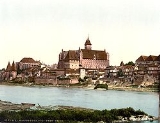
Ordensburg

Encyclopedia

German language
German is a West Germanic language, related to and classified alongside English and Dutch. With an estimated 90 – 98 million native speakers, German is one of the world's major languages and is the most widely-spoken first language in the European Union....
: Ordensburgen) was a fortress built by crusading
Crusades
The Crusades were a series of religious wars, blessed by the Pope and the Catholic Church with the main goal of restoring Christian access to the holy places in and near Jerusalem...
German
Germans
The Germans are a Germanic ethnic group native to Central Europe. The English term Germans has referred to the German-speaking population of the Holy Roman Empire since the Late Middle Ages....
military order
Military order
A military order is a Christian society of knights that was founded for crusading, i.e. propagating or defending the faith , either in the Holy Land or against Islam or pagans in Europe...
s during the Middle Ages
Middle Ages
The Middle Ages is a periodization of European history from the 5th century to the 15th century. The Middle Ages follows the fall of the Western Roman Empire in 476 and precedes the Early Modern Era. It is the middle period of a three-period division of Western history: Classic, Medieval and Modern...
. "Ordensburg" was also used during Nazi Germany
Nazi Germany
Nazi Germany , also known as the Third Reich , but officially called German Reich from 1933 to 1943 and Greater German Reich from 26 June 1943 onward, is the name commonly used to refer to the state of Germany from 1933 to 1945, when it was a totalitarian dictatorship ruled by...
to refer to training schools for Nazi
Nazism
Nazism, the common short form name of National Socialism was the ideology and practice of the Nazi Party and of Nazi Germany...
leaders.
Medieval Ordensburgen
The were originally constructed by the Livonian Brothers of the SwordLivonian Brothers of the Sword
The Livonian Brothers of the Sword were a military order founded by Bishop Albert of Riga in 1202. Pope Innocent III sanctioned the establishment in 1204. The membership of the order comprised German "warrior monks"...
and later the Teutonic Knights
Teutonic Knights
The Order of Brothers of the German House of Saint Mary in Jerusalem , commonly the Teutonic Order , is a German medieval military order, in modern times a purely religious Catholic order...
to fortify territory in Prussia
Prussia
Prussia was a German kingdom and historic state originating out of the Duchy of Prussia and the Margraviate of Brandenburg. For centuries, the House of Hohenzollern ruled Prussia, successfully expanding its size by way of an unusually well-organized and effective army. Prussia shaped the history...
and Livonia
Livonia
Livonia is a historic region along the eastern shores of the Baltic Sea. It was once the land of the Finnic Livonians inhabiting the principal ancient Livonian County Metsepole with its center at Turaida...
against the pagan aboriginals. Later, Ordensburgen were used to defend against Poland
Poland
Poland , officially the Republic of Poland , is a country in Central Europe bordered by Germany to the west; the Czech Republic and Slovakia to the south; Ukraine, Belarus and Lithuania to the east; and the Baltic Sea and Kaliningrad Oblast, a Russian exclave, to the north...
and Lithuania
Lithuania
Lithuania , officially the Republic of Lithuania is a country in Northern Europe, the biggest of the three Baltic states. It is situated along the southeastern shore of the Baltic Sea, whereby to the west lie Sweden and Denmark...
. The often resembled cloisters. While they were considerably larger than those in the Holy Roman Empire
Holy Roman Empire
The Holy Roman Empire was a realm that existed from 962 to 1806 in Central Europe.It was ruled by the Holy Roman Emperor. Its character changed during the Middle Ages and the Early Modern period, when the power of the emperor gradually weakened in favour of the princes...
, they were much scarcer in the Monastic state of the Teutonic Knights
Monastic State of the Teutonic Knights
The State of the Teutonic Order, , also Monastic State of the Teutonic Knights or Ordensstaat , was formed in 1224 during the Northern Crusades, the Teutonic Knights' conquest of the pagan West-Baltic Old Prussians in the 13th century....
. While a normal castle in the Reich would control about 38 km², a castle would control 370 km² in Prussia
Prussia
Prussia was a German kingdom and historic state originating out of the Duchy of Prussia and the Margraviate of Brandenburg. For centuries, the House of Hohenzollern ruled Prussia, successfully expanding its size by way of an unusually well-organized and effective army. Prussia shaped the history...
and 789 km² in Livonia
Livonia
Livonia is a historic region along the eastern shores of the Baltic Sea. It was once the land of the Finnic Livonians inhabiting the principal ancient Livonian County Metsepole with its center at Turaida...
, Courland
Courland
Courland is one of the historical and cultural regions of Latvia. The regions of Semigallia and Selonia are sometimes considered as part of Courland.- Geography and climate :...
and Estonia
Estonia
Estonia , officially the Republic of Estonia , is a state in the Baltic region of Northern Europe. It is bordered to the north by the Gulf of Finland, to the west by the Baltic Sea, to the south by Latvia , and to the east by Lake Peipsi and the Russian Federation . Across the Baltic Sea lies...
. The few small castles are considered to be of vassal
Vassal
A vassal or feudatory is a person who has entered into a mutual obligation to a lord or monarch in the context of the feudal system in medieval Europe. The obligations often included military support and mutual protection, in exchange for certain privileges, usually including the grant of land held...
s, while the larger ones might have served as arsenals and strongholds against rebels and invaders.
Most were rectangular, even quadratic in form, build from red brick and lacking a Bergfried
Bergfried
A bergfried is a tall tower typically found in medieval castles in German-speaking countries . Its defensive function is to some extent similar to that of a keep or donjon in English or French castles...
. Many castles had no towers at all, as the bailey
Bailey
-Fictional Characters:* Beetle Bailey, a comic strip created by Mort Walker* Bailey Pickett, a character on The Suite Life on Deck* Miranda Bailey, a character Grey's Anatomy...
, a mighty quadrangle, was considered sufficient for defense.
Medieval Ordensburgen
|
Hermann Castle Hermann Castle is a castle in Narva, eastern Estonia. It was founded in 1256 by the Danes and the first stone castle was built in the beginning of the 14th century... (Narva, Estonia) Nidzica Nidzica is a town in the Warmian-Masurian Voivodeship in Poland, between Olsztyn and Mława. It has a population of 14,798 . It is the capital of Nidzica County.-History:... (Nidzica, Poland) Nieszawa Nieszawa is a town and a commune in the Kuyavian-Pomeranian Voivodeship, in north-central Poland. As of June 30, 2004, the town has a population of 2,047 people.... (Nieszawa, Poland) Jaunpils Castle Jaunpils Castle is a castle in the historical region of Zemgale, in Latvia. The castle was erected by the Livonian Order in the late 14th century. The tower was added in the 15th century. Castle was heavily damaged by Swedes in 1625. Later there was build third floor and old fortress became manor... (Jaunpils, Latvia) Adaži Ādaži is a town in the historical region of Vidzeme, and the Riga Planning Region in Latvia, and the centre of Ādaži Municipality. It has a population of about 9,000.... (Ādaži, Latvia) Guryevsk, Kaliningrad Oblast Guryevsk is a town and the administrative center of Guryevsky District of Kaliningrad Oblast, Russia, located northeast of Kaliningrad. Population: -History:... (Guryevsk, Kaliningrad Oblast, Russia) Bandava Bandava - the old Curonian land in the late iron age and in 13th century. For the first time was mentioned in the biography of Bishop Ansgar written by Bishop Rimbert of Bremen . The country was located between Ventava, Ceklis, Piemare, Duvzare and the Baltic Sea on the present territory of... (Valtaiķi, Latvia) Vastseliina Castle The Vastseliina Castle was a castle of the Livonian Order, Bishopric of Dorpat. It was constructed by 1342 by the Landmeister Burkhard von Dreileben as part of the border fortifications of Old Livonia against Novgorod, Pskov and later Moscow.... (Vastseliina, Estonia) Salaspils Salaspils is a town in Latvia, the administrative centre of Salaspils municipality. The town is situated on the northern bank of the Daugava River 18 kilometers to the south-east of the city of Riga.-History:... (Salaspils, Latvia) Vasknarva Vasknarva is a village in Alajõe Parish, Ida-Viru County in northeastern Estonia. It's located on the northern shore of Lake Peipus, in the headwaters of Narva River. Vasknarva has a population of 59 , most of them are Old Believers.... (Vasknarva, Estonia) Põltsamaa -External links:... (Põltsamaa, Estonia) Otepää Otepää is a town in Valga County, southern Estonia, it's the administrative centre of Otepää Parish. Town has a population of 2,189 . Otepää is a popular skiing resort, popularly known as the "winter capital" of Estonia... (Otepää, Estonia) Szczytno Szczytno is a town in north-eastern Poland with 27,970 inhabitants . Previously part of the Olsztyn Voivodeship, Szczytno was assigned to the Warmian-Masurian Voivodeship in 1999. It is the seat of Szczytno County.... (Szczytno, Poland) Osiek, Starogard County Osiek is a village in Starogard County, Pomeranian Voivodeship, in northern Poland. It is the seat of the gmina called Gmina Osiek. It lies approximately south of Starogard Gdański and south of the regional capital Gdańsk.... (Osiek, Poland) Ostróda Ostróda is a town in Ostróda County in the Warmian-Masurian Voivodeship in Poland, with 33,603 inhabitants as of January 1, 2005. It lies in the Masurian Lake District and is a growing tourist site owing to its relaxing natural surroundings.-History:... (Ostróda, Poland) Padise Abbey Padise Abbey was a former Cistercian monastery in Padise in Harju County, Estonia, settled in 1310 by the dispossessed monks of Dünamünde Abbey in Latvia. It was converted into a fortress after its dissolution in 1559 and later used as a country house until 1766... (Padise, Estonia) Papowo Biskupie Papowo Biskupie is a village in Chełmno County, Kuyavian-Pomeranian Voivodeship, in north-central Poland. It is the seat of the gmina called Gmina Papowo Biskupie. It lies south-east of Chełmno and north of Toruń. In village is castle Teutonic and Gothic church.The village has a population of... (Papowo Biskupie, Poland) Pärnu Pärnu is a city in southwestern Estonia on the coast of Pärnu Bay, an inlet of the Gulf of Riga in the Baltic Sea. It is a popular summer vacation resort with many hotels, restaurants, and large beaches. The Pärnu River flows through the city and drains into the Gulf of Riga... (Pärnu, Estonia) Pöide Pöide is a village in Pöide Parish, Saare County, on the eastern part of Saaremaa Island, Estonia.... (Pöide, Estonia) Piltene -Population:Population : 40,000 -History:*September 1234: Bishopric of Courland established , consisting of three separate enclaves after numerous distributions of the Couronian lands among the Bishops of Courland, and of Riga, and the Teutonic Order.*1290: The cathedral chapter is incorporated... (Piltene, Latvia) Kalvi Kalvi is a village in Aseri Parish, Ida-Viru County, in northeastern Estonia. It has a population of 54 .-External links:* at Estonian Manors Portal... (Kalvi, Estonia) Przezmark, Warmian-Masurian Voivodeship Przezmark is a village in the administrative district of Gmina Elbląg, within Elbląg County, Warmian-Masurian Voivodeship, in northern Poland. It lies approximately north-east of Elbląg and north-west of the regional capital Olsztyn.... (Przezmark, Poland) Neman (town) Neman is a town and the administrative center of Nemansky District of Kaliningrad Oblast, Russia. It is located in the historic Prussia region, east of the town of Sovetsk, on the steep southern bank of the Neman River, where it currently forms the border with the Klaipėda Region in... (Neman, Kaliningrad Oblast, Russia) Ketrzyn Kętrzyn , is a town in northeastern Poland with 28,351 inhabitants . Situated in the Warmian-Masurian Voivodeship , Kętrzyn was previously in Olsztyn Voivodeship . It is the capital of Kętrzyn County... (Kętrzyn, Poland) Ryn Ryn is a town in Poland located 19 km southwest of Giżycko, in the Warmian-Masurian Voivodeship. Until the reorganization of 1999 it had been assigned to Suwałki Voivodeship. It had a population of 3,062 inhabitants as of December 31, 2004.... (Ryn, Poland) Prabuty Prabuty is a town in Kwidzyn County within the Pomeranian Voivodeship of northern Poland. In the period between 1975–98 Prabuty were part of the Elbląg Voivodeship.Prabuty is an important rail junction on the Warszawa–Gdynia railway.-Early history:... (Prabuty, Poland) Riga Castle Riga Castle is a castle on the banks of River Daugava in Riga, the capital of Latvia. The castle was founded in 1330. This structure was thoroughly rebuilt between 1497 and 1515. Upon the castle's seizure by the Swedes, they constructed spacious annexes in 1641. The fortress was continually... (Riga, Latvia) Reszel Reszel is a town in Poland in the Warmian-Masurian Voivodeship. The population is about 5,700.Reszel was originally a settlement built by the Bartian tribe of Old Prussians and conquered by the Teutonic Knights in 1241. The native Prussians later recaptured the settlement and held it for five... (Reszel, Poland) Rogózno-Zamek Rogóźno-Zamek is a village in the administrative district of Gmina Rogóźno, within Grudziądz County, Kuyavian-Pomeranian Voivodeship, in north-central Poland. It lies approximately west of Rogóźno, north-east of Grudziądz, and north of Toruń.... (Rogóźno-Zamek, Poland) Rauna Castle Rauna Castle ruins are located in the village of Rauna, in Cēsis District, Latvia.- History :Rauna castle was built in 1262 and became the winter residence of the Archbishop of Riga. The biggest reconstructions occurred under the reign of Archbishop Jasper Linde . One of the new towers built... (Rauna, Latvia) Susz Susz is a town in Iława County, Warmian-Masurian Voivodeship, Poland, with 5,600 inhabitants .Throughout its history Rosenberg, Prussia carried a rose in its coat of arms.... (Susz, Poland) Rezekne In the 19th century, the population of Rēzekne was 2/3 Jewish. As a result of the Pale of Settlement many Jews settled in Latgalia and were confined to the cities. The remainder of the population included Poles, Germans, Russians, and an extreme minority of native Latgalians... (Rēzekne, Latvia) Rujiena -Notable people:Arturs Alberings, Prime Minister of Latvia from 7 May 1926 to 18 December, 1926.Gustav Klutsis Constructivist Photographer and Graphic DesignerMoses Wolf Goldberg, chemist, was born here in 1905.-External links:*... (Rūjiena, Latvia) Salacgriva Salacgrīva is a town in Limbaži County, in the Vidzeme region of northern Latvia. The town has a port, situated on the mouth of the Salaca river and the Gulf of Riga... (Salacgrīva, Latvia) Skaistkalne Skaistkalne is a village in Vecumnieki municipality, Latvia, and the centre of Skaistkalne parish.... (Skaistkalne, Latvia) Kowalewo Pomorskie Kowalewo Pomorskie is a town in Golub-Dobrzyń County, Kuyavian-Pomeranian Voivodeship, Poland. It is the capital of the Gmina Kowalewo Pomorskie. From 1975–1998 the city belonged to the Torun Voivodeship.... (Kowalewo Pomorskie, Poland) Gulbene Gulbene and the surrounding Gulbene municipality are located in North-eastern Latvia and adjoin the Alūksne, Balvi, Madona, Cēsis and Valka regions.... (Gulbene, Latvia) Swiecie Świecie is a town in northern Poland with 25,968 inhabitants , situated in Kuyavian-Pomeranian Voivodeship ; it was previously in Bydgoszcz Voivodeship . It is the capital of Świecie County.-History:... (Świecie, Poland) Szestno Szestno is a village in the administrative district of Gmina Mrągowo, within Mrągowo County, Warmian-Masurian Voivodeship, in northern Poland. It lies approximately north of Mrągowo and east of the regional capital Olsztyn.... (Szestno, Poland) Sigulda Medieval Castle The Sigulda Medieval Castle is the ruins of a castle that was initially erected in 1207 by Master Venno of the Order of the Brethren of the Sword.- External links :* 360 degree panorama... (Sigulda, Latvia) Selpils Sēlpils or Sēļpils or Selpils was the military and political center of ancient Selonia, a Baltic land that lay in what is now northern Lithuania and in southern Latvia east of the Semigallian lands and mostly on the left bank of the Daugava river.... (Sēlpils, Latvia) Smiltene Smiltene is a town in the Vidzeme region of in northern Latvia, 150 km northeast of the capital Riga. It has a population of 5,880 .-The name:... (Smiltene, Latvia) Maasi Maasi is a village in Orissaare Parish, Saare County, on the eastern part of Saaremaa Island, Estonia.... (Maasi, Estonia) Brodnica Brodnica is a town in northern Poland with 27,400 inhabitants . Previously part of Toruń Voivodeship [a province], from 1975 to 1998, Brodnica has been situated in the Kuyavian-Pomeranian Voivodeship since 1999... (Brodnica, Poland) Sztum Sztum is a town in northern Poland, located in the Pomeranian Voivodeship. It is the capital of Sztum County, with some 10,141 inhabitants .-History:... (Sztum, Poland) Gvardeysk Gvardeysk is a town and the administrative center of Gvardeysky District of Kaliningrad Oblast, Russia, located on the right bank of the Pregolya River east of Kaliningrad. Population: -History:... (Gvardeysk, Kaliningrad Oblast, Russia) Tervete Tērvete is a village in Latvia and the administrative centre of Tērvete municipality. Famous for the historic hillfort built for the kings of Western Zemgale in the Middle Ages.-History:... (Tērvete, Latvia) Toolse Toolse is a village in Vihula Parish, Lääne-Viru County, in northeastern Estonia.... (Toolse, Estonia) Torun Toruń is an ancient city in northern Poland, on the Vistula River. Its population is more than 205,934 as of June 2009. Toruń is one of the oldest cities in Poland. The medieval old town of Toruń is the birthplace of the astronomer Nicolaus Copernicus.... (Toruń, Poland) Turaida Castle Turaida Castle is a recently reconstructed medieval castle in Turaida, in the Vidzeme region of Latvia, on the opposite bank of the Gauja River from Sigulda.... (Turaida in Latvia) Trikāta parish Trikāta parish is a constituent part of Beverīna municipality .... (Trikāta, Latvia) Tuchola Tuchola is a town in the Kuyavian-Pomeranian Voivodeship in northern Poland. The Pomeranian town, which had a population of 13,976 as of 2004, is located close to the Tuchola Forests about 7t0 km north of Bydgoszcz, and is the seat of Tuchola County... (Tuchola, Poland) Tukums Tukums is a town in Latvia. Three regions of Latvia meet in the vicinity of Tukums – Vidzeme, Zemgale and Courland. The city was host to the Cold War facility Tukums air base.- History :... (Tukums, Latvia) Järve, Kohtla Parish Järve is a village in Kohtla Parish, Ida-Viru County in northeastern Estonia.... (Järve, Estonia) Ikškile Ikšķile is a town in Latvia, the administrative centre of Ikšķile municipality. It was the first capital of the catholic bishopric of Livonia, known by the German name of Üxküll. Saint Meinhard, known from the Chronicle of Henry of Livonia, was the first bishop of Üxküll. In 1197 Berthold of... (Ikšķile, Latvia) Viļaka Castle Viļaka Castle is a castle in the historical region of Latgale, in eastern Latvia. The castle is located close to Viļaka town, on an island in the Viļaka Lake. Built by Archbishopric of Riga in 1342 as a wooden castle, rebuilt as a stone castle after 1516. The castle was destroyed in 1702... (Viļaka, Latvia) Vao, Lääne-Viru County Vao is a village in Väike-Maarja Parish, Lääne-Viru County, in northeastern Estonia.... (Vao, Estonia) Paide Paide is the capital of Järva County, Estonia.A castle built by the Livonian Brothers of the Sword is located here. The town was formally founded 30 September 1291 by Halt, master of the Livonian Order.... (Paide, Estonia) Werder -People:*August von Werder , Prussian general*Ed Werder , U.S. sports journalist*Felix Werder , Australian-based composer of classical and electronic music... Rakvere Rakvere is a town in northern Estonia and the county seat of Lääne-Viru County, 20 km south of the Gulf of Finland.-History:The earliest signs of human settlement dating back to the 3rd-5th centuries AD have been found on the present theatre hill. Probably to protect that settlement, a wooden... (Rakvere, Estonia) Ventspils Castle Ventspils Castle is located in Ventspils, Latvia. It is one of the oldest and most well-preserved Livonian Order castles remaining, in that it has retained its original layout since the 13th century. Through its 700 year history, it has been used as a fortress, residence, garrison, school,... (Ventspils, Latvia) Valmiera Valmiera is the largest city of the historical Vidzeme region, Latvia, with a total area of 18.1 km². It is the center of the Valmiera District. As of 2002, Valmiera had a population of 27,323, and in 2008 – 27,569.... (Valmiera, Latvia) Ciechanów Ciechanów is a town in north-central Poland with 45,900 inhabitants . It is situated in Masovian Voivodeship . It was previously the capital of Ciechanów Voivodeship.-History:The grad numbered approximately 3,000 armed men.... (Ciechanów, Poland) |
NS-Ordensburgen (National Socialist Germany)
The term Ordensburg was later applied to four schools developed for elite Nazi military ranks. There were strict requirements for admission to the school. JunkerJunker
A Junker was a member of the landed nobility of Prussia and eastern Germany. These families were mostly part of the German Uradel and carried on the colonization and Christianization of the northeastern European territories during the medieval Ostsiedlung. The abbreviation of Junker is Jkr...
candidates had to be aged between 25 and 30 years old, belong to either the Nazi Party, the Hitler Youth
Hitler Youth
The Hitler Youth was a paramilitary organization of the Nazi Party. It existed from 1922 to 1945. The HJ was the second oldest paramilitary Nazi group, founded one year after its adult counterpart, the Sturmabteilung...
, the Sturmabteilung
Sturmabteilung
The Sturmabteilung functioned as a paramilitary organization of the National Socialist German Workers' Party . It played a key role in Adolf Hitler's rise to power in the 1920s and 1930s...
, or the Schutzstaffel
Schutzstaffel
The Schutzstaffel |Sig runes]]) was a major paramilitary organization under Adolf Hitler and the Nazi Party. Built upon the Nazi ideology, the SS under Heinrich Himmler's command was responsible for many of the crimes against humanity during World War II...
, be physically completely healthy, and be pure-blooded with no hereditary defects.
The schools themselves were typically stark, modern structures with extensive facilities. Vogelsang, for instance, reportedly contained the world's largest gymnasium at the time. Each student attended all four institutions in sequence, for specialty training, finishing in Marienburg for training that included live-fire military exercises.
The three institutions for education of political leaders were:
- Ordensburg VogelsangOrdensburg VogelsangOrdensburg Vogelsang is a former national socialist estate placed at the former military training area in the national park Eifel in North Rhine-Westphalia. The landmarked and completely preserved estate was used by the National Socialists between 1936 and 1939 as an educational centre for future...
in North Rhine-WestphaliaNorth Rhine-WestphaliaNorth Rhine-Westphalia is the most populous state of Germany, with four of the country's ten largest cities. The state was formed in 1946 as a merger of the northern Rhineland and Westphalia, both formerly part of Prussia. Its capital is Düsseldorf. The state is currently run by a coalition of the... - Ordensburg SonthofenOrdensburg SonthofenThe Generaloberst-Beck-Kaserne are barracks of the armed forces of Germany, the Bundeswehr, in Sonthofen in Oberallgäu.- History :The estate was built in 1934 as NS-Ordensburg Sonthofen by the German Labour Front for the NSDAP.Three NS-Ordensburgen existed:*Ordensburg Krössinsee, in...
in BavariaBavariaBavaria, formally the Free State of Bavaria is a state of Germany, located in the southeast of Germany. With an area of , it is the largest state by area, forming almost 20% of the total land area of Germany...
, AllgäuAllgäuThe Allgäu is a southern German region in Swabia. It covers the south of Bavarian Swabia and southeastern Baden-Württemberg. The region stretches from the prealpine lands up to the Alps...
, built 1934 and was used by Germany's BundeswehrBundeswehrThe Bundeswehr consists of the unified armed forces of Germany and their civil administration and procurement authorities...
until end of 2007. - Ordensburg KrössinseeOrdensburg KrössinseeOrdensburg Krössinsee was placed near the city of Falkenburg in Pomerania, today Złocieniec Poland. It was the first of three NS-Ordensburgen, the educational centers for or cadres of the Nazi Party.- History :...
in PomeraniaPomeraniaPomerania is a historical region on the south shore of the Baltic Sea. Divided between Germany and Poland, it stretches roughly from the Recknitz River near Stralsund in the West, via the Oder River delta near Szczecin, to the mouth of the Vistula River near Gdańsk in the East...
A fourth one was planned at (the historic) Ordensburg Marienburg, in West Prussia
West Prussia
West Prussia was a province of the Kingdom of Prussia from 1773–1824 and 1878–1919/20 which was created out of the earlier Polish province of Royal Prussia...
, which was to be established at the medieval Malbork Castle
Malbork Castle
The Marienburg Castle in Malbork is by area the largest castle in the world. It was built in Prussia by the Teutonic Knights, a German Roman Catholic religious order of crusaders, in a form of an Ordensburg fortress. The Order named it Marienburg...