

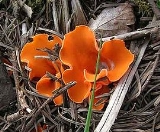
Orange peel fungus

Overview
Fungus
A fungus is a member of a large group of eukaryotic organisms that includes microorganisms such as yeasts and molds , as well as the more familiar mushrooms. These organisms are classified as a kingdom, Fungi, which is separate from plants, animals, and bacteria...
in the order Pezizales
Pezizales
The Pezizales are an order of the subphylum Pezizomycotina within the phylum Ascomycota. The order contains 16 families, 199 genera, and 1683 species. It contains a number of species of economic importance, such as morels, the black and white truffles, and the desert truffles. The Pezizales are...
. The brilliant orange, cup-shaped ascocarp
Ascocarp
An ascocarp, or ascoma , is the fruiting body of an ascomycete fungus. It consists of very tightly interwoven hyphae and may contain millions of asci, each of which typically contains eight ascospores...
s often resemble orange peels strewn on the ground, giving this species its common name.
In Europe, the orange peel may be confused with Otidea
Otidea
Otidea is a genus of fungi in the family Pyronemataceae. The genus is widely distributed in northern temperate regions, and contains about 23 species.-Selected species:*Otidea alutacea*Otidea apophysata*Otidea bufonia*Otidea cochleata...
or Caloscypha
Caloscypha
Caloscypha is a fungal genus in the Caloscyphaceae family . A monotypic genus, it contains the single species Caloscypha fulgens, commonly known as the spring orange peel fungus, the golden cup, or the dazzling cup...
species that are poisonous or of unknown edibility.
The North American Audubon Mushroom Field Guide lists orange peel fungi as edible, though not necessarily choice, with no particularly notable continental lookalikes.
The orange peel fungus grows on bare clay or disturbed soil throughout North America and Europe.
