
Oral candidiasisCandidiasis or thrush is a fungal infection of any of the Candida species, of which Candida albicans is the most common. Candidiasis encompasses infections that range from superficial, such as oral thrush and vaginitis, to systemic and potentially life-threatening diseases...
(also known as "Thrush") is an infection of
yeastYeasts are eukaryotic micro-organisms classified in the kingdom Fungi, with about 1,500 species currently described; they dominate fungal diversity in the oceans. Most reproduce asexually by budding, although a few do so by binary fission...
fungi of the genus
CandidaCandida is a genus of yeasts. Many species of this genus are endosymbionts of animal hosts including humans. While usually living as commensals, some Candida species have the potential to cause disease...
on the mucous membranes of the
mouthThe mouth, buccal cavity, or oral cavity is the first portion of the alimentary canal that receives food and begins digestion by mechanically breaking up the solid food particles into smaller pieces and mixing them with saliva...
. It is frequently caused by
Candida albicansCandida albicans is a diploid fungus and a causal agent of opportunistic oral and genital infections in humans. Systemic fungal infections have emerged as important causes of morbidity and mortality in immunocompromised patients...
, or less commonly by
Candida glabrataCandida glabrata is a haploid yeast of the genus Candida, previously known as Torulopsis glabrata. This species of yeast is non-dimorphic and no mating activity has been observed. Until recently, C. glabrata was thought to be a primarily non-pathogenic organism. However, with the ever increasing...
or
Candida tropicalisCandida tropicalis is a species of yeast in the genus Candida. It is easily recognized as a common medical yeast pathogen, existing as part of the normal human flora.-External links:*...
.
Oral thrush may refer to candidiasis in the mouths of babies, while if occurring in the mouth or throat of adults it may also be termed
candidosis or
moniliasis.
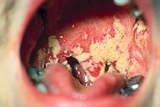
Oral infections by Candida species usually appear as thick white or cream-coloured deposits on mucosal membranes.
Discussion
Ask a question about 'Oral candidiasis'
Start a new discussion about 'Oral candidiasis'
Answer questions from other users
|
Oral candidiasisCandidiasis or thrush is a fungal infection of any of the Candida species, of which Candida albicans is the most common. Candidiasis encompasses infections that range from superficial, such as oral thrush and vaginitis, to systemic and potentially life-threatening diseases...
(also known as "Thrush") is an infection of
yeastYeasts are eukaryotic micro-organisms classified in the kingdom Fungi, with about 1,500 species currently described; they dominate fungal diversity in the oceans. Most reproduce asexually by budding, although a few do so by binary fission...
fungi of the genus
CandidaCandida is a genus of yeasts. Many species of this genus are endosymbionts of animal hosts including humans. While usually living as commensals, some Candida species have the potential to cause disease...
on the mucous membranes of the
mouthThe mouth, buccal cavity, or oral cavity is the first portion of the alimentary canal that receives food and begins digestion by mechanically breaking up the solid food particles into smaller pieces and mixing them with saliva...
. It is frequently caused by
Candida albicansCandida albicans is a diploid fungus and a causal agent of opportunistic oral and genital infections in humans. Systemic fungal infections have emerged as important causes of morbidity and mortality in immunocompromised patients...
, or less commonly by
Candida glabrataCandida glabrata is a haploid yeast of the genus Candida, previously known as Torulopsis glabrata. This species of yeast is non-dimorphic and no mating activity has been observed. Until recently, C. glabrata was thought to be a primarily non-pathogenic organism. However, with the ever increasing...
or
Candida tropicalisCandida tropicalis is a species of yeast in the genus Candida. It is easily recognized as a common medical yeast pathogen, existing as part of the normal human flora.-External links:*...
.
Oral thrush may refer to candidiasis in the mouths of babies, while if occurring in the mouth or throat of adults it may also be termed
candidosis or
moniliasis.
Symptoms
Oral infections by Candida species usually appear as thick white or cream-coloured deposits on mucosal membranes. The infected mucosa of the mouth may appear inflamed (red and possibly slightly raised). In babies the condition is termed thrush. Adults may experience discomfort or burning.
Special risk groups
- Newborn babies.
- Diabetics with poorly controlled diabetes.
- As a side effect of medication, most commonly having taken antibiotic
In common usage, an antibiotic is a substance or compound that kills or inhibits the growth of bacteria...
s. Inhaled corticosteroidCorticosteroids are a class of steroid hormones that are produced in the adrenal cortex. Corticosteroids are involved in a wide range of physiologic systems such as stress response, immune response and regulation of inflammation, carbohydrate metabolism, protein catabolism, blood electrolyte...
s for treatment of lung conditions (e.g, AsthmaAsthma is a predisposition to chronic inflammation of the lungs in which the airways are reversibly narrowed. Asthma affects 7% of the population of the United States, and 300 million worldwide...
or COPDChronic obstructive pulmonary disease refers to chronic bronchitis and emphysema, a pair of two commonly co-existing diseases of the lungs in which the airways become narrowed. This leads to a limitation of the flow of air to and from the lungs causing shortness of breath...
) may also result in oral candidiasis which may be reduced by regularly rinsing the mouth with water after taking the medication.
- People with an immune deficiency (e.g. as a result of AIDS
Acquired immune deficiency syndrome or acquired immunodeficiency syndrome is a disease of the human immune system caused by the human immunodeficiency virus ....
/HIVHuman immunodeficiency virus is a lentivirus that causes acquired immunodeficiency syndrome , a condition in humans in which the immune system begins to fail, leading to life-threatening opportunistic infections. Infection with HIV occurs by the transfer of blood, semen, vaginal fluid,...
or chemotherapyChemotherapy, in its most general sense, is the treatment of disease by chemicals especially by killing micro-organisms or cancerous cells. In popular usage, it refers to antineoplastic drugs used to treat cancer or the combination of these drugs into a cytotoxic standardized treatment regimen...
treatment).
- Women undergoing hormonal changes, like pregnancy or those on birth control pills.
- People with fresh oral piercings coming into regular contact with yeast.
- Denture users.
- Smokers.
Thrush and breastfeeding
Because of the increased use of antibiotics in laboring women to reduce the transmission of Group B streptococcal infection to the infant, thrush has become more prevalent. Symptoms include an oral rash in the infant's mouth, a diaper rash that does not heal with conventional diaper rash treatments and ointments, or burning, painful nipples of the breastfeeding mother.
The rash and pain experienced by the mother can range from severe to mild and may complicate
breastfeedingBreastfeeding is the feeding of an infant or young child with breast milk directly from human breasts rather than from a baby bottle or other container. Babies have a sucking reflex that enables them to suck and swallow milk...
. Treatments include good hygiene of the nipples; oral
probioticProbiotics are dietary supplements of live microorganisms thought to be healthy for the host organism. According to the currently adopted definition by FAO/WHO, probiotics are: "Live microorganisms which when administered in adequate amounts confer a health benefit on the host"...
s containing
L. acidophilus; and over-the-counter antifungal cream containing
nystatinNystatin is a polyene antifungal drug to which many molds and yeast infections are sensitive, including Candida spp. Nystatin has some toxicity associated with it when given intravenously, but it is not absorbed across intact skin or mucous membranes...
,
clotrimazoleClotrimazole is an antifungal medication commonly used in the treatment of fungal infections of both humans and animals such as vaginal yeast infections, oral thrush, and ringworm...
, or
miconazoleMiconazole is an imidazole antifungal agent, developed by Janssen Pharmaceutica, and commonly applied topically or mucus membranes to cure fungal infections. It works by inhibiting the synthesis of ergosterol, a critical component of fungal cell membranes...
on the nipples. Some clinicians recommend washing the cream off before breastfeeding.
Treatment
Oral candidiasis can be treated with topical anti-fungal drugs, such as
nystatinNystatin is a polyene antifungal drug to which many molds and yeast infections are sensitive, including Candida spp. Nystatin has some toxicity associated with it when given intravenously, but it is not absorbed across intact skin or mucous membranes...
,
miconazoleMiconazole is an imidazole antifungal agent, developed by Janssen Pharmaceutica, and commonly applied topically or mucus membranes to cure fungal infections. It works by inhibiting the synthesis of ergosterol, a critical component of fungal cell membranes...
or
amphotericin BAmphotericin B is a polyene antifungal drug, often used intravenously for systemic fungal infections...
. Topical therapy is given as an oral suspension which is washed around the mouth and then swallowed by the patient.
Patients who are immunocompromised, either with HIV/AIDS or as a result of chemotherapy, may require systemic treatment with oral or intravenous administered anti-fungals.
External links