

Ops

Encyclopedia
In ancient Roman religion
, Ops or Opis, (Latin
: "Plenty") was a fertility deity and earth-goddess of Sabine
origin.
, the bountiful monarch of the Golden Age
. Just as Saturn was identified with the Greek deity Cronus
, Opis was identified with Rhea
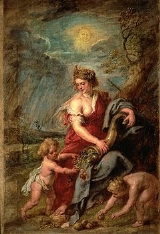
, Cronus' wife. In her statues and coins, Opis is figured sitting down, as Chthonian
deities normally are, and generally holds a scepter or a corn
spike as her main attributes. The Chthonian deities are the manifestations of the Great Goddess
, such as Gaia
or Ge
.
In Latin writings of the time, the singular nominative
(Ops) is not used; only the form Opis is attested by classical authors. According to Festus
(203:19), "Ops is said to be the wife of Saturn. By her they designated the earth
, because the earth distributes all goods to the human genus" (). The Latin word ops means "riches, goods, abundance, gifts, munificence, plenty". The word is also related to opus, which means "work", particularly in the sense of "working the earth, ploughing, sowing". This activity was deemed sacred, and was often attended by religious rituals intended to obtain the good will of chthonic
deities such as Ops and Consus
. Ops is also related to the Sanskrit
word ápnas ("goods, property").
The cult of Opis was (mythically) instituted by King Titus Tatius
, the Sabine monarch. Opis soon became the patroness of riches, abundance, and prosperity, both on a personal and national level. Opis had a famous temple in the Capitolium
. Originally, a festival took place in Opis' honor on August 10. Additionally, on December 19 (some say December 9), the Opalia
was celebrated. On August 25, the Opiconsivia
was held. Opiconsivia was another name used for Opis, indicating when the earth was sown. These festivals also included activities that were called Consualia
, in honor of Consus
, her consort
.
Opis, when synchronized with Greek mythology, was not only the wife of Saturn
, she was his sister and the daughter of Caelus
. Her children were Jupiter
, Neptune
, Pluto
, Juno
, Ceres, and Vesta
. Opis also acquired queenly status and was reputed to be an eminent goddess. By public decree temples, priests, and sacrifices were accorded her.
Religion in ancient Rome
Religion in ancient Rome encompassed the religious beliefs and cult practices regarded by the Romans as indigenous and central to their identity as a people, as well as the various and many cults imported from other peoples brought under Roman rule. Romans thus offered cult to innumerable deities...
, Ops or Opis, (Latin
Latin
Latin is an Italic language originally spoken in Latium and Ancient Rome. It, along with most European languages, is a descendant of the ancient Proto-Indo-European language. Although it is considered a dead language, a number of scholars and members of the Christian clergy speak it fluently, and...
: "Plenty") was a fertility deity and earth-goddess of Sabine
Sabine
The Sabines were an Italic tribe that lived in the central Appennines of ancient Italy, also inhabiting Latium north of the Anio before the founding of Rome...
origin.
Mythology
Her husband was SaturnSaturn (mythology)
In ancient Roman religion and myth, Saturn was a major god presiding over agriculture and the harvest time. His reign was depicted as a Golden Age of abundance and peace by many Roman authors. In medieval times he was known as the Roman god of agriculture, justice and strength. He held a sickle in...
, the bountiful monarch of the Golden Age
Golden Age
The term Golden Age comes from Greek mythology and legend and refers to the first in a sequence of four or five Ages of Man, in which the Golden Age is first, followed in sequence, by the Silver, Bronze, and Iron Ages, and then the present, a period of decline...
. Just as Saturn was identified with the Greek deity Cronus
Cronus
In Greek mythology, Cronus or Kronos was the leader and the youngest of the first generation of Titans, divine descendants of Gaia, the earth, and Uranus, the sky...
, Opis was identified with Rhea
Rhea (mythology)
Rhea was the Titaness daughter of Uranus, the sky, and Gaia, the earth, in Greek mythology. She was known as "the mother of gods". In earlier traditions, she was strongly associated with Gaia and Cybele, the Great Goddess, and was later seen by the classical Greeks as the mother of the Olympian...
, Cronus' wife. In her statues and coins, Opis is figured sitting down, as Chthonian
Chthonic
Chthonic designates, or pertains to, deities or spirits of the underworld, especially in relation to Greek religion. The Greek word khthon is one of several for "earth"; it typically refers to the interior of the soil, rather than the living surface of the land or the land as territory...
deities normally are, and generally holds a scepter or a corn
Wheat
Wheat is a cereal grain, originally from the Levant region of the Near East, but now cultivated worldwide. In 2007 world production of wheat was 607 million tons, making it the third most-produced cereal after maize and rice...
spike as her main attributes. The Chthonian deities are the manifestations of the Great Goddess
Mother goddess
Mother goddess is a term used to refer to a goddess who represents motherhood, fertility, creation or embodies the bounty of the Earth. When equated with the Earth or the natural world such goddesses are sometimes referred to as Mother Earth or as the Earth Mother.Many different goddesses have...
, such as Gaia
Gaia (mythology)
Gaia was the primordial Earth-goddess in ancient Greek religion. Gaia was the great mother of all: the heavenly gods and Titans were descended from her union with Uranus , the sea-gods from her union with Pontus , the Giants from her mating with Tartarus and mortal creatures were sprung or born...
or Ge
Gaia (mythology)
Gaia was the primordial Earth-goddess in ancient Greek religion. Gaia was the great mother of all: the heavenly gods and Titans were descended from her union with Uranus , the sea-gods from her union with Pontus , the Giants from her mating with Tartarus and mortal creatures were sprung or born...
.
In Latin writings of the time, the singular nominative
Nominative case
The nominative case is one of the grammatical cases of a noun or other part of speech, which generally marks the subject of a verb or the predicate noun or predicate adjective, as opposed to its object or other verb arguments...
(Ops) is not used; only the form Opis is attested by classical authors. According to Festus
Festus (historian)
Festus was a Late Roman historian whose breviary was commissioned by the emperor Valens in preparation for war against Persia....
(203:19), "Ops is said to be the wife of Saturn. By her they designated the earth
Earth
Earth is the third planet from the Sun, and the densest and fifth-largest of the eight planets in the Solar System. It is also the largest of the Solar System's four terrestrial planets...
, because the earth distributes all goods to the human genus" (). The Latin word ops means "riches, goods, abundance, gifts, munificence, plenty". The word is also related to opus, which means "work", particularly in the sense of "working the earth, ploughing, sowing". This activity was deemed sacred, and was often attended by religious rituals intended to obtain the good will of chthonic
Chthonic
Chthonic designates, or pertains to, deities or spirits of the underworld, especially in relation to Greek religion. The Greek word khthon is one of several for "earth"; it typically refers to the interior of the soil, rather than the living surface of the land or the land as territory...
deities such as Ops and Consus
Consus
In ancient Roman religion, the god Consus was the protector of grains and storage bins , and as such was represented by a grain seed....
. Ops is also related to the Sanskrit
Sanskrit
Sanskrit , is a historical Indo-Aryan language and the primary liturgical language of Hinduism, Jainism and Buddhism.Buddhism: besides Pali, see Buddhist Hybrid Sanskrit Today, it is listed as one of the 22 scheduled languages of India and is an official language of the state of Uttarakhand...
word ápnas ("goods, property").
The cult of Opis was (mythically) instituted by King Titus Tatius
Titus Tatius
The traditions of ancient Rome held that Titus Tatius was the Sabine king of Cures, who, after the rape of the Sabine women, attacked Rome and captured the Capitol with the treachery of Tarpeia. The Sabine women, however, convinced Tatius and the Roman king, Romulus, to reconcile and subsequently...
, the Sabine monarch. Opis soon became the patroness of riches, abundance, and prosperity, both on a personal and national level. Opis had a famous temple in the Capitolium
Capitoline Triad
In ancient Roman religion, the Capitoline Triad was a group of three supreme deities who were worshipped in an elaborate temple on Rome's Capitoline Hill, the Capitolium. Two distinct Capitoline Triads were worshipped at various times in Rome's history, both originating in ancient traditions...
. Originally, a festival took place in Opis' honor on August 10. Additionally, on December 19 (some say December 9), the Opalia
Opiconsivia
On August 25, the Opiconsivia Roman festival was held in honor of Ops, usually known as Opis, and sometimes as Opus....
was celebrated. On August 25, the Opiconsivia
Opiconsivia
On August 25, the Opiconsivia Roman festival was held in honor of Ops, usually known as Opis, and sometimes as Opus....
was held. Opiconsivia was another name used for Opis, indicating when the earth was sown. These festivals also included activities that were called Consualia
Consualia
The Consuales Ludi or Consualia is a festival instituted by Romulus, which honors Consus, the god of counsel, and the one who protects the harvest which is in storage at the time of the festival, which took place about the middle of Sextilis . According to Livy the festival honors Neptune...
, in honor of Consus
Consus
In ancient Roman religion, the god Consus was the protector of grains and storage bins , and as such was represented by a grain seed....
, her consort
King consort
King consort is an alternative title to the more usual "prince consort" - which is a position given in some monarchies to the husband of a reigning queen. It is a symbolic title only, the sole constitutional function of the holder being similar to a prince consort, which is the male equivalent of a...
.
Opis, when synchronized with Greek mythology, was not only the wife of Saturn
Saturn (mythology)
In ancient Roman religion and myth, Saturn was a major god presiding over agriculture and the harvest time. His reign was depicted as a Golden Age of abundance and peace by many Roman authors. In medieval times he was known as the Roman god of agriculture, justice and strength. He held a sickle in...
, she was his sister and the daughter of Caelus
Caelus
Caelus or Coelus was a primal god of the sky in Roman myth and theology, iconography, and literature...
. Her children were Jupiter
Jupiter (mythology)
In ancient Roman religion and myth, Jupiter or Jove is the king of the gods, and the god of the sky and thunder. He is the equivalent of Zeus in the Greek pantheon....
, Neptune
Neptune (mythology)
Neptune was the god of water and the sea in Roman mythology and religion. He is analogous with, but not identical to, the Greek god Poseidon. In the Greek-influenced tradition, Neptune was the brother of Jupiter and Pluto, each of them presiding over one of the three realms of the universe,...
, Pluto
Pluto (mythology)
In ancient Greek religion and myth, Pluto was a name for the ruler of the underworld; the god was also known as Hades, a name for the underworld itself...
, Juno
Juno (mythology)
Juno is an ancient Roman goddess, the protector and special counselor of the state. She is a daughter of Saturn and sister of the chief god Jupiter and the mother of Mars and Vulcan. Juno also looked after the women of Rome. Her Greek equivalent is Hera...
, Ceres, and Vesta
Vesta (mythology)
Vesta was the virgin goddess of the hearth, home, and family in Roman religion. Vesta's presence was symbolized by the sacred fire that burned at her hearth and temples...
. Opis also acquired queenly status and was reputed to be an eminent goddess. By public decree temples, priests, and sacrifices were accorded her.
Primary sources
- Livy Ab urbe condita libri XXIX.10.4-11.8, 14.5-14
- Lactantius, Divinae institutions I.13.2-4, 14.2-5
Secondary sources
- Virginia Brown's translation of Giovanni Boccaccio’s Famous Women, p. 12 - 13; Harvard University Press 2001; ISBN 0-674-01130-9