


Operation Slipper

Encyclopedia
Operation Slipper is the Australian Defence Force
(ADF) contribution to the war in Afghanistan
. The operation commenced in late 2001 and is ongoing. ADF participation included two major activities centred on Afghanistan and the Persian Gulf
.
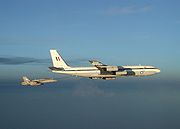 Australian participation in Afghanistan included a Special Forces
Task group and two Royal Australian Air Force
(RAAF) Boeing 707
air-to-air refuelling aircraft from No. 33 Squadron
. These aircraft and associated support personnel operated from Manas Air Base
in Kyrgyzstan
and provided support to coalition aircraft operating in Afghan airspace. Two RAAF AP-3C Orion
aircraft flew maritime patrol missions in support of maritime interdiction operations in the Persian Gulf
. These aircraft were temporarily retasked to Operations Falconer and Catalyst
in 2003.
RAAF C-130 Hercules
transport aircraft were also involved in providing logistic support for deployed forces. The Special Forces
were involved with the establishment of the US-led coalition's first Forward Operating Base (Camp Rhino
) southwest of Kandahar
in November 2001, followed by the capture of Kandahar International Airport in December 2001. The initial ADF
commitment in Afghanistan concluded in December 2002 when the Special Air Service Task Group was withdrawn. Following this date until 2005 Australia’s total contribution to efforts in Afghanistan was a single officer attached to the Coalition’s mine clearing force.
All three squadrons of the Australian Special Air Service Regiment
(SASR) were deployed to Afghanistan in 2001 and 2002. The dates of these deployments were:
A Troop from the New Zealand Special Air Service was attached to each Australian SAS Squadron Group. It's unclear whether the New Zealand SAS Troop was rotated at the same times as the Australian units.
, 4th Battalion, Royal Australian Regiment
(Commando), the Incident Response Regiment and logistic support personnel. As well as heavily modified land rovers, the Special Forces Task Group was also equipped with some Bushmaster infantry mobility vehicles. A detachment of two CH-47 Chinook
helicopters from the 5th Aviation Regiment was deployed to Afghanistan in March 2006 to support the Special Forces Task Group. The Australian Special Forces Task Group was withdrawn from Afghanistan in September 2006 and the helicopter detachment returned to Australia in April 2007.
with protective elements from the 5th/7th Battalion, Royal Australian Regiment
, 6th Battalion, Royal Australian Regiment
and 2nd Cavalry Regiment
began arriving in Orūzgān Province
in southern Afghanistan in early September 2006. The Australian Reconstruction Taskforce formed part of a Dutch
-led Provincial Reconstruction Team
, operating as part of the Dutch-led Task Force Uruzgan
and based at Forward Operating Base Ripley, outside of Tarin Kowt
.
A 300-strong Special Operations Task Group was deployed to support the Reconstruction Taskforce in April 2007, including a Commando company-group, elements of the SASR, and an integral combat service support team. In addition to radar crews, logistics and intelligence officers, and security personnel, this brought the number of Australian personnel in Afghanistan to 950 by mid-2007, with further small increases to 1,000 in mid-2008, 1,100 in early 2009 and 1,550 in mid-2009. These increases have occurred in spite of opinion polls indicating that public support for the deployment is decreasing, with a poll released in September 2008 finding that a majority of those surveyed were opposed to Australia's continued military involvement in the country.
In early 2009 a number of Operational Mentoring and Liaison Teams (OMLTs) were embedded into the Afghan National Army
battalions serving in the 4th (ANA) Brigade, 205th Hero Corps
, in Uruzgan as part of the Australian mission to mentor and partner the ANA within the province. Consequently, the RTF was renamed the Mentoring and Reconstruction Task Force. On 16 January 2009, Trooper
Mark Donaldson
, a member of the SASR, was awarded Australia's highest gallantry medal, the Victoria Cross for Australia
. Donaldson was awarded the medal for exposing himself to enemy fire to protect injured Australian troops and then rescuing an Afghan interpreter under heavy enemy fire during a contact on 2 September 2008.
As of 2010 a modest Australian force remains in Afghanistan where they are involved in counter-insurgency
operations in Uruzgan province in conjunction with Dutch and other coalition forces. MRTF was again renamed to the Mentoring Task Force in early-2010, and is now based around a combined arms
battalion
-sized battle group
, it consists of motorised infantry
and cavalry
force elements supported by engineers, as well as coalition enablers including artillery
and aviation
assets. The Rotary Wing Group flying CH-47D Chinooks, the Force Logistics Asset and an RAAF air surveillance radar unit are currently based in Kandahar
. A further 800 Australian logistic personnel are also based in the Middle East in support of Operation Slipper, but are located outside of Afghanistan. Detachments of maritime patrol and transport aircraft continue to support operations in Iraq and Afghanistan, based out of Al Minhad Air Base
in the United Arab Emirates
.
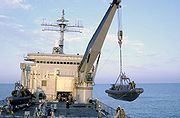 Since October 2001 the Royal Australian Navy
(RAN) has maintained a continuous presence in and around Iraqi territorial waters as part of Operation Slipper and subsequent operations. There were four major rotations of RAN ships to this area of operations between December 2001 and March 2003. The primary focus of these rotations was to conduct Maritime Interception Operations as part of a US, Australian and British force enforcing United Nations
Security Council resolutions against Iraq. The first rotation consisted of Her Majesty's Australian Ships (HMAS) Sydney
, Adelaide
and Kanimbla
. These ships were followed in February 2002 by HMA Ships Canberra, Newcastle and Manoora and again in July 2002 by HMAS Arunta and Melbourne.
Detachments from the Army's 16th Air Defence Regiment
provided point defence to the Kanimbla and Manoora during their deployments. One of the final Operation Slipper rotations was in November 2002 with HMA Ships Anzac and Darwin.
HMAS Kanimbla departed from Sydney, Australia on 20 January 2003 again bound for the Persian Gulf under the mission objectives of Operation Bastille. On arriving in Bahrain on 16 February she reverted to the original mission objects of Operation Slipper (that of enforcing UN Sanctions against Iraq). On 20 March 2003, HMA Ships Kanimbla, Anzac and Darwin participated in the combat phase of the 2003 Iraq War, codenamed Operation Falconer.
During these operations the Australian ships pioneered a number of techniques that increased the effectiveness of Maritime Interception Force operations leading to them intercepting and boarding about 1700 vessels during the period. Four Australian naval officers commanded the multinational force at various times during the course of the operation.
fighter aircraft provided air defence for the US military base on the island of Diego Garcia
during the campaign against the Taliban. The initial detachment was provided by No. 77 Squadron RAAF
between December 2001 and 10 February 2002. This detachment was replaced by a detachment from No. 3 Squadron RAAF
which was deployed between 10 February 2002 and 20 May 2002. No further Australian units have been deployed to Diego Garcia.
, and to date all casualties have occurred during operations in Afghanistan. 32 Australian soldiers have been killed and 213 wounded, the majority since October 2007. Another Australian was killed while serving with the British Army.
Australian Defence Force
The Australian Defence Force is the military organisation responsible for the defence of Australia. It consists of the Royal Australian Navy , Australian Army, Royal Australian Air Force and a number of 'tri-service' units...
(ADF) contribution to the war in Afghanistan
War in Afghanistan (2001–present)
The War in Afghanistan began on October 7, 2001, as the armed forces of the United States of America, the United Kingdom, Australia, and the Afghan United Front launched Operation Enduring Freedom...
. The operation commenced in late 2001 and is ongoing. ADF participation included two major activities centred on Afghanistan and the Persian Gulf
Persian Gulf
The Persian Gulf, in Southwest Asia, is an extension of the Indian Ocean located between Iran and the Arabian Peninsula.The Persian Gulf was the focus of the 1980–1988 Iran-Iraq War, in which each side attacked the other's oil tankers...
.
First phase
Australian Special Air Service Regiment
The Special Air Service Regiment, officially abbreviated SASR but commonly known as the SAS, is a special forces unit of the Australian Army...
Task group and two Royal Australian Air Force
Royal Australian Air Force
The Royal Australian Air Force is the air force branch of the Australian Defence Force. The RAAF was formed in March 1921. It continues the traditions of the Australian Flying Corps , which was formed on 22 October 1912. The RAAF has taken part in many of the 20th century's major conflicts...
(RAAF) Boeing 707
Boeing 707
The Boeing 707 is a four-engine narrow-body commercial passenger jet airliner developed by Boeing in the early 1950s. Its name is most commonly pronounced as "Seven Oh Seven". The first airline to operate the 707 was Pan American World Airways, inaugurating the type's first commercial flight on...
air-to-air refuelling aircraft from No. 33 Squadron
No. 33 Squadron RAAF
No. 33 Squadron is a Royal Australian Air Force transport squadron. It was formed in 1942 for service during World War II. Following the completion of hostilities the squadron was disbanded in 1946. In 1981 the squadron was re-raised as a flight-sized organisation before being expanded to a full...
. These aircraft and associated support personnel operated from Manas Air Base
Manas Air Base
Transit Center at Manas is a United States military installation at Manas International Airport, near Bishkek, the capital of Kyrgyzstan, primarily operated by the U.S. Air Force....
in Kyrgyzstan
Kyrgyzstan
Kyrgyzstan , officially the Kyrgyz Republic is one of the world's six independent Turkic states . Located in Central Asia, landlocked and mountainous, Kyrgyzstan is bordered by Kazakhstan to the north, Uzbekistan to the west, Tajikistan to the southwest and China to the east...
and provided support to coalition aircraft operating in Afghan airspace. Two RAAF AP-3C Orion
AP-3C Orion
The Lockheed AP-3C Orion is a variant of the P-3 Orion used by the Royal Australian Air Force for tasks such as naval fleet support, maritime surveillance, search and survivor supply and anti-surface and anti-submarine warfare...
aircraft flew maritime patrol missions in support of maritime interdiction operations in the Persian Gulf
Persian Gulf
The Persian Gulf, in Southwest Asia, is an extension of the Indian Ocean located between Iran and the Arabian Peninsula.The Persian Gulf was the focus of the 1980–1988 Iran-Iraq War, in which each side attacked the other's oil tankers...
. These aircraft were temporarily retasked to Operations Falconer and Catalyst
Australian contribution to the 2003 invasion of Iraq
The Howard Government supported the disarmament of Iraq during the Iraq disarmament crisis. Australia later provided one of the four most substantial combat force contingents during the 2003 invasion of Iraq, under the operational codename Operation Falconer. Part of its contingent were among the...
in 2003.
RAAF C-130 Hercules
C-130 Hercules
The Lockheed C-130 Hercules is a four-engine turboprop military transport aircraft designed and built originally by Lockheed, now Lockheed Martin. Capable of using unprepared runways for takeoffs and landings, the C-130 was originally designed as a troop, medical evacuation, and cargo transport...
transport aircraft were also involved in providing logistic support for deployed forces. The Special Forces
Australian Special Air Service Regiment
The Special Air Service Regiment, officially abbreviated SASR but commonly known as the SAS, is a special forces unit of the Australian Army...
were involved with the establishment of the US-led coalition's first Forward Operating Base (Camp Rhino
Camp Rhino
Forward operating base Rhino, also known as Camp Rhino, was the first US land base established in Afghanistan during Operation Enduring Freedom. It was located in the Registan Desert, southwest of Kandahar.-History:...
) southwest of Kandahar
Kandahar
Kandahar is the second largest city in Afghanistan, with a population of about 512,200 as of 2011. It is the capital of Kandahar Province, located in the south of the country at about 1,005 m above sea level...
in November 2001, followed by the capture of Kandahar International Airport in December 2001. The initial ADF
Australian Defence Force
The Australian Defence Force is the military organisation responsible for the defence of Australia. It consists of the Royal Australian Navy , Australian Army, Royal Australian Air Force and a number of 'tri-service' units...
commitment in Afghanistan concluded in December 2002 when the Special Air Service Task Group was withdrawn. Following this date until 2005 Australia’s total contribution to efforts in Afghanistan was a single officer attached to the Coalition’s mine clearing force.
All three squadrons of the Australian Special Air Service Regiment
Australian Special Air Service Regiment
The Special Air Service Regiment, officially abbreviated SASR but commonly known as the SAS, is a special forces unit of the Australian Army...
(SASR) were deployed to Afghanistan in 2001 and 2002. The dates of these deployments were:
- 1 Squadron Group, SASR – (October 2001–April 2002)
- 3 Squadron Group, SASR – (April 2002–August 2002)
- 2 Squadron Group, SASR – (August 2002–November 2002)
A Troop from the New Zealand Special Air Service was attached to each Australian SAS Squadron Group. It's unclear whether the New Zealand SAS Troop was rotated at the same times as the Australian units.
Second phase
An Australian Special Forces Task Group was re-deployed to Afghanistan in August or September 2005. This Task Group consisted of elements from the SASRAustralian Special Air Service Regiment
The Special Air Service Regiment, officially abbreviated SASR but commonly known as the SAS, is a special forces unit of the Australian Army...
, 4th Battalion, Royal Australian Regiment
4th Battalion, Royal Australian Regiment
The 4th Battalion, Royal Australian Regiment, was an Australian Army infantry battalion and part of the Royal Australian Regiment. The battalion was formed on 1 February 1964 and was renamed the 2nd Commando Regiment on 19 June 2009....
(Commando), the Incident Response Regiment and logistic support personnel. As well as heavily modified land rovers, the Special Forces Task Group was also equipped with some Bushmaster infantry mobility vehicles. A detachment of two CH-47 Chinook
CH-47 Chinook
The Boeing CH-47 Chinook is an American twin-engine, tandem rotor heavy-lift helicopter. Its top speed of 170 knots is faster than contemporary utility and attack helicopters of the 1960s...
helicopters from the 5th Aviation Regiment was deployed to Afghanistan in March 2006 to support the Special Forces Task Group. The Australian Special Forces Task Group was withdrawn from Afghanistan in September 2006 and the helicopter detachment returned to Australia in April 2007.
Third phase
A Reconstruction Taskforce based around the 1st Combat Engineer Regiment1st Combat Engineer Regiment (Australia)
The 1st Combat Engineer Regiment is a combat engineer regiment of the Australian Army. Based in the Northern Territory and attached to 1st Brigade, it is a Regular Army unit of the Royal Australian Engineers and is tasked with providing mobility and counter mobility support.-Structure:* 1st Combat...
with protective elements from the 5th/7th Battalion, Royal Australian Regiment
5th/7th Battalion, Royal Australian Regiment
The 5th/7th Battalion, Royal Australian Regiment was a mechanised infantry battalion of the Australian Army. The battalion was based at Robertson Barracks in Palmerston, Northern Territory and formed part of the 1st Brigade. It was formed in 1973 by linking both the 5th and 7th Battalions of the...
, 6th Battalion, Royal Australian Regiment
6th Battalion, Royal Australian Regiment
6th Battalion, Royal Australian Regiment is a motorised infantry battalion of the Australian Army. It was originally raised in Brisbane, Queensland, on 6 June 1965 and has since then served in a number of overseas deployments and conflicts including South Vietnam, East Timor and Iraq...
and 2nd Cavalry Regiment
Australian 2nd Cavalry Regiment
The 2nd Cavalry Regiment is a cavalry regiment of the Australian Army. The second most senior regiment in the Royal Australian Armoured Corps, 2 CAV serves in an armoured reconnaissance role and is attached to the 1st Brigade, based in Darwin in the Northern Territory.-History:The regiment was...
began arriving in Orūzgān Province
Oruzgan Province
Orūzgān or Urōzgān , also spelled Uruzgan or Rōzgān , is one of the thirty-four provinces of Afghanistan. It is in the center of the country, though the area is culturally and tribally linked to Kandahar in the south. Its capital is Tarin Kowt...
in southern Afghanistan in early September 2006. The Australian Reconstruction Taskforce formed part of a Dutch
Netherlands
The Netherlands is a constituent country of the Kingdom of the Netherlands, located mainly in North-West Europe and with several islands in the Caribbean. Mainland Netherlands borders the North Sea to the north and west, Belgium to the south, and Germany to the east, and shares maritime borders...
-led Provincial Reconstruction Team
Provincial reconstruction team
A Provincial Reconstruction Team is a unit introduced by the United States government, consisting of military officers, diplomats, and reconstruction subject matter experts, working to support reconstruction efforts in unstable states. PRTs were first established in Afghanistan in late 2001 or...
, operating as part of the Dutch-led Task Force Uruzgan
Task Force Uruzgan
The Netherlands Army Task Force Uruzgan was part of NATO's Regional Command South, International Security Assistance Force, in Afghanistan. The Dutch lead one of the four Provincial Reconstruction Teams in the southern region of the country...
and based at Forward Operating Base Ripley, outside of Tarin Kowt
Tarin Kowt
Tarinkot or Tarin Kowt is the capital of Orūzgān province in southern Afghanistan in Tarin Kowt District. It is a town of about 10,000 people, with some 200 small shops in the city's bazaar...
.
A 300-strong Special Operations Task Group was deployed to support the Reconstruction Taskforce in April 2007, including a Commando company-group, elements of the SASR, and an integral combat service support team. In addition to radar crews, logistics and intelligence officers, and security personnel, this brought the number of Australian personnel in Afghanistan to 950 by mid-2007, with further small increases to 1,000 in mid-2008, 1,100 in early 2009 and 1,550 in mid-2009. These increases have occurred in spite of opinion polls indicating that public support for the deployment is decreasing, with a poll released in September 2008 finding that a majority of those surveyed were opposed to Australia's continued military involvement in the country.
In early 2009 a number of Operational Mentoring and Liaison Teams (OMLTs) were embedded into the Afghan National Army
Afghan National Army
The Afghan National Army is a service branch of the military of Afghanistan, which is currently trained by the coalition forces to ultimately take the role in land-based military operations in Afghanistan. , the Afghan National Army is divided into seven regional Corps. The strength of the Afghan...
battalions serving in the 4th (ANA) Brigade, 205th Hero Corps
205th Corps (Afghanistan)
The 205th 'Atul' Corps is a corps-level formation of the Afghan National Army since 2004. The establishment of the corps started when the first commander, Gul Aqa Nahib, and some of his staff were appointed on September 1, 2004. The corps was officially established in Kandahar on September 19, 2004...
, in Uruzgan as part of the Australian mission to mentor and partner the ANA within the province. Consequently, the RTF was renamed the Mentoring and Reconstruction Task Force. On 16 January 2009, Trooper
Trooper (rank)
Trooper from the French "troupier" is the equivalent rank to private in a regiment with a cavalry tradition in the British Army and many other Commonwealth armies, including those of Australia, Canada, South Africa and New Zealand. Today, most cavalry units operate in the armoured role, equipped...
Mark Donaldson
Mark Donaldson
Mark Gregor Strang Donaldson VC is the first recipient of the Victoria Cross for Australia, awarded for gallantry, the highest award in the Australian honours system. He is the first Australian recipient of a Victoria Cross since Keith Payne in 1969...
, a member of the SASR, was awarded Australia's highest gallantry medal, the Victoria Cross for Australia
Victoria Cross for Australia
The Victoria Cross for Australia is the highest award in the Australian Honours System, superseding the Victoria Cross for issue to Australians...
. Donaldson was awarded the medal for exposing himself to enemy fire to protect injured Australian troops and then rescuing an Afghan interpreter under heavy enemy fire during a contact on 2 September 2008.
As of 2010 a modest Australian force remains in Afghanistan where they are involved in counter-insurgency
Counter-insurgency
A counter-insurgency or counterinsurgency involves actions taken by the recognized government of a nation to contain or quell an insurgency taken up against it...
operations in Uruzgan province in conjunction with Dutch and other coalition forces. MRTF was again renamed to the Mentoring Task Force in early-2010, and is now based around a combined arms
Combined arms
Combined arms is an approach to warfare which seeks to integrate different branches of a military to achieve mutually complementary effects...
battalion
Battalion
A battalion is a military unit of around 300–1,200 soldiers usually consisting of between two and seven companies and typically commanded by either a Lieutenant Colonel or a Colonel...
-sized battle group
Battlegroup (army)
A battlegroup , or task force in modern military theory, is the basic building block of an army's fighting force. A battlegroup is formed around an infantry battalion or armoured regiment, which is usually commanded by a Lieutenant Colonel...
, it consists of motorised infantry
Motorised infantry
In NATO and most other western countries, motorised infantry is infantry which is transported by trucks or other motor vehicles. It is distinguished from mechanized infantry, which is carried in armoured personnel carriers, infantry combat vehicles, or infantry fighting vehicles...
and cavalry
Cavalry
Cavalry or horsemen were soldiers or warriors who fought mounted on horseback. Cavalry were historically the third oldest and the most mobile of the combat arms...
force elements supported by engineers, as well as coalition enablers including artillery
Artillery
Originally applied to any group of infantry primarily armed with projectile weapons, artillery has over time become limited in meaning to refer only to those engines of war that operate by projection of munitions far beyond the range of effect of personal weapons...
and aviation
Aviation
Aviation is the design, development, production, operation, and use of aircraft, especially heavier-than-air aircraft. Aviation is derived from avis, the Latin word for bird.-History:...
assets. The Rotary Wing Group flying CH-47D Chinooks, the Force Logistics Asset and an RAAF air surveillance radar unit are currently based in Kandahar
Kandahar
Kandahar is the second largest city in Afghanistan, with a population of about 512,200 as of 2011. It is the capital of Kandahar Province, located in the south of the country at about 1,005 m above sea level...
. A further 800 Australian logistic personnel are also based in the Middle East in support of Operation Slipper, but are located outside of Afghanistan. Detachments of maritime patrol and transport aircraft continue to support operations in Iraq and Afghanistan, based out of Al Minhad Air Base
Camp Mirage
Camp Mirage is the codename for a former Canadian Forces forward logistics facility located in Dubai, United Arab Emirates. The facility was established in late-December 2001 and, though not officially acknowledged by the Canadian Forces, is considered an "open secret"...
in the United Arab Emirates
United Arab Emirates
The United Arab Emirates, abbreviated as the UAE, or shortened to "the Emirates", is a state situated in the southeast of the Arabian Peninsula in Western Asia on the Persian Gulf, bordering Oman, and Saudi Arabia, and sharing sea borders with Iraq, Kuwait, Bahrain, Qatar, and Iran.The UAE is a...
.
Current order of battle
As of March 2011 approximately 1,550 Australians were deployed to Afghanistan.- National Command Element
- Mentoring Task Force 2 (MTF-2)
- Headquarters, 5th Battalion, Royal Australian Regiment (5 RAR)
- 4 x Combat Teams including infantry, cavalry, engineers and offensive support
- 5 x Operational Mentoring and Liaison Teams
- Force Communications Unit IV (1st Combat Signal Regiment)
- Logistics and support units
- Detachment, 20th Surveillance and Target Acquisition Regiment, Royal Australian Artillery20th Surveillance and Target Acquisition Regiment, Royal Australian ArtilleryThe 20th Surveillance and Target Acquisition Regiment, Royal Australian Artillery is an Australian Army Regiment which was raised in 2006. The Regiment is responsible for providing the Australian Army with artillery spotting and tactical reconnaissance...
(operates ScanEagle UAVs) - Special Operations Task Group
- Elements of the SASR, 1 CDO, 2 CDO and the Incident Response Regiment
- Rotary Wing Group (including two CH-47D Chinooks helicopters).
- Detachment, 1st Regiment, Royal Australian Artillery (16 gunners attached to the British Army)
- RAAF Control and Reporting Centre (Kandahar International Airport)
- Two AP-3C Orion maritime patrol aircraft and three C-130 Hercules transports
- Personnel embedded with various coalition units
- Force Level Logistic Asset (Kandahar International Airport)
- Mentoring Task Force 2 (MTF-2)
Persian Gulf
Royal Australian Navy
The Royal Australian Navy is the naval branch of the Australian Defence Force. Following the Federation of Australia in 1901, the ships and resources of the separate colonial navies were integrated into a national force: the Commonwealth Naval Forces...
(RAN) has maintained a continuous presence in and around Iraqi territorial waters as part of Operation Slipper and subsequent operations. There were four major rotations of RAN ships to this area of operations between December 2001 and March 2003. The primary focus of these rotations was to conduct Maritime Interception Operations as part of a US, Australian and British force enforcing United Nations
United Nations
The United Nations is an international organization whose stated aims are facilitating cooperation in international law, international security, economic development, social progress, human rights, and achievement of world peace...
Security Council resolutions against Iraq. The first rotation consisted of Her Majesty's Australian Ships (HMAS) Sydney
HMAS Sydney (FFG 03)
HMAS Sydney is an Adelaide class guided missile frigate of the Royal Australian Navy . The frigate one of six modified s ordered from 1977 onwards, and the third of four to be constructed in the United States of America...
, Adelaide
HMAS Adelaide (FFG 01)
HMAS Adelaide was the lead ship of the Adelaide class of guided missile frigates built for the Royal Australian Navy, based on the United States Navy's Oliver Hazard Perry class frigates...
and Kanimbla
HMAS Kanimbla (L-51)
HMAS Kanimbla is the lead ship of the Kanimbla class Landing Platform Amphibious. Laid down in 1969 for the United States Navy as Newport class tank landing ship USS Saginaw, the ship was acquired by the Royal Australian Navy in 1994 for conversion into a amphibious warfare transport ship.Since...
. These ships were followed in February 2002 by HMA Ships Canberra, Newcastle and Manoora and again in July 2002 by HMAS Arunta and Melbourne.
Detachments from the Army's 16th Air Defence Regiment
16th Air Defence Regiment, Royal Australian Artillery
The 16th Air Defence Regiment is the youngest regiment of the Royal Regiment of Australian Artillery. As the Australian Defence Force's only Ground Based Air Defence unit the Regiment is responsible for protecting a wide range of military assets during wartime, ranging from Army units in the field...
provided point defence to the Kanimbla and Manoora during their deployments. One of the final Operation Slipper rotations was in November 2002 with HMA Ships Anzac and Darwin.
HMAS Kanimbla departed from Sydney, Australia on 20 January 2003 again bound for the Persian Gulf under the mission objectives of Operation Bastille. On arriving in Bahrain on 16 February she reverted to the original mission objects of Operation Slipper (that of enforcing UN Sanctions against Iraq). On 20 March 2003, HMA Ships Kanimbla, Anzac and Darwin participated in the combat phase of the 2003 Iraq War, codenamed Operation Falconer.
During these operations the Australian ships pioneered a number of techniques that increased the effectiveness of Maritime Interception Force operations leading to them intercepting and boarding about 1700 vessels during the period. Four Australian naval officers commanded the multinational force at various times during the course of the operation.
Diego Garcia
A detachment of four Australian F/A-18 HornetF/A-18 Hornet
The McDonnell Douglas F/A-18 Hornet is a supersonic, all-weather carrier-capable multirole fighter jet, designed to dogfight and attack ground targets . Designed by McDonnell Douglas and Northrop, the F/A-18 was derived from the latter's YF-17 in the 1970s for use by the United States Navy and...
fighter aircraft provided air defence for the US military base on the island of Diego Garcia
Diego Garcia
Diego Garcia is a tropical, footprint-shaped coral atoll located south of the equator in the central Indian Ocean at 7 degrees, 26 minutes south latitude. It is part of the British Indian Ocean Territory [BIOT] and is positioned at 72°23' east longitude....
during the campaign against the Taliban. The initial detachment was provided by No. 77 Squadron RAAF
No. 77 Squadron RAAF
No. 77 Squadron is a Royal Australian Air Force fighter squadron. The Squadron was formed in 1942 and currently operates F/A-18 Hornet aircraft from RAAF Base Williamtown.-History:...
between December 2001 and 10 February 2002. This detachment was replaced by a detachment from No. 3 Squadron RAAF
No. 3 Squadron RAAF
No. 3 Squadron is a Royal Australian Air Force fighter squadron. It was first formed in 1916 and currently operates F/A-18 Hornet aircraft from RAAF Base Williamtown, near Newcastle, New South Wales.-World War I:...
which was deployed between 10 February 2002 and 20 May 2002. No further Australian units have been deployed to Diego Garcia.
Casualties
Operation Slipper is notable for the first Australian combat deaths since the Vietnam WarVietnam War
The Vietnam War was a Cold War-era military conflict that occurred in Vietnam, Laos, and Cambodia from 1 November 1955 to the fall of Saigon on 30 April 1975. This war followed the First Indochina War and was fought between North Vietnam, supported by its communist allies, and the government of...
, and to date all casualties have occurred during operations in Afghanistan. 32 Australian soldiers have been killed and 213 wounded, the majority since October 2007. Another Australian was killed while serving with the British Army.
Timeline
| 2001 |
|
| 2002 |
Operation Anaconda Operation Anaconda took place in early March 2002 in which the United States military and CIA Paramilitary Officers, working with allied Afghan military forces, and other North Atlantic Treaty Organization and non NATO forces attempted to destroy al-Qaeda and Taliban forces in the Shahi-Kot... . More than 500 Taliban were reported killed. |
| 2006 |
Korps Commandotroepen The Korps Commandotroepen are the elite special forces of the Royal Netherlands Army. It is one of the two principal units tasked with special operations in the Netherlands , and it is deployable anywhere in the world under any circumstance, conducting all conceivable missions from... , killed 150 Taliban and al-Qaeda fighters in nine days of fierce fighting in the Chora district, 40 kilometres (24.9 mi) north-east of Tarin Kowt in southern Afghanistan. The fighting was the heaviest experienced by Australian forces since the Vietnam War Vietnam War The Vietnam War was a Cold War-era military conflict that occurred in Vietnam, Laos, and Cambodia from 1 November 1955 to the fall of Saigon on 30 April 1975. This war followed the First Indochina War and was fought between North Vietnam, supported by its communist allies, and the government of... and saw six Australians wounded in action. |
| 2007 |
Battle of Chora The Battle of Chora took place in and around the town of Chora , in Afghanistan's Orūzgān Province, during June 15–19, 2007. The fighting was between ISAF and Afghan forces on one side and Taliban forces on the other for the control of the Chora District center, regarded by the Taliban as a... . |
| 2008 |
|
| 2009 |
Victoria Cross for Australia The Victoria Cross for Australia is the highest award in the Australian Honours System, superseding the Victoria Cross for issue to Australians... for gallantry under heavy enemy fire during a contact on 2 September 2008. Sabi (dog) Sarbi is an Australian special forces explosives detection dog that spent almost 14 months missing in action in Afghanistan having disappeared during an ambush on 2 September 2008. Sarbi was later rediscovered by an American soldier, and was reunited with Australian forces pending repatriation to... , an Australian special forces Special forces of Australia Since 1941, the Australian military has raised a range of special forces and special operations units, which fall into four categories:# Commando units such as the Independent and Commando Companies raised during World War II, and the 1st Commando Regiment, the 4th Battalion, Royal Australian... explosives detection dog Detection dog A detection dog or sniffer dog is a dog that is trained to and works at using its senses to detect substances such as explosives, illegal drugs, or blood. Hunting dogs that search for game and search dogs that search for missing humans are generally not considered detection dogs... which was declared missing in action Missing in action Missing in action is a casualty Category assigned under the Status of Missing to armed services personnel who are reported missing during active service. They may have been killed, wounded, become a prisoner of war, or deserted. If deceased, neither their remains nor grave can be positively... after 2 September 2008 ambush, is recovered safe and well. |
| 2010 |
Shah Wali Kot Offensive The Shah Wali Kot Offensive was a five-day joint operation during the War in Afghanistan, conducted by Australian special forces and the Afghan National Army with US air support, between 10–14 June 2010... in the Shah Wali Kot district of Kandahar province Kandahar Province Kandahar or Qandahar is one of the largest of the thirty-four provinces of Afghanistan. It is located in southern Afghanistan, between Helmand, Oruzgan and Zabul provinces. Its capital is the city of Kandahar, which is located on the Arghandab River. The province has a population of nearly... , resulting in very heavy insurgent casualties, including up to 100 killed in action. The operation occurred in preparation for the coalition clearance of Kandahar and significantly disrupted a major insurgent safe haven. One Australian soldier and one Afghan were wounded in the action. Corporal Ben Roberts-Smith Ben Roberts-Smith Benjamin "Ben" Roberts-Smith VC, MG is an Australian soldier and a recipient of the Victoria Cross for Australia, the highest award in the Australian honours system.... of the Special Air Service Regiment Australian Special Air Service Regiment The Special Air Service Regiment, officially abbreviated SASR but commonly known as the SAS, is a special forces unit of the Australian Army... was awarded the Victoria Cross for Australia Victoria Cross for Australia The Victoria Cross for Australia is the highest award in the Australian Honours System, superseding the Victoria Cross for issue to Australians... for his actions during the offensive. 2nd Commando Regiment (Australia) The 2nd Commando Regiment is an Australian Army Special Forces unit, it is one of three combat-capable units within the Australian Special Operations Command. The regiment was established on 19 June 2009 when it was renamed from the 4th Battalion, Royal Australian Regiment... were killed when the US UH-60 Blackhawk helicopter carrying them crashed in northern Kandahar Province. The helicopter's US pilot was also killed, while a US crewman and the other seven Australian commandos aboard were also injured. Deh Rahwod District Deh Rahwod is a district in Oruzgan Province, southern Afghanistan, and the name of the town that serves as district seat. Deh Rahwod lies along the Helmand River... , in western Uruzgan during the Battle of Derapet Battle of Derapet The Battle of Derapet was fought near the village of Derapat in the Tangi Valley in Deh Rahwod, Orūzgān Province, southern Afghanistan, between a combined Australian Army and Afghan National Army patrol and Taliban forces on 24 August 2010... . AH-64 Apache AH-64 Apache The Boeing AH-64 Apache is a four-blade, twin-engine attack helicopter with a tailwheel-type landing gear arrangement, and a tandem cockpit for a two-man crew. The Apache was developed as Model 77 by Hughes Helicopters for the United States Army's Advanced Attack Helicopter program to replace the... attack helicopters provided close air support before the combined Australian and Afghan patrol broke contact after inflicting heavy casualties on the Taliban who were forced to retreat into the mountains. One Australian was killed in the fighting, while a large number of insurgents were known to have been killed. |
| 2011 |
|
See also
- Australian ArmyAustralian ArmyThe Australian Army is Australia's military land force. It is part of the Australian Defence Force along with the Royal Australian Navy and the Royal Australian Air Force. While the Chief of Defence commands the Australian Defence Force , the Army is commanded by the Chief of Army...
- Civilian casualties of the U.S. invasion of AfghanistanCivilian casualties of the U.S. invasion of AfghanistanThe decade-long War in Afghanistan has caused the deaths of thousands of Afghan civilians directly from insurgent and foreign military action, as well as the deaths of possibly tens of thousands of Afghan civilians indirectly as a consequence of displacement, starvation, disease, exposure, lack of...
- Coalition casualties in AfghanistanCoalition casualties in AfghanistanAs of November 30, 2011, there have been 2,744 coalition deaths in Afghanistan as part of ongoing coalition operations since the invasion in 2001. In this total, the American figure is for deaths "In and Around Afghanistan" which, as defined by the U.S...
- International public opinion on the war in AfghanistanInternational public opinion on the war in AfghanistanInternational public opinion is largely opposed to the war in Afghanistan. A 47-nation global survey of public opinion conducted in June 2007 by the Pew Global Attitudes Project found considerable opposition to the U.S. and NATO military operations in Afghanistan...
- International Security Assistance ForceInternational Security Assistance ForceThe International Security Assistance Force is a NATO-led security mission in Afghanistan established by the United Nations Security Council on 20 December 2001 by Resolution 1386 as envisaged by the Bonn Agreement...
- Taliban insurgencyTaliban insurgencyThe Taliban insurgency took root shortly after the group's fall from power following the 2001 war in Afghanistan. The Taliban continue to attack Afghan, U.S., and other ISAF troops and many terrorist incidents attributable to them have been registered. The war has also spread over the southern and...