


Oncidium

Encyclopedia
Oncidium, abbreviated as Onc. in the horticultural trade, is a genus
that contains about 330 species
of orchids from the subtribe Oncidiinae
of the orchid family (Orchidaceae
). This is a complex, difficult genus, with many species being reclassified. Calls are made for splitting this genus into multiple genera.
in 1800 with the orchid Oncidium altissimum, which has become the type species. Its name is derived from the Greek word "onkos", meaning "swelling". This refers to the callus at the lower lip.
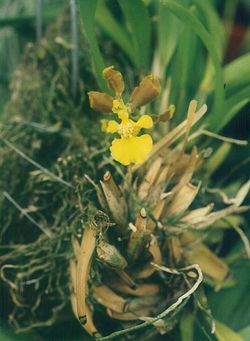
Most species in the Oncidium genus
are epiphytes, although some are lithophyte
s or terrestrials
. They are widespread from northern Mexico
, the Caribbean
, and some parts of South Florida
to South America. They usually occur in seasonally dry areas.
They can be divided in three categories, according to their growth pattern:
Oncidium species are characterised by the following properties :
The flower
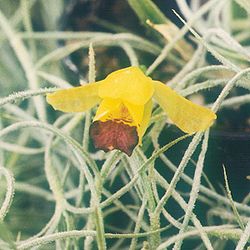
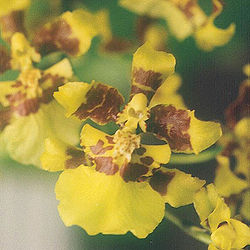
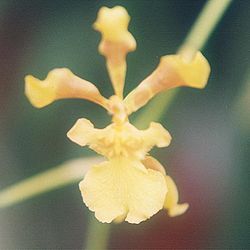
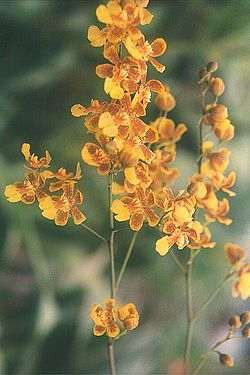
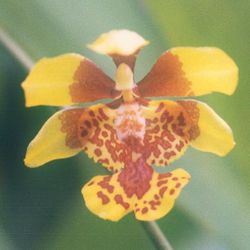
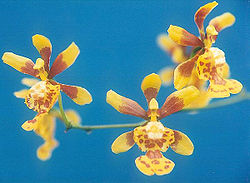
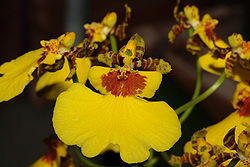
s of the Oncidium genus come in shades of yellow, red, white and pink. The petals are often ruffled on the edges, as is the lip
. The lip is enormous, partially blocking the small petals and sepals.
Some Oncidium orchids are very long : Oncidum altissimum and Oncidium baueri can grow to a height of 5 m, while Oncidum sarcodes can reach 3 m.
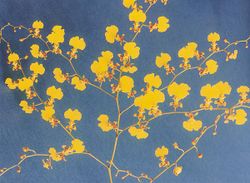
They are known as 'spray orchids' among some florists. They are very varied and are easily hybridised with Odontoglossum. Together with other closely related genera (Cochlioda, Miltonia, Cuitlauzina, Miltoniopsis, Osmoglossum, Leochilus, Comparettia, Cyrtochilum, Odontoglossum, Tolumnia, Rhynchostele [formerly Lemboglossum], Psychopsis, etc.) they form the Oncidium alliance. Some of the best Oncidium alliance hybrids originate from Oncidium tigrinum and Oncidium incurvum, when crossed with Odontoglossums, although hybridization possibilities of this group of orchids are literally endless, and there are literally hundreds of thousands of excellent hybrids in the Oncidium alliance.




Genus
In biology, a genus is a low-level taxonomic rank used in the biological classification of living and fossil organisms, which is an example of definition by genus and differentia...
that contains about 330 species
Species
In biology, a species is one of the basic units of biological classification and a taxonomic rank. A species is often defined as a group of organisms capable of interbreeding and producing fertile offspring. While in many cases this definition is adequate, more precise or differing measures are...
of orchids from the subtribe Oncidiinae
Oncidiinae
The Oncidiinae is a subtribe within the Orchidaceae that consists of a number of genera that are closely related.This subtribe consists of about 70 genera with over 1000 species, with Oncidium as its largest genus. These genera consist of a single floral type based on the angle of the attachment of...
of the orchid family (Orchidaceae
Orchidaceae
The Orchidaceae, commonly referred to as the orchid family, is a morphologically diverse and widespread family of monocots in the order Asparagales. Along with the Asteraceae, it is one of the two largest families of flowering plants, with between 21,950 and 26,049 currently accepted species,...
). This is a complex, difficult genus, with many species being reclassified. Calls are made for splitting this genus into multiple genera.
Description
This genus was first described by Olof SwartzOlof Swartz
Olof Peter Swartz was a Swedish botanist and taxonomist. He is best known for his taxonomic work and studies into pteridophytes...
in 1800 with the orchid Oncidium altissimum, which has become the type species. Its name is derived from the Greek word "onkos", meaning "swelling". This refers to the callus at the lower lip.
Most species in the Oncidium genus
Genus
In biology, a genus is a low-level taxonomic rank used in the biological classification of living and fossil organisms, which is an example of definition by genus and differentia...
are epiphytes, although some are lithophyte
Lithophyte
Lithophytes are a type of plant that grows in or on rocks. Lithophytes feed off moss, nutrients in rain water, litter, and even their own dead tissue....
s or terrestrials
Terrestrial plant
A terrestrial plant is one that grows on land. Other types of plants are aquatic , epiphytic , lithophytes and aerial ....
. They are widespread from northern Mexico
Mexico
The United Mexican States , commonly known as Mexico , is a federal constitutional republic in North America. It is bordered on the north by the United States; on the south and west by the Pacific Ocean; on the southeast by Guatemala, Belize, and the Caribbean Sea; and on the east by the Gulf of...
, the Caribbean
Caribbean
The Caribbean is a crescent-shaped group of islands more than 2,000 miles long separating the Gulf of Mexico and the Caribbean Sea, to the west and south, from the Atlantic Ocean, to the east and north...
, and some parts of South Florida
Florida
Florida is a state in the southeastern United States, located on the nation's Atlantic and Gulf coasts. It is bordered to the west by the Gulf of Mexico, to the north by Alabama and Georgia and to the east by the Atlantic Ocean. With a population of 18,801,310 as measured by the 2010 census, it...
to South America. They usually occur in seasonally dry areas.
They can be divided in three categories, according to their growth pattern:
- Some have green pseudobulbPseudobulbThe pseudobulb is a storage organ derived from the part of a stem between two leaf nodes.It applies to the orchid family , specifically certain groups of epiphytic orchids, and may be single or composed of several internodes with evergreen or deciduous leaves along its length.In some species, it is...
s and long racemeRacemeA raceme is a type of inflorescence that is unbranched and indeterminate and bears pedicellate flowers — flowers having short floral stalks called pedicels — along the axis. In botany, axis means a shoot, in this case one bearing the flowers. In a raceme, the oldest flowers are borne...
s with small flowers and a dominant lipLabellumLabellum is the Latin diminutive of labium, meaning lip. These are anatomical terms used descriptively in biology, for example in Entomology and botany.-Botany:...
. They are mostly golden yellow with or without reddish-brown barring, but some are brown or yellowish-brown. Other Oncidium species have white and pink blooms, while some even have startling, deep red colors in their flowers. - Another group has extremely small pseudobulbs and stiff, erect, solitary leavesLeafA leaf is an organ of a vascular plant, as defined in botanical terms, and in particular in plant morphology. Foliage is a mass noun that refers to leaves as a feature of plants....
. These cylindrical leaves act as a water reserve. They have long racemes with yellow flowers that seem to fan out at the top. Sizes of these orchids can vary from miniature plants of a couple of centimetres to giants with 30 cm-long leaves and racemes of more than one metre long. These species, known as the Mule-Ears, are now classed as PsychopsisPsychopsisPsychopsis, abbreviated Psychp in horticultural trade, is a genus of only four species of orchids distributed from the West Indies and Costa Rica to Peru, where it grows on the trunks and branches of trees. It used to be contained in the massively paraphyletic "wastebin genus" Oncidium...
. - Formerly there was a third group, called the Variegata or equitant oncidiums. They have no pseudobulbs, giving fan-shaped shoots of less than 15 cm, with triangular section leaves. These oval, broad and spongy leaves act as storage organs. Their flowers are most complicated with exquisite colors. The sepals are somewhat fleshy. The petals and the lip are membranaceous. These orchids are now classified as TolumniaTolumniaTolumnia Rafinesque, is a genus in the family Orchidaceae. Previously known as the "equitant Oncidiums," the species were segregated from the mega-genus Oncidium by Guido Braem in 1986...
. Cyrtochilum is another genusGenusIn biology, a genus is a low-level taxonomic rank used in the biological classification of living and fossil organisms, which is an example of definition by genus and differentia...
that many Oncidium species have recently been reclassified into; Cyrtochilum species have extremely long, winding inflorescences that can sometimes reach 20' or more, curled petals that result in three-pointed blooms, and rambling growth habits in which each new pseudobulb appears on top of the old one.
Oncidium species are characterised by the following properties :
- presence of columnColumn (botany)The column, or technically the gynostemium, is a reproductive structure that can be found in several plant families: Aristolochiaceae, Orchidaceae, and Stylidiaceae....
wings - presence of a complicated callus on the lipLabellumLabellum is the Latin diminutive of labium, meaning lip. These are anatomical terms used descriptively in biology, for example in Entomology and botany.-Botany:...
(this can be used to separate the taxa). - pseudobulbPseudobulbThe pseudobulb is a storage organ derived from the part of a stem between two leaf nodes.It applies to the orchid family , specifically certain groups of epiphytic orchids, and may be single or composed of several internodes with evergreen or deciduous leaves along its length.In some species, it is...
s with one to three leaves. - several basal bractBractIn botany, a bract is a modified or specialized leaf, especially one associated with a reproductive structure such as a flower, inflorescence axis, or cone scale. Bracts are often different from foliage leaves. They may be smaller, larger, or of a different color, shape, or texture...
s at the base of the pseudobulbs.
The flower
Flower
A flower, sometimes known as a bloom or blossom, is the reproductive structure found in flowering plants . The biological function of a flower is to effect reproduction, usually by providing a mechanism for the union of sperm with eggs...
s of the Oncidium genus come in shades of yellow, red, white and pink. The petals are often ruffled on the edges, as is the lip
Labellum
Labellum is the Latin diminutive of labium, meaning lip. These are anatomical terms used descriptively in biology, for example in Entomology and botany.-Botany:...
. The lip is enormous, partially blocking the small petals and sepals.
Some Oncidium orchids are very long : Oncidum altissimum and Oncidium baueri can grow to a height of 5 m, while Oncidum sarcodes can reach 3 m.
They are known as 'spray orchids' among some florists. They are very varied and are easily hybridised with Odontoglossum. Together with other closely related genera (Cochlioda, Miltonia, Cuitlauzina, Miltoniopsis, Osmoglossum, Leochilus, Comparettia, Cyrtochilum, Odontoglossum, Tolumnia, Rhynchostele [formerly Lemboglossum], Psychopsis, etc.) they form the Oncidium alliance. Some of the best Oncidium alliance hybrids originate from Oncidium tigrinum and Oncidium incurvum, when crossed with Odontoglossums, although hybridization possibilities of this group of orchids are literally endless, and there are literally hundreds of thousands of excellent hybrids in the Oncidium alliance.
Species
- Oncidium aberrans (Brazil - Paraná).
- Oncidium abortivum (N. Venezuela to Ecuador).
- Oncidium abruptum (Colombia to Ecuador).
- Oncidium acinaceum (Ecuador to Peru).
- Oncidium acrochordonia (Colombia).
- Oncidium adelaidae (Colombia).
- Oncidium advena (N. Venezuela).
- Oncidium albini (Brazil - Paraná).
- Oncidium alcicorne (Colombia).
- Oncidium allenii (Panama).
- Oncidium aloisii (Ecuador).
- Oncidium altissimum : "WydlerWydlerSurname of Swiss origin . Currently people with the family name Wydler are also found in the United States and Argentina where they have emigrated in the early 20th century.* Heinrich Wydler , a Swiss botanist...
's Dancing-lady Orchid" (Jamaica). - Oncidium amabile (Brazil).
- Oncidium amictumOncidium amictumOncidium amictum is a species of orchid endemic to southeastern Brazil....
(SE. Brazil). - Oncidium amoenum (Mexico).
- Oncidium ampliatumLindl. (Panama) (now a synonym of the accepted name Chelyorchis ampliata (Lindl.) Dressler & N.H.Williams in G.A.Romero & G.Carnevali, 2000 )
- Oncidium andradeanum (Ecuador to Peru).
- Oncidium andreae (Colombia).
- Oncidium andreanum (SW. Mexico).
- Oncidium angustisegmentum (Peru).
- Oncidium × ann-hadderae (O. haitiense × O. variegatum) (Dominican Republic).
- Oncidium anomalum (Colombia).
- Oncidium ansiferum (C. America to Colombia).
- Oncidium anthocrene (Colombia to Ecuador).
- Oncidium antioquiense (Colombia).
- Oncidium ariasii (Peru).
- Oncidium arizajulianum (Dominican Republic) (now synonym of Tolumnia arizajuliana)
- Oncidium armillare (W. South America to N. Venezuela).
- Oncidium aspecum (Peru).
- Oncidium auriculaOncidium auriculaOncidium auricula is a species of orchid endemic to southeastern Brazil....
(SE. Brazil). - Oncidium auriferumOncidium auriferumOncidium auriferum is a species of orchid ranging from western South America to northern Venezuela....
(Colombia to NW. Venezuela). - Oncidium aurorae (Peru).
- Oncidium ayabacanum (Peru).
- Oncidium baccatum (Venezuela).
- Oncidium bahiense (Cogn.) Schltr (NE Brasil)
- Oncidium barbaceniae (Brazil - Minas Gerais).
- Oncidium barbatum (Brazil to Bolivia).
- Oncidium batemannianum (Brazil to Peru).
- Oncidium baueriOncidium baueriOncidium baueri is a species of orchid native to the Neotropics....
(Trop. America). - Oncidium bennettii (Peru).
- Oncidium bicolorOncidium bicolorOncidium bicolor is a species of orchid ranging from northeastern Venezuela to Brazil....
(NE. Venezuela to Brazil). - Oncidium bidentatum (Ecuador).
- Oncidium bifoliumOncidium bifoliumOncidium bifolium is a species of orchid ranging from Brazil to northern Argentina....
(Brazil to N. Argentina). - Oncidium blanchetiiOncidium blanchetiiOncidium blanchetii is a species of orchid native to eastern and southern Brazil....
(E. & S. Brazil.). - Oncidium boothianum (Venezuela to Ecuador).
- Oncidium brachyandrum (Mexico)
- Oncidium brachystachys (Colombia).
- Oncidium brachystegium (Bolivia).
- Oncidium bracteatum (Costa Rica to Colombia).
- Oncidium braunii (Trop. America) (?).
- Oncidium brevilabrum (Colombia.
- Oncidium brunleesianumOncidium brunleesianumOncidium brunleesianum is a species of orchid native to Brazil ....
(Brazil - Rio de Janeiro). - Oncidium brunnipetalum (S. Brazil).
- Oncidium bryocladium (Colombia).
- Oncidium bryolophotum (Costa Rica to Panama).
- Oncidium buchtienii (Bolivia).
- Oncidium bustosii Königer (Ecuador)
- Oncidium calanthum (Ecuador to Peru).
- Oncidium callistum (Colombia).
- Oncidium calochilum (Cayman Is., Cuba, Dominican Republic) (now synonym of Tolumnia calochila)
- Oncidium caminiophorum (N. Venezuela).
- Oncidium cardiostigma (Mexico).
- Oncidium × cassolanum (O. cornigerum]] × O. riograndense) (S. Brazil).
- Oncidium caucanum (Colombia).
- Oncidium cebolleta (Mexico to Brazil) (synonym of the accepted name : Trichocentrum cebolleta (Jacq.) M.W.Chase & N.H.Williams, 2001
- Oncidium chapadense (Brazil - Goiás).
- Oncidium cheirophorumOncidium cheirophorumOncidium cheirophorum is a species of orchid found from Mexico to Colombia....
(Mexico - Chiapas to Colombia). - Oncidium chrysomorphum (Colombia to N. Venezuela).
- Oncidium chrysops (Mexico - Guerrero, Oaxaca).
- Oncidium chrysopteranthum (Brazil).
- Oncidium chrysopterum (WC. Brazil to Bolivia).
- Oncidium chrysothyrsus (SE. Brazil)
- Oncidium ciliatumOncidium ciliatumOncidium ciliatum is a species of orchid endemic to Brazil.-Synonyms:*Oncidium barbatum var. ciliatum Lindl.*Oncidium ciliolatum Hoffmanns.*Oncidium fimbriatum Hoffmanns.*Oncidium subciliatum Hoffmanns....
(SE. Brazil).
- Oncidium citrinumOncidium citrinumOncidium citrinum is a species of orchid found from Colombia to Trinidad....
(Trinidad to Venezuela). - Oncidium cogniauxianum (SE. Brazil).
- Oncidium × colnagoi. (O. forbesii × O.) (SE. Brazil).
- Oncidium coloratum (Brazil - Espírito Santo) (now synonym of Carria colorata]] (Königer & J.G.Weinm.bis) V.P.Castro & K.G.Lacerda 2005)
- Oncidium compressicaule (Haiti) (now synonym of Tolumnia compressicaulis)
- Oncidium concolorOncidium concolorOncidium concolor is a species of orchid found from southern and southeastern Brazil to northeastern Argentina....
(Brazil to NE. Argentina). - Oncidium cornigerumOncidium cornigerumOncidium cornigerum is a species of orchid found from southern and southeastern Brazil to Paraguay....
(SE. & S. Brazil to Paraguay). - Oncidium crassopterum (Peru).
- Oncidium crispumOncidium crispumOncidium crispum is a species of orchid endemic to eastern and southern Brazil....
(SE. Brazil). - Oncidium cristatellum (Brazil to Ecuador).
- Oncidium croesusOncidium croesusOncidium croesus is a species of orchid endemic to Brazil ....
(Brazil - Rio de Janeiro). - Oncidium cruciferum (Peru).
- Oncidium cultratum (Ecuador) .
- Oncidium curtum (Brazil - Rio de Janeiro).
- Oncidium cycnicolle (Colombia to Ecuador).
- Oncidium dactyliferum (Venezuela to Ecuador).
- Oncidium dactylopterum (Colombia).
- Oncidium dasytyleOncidium dasytyleOncidium dasytyle is a species of orchid endemic to Brazil ....
(Brazil - Rio de Janeiro). - Oncidium decorum (Colombia).
- Oncidium deltoideumOncidium deltoideumOncidium deltoideum is a species of orchid found from southern Ecuador to northern Peru....
(N. Peru). - Oncidium dichromaticum (Costa Rica to Colombia).
- Oncidium disciferum (Bolivia).
- Oncidium discobulbon (Peru).
- Oncidium divaricatumOncidium divaricatumOncidium divaricatum is a species of orchid found from southeastern and southern Brazil to northeastern Argentina.-External links:*...
(SE. Brazil). - Oncidium donianum (Brazil - São Paulo).
- Oncidium drepanopterum (Ecuador).
- Oncidium durangense (Mexico - Durango).
- Oncidium duveenii (Brazil).
- Oncidium echinophorum (Brazil - Rio de Janeiro).
- Oncidium echinops (Ecuador).
- Oncidium edmundoi (Brazil).
- Oncidium edwallii (Brazil to NE. Argentina).
- Oncidium elephantotis (NW. Venezuela to Ecuador).
- Oncidium emilii (Paraguay).
- Oncidium enderianum (SE. Brazil).
- Oncidium endocharis (Mexico - Chiapas to C. America).
- Oncidium ensatumOncidium ensatumOncidium ensatum is a species of orchid found from southern Florida to Cuba, southern Mexico to northwestern Venezuela....
: Latin American Orchid']] (S. Mexico to NW. Venezuela). - Oncidium erucatum (Ecuador).
- Oncidium estradae (Ecuador).
- Oncidium eurycline (SE. Brazil).
- Oncidium exalatum (Panama).
- Oncidium exasperatoides (Peru).
- Oncidium excavatumOncidium excavatumOncidium excavatum, is also known as the Hollow Oncidium.-Taxonomy:Synonyms include Oncidium aurosum, Oncidium boissieri, Oncidium excavatum var. dawsonii, Oncidium rupestre and Oncidium skinneri.-Distribution and habitat:...
(C. America to Peru). - Oncidium fasciculatum (Mexico - Oaxaca, Chiapas to Guatemala).
- Oncidium fasciferum (Peru).
- Oncidium fimbriatum (Brazil to NE. Argentina).
- Oncidium flexuosumOncidium flexuosumOncidium flexuosum is a species of orchid found from eastern and southern Brazil to north-central Argentina....
(E. & S. Brazil to NC. Argentina). - Oncidium floridanum : Florida Orchid']] (S. Florida to Cuba).
- Oncidium × floride-phillipsae (O. prionochilum]] × O. variegatum) (Leeward Is.).
- Oncidium forbesiiOncidium forbesiiOncidium forbesii is a species of orchid native to southeastern Brazil....
(Brazil - Minas Gerais). - Oncidium formosissimum (Ecuador to Peru).
- Oncidium fragae (Brazil - Rio de Janeiro).
- Oncidium fuscans (Brazil - Minas Gerais).
- Oncidium fuscatumOncidium fuscatumOncidium fuscatum is a species of occurring from Colombia to Peru....
(Ecuador to Peru). - Oncidium fuscopetalum (WC. Brazil).
- Oncidium gardneriOncidium gardneriOncidium gardneri is a species of native to southern and southeastern Brazil.-Synonyms:*Oncidium curtum Lindl.*Oncidium flabelliferum Pinel*Oncidium elegantissimum Rchb.f.*Oncidium gardnerianum auct.*Oncidium praestans Rchb.f....
(Ecuador, SE. Brazil). - Oncidium × gardstyle (O. dasystyle]] × O. gardneri) (Brazil - Rio de Janeiro).
- Oncidium gauntlettii (Jamaica) (now synonym of Tolumnia gauntlettii)
- Oncidium geertianumOncidium geertianumOncidium geertianum is a species of native to central and southwestern Mexico....
(C. & SW. Mexico). - Oncidium gilvum (SE. Brazil).
- Oncidium gracile (SE. Brazil).
- Oncidium graciliforme (C.Panama).
- Oncidium gracillimum (Colombia).
- Oncidium graminifoliumOncidium graminifoliumOncidium graminifolium is a species of orchid occurring from Mexico to Central America....
(Mexico to C. America). - Oncidium gravesianum (E. Brazil).
- Oncidium guianense (Hispaniola) (now synonym of Tolumnia guianensis)
- Oncidium guibertianum (Cuba) (now synonym of Tolumnia guibertiana)
- Oncidium guttatum (Mexico to Colombia and Caribbean) (now synonym of Tolumnia guttata)
- Oncidium gyrobulbon (Ecuador).
- Oncidium hagsaterianum (Mexico to Guatemala).
- Oncidium haitiense (Hispaniola) (now synonym of Tolumnia haitensis)
- Oncidium hannelorae (Windward Is.-(Dominica).
- Oncidium hapalotyle (Colombia to Ecuador).
- Oncidium harrisonianum (SE. Brazil).
- Oncidium hastatumOncidium hastatumOncidium hastatum is a species of orchid endemic to Mexico....
(Mexico). - Oncidium hastilabiumOncidium hastilabiumOncidium hastilabium is a species of orchid found from northwestern Venezuela to western South America.-External links:*...
(W. South America). - Oncidium hatschbachii (Brazil - Paraná).
- Oncidium helgae (Ecuador).
- Oncidium herzogii (Bolivia to NW. Argentina).
- Oncidium heteranthum (S. Trop. America).
- Oncidium hians (Peru, SE. Brazil).
- Oncidium hieroglyphicum (Peru).
- Oncidium hintonii (N. & SW. Mexico).
- Oncidium hirtzii (Ecuador – Napo).
- Oncidium hookeri (SE. & S. Brazil.
- Oncidium hydrophilumOncidium hydrophilumOncidium hydrophilum is a species of orchid found from Brazil to Paraguay....
(Brazil to Paraguay). - Oncidium hyphaematicum (W. South America).
- Oncidium imitans (Costa Rica).
- Oncidium imperatoris-maximiliani (Brazil - Rio de Janeiro).
- Oncidium incurvumOncidium incurvumOncidium incurvum is a species of orchid endemic to Mexico ....
(Mexico - Veracruz to Chiapas).
- Oncidium inouei (Peru).
- Oncidium insigne (Brazil).
- Oncidium ionopterum (Peru - Cajamarca).
- Oncidium iricolor (Trop. America) (?).
- Oncidium isidrense (Peru).
- Oncidium isopterum (Brazil - Minas Gerais).
- Oncidium isthmii (Costa Rica to Panama).
- Oncidium kautskyi (Brazil).
- Oncidium klotzschianumOncidium klotzschianumOncidium klotzschianum is a species of orchid occurring from Costa Rica to Peru and Venezuela....
(Costa Rica to Venezuela and Peru). - Oncidium kraenzlinianum (Brazil).
- Oncidium kramerianum (Costa Rica to Suriname and Ecuador) (now synonym of Psychopsis krameriana)
- Oncidium lancifolium (Ecuador).
- Oncidium leinigii (Brazil).
- Oncidium leleui (SW. Mexico).
- Oncidium lentiginosumOncidium lentiginosumOncidium lentiginosum is a species of orchid occurring from Colombia to northern Venezuela....
(Colombia to N. Venezuela). - Oncidium leopardinum (Peru).
- Oncidium lepidum (Ecuador).
- Oncidium lepturum (Bolivia).
- Oncidium leucochilumOncidium leucochilumOncidium leucochilum is a species of orchid occurring from southeastern Mexico to Honduras....
(SE. Mexico to Guatemala). - Oncidium lietzei (SE. Brazil).
- Oncidium ligiae (Colombia).
- Oncidium lindleyi (S. Mexico to Guatemala).
- Oncidium lineoligerumOncidium lineoligerumOncidium lineoligerum is a species of orchid occurring from Costa Rica to northern Peru....
(N. Peru). - Oncidium litum (SE. Brazil).
- Oncidium loechiloides (Venezuela).
- Oncidium loefgrenii (SE. & S. Brazil).
- Oncidium longicornuOncidium longicornuOncidium longicornu is a species of orchid occurring from Brazil to northeastern Argentina....
(Brazil to NE. Argentina. - Oncidium longipesOncidium longipesOncidium longipes is a species of orchid occurring from Brazil to northeastern Argentina....
(Brazil to NE. Argentina). - Oncidium lucasianum (Peru - Cajamarca).
- Oncidium lucayanum (Bahamas) (now synonym of Tolumnia lucayana)
- Oncidium luteum (Costa Rica).
- Oncidium lykaiosii (Bolivia).
- Oncidium macronyx (Brazil).
- Oncidium macropetalum (WC. Brazil)
- Oncidium maculatumOncidium maculatumOncidium maculatum is a species of orchid occurring from Mexico to Central America.-Synonyms:Cyrtochilum maculatum Lindl. is the basionym. Other synonyms include:*Oncidium funereum Lex.*Cyrtochilum maculatum var. ecornutum Hook....
(Mexico to C. America). - Oncidium maculosum (Brazil - Minas Gerais.
- Oncidium magdalenae (NW. Venezuela - Mérida).
- Oncidium maizifolium (Colombia to NW. Venezuela).
- Oncidium majevskyi (Brazil).
- Oncidium mantense Dodson & R.Estrada (Ecuador)
- Oncidium mandonii (Bolivia).
- Oncidium marshallianumOncidium marshallianumOncidium marshallianum is a species of orchid endemic to southeastern Brazil....
(SE. Brazil). - Oncidium martianum (SE. & S. Brazil).
- Oncidium mathieuanum (Ecuador to Peru).
- Oncidium megalopterum (SE. Brazil).
- Oncidium melanops (Ecuador).
- Oncidium micropogonOncidium micropogonOncidium micropogon is a species of orchid endemic to southeastern Brazil....
(Brazil). - Oncidium micropogon var. micropogon (S. Brazil). Pseudobulb epiphyte
- Oncidium microstigma (C. & SW. Mexico).
- Oncidium millianum (Colombia).
- Oncidium miserrimum (Colombia to NW. Venezuela).
- Oncidium morenoi (Brazil) (replaced synonym of the accepted name Trichocentrum morenoi (Dodson & Luer) M.W.Chase & N.H.Williams, 2001 )
- Oncidium nebulosum (Colombia).
- Oncidium niesseniae (Colombia).
- Oncidium nigratum (Colombia to Guyana).
- Oncidium obryzatoides (Costa Rica to Ecuador).
- Oncidium ochmatochilumOncidium ochmatochilumOncidium ochmatochilum Rchb.f. , reduced to synonymy under Cyrtochiloides ochmatochila N.H.Williams & M.W.Chase , is a species of orchid....
]] (SE. Mexico to Peru).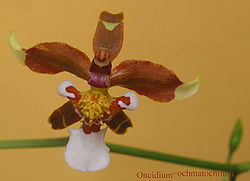
- Oncidium ochthodes (Ecuador).
- Oncidium oliganthum (Mexico - Oaxaca, Chiapas to El Salvador).
- Oncidium orbatum (Colombia).
- Oncidium ornithocephalum (Colombia).
- Oncidium ornithopodum (Trop. America) (?).
- Oncidium ornithorhynchumOncidium ornithorhynchumOncidium ornithorhynchum is a species of orchid found from Mexico to Colombia....
(Mexico to C. America). - Oncidium orthostates (S. Venezuela to Guyana and Brazil). This species has been redefined as Nohawilliamsia pirarense (Rchb. f.), M.W. Chase & Whitten
- Oncidium orthostatoides (Peru).
- Oncidium ototmeton (Bolivia).
- Oncidium ouricanense (Brazil - Bahia).
- Oncidium panamense (Panama).
- Oncidium panduratum (Colombia.
- Oncidium panduriforme (Costa Rica).
- Oncidium papilio (Panama to S. Trop. America and Trinidad) (now synonym of Psychopsis papilio)
- Oncidium paranaense (Brazil to Argentina - Misiones).
- Oncidium paranapiacabense (Brazil - São Paulo).
- Oncidium pardalis (N. Venezuela).
- Oncidium pardoglossum (Trop. America) (?).
- Oncidium pardothyrsus (Ecuador to Peru).
- Oncidium parviflorum (Costa Rica to Panama).
- Oncidium pectoraleOncidium pectoraleOncidium pectorale is a species of orchid endemic to Brazil ....
(Brazil - Rio de Janeiro). - Oncidium pelicanum (Mexico - Guerrero, Oaxaca).
- Oncidium peltiforme (Ecuador).
- Oncidium pentadactylon (W. South America).
- Oncidium pergameneum (NC. & SE. Mexico to C. America).
- Oncidium pictum (W. South America).
- Oncidium picturatum (N. Venezuela).
- Oncidium pirarene (Guyana).
- Oncidium planilabre (W. South America).
- Oncidium platychilum (Colombia to Ecuador).
- Oncidium platyglossum (Colombia).
- Oncidium pollardii (Mexico - Oaxaca).
- Oncidium polyadenium (Ecuador to N. Peru).
- Oncidium polyodontum (SE. Brazil).
- Oncidium portillae (Ecuador).
- Oncidium posadarum (Colombia).
- Oncidium powellii (Panama).
- Oncidium praetextumOncidium praetextumOncidium praetextum is a species of orchid endemic to southern and southeastern Brazil....
(SE. Brazil). - Oncidium prionochilum (Puerto Rico to Virgin Is.) (now synonym of Tolumnia prionochila)
- Oncidium pubesOncidium pubesOncidium pubes is a species of orchid found from Colombia, southeastern and southern Brazil to northeastern Argentina....
(Colombia, SE. Brazil to NE. Argentina). - Oncidium pulchellum (Jamaica) (now synonym of Tolumnia pulchella)
- Oncidium pulvinatum (Brazil to NE. Argentina).
- Oncidium punctulatum (Panama).
- Oncidium pyramidale (W. South America).
- Oncidium pyxidophorum (Trop. America) (?).
- Oncidium quadrilobum (Hispaniola) (now synonym of Tolumnia quadriloba)
- Oncidium raniferumOncidium raniferumOncidium raniferum is a species of orchid endemic to eastern Brazil....
(SE. Brazil). - Oncidium reductum (Bolivia).
- Oncidium reflexumOncidium reflexumOncidium reflexum is a species of orchid endemic to southwestern Mexico.-Synonyms:*Oncidium funereum Lindl.*Oncidium pelicanum Lindl.*Oncidium suttonii Bateman ex Lindl.*Oncidium suave Lindl....
(SW. Mexico) - Oncidium regentii V.P.Castro & G.F.Carr (2005) (Brazil)
- Oncidium reichenbachii (Colombia to NW. Venezuela).
- Oncidium remotiflorum (Brazil).
- Oncidium retusum (Peru).
- Oncidium rhinoceros (Trop. America) (?).
- Oncidium riograndense (S. Brazil to NE. Argentina.
- Oncidium riopalenqueanum (Ecuador).
- Oncidium riviereanum (Brazil).
- Oncidium robustissimum (Brazil).
- Oncidium rodrigoi (Colombia).
- Oncidium rostrans (Colombia).
- Oncidium rutkisii (Venezuela).
- Oncidium sanderae (Peru - Huánuco) (now synonym of Psychopsis sanderae)
- Oncidium sarcodesOncidium sarcodesOncidium sarcodes is a Brazilian orchid.-External links:*...
]] (SE. Brazil). - Oncidium saxicola (Colombia).
- Oncidium schillerianum (Peru).
- Oncidium schmidtianum (Trop. America) (?).
- Oncidium schunkeanum (Brazil).
- Oncidium schwambachiae (Brazil).
- Oncidium sclerophyllum (Costa Rica).
- Oncidium × scullyi (O. curtum]] × O. gravesianum) (SE. Brazil).
- Oncidium sellowii (Brazil).
- Oncidium semele (Ecuador).
- Oncidium sessile (Venezuela to Peru).
- Oncidium silvanoi (Peru).
- Oncidium silvanum (Brazil).
- Oncidium spegazzinianum (Argentina - Misiones).
- Oncidium sphacelatumOncidium sphacelatumOncidium sphacelatum is a species of orchid ranging from Mexico to Central America, southeastern Venezuela....
(Mexico to C. America, SE. Venezuela). - Oncidium sphegiferum (Brazil - Rio de Janeiro).
- Oncidium stelligerum (SW. Mexico).
- Oncidium stenobulbon (Costa Rica).
- Oncidium stenotis (Costa Rica to Ecuador).
- Oncidium storkii (Costa Rica).
- Oncidium suave (C. & SW. Mexico, El Salvador).
- Oncidium subcruciforme (Nicaragua).
- Oncidium suttonii (Mexico - Chiapas to El Salvador).
- Oncidium swartzii (Windward Is.- Martinique).
- Oncidium sylvestre (Cuba to Haiti) (now synonym of TolumniaTolumniaTolumnia Rafinesque, is a genus in the family Orchidaceae. Previously known as the "equitant Oncidiums," the species were segregated from the mega-genus Oncidium by Guido Braem in 1986...
sylvestris) - Oncidium tectum (Colombia).
- Oncidium tenellum (French Guiana).
- Oncidium tenuipes (Guatemala).
- Oncidium tetrotis (Colombia).
- Oncidium tigratum (Ecuador to Peru).
- Oncidium tigrinum (C. & SW. Mexico).
- Oncidium tipuloides (Peru).
- Oncidium toachicum (Ecuador).
- Oncidium trachycaulon (Colombia to Ecuador).
- Oncidium trichodes (N. Brazil).
- Oncidium trilobum (Peru).
- Oncidium trinasutum (Ecuador).
- Oncidium triquetrum (Jamaica) (now synonym of Tolumnia triquetra)
- Oncidium trulliferum (Brazil - Rio de Janeiro).
- Oncidium truncatum (Brazil - Mato Grosso).
- Oncidium tsubotae (Colombia).
- Oncidium tuerckheimii (Cuba to Hispaniola) (now synonym of TolumniaTolumniaTolumnia Rafinesque, is a genus in the family Orchidaceae. Previously known as the "equitant Oncidiums," the species were segregated from the mega-genus Oncidium by Guido Braem in 1986...
tuerckheimii ) - Oncidium unguiculatum (C. & SW. Mexico).
- Oncidium unicolor (SE. Brazil).
- Oncidium uniflorumOncidium uniflorumOncidium uniflorum is a species of orchid endemic to southern and southeastern Brazil....
(SE. & S. Brazil). - Oncidium urophyllum (Lesser Antilles) (now synonym of TolumniaTolumniaTolumnia Rafinesque, is a genus in the family Orchidaceae. Previously known as the "equitant Oncidiums," the species were segregated from the mega-genus Oncidium by Guido Braem in 1986...
urophylla) - Oncidium usneoides (Cuba) (now synonym of TolumniaTolumniaTolumnia Rafinesque, is a genus in the family Orchidaceae. Previously known as the "equitant Oncidiums," the species were segregated from the mega-genus Oncidium by Guido Braem in 1986...
usneoides) - Oncidium varicosumOncidium varicosumOncidium varicosum is a species of orchid ranging from Brazil to northern Argentina....
(Brazil to N. Argentina).
- Oncidium variegatum (S. Florida to Caribbean) (now synonym of TolumniaTolumniaTolumnia Rafinesque, is a genus in the family Orchidaceae. Previously known as the "equitant Oncidiums," the species were segregated from the mega-genus Oncidium by Guido Braem in 1986...
variegata)- Oncidium variegatum subsp. bahamense (S. Florida to Bahamas) (now synonym of Tolumnia bahamensis)
- Oncidium variegatum subsp. leiboldii (Cayman Is. to Cuba) (now synonym of Tolumnia leiboldii )
- Oncidium variegatum subsp. scandens (Haiti) (now synonym of Tolumnia scandens)
- Oncidium variegatum subsp. velutinum (Cuba) (now synonym of Tolumnia velutina)
- Oncidium vasquezii (Bolivia).
- Oncidium venustumOncidium venustumOncidium venustum is a species of orchid endemic to Brazil ....
(Brazil). - Oncidium vernixium (Ecuador).
- Oncidium verrucosissimum (Paraguay to NE. Argentina).
- Oncidium versteegianum (Suriname to Ecuador) (now synonym of Psychopsis versteegiana)
- Oncidium viperinum (Bolivia to NW. Argentina).
- Oncidium virgulatum (Colombia to Ecuador).
- Oncidium volvox (NW. & N. Venezuela).
- Oncidium warmingii (S. Venezuela to Brazil).
- Oncidium warszewiczii (Costa Rica to Colombia).
- Oncidium weddellii (Bolivia).
- Oncidium welteri (Brazil - São Paulo).
- Oncidium wentworthianumOncidium wentworthianumOncidium wentworthianum is a species of orchid occurring from Mexico to El Salvador....
(Mexico – Chiapas to El Salvador). - Oncidium wheatleyanum (Brazil).
- Oncidium widgrenii (SE. & S. Brazil to Paraguay).
- Oncidium williamsii (Bolivia).
- Oncidium xanthocentron (Colombia).
- Oncidium xanthornis (NW. Venezuela to Ecuador).
- Oncidium zappii (Brazil).