
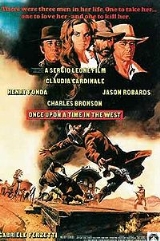
Once Upon a Time in the West is a
1968The year 1968 in film involved some significant events.-Events:* October 30 - The film The Lion in Winter, starring Katharine Hepburn, debuts.* November 1 - The MPAA's film rating system is introduced.-Top grossing films :...
epicThe Epic Western is a sub-genre of the Western movie.An archetypical example is Once Upon a Time in the West, a lengthy revenge epic directed by Sergio Leone and starring Charles Bronson...
spaghetti WesternSpaghetti Western, also known in some countries in mainland Europe as the Italo-Western, is a nickname for a broad sub-genre of Western film that emerged in the mid-1960s, so named because most were produced and directed by Italians, usually in co-production with a Spanish partner.The typical team...
film directed by
Sergio LeoneSergio Leone was an Italian film director, producer and screenwriter most associated with the "Spaghetti Western" genre.Leone's film making style includes juxtaposing extreme close-up shots with lengthy long shots...
. The film stars
Henry FondaHenry Jaynes Fonda was an American film and stage actor, best known for his roles as plain-speaking idealists. Fonda's subtle, naturalistic acting style preceded by many years the popularization of method acting....
cast against type as the villain Frank,
Charles BronsonCharles Bronson was an American actor best known for his "tough guy" image, who starred in such classic films as Once Upon a Time in the West, The Magnificent Seven, The Dirty Dozen, The Great Escape, The Evil That Men Do and the popular Death Wish series...
as his nemesis "Harmonica",
Jason RobardsJason Nelson Robards, Jr., was an American actor and a WWII U.S. Navy combat veteran. He became famous playing works of American dramatist Eugene O'Neill, and would regularly play O'Neill's works throughout his career...
as the bandit Cheyenne and
Claudia CardinaleClaudia Cardinale is an Italian actress. She had starring roles in 8½ and Once Upon a Time in the West ; the majority of Cardinale's films have been either of Italian or French origin.-Early life:...
as Jill, a newly-widowed
homesteaderBroadly defined, homesteading is a lifestyle of simple, agrarian self-sufficiency.-Current practice:Currently the term 'homesteading' applies to anyone who is a limb of the back-to-the-land movement and who chooses to live a sustainable, self-sufficient lifestyle. While land is no longer freely...
with a past as a prostitute. The
screenplayA screenplay or script is a written work that is made especially for a film or television program. Screenplays can be original works or adaptations from existing pieces of writing. A play for television is known as a teleplay.- Format and style :...
was written by Leone and
Sergio DonatiSergio Donati is a Italian screenwriter. He has written for over 70 films since 1952.He was born in Rome, Italy.-Selected filmography:* They Call Me Renegade * Man on Fire * Raw Deal ...
, from a story devised by Leone,
Bernardo BertolucciBernardo Bertolucci is an Italian film director and screenwriter, probably best known for such films as Last Tango in Paris, The Last Emperor, Stealing Beauty, and The Dreamers.-Early years and background:...
, and
Dario ArgentoDario Argento is an Italian film director, producer and screenwriter. He is best known for his work in the horror film genre, particularly in the subgenre known as giallo, and for his influence on modern horror and slasher movies....
. The
widescreenA widescreen image is a film, computer or television image with a wider and shorter aspect ratio than the standard Academy frame developed during the classical Hollywood cinema era. Silent film was projected at a ratio of four units wide to three units tall, often expressed as 4:3 or 1.33:1...
cinematographyCinematography , is the making of lighting and camera choices when recording photographic images for the cinema. It is closely related to the art of still photography...
was by
Tonino Delli ColliTonino Delli Colli was an Italian cinematographer.Born in Rome, he began work at Rome's Cinecittà studio in 1938, at the age of sixteen. By the mid-1940s he was working as a cinematographer and in 1952 shot the first Italian film in colour, Totò a colori...
, and
Ennio MorriconeEnnio Morricone, OMRI , is an Italian composer and conductor. He has composed and arranged scores for more than 500 film and television productions. Morricone is considered as one of the most influential film composers since the late 1950s...
provided the
film scoreA film score is an alternative word used for the background music of a film . The term soundtrack is often confused with film score, though a soundtrack may also include songs featured in the film as well as previously released music by other artists, while the score does not...
.
In
EuropeEurope is, by convention, one of the world's seven continents. Comprising the westernmost peninsula of Eurasia, Europe is generally divided from Asia to its east by the water divide of the Ural Mountains, the Ural River, the Caspian Sea, the Caucasus Mountains , and the Black Sea to the southeast...
, the film was a substantial
box officeA box office is a place where tickets are sold to the public for admission to a venue. Patrons may perform the transaction at a countertop, through an unblocked hole through a wall, or at a wicket...
success, playing for multiple years in some cities. However, it was greeted with a mostly negative critical response upon its 1969 theatrical release in the
United StatesThe United States of America is a federal constitutional republic comprising fifty states and a federal district...
and was a financial flop. The film is now generally acknowledged as a masterpiece and one of the best western films ever made.
Plot
The film opens at an isolated train station in Arizona. The station master is changing the expected arrival time of a train to show that it will be late. Three gunmen (
Jack ElamWilliam Scott "Jack" Elam was an American film actor best known for his numerous roles as villains in Western films.-Early life:...
,
Woody StrodeWoodrow Wilson Woolwine "Woody" Strode was a decathlete and football star before finding even greater fame as a pioneering African-American film actor. He was nominated for a Golden Globe award for best supporting actor for his role in Spartacus in 1960...
and
Al MulockAl Mulock was a character actor, born in Toronto, Ontario, Canada. He is best known for his roles in the Spaghetti Western movies, most notably in his two collaborations with Sergio Leone. He committed suicide May 1968, in Guadix, Spain during shooting of Once Upon a Time in the West...
) arrive at the station with an ambience of tension and foreboding. They wait, trying to occupy themselves. Eventually, the train arrives, and only a man playing a harmonica (
Charles BronsonCharles Bronson was an American actor best known for his "tough guy" image, who starred in such classic films as Once Upon a Time in the West, The Magnificent Seven, The Dirty Dozen, The Great Escape, The Evil That Men Do and the popular Death Wish series...
) disembarks. He asks for Frank, but the three men have been sent instead. A showdown ensues. The man who was playing the harmonica is the only survivor. On the remote farm Sweetwater, Brett McBain (
Frank WolffWalter Frank Hermann Wolff was a versatile American actor whose prolific movie career began with roles in five 1958-61 Roger Corman productions and ended a decade later in Rome, after scores of appearances in European-made films, most of which were lensed in Italy.- Early life :A native of San...
) and his children prepare a feast for the arrival of his new wife, Jill. Frank (
Henry FondaHenry Jaynes Fonda was an American film and stage actor, best known for his roles as plain-speaking idealists. Fonda's subtle, naturalistic acting style preceded by many years the popularization of method acting....
) and his gang emerge from the desert and kill all four McBains.
Jill (
Claudia CardinaleClaudia Cardinale is an Italian actress. She had starring roles in 8½ and Once Upon a Time in the West ; the majority of Cardinale's films have been either of Italian or French origin.-Early life:...
) arrives in Flagstone by train from New Orleans and takes a carriage to the McBain farm. In a roadside establishment along the way, she encounters the bandit Cheyenne (
Jason RobardsJason Nelson Robards, Jr., was an American actor and a WWII U.S. Navy combat veteran. He became famous playing works of American dramatist Eugene O'Neill, and would regularly play O'Neill's works throughout his career...
) who enters after a noisy shootout with his prison escort. Seeing the harmonica-player, Cheyenne dubs him "Harmonica". When Cheyenne's men arrive, Harmonica tells of his shootout earlier with three men who wore similar dusters, but Cheyenne denies they were from
his gang. Jill arrives at the farm to find her husband and his children dead. The assembled crowd came to be wedding guests, but she tells them she married McBain a month earlier in New Orleans. As the funeral ends, part of a duster is found (fake evidence Frank planted), and the men form a posse to hunt down Cheyenne. Jill stays and searches the house for anything of value, as McBain told her he was rich. She finds only some miniature buildings, including a model train station.
Next morning, Cheyenne arrives to survey the scene of his alleged crime. He has coffee with Jill and departs. Harmonica appears and tears the white lace from Jill's black dress. He dispatches with ease two of Frank's men who have been sent to kill her. Railroad tycoon Morton (
Gabriele FerzettiGabriele Ferzetti is an Italian film and stage actor.-Career:He is famous for his appearance in three classic films: In 1960, he made his international breakthrough as an oversexed, restless playboy in Michelangelo Antonioni's controversial L'avventura...
) chastises his hired gun, Frank, for killing the McBains. Frank has been with him since he started building his railroad in sight of the Atlantic. Crippled and slowly dying, Morton rarely leaves his plush private rail car, but he hopes to reach the Pacific before he dies. Harmonica sneaks aboard Morton's train but is discovered. Frank asks who he is, but Harmonica gives only names of men Frank has murdered. Frank goes to capture Jill himself, leaving three of his men to guard Harmonica. Cheyenne has also sneaked aboard. He kills Frank's men, and he and Harmonica go to rescue Jill.
At the farm, Harmonica tells Cheyenne that McBain knew the railroad would have to come past Sweetwater for its remote source of water, and he procured the rights to operate the depot. Building supplies have arrived and now belong to Jill. The station must be built by the time the tracks get there, and Cheyenne puts his men to work building it.
Frank has his way with his captive Jill. He considers marrying her to get the land but knows he'd be a bad husband. He needs a simpler plan. In the saloon in Flagstone, the sheriff (
Keenan WynnKeenan Wynn was an American character actor and member of a well-known show-business family. His bristling mustache and expressive face were his stock in trade as an actor.-Early life and career:...
) presides over the auction of Jill's property. Frank plans to buy the farm cheap: his men bid $500 and keep anyone else from bidding. Harmonica arrives just in time to bid $5,000 — he "delivers" the wanted outlaw Cheyenne for a reward in that amount to win the auction. Jill congratulates Harmonica on getting himself a good deal, but he says he doesn't invest in land. Frank asks again who he is, but Harmonica gives only more names of Frank's victims. Frank tries to get the land by intimidating Harmonica but fails. The farm is Jill's. Morton joins a poker game with four of Frank's men who are guarding him in his rail car. He deals large sums of money to buy their loyalty, and one rides into town to tell the others. They lie in wait for Frank as he exits the saloon, but Harmonica keeps them from killing him, explaining to Jill that not letting
them kill him isn't the same as saving him. At Morton's train, Frank finds a scene of carnage from a shootout between his and Cheyenne's gangs. While he intends to shoot Morton, seeing him pathetically trying to crawl to a mud puddle (a poor substitute for the Pacific) makes him change his mind and leave him there.
The track-laying crews have reached Sweetwater. Harmonica waits for Frank near Jill's house, but Cheyenne arrives first and goes in to have more coffee with her. Frank finally arrives, and the two men position themselves for a duel. Harmonica's motive for revenge is revealed in a flashback: Long ago, Frank forced Harmonica, then a boy, to stand supporting his older brother, whose neck was in a noose. Frank put a harmonica in the boy's mouth. The brother cursed Frank and kicked the boy out from under him to complete his inevitable own hanging. The boy fell face-first into the dirt. Now he faces Frank in their final showdown. Frank loses. Dying, Frank asks again, "Who are you?" Harmonica puts the old, battered harmonica in Frank's mouth. Frank nods weakly in recognition and dies. Harmonica and Cheyenne say goodbye to Jill. As they ride off, Cheyenne stops and gets down. He shows Harmonica that Morton shot him in the gut. He asks Harmonica not to watch him die, and Harmonica looks away. The work train arrives, and the film ends with Jill taking water out to the rail workers as Harmonica rides off with the body of Cheyenne towards the horizon.
Cast
- Claudia Cardinale
Claudia Cardinale is an Italian actress. She had starring roles in 8½ and Once Upon a Time in the West ; the majority of Cardinale's films have been either of Italian or French origin.-Early life:...
as Jill McBain
- Charles Bronson
Charles Bronson was an American actor best known for his "tough guy" image, who starred in such classic films as Once Upon a Time in the West, The Magnificent Seven, The Dirty Dozen, The Great Escape, The Evil That Men Do and the popular Death Wish series...
as Harmonica
- Jason Robards
Jason Nelson Robards, Jr., was an American actor and a WWII U.S. Navy combat veteran. He became famous playing works of American dramatist Eugene O'Neill, and would regularly play O'Neill's works throughout his career...
as Cheyenne
- Henry Fonda
Henry Jaynes Fonda was an American film and stage actor, best known for his roles as plain-speaking idealists. Fonda's subtle, naturalistic acting style preceded by many years the popularization of method acting....
as Frank
- Gabriele Ferzetti
Gabriele Ferzetti is an Italian film and stage actor.-Career:He is famous for his appearance in three classic films: In 1960, he made his international breakthrough as an oversexed, restless playboy in Michelangelo Antonioni's controversial L'avventura...
as Morton
- Paolo Stoppa
Paolo Stoppa was an Italian actor and dubber.Born in Rome, he began as a stage actor in 1927 in the theater in Rome and began acting in films in 1932...
as Sam
- Woody Strode
Woodrow Wilson Woolwine "Woody" Strode was a decathlete and football star before finding even greater fame as a pioneering African-American film actor. He was nominated for a Golden Globe award for best supporting actor for his role in Spartacus in 1960...
as Stony
- Jack Elam
William Scott "Jack" Elam was an American film actor best known for his numerous roles as villains in Western films.-Early life:...
as Snaky
- Keenan Wynn
Keenan Wynn was an American character actor and member of a well-known show-business family. His bristling mustache and expressive face were his stock in trade as an actor.-Early life and career:...
as Sheriff
- Frank Wolff
Walter Frank Hermann Wolff was a versatile American actor whose prolific movie career began with roles in five 1958-61 Roger Corman productions and ended a decade later in Rome, after scores of appearances in European-made films, most of which were lensed in Italy.- Early life :A native of San...
as Brett McBain
- Lionel Stander
Lionel Jay Stander was an American actor in movies, radio, theater and television.-Early life and career:Lionel Stander was born in The Bronx, New York, to Russian Jewish immigrants, the first of three children...
as Barman
Origins
After making his American Civil War epic
The Good, the Bad and the UglyThe Good, the Bad and the Ugly , is a 1966 Italian epic spaghetti western film directed by Sergio Leone, starring Clint Eastwood, Lee Van Cleef, and Eli Wallach in the title roles. The screenplay was written by Age & Scarpelli, Luciano Vincenzoni and Leone, based on a story by Vincenzoni and Leone...
, Leone had intended to retire from making Westerns, believing he had said all he wanted to say. He had come across the novel
The Hoods by the pseudonymous 'Harry Grey', an autobiographical book based on the author's own experiences as a Jewish hood during
ProhibitionProhibition of alcohol, often referred to simply as prohibition, is a sumptuary law which prohibits alcohol. Typically, the manufacture, transportation, import, export, and sale of alcoholic beverages is restricted or illegal. The term can also apply to the periods in the histories of the countries...
, and planned to adapt it into a film (this would eventually, seventeen years later, become his final film,
Once Upon a Time in AmericaOnce Upon a Time in America is a 1984 epic crime film directed and co-written by Sergio Leone and starring Robert De Niro and James Woods. The story chronicles the lives of Jewish ghetto youths who rise to prominence in New York City's world of organized crime...
). Leone though was offered only Westerns by the Hollywood studios.
United ArtistsUnited Artists Entertainment LLC is an American film studio. The current United Artists was formed in November 2006 under a partnership between producer/actor Tom Cruise and his production partner, Paula Wagner, and Metro–Goldwyn–Mayer Studios Inc., an MGM company...
(who had produced the
Dollars TrilogyThe Dollars Trilogy , also known as The Man with No Name Trilogy, refers to the three Italian Spaghetti Westerns starring Clint Eastwood and directed by Sergio Leone:* A Fistful of Dollars * For a Few Dollars More...
) offered him the opportunity to make a film starring
Charlton HestonCharlton Heston was an American actor of film, theatre and television.Heston is known for having played heroic roles, such as Moses in The Ten Commandments, Colonel George Taylor in Planet of the Apes, Rodrigo Díaz de Vivar in El Cid, and Judah Ben-Hur in Ben-Hur, for which he won the Academy...
,
Kirk DouglasKirk Douglas is an American actor and film producer recognized for his prominent cleft chin, his gravelly voice and his recurring roles as the kinds of characters Douglas himself once described as "sons of bitches". He is the father of Hollywood actor and producer Michael Douglas...
and
Rock HudsonRock Hudson was an American film and television actor, recognized as a romantic leading man during the 1960s and 1970s, most notably in several romantic comedies with his most famous co-star, Doris Day...
, but Leone refused. However, when
ParamountParamount Pictures Corporation is a Worldwide American film production and distribution company, located at 5555 Melrose Avenue in Hollywood, California. Founded in 1912 and currently owned by media conglomerate Viacom, it is the world's oldest existing American film studio; it is also the last...
offered Leone a generous budget along with access to
Henry FondaHenry Jaynes Fonda was an American film and stage actor, best known for his roles as plain-speaking idealists. Fonda's subtle, naturalistic acting style preceded by many years the popularization of method acting....
, his favorite actor with whom he had wanted to work for virtually all of his career, Leone accepted the offer.
Leone commissioned
Bernardo BertolucciBernardo Bertolucci is an Italian film director and screenwriter, probably best known for such films as Last Tango in Paris, The Last Emperor, Stealing Beauty, and The Dreamers.-Early years and background:...
and
Dario ArgentoDario Argento is an Italian film director, producer and screenwriter. He is best known for his work in the horror film genre, particularly in the subgenre known as giallo, and for his influence on modern horror and slasher movies....
– film critics, who later became directors – to help him develop the film in late 1966. The men spent much of the following year watching and discussing numerous classic Westerns such as
High NoonHigh Noon is an American 1952 western film directed by Fred Zinnemann and starring Gary Cooper and Grace Kelly. The film tells in real time the story of a town marshal forced to face a gang of killers by himself. The screenplay was written by Carl Foreman, based on John W...
,
The Iron HorseThe Iron Horse is a silent film directed by John Ford in 1924. It was produced by Fox Film. -Synopsis:The film presents an idealized image of the construction of the American first transcontinental railroad. It culminates with the scene of driving of the golden spike at Promontory Summit on May...
,
The ComancherosThe Comancheros is a 1961 western film directed by Michael Curtiz and starring John Wayne and Stuart Whitman. When health troubles prevented Curtiz from finishing the film, Wayne directed the remainder of the movie, though his role remained uncredited. Curtiz died shortly after the film was...
, and
The SearchersThe Searchers is a 1956 epic Western film directed by John Ford, based on the 1954 novel by Alan Le May. It is the story of Ethan Edwards, a middle-aged Civil War veteran portrayed by John Wayne, who spends years looking for his abducted niece with Martin Pawley, his adoptive nephew, portrayed by...
at Leone's house, and constructed a story made up almost entirely of "references" to American Westerns.
Ever since
The Good, the Bad and the Ugly, which originally ran for three hours, Leone's films were usually cut (often quite dramatically) for box office release. Leone was very conscious of the length of
Once Upon a Time in the West during filming and later commissioned Sergio Donati, who had worked on several of Leone's other films, to help him refine the screenplay, largely to curb the length of the film towards the end of production. Many of the film's most memorable lines of dialogue came from Donati, or from the film's English dialogue director, expatriate American actor Mickey Knox.
Style
For
Once Upon a Time in the West, Leone changed his approach over his earlier westerns. Whereas the "Dollars" films were quirky and up-tempo, a celebratory yet tongue-in-cheek parody of the icons of the wild west,
Once upon a Time in the West is much slower in pace and sombre in theme. Leone's distinctive style, which is very different from, but very much influenced by,
Akira Kurosawawas a Japanese film director, producer, screenwriter and editor. In a career that spanned 50 years, Kurosawa directed 30 films. He is widely regarded as one of the most important and influential filmmakers in film history...
's
Sanshiro Sugatawas the directorial debut of the Oscar-winning Japanese film director Akira Kurosawa. It was first released in Japan on 25 March 1943 by Toho film studios, eventually being released in the United States on 28 April 1974 and is based on the novel of the same name by Tsuneo Tomita. It follows the...
(1943), is still present but has been modified for the beginning of Leone's second, the so-called "Once Upon a Time", trilogy. The characters in this film are also beginning to change markedly over their predecessors in the "Dollars" westerns. They are not quite as defined and, unusually for Leone characters up to this point, they begin to change (or at least attempt to) over the course of the story. This signals the start of the second phase of Leone's style, which would be further developed in
A Fistful of DynamiteDuck, You Sucker! , also known as A Fistful of Dynamite and Once Upon a Time… the Revolution , is a 1971 Spaghetti western film directed by Sergio Leone and starring Rod Steiger and James Coburn...
and
Once Upon a Time in AmericaOnce Upon a Time in America is a 1984 epic crime film directed and co-written by Sergio Leone and starring Robert De Niro and James Woods. The story chronicles the lives of Jewish ghetto youths who rise to prominence in New York City's world of organized crime...
.
Themes and motifs
A major motif of the film is the railroad; its advent heralds the arrival of civilization and culture, marking the death of the mythic Old West. This captures in miniature the dying-off of the old cultural heroes in the wake of the modern world, where it is the ordinary man who is important. The West was seen by Leone as the last environment of the old-style hero, and one can understand the film as a nostalgic examination and exploration of the past. Running parallel to this is Leone's sadness at the demise of the mythical Wild West as told by cinema, and the film is his way of laying to rest the old Hollywood-style western heroes and legends, as the film's title suggests. The climactic duel between Harmonica (Bronson) and Frank (Fonda) brings these messages into focus. Harmonica often acts as the thematic voice of the film and has been waiting for Frank (who has been trying to become a businessman throughout the story) to show his irrepressible true colors as a figure of the "ancient race" and engage him in a fated gun duel. Another major theme is water. The transformation of the central character Jill (Cardinale) all takes place due to the water on her land, and there are several scenes involving water being drunk or served. A well and its water have a central role in the plot as the fuel that nourishes the New West, and the
Pacific OceanThe Pacific Ocean is the largest of the Earth's oceanic divisions. Its name is derived from the Latin name Tepre Pacificum, "peaceful sea", bestowed upon it by the Portuguese explorer Ferdinand Magellan. It extends from the Arctic in the north to Antarctica in the south, bounded by Asia and...
plays prominently in Morton's motivational dream to build a trans-American railroad.
Pacing
The film features long, slow scenes in which there is very little dialogue and little happens, broken by brief and sudden violence. Leone was far more interested in the rituals preceding violence than in the violence itself. The tone of the film is consistent with the arid semi-desert in which the story unfolds, and imbues it with a feeling of realism that contrasts with the elaborately choreographed gunplay.
Casting
Fonda did not accept Leone's first offer to play Frank, so Leone flew to New York to convince him, telling him: "Picture this: the camera shows a gunman from the waist down pulling his gun and shooting a running child. The camera tilts up to the gunman's face and...it's Henry Fonda." After meeting with Leone, Fonda called his friend
Eli WallachEli Herschel Wallach is an American film, television and stage actor, who gained fame in the late 1950s. For his performance in Baby Doll he won a BAFTA Award for Best Newcomer and a Golden Globe nomination. One of his most famous roles is that of Tuco in The Good, the Bad and the Ugly...
, who advised him to do the film, as "You will have the time of your life."
When he accepted the role, Fonda came to the set with brown contacts and facial hair. Fonda felt having dark eyes and facial hair would blend well with his character's evil and also help the audience to accept this "new" Fonda as the bad guy. Leone immediately told him to remove the contacts and facial hair upon viewing; Leone felt that Fonda's blue eyes best reflected the cold, icy nature of the killer. Fonda later claimed his role as Frank was his personal favorite.
Leone originally offered the role of Harmonica to
Clint EastwoodClinton "Clint" Eastwood, Jr. is an American actor, film director, film producer and composer. He has received five Academy Awards, five Golden Globe Awards, a Screen Actors Guild Award and five People's Choice Awards—including one for Favorite All-Time Motion Picture Star.Eastwood is...
; when he turned it down, Leone hired
Charles BronsonCharles Bronson was an American actor best known for his "tough guy" image, who starred in such classic films as Once Upon a Time in the West, The Magnificent Seven, The Dirty Dozen, The Great Escape, The Evil That Men Do and the popular Death Wish series...
who had originally been offered and turned down the part of The Man with No Name in
A Fistful of DollarsA Fistful of Dollars is a 1964 western film directed by Sergio Leone and starring Clint Eastwood alongside Gian Maria Volontè, Marianne Koch, Wolfgang Lukschy, José Calvo and Joseph Egger. Released in Italy in 1964 then in the United States in 1967, it initiated the popularity of the Spaghetti...
.
James CoburnJames Harrison Coburn, Jr. was an American film and television actor who appeared in nearly 70 films and made over 100 television appearances in his 45-year career...
was also approached for Harmonica but demanded too much money.
Robert RyanRobert Bushnell Ryan was an American actor who often played hardened cops and ruthless villains.Ryan was born in Chicago, Illinois, the first child of Timothy Ryan and his wife Mabel Bushnell Ryan . He graduated from Dartmouth College in 1932, having held the school's heavyweight boxing title all...
was offered the role of the Sheriff played by
Keenan WynnKeenan Wynn was an American character actor and member of a well-known show-business family. His bristling mustache and expressive face were his stock in trade as an actor.-Early life and career:...
. Ryan initially accepted but backed out after being given a larger role in
Sam PeckinpahDavid Samuel "Sam" Peckinpah was an American filmmaker and screenwriter who achieved his status following the release of his 1969 Western epic The Wild Bunch...
's
The Wild BunchThe Wild Bunch directed by Sam Peckinpah, is a Western film about an aging outlaw gang at the Texas-Mexico border trying to exist in the modern world of supposedly 1913...
.
Enrico Maria SalernoEnrico Maria Salerno was an Italian theatre & film actor, also a film director. He was also the voice of Clint Eastwood in the Italian version of Sergio Leone's Dollars Trilogy films, and the voice of Christ in The Gospel According to St...
and
Robert HosseinRobert Hossein is a French film actor, director and writer. He directed the 1982 adaption of Les Misérables, and appeared in Vice and Virtue, Le Casse, Les Uns et les Autres and Venus Beauty Institute...
were both offered the role of Morton before
Gabriele FerzettiGabriele Ferzetti is an Italian film and stage actor.-Career:He is famous for his appearance in three classic films: In 1960, he made his international breakthrough as an oversexed, restless playboy in Michelangelo Antonioni's controversial L'avventura...
was cast; Hossein had accepted. but had to drop out for a theatre commitment. Ferzetti, who considers it one of his best roles, referred to his casting as "Fate, Destiny" in an interview for the DVD release.
Actor
Al MulockAl Mulock was a character actor, born in Toronto, Ontario, Canada. He is best known for his roles in the Spaghetti Western movies, most notably in his two collaborations with Sergio Leone. He committed suicide May 1968, in Guadix, Spain during shooting of Once Upon a Time in the West...
(featured in the opening train sequence as well as in Leone's
The Good, the Bad and the UglyThe Good, the Bad and the Ugly , is a 1966 Italian epic spaghetti western film directed by Sergio Leone, starring Clint Eastwood, Lee Van Cleef, and Eli Wallach in the title roles. The screenplay was written by Age & Scarpelli, Luciano Vincenzoni and Leone, based on a story by Vincenzoni and Leone...
) committed
suicideSuicide is the intentional killing of one's self. Many dictionaries also note the metaphorical sense of "willful destruction of one's self-interest"...
during shooting of the film by leaping from his hotel room in full costume.
Frank WolffWalter Frank Hermann Wolff was a versatile American actor whose prolific movie career began with roles in five 1958-61 Roger Corman productions and ended a decade later in Rome, after scores of appearances in European-made films, most of which were lensed in Italy.- Early life :A native of San...
, the actor who plays McBain, also committed suicide in a
RomeRome is the capital of Italy and the country's largest and most populated municipality , with over 2.7 million residents in , while the population of the urban area is estimated by Eurostat to be 3.46 million. The metropolitan area of Rome is estimated by OECD to have a population of 3.7 million...
hotel in 1971.
Music
The music was written by composer
Ennio MorriconeEnnio Morricone, OMRI , is an Italian composer and conductor. He has composed and arranged scores for more than 500 film and television productions. Morricone is considered as one of the most influential film composers since the late 1950s...
, Leone's regular collaborator, who wrote the score under Leone's direction before filming began. As in
The Good, the Bad and the UglyThe Good, the Bad and the Ugly , is a 1966 Italian epic spaghetti western film directed by Sergio Leone, starring Clint Eastwood, Lee Van Cleef, and Eli Wallach in the title roles. The screenplay was written by Age & Scarpelli, Luciano Vincenzoni and Leone, based on a story by Vincenzoni and Leone...
, the haunting music contributes to the film's grandeur and, like the music for
The Good the Bad and the Ugly, is considered one of Morricone's greatest compositions.
The film features
leitmotifA leitmotif is a recurring musical theme, associated with a particular person, place, or idea...
s that relate to each of the main characters (each with their own unique theme music) as well as to the spirit of the American West. It was Leone's desire to have the music available and played during filming. Leone had Morricone compose the score before shooting started and would play the music in the background for the actors on set.
Reputation
Though less popular in the US than the earlier "
Dollars TrilogyThe Dollars Trilogy , also known as The Man with No Name Trilogy, refers to the three Italian Spaghetti Westerns starring Clint Eastwood and directed by Sergio Leone:* A Fistful of Dollars * For a Few Dollars More...
",
Once Upon a Time in the West has gained an ardent cult following around the world, particularly among cineastes and film makers.
Once Upon a Time in the West can be found on numerous film polls. It is usually in the top 20 of the IMDB's top 250 and is listed as one of the best all time films by
Time magazine. Film critic Kim Newman claimed it was the best Western ever made, as did film historian
Christopher FraylingSir Christopher John Frayling is a British educationalist and writer, known for his study of popular culture.-Biography:He read history at Churchill College, Cambridge and gained a PhD in the study of Jean-Jacques Rousseau....
, who wrote two books about the film's legacy.
American release
In the U.S., the film had a rather poor opening reception, gaining largely negative or indifferent reviews in its complete form (165 minutes). Paramount edited the film to about 145 minutes for the wide release, but the film tanked at the box office. The following scenes were cut for the American release:
- The entire scene at Lionel Stander
Lionel Jay Stander was an American actor in movies, radio, theater and television.-Early life and career:Lionel Stander was born in The Bronx, New York, to Russian Jewish immigrants, the first of three children...
's trading post. Cheyenne (Robards) was not introduced in the American release until his arrival at the McBain ranch later in the film. Stander remained in the credits, even though he did not appear in this version at all.
- The scene in which Morton and Frank discuss what to do with Jill at the Navajo Cliffs. This scene was important because it established the growing rift between Morton and Frank — a key reason why Morton decides later on in the film to have Frank killed.
- Morton's death scene was reduced considerably.
- Cheyenne's death scene was completely excised.
Otherwise, one scene was slightly longer in the U.S. version than in the international film release:
Following the opening duel (where all four gunmen fire and fall), Charles Bronson's character stands up again showing that he had only been shot in the arm. This part of the scene had been originally cut by director Sergio Leone for the worldwide theatrical release. It was added again for the U.S. market because the American distributors feared American viewers would not understand the story otherwise, especially since Harmonica's arm wound is originally shown for the first time in the scene at the trading post which was cut for the shorter U.S. version.
1984 re-release
The English language version was restored to approximately 165 minutes for a re-release in 1984, and for its video release the following year.
Extended versions
A slightly longer, 168 minute version exists in Italy which features several scenes augmented with additional material, though no complete scenes are present that are missing. The longest known cut is 171 minutes long and is only unofficially available as a bootleg copy on various file sharing platforms.
German language release
The German-language release has been titled
Spiel mir das Lied vom Tod ("Play to me the Song of Death"). In the original (english) version, Frank says "Keep your lovin' brother happy" when he shoves the harmonica in young Harmonica's mouth as he stands supporting his brother; this line is overdubbed with
Na komm' - spiel mir das Lied vom Tod ("Come - play to me the Song of Death"). While Harmonica silently puts the instrument between Frank's teeth as he is dying after their climactic duel, in the German edition his voice (while Bronson's character is off-screen and the camera is focused on Fonda's face) says
Spiel mir das Lied vom Tod, Frank!. This stresses Harmonica's story and his reason for seeking revenge, and strongly emphasizes Harmonica's theme and its sinister origin and meaning to the point of tilting the focus of the entire film to this theme.
Since the original line is the only mention of Harmonica's brother, many German viewers of the film believe that the lynched man is Harmonica's father. There are some other additions to the original text as well, most notably a line Frank says to Morton — "Pacific Ocean, hm?" — as Morton is dying in a mud puddle.
DVD release
After years of public requests, Paramount Pictures released a 2-Disc "Special Collector's Edition" of
Once Upon a Time in the West on November 18, 2003. With a running time of 165-minutes(158-minutes in other regions), this edition is the color 2.35:1 aspect ratio version in anamorphic wide-screen, closed captioned and Dolby. The commentary includes commentary from film experts and historians such as
John CarpenterJohn Howard Carpenter is an American film director, screenwriter, producer, editor, composer, and occasional actor. Although Carpenter has worked in numerous film genres, his name is most commonly associated with horror and science fiction.- Early life :Carpenter was born in Carthage, New York,...
,
John MiliusJohn Frederick Milius is an American screenwriter, director, and producer of motion pictures.-Life:Milius was born in St. Louis, Missouri, the son of Elizabeth and William Styx Milius, who was a shoe manufacturer. Milius attempted to join the Marine Corps in the late 1960's, but was rejected due...
,
Alex CoxAlexander Cox is a British film director, screenwriter, nonfiction author and sometime actor, notable for his idiosyncratic style and approach to scripts. Cox has previously cited Luis Buñuel and Akira Kurosawa as influences, as well as the great Western movie directors Sergio Leone, Sam...
, film historian and Leone biographer Sir Christopher Frayling, Dr. Sheldon Hall, as well as actors Claudia Cardinale and Gabriele Ferzetti, and director
Bernardo BertolucciBernardo Bertolucci is an Italian film director and screenwriter, probably best known for such films as Last Tango in Paris, The Last Emperor, Stealing Beauty, and The Dreamers.-Early years and background:...
, a co-writer of the film.
The second disc has special features, including three recent documentaries on several aspects of the film:
- An Opera of Violence
- The Wages of Sin
- Something to Do with Death
There is a
Railroads: Revolutionizing the West featurette, location and production galleries, cast profiles, as well as the original trailer.
Film references
Leone's intent was to take the stock conventions of the American Westerns of
John FordJohn Ford was an American film director of Irish heritage famous for both his westerns such as Stagecoach and The Searchers and adaptations of such classic 20th-century American novels as The Grapes of Wrath...
,
Howard HawksHoward Winchester Hawks was an influential American film director, producer and screenwriter of the classic Hollywood era...
and others, and rework them in an ironic fashion, essentially reversing their intended meaning in their original sources to create a darker connotation. The most obvious example of this is the casting of veteran film good guy Henry Fonda as the villainous Frank, but there are also many other, more subtle reversals throughout the film. According to film critic and historian
Christopher FraylingSir Christopher John Frayling is a British educationalist and writer, known for his study of popular culture.-Biography:He read history at Churchill College, Cambridge and gained a PhD in the study of Jean-Jacques Rousseau....
, the film quotes from as many as 30 classic American Westerns. (See
this discussion, which lists many references confirmed by Frayling, Leone and others, as well as speculative ones.)
Some of the major films used as references for the film include:
- High Noon
High Noon is an American 1952 western film directed by Fred Zinnemann and starring Gary Cooper and Grace Kelly. The film tells in real time the story of a town marshal forced to face a gang of killers by himself. The screenplay was written by Carl Foreman, based on John W...
. The opening sequence is similar to the opening High Noon, in which three bad guys (Lee Van CleefLee Van Cleef was an American film actor who appeared mostly in Western and action pictures. His sharp features and piercing eyes led to his casting as a villain in scores of films, though in later years he was often a film's protagonist, such as with his co-lead role as a former colonel in For a...
, Sheb WooleyShelby F. "Sheb" Wooley was a character actor and singer, best known for his 1958 novelty hit "The Purple People Eater". Also for playing Ben Miller, brother of Frank Miller arriving on the train at High Noon....
and Robert J. WilkeRobert J. Wilke was a prolific American film actor noted primarily for his villainous roles, mainly in westerns....
) wait at a station for the arrival of their gang leader (also named Frank, played by Ian MacDonaldIan MacDonald was an American actor and producer during the 1940s and 1950s. Some of his notable films included:* Warlock * The Lonesome Trail * Taza, Son of Cochise * Hiawatha...
) on the noon train. In the opening of Once Upon a Time in the West, three bad guys (Jack ElamWilliam Scott "Jack" Elam was an American film actor best known for his numerous roles as villains in Western films.-Early life:...
, who appeared in a small part in High Noon, Woody StrodeWoodrow Wilson Woolwine "Woody" Strode was a decathlete and football star before finding even greater fame as a pioneering African-American film actor. He was nominated for a Golden Globe award for best supporting actor for his role in Spartacus in 1960...
, and Al MulockAl Mulock was a character actor, born in Toronto, Ontario, Canada. He is best known for his roles in the Spaghetti Western movies, most notably in his two collaborations with Sergio Leone. He committed suicide May 1968, in Guadix, Spain during shooting of Once Upon a Time in the West...
) wait at a station. However, the period of waiting is depicted in a lengthy eight-minute sequence, the train arrives several hours after noon, and its passenger is the film's hero (Charles Bronson) rather than its villain. The scene is famous for its use of natural sounds: a squeaky windmill, knuckles cracking, and Jack Elam's character trying to shoo off a fly. According to rumor, Leone offered the parts of the three bad guys to The Good, the Bad and the UglyThe Good, the Bad and the Ugly , is a 1966 Italian epic spaghetti western film directed by Sergio Leone, starring Clint Eastwood, Lee Van Cleef, and Eli Wallach in the title roles. The screenplay was written by Age & Scarpelli, Luciano Vincenzoni and Leone, based on a story by Vincenzoni and Leone...
stars Clint EastwoodClinton "Clint" Eastwood, Jr. is an American actor, film director, film producer and composer. He has received five Academy Awards, five Golden Globe Awards, a Screen Actors Guild Award and five People's Choice Awards—including one for Favorite All-Time Motion Picture Star.Eastwood is...
, Lee Van CleefLee Van Cleef was an American film actor who appeared mostly in Western and action pictures. His sharp features and piercing eyes led to his casting as a villain in scores of films, though in later years he was often a film's protagonist, such as with his co-lead role as a former colonel in For a...
and Eli WallachEli Herschel Wallach is an American film, television and stage actor, who gained fame in the late 1950s. For his performance in Baby Doll he won a BAFTA Award for Best Newcomer and a Golden Globe nomination. One of his most famous roles is that of Tuco in The Good, the Bad and the Ugly...
.
- 3:10 to Yuma. This cult Western by Delmer Daves
Delmer Daves was an American screenwriter, director, and producer.-Life and career:Born in San Francisco, Delmer Daves first pursued a career as a lawyer...
may have had considerable influence on the film. The most obvious reference is a brief exchange between Keenan WynnKeenan Wynn was an American character actor and member of a well-known show-business family. His bristling mustache and expressive face were his stock in trade as an actor.-Early life and career:...
's Sheriff and Cheyenne, in which they discuss sending the latter to YumaYuma is a city in and the county seat of Yuma County, Arizona, United States. The population of the city was 77,515 at the 2000 census, with a 2006 Census Bureau estimated population of 87,423....
prison. In addition, as in West the main villain is played by an actor (Glenn FordGwyllyn Samuel Newton "Glenn" Ford was a Canadian-born American actor from Hollywood's Golden Era with a career that spanned seven decades. Despite his versatility, Ford was best known for playing ordinary men in unusual circumstances.-Early life and career:Born Gwyllyn Ford at Jeffrey Hale...
) who normally played good guys. The film also features diegetic music (Ford at one point whistles the film's theme song just as Harmonica provides music in West). And the scene in which Van HeflinEmmett Evan "Van" Heflin, Jr. was an American film and theatre actor. He played mostly character parts over the course of his film career, but during the 1940s had a string of roles as a leading man...
's character escorts Ford to the railroad station while avoiding an ambush by his gang may have inspired the ambush of Frank by his own men in Leone's film.
- The Comancheros
The Comancheros is a 1961 western film directed by Michael Curtiz and starring John Wayne and Stuart Whitman. When health troubles prevented Curtiz from finishing the film, Wayne directed the remainder of the movie, though his role remained uncredited. Curtiz died shortly after the film was...
. The name McBain and the name of the town Sweetwater come from this film.
- Johnny Guitar
Johnny Guitar is a Republic Pictures western film starring Joan Crawford, Sterling Hayden, Mercedes McCambridge, and Scott Brady.The screenplay by Philip Yordan was based upon a novel by Roy Chanslor. The film was directed by Nicholas Ray and produced by Herbert J. Yates.This was the last feature...
. The character of Jill McBain is supposedly based on Joan CrawfordJoan Crawford was an American actress in film, television and theatre. Starting as a dancer in traveling theatrical companies before debuting on Broadway, Crawford was signed to a motion picture contract by Metro-Goldwyn-Mayer in 1925...
's character Vienna, and Harmonica may be influenced by Sterling HaydenSterling Hayden was an American actor and author. For most of his career as a leading man, he specialized in westerns and film noir, such as Johnny Guitar, The Asphalt Jungle and The Killing. Later on he became noted as a character actor for such roles as Gen. Jack D. Ripper in Dr...
's title character. Some of the basic plot (settlers vs. the railroad) may be recycled from this film.
- The Iron Horse
The Iron Horse is a silent film directed by John Ford in 1924. It was produced by Fox Film. -Synopsis:The film presents an idealized image of the construction of the American first transcontinental railroad. It culminates with the scene of driving of the golden spike at Promontory Summit on May...
. West may contain several subtle references to this film, including a low angle shot of a shrieking train rushing towards the screen in the opening scene, and the shot of the train pulling into the Sweetwater station at the end of the film.
- Shane. The massacre scene in West features young Timmy McBain hunting with his father, just as Joey hunts with his father in Shane. The funeral of the McBains is borrowed almost shot-for-shot from Shane.
- The Searchers
The Searchers is a 1956 epic Western film directed by John Ford, based on the 1954 novel by Alan Le May. It is the story of Ethan Edwards, a middle-aged Civil War veteran portrayed by John Wayne, who spends years looking for his abducted niece with Martin Pawley, his adoptive nephew, portrayed by...
. Leone admitted that during the massacre of the McBain family, the rustling bushes, the stopping of the cicadaA cicada is an insect of the order Hemiptera, suborder Auchenorrhyncha, in the superfamily Cicadoidea, with large eyes wide apart on the head and usually transparent, well-veined wings. There are about 2,500 species of cicada around the world, and many remain unclassified...
chirps, and the fluttering pheasants to suggest a menace approaching the farmhouse, were all taken from The Searchers. The ending of the film — where Western nomads Harmonica and Cheyenne are forced to move on rather than join modern society — also echoes the famous ending of Ford's film.
- Warlock
Warlock is a 1959 film, released by Twentieth Century Fox and shot in DeLuxe Color and CinemaScope. It is a Western adapted from the novel by Oakley Hall...
. At the end of this film, Henry Fonda's character wears clothing very similar to his costume throughout West. In addition, Warlock features a discussion about mothers between Fonda and Dorothy MaloneDorothy Malone is an American actress.Malone's film career began in the mid 1940s, and in her early years she played small roles, mainly in B-movies. After a decade in films, she began to acquire a more glamorous image, particularly after her performance in Written on the Wind , for which she won...
that is similar to those between Cheyenne and Jill in West. Finally, Warlock contains a sequence in which Fonda's character kicks a crippled man off his crutches, as he does to Mr. Morton in West.
- The Magnificent Seven
The Magnificent Seven is a 1960 American western film directed by John Sturges about a group of hired gunmen protecting a Mexican village from bandits. It is a resetting of Akira Kurosawa's 1954 film, Seven Samurai.-Plot:...
. In this film, Charles Bronson's character whittles a piece of wood. In West, he does the same, although in a different context. The Magnificent Seven was based on the Seven Samuri by Akira Kurasawa whose Yohimbo(The Bodyguard) was the inspiration (and later, litigation) behind a Leone's A Fistful of Dollars.
- Winchester '73. It has been claimed that the scenes in West at the trading post are based on those in Winchester '73, but the resemblance is slight.
- The Man Who Shot Liberty Valance
The Man Who Shot Liberty Valance is a 1962 Western movie directed by John Ford and starring James Stewart and John Wayne. It was released by Paramount Pictures. The screenplay is adapted from a short story written by Dorothy M...
. The dusterA duster is a light, loose-fitting long coat.The original dusters were full-length, light-colored canvas or linen coats worn by horsemen to protect their clothing from trail dust. These dusters were typically slit up the back to hip level for ease of wear on horseback and were the recommended...
s (long coats) worn by Frank and his men in the opening massacre resemble those worn by Liberty Valance (Lee MarvinLee Marvin was an American film actor. Known for his gravelly voice, white hair and 6' 2" stature, Marvin at first did supporting roles, mostly villains, soldiers and other hardboiled characters, but after winning an Academy Award for Best Actor for his dual roles in Cat Ballou, he landed more...
) and his henchmen when they are introduced in this film. In addition, the auction scene in West was intended to recall the election scene in Liberty Valance .
- The Last Sunset
The Last Sunset is a 1961 western movie starring Rock Hudson and directed by Robert Aldrich.The film was released by Universal studios, shot in Eastman color. The screenplay was adapted from Howard Rigsby's novel "Sundown at Crazy Horse" by Dalton Trumbo.-Cast:*Rock Hudson .... Dana...
. The final duel between Frank and Harmonica is shot almost identically to the duel between Kirk DouglasKirk Douglas is an American actor and film producer recognized for his prominent cleft chin, his gravelly voice and his recurring roles as the kinds of characters Douglas himself once described as "sons of bitches". He is the father of Hollywood actor and producer Michael Douglas...
and Rock HudsonRock Hudson was an American film and television actor, recognized as a romantic leading man during the 1960s and 1970s, most notably in several romantic comedies with his most famous co-star, Doris Day...
in this film.
- Duel in the Sun. The character of Morton, the crippled railroad baron in West, was based on the character played by Lionel Barrymore
Lionel Barrymore was an American actor of stage, radio and film. He won an Academy Award for Best Actor for his performance in A Free Soul .-Early life:...
in this film.
- Sergeant Rutledge
Sergeant Rutledge is a 1960 film directed by John Ford, with Woody Strode in the title role. The film, controversial for its time, stars Strode as a black sergeant in the United States Cavalry accused of the rape and murder of a white girl.-Plot:...
(with Woody StrodeWoodrow Wilson Woolwine "Woody" Strode was a decathlete and football star before finding even greater fame as a pioneering African-American film actor. He was nominated for a Golden Globe award for best supporting actor for his role in Spartacus in 1960...
as the title character). In this John FordJohn Ford was an American film director of Irish heritage famous for both his westerns such as Stagecoach and The Searchers and adaptations of such classic 20th-century American novels as The Grapes of Wrath...
Western, there is a scene in which Constance TowersConstance Towers is an American singer and actress.-Early life:Towers was born in Whitefish, Montana, the daughter of Ardath L. and Harry J. Towers. According to her official Web site, a contract from Paramount Pictures was offered to her at age 11 but was declined...
' character falls asleep in a chair with a rifle in her lap, looking out for hostile Apache, just as Jill McBain does in Leone's film.
- My Darling Clementine
My Darling Clementine is a western film, directed by John Ford, and based on the story of the Gunfight at the O.K. Corral between the Earp brothers and the Clanton gang. It features an ensemble cast including Henry Fonda, Victor Mature, Walter Brennan, and others.The movie was adapted by Samuel G...
. In the trading post scene, Cheyenne slides Harmonica's gun down the bar to him, challenging him to shoot - much like Morgan Earp (Ward BondWardell Edwin Bond was an American film actor whose rugged appearance and easygoing charm featured in numerous roles.-Early life:...
) sliding his weapon to brother Wyatt (Henry FondaHenry Jaynes Fonda was an American film and stage actor, best known for his roles as plain-speaking idealists. Fonda's subtle, naturalistic acting style preceded by many years the popularization of method acting....
) in the Ford film when the Earps meet Doc Holiday (Victor Mature-Early life:Victor John Mature was born in Louisville, Kentucky to a German-speaking father from Trentino-Alto Adige/Südtirol Italy, Marcellus George Mature a cutler, and a Kentucky-born mother of Swiss-American heritage, Clara P. Ackley. An older brother, Marcellus Paul Mature, died at 11 in...
) for the first time. Also, a deleted scene in West featured Frank getting a shave with perfume in a barber's shop, much like Fonda's Wyatt.
There are other, smaller references, to various non-Westerns, most notably
Luchino ViscontiLuchino Visconti di Modrone, Count of Lonate Pozzolo was an Italian theatre, opera and cinema director and writer, best known for films such as The Leopard and Death in Venice . He died in Rome of a stroke at the age of 69...
's
The LeopardThe Leopard is an award-winning 1963 film by Italian director Luchino Visconti, based on Giuseppe Tomasi di Lampedusa's novel of the same name.-Production:...
.
Contrary to popular belief, the name of the town "Sweetwater" was not taken from
The WindThe Wind is an American dramatic silent film directed by Victor Sjöström. The movie was adapted by Frances Marion from the novel The Wind written by Dorothy Scarborough...
,
Victor Sjöströmwas a Swedish actor, screenwriter, and film director.- Biography:...
's silent epic. Bernardo Bertolucci has stated that he looked at a map of the
southwestern United StatesThe Southwestern United States is defined as the states that lie west of the Mississippi River, with the qualification of a certain northern limit such as the 37, 38, 39, or 40 degree north latitude. A 97.33 longitude degree west could qualify as the separation of the American Southwest from the...
, found the name of the town in
ArizonaThe State of Arizona is a state located in the southwestern region of the United States. The capital and largest city is Phoenix. The second largest city is Tucson, followed in size by the four Phoenix metropolitan area cities of Mesa, Glendale, Chandler, and Scottsdale.Arizona was the 48th and...
, and decided to incorporate it into the film. However, a "Sweetwater" — along with a character named McBain — also appeared in a
John WayneMarion Mitchell Morrison , born Marion Robert Morrison, better known by his stage name John Wayne, was an American film actor, director and producer. He epitomized rugged masculinity and has become an enduring American icon. He is famous for his distinctive voice, walk and height...
Western,
The ComancherosThe Comancheros is a 1961 western film directed by Michael Curtiz and starring John Wayne and Stuart Whitman. When health troubles prevented Curtiz from finishing the film, Wayne directed the remainder of the movie, though his role remained uncredited. Curtiz died shortly after the film was...
, which Leone admired.
Once Upon a Time in the West would, itself, be referenced in
The Quick and the DeadThe Quick and the Dead is a 1995 western film directed by Sam Raimi and starring Sharon Stone, Gene Hackman, Russell Crowe and Leonardo DiCaprio....
, with
Gene HackmanEugene Allen "Gene" Hackman is an American actor and currently a novelist.Hackman has made 80 films. He came to fame in 1967 when his performance as Buck Barrow in Bonnie and Clyde earned him his first Oscar nomination...
's character, John Herod, facing Ellen, a.k.a. "Lady" (
Sharon StoneSharon Yvonne Stone is an American actress, film producer, and former fashion model. She first achieved international recognition for her performance in the erotic thriller Basic Instinct...
) in the final gunfight. Her identity is a mystery until the end, when the audience sees Ellen's flashback to Herod lynching her father, a sheriff, and giving her a chance to save her father by shooting the rope and severing it, but it goes wrong. As with Frank, Herod yells, "Who are you?" and the only response he receives is an artifact from the earlier lynching, in this case the sheriff's badge that Ellen has kept all these years.
The Quick and the Dead has another connection to
Once Upon a Time in the West: It was the final film for Woody Strode, who died before it could be released.
Many other films have paid tribute to Leone's film.
Quentin TarantinoQuentin Jerome Tarantino is an American film director, screenwriter, producer, cinematographer and actor. In the early 1990s he was an independent filmmaker whose films used nonlinear storylines and aestheticization of violence...
's
Inglourious Basterds opens with a lengthy sequence entitled
Once Upon a Time in Nazi-Occupied France (though in specifics the scene bears more resemblance to Lee Van Cleef's entrance in
The Good, the Bad and the Ugly), and his
Kill BillKill Bill is a two part film by writer-director Quentin Tarantino, starring Uma Thurman as The Bride. Originally conceived as one film, it was released in two separate 'volumes' due to its running time of approximately four hours...
films feature snatches of Morricone's soundtrack.
Pirates of the Caribbean: At World's End features a parody of the "Man With a Harmonica" theme on the soundtrack, as the film's protagonists parlay on a sandbar before the final battle. Baz Luhrman's
Australia features several nods to Leone's film, including a homestead with a squeaky windmill, an almost-identical funeral scene, and the antagonistic relationship of the film's villains.
External links