

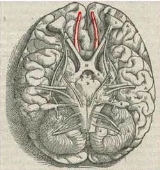
Olfactory system

Encyclopedia
The olfactory system is the sensory system
used for olfaction
, or the sense of smell. Most mammals and reptiles have two distinct parts to their olfactory system: a main olfactory system and an accessory olfactory system. The main olfactory system detects volatile, airborne substances, while the accessory olfactory system senses fluid-phase stimuli. Behavioral evidence indicates that most often, the stimuli detected by the accessory olfactory system are pheromones.
The olfactory system is often spoken of along with the gustatory system
as the chemosensory senses because both transduce
chemical signals into perception
.
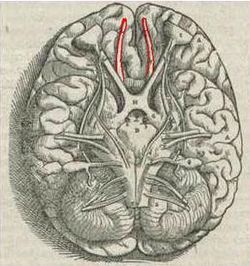
and encoding it as an electric signal in neurons, and a central one, where all signals are integrated and processed in the central nervous system
.
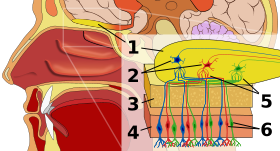
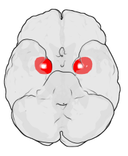 In mammals, the main olfactory system detects odorants that are inhaled through the nose
, where they contact the main olfactory epithelium
, which contains various olfactory receptor
s. These olfactory receptors are membrane proteins of bipolar olfactory receptor neuron
s in the olfactory epithelium. Rather than binding specific ligands like most receptors, olfactory receptors display affinity for a range of odor molecules. Olfactory neurons transduce receptor activation into electrical signals in neurons. The signals travel along the olfactory nerve
, which belongs to the peripheral nervous system
. This nerve terminates in the olfactory bulb
, which belongs to the central nervous system
. The complex set of olfactory receptors on different olfactory neurons can distinguish a new odor from the background environmental odors and determine the concentration of the odor.
s from the olfactory sensory neurons converge in the olfactory bulb
to form tangles called glomeruli
(singular glomerulus). Inside the glomerulus, the axons contact the dendrite
s of mitral cells and several other types of cells. Mitral cells send their axons to a number of brain areas, including the anterior olfactory nucleus
, piriform cortex
, the medial amygdala
, and the entorhinal cortex
.
The piriform cortex is probably the area most closely associated with identifying the odor. The medial amygdala
is involved in social functions such as mating and the recognition of animals of the same species. The entorhinal cortex
is associated with memory, e.g. to pair odors with proper memories. The exact functions of these higher areas are a matter of scientific research and debate.
In the central nervous system, odors are represented as patterns of neural activity. These representations may be encoded by space (a pattern of activated neurons across a given olfactory region corresponds to the odor), time (a pattern of action potential
s by multiple neurons corresponds to the odor) or a combination of the two. Scientists debate whether the odor code is primarily temporal or spatial.
, cancer
, infection, inhalation of toxic fumes, or neurodegenerative diseases such as Parkinson's disease
and Alzheimer's disease
. These conditions can cause anosmia
. Doctors can detect damage to the olfactory system by presenting the patient with odors via a scratch and sniff card or by having the patient close their eyes and try to identify commonly available odors like coffee or peppermint candy.
and Richard Axel
won the 2004 Nobel Prize in Physiology or Medicine
for their work on the olfactory system.
Sensory system
A sensory system is a part of the nervous system responsible for processing sensory information. A sensory system consists of sensory receptors, neural pathways, and parts of the brain involved in sensory perception. Commonly recognized sensory systems are those for vision, hearing, somatic...
used for olfaction
Olfaction
Olfaction is the sense of smell. This sense is mediated by specialized sensory cells of the nasal cavity of vertebrates, and, by analogy, sensory cells of the antennae of invertebrates...
, or the sense of smell. Most mammals and reptiles have two distinct parts to their olfactory system: a main olfactory system and an accessory olfactory system. The main olfactory system detects volatile, airborne substances, while the accessory olfactory system senses fluid-phase stimuli. Behavioral evidence indicates that most often, the stimuli detected by the accessory olfactory system are pheromones.
The olfactory system is often spoken of along with the gustatory system
Gustatory system
The gustatory system is the sensory system for the sense of taste.- Importance :The gustatory system allows humans to distinguish between safe and harmful food. Bitter and sour foods we find unpleasant, while salty, sweet, and meaty tasting foods generally provide a pleasurable sensation...
as the chemosensory senses because both transduce
Transduction (physiology)
In physiology, transduction is the conversion of a stimulus from one form to another.Transduction in the nervous system typically refers to stimulus alerting events wherein a mechanical/physical/etc stimulus is converted into an action potential which is transmitted along axons towards the central...
chemical signals into perception
Perception
Perception is the process of attaining awareness or understanding of the environment by organizing and interpreting sensory information. All perception involves signals in the nervous system, which in turn result from physical stimulation of the sense organs...
.
Function
The mechanism of the olfactory system can be divided into a peripheral one, sensing an external stimulusStimulus (physiology)
In physiology, a stimulus is a detectable change in the internal or external environment. The ability of an organism or organ to respond to external stimuli is called sensitivity....
and encoding it as an electric signal in neurons, and a central one, where all signals are integrated and processed in the central nervous system
Central nervous system
The central nervous system is the part of the nervous system that integrates the information that it receives from, and coordinates the activity of, all parts of the bodies of bilaterian animals—that is, all multicellular animals except sponges and radially symmetric animals such as jellyfish...
.
Peripheral
Nose
Anatomically, a nose is a protuberance in vertebrates that houses the nostrils, or nares, which admit and expel air for respiration in conjunction with the mouth. Behind the nose are the olfactory mucosa and the sinuses. Behind the nasal cavity, air next passes through the pharynx, shared with the...
, where they contact the main olfactory epithelium
Olfactory epithelium
The olfactory epithelium is a specialized epithelial tissue inside the nasal cavity that is involved in smell. In humans, it measures about 1 square centimetre and lies on the roof of the nasal cavity about 7 cm above and behind the nostrils...
, which contains various olfactory receptor
Olfactory receptor
Olfactory receptors expressed in the cell membranes of olfactory receptor neurons are responsible for the detection of odor molecules. Activated olfactory receptors are the initial player in a signal transduction cascade which ultimately produces a nerve impulse which is transmitted to the brain...
s. These olfactory receptors are membrane proteins of bipolar olfactory receptor neuron
Olfactory receptor neuron
An olfactory receptor neuron , also called an olfactory sensory neuron , is a transduction cell within the olfactory system. J. Rospars, Dendritic integration in olfactory sensory neurons: a steady-state analysis of how the neuron structure and neuron environment influence the coding of odor...
s in the olfactory epithelium. Rather than binding specific ligands like most receptors, olfactory receptors display affinity for a range of odor molecules. Olfactory neurons transduce receptor activation into electrical signals in neurons. The signals travel along the olfactory nerve
Olfactory nerve
The olfactory nerve, or cranial nerve I, is the first of twelve cranial nerves. It is instrumental in the sense of smell. Derived from the embryonic nasal placode, the olfactory nerve is capable of regeneration.-Anatomy:...
, which belongs to the peripheral nervous system
Peripheral nervous system
The peripheral nervous system consists of the nerves and ganglia outside of the brain and spinal cord. The main function of the PNS is to connect the central nervous system to the limbs and organs. Unlike the CNS, the PNS is not protected by the bone of spine and skull, or by the blood–brain...
. This nerve terminates in the olfactory bulb
Olfactory bulb
The olfactory bulb is a structure of the vertebrate forebrain involved in olfaction, the perception of odors.-Anatomy:In most vertebrates, the olfactory bulb is the most rostral part of the brain. In humans, however, the olfactory bulb is on the inferior side of the brain...
, which belongs to the central nervous system
Central nervous system
The central nervous system is the part of the nervous system that integrates the information that it receives from, and coordinates the activity of, all parts of the bodies of bilaterian animals—that is, all multicellular animals except sponges and radially symmetric animals such as jellyfish...
. The complex set of olfactory receptors on different olfactory neurons can distinguish a new odor from the background environmental odors and determine the concentration of the odor.
Central
AxonAxon
An axon is a long, slender projection of a nerve cell, or neuron, that conducts electrical impulses away from the neuron's cell body or soma....
s from the olfactory sensory neurons converge in the olfactory bulb
Olfactory bulb
The olfactory bulb is a structure of the vertebrate forebrain involved in olfaction, the perception of odors.-Anatomy:In most vertebrates, the olfactory bulb is the most rostral part of the brain. In humans, however, the olfactory bulb is on the inferior side of the brain...
to form tangles called glomeruli
Glomerulus (olfaction)
The glomerulus is a spherical structure located in the olfactory bulb of the brain where synapses form between the terminals of the olfactory nerve and the dendrites of mitral, periglomerular and tufted cells...
(singular glomerulus). Inside the glomerulus, the axons contact the dendrite
Dendrite
Dendrites are the branched projections of a neuron that act to conduct the electrochemical stimulation received from other neural cells to the cell body, or soma, of the neuron from which the dendrites project...
s of mitral cells and several other types of cells. Mitral cells send their axons to a number of brain areas, including the anterior olfactory nucleus
Anterior olfactory nucleus
The anterior olfactory nucleus is a portion of the forebrain of vertebrates.It is involved in olfaction.-Location:...
, piriform cortex
Piriform cortex
In anatomy of animals, the piriform cortex, or pyriform cortex is a region in the brain.-Anatomy and function:The piriform cortex is part of the rhinencephalon situated in the telencephalon....
, the medial amygdala
Amygdala
The ' are almond-shaped groups of nuclei located deep within the medial temporal lobes of the brain in complex vertebrates, including humans. Shown in research to perform a primary role in the processing and memory of emotional reactions, the amygdalae are considered part of the limbic system.-...
, and the entorhinal cortex
Entorhinal cortex
The entorhinal cortex is located in the medial temporal lobe and functions as a hub in a widespread network for memory and navigation. The EC is the main interface between the hippocampus and neocortex...
.
The piriform cortex is probably the area most closely associated with identifying the odor. The medial amygdala
Amygdala
The ' are almond-shaped groups of nuclei located deep within the medial temporal lobes of the brain in complex vertebrates, including humans. Shown in research to perform a primary role in the processing and memory of emotional reactions, the amygdalae are considered part of the limbic system.-...
is involved in social functions such as mating and the recognition of animals of the same species. The entorhinal cortex
Entorhinal cortex
The entorhinal cortex is located in the medial temporal lobe and functions as a hub in a widespread network for memory and navigation. The EC is the main interface between the hippocampus and neocortex...
is associated with memory, e.g. to pair odors with proper memories. The exact functions of these higher areas are a matter of scientific research and debate.
In the central nervous system, odors are represented as patterns of neural activity. These representations may be encoded by space (a pattern of activated neurons across a given olfactory region corresponds to the odor), time (a pattern of action potential
Action potential
In physiology, an action potential is a short-lasting event in which the electrical membrane potential of a cell rapidly rises and falls, following a consistent trajectory. Action potentials occur in several types of animal cells, called excitable cells, which include neurons, muscle cells, and...
s by multiple neurons corresponds to the odor) or a combination of the two. Scientists debate whether the odor code is primarily temporal or spatial.
Clinical implications
Damage to the olfactory system can occur by traumatic brain injuryTraumatic brain injury
Traumatic brain injury , also known as intracranial injury, occurs when an external force traumatically injures the brain. TBI can be classified based on severity, mechanism , or other features...
, cancer
Cancer
Cancer , known medically as a malignant neoplasm, is a large group of different diseases, all involving unregulated cell growth. In cancer, cells divide and grow uncontrollably, forming malignant tumors, and invade nearby parts of the body. The cancer may also spread to more distant parts of the...
, infection, inhalation of toxic fumes, or neurodegenerative diseases such as Parkinson's disease
Parkinson's disease
Parkinson's disease is a degenerative disorder of the central nervous system...
and Alzheimer's disease
Alzheimer's disease
Alzheimer's disease also known in medical literature as Alzheimer disease is the most common form of dementia. There is no cure for the disease, which worsens as it progresses, and eventually leads to death...
. These conditions can cause anosmia
Anosmia
Anosmia is a lack of functioning olfaction, or in other words, an inability to perceive odors. Anosmia may be either temporary or permanent. A related term, hyposmia, refers to a decreased ability to smell, while hyperosmia refers to an increased ability to smell. Some people may be anosmic for one...
. Doctors can detect damage to the olfactory system by presenting the patient with odors via a scratch and sniff card or by having the patient close their eyes and try to identify commonly available odors like coffee or peppermint candy.
History
Linda B. BuckLinda B. Buck
Linda Brown Buck is an American biologist best known for her work on the olfactory system. She was awarded the 2004 Nobel Prize in Physiology or Medicine, along with Richard Axel, for their work on olfactory receptors....
and Richard Axel
Richard Axel
Richard Axel is an American neuroscientist whose work on the olfactory system won him and Linda B. Buck, a former post-doctoral scientist in his research group, the Nobel Prize in Physiology or Medicine in 2004....
won the 2004 Nobel Prize in Physiology or Medicine
Nobel Prize in Physiology or Medicine
The Nobel Prize in Physiology or Medicine administered by the Nobel Foundation, is awarded once a year for outstanding discoveries in the field of life science and medicine. It is one of five Nobel Prizes established in 1895 by Swedish chemist Alfred Nobel, the inventor of dynamite, in his will...
for their work on the olfactory system.
See also
- Olfactory transductionOlfactory transductionOlfactory transduction is a series of events in which odor molecules are detected by olfactory receptors and chemical signals are transformed into electrical signal to the brain where they are perceived as smells....